 Скачать презентацию The New EU ETS and the Global Carbon
8dbb3397529992b8cb2f4a9f27e3f515.ppt
- Количество слайдов: 40



The New EU ETS and the Global Carbon Market Montréal 2010 Dr Nicola Notaro Deputy Head of the Water Unit DG Environment, European Commission
Context
Political framework « Overall EU objective: limit global warming to 2° C above pre-industrial level to avoid dangerous climate change Ä Stern report (2006): no action = costs of climate change to 5 – 20% of global GDP Ä 4 th IPCC report (2007): man-made climate change “unequivocal” « European Council March 2007 Ä 20% reduction of GHG emissions by 2020, independently of an international agreement Ä 30% in case of satisfactory international agreement Ä 20% share of renewable energy by 2020 Ä 20% increase of energy efficiency by 2020
The Climate and Energy Package «Commission’s Climate and Energy Package 23 January 2008: ÄDirective to amend the EU ETS to contribute to GHG emission reductions ÄDecision to share the efforts to reduce GHG emissions in non-ETS sector ÄDirective to reach 20% renewable energy by 2020 ÄDirective on legislative framework for carbon capture and storage
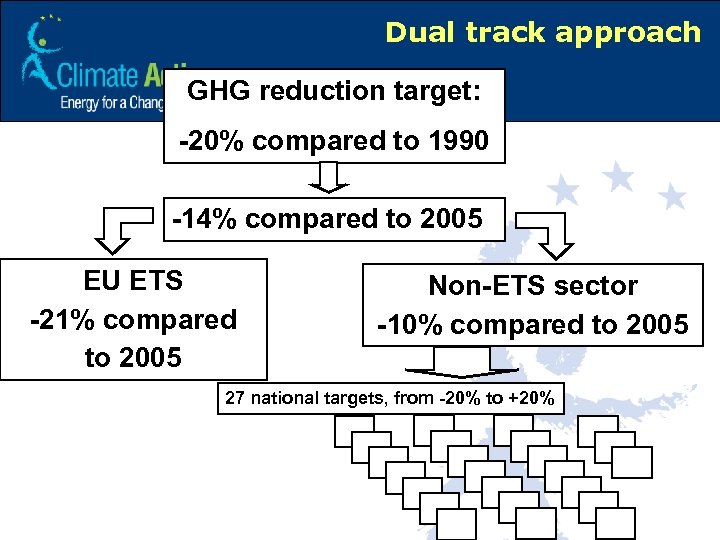
Dual track approach GHG reduction target: -20% compared to 1990 -14% compared to 2005 EU ETS -21% compared to 2005 Non-ETS sector -10% compared to 2005 27 national targets, from -20% to +20%
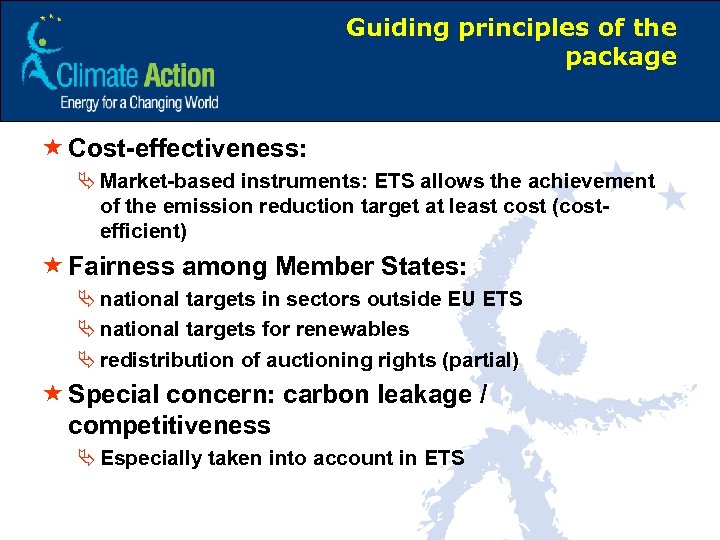
Guiding principles of the package « Cost-effectiveness: Ä Market-based instruments: ETS allows the achievement of the emission reduction target at least cost (costefficient) « Fairness among Member States: Ä national targets in sectors outside EU ETS Ä national targets for renewables Ä redistribution of auctioning rights (partial) « Special concern: carbon leakage / competitiveness Ä Especially taken into account in ETS
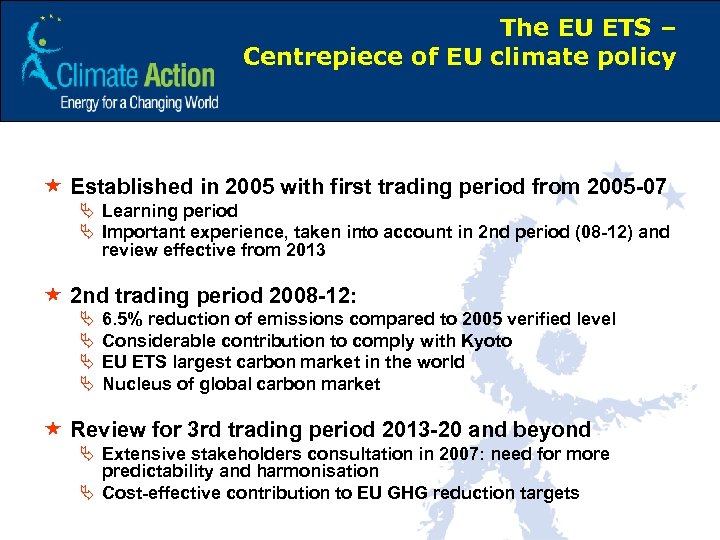
The EU ETS – Centrepiece of EU climate policy « Established in 2005 with first trading period from 2005 -07 Ä Learning period Ä Important experience, taken into account in 2 nd period (08 -12) and review effective from 2013 « 2 nd trading period 2008 -12: Ä Ä 6. 5% reduction of emissions compared to 2005 verified level Considerable contribution to comply with Kyoto EU ETS largest carbon market in the world Nucleus of global carbon market « Review for 3 rd trading period 2013 -20 and beyond Ä Extensive stakeholders consultation in 2007: need for more predictability and harmonisation Ä Cost-effective contribution to EU GHG reduction targets
Main changes
Key elements in the new EU ETS «EU-wide cap «Scope «Harmonised allocation rules «Carbon leakage «Use of auctioning revenues «Strengthened Monitoring, Reporting and Verification/Market oversight «Towards a global carbon market: ETS linking and CDM
EU-wide cap «Single EU-wide cap «Linear annual reduction factor of 1. 74% that reduces the cap also beyond 2020 «ETS cap in 2020 would be 1720 million tonnes based on 2008 -2012 scope «Adjustment of the cap to take account of new sectors and gases (deadline: 30 September 2010)
Scope « New sectors Ä Aluminium Ä Basic chemical production « New gases: Ä PFCs from aluminium Ä nitrous oxide from certain chemicals « Combined effect: appr. 6 - 7% increase of scope compared to current trading period « Confirmation that all sectors should contribute to emission reduction commitments Ä Aviation as of 2012 Ä Maritime: proposal foreseen by 2011
Harmonised allocation rules « Fully harmonised allocation rules Ä Minimum distortion of competition Ä No ‘National Allocation Plans’, only ‘National Implementing Measures’, a list of installations with corresponding allocations based on harmonised rules « Auctioning is the default allocation method Ä Principle: no free allocation for energy production, phase out of free allocation for other sectors exposed or not to international competition « Auctioning Regulation Ä to be adopted by 30 June 2010 Ä Auctioning based on clear and objective principles laid down in Regulation Ä More than 50% of allowances to be auctioned in 2013, increasing thereafter « Free allocation on basis of ex-ante benchmark for all sectors receiving free allocation
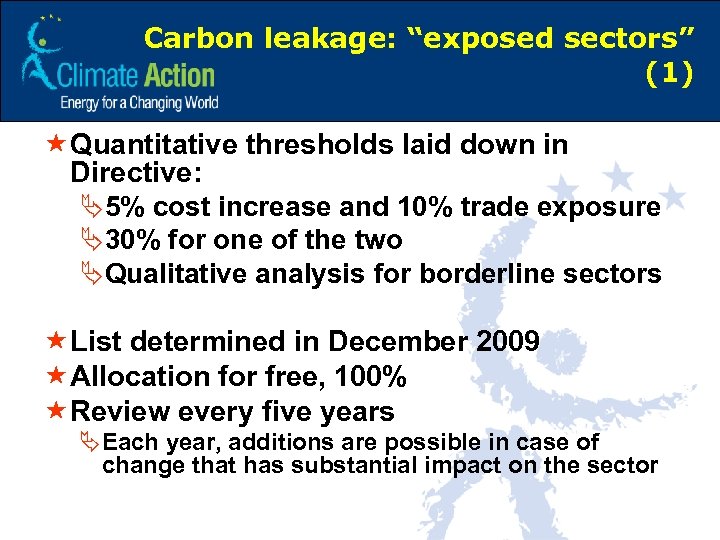
Carbon leakage: “exposed sectors” (1) «Quantitative thresholds laid down in Directive: Ä5% cost increase and 10% trade exposure Ä30% for one of the two ÄQualitative analysis for borderline sectors «List determined in December 2009 «Allocation for free, 100% «Review every five years ÄEach year, additions are possible in case of change that has substantial impact on the sector
Carbon leakage: “exposed and non exposed sectors” (2) « Individual allocations for free at 100% (exposed) or 80% (non-exposed) down to 0% in 2027 Ä% is of the amount determined by benchmarks
Option of transitional free allowances in power sector « Total amount in 2013 capped at 70% of 2005 -2007 verified emissions, gradual decrease to zero in 2020 « 10 Member States qualify Ä New MS except SI, SK, Ä MS to apply by 30 September 2011, COM can reject within 6 months « For existing installations only « Conditional upon national plan to modernise energy infrastructure, clean technologies, diversification of energy mix Ä Taking into account the need to limit as far as possible directly linked prices rises, Ä Annual reporting to the Commission
Benchmarks (1) «Free allocation based on benchmarks, where possible: ÄAllocations determined ex-ante, no ex-post adjustment ÄStarting point: average performance of 10% most efficient installations in (sub)sector ÄImportant to determine the products for which to set the benchmarks (for e. g. chemical industry a few lead products must be selected)
Benchmarks (2) «Benchmarks to be multiplied by historic production to get the amount of free allowances per installation «Maximum total free allocation for industry set at industry’s share in total cap based on emissions in 2005 -07 ÄA correction factor may be applied if necessary (if benchmarks are too generous) to keep within the maximum
Solidarity « 88% of auction rights distributed according to MS’ share in verified emissions in 2005 or average of period from 2005 – 07 (whichever is the highest) « 10% redistributed for ‘solidarity and growth’ (Annex IIa) « 2% “Kyoto bonus”: for MS which are at least 20% below Kyoto base year emission levels (Annex IIb)
Use of auctioning revenues (1) « Member States collect and decide on the use of auctioning revenues « 50% of revenues should be used for climate related purposes domestically or in third countries that have ratified the international agreement including: Ä Global Energy Efficiency and Renewable Energy Fund, Adaptation Fund Ä Developing renewable energies Ä Avoided deforestation Ä Carbon Capture and Storage (CCS) including in third countries that ratify the international agreement Ä Low emission and public forms of transport
Use of auctioning revenues (2) «Fiscal or financial support policies can be accounted for «MS to inform COM on use of revenues by means of the reports under the Kyoto implementation decision 280/2004/EC
Incentivising CCS and RES projects « 300 million allowances available for CCS and innovative renewable energy technology demonstration projects ÄUntil 31 December 2015 ÄTo be given via Member States ÄProjects selected on the basis of objective and transparent criteria ÄGeographically balanced support ÄSupport for a single project no more than 15% of total number of allowances ÄRules to be determined by comitology
Market oversight provisions (1) «Commission to monitor carbon market ÄRegular annual reporting to Council and Parliament ÄIf evidence of malfunctioning, special report along with proposals to improve market functioning «Member States to report on auctions; to be published on Commission website
Market oversight provisions (2) « Insider dealing and market manipulation: Ä By end of 2010, examination whether market is sufficiently protected from insider dealing and market manipulation Ä If appropriate, proposals to eliminate insider dealing and market manipulation « Excessive price fluctuations: Ä Definition: average price of allowances in a six months period more than three times of the two preceding years; Ä Climate Change Committee to meet and consider possible measures (alternatively): • Bring forward auctions; • Authorise auctioning of up to 25% of remaining NER
Strengthened Monitoring, Reporting and Verification « Monitoring and Reporting Regulation Ä To replace current guidelines Ä To be adopted by 31 December 2011 « Verification and Accreditation Regulation Ä Rules for accreditation are new Ä To be adopted by 31 December 2011 « Harmonised € 100 penalty for non-compliance Ä Inflation-linked Ä Requirement to surrender allowances remains « Single Community registry
Quantitative use of JI/CDM « Maximum allowed use of Kyoto mechanisms fixed at about 4. 5% of the EU 2020 target: this is unlikely ever to be reached!
Quality of CDM « Comitology procedure to restrict from 1/1/2013 the use of specific credits Ä Ensure credits represent real, verifiable, additional and permanent reductions, clear SD benefits and no significant negative environmental or social impacts Ä Can be done at any time (no one-off measure) « If there is an international agreement Ä Only credits from projects from countries that have ratified agreement from 1/1/2013
Adjustment from 20% to 30% « Three months after the signature of an international agreement, COM to submit report to assess implications to adjust from 20 to 30% « Report represents basis for proposal to be submitted Ä co-decision « Proposal based on principles of transparency, economic efficiency, cost-effectiveness, fairness, solidarity in the distribution of efforts;
The international carbon market and linking emissions trading systems 28
Where we are ÄThe EU ETS has been the core of the ‘global carbon market’ • An absolute emissions cap covering 30 countries for around 11, 500 installations and emissions from aircraft • EU ETS and EU Member States have provided the main demand for Clean Development Mechanism (CDM) credits • The EU: around 10% of global GHG 29 emissions
Where we need to go ÄLimit global temperature increase to 2°C ÄAll countries, including emerging economies, need to take more action to reduce emissions ÄPledges under Copenhagen Accord ÄEmission trading systems are a cost-effective way to do so ÄCap and trade in place or in discussion: US (Federal, RGGI and WCI), Australia (2013? ), Japan, Switzerland, New Zealand others. ETS developments in Mexico, South Korea, China and India… 30
An important source of climate finance « Climate actions require roughly € 100 billion per year by 2020 in developing countries, with total international public finance needs estimated around € 22 to 50 billion per year. « A strong carbon market can deliver € 38 billion per year by 2020, requires: Ä Ambitious developed country action (-30% developed country as a group by 2020 rel to 1990) Ä A shift from CDM to sectoral crediting mechanism in advanced developing countries and sectors « Making the most of the carbon market reduces the need for public finance 31
A robust international carbon market « Through bottom up linking of cap and trade systems in developed countries « OECD wide market by 2015 - transatlantic market as first step « Linking increases liquidity, reduces volatility, increases opportunity for low cost abatement 32
A robust international carbon market «Inclusion of advanced developing countries and competitive sectors by 2020 «Reform of CDM and replacement over time by a sectoral mechanism for advanced developing economies and sectors «Sectoral crediting as a stepping stone to ETS 33
International Carbon Action Partnership ICAP « Public authorities committed to cap and trade « Technical exchange on best practice to improve design and promote compatible systems Members: « EU: European Commission, Denmark , France , Germany, Greece , Ireland, Italy , Netherlands , Portugal , Spain , United Kingdom « North America: Ä Regional Greenhouse Gas Initiative Members (RGGI): Maine, Maryland, Massachusetts, New Jersey, New York Ä Western Climate Initiative Members (WCI): Arizona, British Columbia, California, Manitoba, New Mexico, Ontario, Oregon, Québec, Washington « Others: Australia, New Zealand, Norway, Tokyo Metropolitan Government « Plus Observers: Japan and Ukraine www. icapcarbonaction. com 34
RGGI & WCI « RGGI (10 North-east US States) Ä 10% reduction CO 2 emissions from the electricity sector by 2018 Ä Allowances are auctioned Ä Proceeds for clean energy/consumer benefits Ä Offsets from projects in RGGI States, 10% ceiling per power plant Ä First auctions in 2009 WCI Ä 15% reduction Kyoto gases below 2005 by 2020, multisector, offsets possible but capped, complementary measures Ä Still to start…
US Federal Level « Waxman Markey (House June 2009) « Boxer Kerry (Senate October 2009) « Kerry Lieberman Ä Complex legislation, including wide-ranging ETS Ä 17% below 2005 by 2020; 83% by 2050 Ä High levels of offsets (2 bn T each year v. 1. 6 bn T for 2008 -2020 in the EU); too many domestic agricultural offsets Ä Price collar Ä Border tax adjustment (softer than in the previous bills) Ä Increased free allocation to industry Ä Will it ever be approved ? ? ?
Linking – EU legislation provisions for mutual recognition « EU ETS Directive: Art 25, 1 bis and 2: “ Agreements may be made to provide for the recognition of allowances between the Community scheme and compatible mandatory greenhouse gas emissions trading systems with absolute emissions caps established in any other country or in sub-federal or regional entities. ” “ Where an agreement […] has been concluded, the Commission shall adopt any necessary provisions relating to the mutual recognition of allowances. . . ” 37
Linking through Aviation «All flights into and out of the EU will be covered by EU ETS from 2012 «Where non-EU ETS countries take action on aviation emissions, the EU ETS may recognise it as equivalent action 38
Importance of coordination of recognition policies «In practice two systems accepting the same international credits for compliance will be linked through these international credits «Need for cooperation in the development phase 39
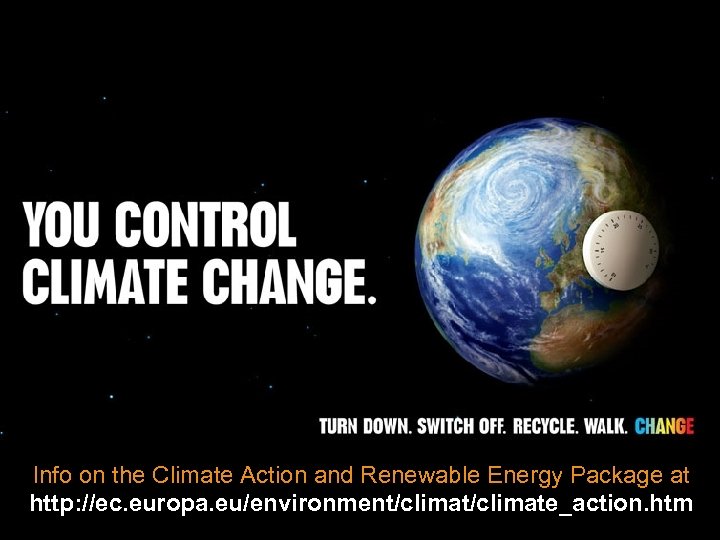
Info on the Climate Action and Renewable Energy Package at 40 http: //ec. europa. eu/environment/climate_action. htm
Скачать презентацию The New EU ETS and the Global Carbon
8dbb3397529992b8cb2f4a9f27e3f515.ppt