


 Скачать презентацию The New Deal Review New Deal FDR
ccc289469862d0a7b24119a17214ff01.ppt
- Количество слайдов: 20
 The New Deal Review

 New Deal FDR promised Americans a New Deal to combat the Depression Two parts to the plan: 1. The “Hundred Days” 2. The Second New Deal
 The “Hundred Days” Launched programs to provide: • RELIEF • RECOVERY • REFORM Essentially, sought to: relieve the suffering of the GD create jobs stimulate the economy
 FDR Needs To Give Hope Back to Americans • Second Bonus March – White House provides campsites & First Lady visits • “Fireside Chats” • Promised New Deal – – Programs to provide relief, create jobs, & stimulate economic recovery – Influenced by Progressives – Programs built on WWI programs
 The First Hundred Days • Stabilize Financial Institutions – – – Declared “bank holiday” Emergency Banking Act Glass-Steagall Banking Act Federal Securities Act Set up Securities & Exchange Commission Gave Federal Reserve Board power to regulate buying of stock on margin – July 1933 took US currency off gold standard decreasing value of the dollar • Hoped it would raise prices of farm goods & other goods • Stimulate export trade
 The First Hundred Days • Provide Relief & Create Jobs – Established Federal Emergency Relief Administration • Put money into public works programs – Civil Works Administration (CWA) – Civil Conservation Corps (CCC) – Indian Reorganization Act • Regulate the Economy – National Industry Recovery Act (NRA) – Public Works Administration (PWA)
 The First Hundred Days • Assisting Homeowners & Farmers – Home Owners Loan Corporation – National Housing Act – Agricultural Adjustment Administration – Tennessee Valley Authority
 The First Hundred Days • FDR’s “ Brain Trust” – informal group of intellectuals who helped shape FDR’s policies, prior to inauguration • FDR appointed women & African-Americans in more than a hundred policymaking posts – Frances Perkins – Mary Mc. Leod Bethune – Eleanor Roosevelt
 The Second New Deal • “Second New Deal” – Included: • • • more social welfare benefits stricter controls over business stronger support for unions higher taxes on rich addressed criticism of the first 100 days
 The Second New Deal • New & Expanded Agencies – Works Progress Administration • National Youth Administration – Resettlement Administration • Farm Security Administration
 The Second New Deal • Rural Electrification – Rural Electrification Administration • Social Security Act • New labor legislation – National Labor Relations Act (Wagner Act) • National Labor Relations Board
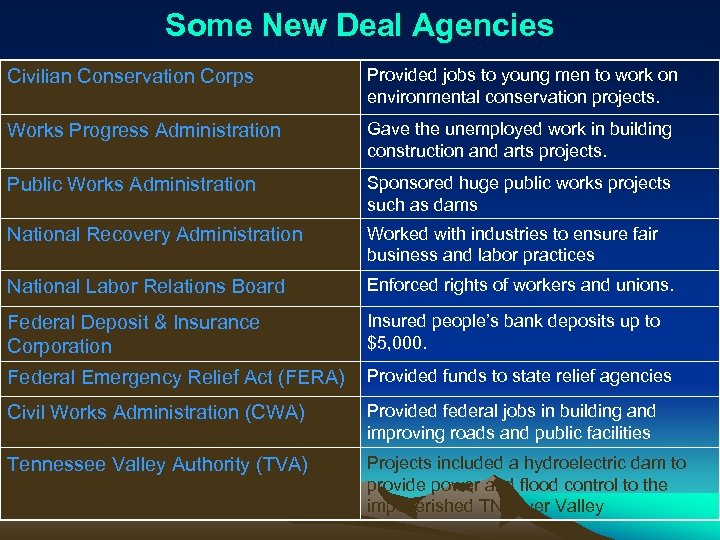 Some New Deal Agencies Civilian Conservation Corps Provided jobs to young men to work on environmental conservation projects. Works Progress Administration Gave the unemployed work in building construction and arts projects. Public Works Administration Sponsored huge public works projects such as dams National Recovery Administration Worked with industries to ensure fair business and labor practices National Labor Relations Board Enforced rights of workers and unions. Federal Deposit & Insurance Corporation Insured people’s bank deposits up to $5, 000. Federal Emergency Relief Act (FERA) Provided funds to state relief agencies Civil Works Administration (CWA) Provided federal jobs in building and improving roads and public facilities Tennessee Valley Authority (TVA) Projects included a hydroelectric dam to provide power and flood control to the impoverished TN River Valley
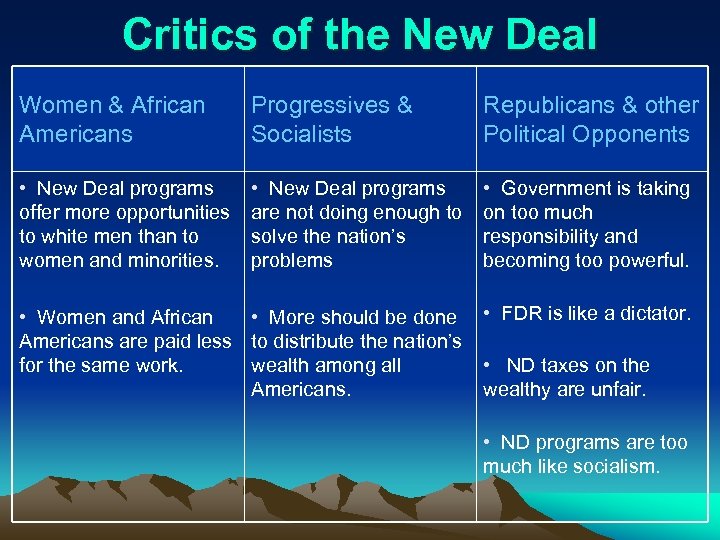 Critics of the New Deal Women & African Americans Progressives & Socialists Republicans & other Political Opponents • New Deal programs offer more opportunities to white men than to women and minorities. • New Deal programs are not doing enough to solve the nation’s problems • Government is taking on too much responsibility and becoming too powerful. • Women and African • More should be done Americans are paid less to distribute the nation’s for the same work. wealth among all Americans. • FDR is like a dictator. • ND taxes on the wealthy are unfair. • ND programs are too much like socialism.
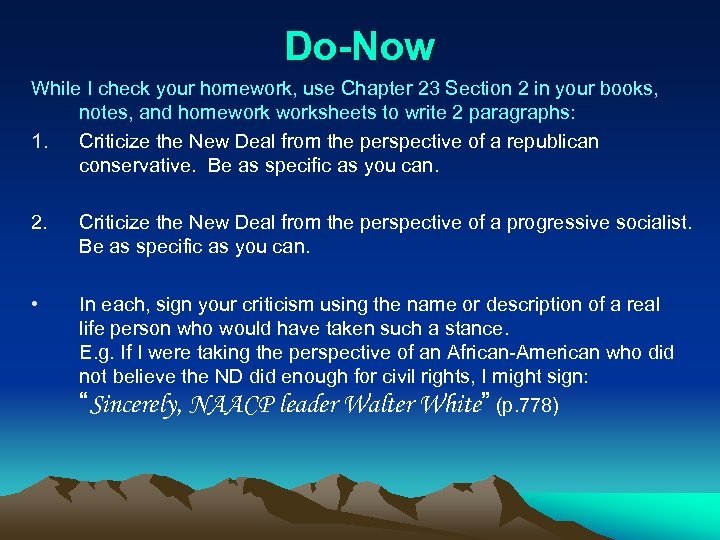 Do-Now While I check your homework, use Chapter 23 Section 2 in your books, notes, and homeworksheets to write 2 paragraphs: 1. Criticize the New Deal from the perspective of a republican conservative. Be as specific as you can. 2. Criticize the New Deal from the perspective of a progressive socialist. Be as specific as you can. • In each, sign your criticism using the name or description of a real life person who would have taken such a stance. E. g. If I were taking the perspective of an African-American who did not believe the ND did enough for civil rights, I might sign: “Sincerely, NAACP leader Walter White” (p. 778)
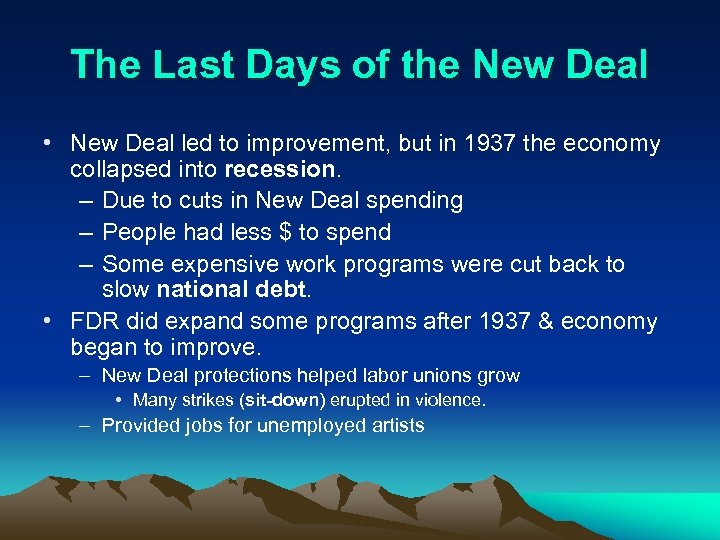 The Last Days of the New Deal • New Deal led to improvement, but in 1937 the economy collapsed into recession. – Due to cuts in New Deal spending – People had less $ to spend – Some expensive work programs were cut back to slow national debt. • FDR did expand some programs after 1937 & economy began to improve. – New Deal protections helped labor unions grow • Many strikes (sit-down) erupted in violence. – Provided jobs for unemployed artists
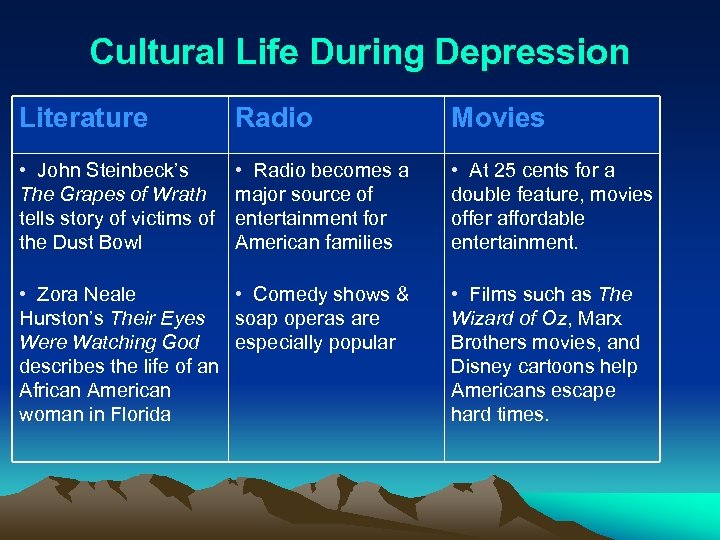 Cultural Life During Depression Literature Radio Movies • John Steinbeck’s The Grapes of Wrath tells story of victims of the Dust Bowl • Radio becomes a major source of entertainment for American families • At 25 cents for a double feature, movies offer affordable entertainment. • Zora Neale • Comedy shows & Hurston’s Their Eyes soap operas are Were Watching God especially popular describes the life of an African American woman in Florida • Films such as The Wizard of Oz, Marx Brothers movies, and Disney cartoons help Americans escape hard times.
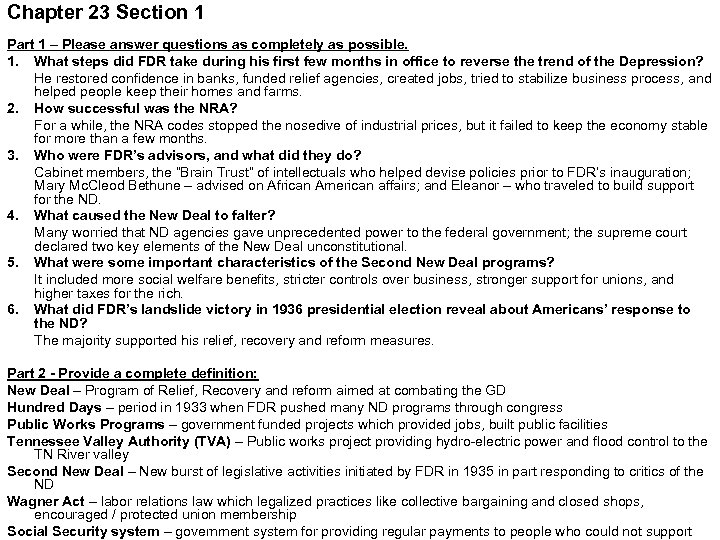 Chapter 23 Section 1 Part 1 – Please answer questions as completely as possible. 1. What steps did FDR take during his first few months in office to reverse the trend of the Depression? He restored confidence in banks, funded relief agencies, created jobs, tried to stabilize business process, and helped people keep their homes and farms. 2. How successful was the NRA? For a while, the NRA codes stopped the nosedive of industrial prices, but it failed to keep the economy stable for more than a few months. 3. Who were FDR’s advisors, and what did they do? Cabinet members, the “Brain Trust” of intellectuals who helped devise policies prior to FDR’s inauguration; Mary Mc. Cleod Bethune – advised on African American affairs; and Eleanor – who traveled to build support for the ND. 4. What caused the New Deal to falter? Many worried that ND agencies gave unprecedented power to the federal government; the supreme court declared two key elements of the New Deal unconstitutional. 5. What were some important characteristics of the Second New Deal programs? It included more social welfare benefits, stricter controls over business, stronger support for unions, and higher taxes for the rich. 6. What did FDR’s landslide victory in 1936 presidential election reveal about Americans’ response to the ND? The majority supported his relief, recovery and reform measures. Part 2 - Provide a complete definition: New Deal – Program of Relief, Recovery and reform aimed at combating the GD Hundred Days – period in 1933 when FDR pushed many ND programs through congress Public Works Programs – government funded projects which provided jobs, built public facilities Tennessee Valley Authority (TVA) – Public works project providing hydro-electric power and flood control to the TN River valley Second New Deal – New burst of legislative activities initiated by FDR in 1935 in part responding to critics of the ND Wagner Act – labor relations law which legalized practices like collective bargaining and closed shops, encouraged / protected union membership Social Security system – government system for providing regular payments to people who could not support
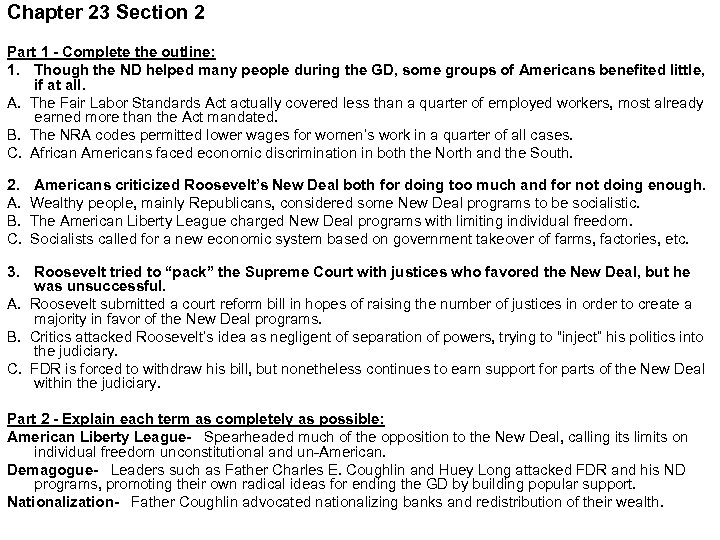 Chapter 23 Section 2 Part 1 - Complete the outline: 1. Though the ND helped many people during the GD, some groups of Americans benefited little, if at all. A. The Fair Labor Standards Act actually covered less than a quarter of employed workers, most already earned more than the Act mandated. B. The NRA codes permitted lower wages for women’s work in a quarter of all cases. C. African Americans faced economic discrimination in both the North and the South. 2. A. B. C. Americans criticized Roosevelt’s New Deal both for doing too much and for not doing enough. Wealthy people, mainly Republicans, considered some New Deal programs to be socialistic. The American Liberty League charged New Deal programs with limiting individual freedom. Socialists called for a new economic system based on government takeover of farms, factories, etc. 3. Roosevelt tried to “pack” the Supreme Court with justices who favored the New Deal, but he was unsuccessful. A. Roosevelt submitted a court reform bill in hopes of raising the number of justices in order to create a majority in favor of the New Deal programs. B. Critics attacked Roosevelt’s idea as negligent of separation of powers, trying to “inject” his politics into the judiciary. C. FDR is forced to withdraw his bill, but nonetheless continues to earn support for parts of the New Deal within the judiciary. Part 2 - Explain each term as completely as possible: American Liberty League- Spearheaded much of the opposition to the New Deal, calling its limits on individual freedom unconstitutional and un-American. Demagogue- Leaders such as Father Charles E. Coughlin and Huey Long attacked FDR and his ND programs, promoting their own radical ideas for ending the GD by building popular support. Nationalization- Father Coughlin advocated nationalizing banks and redistribution of their wealth.
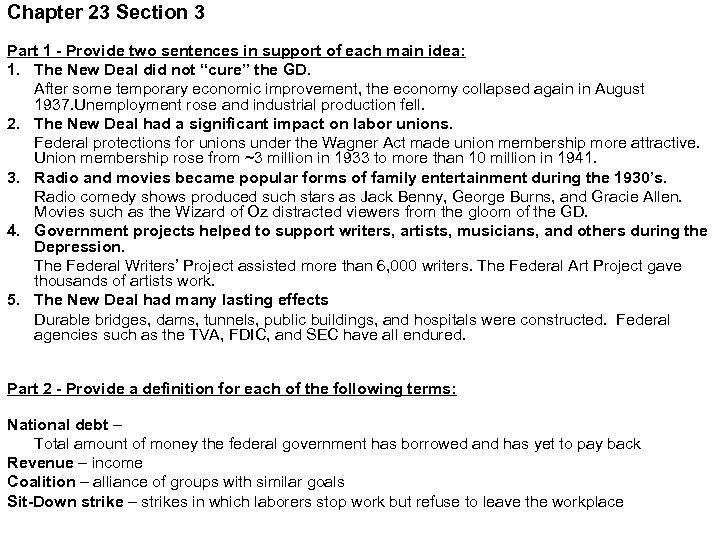 Chapter 23 Section 3 Part 1 - Provide two sentences in support of each main idea: 1. The New Deal did not “cure” the GD. After some temporary economic improvement, the economy collapsed again in August 1937. Unemployment rose and industrial production fell. 2. The New Deal had a significant impact on labor unions. Federal protections for unions under the Wagner Act made union membership more attractive. Union membership rose from ~3 million in 1933 to more than 10 million in 1941. 3. Radio and movies became popular forms of family entertainment during the 1930’s. Radio comedy shows produced such stars as Jack Benny, George Burns, and Gracie Allen. Movies such as the Wizard of Oz distracted viewers from the gloom of the GD. 4. Government projects helped to support writers, artists, musicians, and others during the Depression. The Federal Writers’ Project assisted more than 6, 000 writers. The Federal Art Project gave thousands of artists work. 5. The New Deal had many lasting effects Durable bridges, dams, tunnels, public buildings, and hospitals were constructed. Federal agencies such as the TVA, FDIC, and SEC have all endured. Part 2 - Provide a definition for each of the following terms: National debt – Total amount of money the federal government has borrowed and has yet to pay back Revenue – income Coalition – alliance of groups with similar goals Sit-Down strike – strikes in which laborers stop work but refuse to leave the workplace