


 Скачать презентацию The New 2012 Life Safety Code It s Finally
75f5ddbfdcaa5a18563db2844398727e.ppt
- Количество слайдов: 94
 The New 2012 Life Safety Code: It’s Finally Here! Presented by Brad Keyes, CHSP Jamie Crouch, BSBM, MHA
 Learning Objectives At the completion of this educational activity, the learner will be able to: – Realize that CMS’ final rule did not endorse everything in their proposed rule – Learn that there will be a delay in enforcing the new 2012 Life Safety Code by HFAP – Understand that the new 2012 Life Safety Code will have changes that will effect how the facility is managed – Implement a plan to address those changes 2
 CMS Final Rule On May 4, 2016, the Centers for Medicare & Medicaid Services (CMS) issued their final rule and adopted the 2012 Life Safety Code for all healthcare facilities receiving Medicare or Medicaid reimbursements. The final rule set the date of July 5, 2016 when the 2012 Life Safety Code becomes effective. 3
 CMS Final Rule But CMS issued an S&C memo 16 -29 dated June 20, 2016 informing everyone that CMS will not begin surveying to the new 2012 LSC until November 1, 2016, allowing healthcare providers and AOs additional time to prepare. The AOs need to submit their revised manuals to CMS for review before they are permitted to enforce the new LSC. 4
 CMS Final Rule The period between July 5 and November 1 will be a time of leniency whereby the new requirements of the 2012 LSC will not be enforced, but the breaks and advantages of the new 2012 LSC will be permitted. However it works out… be prepared to be fully compliant with the new 2012 LSC by November 1, 2016. This means any new annual test or inspection requirement needs to be completed by then. 5
 CMS Final Rule The new 2012 Life Safety Code will reference other new editions of NFPA standards, such as: – NFPA 10 -2010 Fire Extinguishers – NFPA 13 -2010 Sprinkler Installation – NFPA 25 -2011 Sprinkler Testing, Inspection & Maintenance – NFPA 70 -2011 National Electrical Code – NFPA 72 -2010 Fire Alarm Systems – NFPA 80 -2010 Fire Doors & Dampers – NFPA 96 -2011 Cooking Hood Systems – NFPA 110 -2010 Generators – NFPA 241 -2009 Construction 6
 CMS Final Rule In their final rule, CMS also adopted most of the NFPA 99 Health Care Facilities Code, 2012 edition which they never have done before. Portions of NFPA 99 were referenced by the Life Safety Code, but now all of the adopted portions are mandatory. The sections of NFPA 99 that they did not adopt are: – – Chapter 7 Chapter 8 Chapter 12 Chapter 13 Information Technology Plumbing Emergency Management Security Management 7
 CMS Final Rule For chapter 7, 8, and 13, CMS states they believe they do not have jurisdiction on those issues (IT, plumbing, & security). But CMS did issue a proposed rule in December, 2013 to adopt new standards regarding Emergency Management that is far more intensive than NFPA 99 chapter 12. They plan on issuing a final rule to implement the new Emergency Management standards, but they need to do so by December, 2016. 8
 CMS Final Rule Here are some highlights from the CMS final rule that may interest healthcare organizations: – In their proposed rule issued in April, 2014, CMS said they intended to not allow the change in NFPA 25 when the sprinkler system is impaired for 10 hours or more in a 24 hour period, then a fire watch is required. CMS stated in 2014 that they wanted to stay with the 4 -hours or more in a 24 hour period as required by the 2000 Life Safety Code. After receiving overwhelming responses from the public, CMS changed their mind and in their final rule that agreed to leave the 10 -hour in a 24 -hour period as is. 9
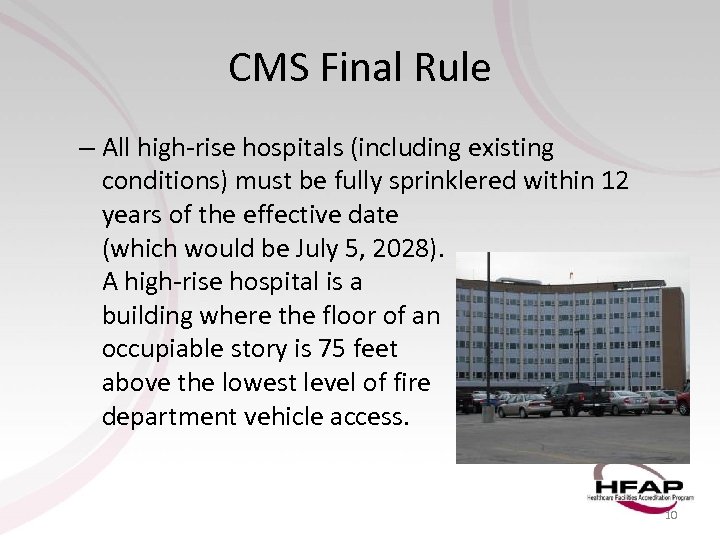 CMS Final Rule – All high-rise hospitals (including existing conditions) must be fully sprinklered within 12 years of the effective date (which would be July 5, 2028). A high-rise hospital is a building where the floor of an occupiable story is 75 feet above the lowest level of fire department vehicle access. 10
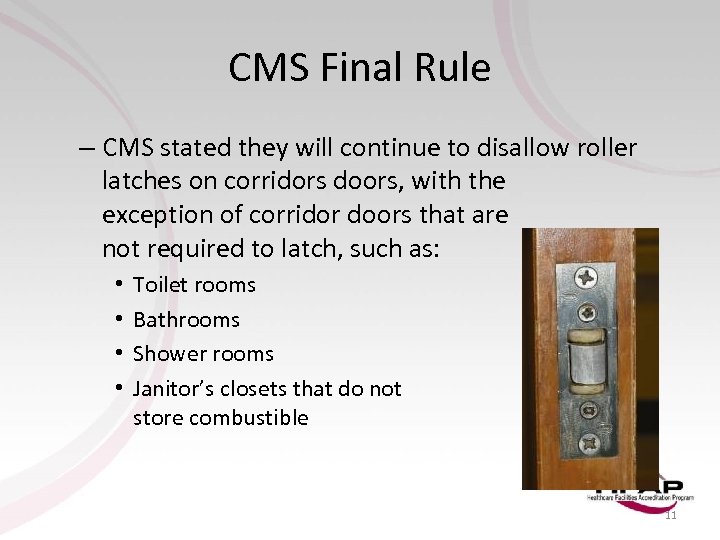 CMS Final Rule – CMS stated they will continue to disallow roller latches on corridors doors, with the exception of corridor doors that are not required to latch, such as: • • Toilet rooms Bathrooms Shower rooms Janitor’s closets that do not store combustible 11
 CMS Final Rule – CMS clarified as to what facility qualifies as existing conditions (Chapter 19) and what qualifies as new construction (Chapter 18) when the new 2012 Life Safety Code becomes effective: “Buildings that have not received all pre-construction governmental approvals [i. e. state and local AHJs] before July 5, 2016, or those buildings that begin construction after the effective date (July 5, 2016) would be required to meet new occupancy standards [i. e. Chapter 18] in the 2012 Life Safety Code. ” 12
 CMS Final Rule – CMS clarified as to what their expectations are regarding the frequency of a fire watch: “A fire watch consists of dedicated staff with no other duties constantly circulating throughout the portion of the facility affected by the impairment looking for fire, fire hazards, or hazardous conditions that may affect the fire safety of the facility. ” It is important to note that ‘constantly circulating’ means continuous. No breaks and no stoppage until the fire watch is discontinued. CMS takes this interpretation directly from the Annex section of NFPA 25. HFAP will be enforcing this interpretation. 13
 CMS Final Rule – CMS removed the requirement for separate ventilation systems in windowless anesthetizing locations in hospitals and ASCs from their proposed rule. – CMS removed their requirement that all facilities have to meet the occupancy requirements of the Life Safety Code regardless of the number of patients incapable of self-preservation. They agree to follow what the Life Safety Code says; four or more people incapable of self preservation must comply with the occupancy requirements. This will now allow inpatients in ancillary locations that are not typically healthcare occupancies. 14
 CMS Final Rule – CMS is retaining from their proposed rule that they will adopt the ADA requirements for corridor projections to not exceed 4 inches. The 2012 Life Safety Code says 6 inches, but CMS will enforce the more restrictive 4 inches. – CMS clarified that they will require annual inspections on all fire doors, including side-hinged swinging fire doors, in the facility. – Traditionally, the 2013 edition of NFPA 101 A applies to the 2012 Life Safety Code, but CMS decided to adopt the 2010 edition of NFPA 101 A, which is the guide on equivalencies. 15
 CMS Final Rule – CMS clarified that they will enforce the 2012 Life Safety Code requirement found in Chapters 20 and 21 that all ambulatory healthcare occupancy (i. e. ASC) hazardous area doors must be self-closing or automatic closing. Previously, they were not required to be. – The existing categorical waivers that allowed use of selected sections of the 2012 Life Safety Code and referenced standards are complete, finished, over. CMS stated they will continue to consider issuing categorical waivers when new codes and standards dictate. However, they made it very clear that standard waiver and equivalency requests will continue to require a citation first before they consider approval. 16
 CMS Final Rule So…. Those are the highlights of the actual final rule that CMS published in the Federal Register on May 4, 2016. Let’s look at HFAP’s role in the new 2012 Life Safety Code… 17
 Accreditation Organizations HFAP must have CMS’s approval on any change to their standards before they can enforce the new standards. That means HFAP must re-write their Life Safety standards, submit them to CMS for approval, then train their surveyors on the changes before they can enforce the new changes created by the 2012 Life Safety Code. 18
 Accreditation Organizations So, until HFAP gets their manuals approved, we will not be enforcing the requirements of the new 2012 Life Safety Code, because they are not allowed to according to CMS rules. But that does not prevent you from using the 2012 Life Safety Code to your advantage beginning July 5, 2012, and utilize any changes that actually reduces the amount of work required. 19
 Transition… Let’s transition now to what the actual changes are that involve the new 2012 Life Safety Code… 20
 Changes to Life Safety Compliance The following presentation is not a complete list of all the changes caused by the adoption of the 2012 Life Safety Code, but the common ones that most likely will affect operations for a healthcare facility All references to the Life Safety Code are to the 2012 edition 21
 Openings in Exit Enclosures Currently, the 2000 edition of the Life Safety Code does not allow any openings (doors) to unoccupied rooms in exit enclosures (stairwells or exit passageways). 22
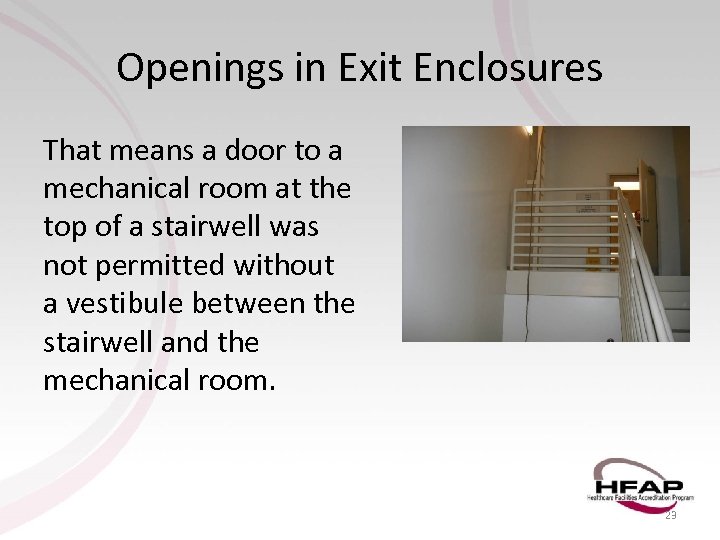 Openings in Exit Enclosures That means a door to a mechanical room at the top of a stairwell was not permitted without a vestibule between the stairwell and the mechanical room. 23
 Openings in Exit Enclosures Section 7. 1. 3. 2. 1 (9) now permits openings (doors) to non-occupied mechanical rooms provided: – It is an existing opening – It is a properly fire rated assembly – No fuel-fired equipment in the room – The room does not contain storage of combustibles – The entire building is fully protected with automatic sprinklers 24
 Electrically Locked Doors Previously there were three situations where you can lock doors in the path of egress: – Clinical needs – Delayed egress – Access control Now, there will be a fourth situation involving electric locks… 25
 Electrically Locked Doors Section 7. 2. 1. 5. 6 will now allow doors in the path of egress to be ‘electrically’ locked if equipped with listed hardware and meets the following conditions: – The door release hardware (crash bar) is affixed to the door leaf- (This means a wall-mounted ‘Push to Exit’ button is not sufficient) – The door release hardware must be obvious on how it operates and readily operates in the direction of egress 26
 Electrically Locked Doors (cont. ) – The door release hardware (crash bar) is capable of being operated with one hand in the direction of egress– Operation of the door release hardware interrupts power directly to the electric lock and unlocks the door – Loss of power to the door release hardware automatically unlocks the door – Hardware must be appropriately listed in accordance with ANSI/UL 294 standard 27
 Electrically Locked Doors In essence, the Life Safety Code now considers electrically locked doors as a normal door assembly and does not consider it as a special locking arrangement This has the effect of equating the electrically controlled lock to a traditional, mechanically latched or locked door. Sections 18/19. 2. 2. 2. 1 allow for this arrangement in hospitals 28
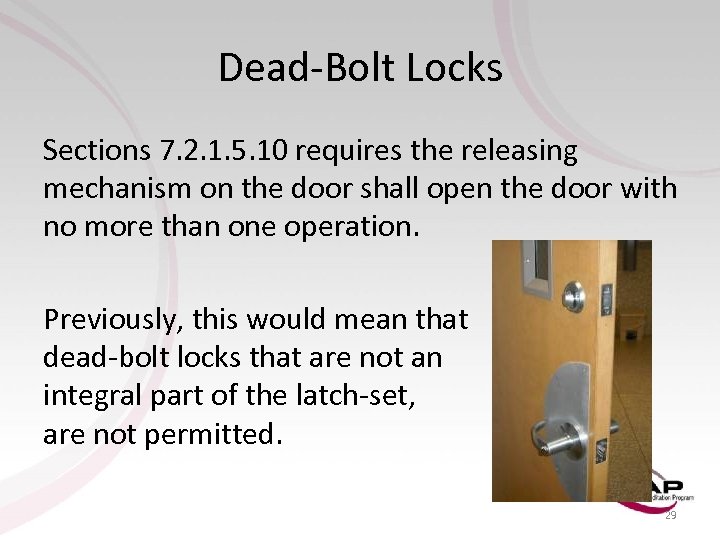 Dead-Bolt Locks Sections 7. 2. 1. 5. 10 requires the releasing mechanism on the door shall open the door with no more than one operation. Previously, this would mean that dead-bolt locks that are not an integral part of the latch-set, are not permitted. 29
 Dead-Bolt Locks A new section (7. 2. 1. 5. 10. 6) allows two releasing operations will be permitted for existing hardware on a door serving an occupant load not exceeding three persons, provided the releasing mechanisms do not require simultaneous operations. 30
 Fire Door Testing and Inspection Sections 7. 2. 1. 15. 2 and 8. 3. 3. 1 require all fire doors to be inspected and tested (per NFPA 80) The individual conducting the inspection must have knowledge and understanding of the operating components of the door being inspected 31
 Fire Door Testing and Inspection What qualifies the individual to have knowledge or understanding? The LSC does not specify, but HFAP will want to see how you determined that the designated individual is ‘knowledgeable and understands’ on door operations. 32
 Fire Door Testing and Inspection Some of the requirements for each fire door inspection and testing: – Must be conducted annually with written records that are dated and signed – Visually inspect doors for any damage or missing parts – Operate the door fully to ensure door will close and function properly – Inspect door hardware and replace all defective items – Tin-clad doors must be inspected for dry rot of the wood core 33
 Fire Door Testing and Inspection Additional requirements for each fire door inspection and testing: – No holes or breaks exist in the surfaces of the door or frame – Glazing and glazing beads are intact and secure – Clearance between the bottom of the door and the threshold cannot exceed ¾ inch, unless the bottom of the door is mounted more than 38 inches above the floor, then the clearance is limited to 3/8 inch – Check to make sure the coordinator is operating correctly 34
 Fire Door Testing and Inspection Additional requirements for each fire door inspection and testing: – Make sure positive latching hardware secures the door in the closed position – Confirm that no field modifications have been made to the door or frame that would void the fire rating – Check door and rating label to ensure it is legible, and it is the proper rating for the barrier 35
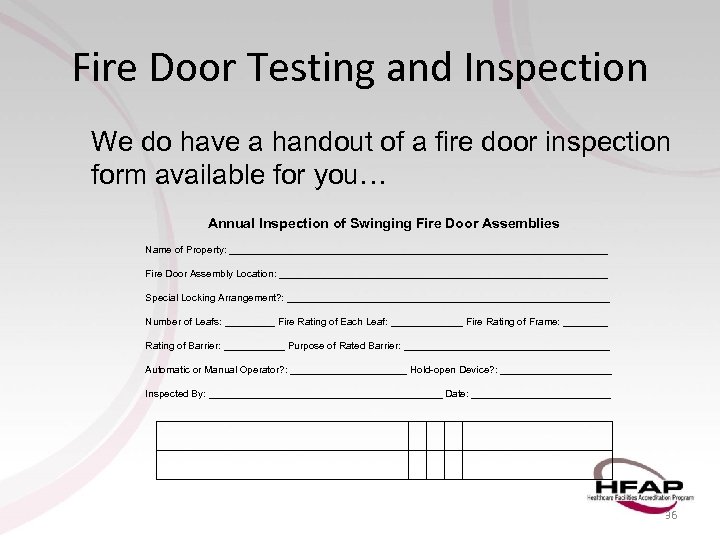 Fire Door Testing and Inspection We do have a handout of a fire door inspection form available for you… Annual Inspection of Swinging Fire Door Assemblies Name of Property: __________________________________ Fire Door Assembly Location: ______________________________ Special Locking Arrangement? : _____________________________ Number of Leafs: _____ Fire Rating of Each Leaf: _______ Fire Rating of Frame: ____ Rating of Barrier: ______ Purpose of Rated Barrier: ___________________ Automatic or Manual Operator? : ___________ Hold-open Device? : __________ Inspected By: _____________________ Date: _____________ 36
 Door Locks for Safety Needs Let’s look at door locking arrangements, again… The application of locks for ‘clinical needs’ was always confusing. It was always allowed for Psychiatric and Alzheimer’s units, but the AHJs could not always agree that these locks could be used in infant nurseries and pediatric units. 37
 Door Locks for Safety Needs Section 19. 2. 2. 2. 5. 2 now allows doors to be locked for ‘safety needs’ frequently found in nurseries, pediatric and maternity units, provided: – Staff can readily unlock the doors at all times – A complete smoke detection system is installed in the locked space, or the locked doors can be remotely unlocked from a constantly attended location – The building is fully protected with sprinklers – The locks are electrical locks that fail safe on a power loss – Doors unlock on activation of smoke detectors or sprinklers 38
 New Corridor Projection Requirements Section 19. 2. 3. 4 now allows: – Non-continuous projections on wall no more than 6 inches above the handrail height in corridors that are at least 6 feet wide The 2000 edition did not have this allowance but it was permitted through the interpretation of the Tentative Interim Amendment (TIA) for Alcohol Based Hand-Rub (ABHR) dispensers 39
 New Corridor Projection Requirements The TIA for the 2000 edition had requirements on how far apart items mounted on the wall had to be The 2012 edition did away with the distance requirements for everything except ABHR dispensers which requires 48 inches separation. 40
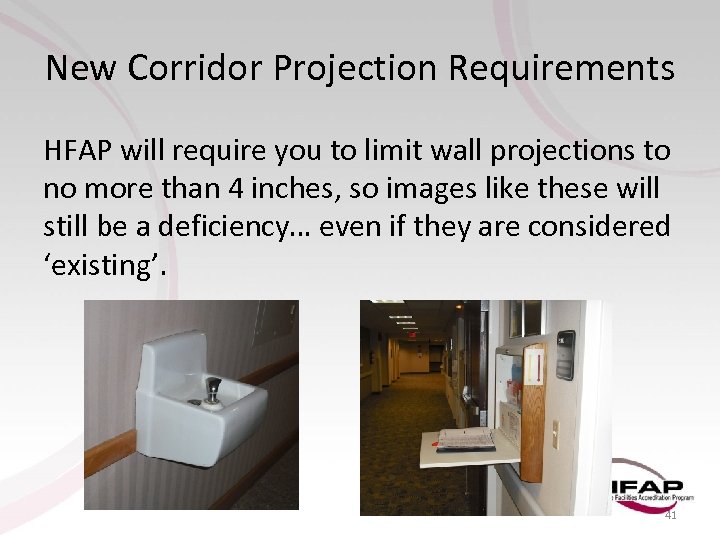 New Corridor Projection Requirements HFAP will require you to limit wall projections to no more than 4 inches, so images like these will still be a deficiency… even if they are considered ‘existing’. 41
 New Corridor Width Requirements Section 19. 2. 3. 4 now will allow certain wheeled equipment to project into the required width of the corridor, provided the following is in compliance: – The corridor is at least 8 feet wide – The clear width of the corridor is not reduced to less than 5 feet – There is a written fire safety plan and training program that address the relocation of the wheeled equipment during a fire 42
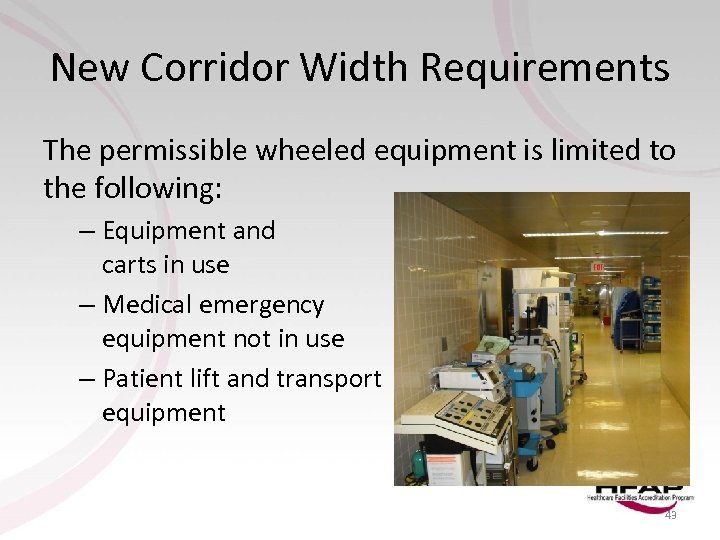 New Corridor Width Requirements The permissible wheeled equipment is limited to the following: – Equipment and carts in use – Medical emergency equipment not in use – Patient lift and transport equipment 43
 New Corridor Width Requirements Examples of the permissible wheeled equipment are: – Food service carts in use – Housekeeping carts in use – Medication carts in use – Isolation carts (should be removed when not used) – Crash carts – Wheeled emergency medical equipment – Portable lift equipment – Transport equipment 44
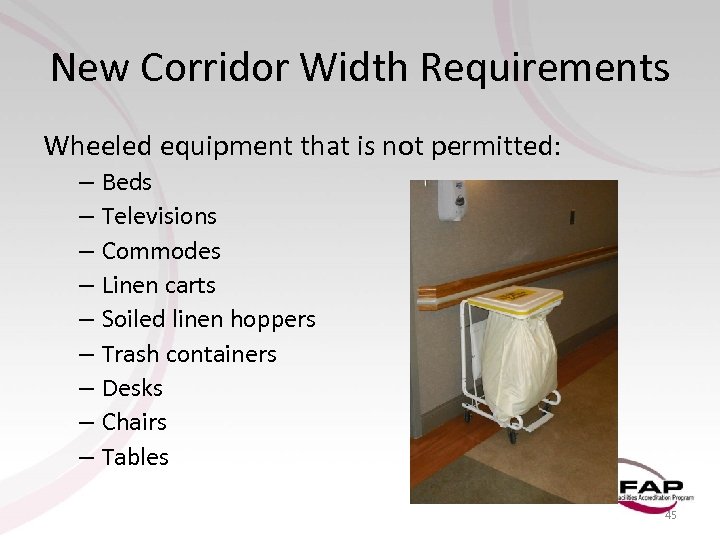 New Corridor Width Requirements Wheeled equipment that is not permitted: – Beds – Televisions – Commodes – Linen carts – Soiled linen hoppers – Trash containers – Desks – Chairs – Tables 45
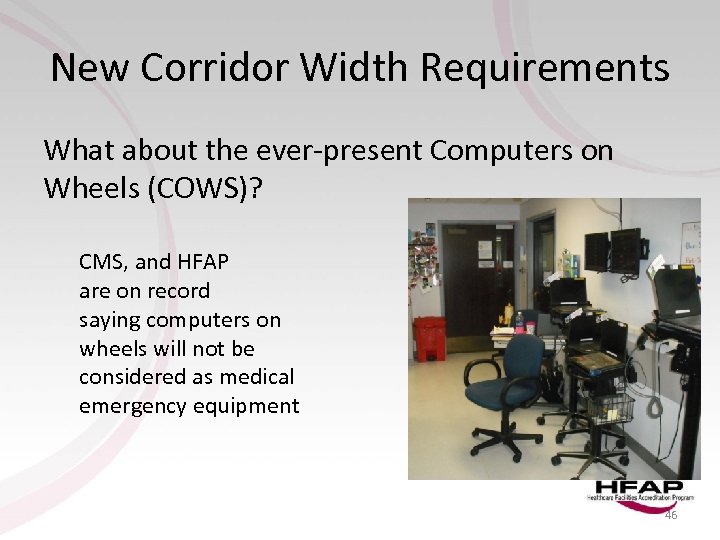 New Corridor Width Requirements What about the ever-present Computers on Wheels (COWS)? CMS, and HFAP are on record saying computers on wheels will not be considered as medical emergency equipment as 46
 New Corridor Width Requirements Section 19. 2. 3. 4 permits fixed furniture in corridors that are at least 8 feet wide, provided that: – The fixed furniture is securely attached to the floor or wall – The fixed furniture does not reduce the clear, unobstructed width of the corridor to less than 6 feet – The fixed furniture is located only on one side of the corridor – The group of fixed furniture does not exceed 50 square feet 47
 New Corridor Width Requirements Additional fixed furniture provisions: – The groupings of fixed furniture are separated from each other by at least 10 feet – The fixed furniture is located so as not to obstruct access to building service equipment – Smoke compartment corridors are protected by smoke detectors, or the fixed furniture is arranged to allow direct supervision by staff – Smoke compartment must be protected by automatic sprinklers 48
 Suites of Rooms The 2012 edition has clarified many issues involving suites, and has a few changes that should be of some help to hospitals – Suites are only described in healthcare occupancy and ambulatory healthcare occupancy chapters. Only sleeping suites are found in healthcare occupancies. – A suite can be defined as one large room with many smaller rooms inside it 49
 Suites of Rooms Clarifications: – Suite perimeter walls and doors must meet the requirements for corridor walls and doors – Hazardous areas inside a non-sleeping suite do not have to be separated from the rest of the suite, if the entire suite is classified as a hazardous area (Labs) – Sterile surgical materials limited to a one-day supply in a sprinklered OR suite may be open to the rest of the suite without separation 50
 Suites of Rooms New changes, according to 19. 2. 5. 7: – Sleeping suites may use a horizontal exit as one of their required exits – If two or more exit access doors are required from a suite, then one of the exit access doors may be to an exit enclosure or an exterior exit – Sleeping suites are required to have constant supervision by staff 51
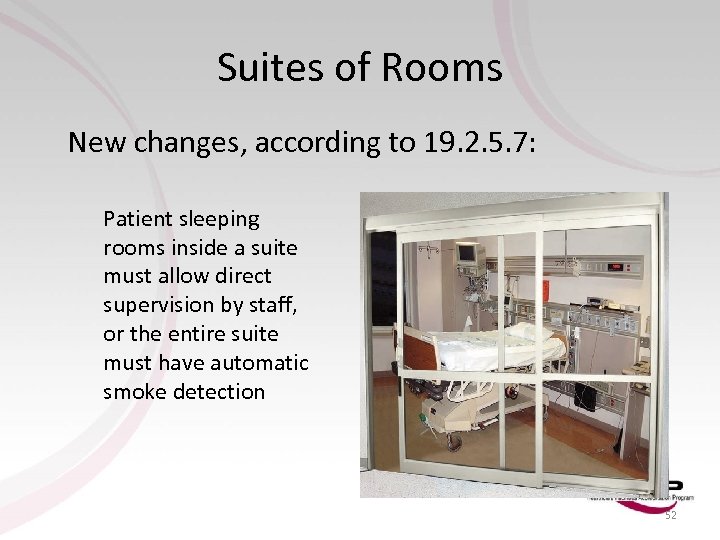 Suites of Rooms New changes, according to 19. 2. 5. 7: Patient sleeping rooms inside a suite must allow direct supervision by staff, or the entire suite must have automatic smoke detection 52
 Suites of Rooms New changes, according to 19. 2. 5. 7: – Where two exits are required from a suite, one of the paths of egress is permitted to be into an adjoining suite, provided the separation between the suites meet corridor wall and door requirements – The 100 foot travel distance limitation applies to the first suite, then another 100 foot ravel limit applies to the second suite (The travel distance limitation resets for the 2 nd suite) 53
 Suites of Rooms New changes, according to 19. 2. 5. 7: – Sleeping suites are limited to 5, 000 ft² – Sleeping suites are limited to 7, 500 ft² provided the following conditions apply: • The entire smoke compartment where the suite is located is protected with standard response sprinklers and smoke detector, or; • If the entire smoke compartment where the suite is located is protected with quick-response sprinklers, then smoke detectors are not required 54
 Suites of Rooms New changes, according to 19. 2. 5. 7: – Sleeping suites are limited to 10, 000 ft² provided: • The patient sleeping rooms are arranged for direct supervision by staff • The entire suite is covered by smoke detectors • The entire suite is protected with automatic sprinklers 55
 Suites of Rooms New changes, according to 19. 2. 5. 7: – Non-sleeping suites must have an exit access to a corridor or to a horizontal exit – In non-sleeping suites, where two or more exit access doors are required, one of the exit access doors is permitted to an exit enclosure or exit door to the exterior 56
 Suites of Rooms New changes, according to 19. 2. 5. 7: – In non-sleeping suites that require two means of egress, one of the means of egress is permitted to be into another suite, provided the separation between the suites complies with corridor wall and door requirements (The adjacent suite is not considered an intervening room) – Travel distances within a non-sleeping suite to an exit access door is 100 feet (No limitations for intervening rooms) 57
 Hazardous Areas The Life Safety Code always had a ‘short-list’ of what a hazardous area is in a healthcare occupancy: – – – – Boiler and fuel fired rooms Central laundries larger than 100 ft² Paint shops Repair shops Soiled linen rooms Trash collection rooms Storage room greater than 50 ft² containing combustibles Laboratories containing flammables or combustibles in quantities less than ‘severe hazard’ 58
 Hazardous Areas Here’s what changed for the 2012 edition, according to section 19. 3. 2. 1. 5: – Soiled linen rooms containing no more than 64 gallons of soiled linen are not considered hazardous – Trash collection rooms are now defined as ‘Rooms with collected trash’ and are not considered hazardous if they contain no more than 64 gallons of trash 59
 Hazardous Areas Additional changes involving hazardous rooms: – Gift shops have been removed from the definition of hazardous rooms, and only the gift shop storage room would be considered hazardous if it exceeds 50 ft² and contains combustibles – Section 19. 3. 2. 5. 5 specifically says cooking facilities that comply with section 9. 2. 3 (and NFPA 96) on fire safety features no longer has to be considered a hazardous area 60
 Hazardous Areas Additional changes involving hazardous rooms: – Section 43. 7. 1. 2 (2) allows a change in use of a space (such as taking a patient room out of service and making it a supply room with combustibles) in existing healthcare occupancies that is protected throughout by an automatic sprinkler system, to not have to meet new construction requirements for hazardous rooms, provided it does not exceed 250 ft² and it meets the provisions for existing hazardous rooms 61
 Hazardous Areas Additional changes involving hazardous rooms: – This means section 43. 7. 1. 2 (2) would require the space to have smoke resistant partitions, and smoke resistant doors that are self-closing, provided the building is fully protected with sprinklers – The sprinkler design criteria would have to be checked to make sure it meets ‘ordinary hazard’ designation 62
 Cooking Facilities The 2012 edition has new sections on cooking equipment which is focused towards nursing homes. Section 19. 3. 2. 5. 2 allows residential cooking equipment that is used for food warming or ‘limited cooking’ not to have to comply with NFPA 96 (such as exhaust hoods), and the area is not considered a hazardous area. 63
 Cooking Facilities Other new sections permit small cooking areas that are limited to preparing meals for no more than 30 persons to either be open to the corridor, or not be required to comply with NFPA 96 However, there are heavy restrictions on how the cooking equipment is arranged and used. 64
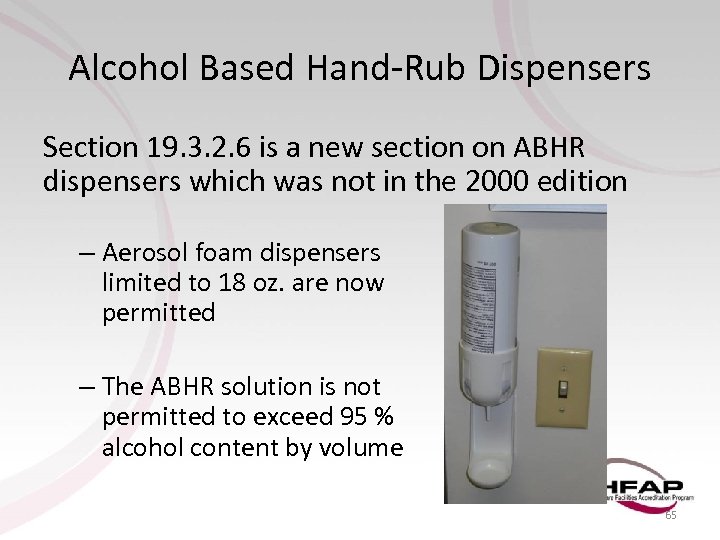 Alcohol Based Hand-Rub Dispensers Section 19. 3. 2. 6 is a new section on ABHR dispensers which was not in the 2000 edition – Aerosol foam dispensers limited to 18 oz. are now permitted – The ABHR solution is not permitted to exceed 95 % alcohol content by volume 65
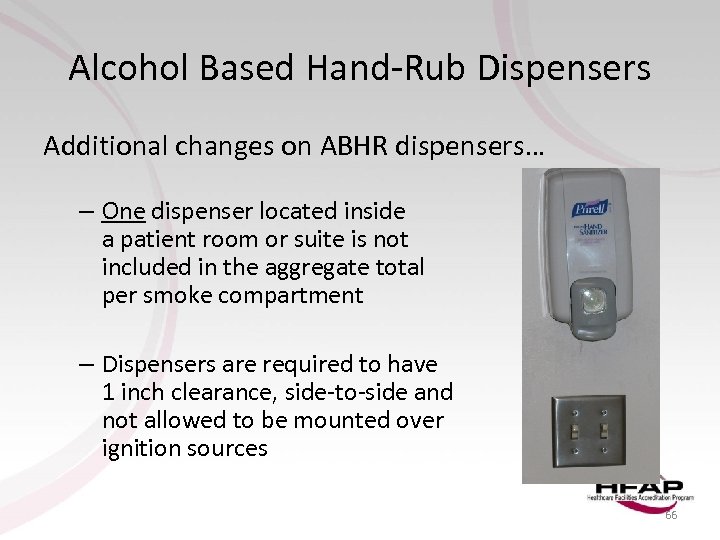 Alcohol Based Hand-Rub Dispensers Additional changes on ABHR dispensers… – One dispenser located inside a patient room or suite is not included in the aggregate total per smoke compartment – Dispensers are required to have 1 inch clearance, side-to-side and not allowed to be mounted over ignition sources 66
 Alcohol Based Hand-Rub Dispensers Section 21. 3. 2. 6 now allows ABHR dispensers in corridors of Ambulatory Care Occupancies But the 2012 Life Safety Code does not allow ABHR dispensers in corridors of business occupancies. 67
 Fireplaces Section 19. 5. 2. 3 now allows fire places in new areas of the healthcare facility – Direct-vent gas fire places are permitted inside smoke compartments containing patient sleeping areas, provided: • They are not located inside patient sleeping rooms • The smoke compartment must be fully protected with automatic sprinklers • Fireplace must have a sealed glass front • Carbon monoxide detectors must be placed in the room with the fireplace 68
 Fireplaces Section 19. 5. 2. 3 now allows solid fuel-burning fireplaces in areas other than patient sleeping areas – Solid fuel-burning fireplaces must be separated from patient sleeping areas by a 1 -hour fire rated barrier – Must comply with applicable NFPA standards (see 9. 2. 2) – Carbon monoxide detectors must be placed in the room with the fireplace 69
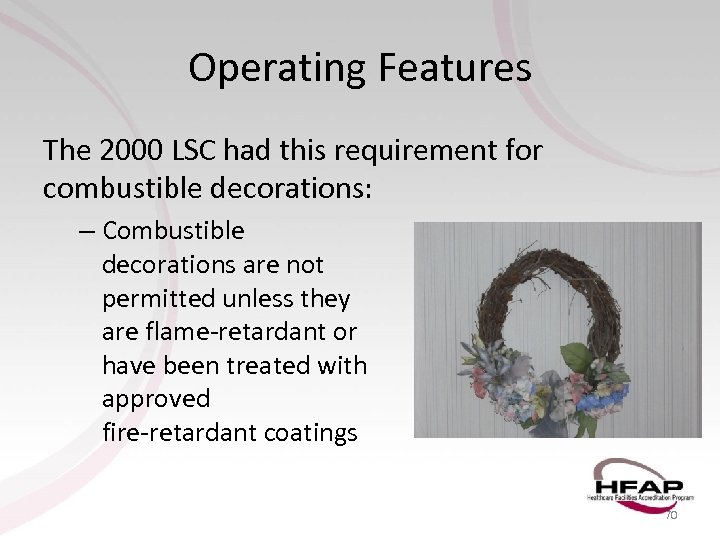 Operating Features The 2000 LSC had this requirement for combustible decorations: – Combustible decorations are not permitted unless they are flame-retardant or have been treated with approved fire-retardant coatings 70
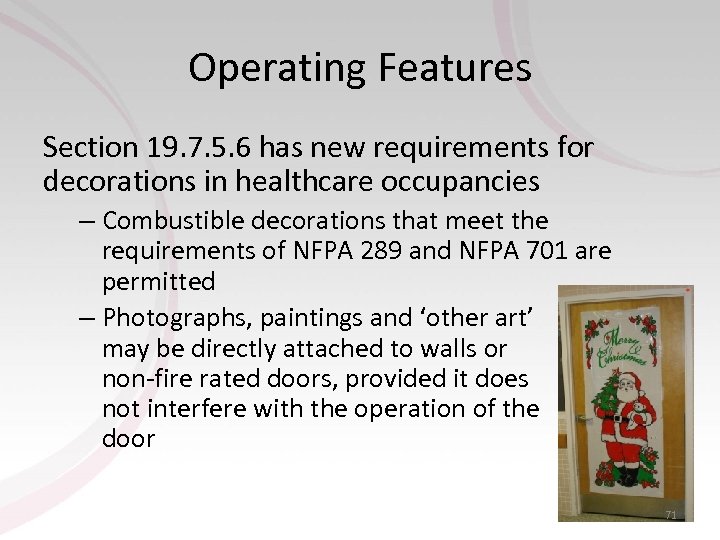 Operating Features Section 19. 7. 5. 6 has new requirements for decorations in healthcare occupancies – Combustible decorations that meet the requirements of NFPA 289 and NFPA 701 are permitted – Photographs, paintings and ‘other art’ may be directly attached to walls or non-fire rated doors, provided it does not interfere with the operation of the door 71
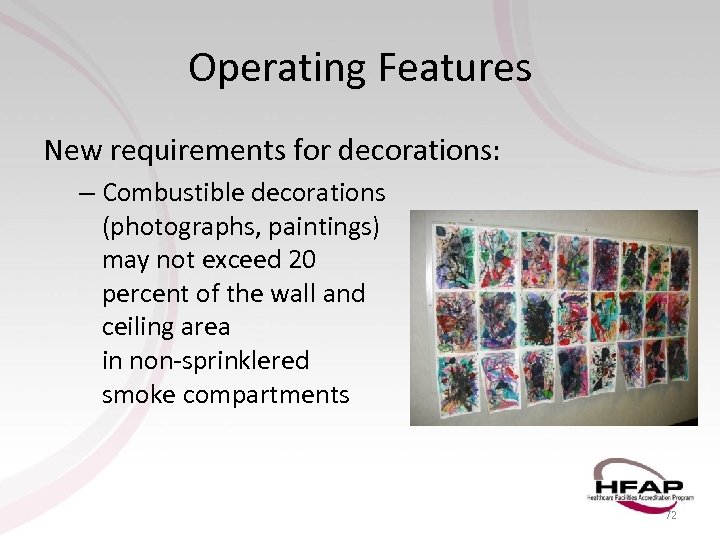 Operating Features New requirements for decorations: – Combustible decorations (photographs, paintings) may not exceed 20 percent of the wall and ceiling area in non-sprinklered smoke compartments 72
 Operating Features New requirements for decorations: – Combustible decorations may not exceed 30 percent of the wall and ceiling area in a sprinklered smoke compartment – Combustible decorations may not exceed 50 percent of wall and ceiling area inside patient sleeping rooms having a capacity not exceeding 4 persons, in a sprinklered smoke compartment 73
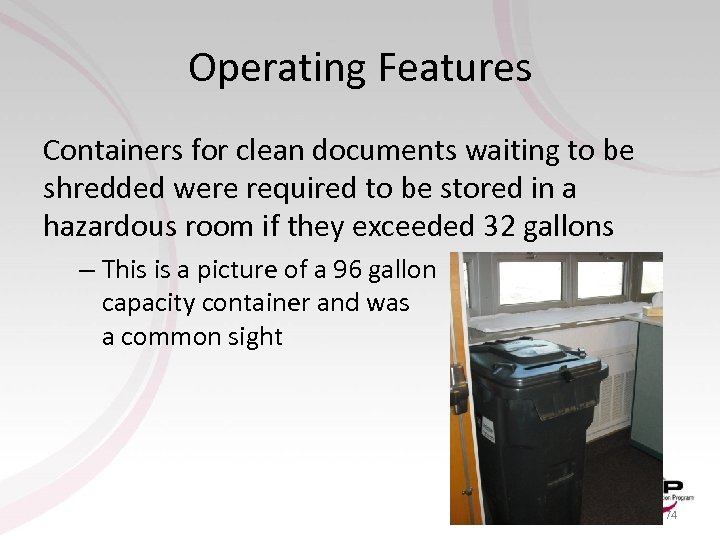 Operating Features Containers for clean documents waiting to be shredded were required to be stored in a hazardous room if they exceeded 32 gallons – This is a picture of a 96 gallon capacity container and was a common sight 74
 Operating Features Section 19. 7. 5. 7. 2 has new requirements for containers used for recycling clean waste and/or patient records – Containers must be labeled and listed as meeting FM Approval Standard 6921, or similar approval – Containers up to 96 gallons capacity are not required to be stored in a hazardous room 75
 Sprinkler System Testing NFPA 25 Standard for the Inspection, Testing and Maintenance of Water-Based Fire Protection Systems, 2011 edition is referenced by the new 2012 LSC. – Water-flow switches that are vane-actuated or pressure-switch type are now permitted to be tested semi-annually, instead of quarterly. 76
 Sprinkler System Testing NFPA 25: – Once every 5 -years, an internal inspection of the sprinkler piping is required in two places: Removal of an end-cap on the main and the removal of sprinkler at the end of a branch. The inspection is looking for the presence of foreign material or inorganic material. If slime is found it must be tested for Microbiological Influenced Corrosion (MIC). If foreign material is found, then an obstruction investigation must be conducted (which is a lot more intensive). 77
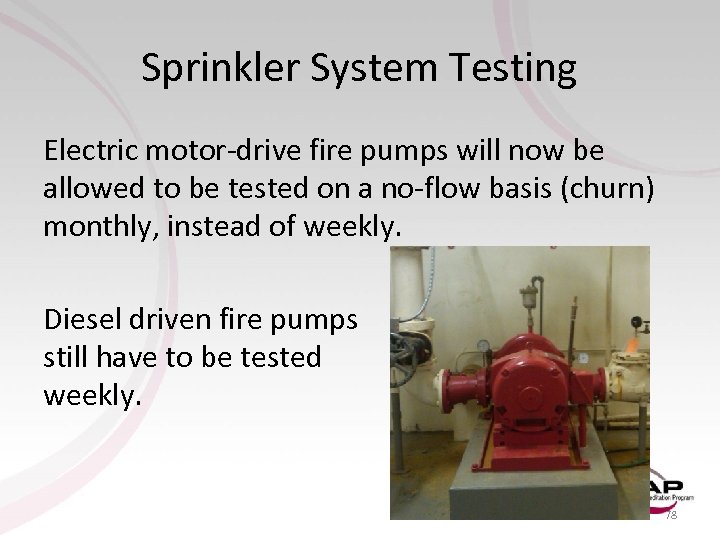 Sprinkler System Testing Electric motor-drive fire pumps will now be allowed to be tested on a no-flow basis (churn) monthly, instead of weekly. Diesel driven fire pumps still have to be tested weekly. 78
 Sprinkler System Testing Fire hose valves must be inspected quarterly and tested according to their class. – All fire hose valves must be inspected quarterly to ensure the caps are in place and not damaged; hose threads are not damaged; valve handles are present and not damaged; gaskets are not damaged; ensure there are no leaks; and ensure no obstructions are present. – 2½-inch hose valves must be tested annually, by opening and closing the valve (full flow not required). – 1½-inch hose valves must be tested every 3 -years, by opening and closing the valve (full flow not required). 79
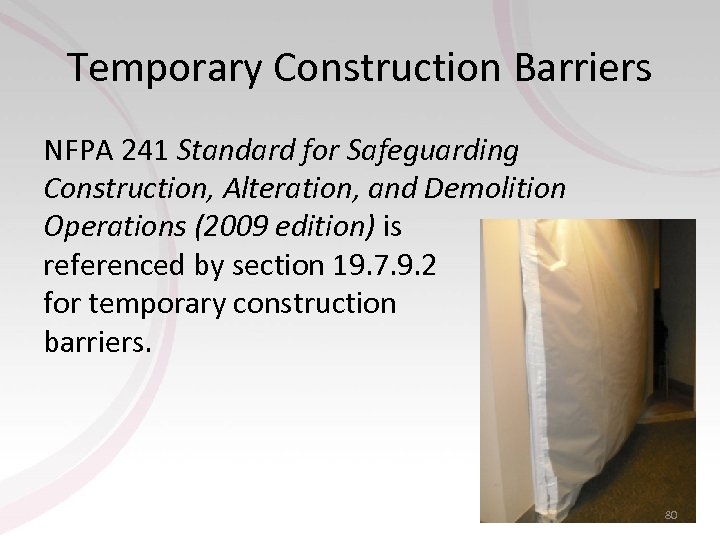 Temporary Construction Barriers NFPA 241 Standard for Safeguarding Construction, Alteration, and Demolition Operations (2009 edition) is referenced by section 19. 7. 9. 2 for temporary construction barriers. 80
 Temporary Construction Barriers This new edition of NFPA 241 will require 1 -hour fire rated barriers between construction areas, and occupied areas if the construction area is not protected with automatic sprinklers. If the construction area is protected with sprinklers, then non-rated barriers are permitted. 81
 Temporary Construction Barriers – Construction ‘tarps’ will not be permitted as barriers for sprinklered construction areas, even if they are fire retardant. – There is much debate whether flame retardant plastic sheeting will be allowed where non-rated barriers are permitted. HITF discussed this issue but could not make a consensus decision. 82
 Generator Testing If your monthly generator load test does not meet the 30% capacity of the nameplate rating, then an annual load test is required. – The new 2010 edition of NFPA 110 which will be referenced by the 2012 LSC only requires a 90 minute load test, rather than a 2 -hour load test. The new annual test will begin at 50% load for 30 minutes, then move to 75% load for 60 minutes, for a total of 90 -minutes of continuous test. 83
 To Summarize… With the adoption of the 2012 edition of the Life Safety Code there will be many changes. Assuming all changes are to the advantage of the healthcare organization, let’s list them one last time based on whether they will decrease or increase the work load for the typical healthcare facility… 84
 To Summarize… Decrease the work load: 1. Sprinkler impairments do not require fire watches until the sprinklers are impaired for 10 hours. 2. Existing openings into exit enclosures from unoccupied mechanical rooms permitted. 3. ‘Electrically’ locked hardware vs. mechanical locks on egress doors. 4. Existing dead-bolt locks on a door to a room serving not more than 3 occupants. 5. Locked doors now permitted where the safety needs are required for the patient. 85
 To Summarize… Decrease the work load: 6. Less restrictions on ABHR dispensers. 7. Certain wheeled equipment may now be left unattended in the corridor. 8. Many changes to allow bigger sleeping suites. 9. Small capacity soiled linen and trash rooms no longer have to be considered hazardous areas. 10. Gift shops no longer have to be considered hazardous areas. 11. Kitchens no longer have to be considered hazardous areas if the cooking exhaust hoods are fitted with fire suppression systems. 86
 To Summarize… Decrease the work load: 12. Small changes in use of space do not have to meet new construction requirements. 13. Less restrictions on the display of combustible decorations. 14. 96 gallon waste containers for clean waste permitted outside of a hazardous room. 15. Waterflow switches need to be tested semi-annually instead of quarterly. 16. Fire pump no-flow test is now monthly rather than weekly. 87
 To Summarize… Decrease the work load: 17. Generator annual load test is only required for 90 minutes rather than 2 -hours. Now let’s look at those changes that will increase the work load for the typical facility… 88
 To Summarize… Increase the work load: 1. High-rise hospitals must be fully sprinklered by July 5, 2028. 2. Fire watches must be continuous, ‘constantly circulating’ through the impaired area. 3. Maximum 4 inch projection into corridors. 4. All side-hinged swinging fire doors need to be tested annually. 5. The allowance for certain wheeled equipment to be left unattended in the corridor will be difficult to maintain and enforce. 89
 To Summarize… Increase the work load: 6. Once every 5 -years, an internal inspection of sprinkler pipe is required. 7. Fire hose valves must be inspected quarterly and tested annually/3 -years, depending on size. 8. 1 -hour fire rated barriers required between construction areas and occupied areas. 90
 To Summarize… So the new 2012 Life Safety Code is running about 2: 1 in favor of lessoning the work load for the typical facility… But some of those requirements that add to your work load can be a real challenge. Be ready by November 7 and have all of the new required features completed by then! 91
 QUESTIONS 92 |
 Want to ask Questions later? Contact Brad Keyes at: bkeyes@hfap. org 815 -629 -2240 Or, please submit questions to: info@hfap. org
 Certificate of Attendance ______________ Awarded 1. 5 contact hours The New 2012 Life Safety Code: It’s Finally Here! A 90 minute audio-conference June 30, 2016 _________ Brad Keyes, Presenter HFAP Engineering Advisor