 Скачать презентацию The neuroethics of noninvasive brain stimulation TDCS
Ethics.pptx
- Количество слайдов: 24



The neuroethics of noninvasive brain stimulation
TDCS 1. Wear electrical currents (1 m. A) are applied for a short duration (20 min. ) to the heard via electrodes tat are placed on the scalp. The currants pass through the skull and alter spontaneous neural activity. 2. Studies in animals and humans have found that anodal stimulation increases tissue excitability, while catodal stimulation inhibits cell ring and decrease excitability. 3. The effect of TDSC is long-lasting and ca persist for up to 12 months.
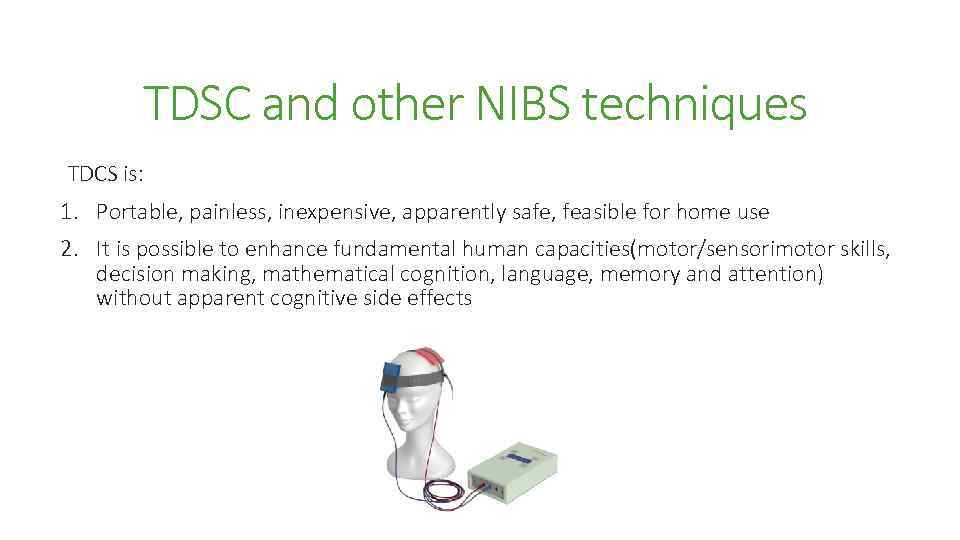
TDSC and other NIBS techniques TDCS is: 1. Portable, painless, inexpensive, apparently safe, feasible for home use 2. It is possible to enhance fundamental human capacities(motor/sensorimotor skills, decision making, mathematical cognition, language, memory and attention) without apparent cognitive side effects
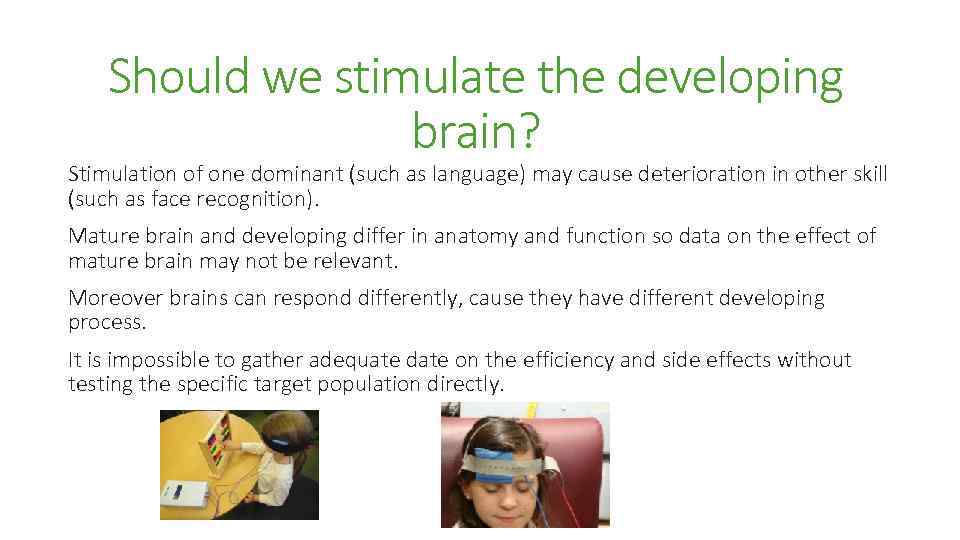
Should we stimulate the developing brain? Stimulation of one dominant (such as language) may cause deterioration in other skill (such as face recognition). Mature brain and developing differ in anatomy and function so data on the effect of mature brain may not be relevant. Moreover brains can respond differently, cause they have different developing process. It is impossible to gather adequate date on the efficiency and side effects without testing the specific target population directly.
Brain stimulation as a Performance. Enhancing Measure Modulating the activity of the brain during training or during sport will lead to benefits comparable to those of using drugs. t. CS has a number of advantages over TMS: 1. is cheaper and more portable 2. t. CS stimulators are now commercially available 3. electric field induced by t. CS spreads across the whole brain surface (TMS is, however, a more focal technique, with a relatively small area of the brain being affected by the stimulation)
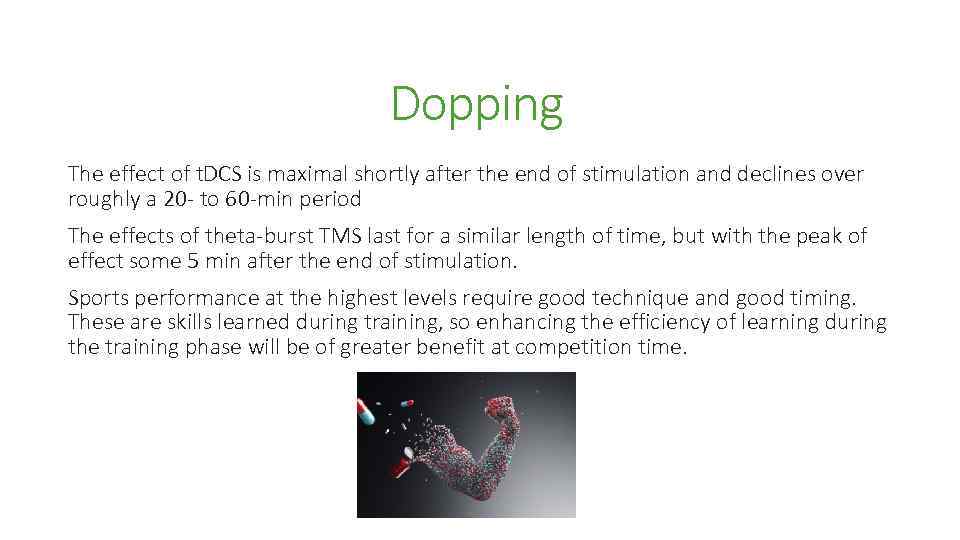
Dopping The effect of t. DCS is maximal shortly after the end of stimulation and declines over roughly a 20 - to 60 -min period The effects of theta-burst TMS last for a similar length of time, but with the peak of effect some 5 min after the end of stimulation. Sports performance at the highest levels require good technique and good timing. These are skills learned during training, so enhancing the efficiency of learning during the training phase will be of greater benefit at competition time.
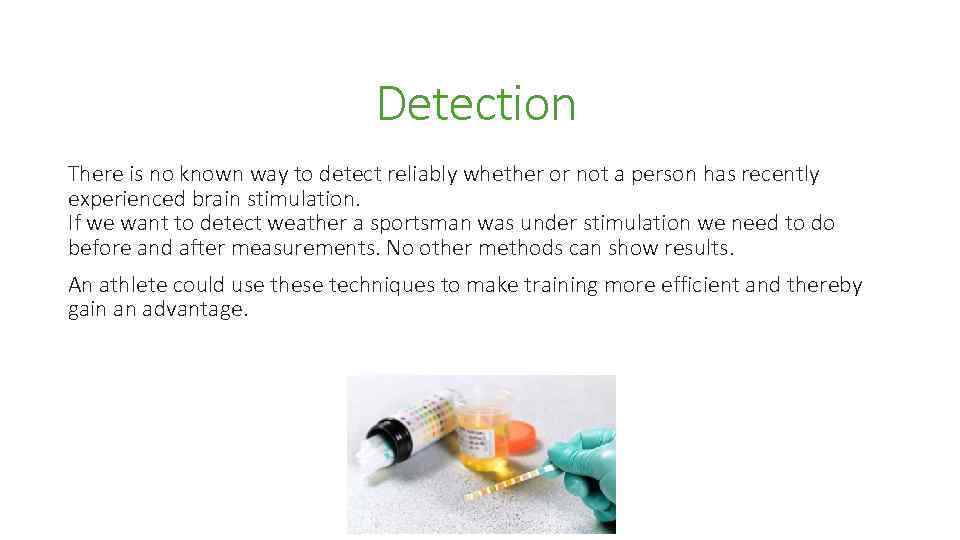
Detection There is no known way to detect reliably whether or not a person has recently experienced brain stimulation. If we want to detect weather a sportsman was under stimulation we need to do before and after measurements. No other methods can show results. An athlete could use these techniques to make training more efficient and thereby gain an advantage.
Ethic for using TACS, TDSC and TRNS People can cause themselves damage if use it unappropriate The effect of t. DCS depends on which electrode is applied to the scalp: 1. cathodal stimulation is associated with decreased cortical excitability due to hyperpolarization of cortical neurons 2. anodal stimulation is associated with increased cortical excitability due to subthreshold depolarization. These effects may last from minutes to hours depending on the intensity, polarity, and duration of stimulation.
Also, compared to TMS, t. DCS is currently less expensive, much more portable, very well-tolerated, and associated with fewer safety concerns Brain stimulation may eventually be used for self-enhancement in at least 3 realms: cognitive skills, mood, and social cognition.
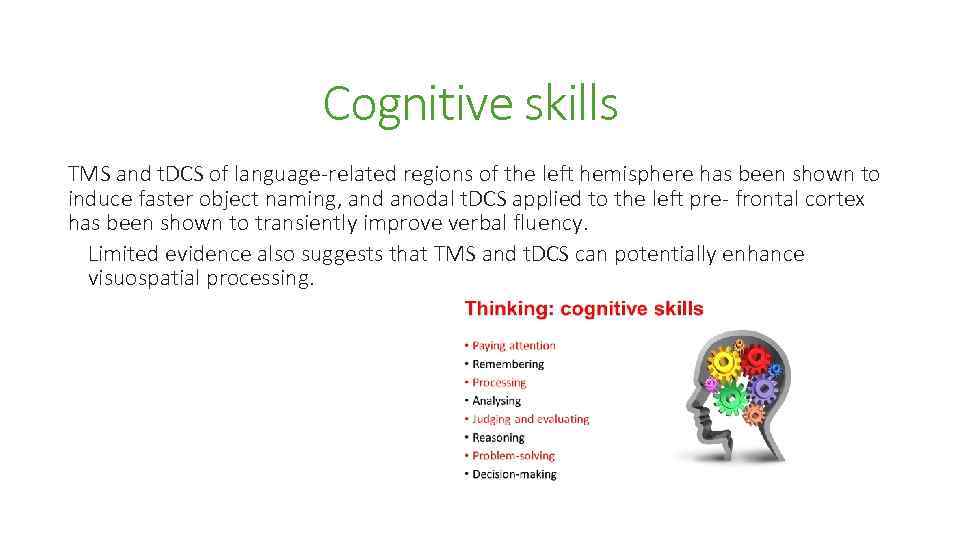
Cognitive skills TMS and t. DCS of language-related regions of the left hemisphere has been shown to induce faster object naming, and anodal t. DCS applied to the left pre- frontal cortex has been shown to transiently improve verbal fluency. Limited evidence also suggests that TMS and t. DCS can potentially enhance visuospatial processing.
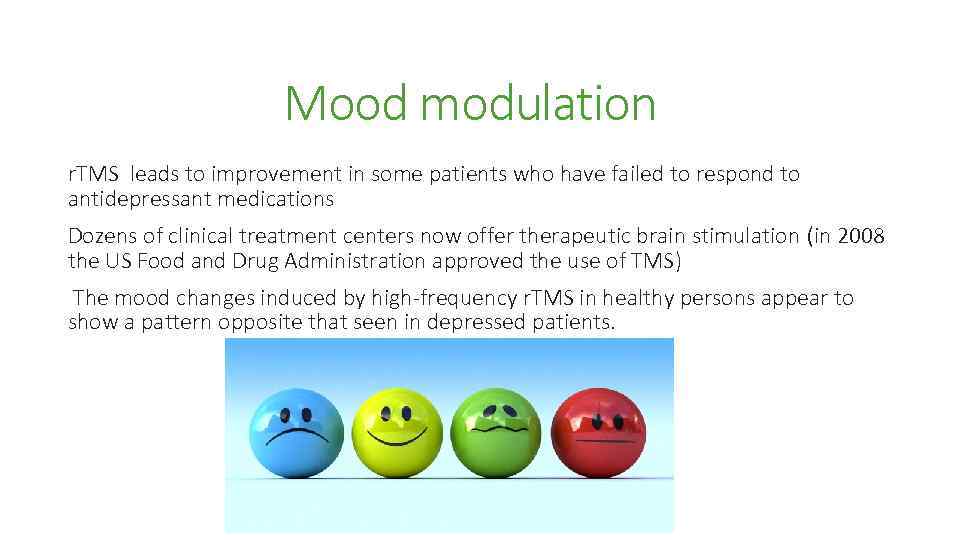
Mood modulation r. TMS leads to improvement in some patients who have failed to respond to antidepressant medications Dozens of clinical treatment centers now offer therapeutic brain stimulation (in 2008 the US Food and Drug Administration approved the use of TMS) The mood changes induced by high-frequency r. TMS in healthy persons appear to show a pattern opposite that seen in depressed patients.
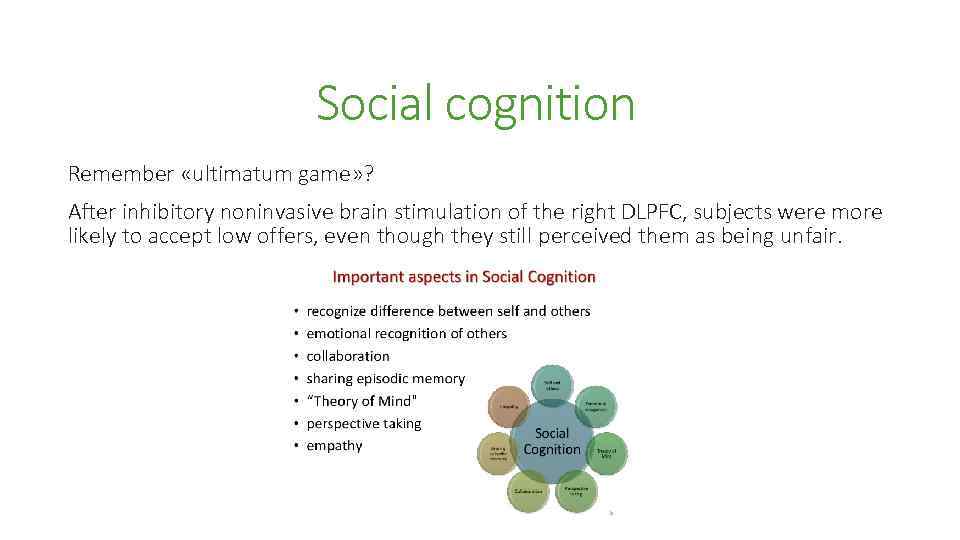
Social cognition Remember «ultimatum game» ? After inhibitory noninvasive brain stimulation of the right DLPFC, subjects were more likely to accept low offers, even though they still perceived them as being unfair.
Safety The most important safety risk associated with TMS is the risk of inducing seizures. All current evidence indicates that t. DCS is extremely safe; its main safety risks are mild headache and a mild burning or itching sensation under the electrodes.
Character 1. concentration or memory (are abilities that are acceptable to change) 2. honesty or fairness ( inappropriate to manipulate) Individual who has changed them has changed his or her identity—that he or she is now in fact a different person.
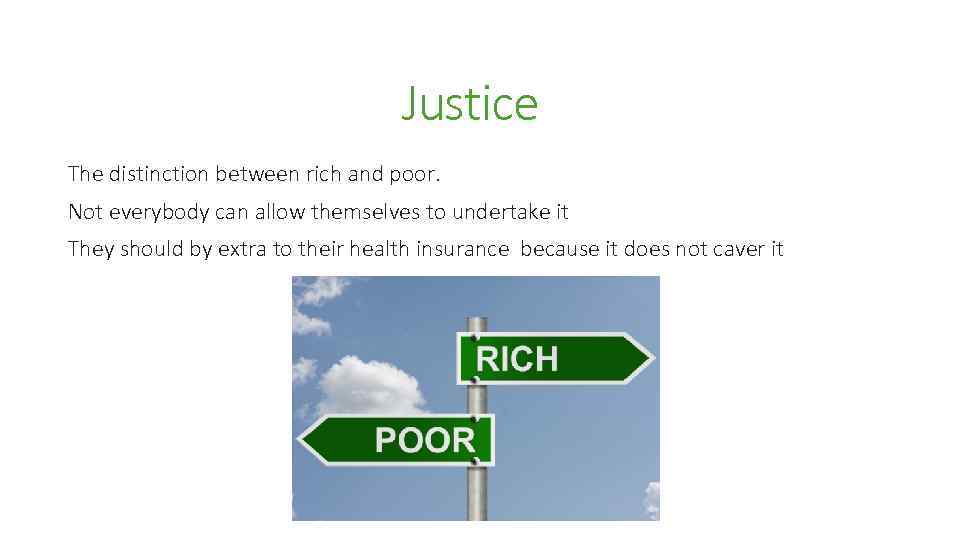
Justice The distinction between rich and poor. Not everybody can allow themselves to undertake it They should by extra to their health insurance because it does not caver it
Autonomy Could someday arise in which one could be explicitly or implicitly coerced to undergo brain stimulation? 1. Explicit coercion refers to forcing individuals to undergo noninvasive brain stimulation against their will 2. Implicit coercion refers to the pressure to engage in brain enhancement as a way to keep up with the demands of a competitive society.
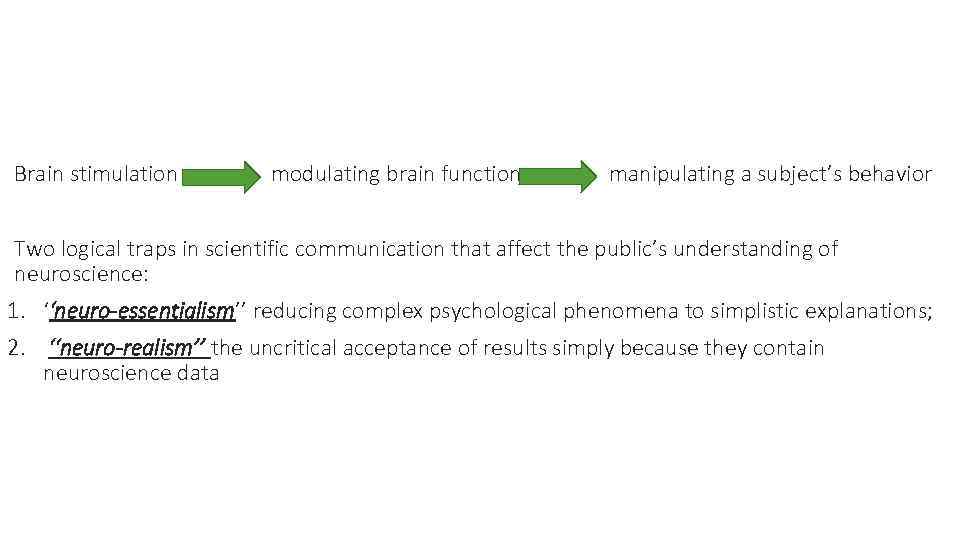
Brain stimulation modulating brain function manipulating a subject’s behavior Two logical traps in scientific communication that affect the public’s understanding of neuroscience: 1. ‘‘neuro-essentialism’’ reducing complex psychological phenomena to simplistic explanations; 2. ‘‘neuro-realism’’ the uncritical acceptance of results simply because they contain neuroscience data
Many ‘‘neuromarketing’’ companies are selling f. MRI and other neuroscience techniques to find the ‘‘buy button’’ in the mind of consumers
Putting aside the low potential for efficacy of such measures, this application certainly would be a more troubling infringement (грубе порушення) on personal autonomy and free choice. The present level of brain stimulation research in deception is scientifically close to, but as yet distinct from, the manipulation of trust or social behavior to extract information from subjects.
Deceptive behavior In one study, TMS was delivered to the left and right motor cortices of eight subjects before and immediately after a question was answered 1. with a false response the amplitude of the motor evoked potential elicited by TMS was larger after a ‘lie’ response than before. 2. an effect not seen with ‘truth’ responses.
Overlock your brain for gaming? Individuals with reduced inhibitory control of prefrontal activity may develop pathological gambling , that is the difficulty to control the impulse to gamble. TDCS modifies cortical excitability in a polarity-specific manner, with effects lasting long after stimulation. TDSC applied over the prefrontal cortex can induce long lasting improvements in cognitive abilities. It does not influence everyday life, but if we make self-stimulation for long time outside the lab, safety issues may arise. It would not only affect the single function supported by that region, but also other process. Overlocking usually leads to wearing out.
Ethical and social risks in brain stimulation If one simply contracts the hand during the application of TDCS, then the after effects become inhibitory. Nevertheless, the perfect conditions in the lab we can see the small effect. Despite best reputable studies we still don’t know: 1. Where to put the electrodes 2. Whether the effects are excitatory or inhibitory 3. What other behaviors are affected
Usage in medicine As a treatment for stroke, pain and depression TDCS is a tool to modify the brains of healthy humans Functional MRI is more expensive
Worries of the DIY 1. Configuration of the device is flexible (problem with the left-handed people) 2. Reversing polarity can impair function (reversing the polarity of electrodes may be ineffective) 3. Stimulation can interact with extant treatment 4. Effects may be long lasting
Скачать презентацию The neuroethics of noninvasive brain stimulation TDCS
Ethics.pptx