


 Скачать презентацию The Neural Electro Magnetic Ontology NEMO System 39
9292724920b9670903f94528412714dd.ppt
- Количество слайдов: 1
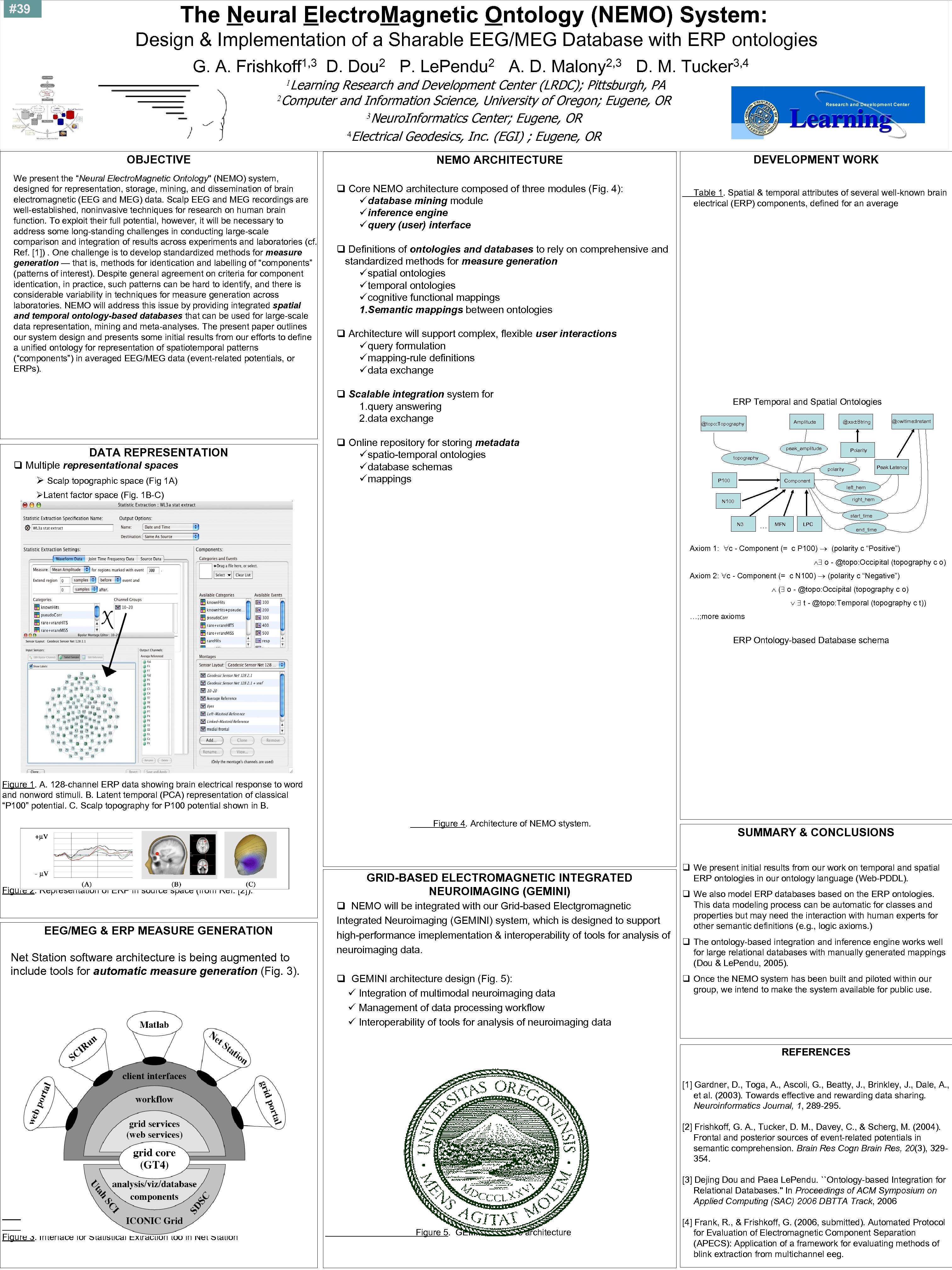 The Neural Electro. Magnetic Ontology (NEMO) System: #39 Design & Implementation of a Sharable EEG/MEG Database with ERP ontologies 1, 3 D. Dou 2 P. Le. Pendu 2 A. D. Malony 2, 3 D. M. Tucker 3, 4 G. A. Frishkoff Learning Research and Development Center (LRDC); Pittsburgh, PA 2 Computer and Information Science, University of Oregon; Eugene, OR 3 Neuro. Informatics Center; Eugene, OR 4 Electrical Geodesics, Inc. (EGI) ; Eugene, OR 1 OBJECTIVE DEVELOPMENT WORK NEMO ARCHITECTURE We present the “Neural Electro. Magnetic Ontology" (NEMO) system, designed for representation, storage, mining, and dissemination of brain electromagnetic (EEG and MEG) data. Scalp EEG and MEG recordings are well-established, noninvasive techniques for research on human brain function. To exploit their full potential, however, it will be necessary to address some long-standing challenges in conducting large-scale comparison and integration of results across experiments and laboratories (cf. Ref. [1]). One challenge is to develop standardized methods for measure generation — that is, methods for identication and labelling of “components” (patterns of interest). Despite general agreement on criteria for component identication, in practice, such patterns can be hard to identify, and there is considerable variability in techniques for measure generation across laboratories. NEMO will address this issue by providing integrated spatial and temporal ontology-based databases that can be used for large-scale data representation, mining and meta-analyses. The present paper outlines our system design and presents some initial results from our efforts to define a unified ontology for representation of spatiotemporal patterns (“components”) in averaged EEG/MEG data (event-related potentials, or ERPs). q Core NEMO architecture composed of three modules (Fig. 4): + ü database– mining module ü inference engine ü query (user) interface q Definitions of ontologies and databases to rely on comprehensive and standardized methods for measure generation ü spatial ontologies ü temporal ontologies ü cognitive functional mappings 1. Semantic mappings between ontologies q Architecture will support complex, flexible user interactions ü query formulation ü mapping-rule definitions ü data exchange q Scalable integration system for 1. query answering 2. data exchange DATA REPRESENTATION q Multiple representational spaces Ø Scalp topographic space (Fig 1 A) Table 1. Spatial & temporal attributes of several well-known brain electrical (ERP) components, defined for an average q Online repository for storing metadata ü spatio-temporal ontologies ü database schemas ü mappings ERP Temporal and Spatial Ontologies Amplitude peak_amplitude @owltime: Instant @xsd: String Polarity @topo: Topography topography Peak Latency polarity P 100 Component left_hem ØLatent factor space (Fig. 1 B-C) right_hem N 100 Ø Neural source space (Fig. 2) start_time N 3 … MFN LPC end_time Axiom 1: c - Component (= c P 100) (polarity c “Positive”) o - @topo: Occipital (topography c o) Axiom 2: c - Component (= c N 100) (polarity c “Negative”) ( o - @topo: Occipital (topography c o) t - @topo: Temporal (topography c t)) …; ; more axioms ERP Ontology-based Database schema Figure 1. A. 128 -channel ERP data showing brain electrical response to word and nonword stimuli. B. Latent temporal (PCA) representation of classical “P 100” potential. C. Scalp topography for P 100 potential shown in B. Figure 2. Representation of ERP in source space (from Ref. [2]). EEG/MEG & ERP MEASURE GENERATION Net Station software architecture is being augmented to include tools for automatic measure generation (Fig. 3). Figure 4. Architecture of NEMO stystem. GRID-BASED ELECTROMAGNETIC INTEGRATED NEUROIMAGING (GEMINI) SUMMARY & CONCLUSIONS q We present initial results from our work on temporal and spatial ERP ontologies in our ontology language (Web-PDDL). q We also model ERP databases based on the ERP ontologies. This data modeling process can be automatic for classes and properties but may need the interaction with human experts for other semantic definitions (e. g. , logic axioms. ) q NEMO will be integrated with our Grid-based Electgromagnetic Integrated Neuroimaging (GEMINI) system, which is designed to support high-performance imeplementation & interoperability of tools for analysis of q The ontology-based integration and inference engine works well neuroimaging data. for large relational databases with manually generated mappings (Dou & Le. Pendu, 2005). q GEMINI architecture design (Fig. 5): ü Integration of multimodal neuroimaging data ü Management of data processing workflow ü Interoperability of tools for analysis of neuroimaging data q Once the NEMO system has been built and piloted within our group, we intend to make the system available for public use. REFERENCES [1] Gardner, D. , Toga, A. , Ascoli, G. , Beatty, J. , Brinkley, J. , Dale, A. , et al. (2003). Towards effective and rewarding data sharing. Neuroinformatics Journal, 1, 289 -295. [2] Frishkoff, G. A. , Tucker, D. M. , Davey, C. , & Scherg, M. (2004). Frontal and posterior sources of event-related potentials in semantic comprehension. Brain Res Cogn Brain Res, 20(3), 329354. [3] Dejing Dou and Paea Le. Pendu. ``Ontology-based Integration for Relational Databases. " In Proceedings of ACM Symposium on Applied Computing (SAC) 2006 DBTTA Track, 2006 Figure 3. Interface for Statistical Extraction too in Net Station Figure 5. GEMINI software architecture [4] Frank, R. , & Frishkoff, G. (2006, submitted). Automated Protocol for Evaluation of Electromagnetic Component Separation (APECS): Application of a framework for evaluating methods of blink extraction from multichannel eeg.