 Скачать презентацию The Neural Basis of Thought and Language Midterm
967e99e1ee04f262879fab46bb946e01.ppt
- Количество слайдов: 32



The Neural Basis of Thought and Language Midterm Review Session
DISCLAIMER We haven’t seen the test We don’t know what’s on the test What we present today is purely our opinion on what some of the important topics are
Administrivia • Midterm in class next Tuesday, March 7 th • Be there on time! • Format: – closed books, closed notes – short answers, no blue books – up to Feb. 28 th lecture
The format for this evening. . . • Question • Work on it • Discuss • Repeat. . .
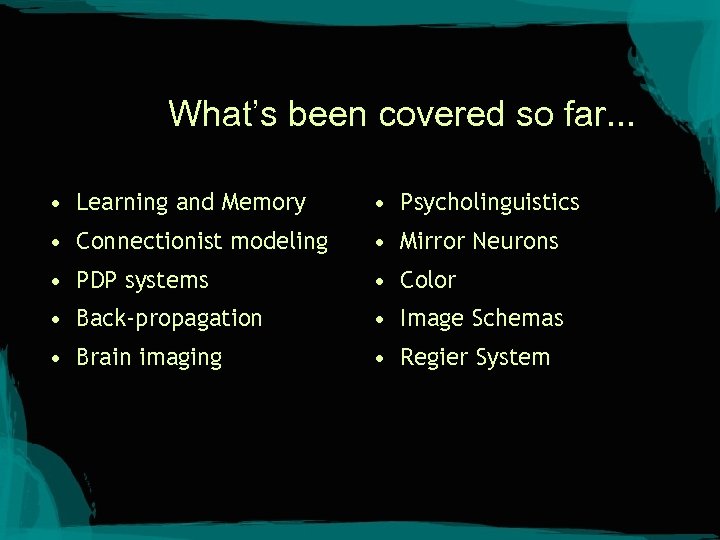
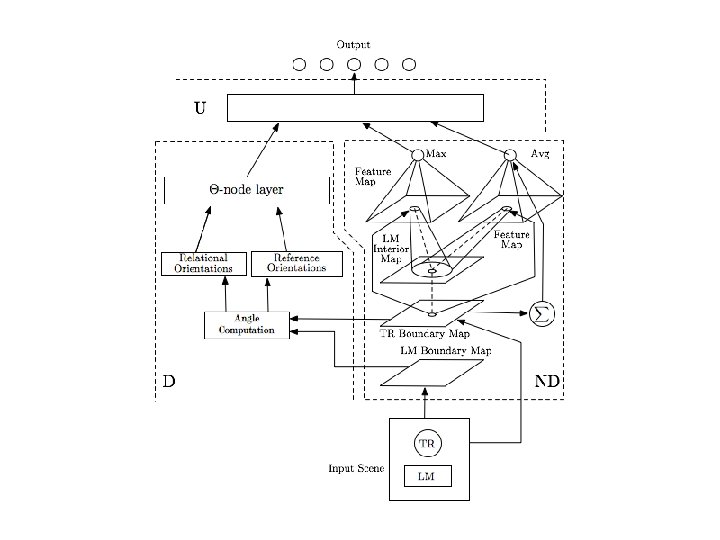
What’s been covered so far. . . • Learning and Memory • Psycholinguistics • Connectionist modeling • Mirror Neurons • PDP systems • Color • Back-propagation • Image Schemas • Brain imaging • Regier System
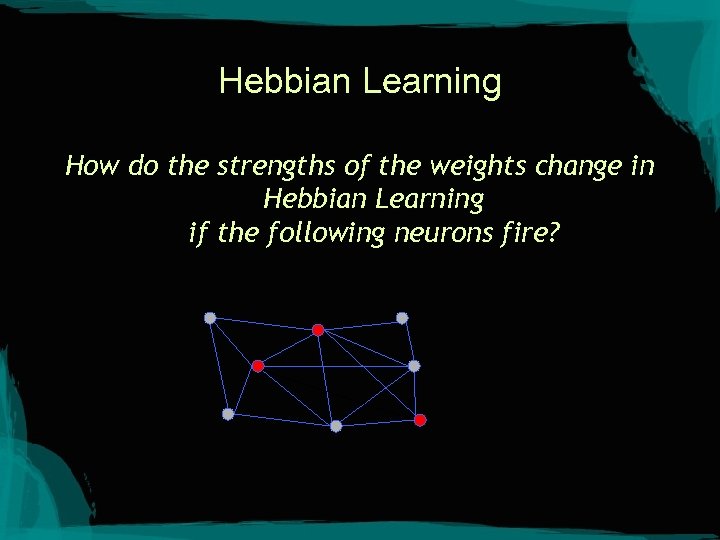
Hebbian Learning How do the strengths of the weights change in Hebbian Learning if the following neurons fire?
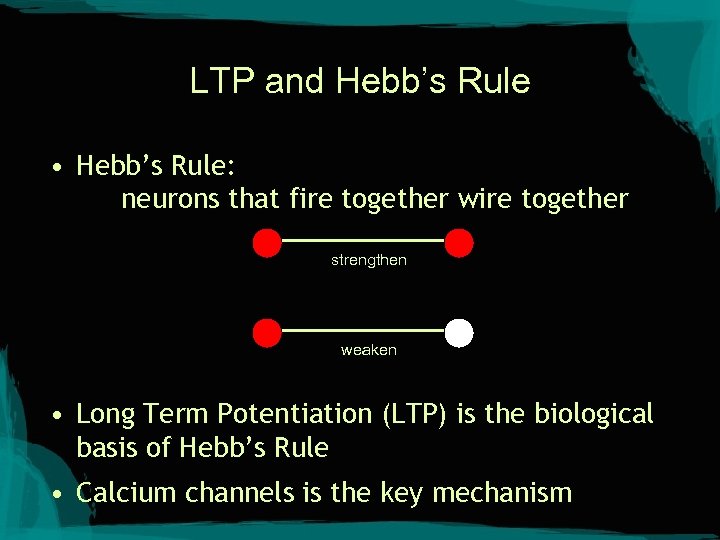
LTP and Hebb’s Rule • Hebb’s Rule: neurons that fire together wire together strengthen weaken • Long Term Potentiation (LTP) is the biological basis of Hebb’s Rule • Calcium channels is the key mechanism
Long Term Potentiation (LTP) • These changes make each of the winning synapses more potent for an intermediate period, lasting from hours to days (LTP). • In addition, repetition of a pattern of successful firing triggers additional chemical changes that lead, in time, to an increase in the number of receptor channels associated with successful synapses - the requisite structural change for long term memory. – There also related processes for weakening synapses and also for strengthening pairs of synapses that are active at about the same time.

Questions?
Learning What type of learning discussed in class solves the problem of assigning blame?
Back-prop Questions?
The Brain What areas of the brain would be active when picking up an object vs. seeing someone pick up an object? How does this play into the embodiment debate?
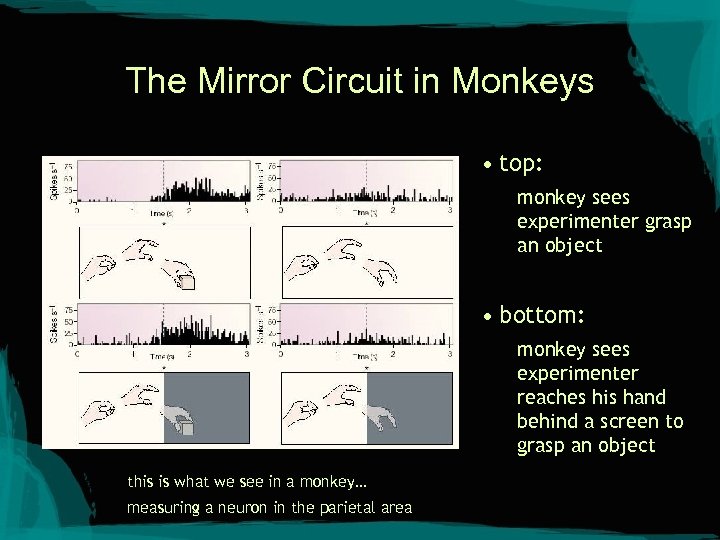
The Mirror Circuit in Monkeys • top: monkey sees experimenter grasp an object • bottom: monkey sees experimenter reaches his hand behind a screen to grasp an object this is what we see in a monkey… measuring a neuron in the parietal area
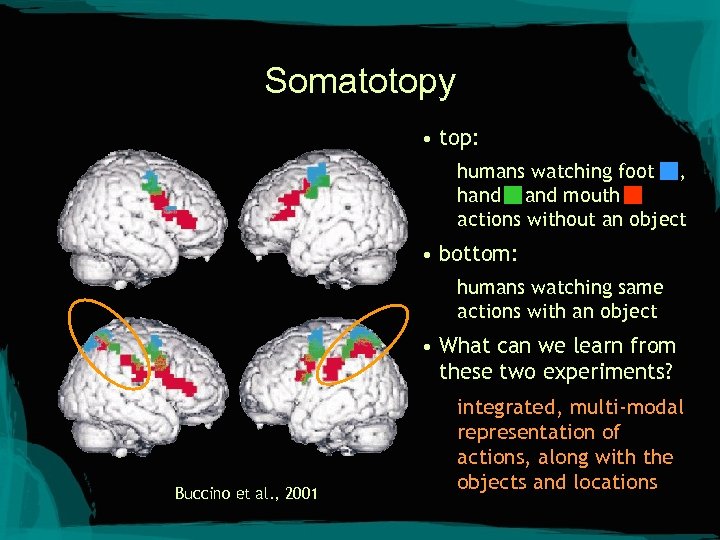
Somatotopy • top: humans watching foot , hand mouth actions without an object • bottom: humans watching same actions with an object • What can we learn from these two experiments? Buccino et al. , 2001 integrated, multi-modal representation of actions, along with the objects and locations
Concepts • What Concepts Are: Basic Constraints – Concepts are the elements of reason, and – constitute the meanings of words and linguistic expressions.
Concepts: Traditional Theory • The Traditional Theory • Reason and language are what distinguish human beings from other animals. • Concepts therefore use only human-specific brain mechanisms. • Reason is separate from perception and action, and does not make direct use of the sensory-motor system. • Concepts must be “disembodied” in this sense.
The neural theory Human concepts are embodied. Many concepts make direct use of the sensory-motor capacities of our body-brain system. • Many of these capacities are also present in non-human primates. • Let us look at concepts that make use of our sensory-motor capacities, ex. Grasp.

Questions?
Color What is the biological basis of basic color terms?
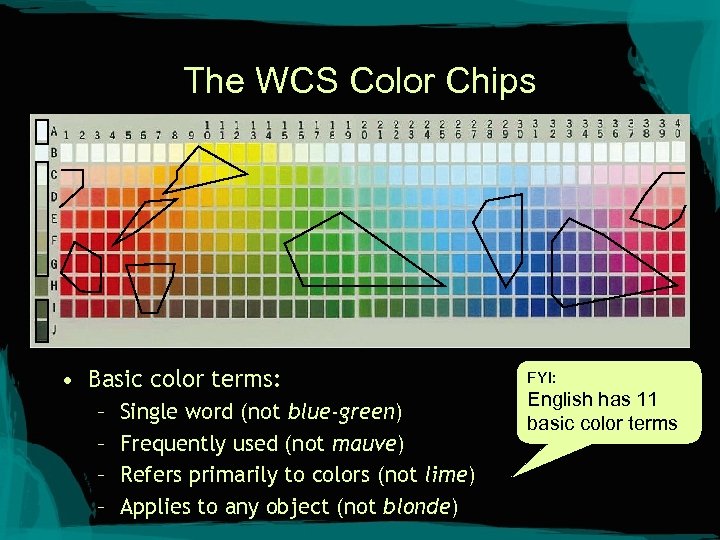
The WCS Color Chips • Basic color terms: – – Single word (not blue-green) Frequently used (not mauve) Refers primarily to colors (not lime) Applies to any object (not blonde) FYI: English has 11 basic color terms
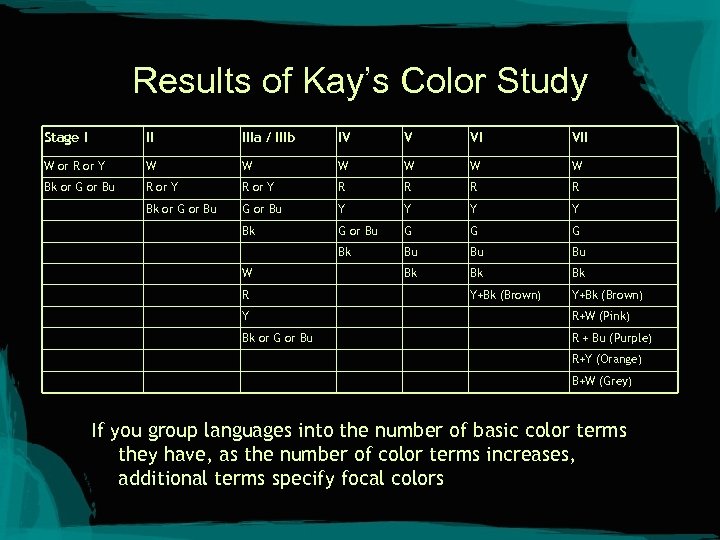
Results of Kay’s Color Study Stage I II IIIa / IIIb IV V VI VII W or R or Y W W W Bk or G or Bu R or Y R R Bk or G or Bu Y Y Bk G or Bu G G G Bk Bu Bu Bu Bk Bk Bk Y+Bk (Brown) W R Y R+W (Pink) Bk or G or Bu R + Bu (Purple) R+Y (Orange) B+W (Grey) If you group languages into the number of basic color terms they have, as the number of color terms increases, additional terms specify focal colors
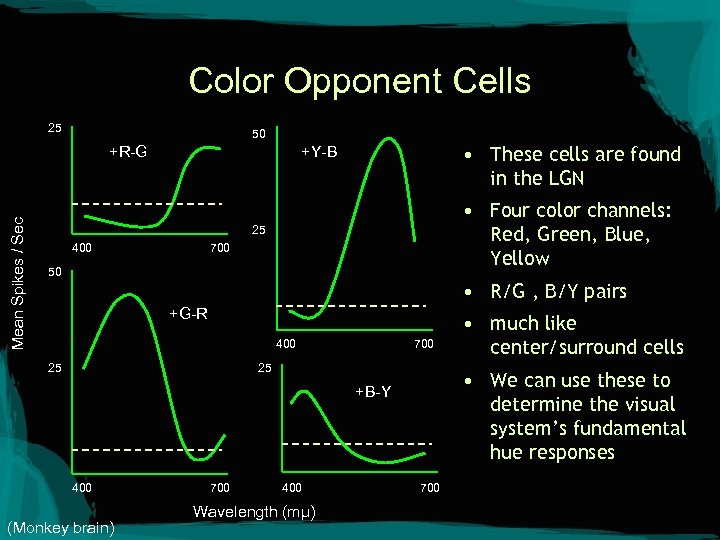
Color Opponent Cells 25 50 Mean Spikes / Sec +R-G • These cells are found in the LGN +Y-B • Four color channels: Red, Green, Blue, Yellow 25 400 700 50 • R/G , B/Y pairs +G-R 400 25 700 25 • We can use these to determine the visual system’s fundamental hue responses +B-Y 400 (Monkey brain) 700 400 Wavelength (mμ) • much like center/surround cells 700

Questions?
Categories • Internal structure (classical, radial, family resemblance, prototype-based, “essentiallycontested, ” ad-hoc) • “External” structure (basic-level, superordinate, subordinate)
Categories What are super- and sub-ordinate types to “red”?
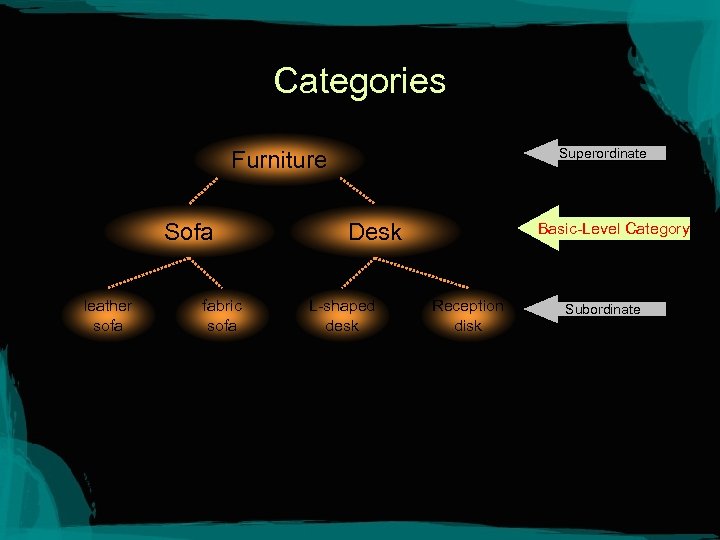
Categories Superordinate Furniture Sofa leather sofa fabric sofa Desk L-shaped desk Basic-Level Category Reception disk Subordinate
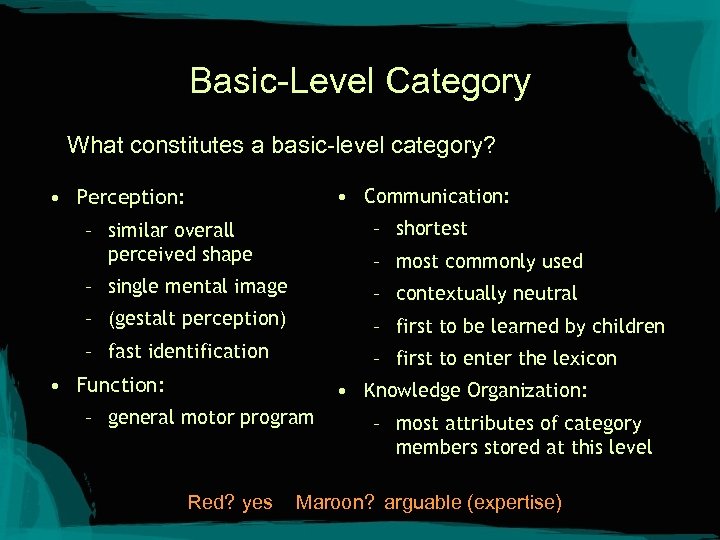
Basic-Level Category What constitutes a basic-level category? • Communication: • Perception: – similar overall perceived shape – shortest – single mental image – contextually neutral – (gestalt perception) – first to be learned by children – fast identification – first to enter the lexicon – most commonly used • Function: • Knowledge Organization: – general motor program Red? yes – most attributes of category members stored at this level Maroon? arguable (expertise)
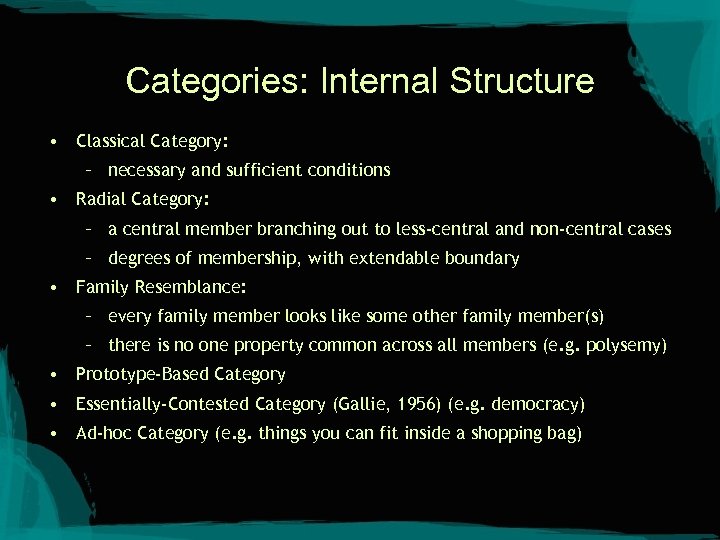
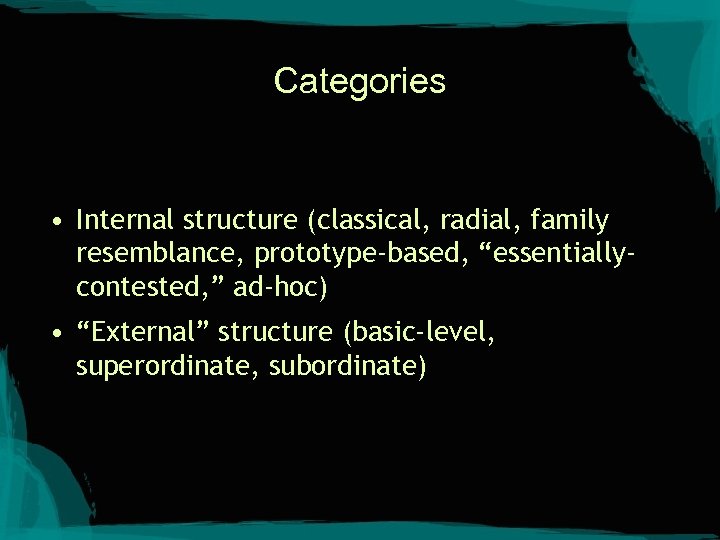
Categories: Internal Structure • Classical Category: – necessary and sufficient conditions • Radial Category: – a central member branching out to less-central and non-central cases – degrees of membership, with extendable boundary • Family Resemblance: – every family member looks like some other family member(s) – there is no one property common across all members (e. g. polysemy) • Prototype-Based Category • Essentially-Contested Category (Gallie, 1956) (e. g. democracy) • Ad-hoc Category (e. g. things you can fit inside a shopping bag)

Questions?
Image Schemas and Regier
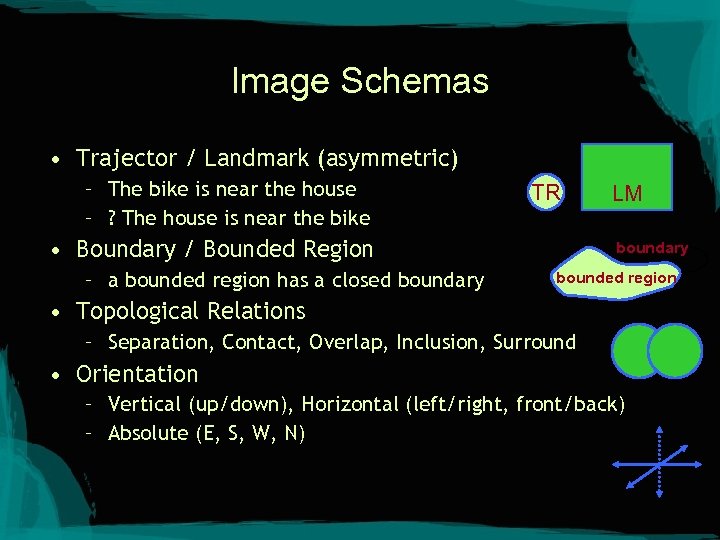
Image Schemas • Trajector / Landmark (asymmetric) – The bike is near the house – ? The house is near the bike TR • Boundary / Bounded Region – a bounded region has a closed boundary LM boundary bounded region • Topological Relations – Separation, Contact, Overlap, Inclusion, Surround • Orientation – Vertical (up/down), Horizontal (left/right, front/back) – Absolute (E, S, W, N)
 Скачать презентацию The Neural Basis of Thought and Language Midterm
967e99e1ee04f262879fab46bb946e01.ppt