


 Скачать презентацию The network of leading European providers of services
87ab92f957eacfeeb10c9aea3a38e892.ppt
- Количество слайдов: 18
 The network of leading European providers of services to people with disabilities 1
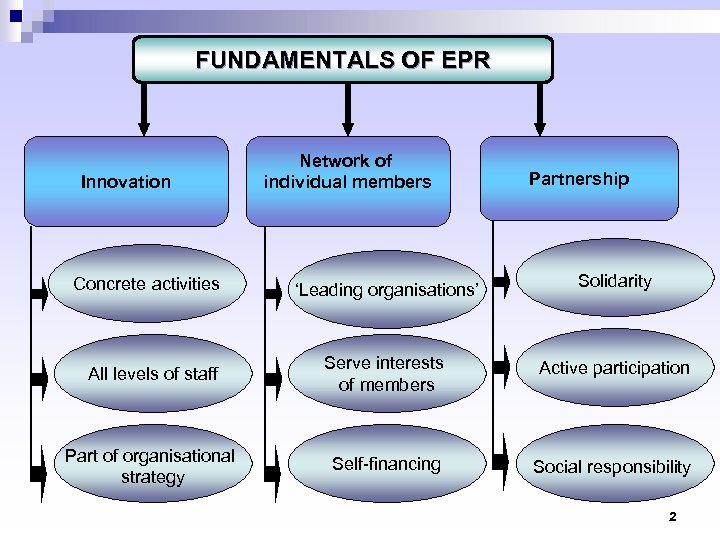 FUNDAMENTALS OF EPR Innovation Concrete activities Network of individual members ‘Leading organisations’ Partnership Solidarity All levels of staff Serve interests of members Active participation Part of organisational strategy Self-financing Social responsibility 2
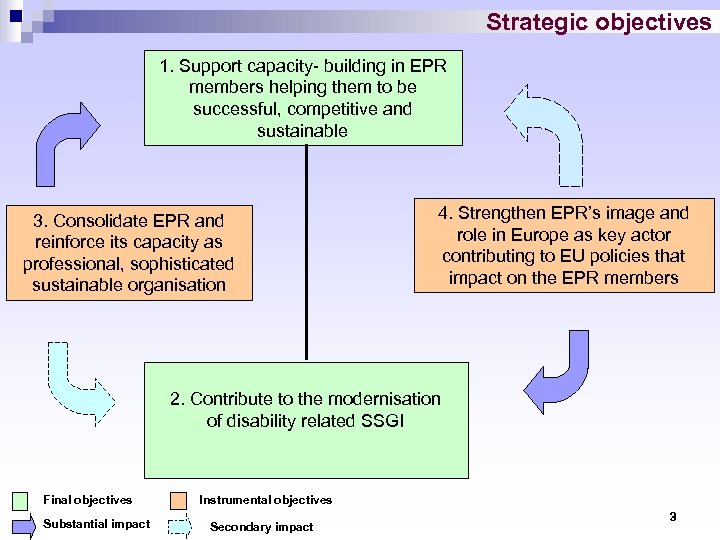 Strategic objectives 1. Support capacity- building in EPR members helping them to be successful, competitive and sustainable 3. Consolidate EPR and reinforce its capacity as professional, sophisticated sustainable organisation 4. Strengthen EPR’s image and role in Europe as key actor contributing to EU policies that impact on the EPR members 2. Contribute to the modernisation of disability related SSGI Final objectives Substantial impact Instrumental objectives Secondary impact 3
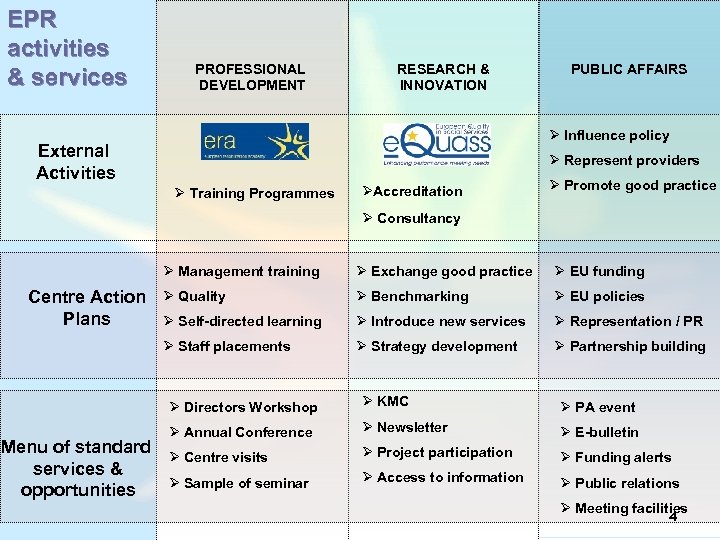 EPR activities & services PROFESSIONAL DEVELOPMENT RESEARCH & INNOVATION PUBLIC AFFAIRS Ø Influence policy External Activities Ø Represent providers Ø Training Programmes ØAccreditation Ø Promote good practice Ø Consultancy Ø Management training Centre Action Ø Quality Plans Ø Self-directed learning Ø Staff placements Ø Exchange good practice Ø EU funding Ø Benchmarking Ø EU policies Ø Introduce new services Ø Representation / PR Ø Strategy development Ø Partnership building Ø Directors Workshop Menu of standard services & opportunities Ø KMC Ø PA event Ø Annual Conference Ø Newsletter Ø E-bulletin Ø Centre visits Ø Project participation Ø Funding alerts Ø Sample of seminar Ø Access to information Ø Public relations Ø Meeting facilities 4
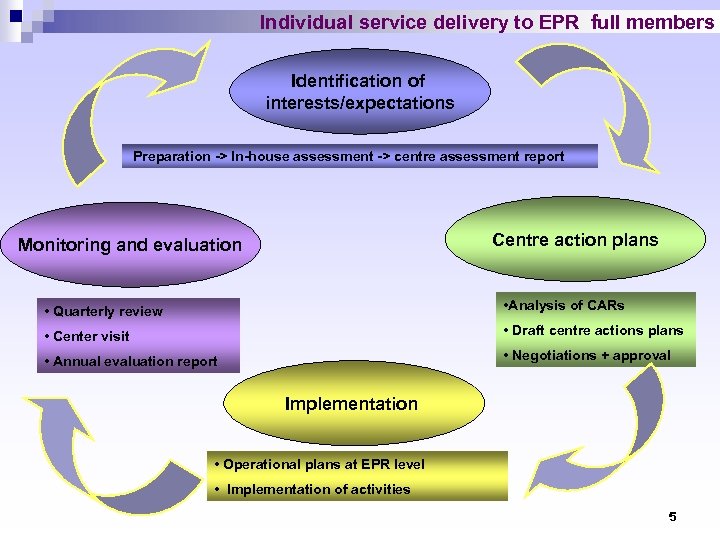 Individual service delivery to EPR full members Identification of interests/expectations Preparation -> In-house assessment -> centre assessment report Centre action plans Monitoring and evaluation • Quarterly review • Analysis of CARs • Center visit • Draft centre actions plans • Annual evaluation report • Negotiations + approval Implementation • Operational plans at EPR level • Implementation of activities 5
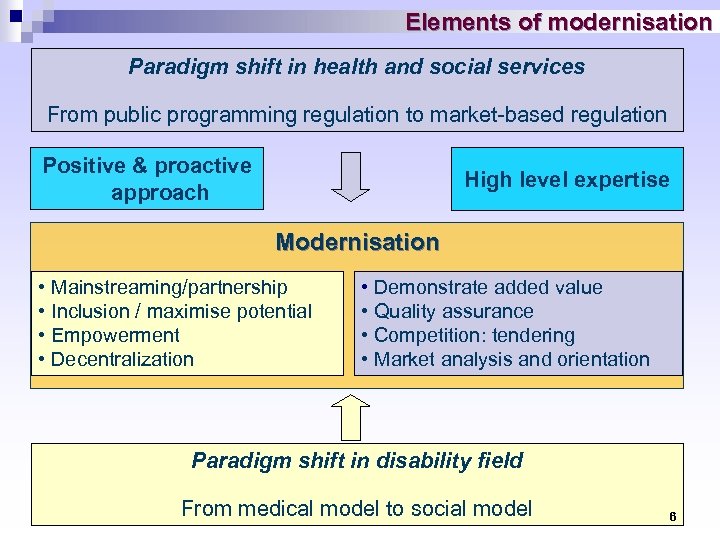 Elements of modernisation Paradigm shift in health and social services From public programming regulation to market-based regulation Positive & proactive approach High level expertise Modernisation • Mainstreaming/partnership • Inclusion / maximise potential • Empowerment • Decentralization • Demonstrate added value • Quality assurance • Competition: tendering • Market analysis and orientation Paradigm shift in disability field From medical model to social model 6
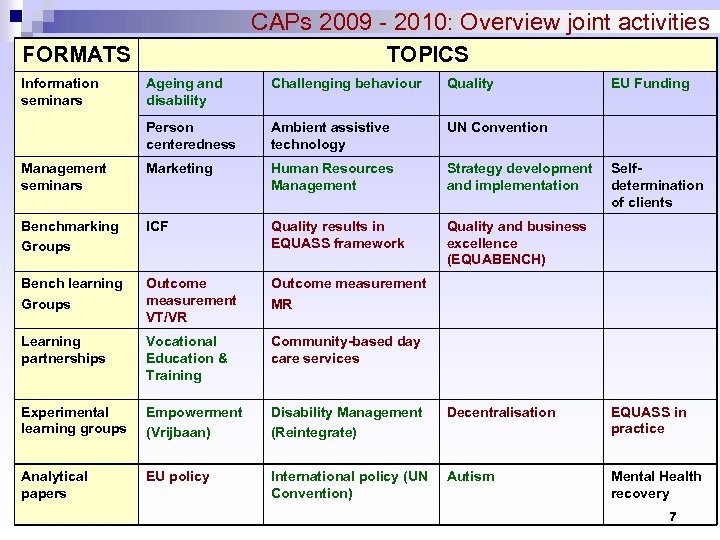 CAPs 2009 - 2010: Overview joint activities FORMATS Information seminars TOPICS Ageing and disability Challenging behaviour Quality EU Funding Person centeredness Ambient assistive technology UN Convention Management seminars Marketing Human Resources Management Strategy development and implementation Benchmarking Groups ICF Quality results in EQUASS framework Quality and business excellence (EQUABENCH) Bench learning Groups Outcome measurement VT/VR Outcome measurement MR Learning partnerships Vocational Education & Training Community-based day care services Experimental learning groups Empowerment (Vrijbaan) Disability Management (Reintegrate) Decentralisation EQUASS in practice Analytical papers EU policy International policy (UN Convention) Autism Mental Health recovery Selfdetermination of clients 7
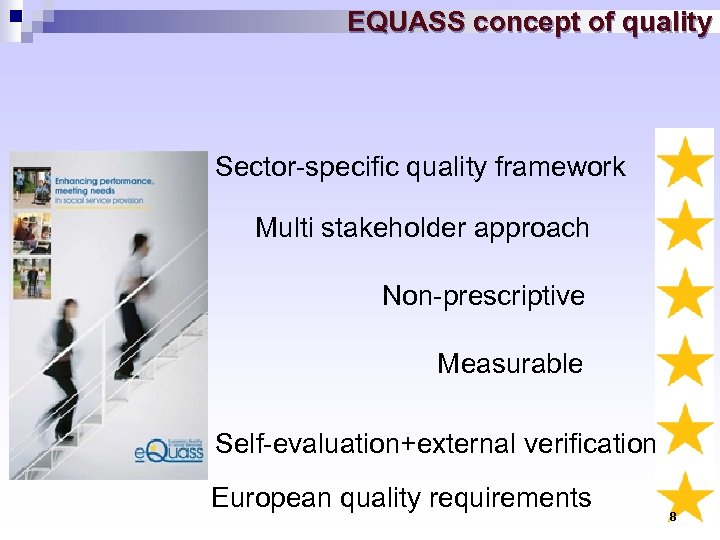 EQUASS concept of quality Sector-specific quality framework Multi stakeholder approach Non-prescriptive Measurable Self-evaluation+external verification European quality requirements 8
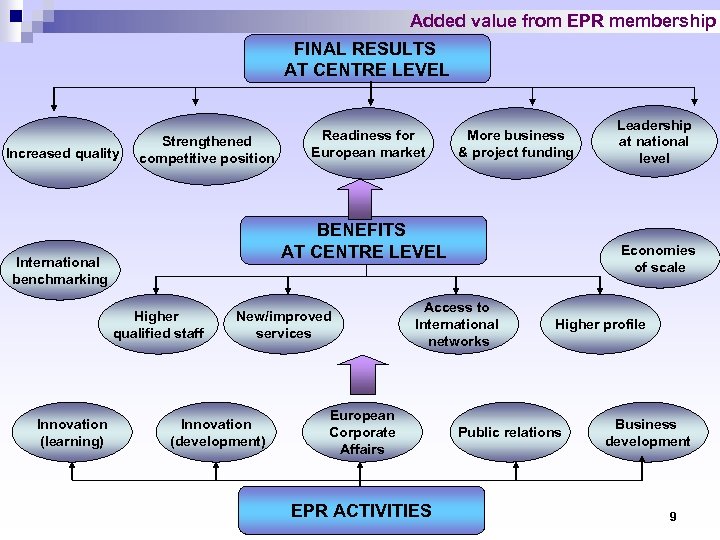 Added value from EPR membership FINAL RESULTS AT CENTRE LEVEL Increased quality Strengthened competitive position More business & project funding BENEFITS AT CENTRE LEVEL International benchmarking Higher qualified staff Innovation (learning) Readiness for European market New/improved services Innovation (development) Economies of scale Access to International networks European Corporate Affairs EPR ACTIVITIES Leadership at national level Higher profile Public relations Business development 9
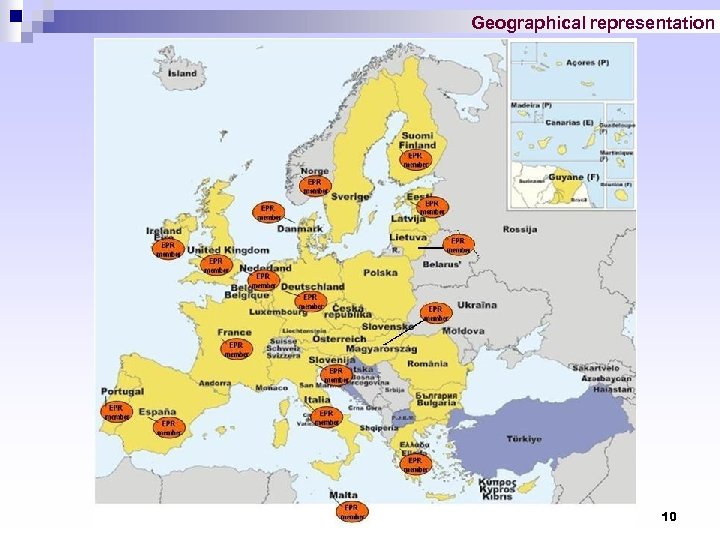 Geographical representation 10
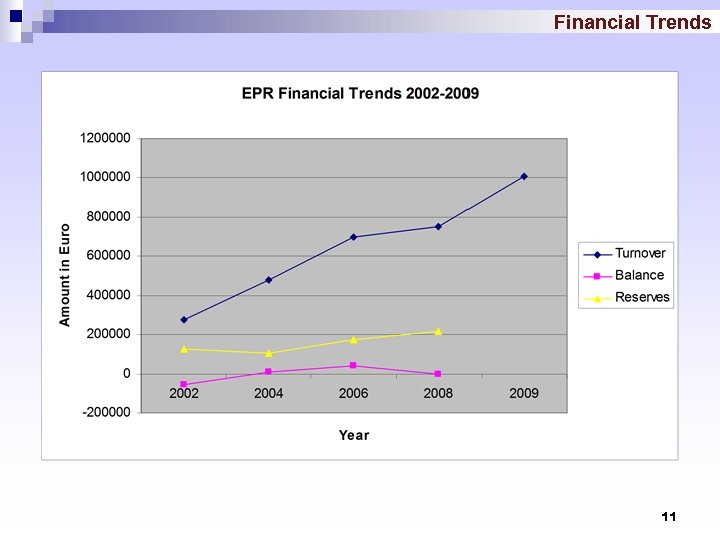 Financial Trends 11
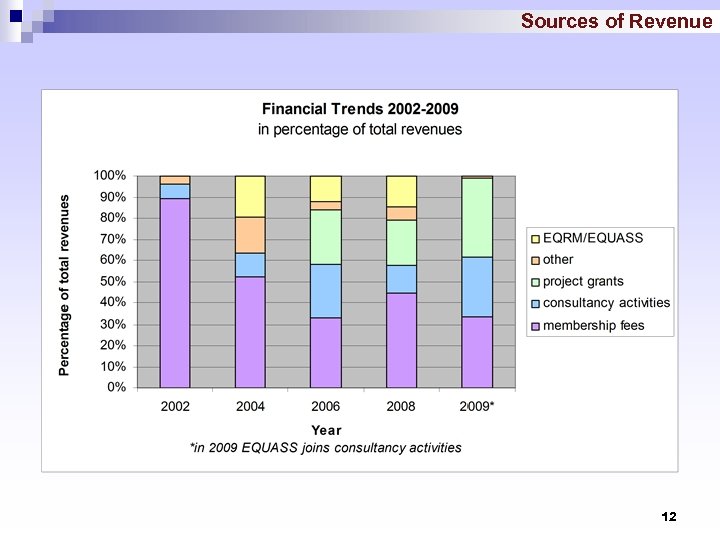 Sources of Revenue 12
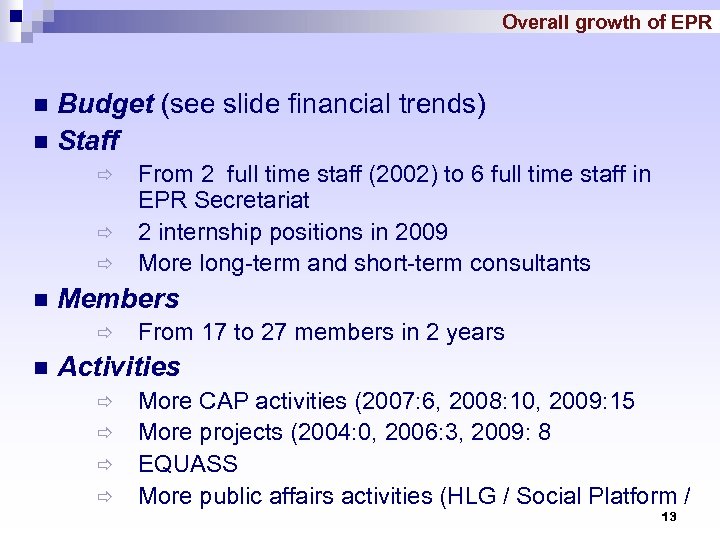 Overall growth of EPR Budget (see slide financial trends) n Staff n ð ð ð n Members ð n From 2 full time staff (2002) to 6 full time staff in EPR Secretariat 2 internship positions in 2009 More long-term and short-term consultants From 17 to 27 members in 2 years Activities ð ð More CAP activities (2007: 6, 2008: 10, 2009: 15 More projects (2004: 0, 2006: 3, 2009: 8 EQUASS More public affairs activities (HLG / Social Platform / 13
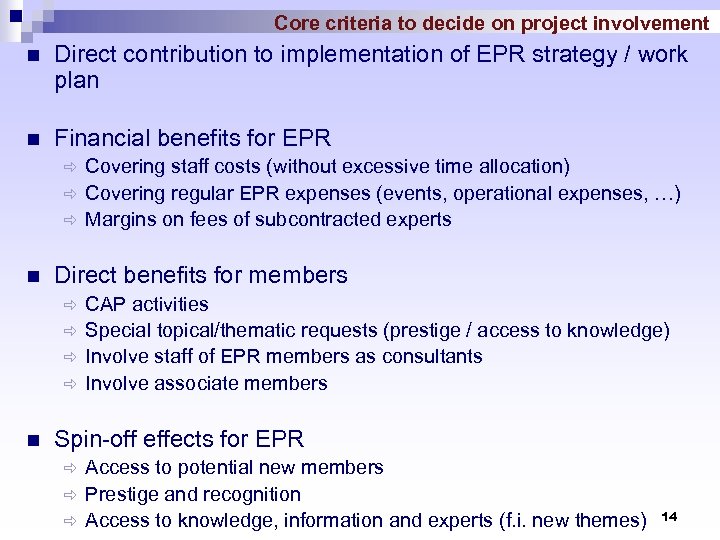 Core criteria to decide on project involvement n Direct contribution to implementation of EPR strategy / work plan n Financial benefits for EPR Covering staff costs (without excessive time allocation) ð Covering regular EPR expenses (events, operational expenses, …) ð Margins on fees of subcontracted experts ð n Direct benefits for members CAP activities ð Special topical/thematic requests (prestige / access to knowledge) ð Involve staff of EPR members as consultants ð Involve associate members ð n Spin-off effects for EPR Access to potential new members ð Prestige and recognition ð Access to knowledge, information and experts (f. i. new themes) ð 14
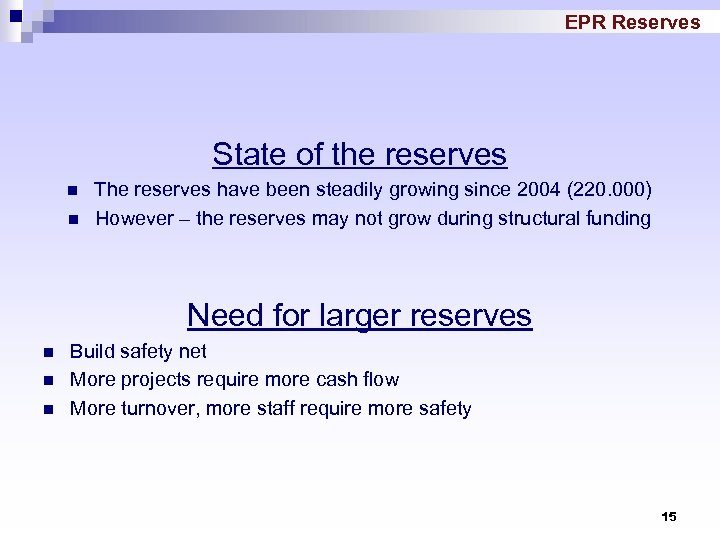 EPR Reserves State of the reserves n n The reserves have been steadily growing since 2004 (220. 000) However – the reserves may not grow during structural funding Need for larger reserves n n n Build safety net More projects require more cash flow More turnover, more staff require more safety 15
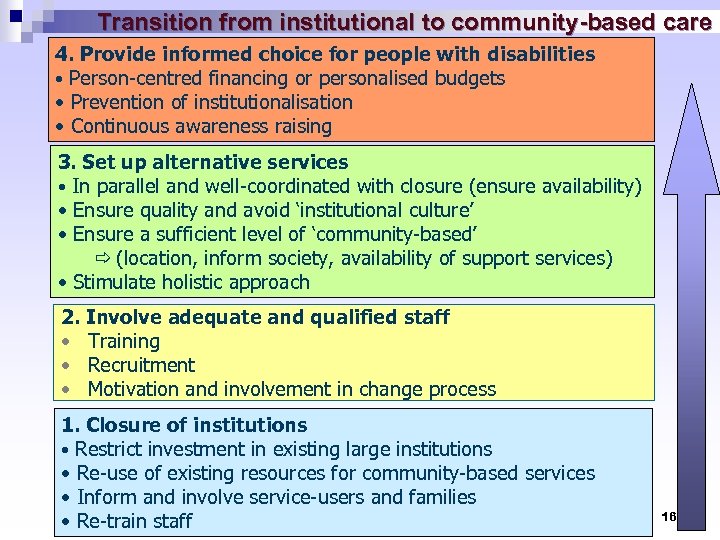 Transition from institutional to community-based care 4. Provide informed choice for people with disabilities • Person-centred financing or personalised budgets • Prevention of institutionalisation • Continuous awareness raising 3. Set up alternative services • In parallel and well-coordinated with closure (ensure availability) • Ensure quality and avoid ‘institutional culture’ • Ensure a sufficient level of ‘community-based’ ð (location, inform society, availability of support services) • Stimulate holistic approach 2. Involve adequate and qualified staff • Training • Recruitment • Motivation and involvement in change process 1. Closure of institutions • Restrict investment in existing large institutions • Re-use of existing resources for community-based services • Inform and involve service-users and families • Re-train staff 16
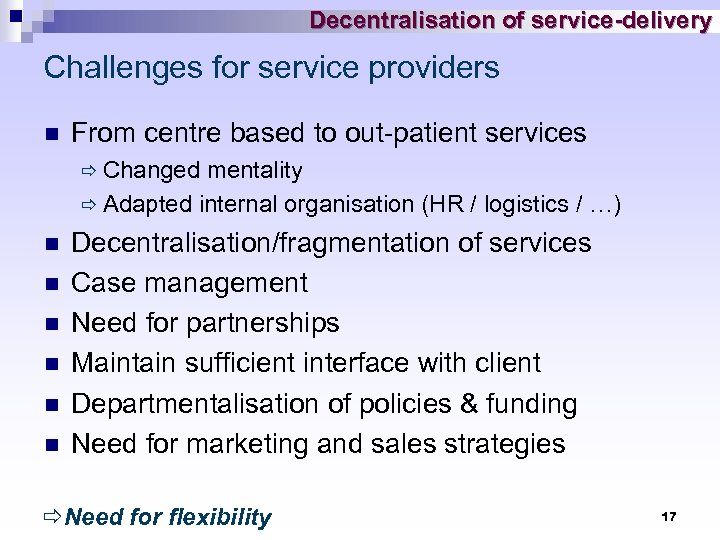 Decentralisation of service-delivery Challenges for service providers n From centre based to out-patient services ð Changed mentality ð Adapted internal organisation (HR / logistics / …) n n n Decentralisation/fragmentation of services Case management Need for partnerships Maintain sufficient interface with client Departmentalisation of policies & funding Need for marketing and sales strategies ðNeed for flexibility 17
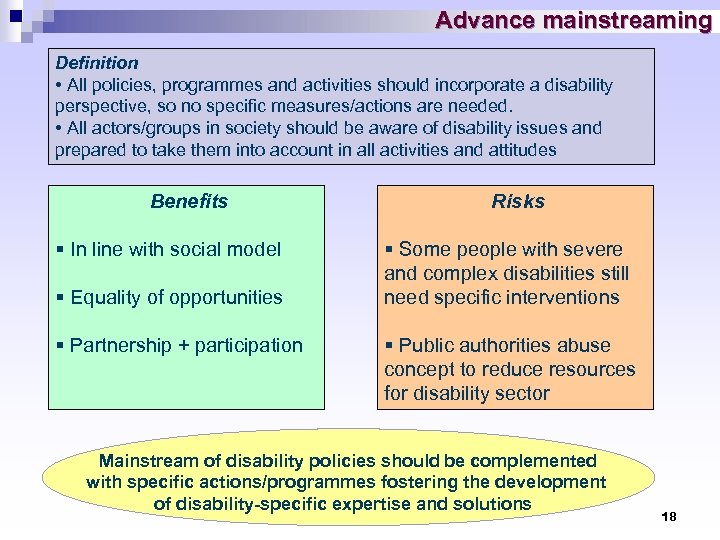 Advance mainstreaming Definition • All policies, programmes and activities should incorporate a disability perspective, so no specific measures/actions are needed. • All actors/groups in society should be aware of disability issues and prepared to take them into account in all activities and attitudes Benefits § In line with social model § Equality of opportunities § Partnership + participation Risks § Some people with severe and complex disabilities still need specific interventions § Public authorities abuse concept to reduce resources for disability sector Mainstream of disability policies should be complemented with specific actions/programmes fostering the development of disability-specific expertise and solutions 18