


 Скачать презентацию The Network Layer Introduction functionality and service models
89da908177c51d1a387208bf58d4a3b8.ppt
- Количество слайдов: 14
 The Network Layer Introduction. functionality and service models Theory. link state and distance vector algorithms. broadcast algorithms. hierarchical routing Case Study: IP. services. packet formats, addressing. routing protocols: RIP, OSPF, BGP. ICMP. IPV 6
 The Network Layer (cont) Case Study: ATM. services. cell formats. VP's and VC's Routers and Switches how they work Readings. textbook: sections 5. 1, 5. 2, 5. 4 -5. 7

 Network Layer: Introduction Network layer: a network-wide concern. transport layer: between two hosts. data link layer: between two physically connected hosts, routers. network layer: involves each and every router, host, gateway in the network
 Network Layer Service: Virtual Circuit Virtual: looks like a circuit but isn't. generally associated with connection-oriented service. all packets within connection follow same route
 At connection establishment time: . connection setup packet flows from sender to receiver. routing tables updated at intermediate nodes to reflect new VC. key issue: per-connection state at router. fits well with Qo. S guarantees: reserve resources and/or accept/reject call based on resources at this router Analogy: telephone network
 Network Layer Service: datagrams. no notion of connection in network layer. no routes set up at connection establishment time - each packet in "connection" may follow different path. no guarantee of reliable, or in-order delivery. advantages: u u u no connection state in routers robust with respect to link failures recovery at end-systems (transport level)
 Burning question: to VC or not to VC? Answer: support both, offering different service models: . best effort service: datagrams. service with performance guarantees: QOS
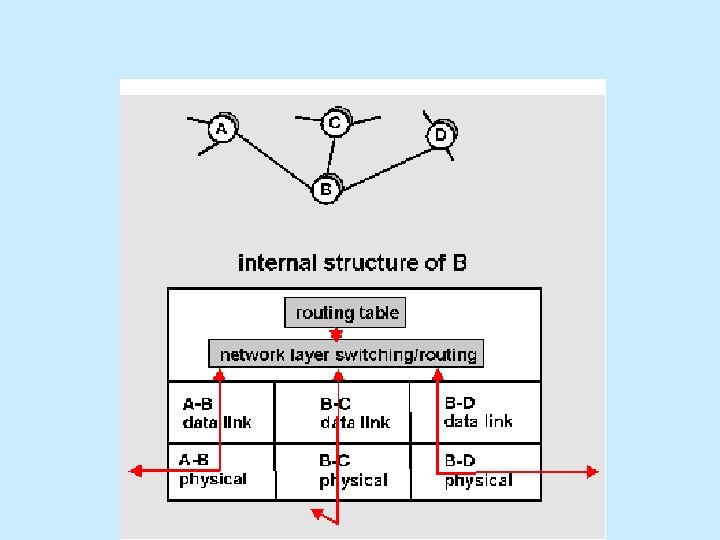
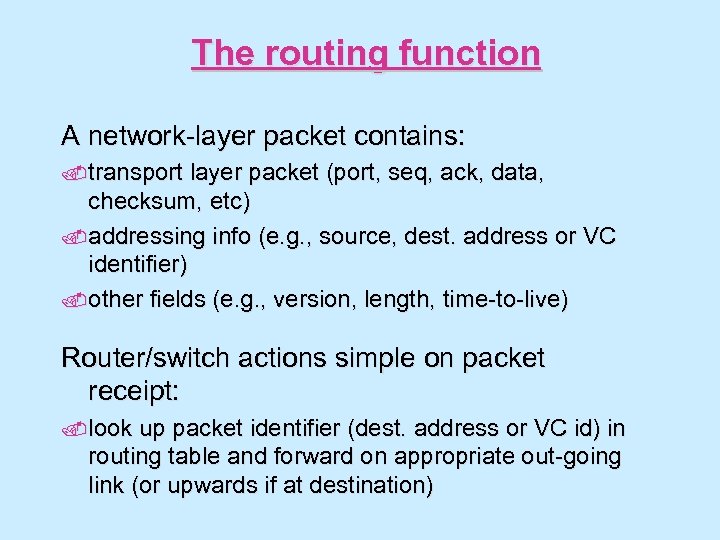 The routing function A network-layer packet contains: . transport layer packet (port, seq, ack, data, checksum, etc). addressing info (e. g. , source, dest. address or VC identifier). other fields (e. g. , version, length, time-to-live) Router/switch actions simple on packet receipt: . look up packet identifier (dest. address or VC id) in routing table and forward on appropriate out-going link (or upwards if at destination)
 Routing Table: issues Key question: how are routing tables determined/updated? . who determines table entries? . what info used in determining table entries? . when do routing table entries change? . where is routing info stored? . how to control table size? . why are routing tables determined a particular way. What is theoretical basis? Answer these and we are done!
 Routing issues: . scalability: must be able to support large numbers of hosts, routers, networks. adapt to changes in topology or significant changes in traffic, quickly and efficiently u self-healing: little or not human intervention . route selection may depend on different criteria. performance: "choose route with smallest delay". policy: "choose a route that doesn't cross a government network" (equivalently: "let no non-government traffic cross this network")
 Classification of Routing Algorithms Centralized versus decentralized: central site computes and distributed routes (equivalently: information for computing routes known globally, each router makes same computation). decentralized: each router sees only local information (itself and physically-connected neighbors) and computes routes on this basis. pros and cons?
 Classification (cont) Static versus adaptive. static: routing tables change very slowly, often in response to human intervention. dynamic: routing tables change as network traffic or topology change. pros and cons? Two basic approaches adopted in practice: . link-state routing: centralized, dynamic (periodically run). distance vector: distributed, dynamic (in direct response to changes)