


 Скачать презентацию THE NEEDHAM PUZZLE WHY THE INDUSTRIAL REVOLUTION DID
The Needham Puzzle.pptx
- Количество слайдов: 10
 “THE NEEDHAM PUZZLE: WHY THE INDUSTRIAL REVOLUTION DID NOT ORIGINATE IN CHINA” JUSTIN YIFU LIN Prepared by: Kartoshkin Vladimir Dronova Natalia Moscow, 2014
 Plan 1. The Needham Puzzle. 2. Possible explanations: 1. Failure of the demand for technology 2. Failure of the supply for technology: 1. Model of technological invention 2. Why the scientific revolution didn’t occur in China? 3. Results of the analysis
 What is the problem? Agriculture ½ XI c. Technology By IX c. Industry Dryland crops => wetland rice 3 crops/year => Highest yields in the world Improved plow, share plow, deep-tooth harrow Gunpowder, magnetic compass, paper, printing By XIII c. Water-powered reeling machine for spinning thread Iron production 1. Why had China been so far ahead of other civilizations before the XIV century? 2. Why isn’t China now ahead of the rest of the world?
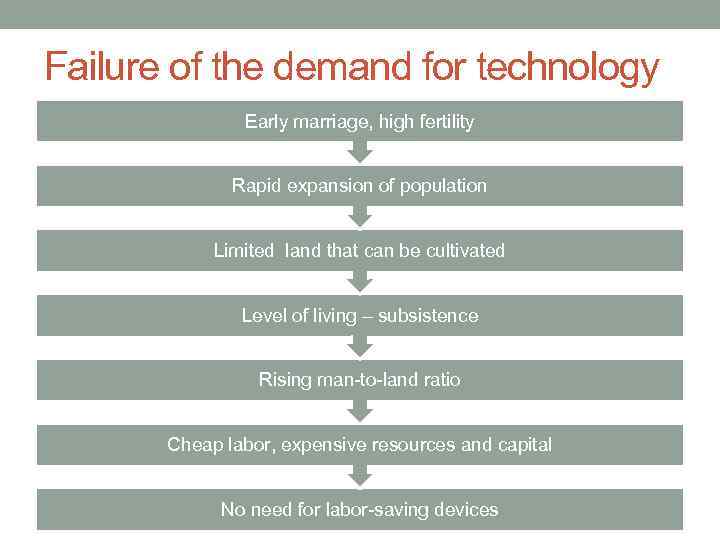 Failure of the demand for technology Early marriage, high fertility Rapid expansion of population Limited land that can be cultivated Level of living – subsistence Rising man-to-land ratio Cheap labor, expensive resources and capital No need for labor-saving devices
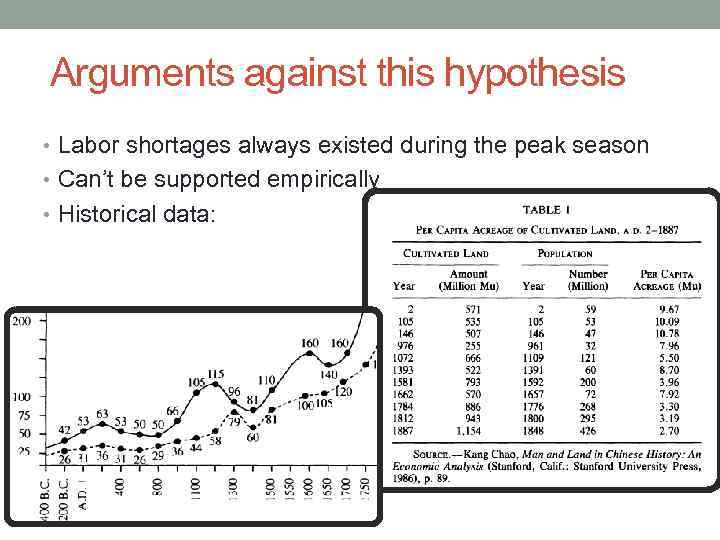 Arguments against this hypothesis • Labor shortages always existed during the peak season • Can’t be supported empirically • Historical data:
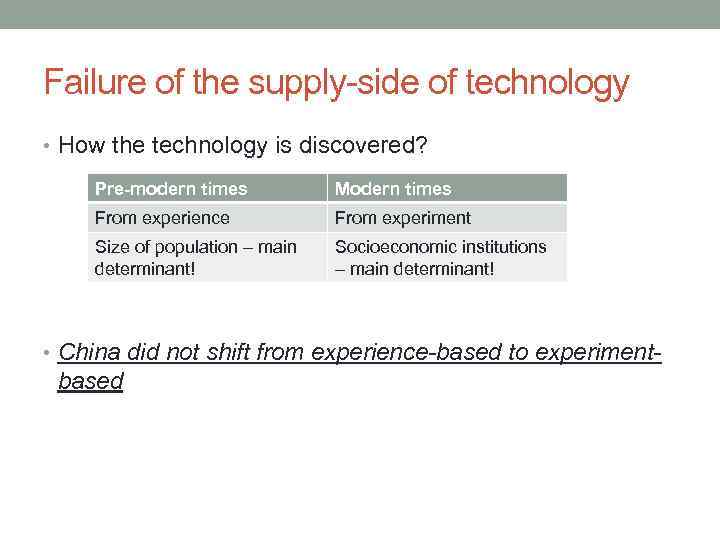 Failure of the supply-side of technology • How the technology is discovered? Pre-modern times Modern times From experience From experiment Size of population – main determinant! Socioeconomic institutions – main determinant! • China did not shift from experience-based to experiment- based
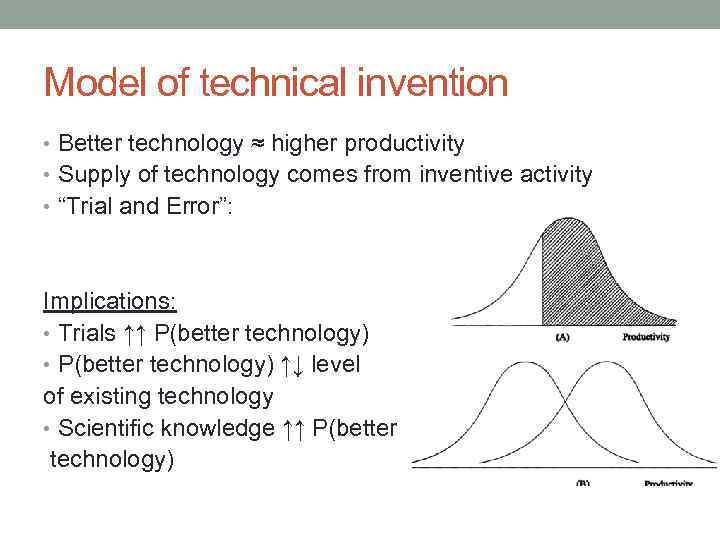 Model of technical invention • Better technology ≈ higher productivity • Supply of technology comes from inventive activity • “Trial and Error”: Implications: • Trials ↑↑ P(better technology) • P(better technology) ↑↓ level of existing technology • Scientific knowledge ↑↑ P(better technology)
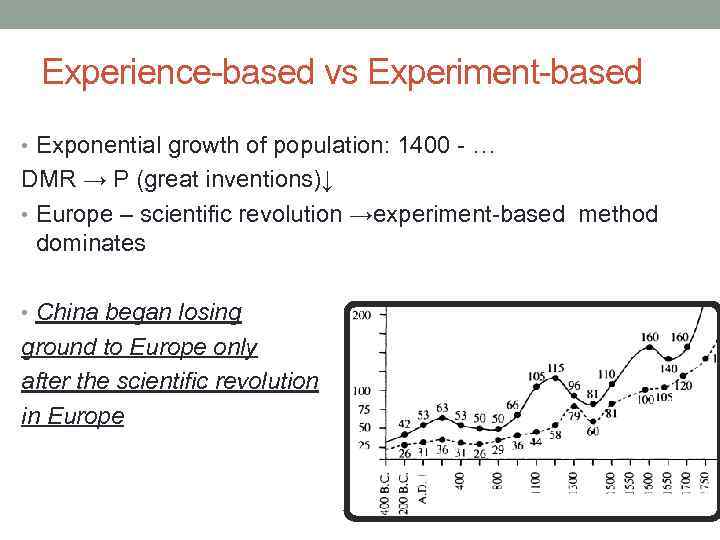 Experience-based vs Experiment-based • Exponential growth of population: 1400 - … DMR → P (great inventions)↓ • Europe – scientific revolution →experiment-based method dominates • China began losing ground to Europe only after the scientific revolution in Europe
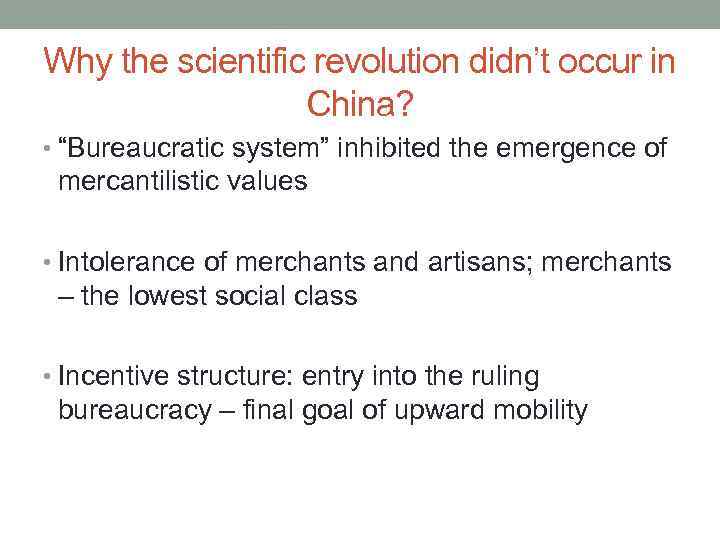 Why the scientific revolution didn’t occur in China? • “Bureaucratic system” inhibited the emergence of mercantilistic values • Intolerance of merchants and artisans; merchants – the lowest social class • Incentive structure: entry into the ruling bureaucracy – final goal of upward mobility
 Field for further study • Are the probabilities of discovering new technology really were that different among countries, or is there some other unknown supply-side factor that contributed to the “China’s Puzzle”? • How traditions and customs could have influenced the braking of development? • Was the socioeconomic structure of China’s pre-modern society really as unimportant as it was claimed to be?