


 Скачать презентацию The Need for an 802 11 Wireless Toolkit
34adeb601af8e39b478220fc74d94a44.ppt
- Количество слайдов: 61
 The Need for an 802. 11 Wireless Toolkit Invictus Ferramenta Mike Schiffman Black. Hat Briefings July 2002
 © 2002 Agenda 1. Introduction and Overview 2. Protocol Primer 3. Protocol Flaws 4. Existing Tools 5. Gap Analysis 6. Radiate 7. Theory into Practice 8. Closing Comments and Questions @STAKE, INC.
 © 2002 Mike Schiffman • mike@stake. com • Senior Consultant with @stake • The Premier provider of Digital Security Services • Centers Of Excellence • Technical Advisory Board for Qualys • R&D background • Firewalk, Libnet, Libsf, Libradiate • Books: • Building Open Source Network Security Tools, Wiley & Sons • Hacker’s Challenge I, Osborne Mc. Graw-Hill • Hacker’s Challenge II, Osborne Mc. Graw-Hill @STAKE, INC.
 © 2002 Overview • What you will learn • Weaknesses in the 802. 11 protocol • The nature of asynchronous flaws • How to use libradiate to build custom 802. 11 security tools • What you should know • General understanding of the TCP/IP protocol suite • Primarily layers 2 - 3 • General understanding of 802. 11 • General network security concepts • The C programming language @STAKE, INC.
 © 2002 @STAKE, Nomenclature • Network Security Tool or Tool • A network security tool is an algorithmic implement that is designed to probe, assess, or increase the overall safety of or mitigate risk associated with an entity across a communications medium. • Toolkit • An API, or set of APIs used to build Network Security Tools • A C programming library • “Component” INC.
 © 2002 @STAKE, 802. 11 is Fantastic • 802. 11 -based networks are incredibly useful • Many new products and services on top of them • Newer, faster physical interfaces being turned out on top of the same layer 2 • There a “few” security concerns… • And yes, we need a way to be able to test for these issues • Some tools do exist • But what we really need is a way to be able to test for arbitrary security issues with arbitrary tools • We need a generic 802. 11 toolkit INC.
 © 2002 802. 11 Primer • Borne out of the IEEE 802 LMSC • 802. 11 WLAN standard • PHY layer: 802. 11 b 2. 4 Ghz @ 11 Mbps • PHY layer: 802. 11 a 5 Ghz @ 54 Mbps • Drop in replacement for Ethernet • Upper layer protocols should be none the wiser • This seamless integration comes at a stiff price – under the hood complexity @STAKE, INC.
 © 2002 802. 11 Primer: Physical Interface • DSSS • Direct Sequence Spread Spectrum • 2. 4 GHz ISM Band • Industrial / Instrumentation, Scientific, Medical • 2. 400 GHz – 2. 4835 GHz • 14 channels or frequency divisions • 1 – 11 used in the United States • 1000 m. W power maximum • Most devices are 30 m. W – 100 m. W @STAKE, INC.
 © 2002 802. 11 Primer: MAC Sublayer Tidbits • CSMA/CA • LBT (Listen Before Talk) • Exponential back off and retry • Collision avoidance via physical carrier sense and NAV • Network Allocation Vector • Virtual Carrier Sense @STAKE, INC.
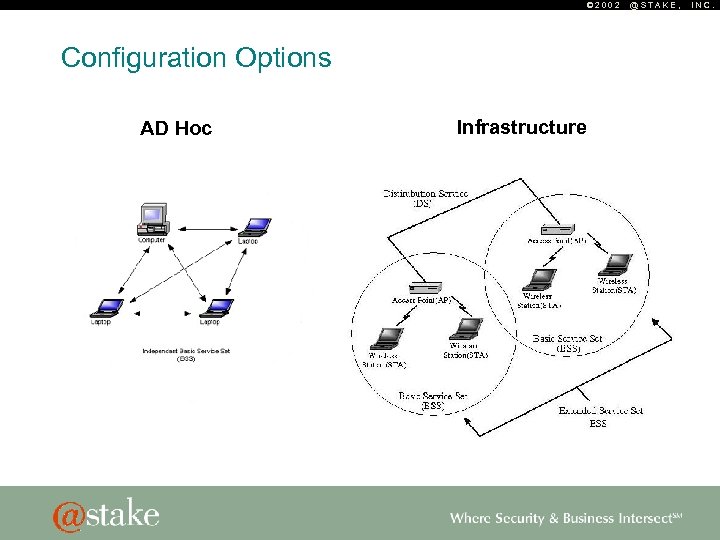 © 2002 Configuration Options AD Hoc Infrastructure @STAKE, INC.
 © 2002 Management Frame Subtypes • Beacon • Transmitted frequently announcing availability and capabilities of BSS • Probe Request and Response • Client initiated request for a WLAN • Response is essentially the same as a beacon • Associate Request and Response • “I’d like to be a part of your BSS” • Disassociate • Tell your story walking! @STAKE, INC.
 © 2002 Control Frame Subtypes • RTS • “I’d like to send a frame or two” • Updates NAV values for neighboring stations (transmitter) • CTS • “Sounds good” • Updates NAV values for neighboring stations (receiver) • ACK • “Got your data” • Also updates NAV as per CTS @STAKE, INC.
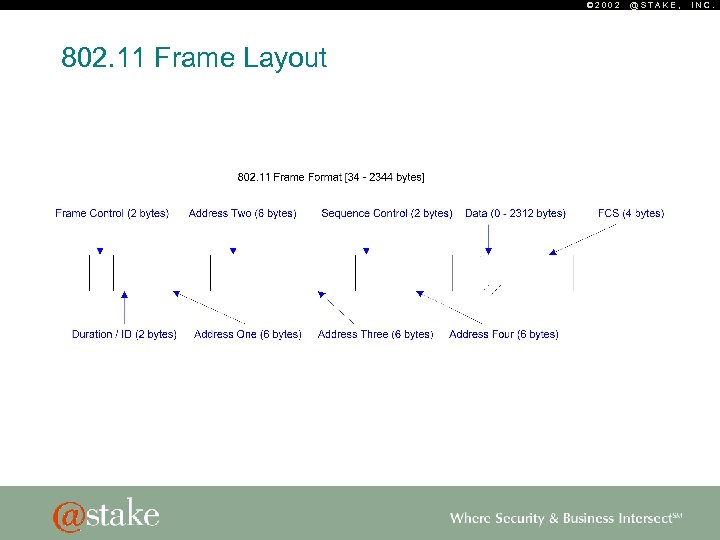 © 2002 802. 11 Frame Layout @STAKE, INC.
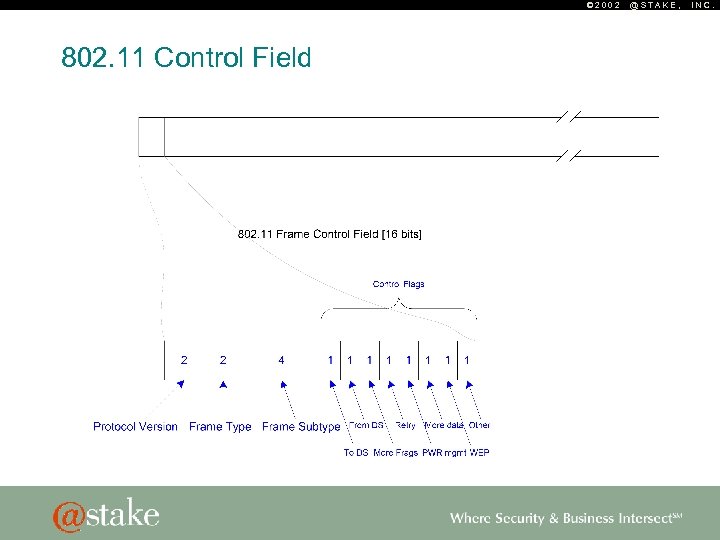 © 2002 802. 11 Control Field @STAKE, INC.
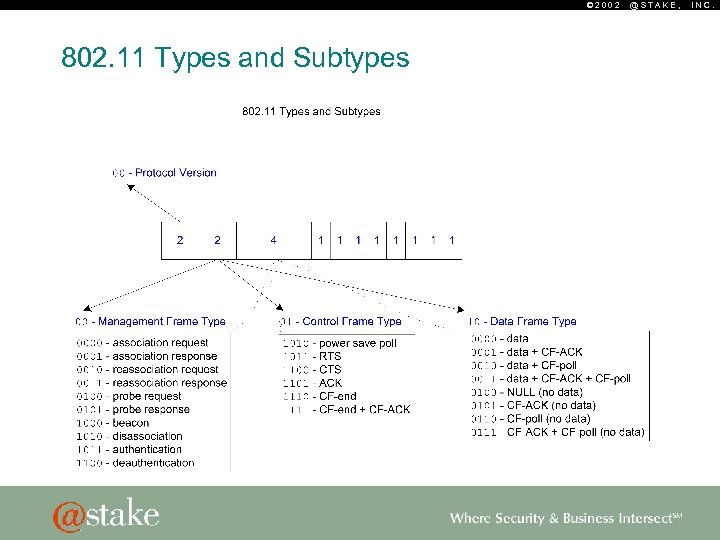 © 2002 802. 11 Types and Subtypes @STAKE, INC.
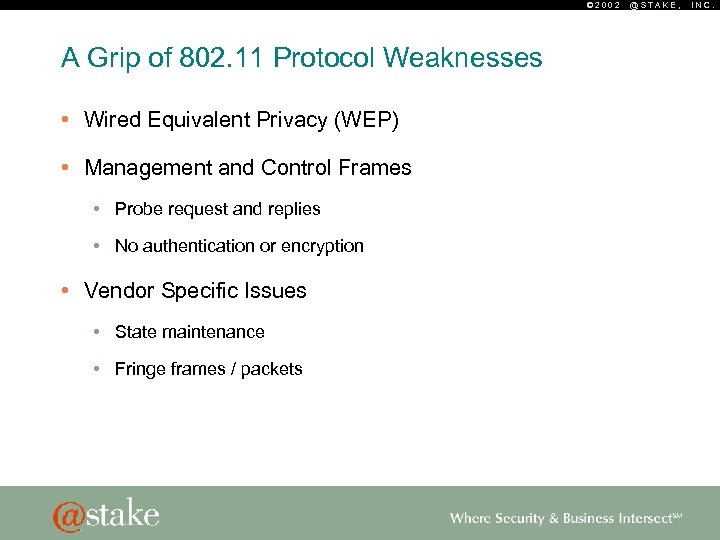 © 2002 A Grip of 802. 11 Protocol Weaknesses • Wired Equivalent Privacy (WEP) • Management and Control Frames • Probe request and replies • No authentication or encryption • Vendor Specific Issues • State maintenance • Fringe frames / packets @STAKE, INC.
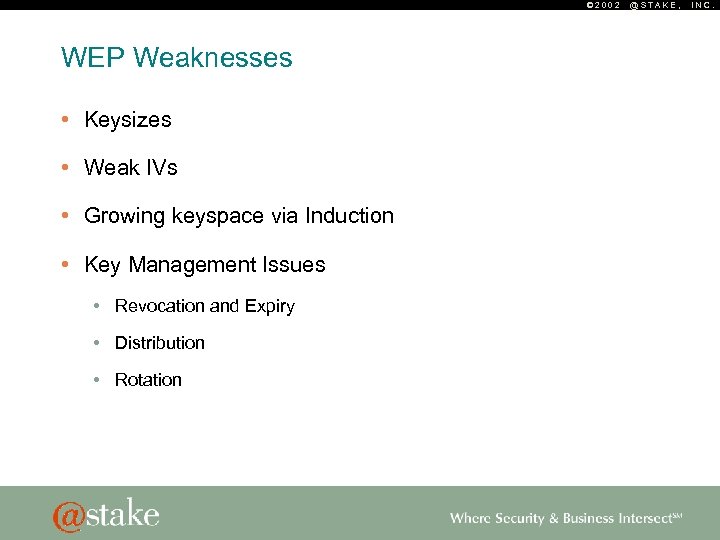 © 2002 WEP Weaknesses • Keysizes • Weak IVs • Growing keyspace via Induction • Key Management Issues • Revocation and Expiry • Distribution • Rotation @STAKE, INC.
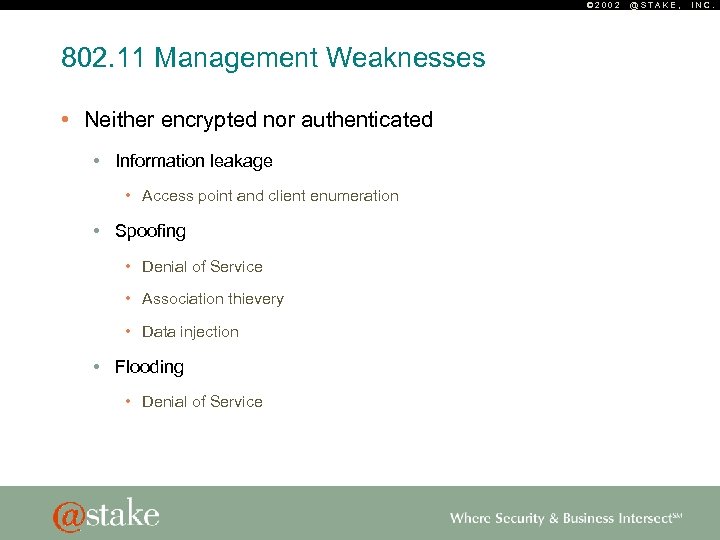 © 2002 802. 11 Management Weaknesses • Neither encrypted nor authenticated • Information leakage • Access point and client enumeration • Spoofing • Denial of Service • Association thievery • Data injection • Flooding • Denial of Service @STAKE, INC.
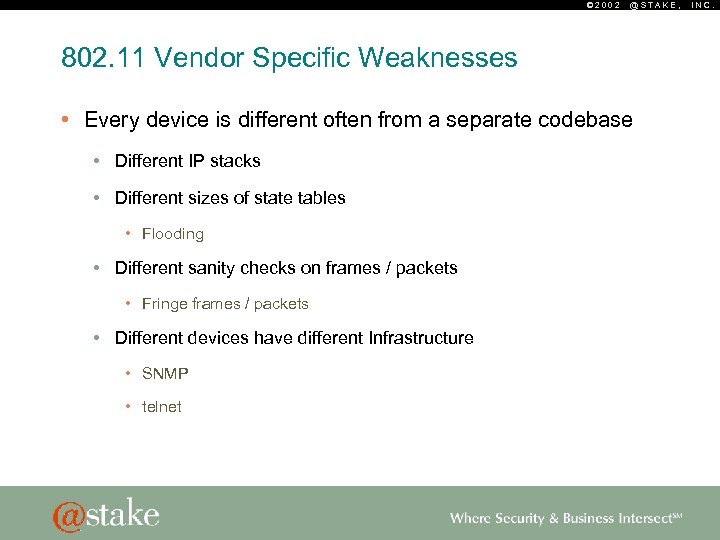 © 2002 @STAKE, 802. 11 Vendor Specific Weaknesses • Every device is different often from a separate codebase • Different IP stacks • Different sizes of state tables • Flooding • Different sanity checks on frames / packets • Fringe frames / packets • Different devices have different Infrastructure • SNMP • telnet INC.
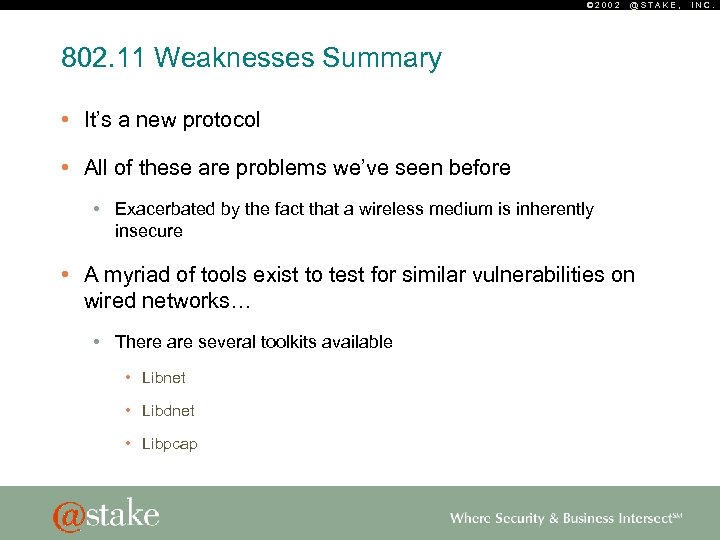 © 2002 @STAKE, 802. 11 Weaknesses Summary • It’s a new protocol • All of these are problems we’ve seen before • Exacerbated by the fact that a wireless medium is inherently insecure • A myriad of tools exist to test for similar vulnerabilities on wired networks… • There are several toolkits available • Libnet • Libdnet • Libpcap INC.
 © 2002 Existing 802. 11 Network Security Tools • Airo. Peek / Airo. Peek NX • Wireless frame sniffer / analyzer • Air. Traf • Wireless sniffer / analyzer / “IDS” • Air. Snort • WEP key “cracker” • Net. Stumbler • Access point enumeration tool @STAKE, INC.
 © 2002 @STAKE, Where Existing Tools Come Up Lacking • Very task-oriented and specific • Closed-source tools are not tunable • “I’d like to use Net. Stumbler to listen for Beacons” • TOUGH LUCK DORKUS! • In order to test for unspecified security issues there needs to be a generic testing framework… INC.
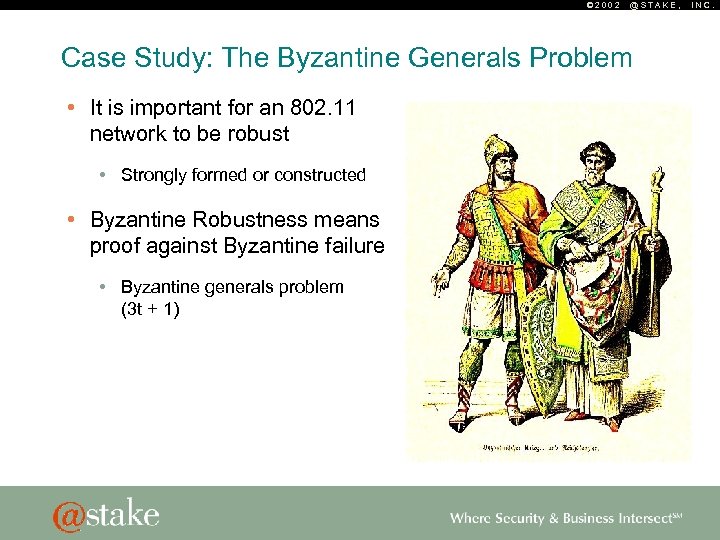 © 2002 @STAKE, Case Study: The Byzantine Generals Problem • It is important for an 802. 11 network to be robust • Strongly formed or constructed • Byzantine Robustness means proof against Byzantine failure • Byzantine generals problem (3 t + 1) INC.
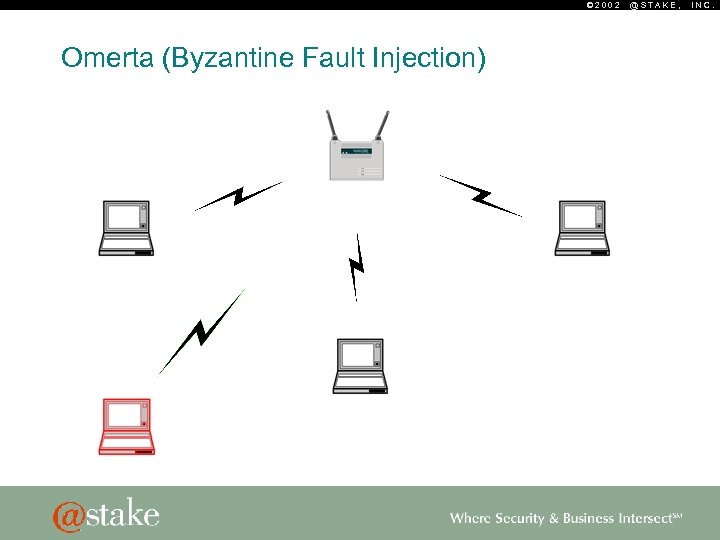 © 2002 Omerta (Byzantine Fault Injection) @STAKE, INC.
 © 2002 @STAKE, Byzantine Failure and the Need for a Toolkit • Byzantine fault injection • Omerta in practice • Theories are nice, code is better • In order to ferret out Byzantine failure vulnerabilities requires arbitrary security tools • A generic toolkit would allow an application developer to build tools to test for Byzantine failures via controlled Byzantine fault injection • One example of such a toolkit for wired networks would be our handsome friend Libnet… INC.
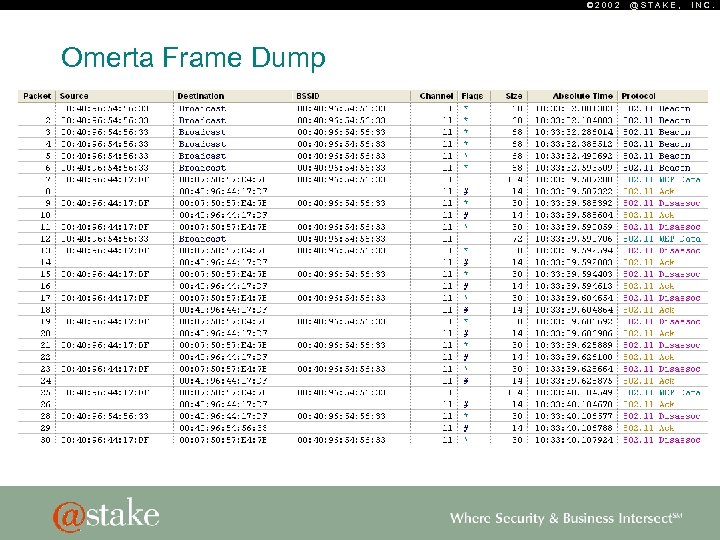 © 2002 Omerta Frame Dump @STAKE, INC.
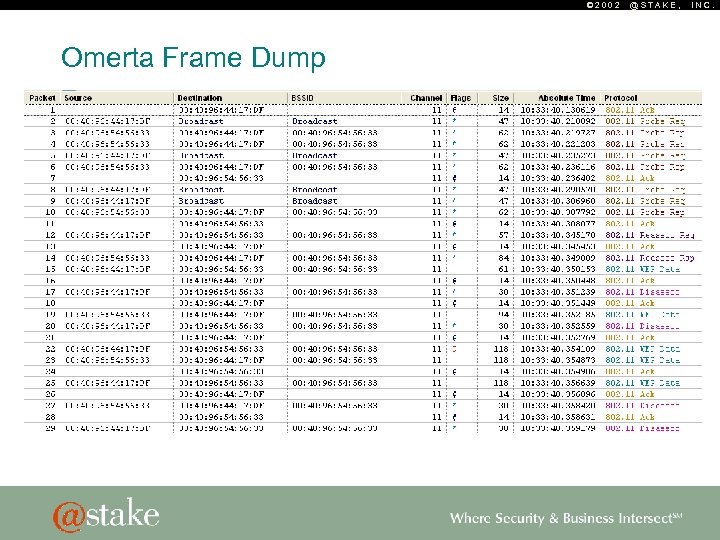 © 2002 Omerta Frame Dump @STAKE, INC.
 © 2002 @STAKE, Radiate • The 802. 11 wireless analog (addition? ) to Libnet • 802. 11 frame capturing, creation and injection library • Simple C library consisting of a few function calls and a header file • Version 0. 3 currently runs only under Intersil Prism 2 -based cards • SMC, D-link, etc • Prism-2. 5 support? INC.
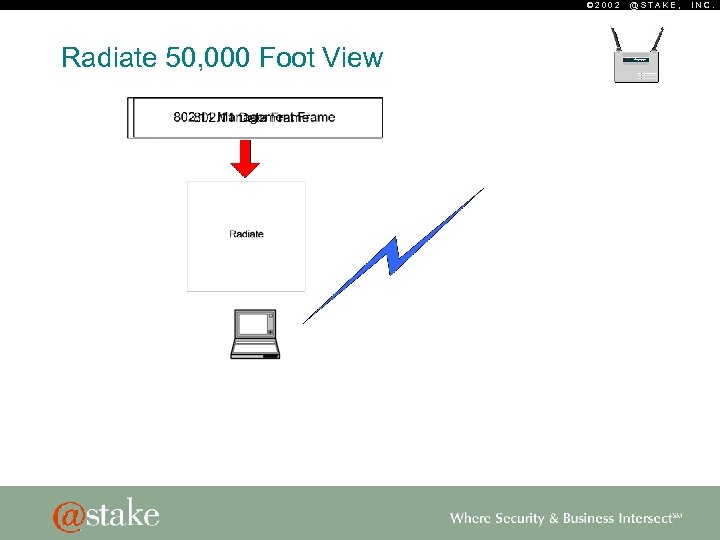 © 2002 Radiate 50, 000 Foot View @STAKE, INC.
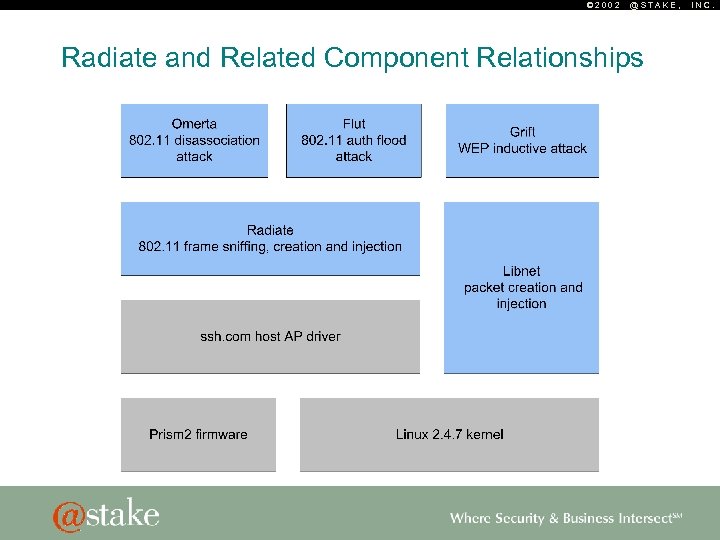 © 2002 @STAKE, Radiate and Related Component Relationships INC.
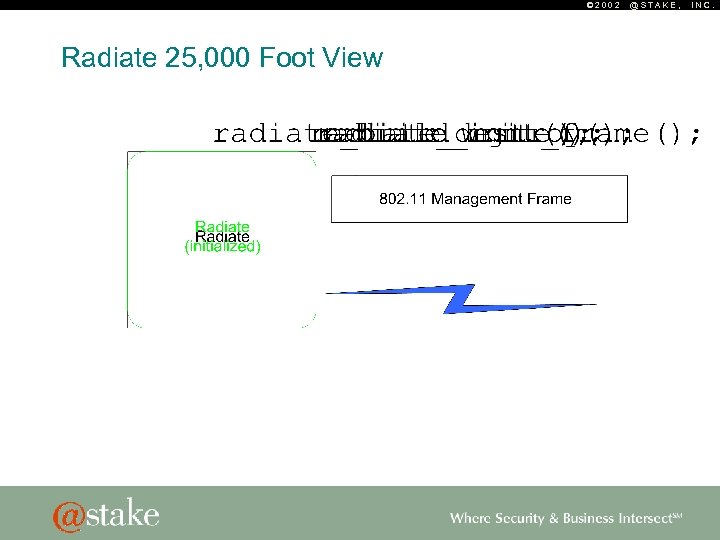 © 2002 Radiate 25, 000 Foot View @STAKE, INC.
 © 2002 Radiate Primer @STAKE, INC.
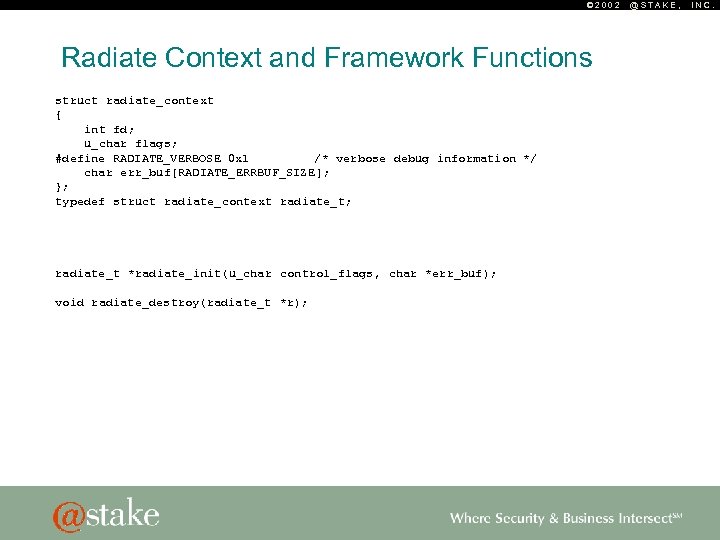 © 2002 Radiate Context and Framework Functions struct radiate_context { int fd; u_char flags; #define RADIATE_VERBOSE 0 x 1 /* verbose debug information */ char err_buf[RADIATE_ERRBUF_SIZE ]; }; typedef struct radiate_context radiate_t; radiate_t *radiate_init(u_char control_flags, char *err_buf); void radiate_destroy(radiate_t *r); @STAKE, INC.
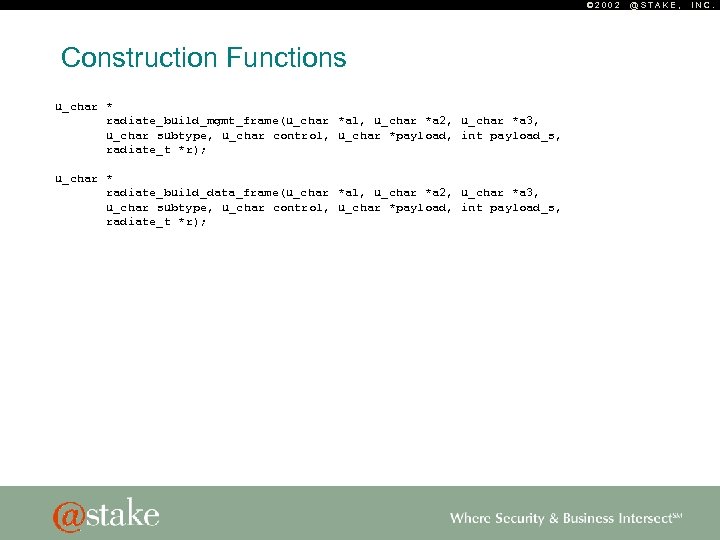 © 2002 Construction Functions u_char * radiate_build_mgmt_frame(u_char *a 1, u_char *a 2, u_char *a 3, u_char subtype, u_char control, u_char *payload, int payload_s, radiate_t *r); u_char * radiate_build_data_frame(u_char *a 1, u_char *a 2, u_char *a 3, u_char subtype, u_char control, u_char *payload, int payload_s, radiate_t *r); @STAKE, INC.
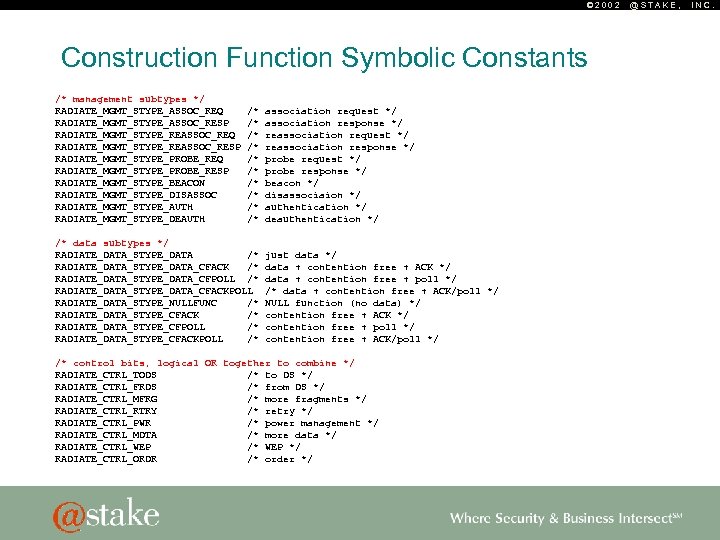 © 2002 Construction Function Symbolic Constants /* management subtypes */ RADIATE_MGMT_STYPE_ASSOC_REQ RADIATE_MGMT_STYPE_ASSOC_RESP RADIATE_MGMT_STYPE_REASSOC_REQ RADIATE_MGMT_STYPE_REASSOC_RESP RADIATE_MGMT_STYPE_PROBE_REQ RADIATE_MGMT_STYPE_PROBE_RESP RADIATE_MGMT_STYPE_BEACON RADIATE_MGMT_STYPE_DISASSOC RADIATE_MGMT_STYPE_AUTH RADIATE_MGMT_STYPE_DEAUTH /* /* /* data subtypes */ RADIATE_DATA_STYPE_DATA /* RADIATE_DATA_STYPE_DATA_CFACK /* RADIATE_DATA_STYPE_DATA_CFPOLL /* RADIATE_DATA_STYPE_DATA_CFACKPOLL RADIATE_DATA_STYPE_NULLFUNC /* RADIATE_DATA_STYPE_CFACK /* RADIATE_DATA_STYPE_CFPOLL /* RADIATE_DATA_STYPE_CFACKPOLL /* association request */ association response */ reassociation request */ reassociation response */ probe request */ probe response */ beacon */ disassociaion */ authentication */ deauthentication */ just data */ data + contention free + ACK */ data + contention free + poll */ /* data + contention free + ACK/poll */ NULL function (no data) */ contention free + ACK */ contention free + poll */ contention free + ACK/poll */ /* control bits, logical OR together to combine */ RADIATE_CTRL_TODS /* to DS */ RADIATE_CTRL_FRDS /* from DS */ RADIATE_CTRL_MFRG /* more fragments */ RADIATE_CTRL_RTRY /* retry */ RADIATE_CTRL_PWR /* power management */ RADIATE_CTRL_MDTA /* more data */ RADIATE_CTRL_WEP /* WEP */ RADIATE_CTRL_ORDR /* order */ @STAKE, INC.
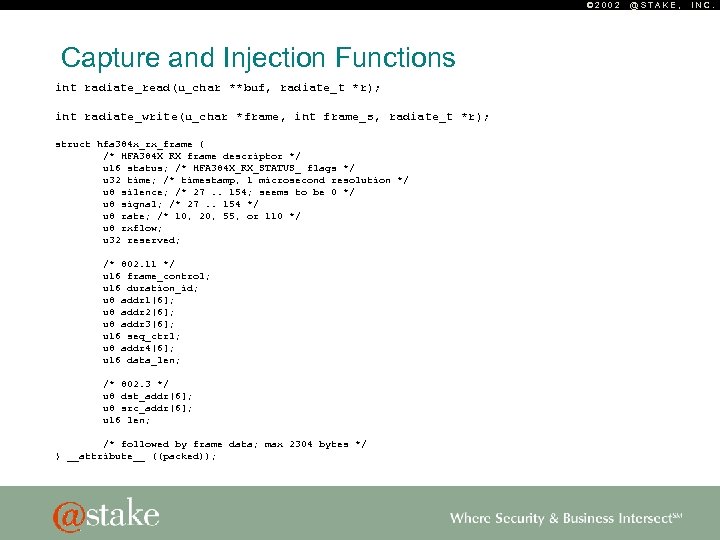 © 2002 Capture and Injection Functions int radiate_read(u_char **buf, radiate_t *r); int radiate_write(u_char *frame, int frame_s, radiate_t *r); struct hfa 384 x_rx_frame { /* HFA 384 X RX frame descriptor */ u 16 status; /* HFA 384 X_RX_STATUS_ flags */ u 32 time; /* timestamp, 1 microsecond resolution */ u 8 silence; /* 27. . 154; seems to be 0 */ u 8 signal; /* 27. . 154 */ u 8 rate; /* 10, 20, 55, or 110 */ u 8 rxflow; u 32 reserved; /* 802. 11 */ u 16 frame_control; u 16 duration_id; u 8 addr 1[6]; u 8 addr 2[6]; u 8 addr 3[6]; u 16 seq_ctrl; u 8 addr 4[6]; u 16 data_len; /* 802. 3 */ u 8 dst_addr[6]; u 8 src_addr[6]; u 16 len; /* followed by frame data; max 2304 bytes */ } __attribute__ ((packed)); @STAKE, INC.
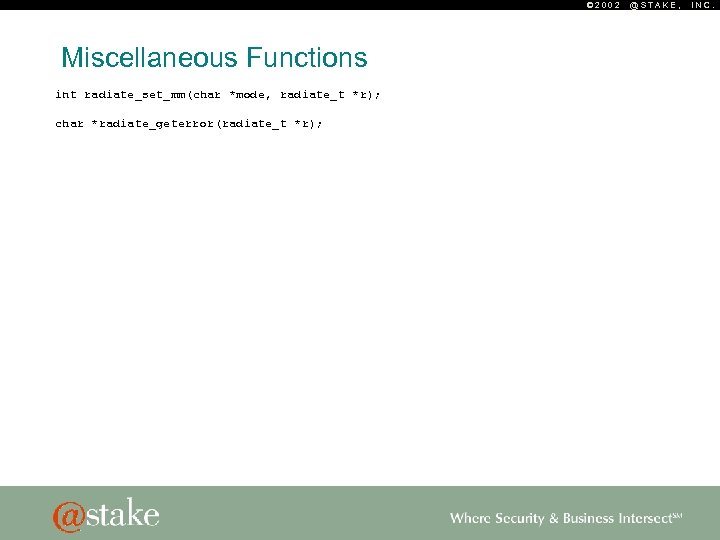 © 2002 Miscellaneous Functions int radiate_set_mm(char *mode, radiate_t *r); char *radiate_geterror(radiate_t *r); @STAKE, INC.
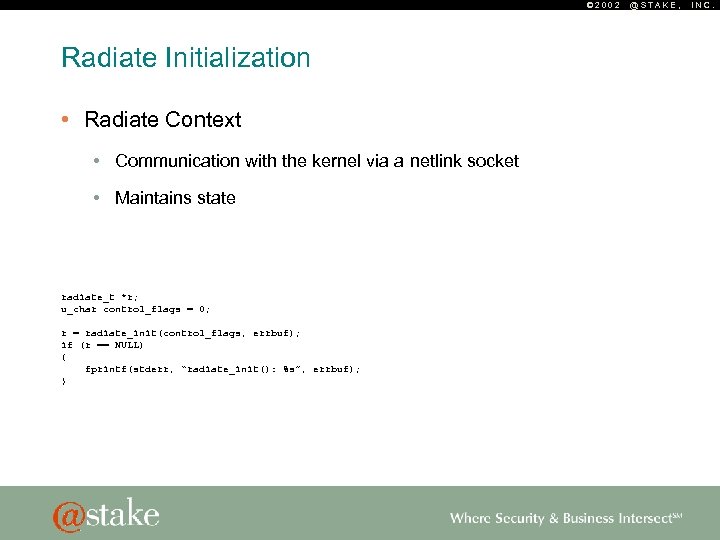 © 2002 Radiate Initialization • Radiate Context • Communication with the kernel via a netlink socket • Maintains state radiate_t *r; u_char control_flags = 0; r = radiate_init(control_flags, errbuf); if (r == NULL) { fprintf(stderr, “radiate_init(): %s”, errbuf); } @STAKE, INC.
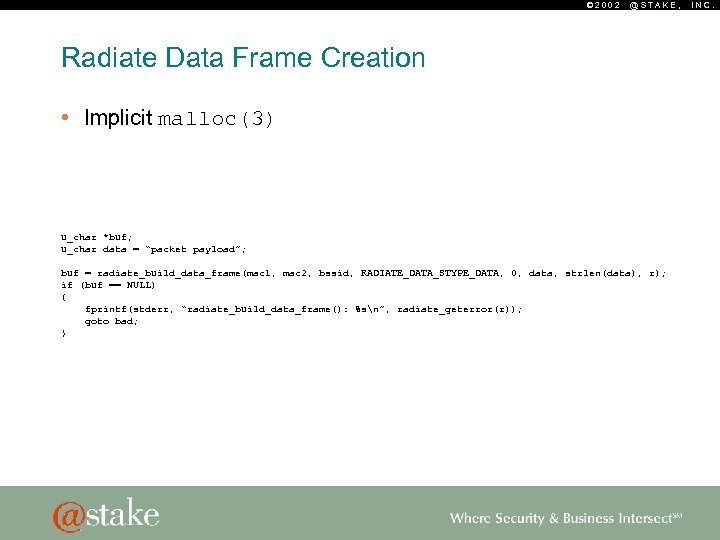 © 2002 @STAKE, Radiate Data Frame Creation • Implicit malloc(3) u_char *buf; u_char data = “packet payload”; buf = radiate_build_data_frame(mac 1, mac 2, bssid, RADIATE_DATA_STYPE_DATA, 0, data, strlen(data), r); if (buf == NULL) { fprintf(stderr, “radiate_build_data_frame(): %sn”, radiate_geterror(r)); goto bad; } INC.
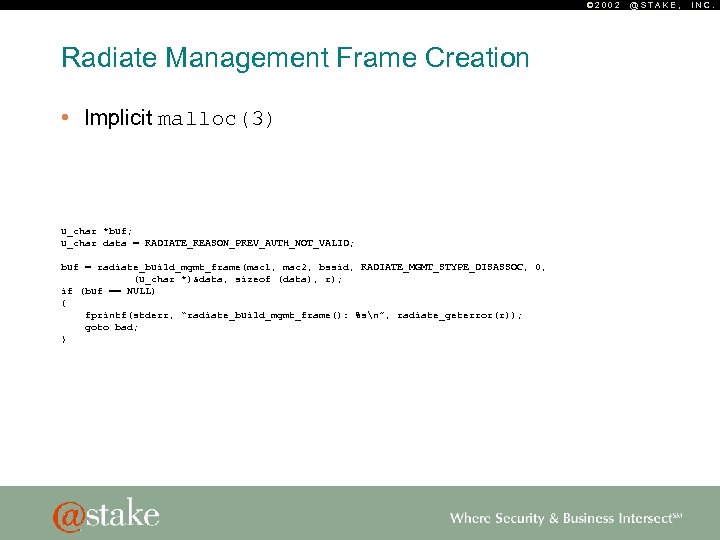 © 2002 Radiate Management Frame Creation • Implicit malloc(3) u_char *buf; u_char data = RADIATE_REASON_PREV_AUTH_NOT_VALID; buf = radiate_build_mgmt_frame(mac 1, mac 2, bssid, RADIATE_MGMT_STYPE_DISASSOC, 0, (u_char *)&data, sizeof (data), r); if (buf == NULL) { fprintf(stderr, “radiate_build_mgmt_frame(): %sn”, radiate_geterror(r)); goto bad; } @STAKE, INC.
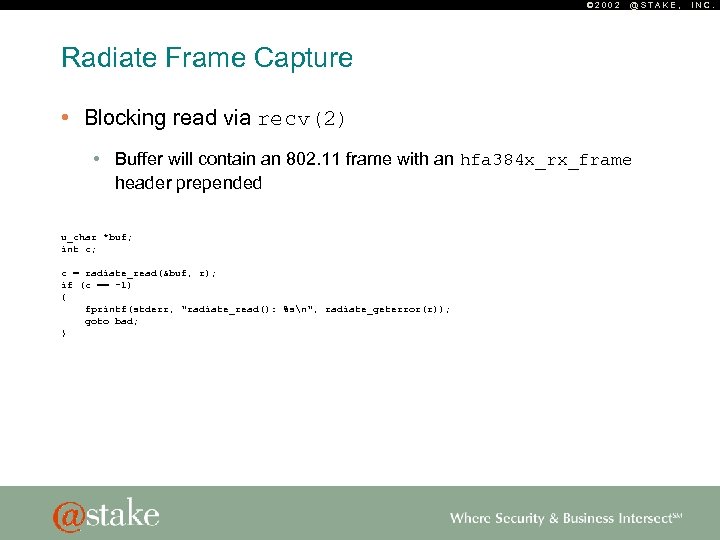 © 2002 @STAKE, Radiate Frame Capture • Blocking read via recv(2) • Buffer will contain an 802. 11 frame with an hfa 384 x_rx_frame header prepended u_char *buf; int c; c = radiate_read(&buf, r); if (c == -1) { fprintf(stderr, "radiate_read(): %sn", radiate_geterror(r)); goto bad; } INC.
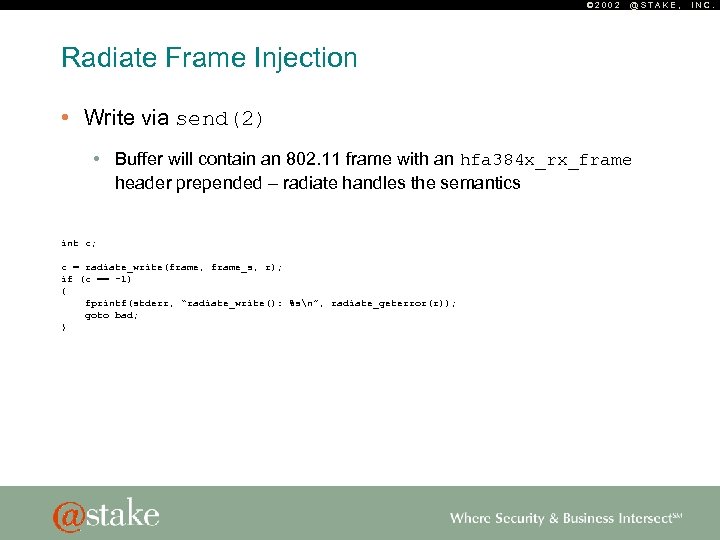 © 2002 @STAKE, Radiate Frame Injection • Write via send(2) • Buffer will contain an 802. 11 frame with an hfa 384 x_rx_frame header prepended – radiate handles the semantics int c; c = radiate_write(frame, frame_s, r); if (c == -1) { fprintf(stderr, “radiate_write(): %sn”, radiate_geterror(r)); goto bad; } INC.
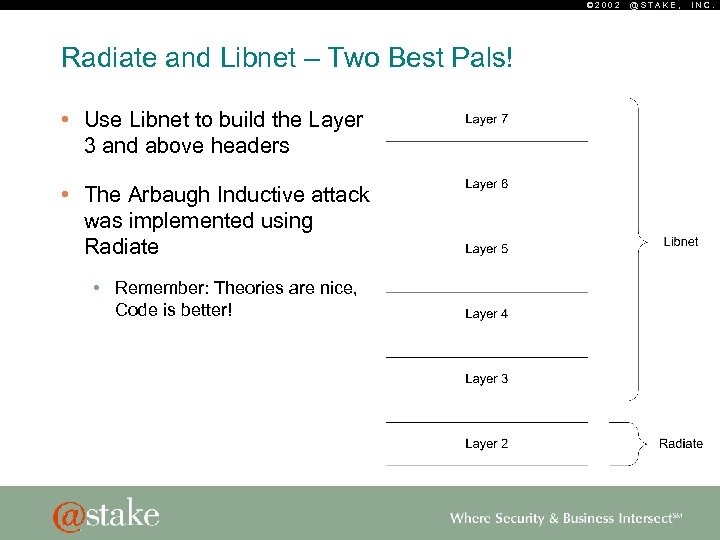 © 2002 Radiate and Libnet – Two Best Pals! • Use Libnet to build the Layer 3 and above headers • The Arbaugh Inductive attack was implemented using Radiate • Remember: Theories are nice, Code is better! @STAKE, INC.
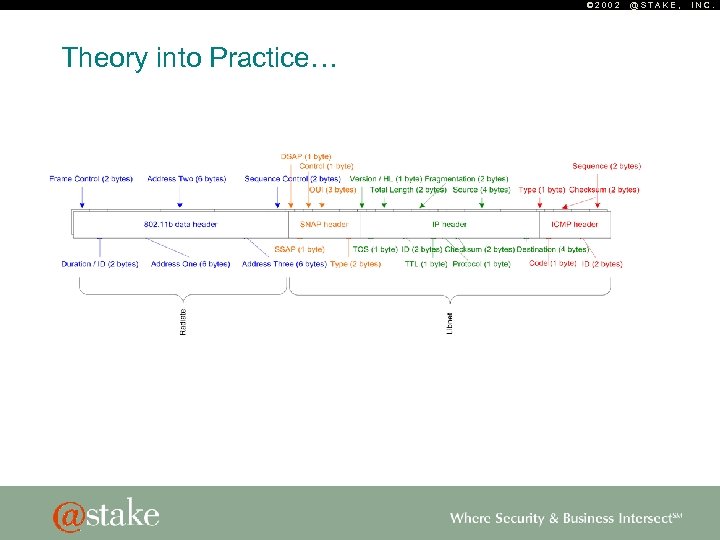 © 2002 Theory into Practice… @STAKE, INC.
 © 2002 Using Libradiate and Libnet • Disperse • Small 300 line program (with copious comments) • Uses libradiate and libnet to build and send an 802. 11 b encapsulated ICMP ECHO packet @STAKE, INC.
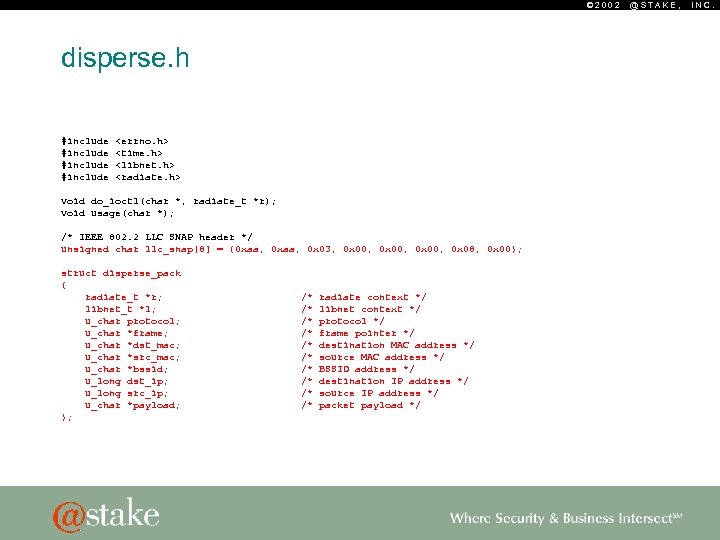 © 2002 disperse. h #include
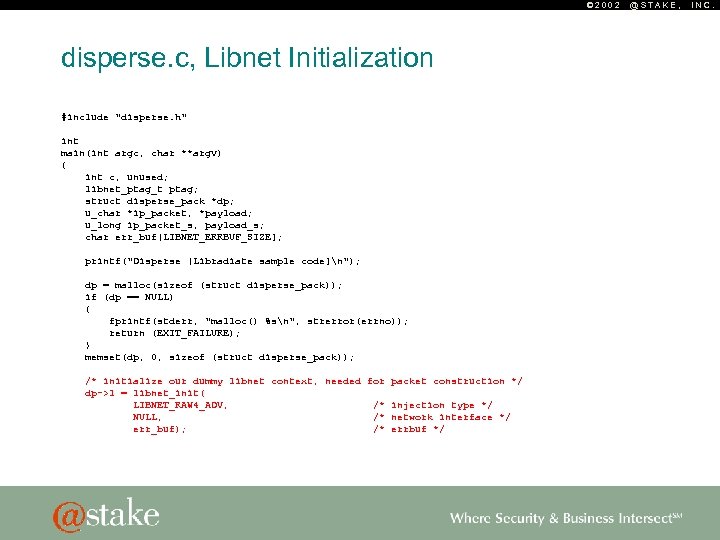 © 2002 disperse. c, Libnet Initialization #include "disperse. h" int main(int argc, char **argv) { int c, unused; libnet_ptag_t ptag; struct disperse_pack *dp; u_char *ip_packet, *payload; u_long ip_packet_s, payload_s; char err_buf[LIBNET_ERRBUF_SIZE]; printf("Disperse [Libradiate sample code]n"); dp = malloc(sizeof (struct disperse_pack)); if (dp == NULL) { fprintf(stderr, "malloc() %sn", strerror(errno)); return (EXIT_FAILURE); } memset(dp, 0, sizeof (struct disperse_pack)); /* initialize our dummy libnet context, needed for packet construction */ dp->l = libnet_init( LIBNET_RAW 4_ADV, /* injection type */ NULL, /* network interface */ err_buf); /* errbuf */ @STAKE, INC.
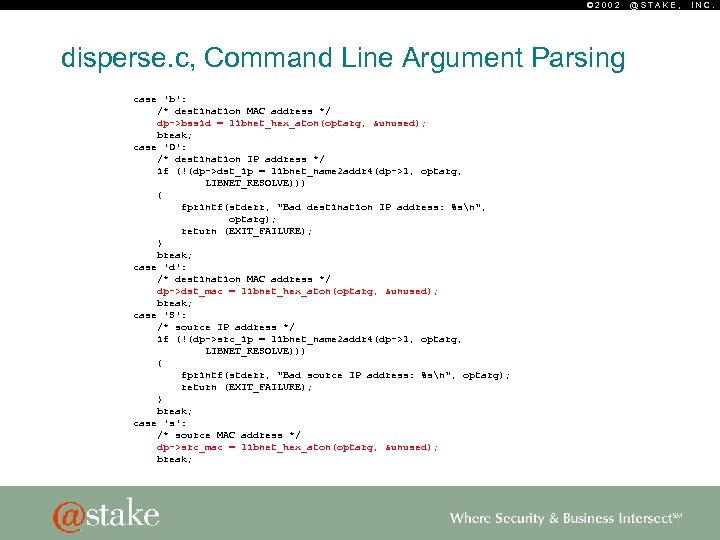 © 2002 disperse. c, Command Line Argument Parsing case 'b': /* destination MAC address */ dp->bssid = libnet_hex_aton(optarg, &unused); break; case 'D': /* destination IP address */ if (!(dp->dst_ip = libnet_name 2 addr 4(dp->l, optarg, LIBNET_RESOLVE))) { fprintf(stderr, "Bad destination IP address: %sn", optarg); return (EXIT_FAILURE); } break; case 'd': /* destination MAC address */ dp->dst_mac = libnet_hex_aton(optarg, &unused); break; case 'S': /* source IP address */ if (!(dp->src_ip = libnet_name 2 addr 4(dp->l, optarg, LIBNET_RESOLVE))) { fprintf(stderr, "Bad source IP address: %sn", optarg); return (EXIT_FAILURE); } break; case 's': /* source MAC address */ dp->src_mac = libnet_hex_aton(optarg, &unused); break; @STAKE, INC.
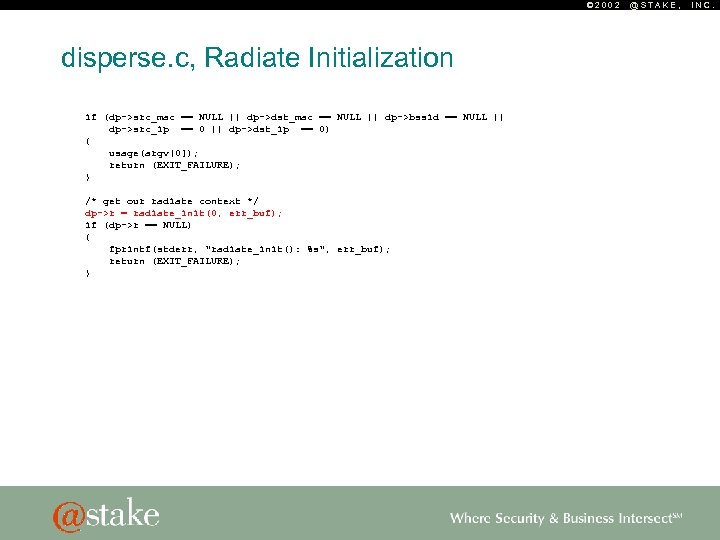 © 2002 disperse. c, Radiate Initialization if (dp->src_mac == NULL || dp->dst_mac == NULL || dp->bssid == NULL || dp->src_ip == 0 || dp->dst_ip == 0) { usage(argv[0]); return (EXIT_FAILURE); } /* get our radiate context */ dp->r = radiate_init(0, err_buf); if (dp->r == NULL) { fprintf(stderr, "radiate_init(): %s", err_buf); return (EXIT_FAILURE); } @STAKE, INC.
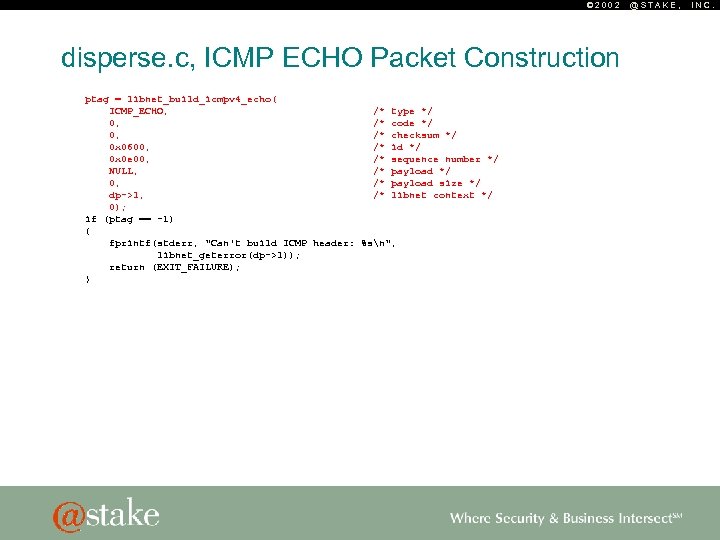 © 2002 disperse. c, ICMP ECHO Packet Construction ptag = libnet_build_icmpv 4_echo( ICMP_ECHO, /* type */ 0, /* code */ 0, /* checksum */ 0 x 0600, /* id */ 0 x 0 e 00, /* sequence number */ NULL, /* payload */ 0, /* payload size */ dp->l, /* libnet context */ 0); if (ptag == -1) { fprintf(stderr, "Can't build ICMP header: %sn", libnet_geterror(dp->l)); return (EXIT_FAILURE); } @STAKE, INC.
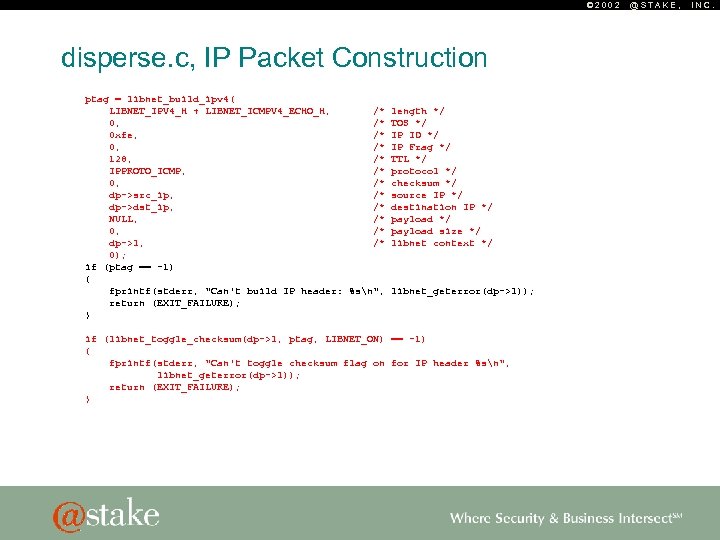 © 2002 disperse. c, IP Packet Construction ptag = libnet_build_ipv 4( LIBNET_IPV 4_H + LIBNET_ICMPV 4_ECHO_H, /* 0 xfe, /* 0, /* 128, /* IPPROTO_ICMP, /* 0, /* dp->src_ip, /* dp->dst_ip, /* NULL, /* 0, /* dp->l, /* 0); if (ptag == -1) { fprintf(stderr, "Can't build IP header: %sn", return (EXIT_FAILURE); } length */ TOS */ IP ID */ IP Frag */ TTL */ protocol */ checksum */ source IP */ destination IP */ payload size */ libnet context */ libnet_geterror(dp->l)); if (libnet_toggle_checksum(dp->l, ptag, LIBNET_ON) == -1) { fprintf(stderr, "Can't toggle checksum flag on for IP header %sn", libnet_geterror(dp->l)); return (EXIT_FAILURE); } @STAKE, INC.
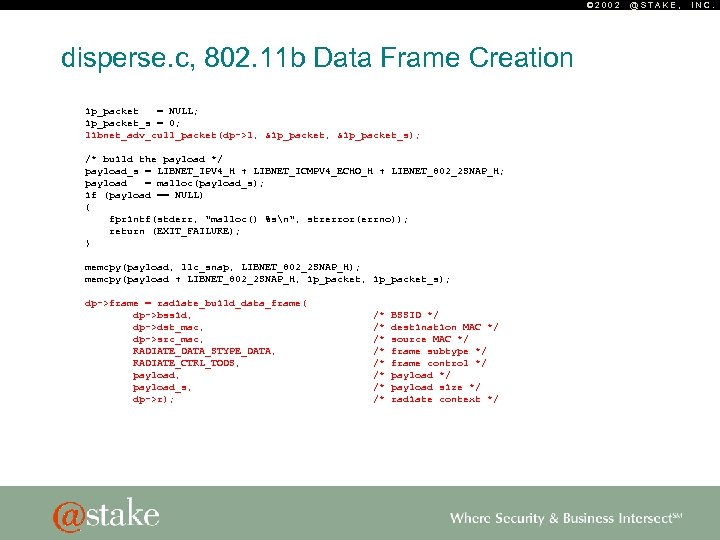 © 2002 disperse. c, 802. 11 b Data Frame Creation ip_packet = NULL; ip_packet_s = 0; libnet_adv_cull_packet(dp->l, &ip_packet_s); /* build the payload */ payload_s = LIBNET_IPV 4_H + LIBNET_ICMPV 4_ECHO_H + LIBNET_802_2 SNAP_H; payload = malloc(payload_s); if (payload == NULL) { fprintf(stderr, "malloc() %sn", strerror(errno)); return (EXIT_FAILURE); } memcpy(payload, llc_snap, LIBNET_802_2 SNAP_H); memcpy(payload + LIBNET_802_2 SNAP_H, ip_packet_s); dp->frame = radiate_build_data_frame( dp->bssid, dp->dst_mac, dp->src_mac, RADIATE_DATA_STYPE_DATA, RADIATE_CTRL_TODS, payload_s, dp->r); /* /* BSSID */ destination MAC */ source MAC */ frame subtype */ frame control */ payload size */ radiate context */ @STAKE, INC.
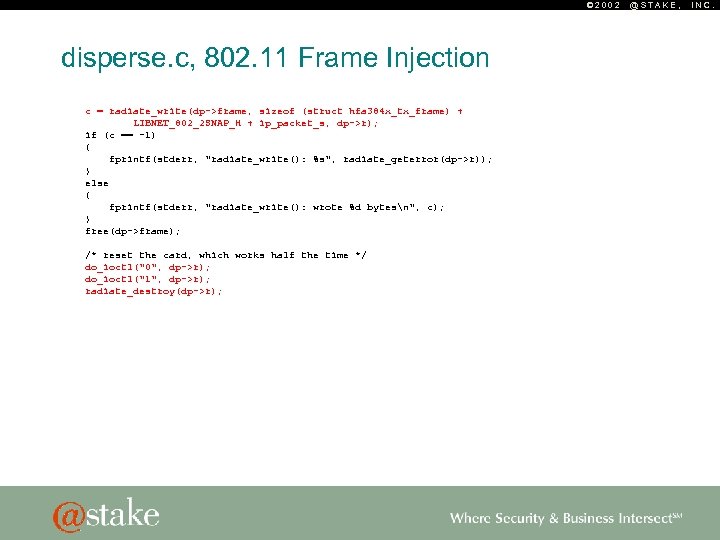 © 2002 disperse. c, 802. 11 Frame Injection c = radiate_write(dp->frame, sizeof (struct hfa 384 x_tx_frame) + LIBNET_802_2 SNAP_H + ip_packet_s, dp->r); if (c == -1) { fprintf(stderr, "radiate_write(): %s", radiate_geterror(dp->r)); } else { fprintf(stderr, "radiate_write(): wrote %d bytesn", c); } free(dp->frame); /* reset the card, which works half the time */ do_ioctl("0", dp->r); do_ioctl("1", dp->r); radiate_destroy(dp->r); @STAKE, INC.
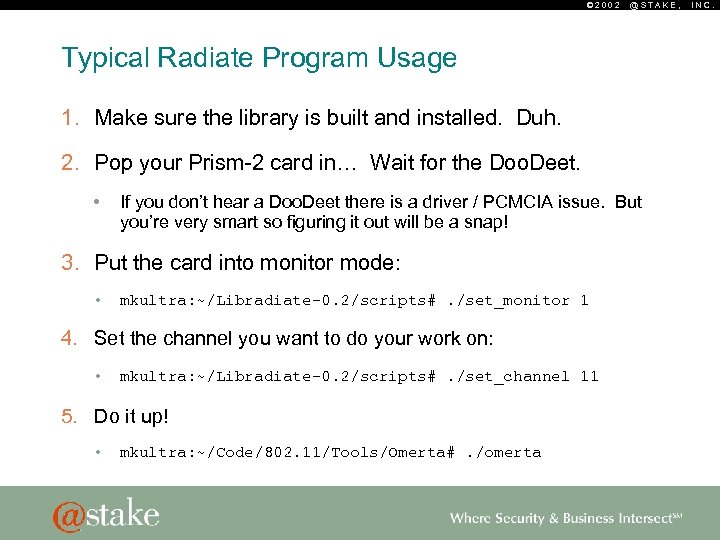 © 2002 @STAKE, Typical Radiate Program Usage 1. Make sure the library is built and installed. Duh. 2. Pop your Prism-2 card in… Wait for the Doo. Deet. • If you don’t hear a Doo. Deet there is a driver / PCMCIA issue. But you’re very smart so figuring it out will be a snap! 3. Put the card into monitor mode: • mkultra: ~/Libradiate-0. 2/scripts#. /set_monitor 1 4. Set the channel you want to do your work on: • mkultra: ~/Libradiate-0. 2/scripts#. /set_channel 11 5. Do it up! • mkultra: ~/Code/802. 11/Tools/Omerta#. /omerta INC.
 © 2002 The Warez • You don’t get Omerta • You do get Radiate (along with disperse): • http: //www. packetfactory. net/Radiate @STAKE, INC.
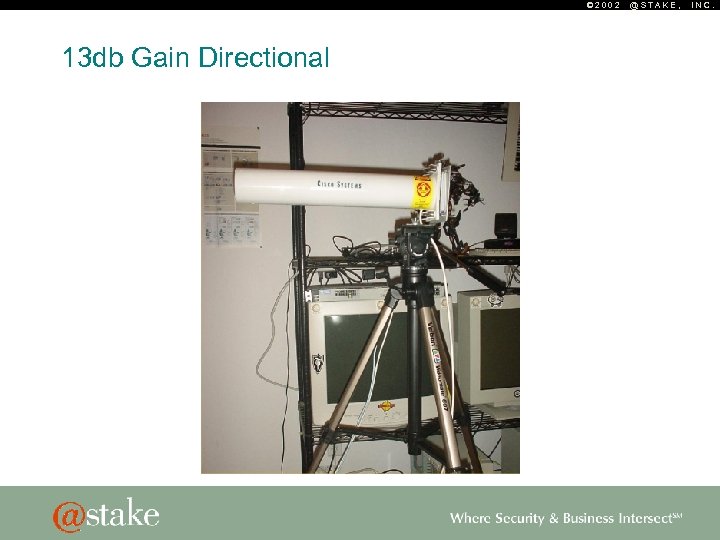 © 2002 13 db Gain Directional @STAKE, INC.
 © 2002 @STAKE, Known Issues • We’re at the mercy of the firmware… • Problems with sending certain frames • To send data frames with the TO_DS bit set requires the module to be recompiled with -DPRISM 2_MONITOR_PACKET_INJECT • Can’t sniff frames when driver is built in this mode • Would be nice if we could make the card act as a passive radio • Driver tends to crash or fail when card is removed and reseated frequently • We need a logo INC.
 © 2002 @STAKE, Futures • This is pretty rough – we need a lot of code cleanup • Buffer management (pblocks? ) • Possible API change to accommodate different layer 1 interfaces • We’ll support additional cards • Current issues with Prism-2 cards might go away • Did someone say Libnet Merger? Could be! INC.
 © 2002 @STAKE, Summary • The need exists to be able to develop arbitrary tools to test 802. 11 networks for anomalous events such as Byzantine failure susceptibility • Radiate is a toolkit that allows the application programmer to develop tools to test for 802. 11 b security issues • Extra Special thanks to Timothy “The Newsh” Newsham INC.
 © 2002 Building Open Source Network Security Tools • Simple C library; A “component” • Upon which techniques are built • From which tools are created • New book on how to rapidly develop your own network security tools • New paradigm for describing a network security tool; accelerates conceptualization and development • Wiley & Sons • Due out in October 2002 @STAKE, INC.
 © 2002 Questions? @STAKE, mike@stake. com INC.