


 Скачать презентацию The Nature of Leadership Part 1 A Conversation
5729e059d3f6a82e6fbec48738c744c7.ppt
- Количество слайдов: 70
 The Nature of Leadership Part 1 A Conversation About Theories Informing Effective Leadership
 Developed from the Contents of Reginald Leon Green’s Practicing the Art of Leadership: A Problem-based Approach to Implementing the ISLLC Standards Chapter 2
 The Study of Leadership n What is it that a leader adds to a group to make it effective? n What can a leader do to help improve the performance of followers?
 The Theoretical Base n The behavior of professionals is guided by a solid theoretical base.
 Theory n A body of organized and tested knowledge n A statement that explains some phenomena in a systematic way
 Theory n A set of interrelated constructs that provide a systematic view of phenomena, explaining the relations among variables, and predicting probable outcomes
 Ways of Studying Leadership n Traits n Behavior n Contingency n Situational
 Some Major Theories Informing Leadership n Organizational Theories n Leadership Theories n Motivational Theories n Contemporary Theories
 Organizational Theories n n Classical Human Relations Social Systems Open Systems
 Leadership Theories n Theory X Theory Y n Trait Theories n Behavior Theories
 Leadership Theories n Contingency Theories n Transformational and Charismatic Theories n Self Leadership Theories
 Motivational Theories n Maslow’s Hierarchy of Needs n Herzberg’s Two-Factor Theory
 Motivational Theories n House’s Path-Goal Theory n Expectancy Theory n Equity Theory
 Major Leadership Processes
 Major Leadership Processes n Leadership n Decision Making n Communication n Conflict Management n Change
 Organizational Theories Informing Leadership
 Classical Organizational Theory n n n Division of Labor Span of Control Formal Rules Goal Definition Extrinsic Rewards Hierarchy
 Beliefs of the Classical Theorists n n n Bureaucratic Structure Organizational Control Scientific Management Efficient Behavior Disciplined Behavior
 Classical Organizational Theory Organizational thought: n Scientific Management – Frederick Taylor n Administrative Management – Henri Fayol n The Bureaucratic structure – Max Weber
 Scientific Management of Work and Worker Frederick W. Taylor, the Father of Scientific Management 1800 s
 Taylor’s Four Principles of Scientific Management n Scientific Job Analysis n Selection of Personnel n Management Cooperation n Functional Supervision
 Scientific Management Key Principles n Identify “the one best way” of doing a job n Develop workers to function in that manner
 Administrative Management Henri Fayol 1920
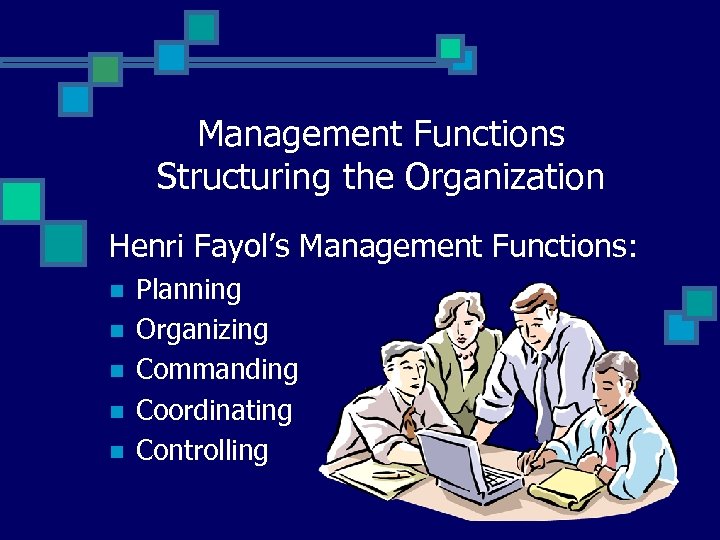 Management Functions Structuring the Organization Henri Fayol’s Management Functions: n n n Planning Organizing Commanding Coordinating Controlling
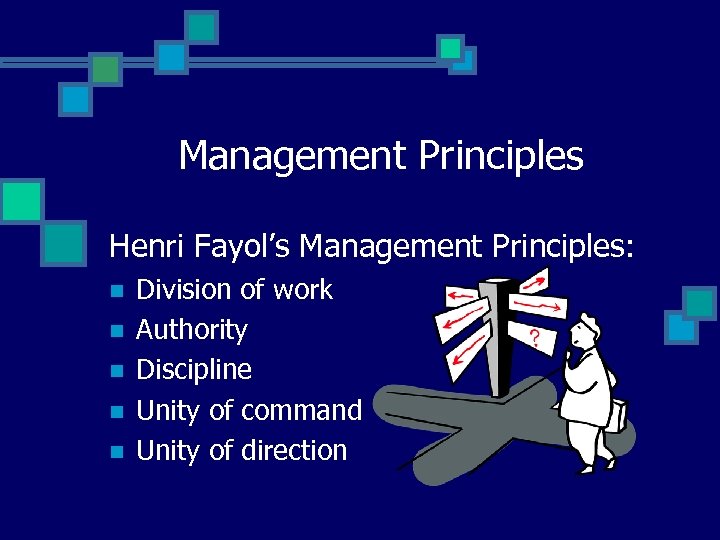 Management Principles Henri Fayol’s Management Principles: n n n Division of work Authority Discipline Unity of command Unity of direction
 Management Principles Henri Fayol’s Management Principles: n n n Subordination of individual interest Remuneration Centralization Scalar chain Stability of personnel
 Management Principles Henri Fayol’s Management Principles: n n Esprit de corps Order Equity Initiative
 Weber’s Bureaucratic Structure n n n Hierarchical structure Division of labor Control by rules Impersonal relationships Career orientation
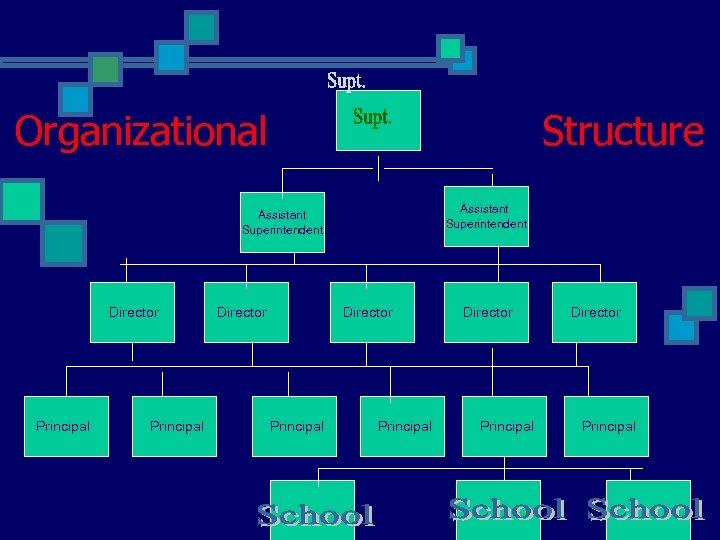 Organizational Structure Assistant Superintendent Director Principal Director Principal
 A Summary of Classical Theory n Classical organizational theorists sought to identify and describe a set of fixed principles (rules) that would establish the basis for management.
 A Summary of Classical Theory n Classic theorists believed that an application of the bureaucratic structure and processes of organizational control would promote rational, efficient, and disciplined behavior, making possible the achievement of well-defined goals.
 A Summary of Classical Theory n Efficiency is achieved by arranging positions within an organization according to hierarchy and jurisdiction and by placing power at the top of a clear chain of command.
 A Summary of Classical Theory n Scientific procedures are used to determine the best way of performing a task, and then rules are written that require workers to perform in a prescribed manner. Experts are hired for defined roles and are grouped according to task specialization.
 Principles of Classical Theory in Today’s Schools n Hierarchy n Unit of Command n Span of Control
 The Classical School Leader n Goes by the book. n Runs a tight ship. n Insists on disciplined obedience to policy.
 The Classical School Leader n Believes in the chain of command. n Considers himself/herself to have ultimate authority and responsibility over everything in the school. n Focuses on tasks and gives little attention to the individual or groups in the school.
 The Classical School Leader n Places great emphasis on formal organizational structure. n Views people as fitting into the structure.
 The Nature of Leadership Part 2 A Conversation About Theories Informing Effective Leadership
 Developed from the Contents of Reginald Leon Green’s Practicing the Art of Leadership: A Problembased Approach to Implementing the ISLLC Standards Chapter 2
 Human Relations Theory A focus on the needs of the workers 1920 s-1930 s
 The Hawthorne Studies n From these studies came the idea that worker output was affected by numerous variables.
 The Hawthorne Studies Variables n n The manner in which workers were treated How they felt about their work How they felt about coworkers and their bosses What happened outside of work
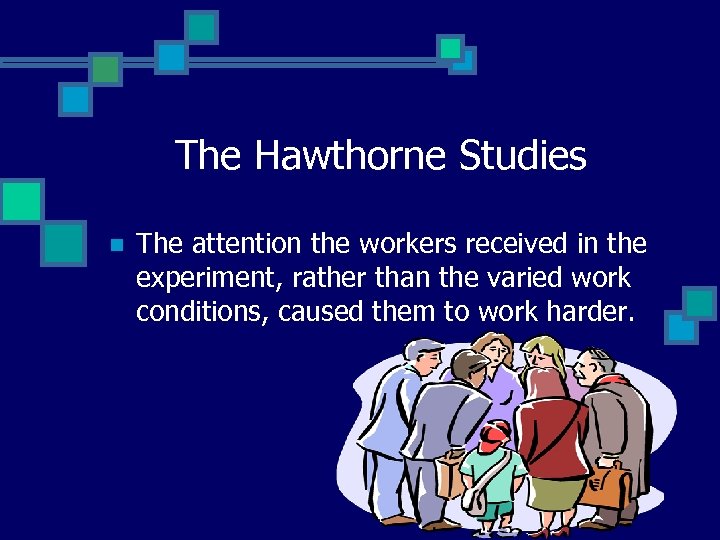 The Hawthorne Studies n The attention the workers received in the experiment, rather than the varied work conditions, caused them to work harder.
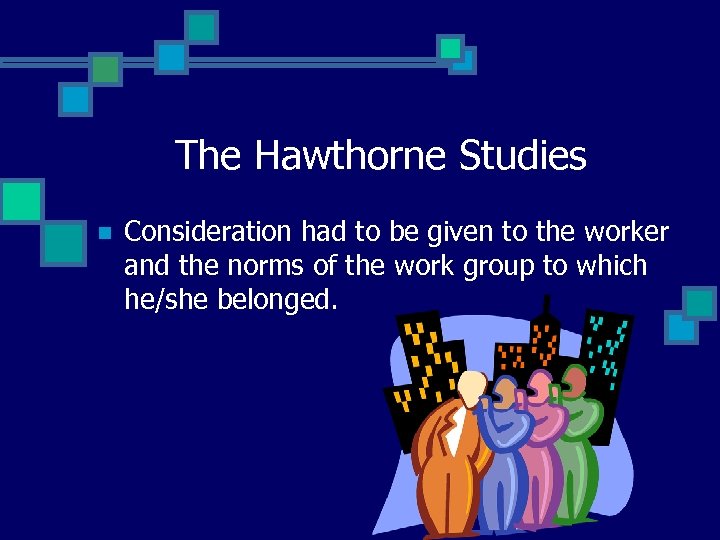 The Hawthorne Studies n Consideration had to be given to the worker and the norms of the work group to which he/she belonged.
 A Summary of Human Relations Theory n n n Individuals are involved in the work. There is a team orientation. Individuals are mentored.
 A Summary of Human Relations Theory n n n There is a commitment. Consideration is given to morale. There is a focus on participation, cohesion, and consensus building.
 The School Leader with a Human Relations Perspective n Is aware of the norms of groups in the schoolhouse. n Is considerate of the social needs of individuals.
 The School Leader with a Human Relations Perspective n Seeks the ideas of individuals regarding work issues. n Takes into consideration the feelings and attitudes of individuals.
 Social Systems Theory 1930 -1975
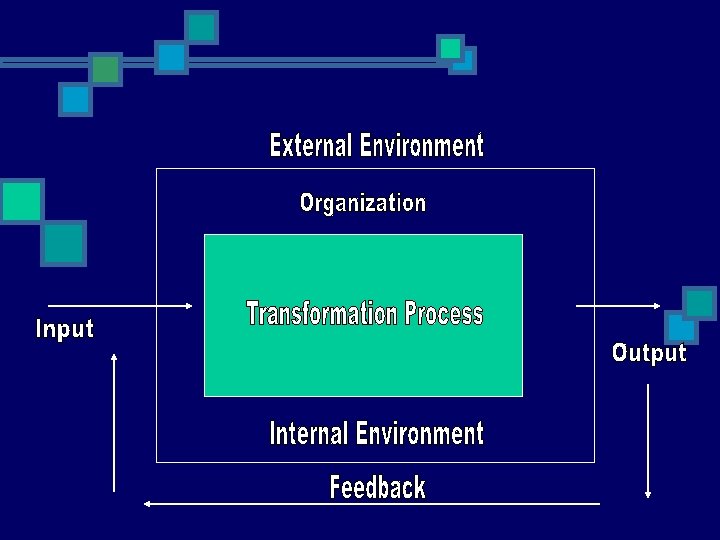
 A System n A system is a set of interrelated elements that functions as a unit for a specific purpose. n These elements interact with the environment almost as a living creature does.
 Parts of the Basic Social System n Inputs n Transformation Process n Outputs n Feedback n Environment
 Parts of the Basic Social System n Inputs The human, material, financial, or information resources used to produce a product or service
 Parts of the Basic Social System n Transformation Process The interaction between and among the parts
 Parts of the Basic Social System n Outputs The products and/or services produced
 Parts of the Basic Social System n Feedback Information concerning the outputs or the transformation process of the organization that influence decision making and the selection of inputs during the next cycle
 Parts of the Basic Social System n Environment The area surrounding the organization including the social, political, and economic forces that impinge on the organization
 Social Interaction in Organizations n n Individual Behavior Group Behavior Formal Behavior Informal Behavior
 Social Interaction in Organizations n The focus is on the whole, parts, and the relationships among the parts. n All parts of the system are interdependent and subject to influence by any other part.
 The School Leader with a Social Systems Perspective n Involves the faculty in work decisions. n Pays attention to the faculty to keep them happy. n Seeks to work with the faculty to keep them from resisting change.
 The School Leader with a Social Systems Perspective n Considers the content of the job, as well as the leadership process. n Pays attention to the climate of the organization.
 The School Leader with a Social Systems Perspective n Assists the individual in career development. n Considers the whole person as he/she adapts to the work environment.
 The School Leader with a Social Systems Perspective n Encourages individuals to assume some responsibility for the development of their own careers.
 The Importance of Leadership Behavior Leadership behavior is guided by: n Standards of Practice. n Best Practice.
 Key Factors for Educational Leaders n Explain Behavior n Predict Behavior
 Open Systems Theory 1950 s
 Open Systems Theory n The organization trades with its environment
 Open Systems Theory n From the environment, the organization receives: n Human and material resources. Values. Community expectations. Societal demands. n n n
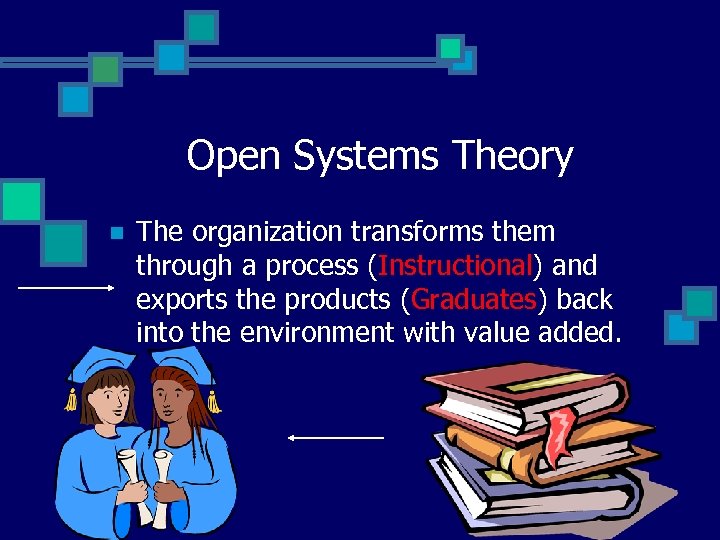 Open Systems Theory n The organization transforms them through a process (Instructional) and exports the products (Graduates) back into the environment with value added.
 References n n n Barth, R. (1990). Improving schools from within. San Francisco: Jossey-Bass. Fullan, M. (1999). Change forces: The sequel. New York: Falmer Press. Greenberg, J. (1996). Managing behavior in organizations. Upper Saddle River, NJ: Prentice Hall. Senge, P. (1990). The fifth discipline: The art and practice of the learning organization. New York: Doubleday. Sergiovanni, T. J. (1995). The principalship: A reflective perspective. Boston: Allyn & Bacon.