 Скачать презентацию The Natural History of a National Practice-Based Research
f18f488c91c0607a677469448fe90cf7.ppt
- Количество слайдов: 1



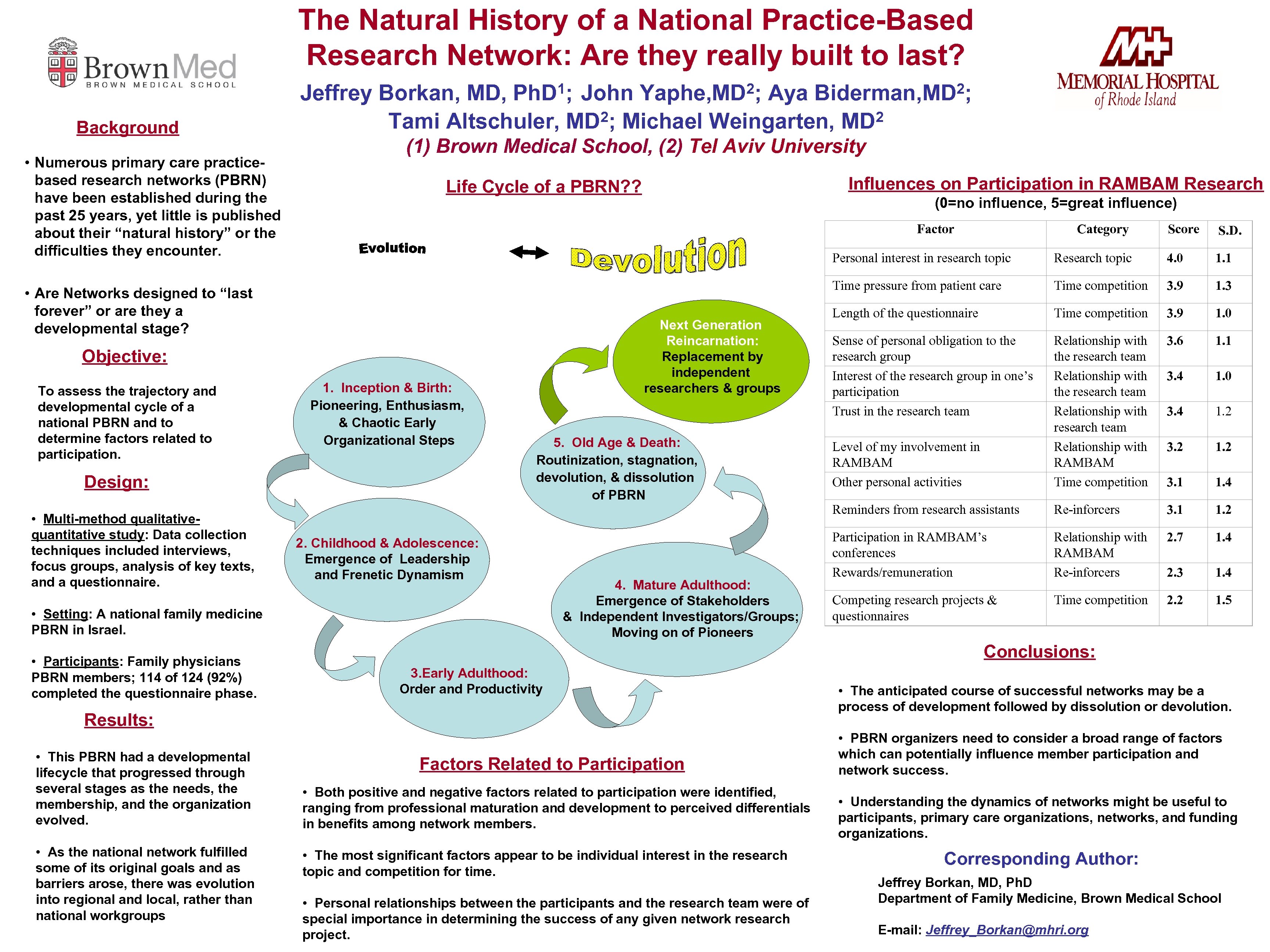
The Natural History of a National Practice-Based Research Network: Are they really built to last? 1; Ph. D Background • Numerous primary care practicebased research networks (PBRN) have been established during the past 25 years, yet little is published about their “natural history” or the difficulties they encounter. Jeffrey Borkan, MD, John Aya 2; Michael Weingarten, MD 2 Tami Altschuler, MD (0=no influence, 5=great influence) Factor Next Generation Reincarnation: Replacement by independent researchers & groups 1. Inception & Birth: Pioneering, Enthusiasm, & Chaotic Early Organizational Steps 5. Old Age & Death: Routinization, stagnation, devolution, & dissolution of PBRN 2. Childhood & Adolescence: Emergence of Leadership and Frenetic Dynamism 4. Mature Adulthood: Emergence of Stakeholders & Independent Investigators/Groups; Moving on of Pioneers S. D. Research topic 4. 0 1. 1 Time competition 3. 9 1. 3 Length of the questionnaire Time competition 3. 9 1. 0 Sense of personal obligation to the research group Interest of the research group in one’s participation Trust in the research team 3. 6 1. 1 3. 4 1. 0 3. 4 1. 2 Level of my involvement in RAMBAM Other personal activities Relationship with the research team Relationship with RAMBAM Time competition 3. 2 1. 2 3. 1 1. 4 Reminders from research assistants Re-inforcers 3. 1 1. 2 Participation in RAMBAM’s conferences Rewards/remuneration Relationship with RAMBAM Re-inforcers 2. 7 1. 4 2. 3 1. 4 Competing research projects & questionnaires Time competition 2. 2 1. 5 Conclusions: 3. Early Adulthood: Order and Productivity Results: • As the national network fulfilled some of its original goals and as barriers arose, there was evolution into regional and local, rather than national workgroups Score Time pressure from patient care • Setting: A national family medicine PBRN in Israel. • This PBRN had a developmental lifecycle that progressed through several stages as the needs, the membership, and the organization evolved. Category Personal interest in research topic Design: • Participants: Family physicians PBRN members; 114 of 124 (92%) completed the questionnaire phase. Influences on Participation in RAMBAM Research Life Cycle of a PBRN? ? Objective: • Multi-method qualitativequantitative study: Data collection techniques included interviews, focus groups, analysis of key texts, and a questionnaire. 2; Biderman, MD (1) Brown Medical School, (2) Tel Aviv University • Are Networks designed to “last forever” or are they a developmental stage? To assess the trajectory and developmental cycle of a national PBRN and to determine factors related to participation. 2; Yaphe, MD Factors Related to Participation • Both positive and negative factors related to participation were identified, ranging from professional maturation and development to perceived differentials in benefits among network members. • The most significant factors appear to be individual interest in the research topic and competition for time. • Personal relationships between the participants and the research team were of special importance in determining the success of any given network research project. • The anticipated course of successful networks may be a process of development followed by dissolution or devolution. • PBRN organizers need to consider a broad range of factors which can potentially influence member participation and network success. • Understanding the dynamics of networks might be useful to participants, primary care organizations, networks, and funding organizations. Corresponding Author: Jeffrey Borkan, MD, Ph. D Department of Family Medicine, Brown Medical School E-mail: Jeffrey_Borkan@mhri. org
Скачать презентацию The Natural History of a National Practice-Based Research
f18f488c91c0607a677469448fe90cf7.ppt