


 Скачать презентацию The National Vital Statistics System U S DEPARTMENT
11d10e6e26fdc58041f98333f1fb8997.ppt
- Количество слайдов: 28
 The National Vital Statistics System U. S. DEPARTMENT OF HEALTH AND HUMAN SERVICES Centers for Disease Control and Prevention National Center for Health Statistics
 Vital Statistics • Birth • Death • Fetal death • Induced termination of pregnancy • Marriage • Divorce The “official” records
 National Vital Statistics System • 57 reporting areas • Decentralized • US historical development-selfgoverning States • Nothing on registration in US Constitution • Responsibility based in state law • Responsibility with provider of services
 History 1933 • Birth and death registration areas include all 1960 1972 • National Center for Health Statistics created • Vital Statistics Cooperative program – 4 States Today • 56 of 57 Registration areas send automated States sent data to NCHS on Computer tape birth and demographic death data to NCHS • EBC – 95 percent of births • EDC – electronic death registration under development in several States • Data transmitted continuously to NCHS – expedited data release
 Federal Role Defined by the Public Health Service Act – Sec 306 (h) (1) • Annual collection of data from the records of births, deaths, marriages, and divorces • Satisfactory data in necessary detail and form • Detailed data on ethnic and racial populations • Each State or registration area shall be paid by the Secretary the Federal share of its reasonable costs
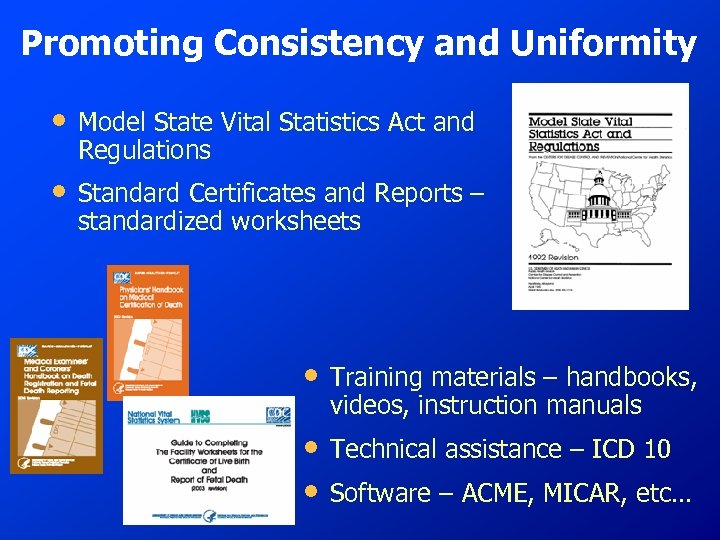 Promoting Consistency and Uniformity • Model State Vital Statistics Act and Regulations • Standard Certificates and Reports – standardized worksheets • Training materials – handbooks, videos, instruction manuals • • Technical assistance – ICD 10 Software – ACME, MICAR, etc…
 Uses of Vital Statistics Mortality data are widely used • Life expectancy • Leading causes • Injury mortality • Occupational mortality • Causes of death • Infant mortality • National Death Index Natality data used for many purposes • Birth and fertility rates • Nonmarital births • Births to teens • Prenatal care • Low birthweight and preterm births • Cesarean delivery • Birth timing – mother’s age • Pregnancy rates
 Other Vital Statistics Data Sets Linked birth/infant death file • Unique data file which links death certificates for infants under one year to their respective birth certificate. This provides critical maternal characteristics that can be linked with the death certificate information. Complementing National Natality Datasets • Matched multiple birth file (twins, triplets, quads) • Fetal death • Perinatal file (live births, infant deaths, fetal deaths)
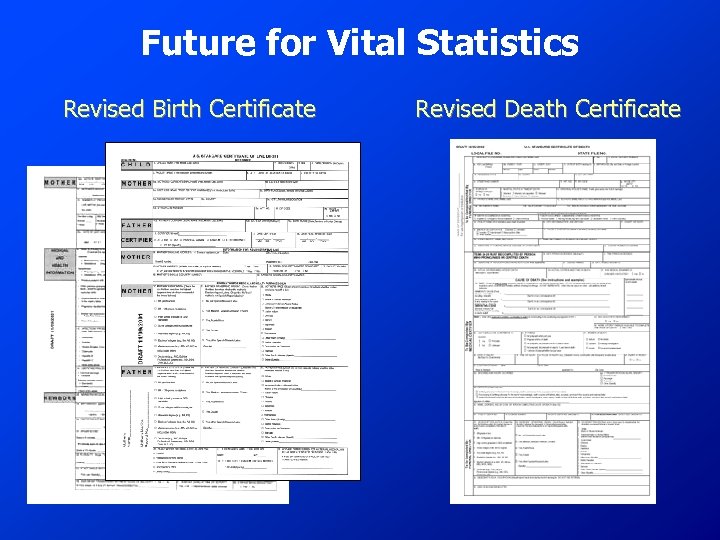 Future for Vital Statistics Revised Birth Certificate Revised Death Certificate
 Revised Birth Certificate • More detail on cigarette smoking • Method of delivery • More height & weight info • Congenital anomalies • Infertility treatment • WIC • Infections during pregnancy • Maternal morbidity • Breast feeding • Payment for delivery New worksheets developed and tested – to encourage data collection from the most appropriate sources
 Revised Death Certificate • Decedent’s marital status distinguishes “Married” from “Married, but separated” • Place of death includes hospice • If female, pregnancy status at time of death to identify maternal and pregnancy-related deaths • If transportation injury, decedent’s status with respect to vehicles • Did tobacco use contribute to death? • Separate instructions for funeral director and person completing medical portion
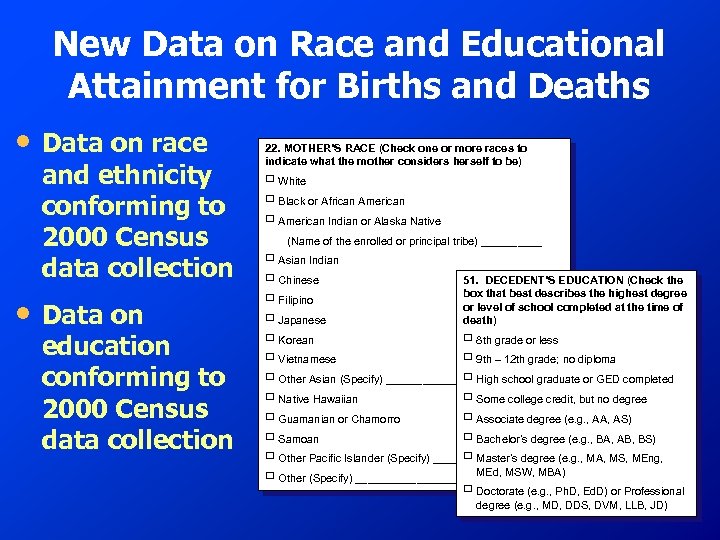 New Data on Race and Educational Attainment for Births and Deaths • • Data on race and ethnicity conforming to 2000 Census data collection Data on education conforming to 2000 Census data collection 22. MOTHER’S RACE (Check one or more races to indicate what the mother considers herself to be) □ White □ Black or African American □ American Indian or Alaska Native (Name of the enrolled or principal tribe) _____ □ Asian Indian □ Chinese 51. DECEDENT’S EDUCATION (Check the box that best describes the highest degree □ Filipino or level of school completed at the time of □ Japanese death) □ Korean □ 8 th grade or less □ 9 th – 12 th grade; no diploma □ Vietnamese □ High school □ Other Asian (Specify) _____________graduate or GED completed □ Some college credit, but no degree □ Native Hawaiian □ Associate degree (e. g. , AA, AS) □ Guamanian or Chamorro □ Bachelor’s degree (e. g. , BA, AB, BS) □ Samoan □ Master’s degree □ Other Pacific Islander (Specify) _________ (e. g. , MA, MS, MEng, MEd, MSW, □ Other (Specify) _______________MBA) □ Doctorate (e. g. , Ph. D, Ed. D) or Professional degree (e. g. , MD, DDS, DVM, LLB, JD)
 Where are we Now? • Births registered electronically for well over a decade, but States are using individually developed legacy systems not adaptable for the revised certificates. • Death registration has never been • electronic. Need to get hospitals, physicians, and funeral directors to use electronic systems and update their technology. In sum, implementing new certificates requires States to re-engineer their data collection systems for birth and deaths.
 Progress to Date • Work complicated and intense, historic new approach to improving timeliness and data quality – States accustomed to working independently • Work on functional requirements phase now nearly complete • Individual States or, hopefully, collections of States will be able to use the requirements to better develop more standardized re-engineered systems
 NCHS Role in Transition • NCHS does not have funds to take this effort to the next stages – i. e. , to build the prototypes • Georgia and New York City heavily involved in developing functional requirements; hope they can take this to next stage – to develop prototypes for birth and death • Significant resources needed – not now available
 The National Survey of Family Growth (NSFG)
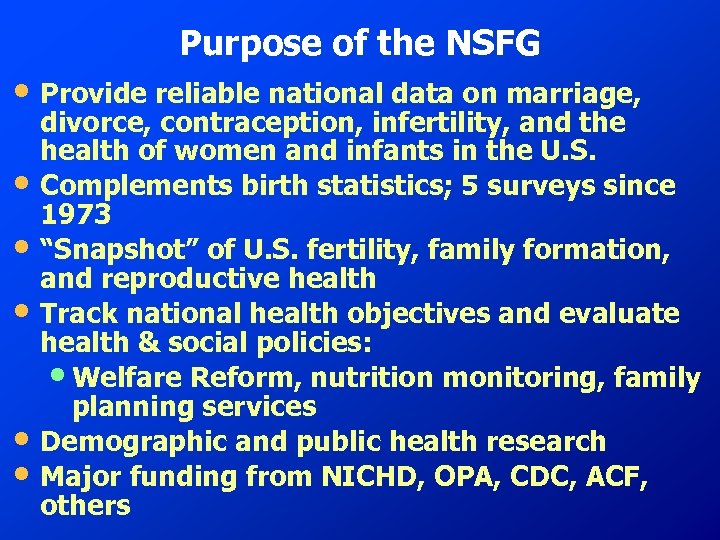 Purpose of the NSFG • Provide reliable national data on marriage, • • • divorce, contraception, infertility, and the health of women and infants in the U. S. Complements birth statistics; 5 surveys since 1973 “Snapshot” of U. S. fertility, family formation, and reproductive health Track national health objectives and evaluate health & social policies: • Welfare Reform, nutrition monitoring, family planning services Demographic and public health research Major funding from NICHD, OPA, CDC, ACF, others
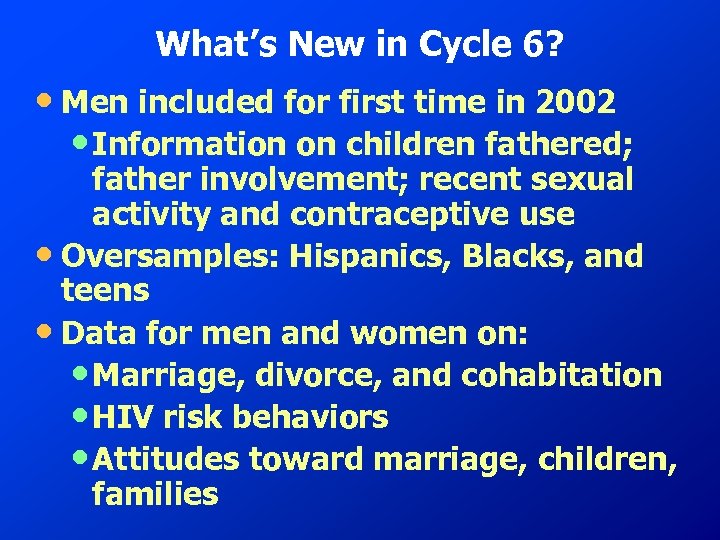 What’s New in Cycle 6? • Men included for first time in 2002 • Information on children fathered; father involvement; recent sexual activity and contraceptive use • Oversamples: Hispanics, Blacks, and teens • Data for men and women on: • Marriage, divorce, and cohabitation • HIV risk behaviors • Attitudes toward marriage, children, families
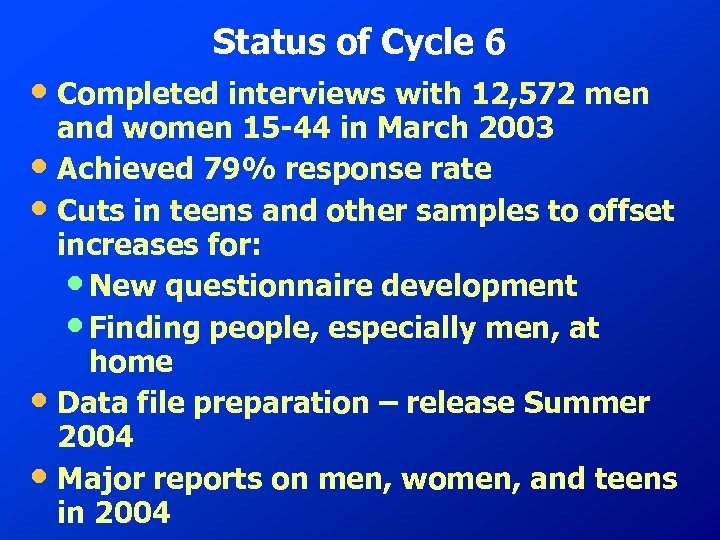 Status of Cycle 6 • Completed interviews with 12, 572 men • • and women 15 -44 in March 2003 Achieved 79% response rate Cuts in teens and other samples to offset increases for: • New questionnaire development • Finding people, especially men, at home Data file preparation – release Summer 2004 Major reports on men, women, and teens in 2004
 Planning for Cycle 7 Exploring continuous interviewing to collect data more frequently and more efficiently • More cost-efficient fieldwork • More frequent and timely data First priority: A larger national sample, starting in 2006 Other possibilities: • Wider age range • Include military population; incarcerated population • State or city samples Ultimate design and schedule will depend on resources $$$
 Other DVS Activities Early Childhood Longitudinal Study – Birth Cohort • Followback survey, now underway, conducted by NCES • Comprehensive study of all aspects of infant and child health and development • Uses birth certificates for sampling frame • NCHS key role in obtaining State cooperation Recent NCHS followback surveys • National Maternal and Infant Health Survey, 1988 • National Mortality Followback Survey, 1993
 Other DVS Activities (cont. ) Future for followback surveys • Immense research potential – to explain factors surrounding sentinel events of birth and death • Very expensive and resource intensive $$$ • NCHS hopes to resume leadership role in followback surveys in near future
 Challenges in Creating National Data Sets for Births and Deaths Tracking who’s doing what, when Implementation schedules • Some will implement entire standard certificate • Some will implement partial certificate • Some will implement multiple race only • Some will implement mid-year Putting together a National data set • Comparability between jurisdictions • Comparability over time
 Implementation of the Revised Race/Ethnicity Standard … • Has not yet occurred in State birth and death record systems, with a few exceptions; • Several States are sending multiple-race data to NCHS in 2003 for processing with NCHS’ coding and editing software: California, Washington, Hawaii currently transmitting, and others are on the way or soon will be. • NCHS transmits the edited codes back to the States for their own use.
 The Compatibility Problem… • Race data are not compatible between States; • Race data are not compatible between vital • • • records and data collected in the 2000 census or produced for post-censal estimates. OMB recognizes the problem of incompatibility between data systems and allows agencies to employ a “bridge period. ” Provide consistent numerators and denominators for transition period, before all data are available in the new format. To get national rates, we must bridge numerator data as an interim measure until all States collect multiple-race vital statistics.
 Challenges to National Data Sets for Other Key Birth and Death Items modified or changed • Birth: Education, Prenatal care, Smoking, Maternal weight gain • Death: Place of Death, autopsy findings, marital status Items added • Birth: Fertility therapy, WIC, Maternal morbidity, Source of payment for delivery • Death: Relationship of informant to decedent, date of death, tobacco, pregnancy status, transportation injury Sources potentially changed • Health/medical items on birth certificate from medical records NOT parents
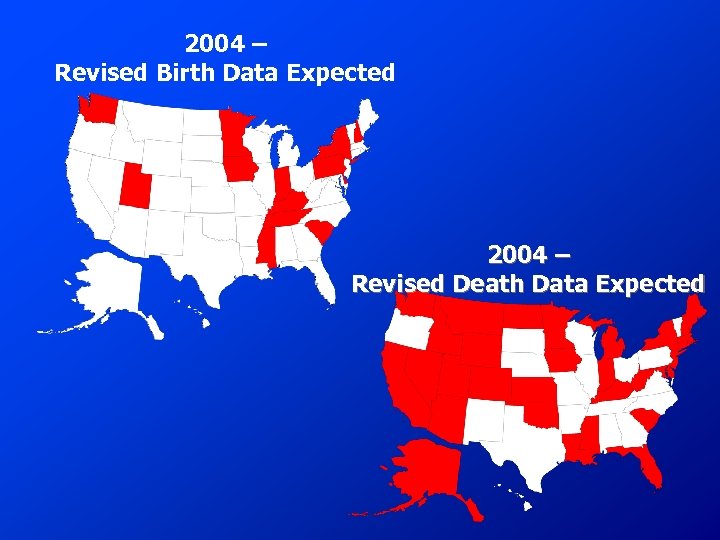 2004 – Revised Birth Data Expected 2004 – Revised Death Data Expected