


 Скачать презентацию The National Violent Death Reporting System NVDRS Thomas
5bf9c80dbabdc1fdcc3904da3c039fb3.ppt
- Количество слайдов: 34
 The National Violent Death Reporting System (NVDRS) Thomas Songer, Ph. D, MSc, MPH University of Pittsburgh
 Background • >50, 000 Americans died from violence in 2000 • Violence is a particular scourge of the young: – Homicide is the second leading cause of death in the 1 -34 yrs age group. – Suicide is the third leading cause of death in this age group. Paulozzi, Frazier
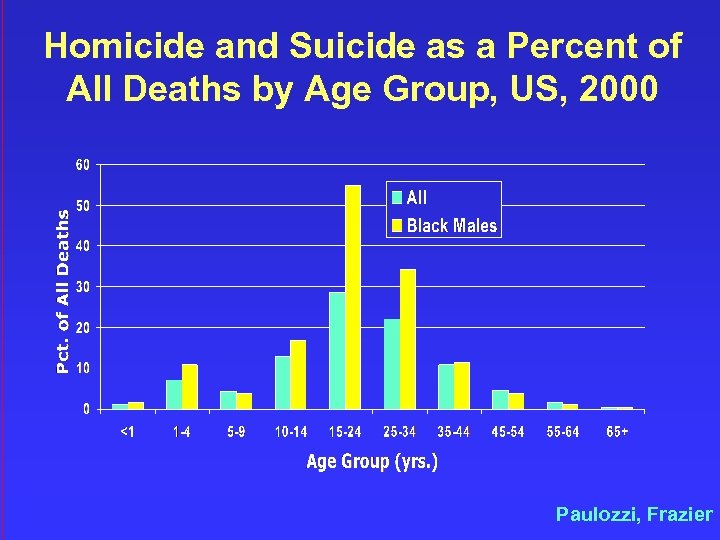 Homicide and Suicide as a Percent of All Deaths by Age Group, US, 2000 Paulozzi, Frazier
 …But We Don’t Know Enough: • Death certificates don’t mention suspects and can’t combine deaths in one incident • Supplementary Homicide Reports cover only homicides and carry little information • The National Incident Based Reporting System has trouble getting law enforcement buy-in in addition to other deficiencies Paulozzi, Frazier
 Why Not Just Go to the Original Sources? • Law enforcement information describes what happened before death • Medical examiner/coroner files contains information collected after death • Death certificates describe the person, not what happened. • In short, we need something new to compile multiple sources to get the full picture. Paulozzi, Frazier
 The NVDRS
 The History of the NVDRS • Conception: 1999 Institute of Medicine Report recommends the creation of a national fatal intentional injury surveillance system • Early pilot: 1999 Six foundations start the National Violent Injury Statistics System (NVISS) in academic test tubes Paulozzi, Frazier
 History – Continued • 2000 NVISS gets under way at 12 sites, mostly universities • 2000 Harvard and the Joyce Foundation convene an expert meeting that suggests the CDC direct a publicly funded system • 2000 CDC starts planning Paulozzi, Frazier
 Finally, NVDRS Is Born • Feb, 2002 Congress’s first appropriation ($1. 5 million) • Sept, 2002 CDC funds 6 of 17 applying: MA, MD, NJ, OR, SC, and VA • Feb, 2003 Second appropriation • Aug. , 2003 CDC funds 7 of 16 applying: AK, CO, GA, NC, OK, RI, WI Paulozzi, Frazier
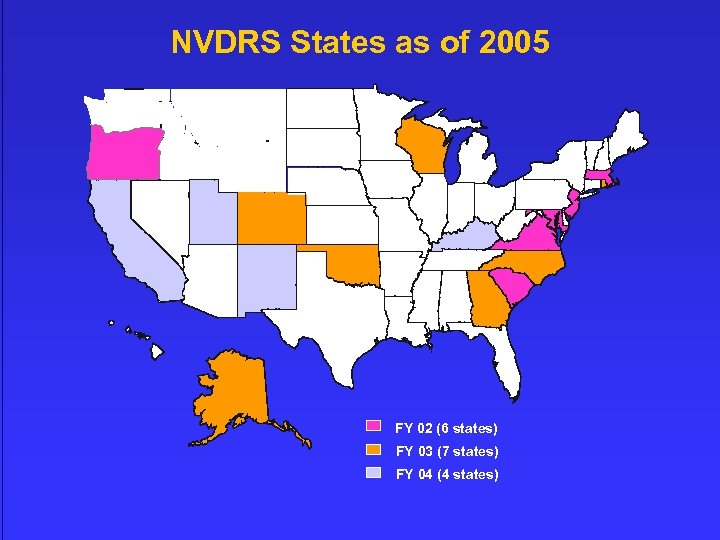 NVDRS States as of 2005 FY 02 (6 states) FY 03 (7 states) FY 04 (4 states)
 The NVDRS is a multi-source violent death surveillance system
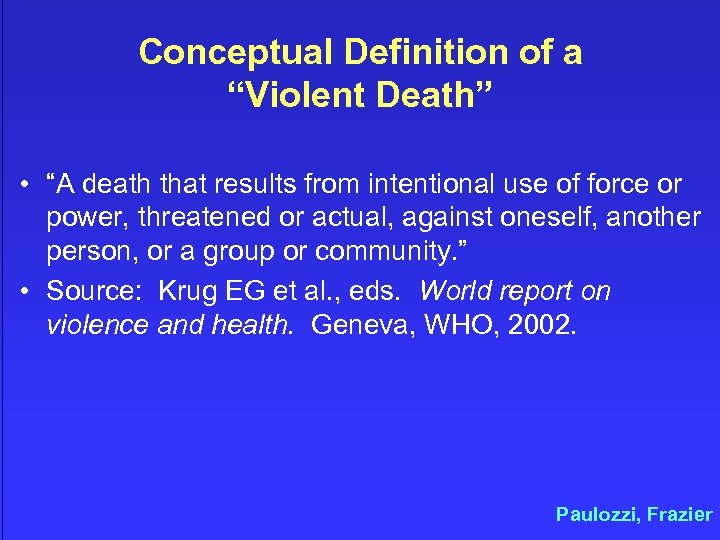 Conceptual Definition of a “Violent Death” • “A death that results from intentional use of force or power, threatened or actual, against oneself, another person, or a group or community. ” • Source: Krug EG et al. , eds. World report on violence and health. Geneva, WHO, 2002. Paulozzi, Frazier
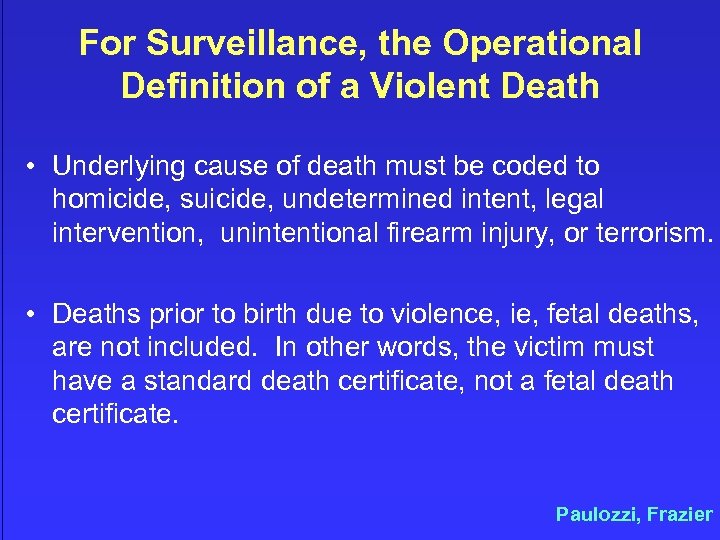 For Surveillance, the Operational Definition of a Violent Death • Underlying cause of death must be coded to homicide, suicide, undetermined intent, legal intervention, unintentional firearm injury, or terrorism. • Deaths prior to birth due to violence, ie, fetal deaths, are not included. In other words, the victim must have a standard death certificate, not a fetal death certificate. Paulozzi, Frazier
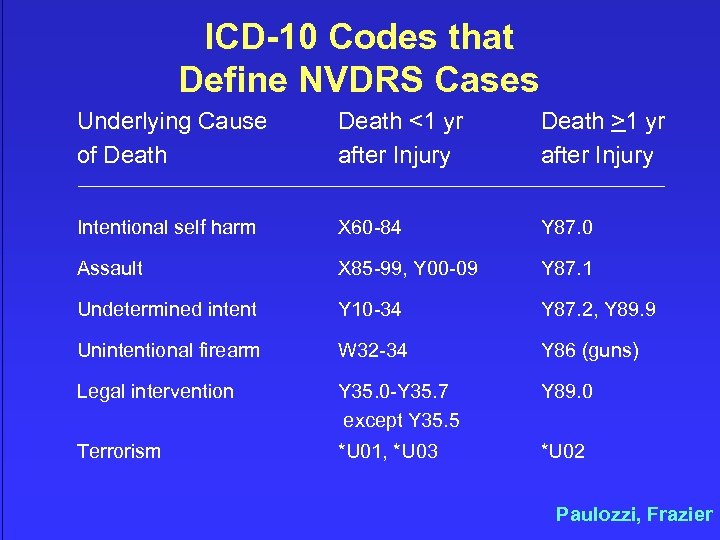 ICD-10 Codes that Define NVDRS Cases Underlying Cause of Death <1 yr after Injury Death >1 yr after Injury Intentional self harm X 60 -84 Y 87. 0 Assault X 85 -99, Y 00 -09 Y 87. 1 Undetermined intent Y 10 -34 Y 87. 2, Y 89. 9 Unintentional firearm W 32 -34 Y 86 (guns) Legal intervention Y 35. 0 -Y 35. 7 except Y 35. 5 Y 89. 0 Terrorism *U 01, *U 03 *U 02 Paulozzi, Frazier
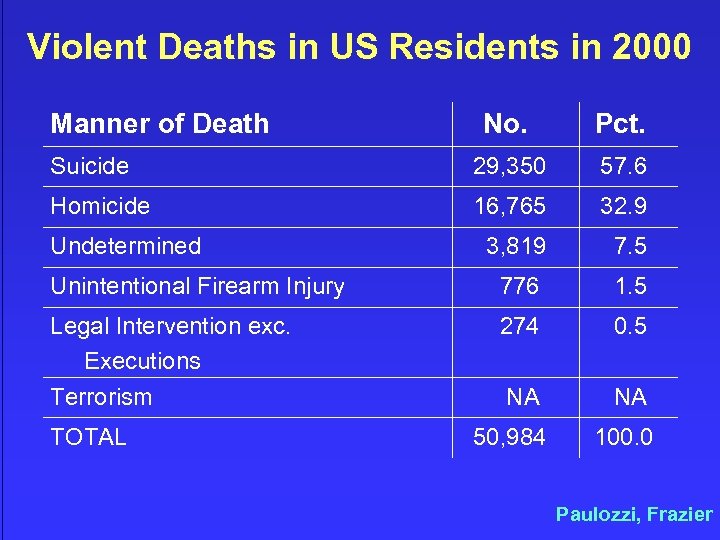 Violent Deaths in US Residents in 2000 Manner of Death No. Pct. Suicide 29, 350 57. 6 Homicide 16, 765 32. 9 3, 819 7. 5 Unintentional Firearm Injury 776 1. 5 Legal Intervention exc. Executions Terrorism 274 0. 5 NA NA 50, 984 100. 0 Undetermined TOTAL Paulozzi, Frazier
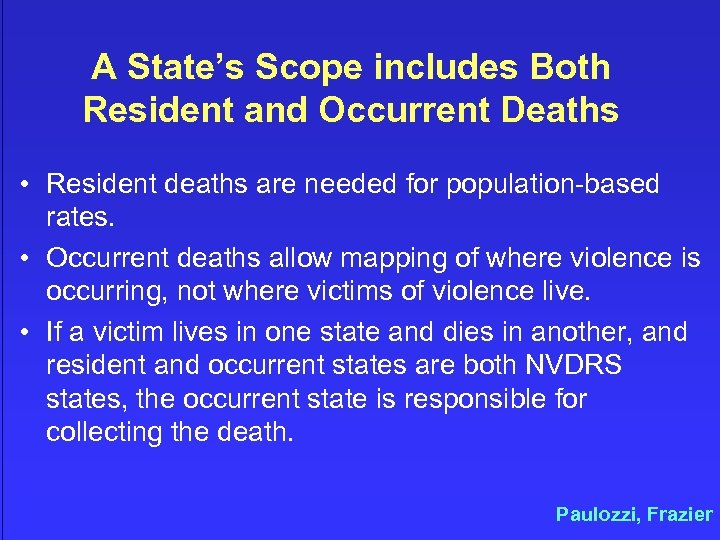 A State’s Scope includes Both Resident and Occurrent Deaths • Resident deaths are needed for population-based rates. • Occurrent deaths allow mapping of where violence is occurring, not where victims of violence live. • If a victim lives in one state and dies in another, and resident and occurrent states are both NVDRS states, the occurrent state is responsible for collecting the death. Paulozzi, Frazier
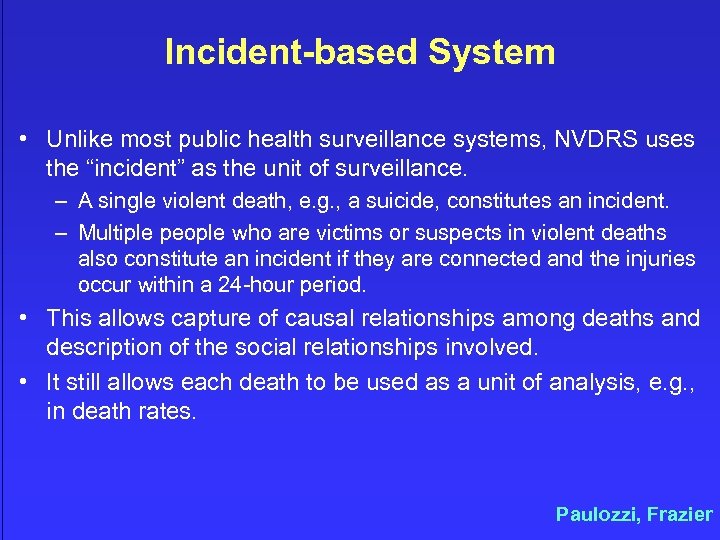 Incident-based System • Unlike most public health surveillance systems, NVDRS uses the “incident” as the unit of surveillance. – A single violent death, e. g. , a suicide, constitutes an incident. – Multiple people who are victims or suspects in violent deaths also constitute an incident if they are connected and the injuries occur within a 24 -hour period. • This allows capture of causal relationships among deaths and description of the social relationships involved. • It still allows each death to be used as a unit of analysis, e. g. , in death rates. Paulozzi, Frazier
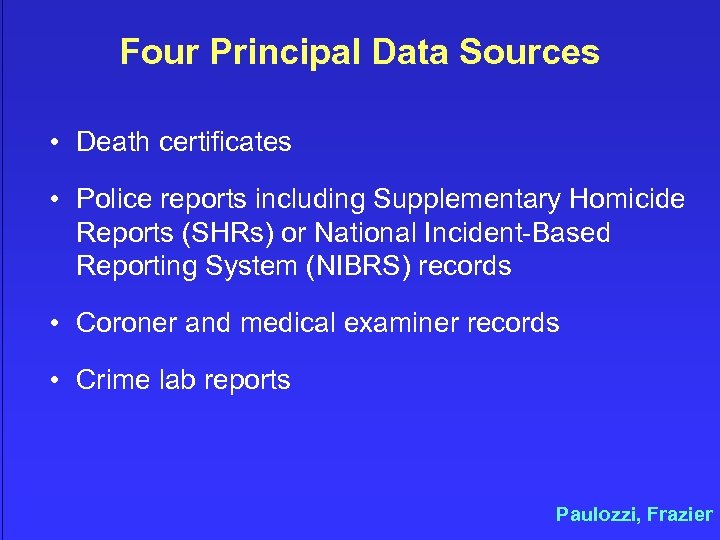 Four Principal Data Sources • Death certificates • Police reports including Supplementary Homicide Reports (SHRs) or National Incident-Based Reporting System (NIBRS) records • Coroner and medical examiner records • Crime lab reports Paulozzi, Frazier
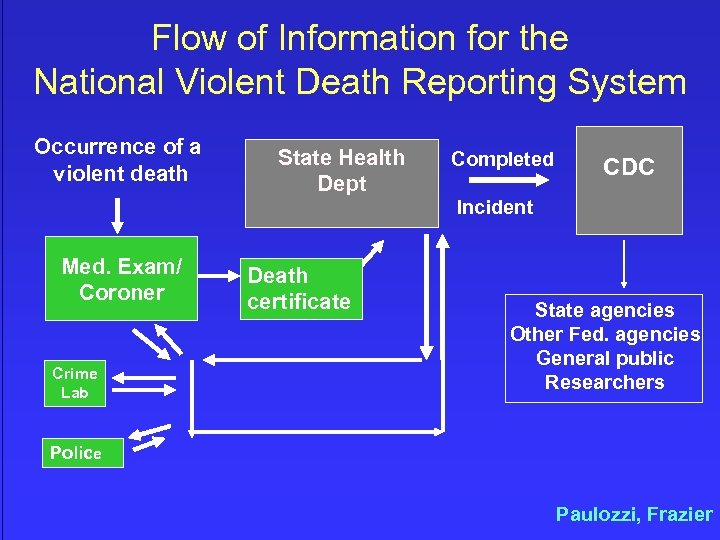 Flow of Information for the National Violent Death Reporting System Occurrence of a violent death State Health Dept Completed CDC Incident Med. Exam/ Coroner Crime Lab Death certificate State agencies Other Fed. agencies General public Researchers Police Paulozzi, Frazier
 The Death Certificate Typically Starts the Case-finding Process • Deaths meeting the case definition are identified from those received at the state DOH Paulozzi, Frazier
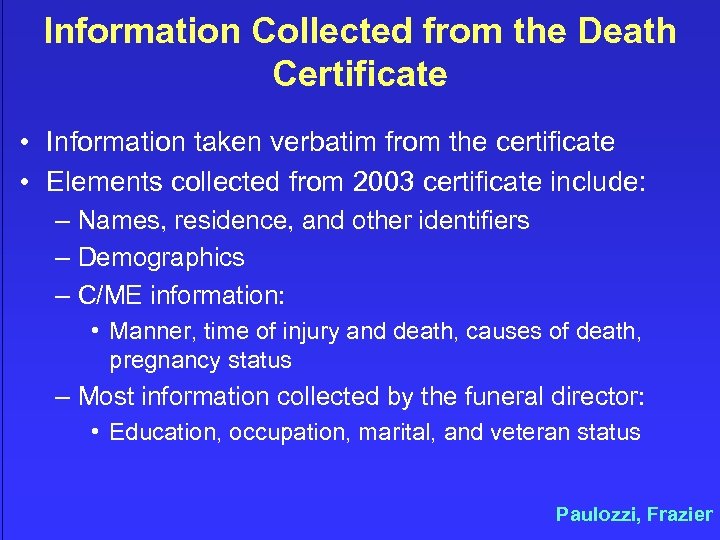 Information Collected from the Death Certificate • Information taken verbatim from the certificate • Elements collected from 2003 certificate include: – Names, residence, and other identifiers – Demographics – C/ME information: • Manner, time of injury and death, causes of death, pregnancy status – Most information collected by the funeral director: • Education, occupation, marital, and veteran status Paulozzi, Frazier
 Coroner/Medical Examiner information is an important second source • C/ME data is not standardized. Some offices are computerized with commercial software, but most use paper. • The files are mostly narrative plus toxicology and autopsy reports. • Relatively little about suspects Paulozzi, Frazier
 Types of Information Recorded from C/ME Records into NVDRS • • • A brief narrative of the incident Identifiers and demographics Toxicology test results, including victim BAC Wound locations Circumstances associated with suicides, homicides, and unintentional firearm deaths • Weapon information • Relationships among involved persons (if available) Paulozzi, Frazier
 Law Enforcement Records are another source of information in NVDRS • Information stored in ways ranging from almost entirely coded forms to almost entirely narratives. • Some national standards exist for some information, eg, Supplementary Homicide Reports, and National Incident Based Reporting Systems • Less recorded on suicides than homicides • More on suspects and weapons than in C/ME files Paulozzi, Frazier
 Types of Information Recorded from Law Enforcement Records into NVDRS • • • A brief narrative of the incident Identifiers and demographics Suspicion of intoxication Wound locations Circumstances associated with suicides, homicides, and unintentional firearm deaths • Weapon information • Relationships among involved persons Paulozzi, Frazier
 Information Collected from Crime Labs • Firearm information only • Not obtained by law enforcement for every firearm • Reports found in C/ME or Police files or obtained separately. • Information includes: – Type, make, and model – Caliber or gauge – Serial number – Importer’s name and address Paulozzi, Frazier
 Data Elements in NVDRS • Victim demographics • Information on the incident • • • – (where, when, who) Weapon type Autopsy results Current judicial standing Circumstance elements Narrative describing the incident
 Data Elements Overlap • Data is kept sorted by source • Elements are not unique to one source, that is, same information can be available from >1 source • Number of unique data elements is < 250. Paulozzi, Frazier
 Circumstances surrounding violent deaths are often not reported • Only 40% of violent deaths have circumstance data from both ME and police • Nearly 26% had no circumstance information • Only ~6% had information only from police • Suicides (87%) and undetermined deaths (79%) more likely to have circumstance information than homicides (49%) • Circumstance information critical for developing effective prevention programs
 A Fifth Data Source Under Development: Child Fatality Review Teams (CFRT) • CFRTs merge data on child deaths from the 4 primary sources and multiple others • They have a particular interest in uncovering violent deaths • They offer unique information on the victim’s household, caregivers, supervision, and previous contacts with the system Paulozzi, Frazier
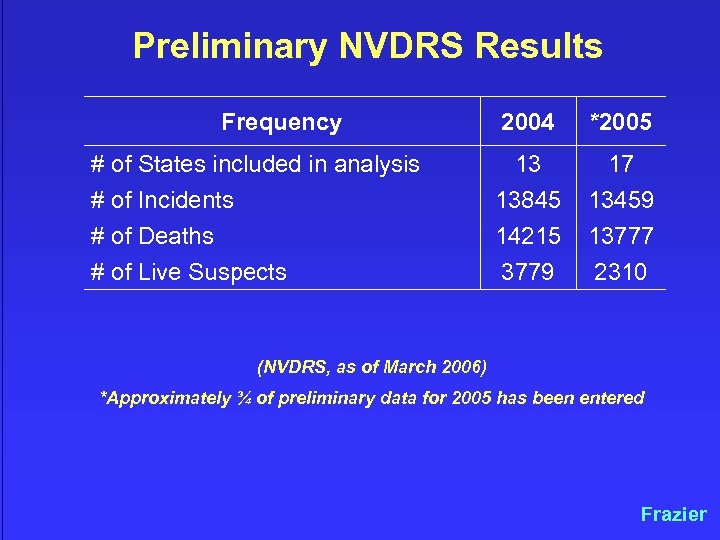 Preliminary NVDRS Results Frequency 2004 *2005 # of States included in analysis # of Incidents # of Deaths 13 13845 14215 17 13459 13777 # of Live Suspects 3779 2310 (NVDRS, as of March 2006) *Approximately ¾ of preliminary data for 2005 has been entered Frazier
 Preliminary NVDRS Results: Manner of Death; 13 states, 2004, N=13 For 44 cases Abstractor Assigned Manner of death is missing, mostly pending cases. (NVDRS, as of March 2006) Frazier
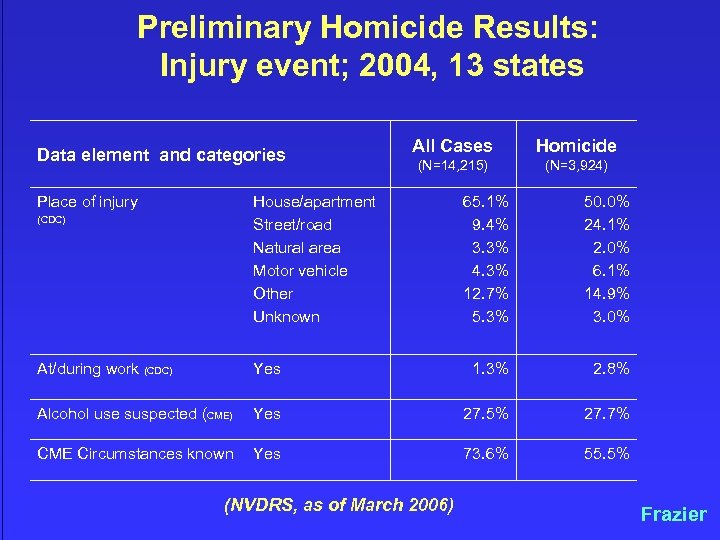 Preliminary Homicide Results: Injury event; 2004, 13 states Data element and categories Place of injury All Cases Homicide (N=14, 215) (N=3, 924) House/apartment Street/road Natural area Motor vehicle Other Unknown (CDC) 65. 1% 9. 4% 3. 3% 4. 3% 12. 7% 5. 3% 50. 0% 24. 1% 2. 0% 6. 1% 14. 9% 3. 0% At/during work (CDC) Yes 1. 3% 2. 8% Alcohol use suspected (CME) Yes 27. 5% 27. 7% CME Circumstances known Yes 73. 6% 55. 5% (NVDRS, as of March 2006) Frazier
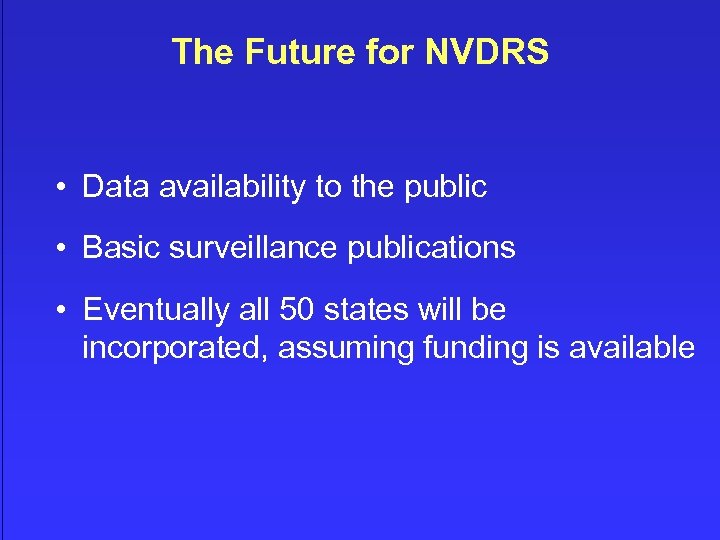 The Future for NVDRS • Data availability to the public • Basic surveillance publications • Eventually all 50 states will be incorporated, assuming funding is available