


 Скачать презентацию The National Land Imaging Program NLIP Ensuring Operational
0f93d01d3fde800a777f59e56e0e0445.ppt
- Количество слайдов: 29
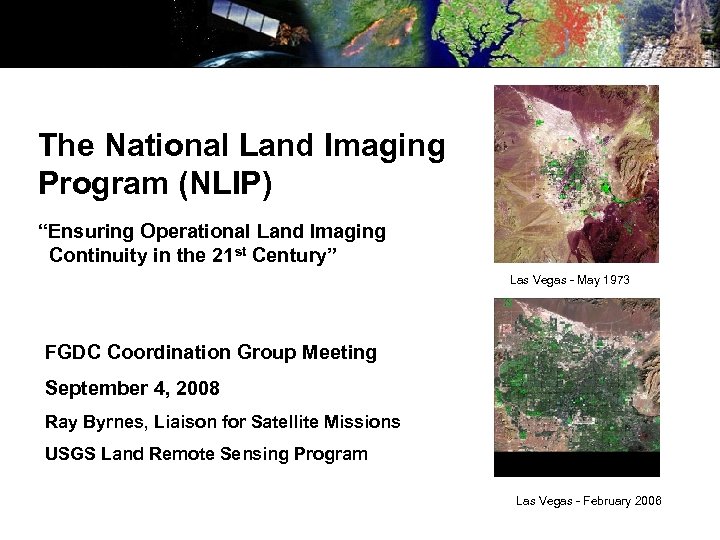 The National Land Imaging Program (NLIP) “Ensuring Operational Land Imaging Continuity in the 21 st Century” Las Vegas - May 1973 FGDC Coordination Group Meeting September 4, 2008 Ray Byrnes, Liaison for Satellite Missions USGS Land Remote Sensing Program U. S. Department of the Interior U. S. Geological Survey Las Vegas - February 2006
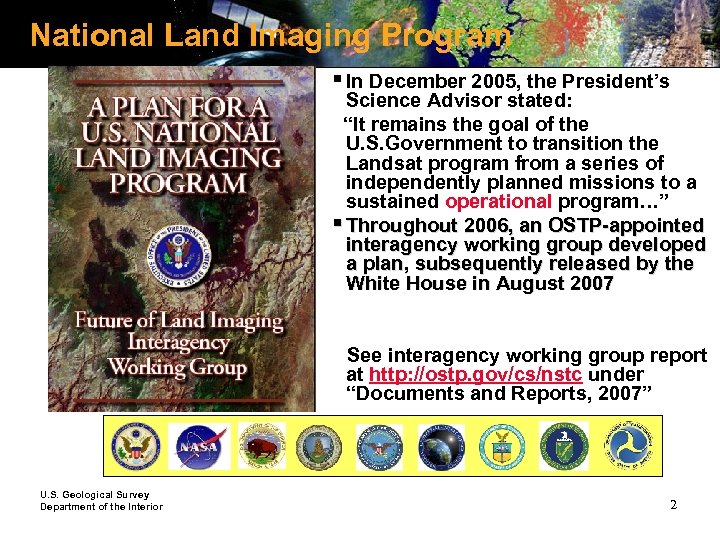 National Land Imaging Program § In December 2005, the President’s Science Advisor stated: “It remains the goal of the U. S. Government to transition the Landsat program from a series of independently planned missions to a sustained operational program…” § Throughout 2006, an OSTP-appointed interagency working group developed a plan, subsequently released by the White House in August 2007 See interagency working group report at http: //ostp. gov/cs/nstc under “Documents and Reports, 2007” U. S. Geological Survey Department of the Interior 2
 Why NLIP? § § § No long-term U. S. commitment for providing Landsat-like data. § Landsat has been a series of independent missions, funded in an ad hoc manner. § No U. S. agency has responsibility to meet U. S. operational requirements. § Advancement of land imaging technology and applications has been delayed or disrupted. No U. S. commercial alternative. § Landsat commercialization has failed twice. § U. S. commercial and foreign systems can augment, but not replace Landsat. No resources to sustain an operational land imaging program for the U. S. § No satellite funding or plans beyond Landsat Data Continuity Mission (LDCM)/Landsat 8. U. S. Geological Survey Department of the Interior 3
 Interagency Working Group Recommendations § The U. S. must commit to continue the collection of moderate-resolution land imagery. § The U. S. should establish and maintain a core operational capability to collect moderate-resolution land imagery through the procurement and launch of a series of U. S. -owned satellites (Landsat 9 and beyond). § The U. S. should establish the National Land Imaging Program, hosted and managed by the Department of the Interior, to meet U. S. civil land imaging needs. U. S. Geological Survey Department of the Interior 4
 Federal Government Responsibilities § National Land Imaging Program (NLIP) Mission: § To serve the Nation by acquiring and providing operational land imaging capabilities and applications to support U. S. economic, environmental, foreign policy, and security interests. § Federal Government to run an operational program to: § Coordinate a Federal Land Imaging Council composed of data users and other interested agencies and a (FACA) Land Imaging Advisory Committee; § Gather U. S. land imaging requirements (e. g. data needs); § Manage the acquisition of U. S. land imaging systems and data; § Coordinate acquisition and data distribution plans with U. S. industry, foreign governments, and foreign commercial firms; § Ensure timely data delivery to all users; § Permanently archive these data for future generations; § Develop new applications for Federal, State, local and tribal governments; and § Investigate and develop new remote sensing technology to meet land imaging requirements. § Above all else, ensure availability, access, and ease of use of land imaging data for the Nation. U. S. Geological Survey Department of the Interior 5
 NLIP Program Elements § Current (under USGS Land Remote Sensing Program) Landsat 5 and 7 satellite and data operations. Landsat Data Continuity Mission (LDCM)/Landsat 8 Development: Space and Ground Systems development, test, and satellite launch plus satellite and data operations § For current information on Landsat/LDCM see http: //landsat. usgs. gov § § § Proposed (under authorized NLIP) New NLIP Baseline: Stable program management, advanced technology and mission concept studies, new science applications, and outreach initiatives. § Future Land Imager Development: Satellite design and development, ground systems augmentation, and mission and data operations. NASA to provide technical and procurement support. § Expand existing International Cooperator partnerships to augment global collection of moderate-resolution land image data. § U. S. Geological Survey Department of the Interior 6
 NLIP Ground Segment Plans § Multi-Mission USGS Operations: § Operate U. S. Government-owned satellites. § Receive data downlinks from domestic or § § § international government or commercial partners. Purchase global or regional satellite or aerialplatform data sets. Consolidate Landsat data holdings of International Cooperators. Ingest selected “purged” commercial or government data sets. U. S. Geological Survey Department of the Interior 7
 Landsat Data Policy Update § § Updated Landsat data policy was approved in January 2008. § Located at: http: //ldcm. usgs. gov/pdf/Landsat_Data_Policy. pdf Policy Goals § Extend the principles of the Landsat 7 Data Policy established in Section 5615 of U. S. Code Title 15, Chapter 82 to Landsats 1 -7, LDCM, and future U. S. -owned moderate resolution land-image data sets. § The goals ensure § Unenhanced data are available to all users at no more than the Cost § § § of Fulfilling User Requests (COFUR). Timely delivery of unenhanced data to civilian, national security, commercial, and foreign users. U. S. retains ownership of all unenhanced data generated by the Landsat series of satellites. Development of the commercial market for remote sensing data. U. S. Geological Survey Department of the Interior 8
 Backup Materials U. S. Geological Survey Department of the Interior 9
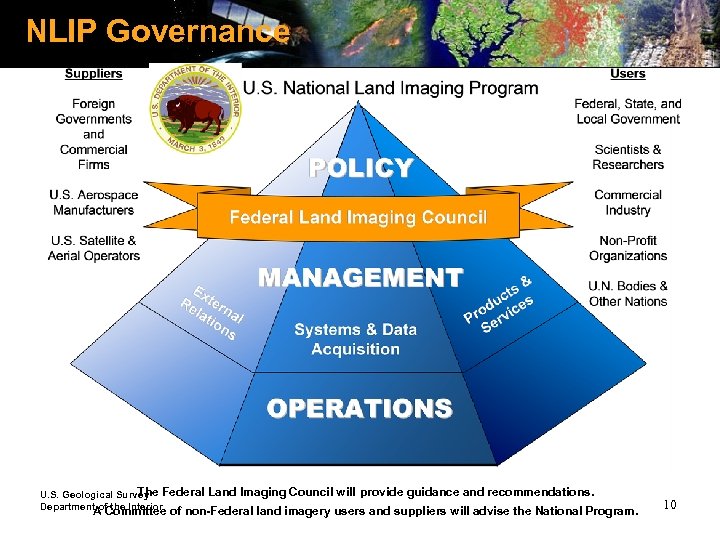 NLIP Governance The Federal Land Imaging Council will provide guidance and recommendations. U. S. Geological Survey Department of the Interior A Committee of non-Federal land imagery users and suppliers will advise the National Program. 10
 USGS Operations for Landsat 8 § Landsat 8: § USGS/EROS to operate satellite and ground § § system. Ground command/control/data-reception network sites under study. Seasonal, global data set collection. Data management and distribution at USGS/EROS. International Cooperators invited to participate; many showing interest in local data reception. U. S. Geological Survey Department of the Interior 11
 Landsat 8 Ground System Status § Requirements development work is nearing completion. § § § Completed Ground System Requirements Review on Sept 26 -27, 2008. Completed the Science and Mission Requirements Document (SMRD) (Level 2) and the Ground System Requirements Document (Level 3). 6 of 8 ground system element requirements reviews completed (Level 4). § § Ground Network Element (GNE) SRR is scheduled for April 10 th. Mission Operations Element (MOE) SRR to be held after NASA’s contract award. Ground System preliminary design activities have commenced. § § Ground System Preliminary Design Review (GSPDR) planned for Nov 2008. Element PDRs are scheduled and will complete before the GSPDR. Ground System Critical Design Review scheduled for April 2009. § Provides the detailed ground system designs for system development. U. S. Geological Survey Department of the Interior 12
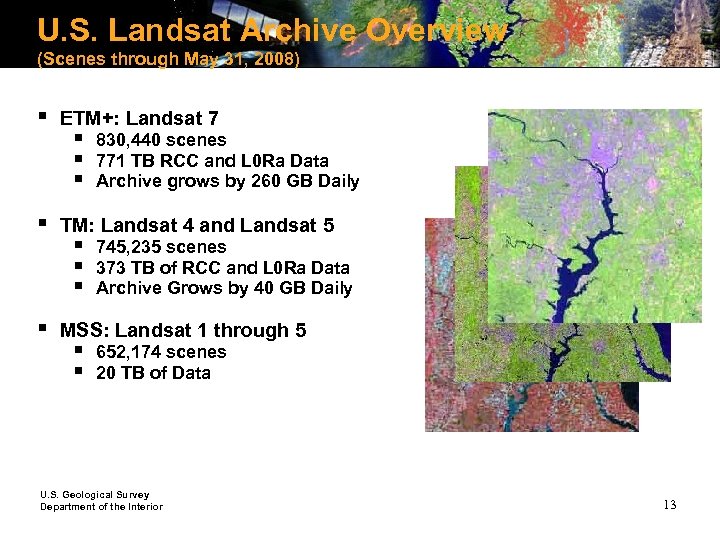 U. S. Landsat Archive Overview (Scenes through May 31, 2008) § ETM+: Landsat 7 § TM: Landsat 4 and Landsat 5 § MSS: Landsat 1 through 5 § § § § 830, 440 scenes 771 TB RCC and L 0 Ra Data Archive grows by 260 GB Daily 745, 235 scenes 373 TB of RCC and L 0 Ra Data Archive Grows by 40 GB Daily 652, 174 scenes 20 TB of Data U. S. Geological Survey Department of the Interior 13
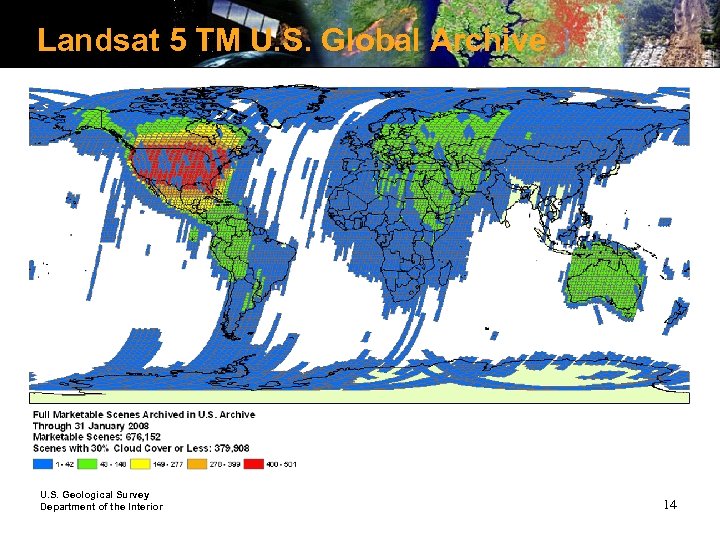 Landsat 5 TM U. S. Global Archive U. S. Geological Survey Department of the Interior 14
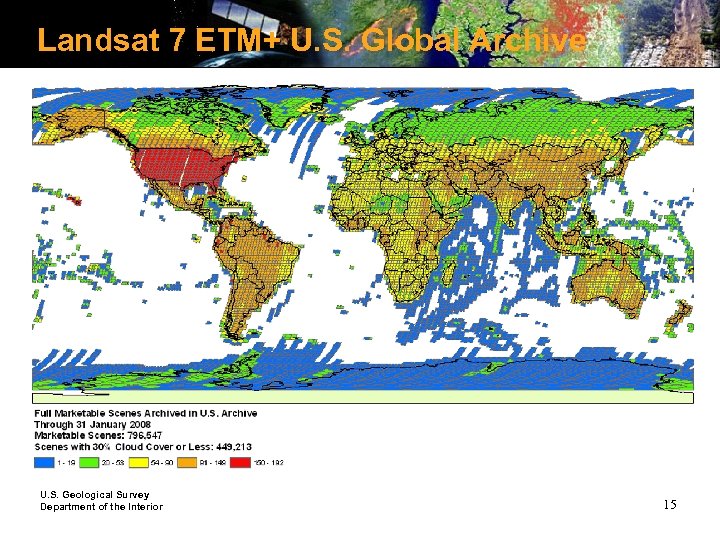 Landsat 7 ETM+ U. S. Global Archive U. S. Geological Survey Department of the Interior 15
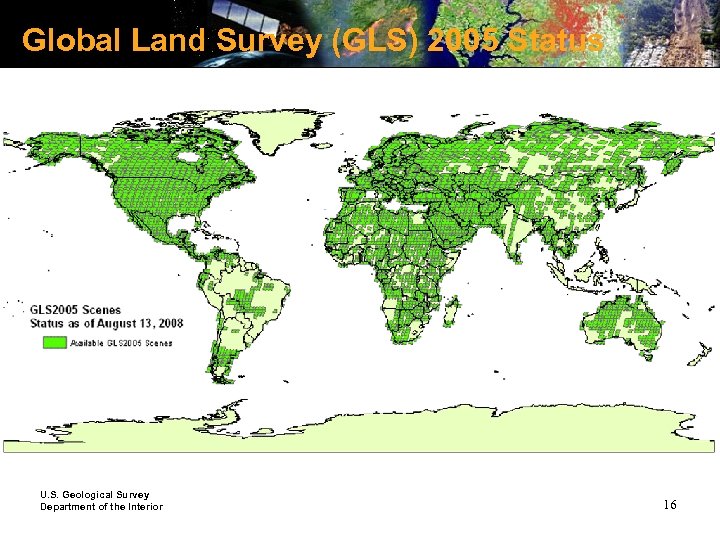 Global Land Survey (GLS) 2005 Status U. S. Geological Survey Department of the Interior 16
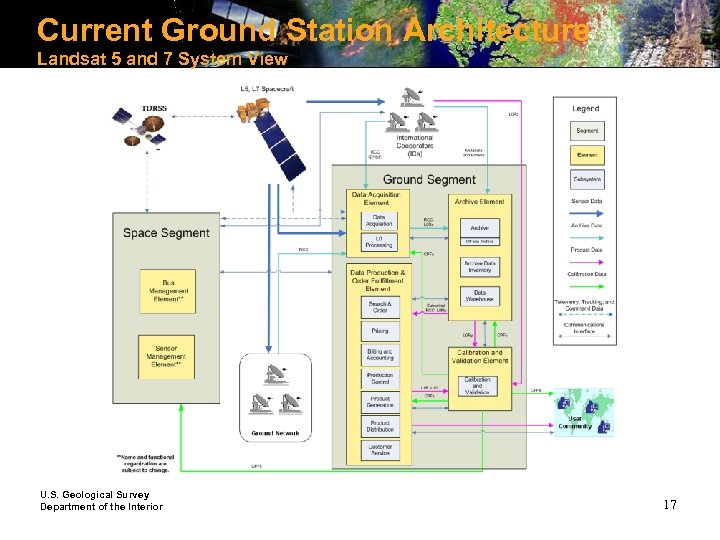 Current Ground Station Architecture Landsat 5 and 7 System View U. S. Geological Survey Department of the Interior 17
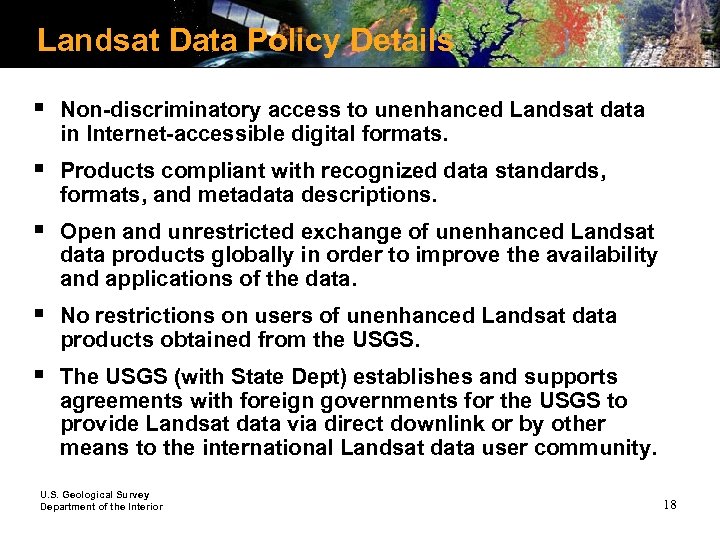 Landsat Data Policy Details § Non-discriminatory access to unenhanced Landsat data in Internet-accessible digital formats. § Products compliant with recognized data standards, formats, and metadata descriptions. § Open and unrestricted exchange of unenhanced Landsat data products globally in order to improve the availability and applications of the data. § No restrictions on users of unenhanced Landsat data products obtained from the USGS. § The USGS (with State Dept) establishes and supports agreements with foreign governments for the USGS to provide Landsat data via direct downlink or by other means to the international Landsat data user community. U. S. Geological Survey Department of the Interior 18
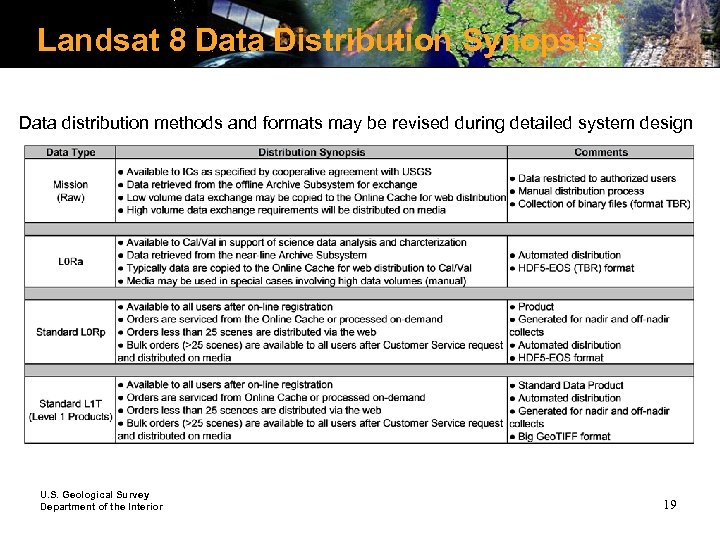 Landsat 8 Data Distribution Synopsis Data distribution methods and formats may be revised during detailed system design U. S. Geological Survey Department of the Interior 19
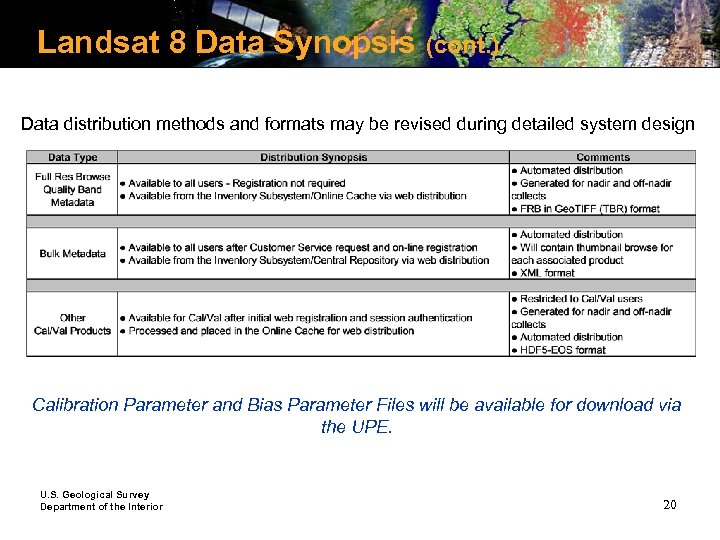 Landsat 8 Data Synopsis (cont. ) Data distribution methods and formats may be revised during detailed system design Calibration Parameter and Bias Parameter Files will be available for download via the UPE. U. S. Geological Survey Department of the Interior 20
 Data Policy – The Bottom Line. . . “In accordance with OMB Circular A-130 and USGS Data Policy, the USGS provides selected satellite data products for retrieval via the Internet at no charge to users. Other products that may be ordered by users from the NSLRSDA are provided at no more than COFUR; this includes special arrangements made for users who require higher volumes of Landsat data products than can be provided by standard USGS distribution mechanisms. ” U. S. Geological Survey Department of the Interior 21
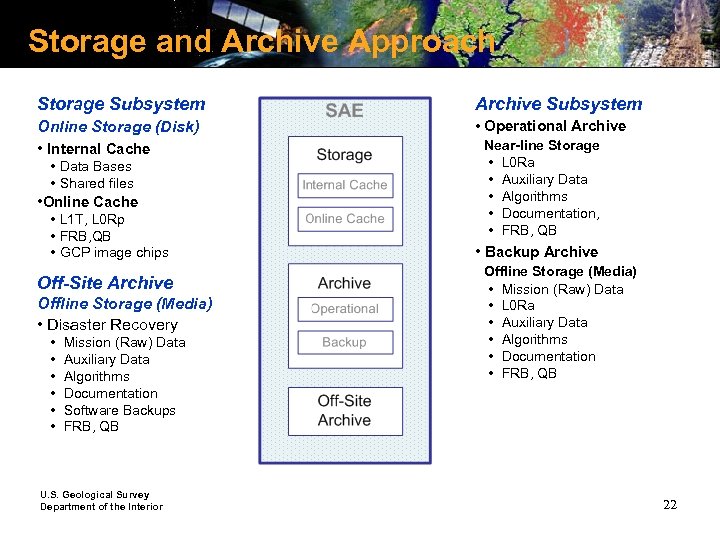 Storage and Archive Approach Storage Subsystem Archive Subsystem Online Storage (Disk) • Internal Cache • Operational Archive Near-line Storage • L 0 Ra • Auxiliary Data • Algorithms • Documentation, • FRB, QB • Data Bases • Shared files • Online Cache • L 1 T, L 0 Rp • FRB, QB • GCP image chips Off-Site Archive Offline Storage (Media) • Disaster Recovery • • • Mission (Raw) Data Auxiliary Data Algorithms Documentation Software Backups FRB, QB U. S. Geological Survey Department of the Interior • Backup Archive Offline Storage (Media) • • • Mission (Raw) Data L 0 Ra Auxiliary Data Algorithms Documentation FRB, QB 22
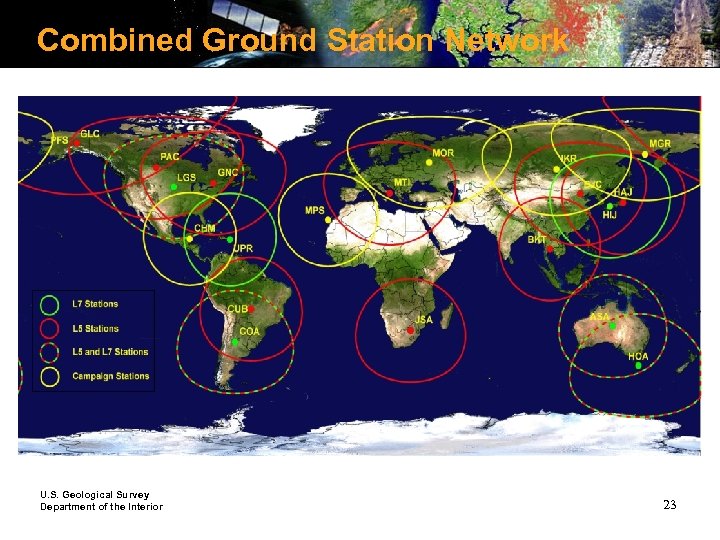 Combined Ground Station Network U. S. Geological Survey Department of the Interior 23
 Landsat Ground Station Historical Perspective § § § Over the past 35 years, over 50 ground stations have been configured to receive Landsat data. Currently, there are 24 ground stations around the world that are configured to operationally receive Landsat data (19 currently active). Beyond the current stations, there are 9 historical collection sites operated by 7 organizations that we believe could have a significant, unique historical archive. U. S. Geological Survey Department of the Interior 24
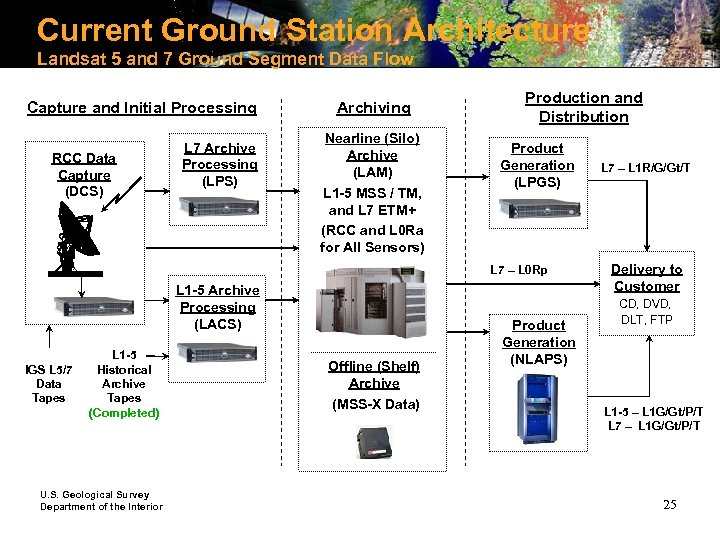 Current Ground Station Architecture Landsat 5 and 7 Ground Segment Data Flow Capture and Initial Processing RCC Data Capture (DCS) L 7 Archive Processing (LPS) Archiving Nearline (Silo) Archive (LAM) L 1 -5 MSS / TM, and L 7 ETM+ (RCC and L 0 Ra for All Sensors) Production and Distribution Product Generation (LPGS) L 7 – L 0 Rp L 1 -5 Archive Processing (LACS) IGS L 5/7 Data Tapes L 1 -5 Historical Archive Tapes (Completed) U. S. Geological Survey Department of the Interior Offline (Shelf) Archive (MSS-X Data) Product Generation (NLAPS) L 7 – L 1 R/G/Gt/T Delivery to Customer CD, DVD, DLT, FTP L 1 -5 – L 1 G/Gt/P/T L 7 – L 1 G/Gt/P/T 25
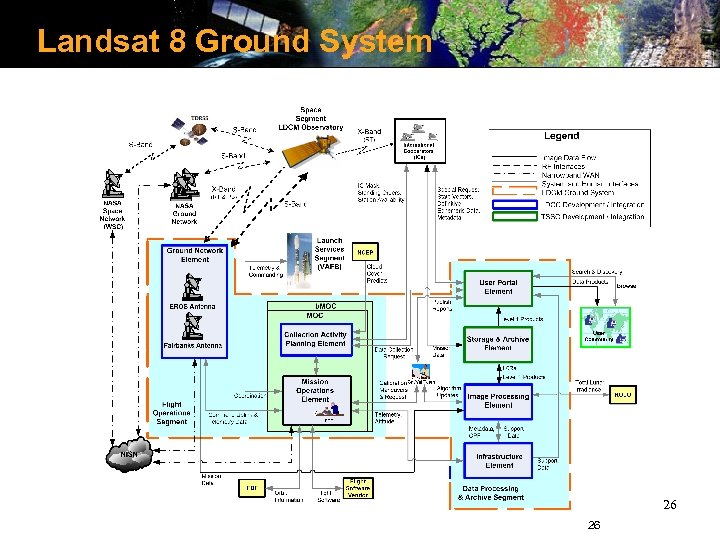 Landsat 8 Ground System U. S. Geological Survey Department of the Interior 26 26
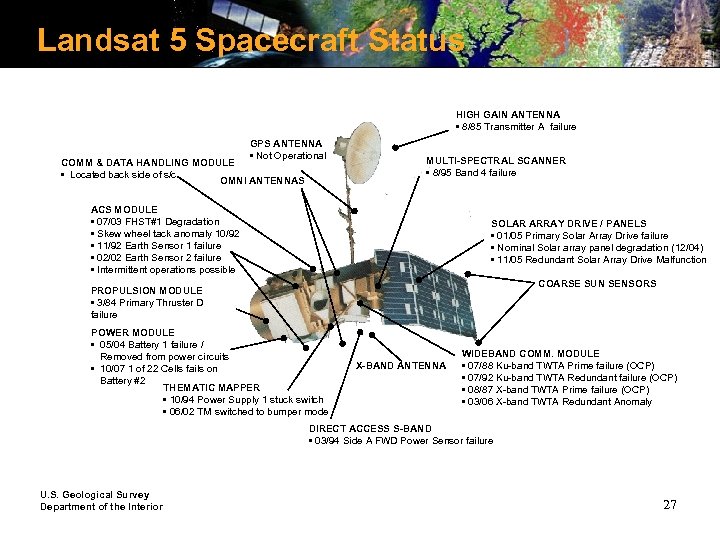 Landsat 5 Spacecraft Status HIGH GAIN ANTENNA • 8/85 Transmitter A failure GPS ANTENNA • Not Operational COMM & DATA HANDLING MODULE • Located back side of s/c OMNI ANTENNAS MULTI-SPECTRAL SCANNER • 8/95 Band 4 failure ACS MODULE • 07/03 FHST#1 Degradation • Skew wheel tack anomaly 10/92 • 11/92 Earth Sensor 1 failure • 02/02 Earth Sensor 2 failure • Intermittent operations possible SOLAR ARRAY DRIVE / PANELS • 01/05 Primary Solar Array Drive failure • Nominal Solar array panel degradation (12/04) • 11/05 Redundant Solar Array Drive Malfunction COARSE SUN SENSORS PROPULSION MODULE • 3/84 Primary Thruster D failure POWER MODULE • 05/04 Battery 1 failure / Removed from power circuits • 10/07 1 of 22 Cells fails on Battery #2 THEMATIC MAPPER • 10/94 Power Supply 1 stuck switch • 06/02 TM switched to bumper mode X-BAND ANTENNA WIDEBAND COMM. MODULE • 07/88 Ku-band TWTA Prime failure (OCP) • 07/92 Ku-band TWTA Redundant failure (OCP) • 08/87 X-band TWTA Prime failure (OCP) • 03/06 X-band TWTA Redundant Anomaly DIRECT ACCESS S-BAND • 03/94 Side A FWD Power Sensor failure U. S. Geological Survey Department of the Interior 27
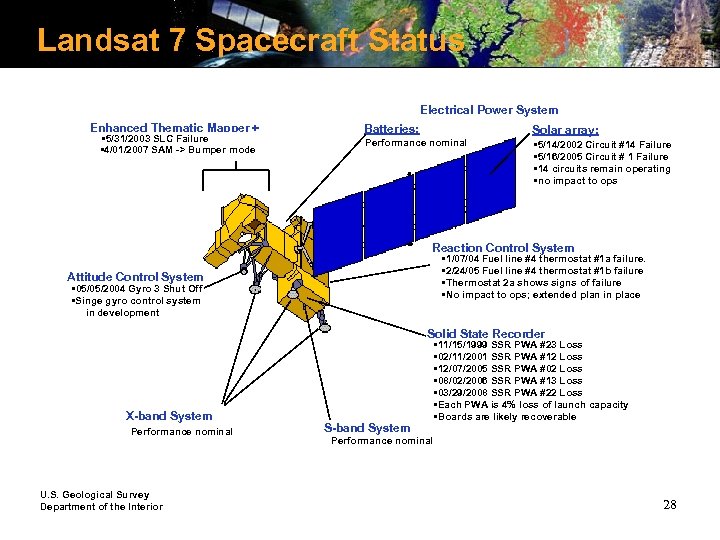 Landsat 7 Spacecraft Status Electrical Power System Enhanced Thematic Mapper + • 5/31/2003 SLC Failure • 4/01/2007 SAM -> Bumper mode Batteries: Solar array: Performance nominal • 5/14/2002 Circuit #14 Failure • 5/16/2005 Circuit # 1 Failure • 14 circuits remain operating • no impact to ops Reaction Control System • 1/07/04 Fuel line #4 thermostat #1 a failure. • 2/24/05 Fuel line #4 thermostat #1 b failure • Thermostat 2 a shows signs of failure • No impact to ops; extended plan in place Attitude Control System • 05/05/2004 Gyro 3 Shut Off • Singe gyro control system in development Solid State Recorder X-band System Performance nominal U. S. Geological Survey Department of the Interior S-band System • 11/15/1999 SSR PWA #23 Loss • 02/11/2001 SSR PWA #12 Loss • 12/07/2005 SSR PWA #02 Loss • 08/02/2006 SSR PWA #13 Loss • 03/29/2008 SSR PWA #22 Loss • Each PWA is 4% loss of launch capacity • Boards are likely recoverable Performance nominal 28
 Landsat Global Archive Consolidation § The USGS is evaluating the process, cost and relative merit for consolidating a copy of the global archive of historical Landsat imagery. § § § § § There is growing concern about the state of historical archives, especially at inactive stations where we have no active contacts. At this point, it is not known what the historical archive extent is. There is an increasing interest from user community and USGS/NASA for more frequent surveys. New tools such as Large Area Scene Selection Interface (LASSI) are being developed and made available to support large scale scene selections/data mining. A consolidated archive would better support/facilitate global change analysis and assessment. Determine the location, extent and condition of the historical Landsat archives around the world. Generate a list of the instrument (RBV, MSS, TM, ETM+), data format and media type at each location. Assess the equipment, software, logistics and level of effort necessary to acquire, ingest, process and archive the data. Develop an estimated cost and schedule for project. U. S. Geological Survey Department of the Interior 29