


 Скачать презентацию The National Environmental Policy Act NEPA Modified from
7f1c7c2bac620fde76d41544dc106777.ppt
- Количество слайдов: 50
 The National Environmental Policy Act (NEPA) (Modified from DOE) NEPA 1
 History 1959 Senator James E. Murry (Mont. ) introduced the “Resources and Conservation Act of 1960” Late 1960’s – Senator Henry Jackson (Wash. ) and Senator John Dingell (Mich. ) collaborated to enact an environmental policy. h Early versions of the legislation contained no policy, goals or action-forcing provisions h Policy and reporting provisions of NEPA added only AFTER the legislation had passed both houses of Congress and been amended by the House-Senate Conference Committee NEPA 2
 Overview The National Environmental Policy Act (NEPA) of 1969 is the basic national charter for protection of the environment. NEPA 3
 Overview NEPA was necessary to ensure that Federal agencies would consider environmental concerns when making decisions, because often the statutes that created the agencies did not include an environmental mandate. NEPA 4
![Overview NEPA: h Established policy [Section 101(a)] h Set goals [Section 101(b)] h Provided](https://present5.com/presentation/7f1c7c2bac620fde76d41544dc106777/image-5.jpg "Overview NEPA: h Established policy [Section 101(a)] h Set goals [Section 101(b)] h Provided") Overview NEPA: h Established policy [Section 101(a)] h Set goals [Section 101(b)] h Provided the means for carrying out policy (Section 102) h Established the Council on Environmental Quality (CEQ) (Section 202) NEPA 5
Overview NEPA: h Established policy [Section 101(a)] h Set goals [Section 101(b)] h Provided the means for carrying out policy (Section 102) h Established the Council on Environmental Quality (CEQ) (Section 202) NEPA 5
 Objectives The objectives of NEPA are to: h Declare a national policy that will encourage productive and enjoyable harmony between man and the environment NEPA 6
 Objectives h Promote efforts that will prevent or eliminate damage to the environment and biosphere and stimulate the health and welfare of man h Enrich the understanding of the ecological systems and natural resources important to the Nation h Establish the CEQ NEPA 7
 Objectives How does NEPA accomplish these objectives? By ensuring considerations of environmental issues before conducting major Federal actions NEPA 8
 Title I Section 101(a) declares NEPA’s general policy: It is the continuing policy. . . to use all practicable means and measures. . . to create and maintain conditions under which man and nature can exist in productive harmony, and fulfill the social, economic, and other requirements of. . . Americans. 9 NEPA
 Title I Section 101(b) sets forth NEPA’s six goals: h Fulfill the responsibilities of each generation as trustee of the environment for succeeding generations h Assure for all Americans safe, healthful, productive, and esthetically and culturally pleasing surroundings NEPA 10
 Title I Section 101 h Attain a wide range of beneficial environmental uses without degradation, risk to health or safety, or other undesirable and unintended consequences NEPA 11
 Title I Section 101 h Preserve important historic, cultural, and natural aspects of our national heritage. . . and maintain. . . an environment that supports diversity, and variety of individual choices NEPA 12
 Title I Section 101 h Achieve a balance between population and resource use that will permit high standards of living and a wide sharing of life’s amenities h Enhance the quality of renewable resources and approach the maximum attainable recycling of depletable resources NEPA 13
 Title I Section 102 contains NEPA’s “actionforcing” provisions, which direct all agencies of the Federal Government to consider environmental impact prior to any recommendation; proposal for legislation; or proposed action, planning, or decisionmaking. NEPA 14
 Title II Section 202 created the CEQ, whose members are appointed by the President and approved by the Senate. NEPA 15
 Title II The duties and functions of the CEQ are: h Assist and advise the President on environmental matters h Gather, analyze, and interpret information concerning the quality of the environment h Review and appraise Federal Government programs and activities NEPA 16
 Title II h Develop and recommend to the President national policies to improve environmental quality h Conduct investigations, studies, surveys, research, and analyses relating to ecological systems and environmental quality NEPA 17
 Title II h Document and define changes in the natural environment h Report to the President on the state and condition of the environment h Make and furnish to the President studies, reports, and recommendations regarding policy and legislation NEPA 18
 NEPA Compliance Environmental review planning is: h An integral part of an integrated environmental compliance planning strategy h Should be considered early in the planning process NEPA 19
 NEPA Compliance Integrated environmental compliance: h Avoids or minimizes environmentally related delayed construction starts h Avoids or minimizes premature commitment of project resources NEPA 20
 NEPA Compliance h Allows for stepwise, progressive decisionmaking h Avoids prejudicing the NEPA review h Will likely facilitate subsequent permitting processes through its GOAL! early EIS preparation effort NEPA 21
 NEPA Documentation The NEPA processes and documents required by CEQ regulations and DOE NEPA guidelines are as follows: h Categorical Exclusion (CX) h EA h EIS NEPA GUIDELINES NEPA 22
 Categorical Exclusion A CX: h Is a category of actions that individually or cumulatively have no significant effect on the quality of the human environment h Does not require an EA or EIS and documentation does not need to be submitted when a CX is applied NEPA 23
 Categorical Exclusion 10 CFR 1021 includes guidance on levels of NEPA documentation h Examples of actions that can be categorically excluded are in Tables 1 -1 and 1 -2 NEPA 24
 Categorical Exclusions Examples of EM Categorical Exclusions h CERCLA removals h Waste sorting, characterizing, overpacking facility (not HLW) h Modifications for waste minimization/reuse of materials NEPA 25
 Environmental Assessment An EA has three functions: h To determine whether a proposed action requires an EIS h To aid an agency’s compliance with NEPA when an EIS is not necessary h To facilitate preparation of an EIS when necessary NEPA 26
 Environmental Assessment CEQ regulations state that an EA should briefly discuss: h The need for the proposal h The environmental impacts of the proposed action and alternatives h A listing of agencies and persons consulted h Alternatives as required by NEPA Section 102(2)(E) NEPA 27
 Actions Requiring an EA Examples of EM EA actions h Siting/construction/operation of water treatment facilities h Siting/construction/operations of R&D/ non -hazardous waste incinerators h Siting/construction/operation of on-site waste storage facilities (not HLW) NEPA 28
 Finding of No Significant Impact h A FONSI explains why an action will not have significant effects on the human environment, and therefore will not require an EIS h The public must be notified that a FONSI has been issued h A FONSI or proposed FONSI with effects of national concern must be published in the Federal Register NEPA 29
 Finding of No Significant Impact The FONSI does not have a strictly defined format, but generally should include: h A summary of the proposed action h Availability - how to obtain the EA h Contact name for additional information h Proposed action - brief description NEPA 30
 Finding of No Significant Impact h Background information h Environmental impacts h Alternatives considered h Determination of the finding NEPA 31
 Actions Requiring an EIS Examples of EM EIS actions h Decommissioning of uranium enrichment facilities h Decommissioning of reactors h Decommissioning of nuclear fuel reprocessing facilities NEPA 32
 Actions Requiring an EIS Examples of EM EIS Actions (cont. ) h Siting/construction/operation of a major HLW treatment, storage, disposal facilities h Siting/construction/operation of waste disposal facility for TRU waste h Siting/construction/operation of incinerators (other than R&D or nonhazardous waste) NEPA 33
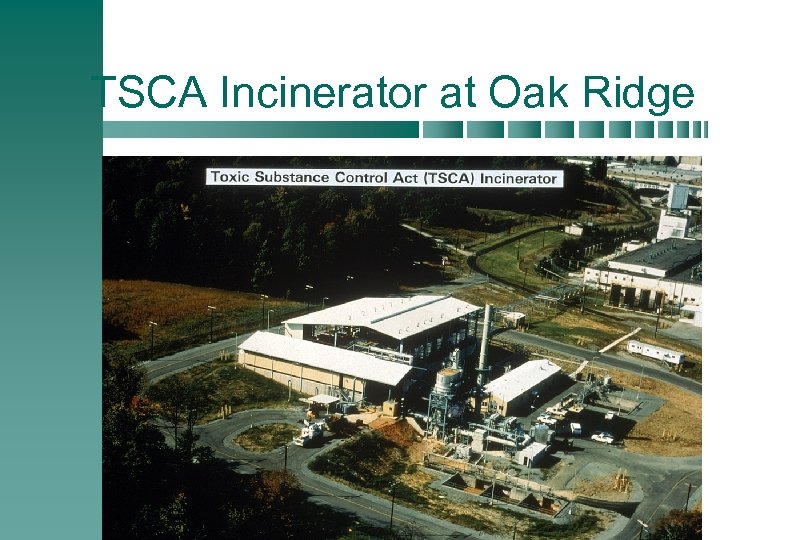 TSCA Incinerator at Oak Ridge NEPA 34
 Scoping is a process that solicits public input to the EIS process to ensure that: h Issues are identified early and properly studied h Insignificant issues do not consume time and effort h The draft EIS is thorough and balanced NEPA 35
 Notice of Intent An NOI is published in the Federal Register to let the public know that an EIS will be prepared. This publication initiates: h At a minimum, the 30 -day public comment period h The EIS process NEPA 36
 Notice of Intent An NOI should include: h A description of the proposed action and possible alternatives h The DOE’s proposed scoping process h The name and address of a DOE contact person NEPA 37
 Environmental Impact Statement h The EIS ensures that the policies and goals defined in NEPA are introduced into the programs and actions of the Federal Government h The EIS is to be used by Federal officials (with other relevant material) to plan actions and make decisions NEPA 38
 Environmental Impact Statement An EIS should include the following: h Cover sheet h Summary h Table of Contents h Purpose of and need for action h Alternatives (including proposed action) h Affected environment NEPA 39
 Environmental Impact Statement h Environmental impacts (effects) h List of preparers h List of agencies, organizations, and persons to whom copies of the statement are sent h Appendices (if any) NEPA 40
 Environmental Impact Statement h The EIS ensures that the policies and goals defined in NEPA are introduced into the programs and actions of the Federal Government h The EIS is to be used by Federal officials (with other relevant material) to plan actions and make decisions NEPA 41
 NEPA Document Distribution procedures for any NEPA document must be decided on a case-bycase basis taking into consideration: h The nature of the action h The extent of public interest NEPA 42
 Notice of Availability h The Environmental Protection Agency (EPA) publishes in the Federal Register a weekly NOA of Draft EISs filed during the previous week q This notice begins the review period for an EIS NEPA 43
 Public Hearings The CEQ guidance for public hearings is found in 40 CFR 1506. 6, which states that an agency shall hold or sponsor public meetings or hearings whenever appropriate or required by statute. NEPA 44
 Record of Decision A ROD is published in the Federal Register. It: h States the decision by the DOE h Identifies all alternatives considered h Specifies the alternative(s) considered to be environmentally preferable h States whether all practical means to avoid or minimize environmental harm from the alternative(s) selected have been adopted NEPA 45
 Supplements to draft or final EISs are prepared if there are: h Substantial changes made in the proposed action relevant to environmental concerns h Significant new circumstances or information affecting the proposed action or its impacts relevant to environmental concerns NEPA 46
 NEPA Integration With Other Laws and Regulations The CEQ regulations state that agencies shall integrate NEPA requirements with other planning and environmental review procedures required by law so that the procedures run concurrently rather than consecutively. NEPA 47
 NEPA Integration With Other Laws and Regulations Once the applicable environmental regulations have been identified, one must: h Affirm the applicability of specific environmental regulations h Assist in understanding the implementing regulations h Determine the activities required for compliance NEPA 48
 NEPA Integration With Other Laws and Regulations h Determine the sequence and timing of activities h Determine the relationship of the regulations to the NEPA process h Identify other environmental documents that might be needed or should be coordinated with the NEPA document NEPA 49
 NEPA Integration With Other Laws and Regulations h Identify agency coordination requirements h Identify restrictions that have the potential for delaying or halting the project h Determine the approximate time required for compliance h Identify the regulatory/consulting agency NEPA 50