


 Скачать презентацию The multiscale dynamics sparks and lightning of Ute
82874156884a0c82d2a588a3d0b4ecc3.ppt
- Количество слайдов: 39
 The multiscale dynamics sparks and lightning of Ute Ebert CWI Amsterdam and TU Eindhoven http: //homepages. cwi. nl/~ebert/
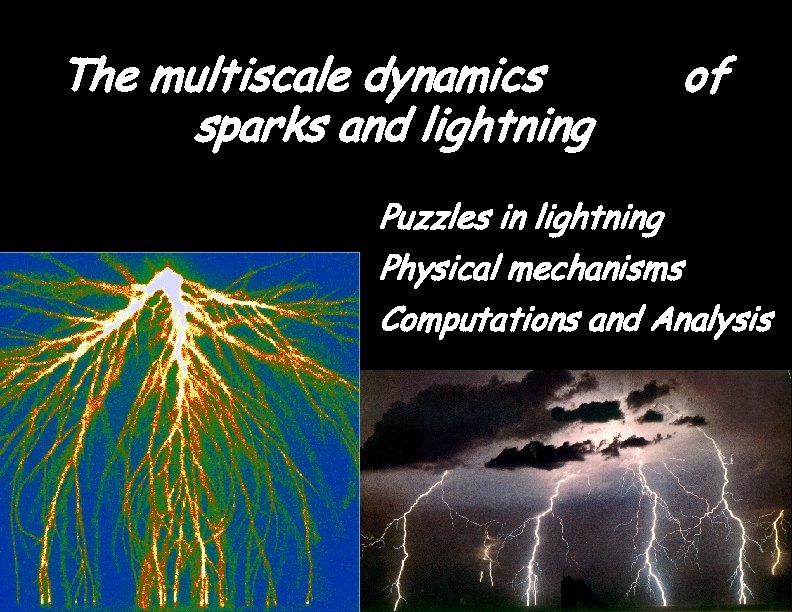 The multiscale dynamics sparks and lightning of Puzzles in lightning Physical mechanisms Computations and Analysis
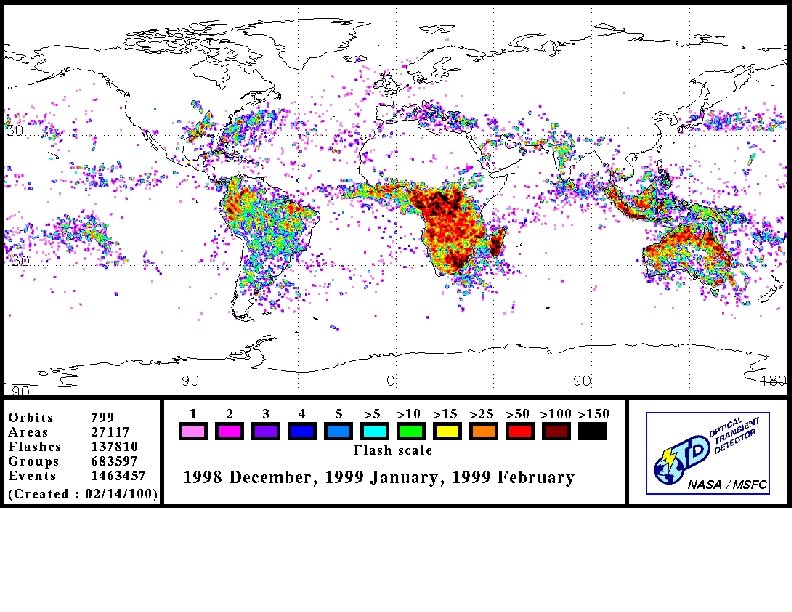
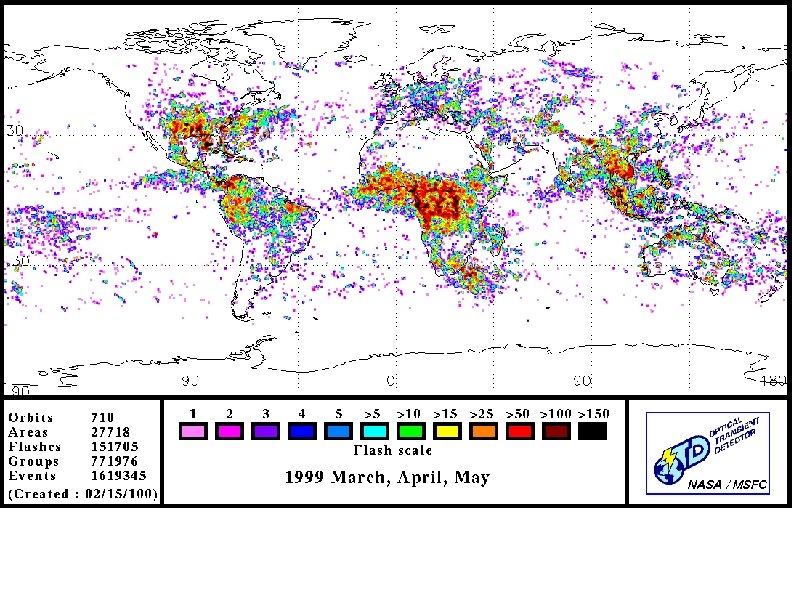
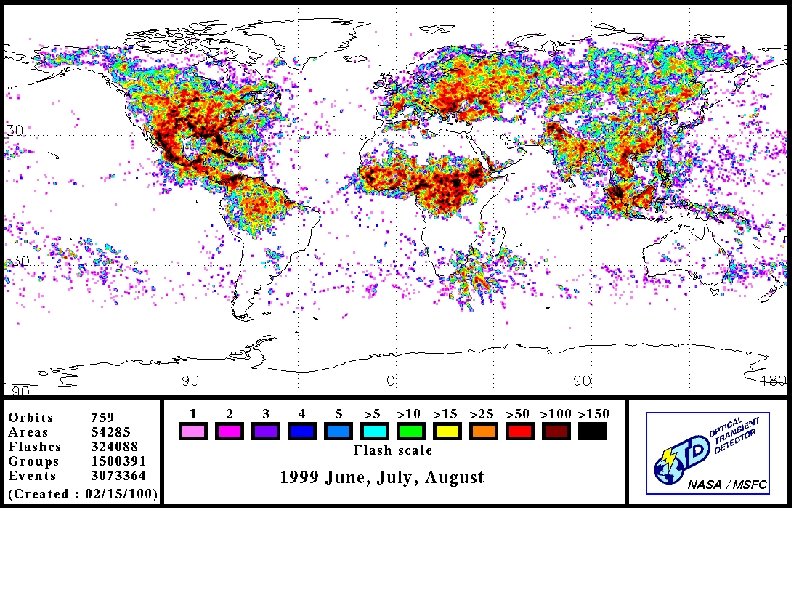
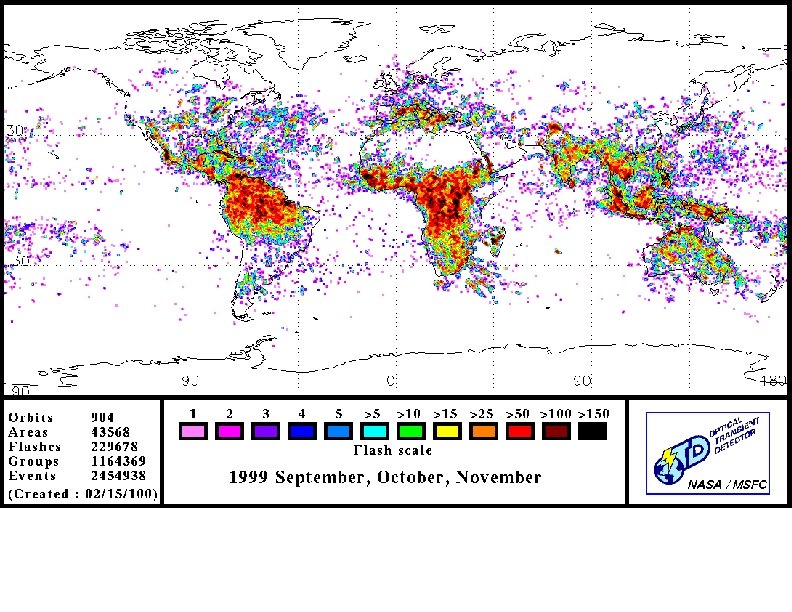
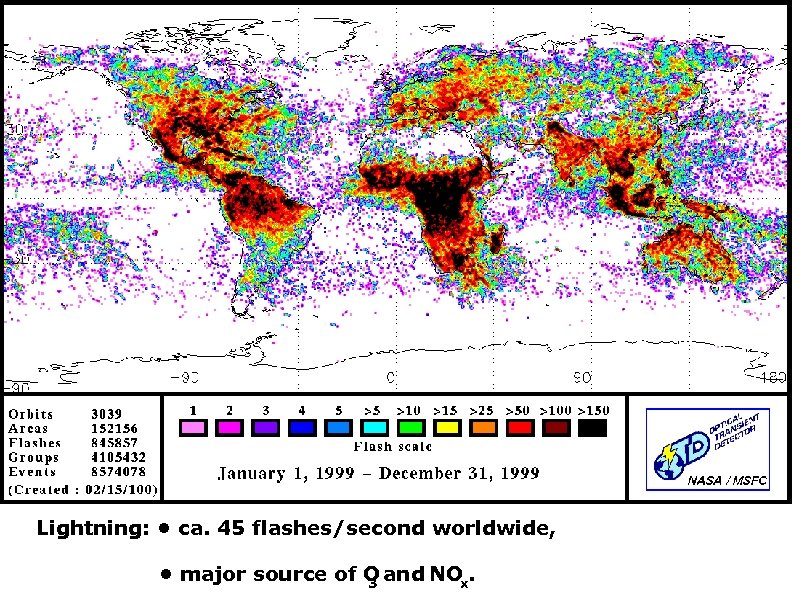 Lightning: • ca. 45 flashes/second worldwide, • major source of O and NOx. 3
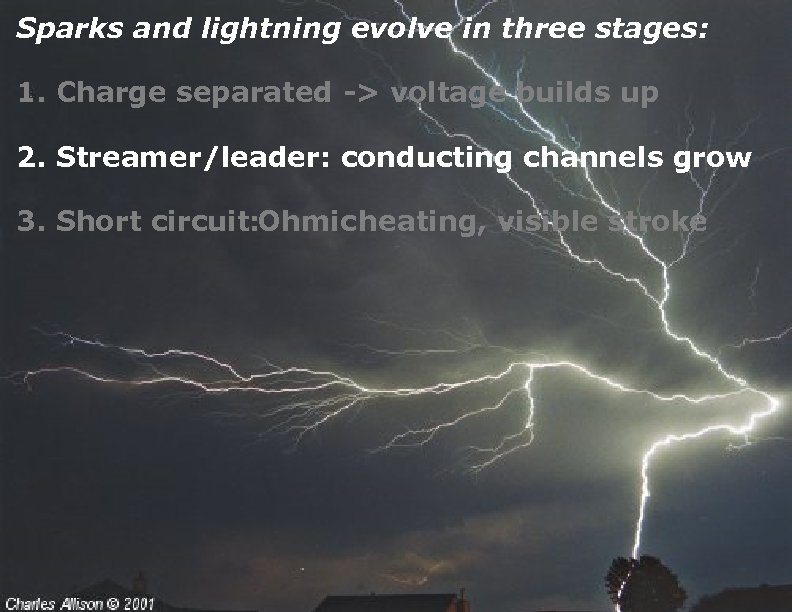 Sparks and lightning evolve in three stages: 1. Charge separated -> voltage builds up 2. Streamer/leader: conducting channels grow 3. Short circuit: Ohmic heating, visible stroke
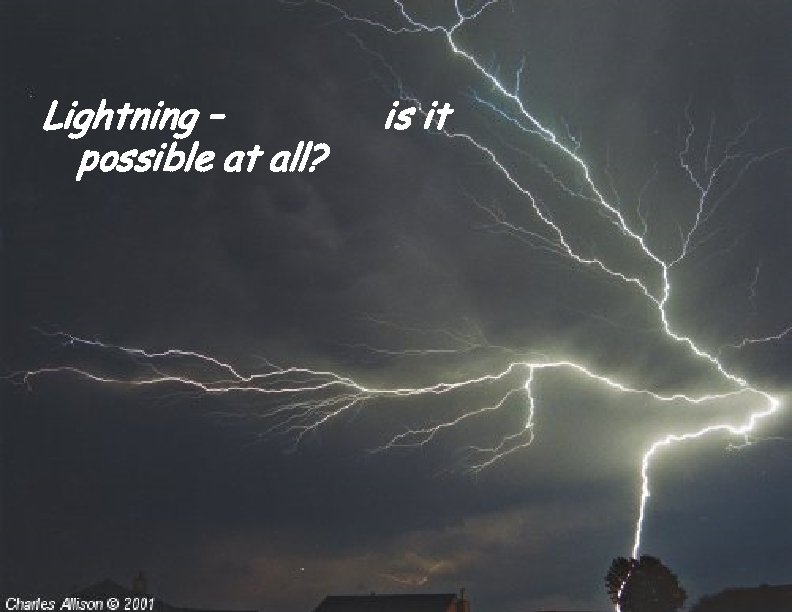 Lightning – possible at all? is it
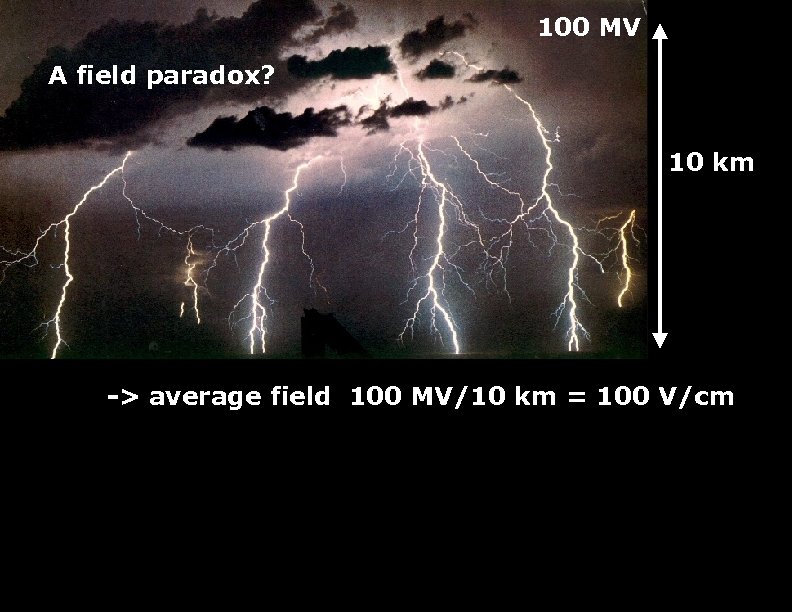 100 MV A field paradox? 100 MV on 10 km = 10 k. V/m … electric breakdown of air requires 30 k. V/cm 10 km -> average field 100 MV/10 km = 100 V/cm
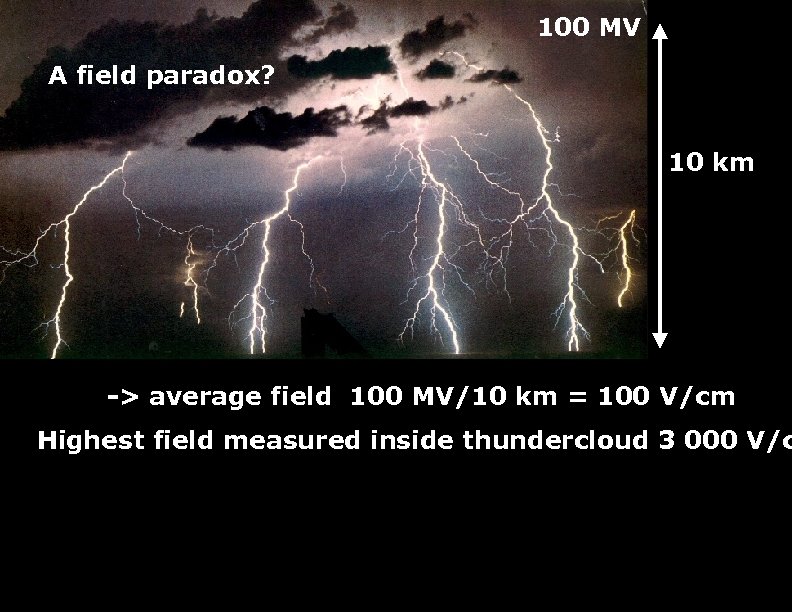 100 MV A field paradox? 100 MV on 10 km = 10 k. V/m … electric breakdown of air requires 30 k. V/cm 10 km -> average field 100 MV/10 km = 100 V/cm Highest field measured inside thundercloud 3 000 V/c
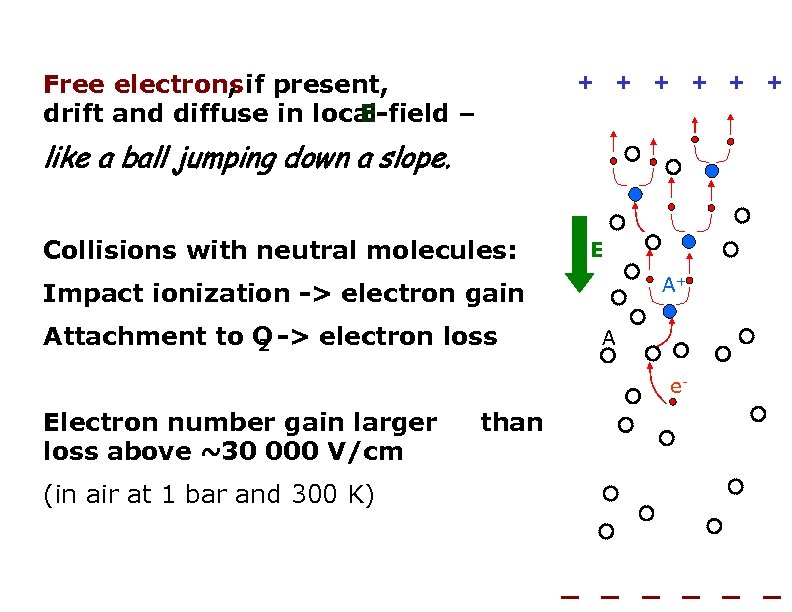 Free electrons if present, , drift and diffuse in local E-field – + + + — — - - + + - +- + + - - + +- - + + - - like a ball jumping down a slope. Collisions with neutral molecules: E A+ Impact ionization -> electron gain Attachment to O -> electron loss 2 Electron number gain larger loss above ~30 000 V/cm A e- than (in air at 1 bar and 300 K) — —
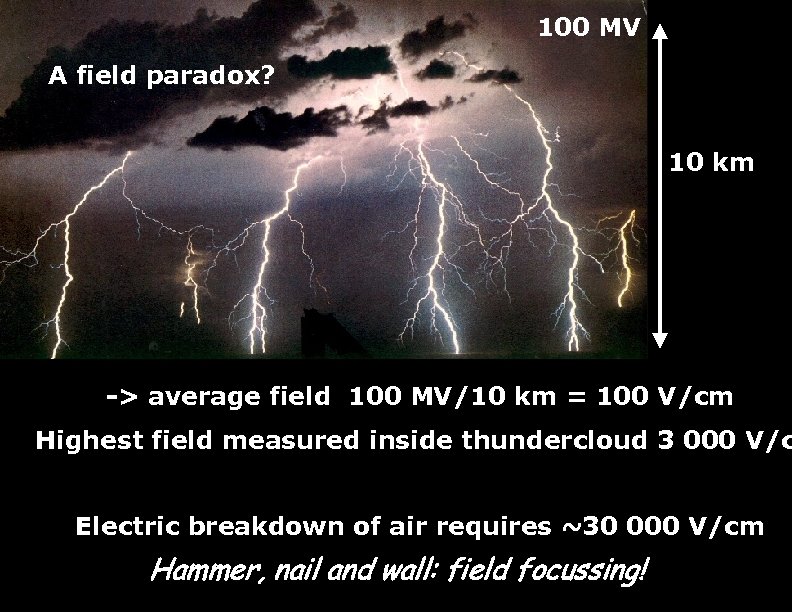 100 MV A field paradox? 100 MV on 10 km = 10 k. V/m … electric breakdown of air requires 30 k. V/cm 10 km -> average field 100 MV/10 km = 100 V/cm Highest field measured inside thundercloud 3 000 V/c Electric breakdown of air requires ~30 000 V/cm Hammer, nail and wall: field focussing!
![Movie of Lightning leader [G. M. Mc. Harg, US Air Force Academy, summer 2007]](https://present5.com/presentation/82874156884a0c82d2a588a3d0b4ecc3/image-14.jpg "Movie of Lightning leader [G. M. Mc. Harg, US Air Force Academy, summer 2007]") Movie of Lightning leader [G. M. Mc. Harg, US Air Force Academy, summer 2007] shows how the lightning leader searches its way to the ground. The total duration of the movie is only 3. 5 milliseconds, time steps are 5 microseconds. Not the total channel is illuminated, but only the actively propagating tip. In this tip electrical forces are focused, similarly to the focusing of mechanical forces in the tip of the nail. But the “lightning nail” is not pre-fabricated, but self-organized. We later will see how. Similar glowing tips are seen on smaller scale in the lab:
Movie of Lightning leader [G. M. Mc. Harg, US Air Force Academy, summer 2007] shows how the lightning leader searches its way to the ground. The total duration of the movie is only 3. 5 milliseconds, time steps are 5 microseconds. Not the total channel is illuminated, but only the actively propagating tip. In this tip electrical forces are focused, similarly to the focusing of mechanical forces in the tip of the nail. But the “lightning nail” is not pre-fabricated, but self-organized. We later will see how. Similar glowing tips are seen on smaller scale in the lab:
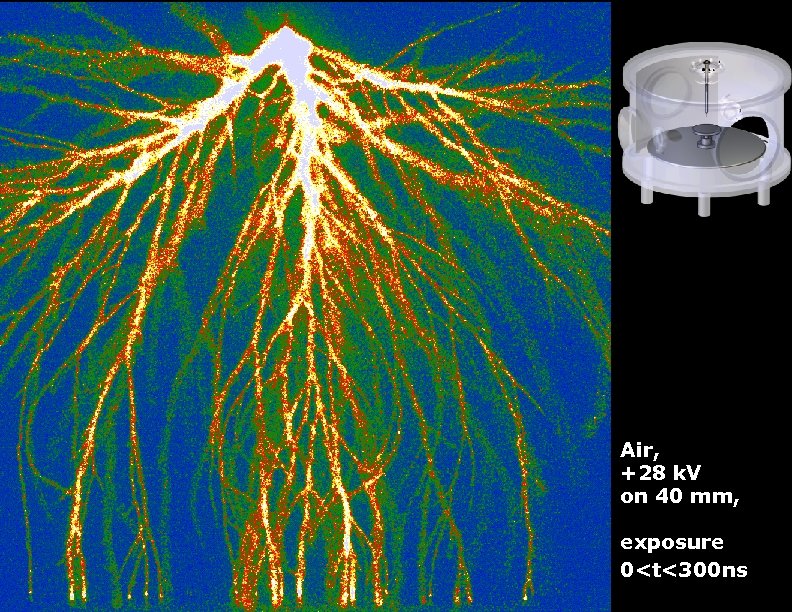 Air, +28 k. V on 40 mm, exposure 0
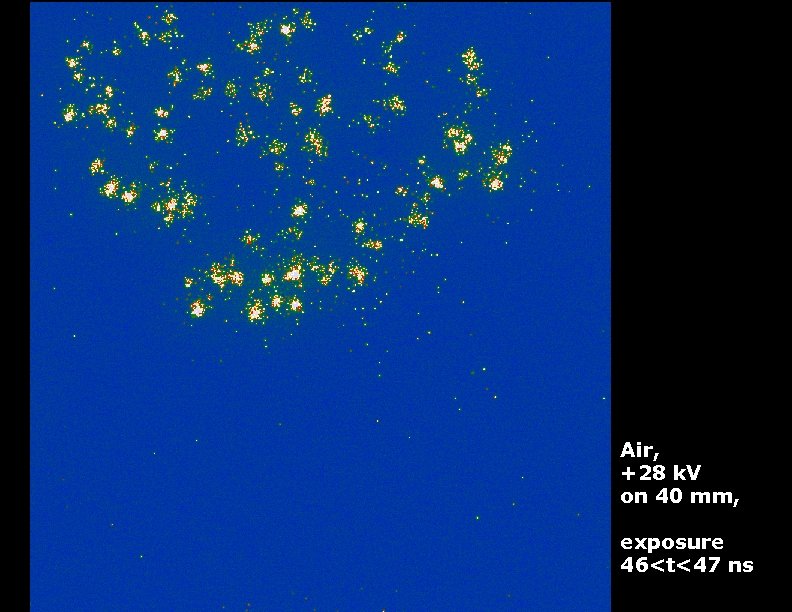 Air, +28 k. V on 40 mm, exposure 46
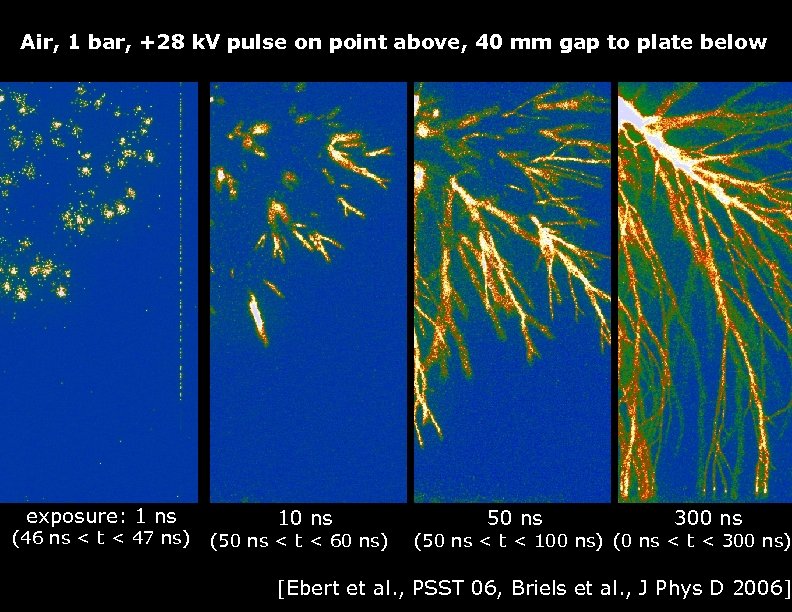 Air, 1 bar, +28 k. V pulse on point above, 40 mm gap to plate below exposure: 1 ns (46 ns < t < 47 ns) 10 ns (50 ns < t < 60 ns) 50 ns 300 ns (50 ns < t < 100 ns) (0 ns < t < 300 ns) [Ebert et al. , PSST 06, Briels et al. , J Phys D 2006]
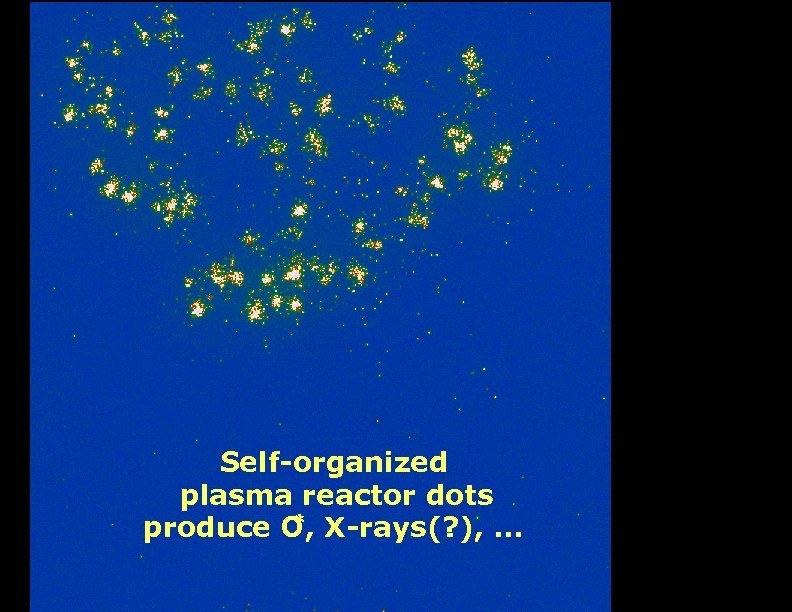 Self-organized plasma reactor dots * produce O, X-rays(? ), …
![Terrestrial. Gamma-Ray Flashes, > 50/day [discovered 1994, here RHESSI satellite data 2006] correlated with](https://present5.com/presentation/82874156884a0c82d2a588a3d0b4ecc3/image-19.jpg "Terrestrial. Gamma-Ray Flashes, > 50/day [discovered 1994, here RHESSI satellite data 2006] correlated with") Terrestrial. Gamma-Ray Flashes, > 50/day [discovered 1994, here RHESSI satellite data 2006] correlated with lightning strokes There are puzzles in cosmology, but do we understand our own earth?
Terrestrial. Gamma-Ray Flashes, > 50/day [discovered 1994, here RHESSI satellite data 2006] correlated with lightning strokes There are puzzles in cosmology, but do we understand our own earth?
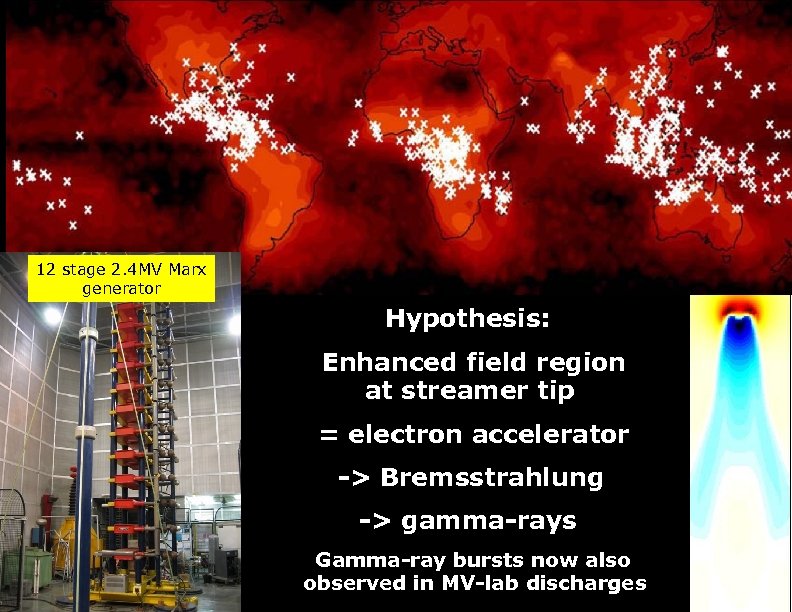 12 stage 2. 4 MV Marx generator Hypothesis: Enhanced field region at streamer tip = electron accelerator -> Bremsstrahlung -> gamma-rays Gamma-ray bursts now also observed in MV-lab discharges
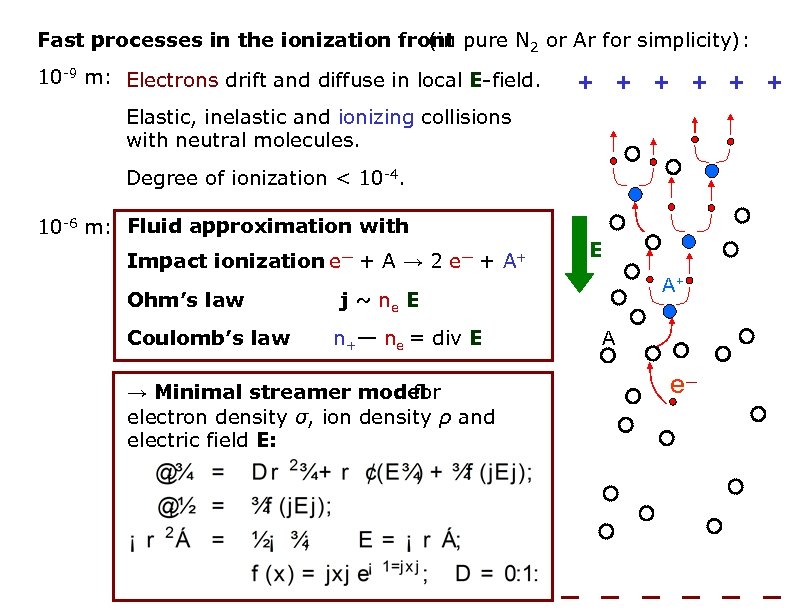 Fast processes in the ionization front pure N 2 or Ar for simplicity): (in 10 -9 m: Electrons drift and diffuse in local E-field. + + + — — - - - Elastic, inelastic and ionizing collisions with neutral molecules. - + + - +- + + - - + +- - + + - + Degree of ionization < 10 -4. 10 -6 m: Fluid approximation with E Impact ionization e— + A → 2 e— + A+ Ohm’s law Coulomb’s law A+ j ~ ne E n+— ne = div E A e— → Minimal streamer model for electron density σ, ion density ρ and electric field E: — —
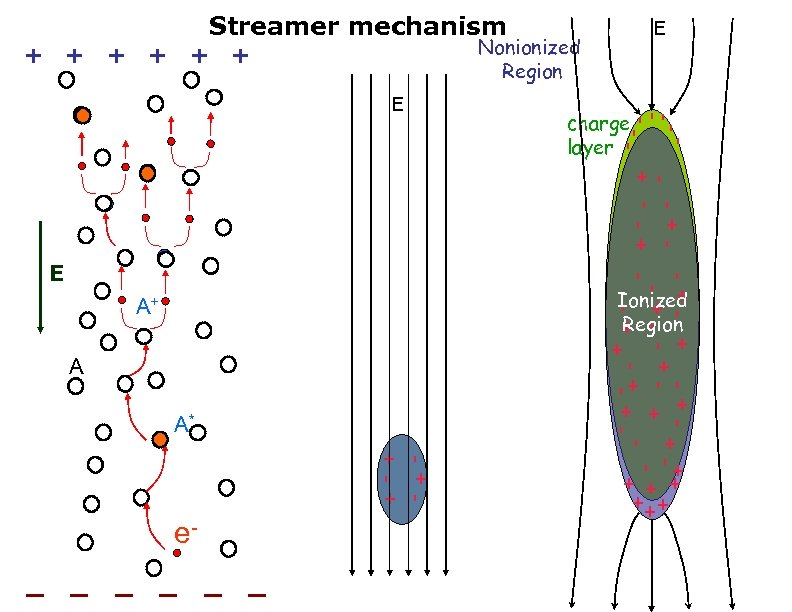 — + — + + — — + E E A+ A A* e- — charge layer Ionized Region + + - - + -+ - - - + --+ + + - - + + - + - + - - + ++ -- + - + Streamer mechanism Nonionized Region E
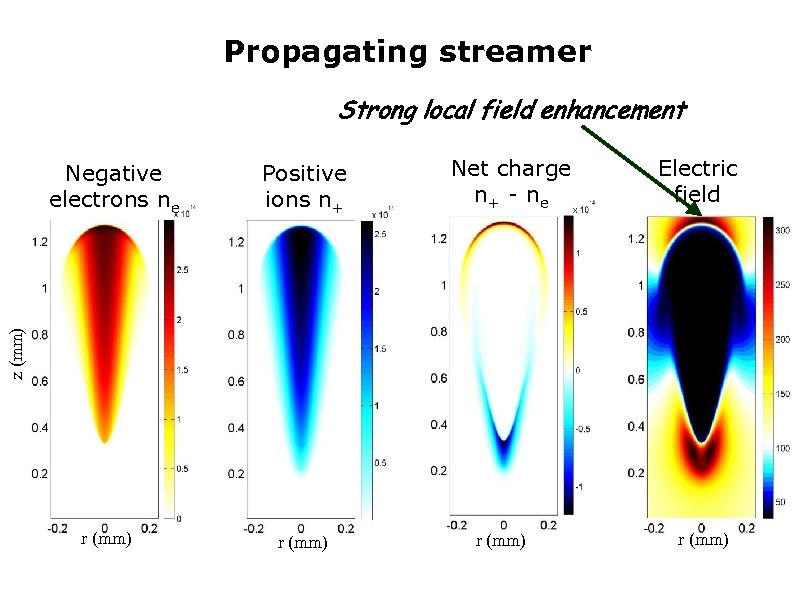 Propagating streamer Strong local field enhancement Positive ions n+ Net charge n+ - n e Electric field z (mm) Negative electrons ne r (mm)
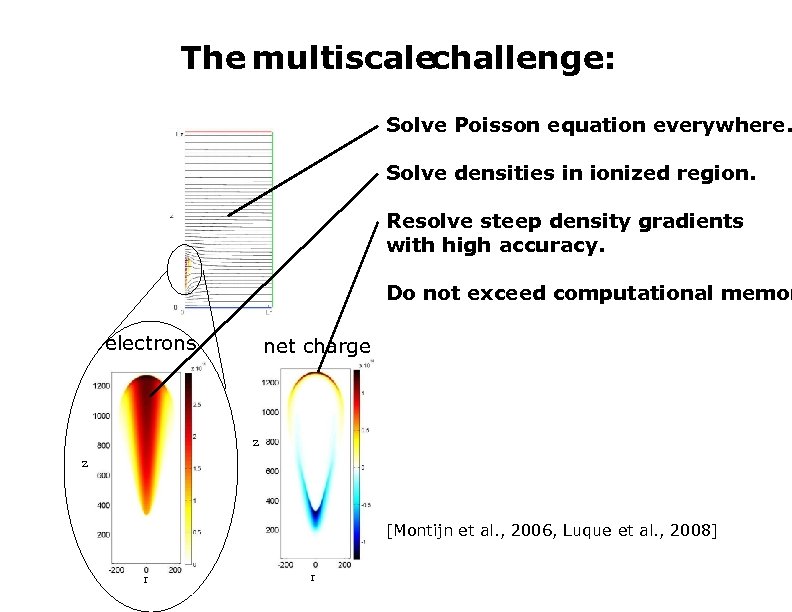 The multiscalechallenge: Solve Poisson equation everywhere. Solve densities in ionized region. Resolve steep density gradients with high accuracy. Do not exceed computational memor electrons net charge z z [Montijn et al. , 2006, Luque et al. , 2008] r r
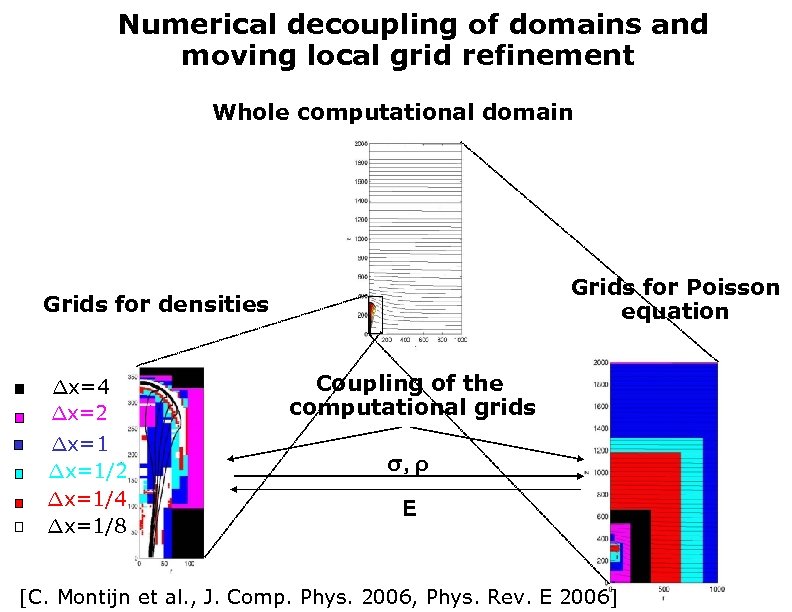 Numerical decoupling of domains and moving local grid refinement Whole computational domain Grids for Poisson equation Grids for densities ¢x=4 ¢x=2 ¢x=1/2 ¢x=1/4 ¢x=1/8 Coupling of the computational grids σ, ρ E [C. Montijn et al. , J. Comp. Phys. 2006, Phys. Rev. E 2006]
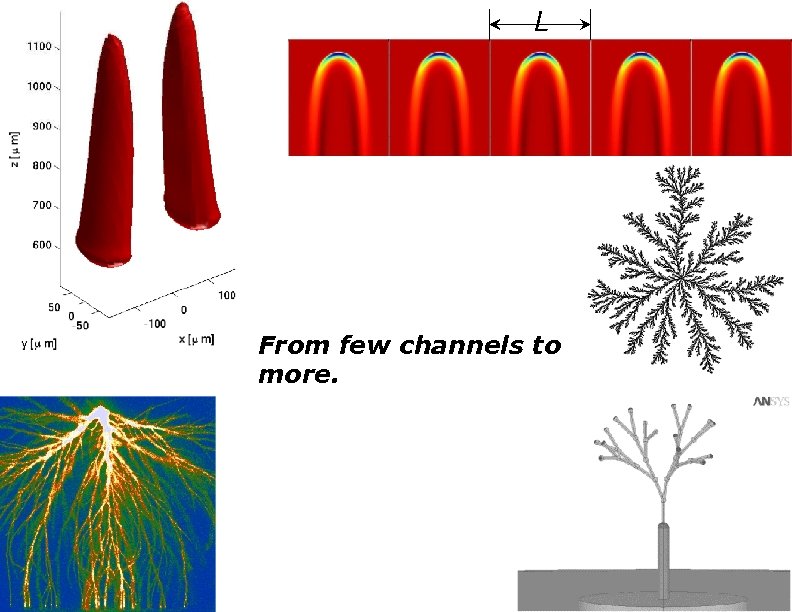
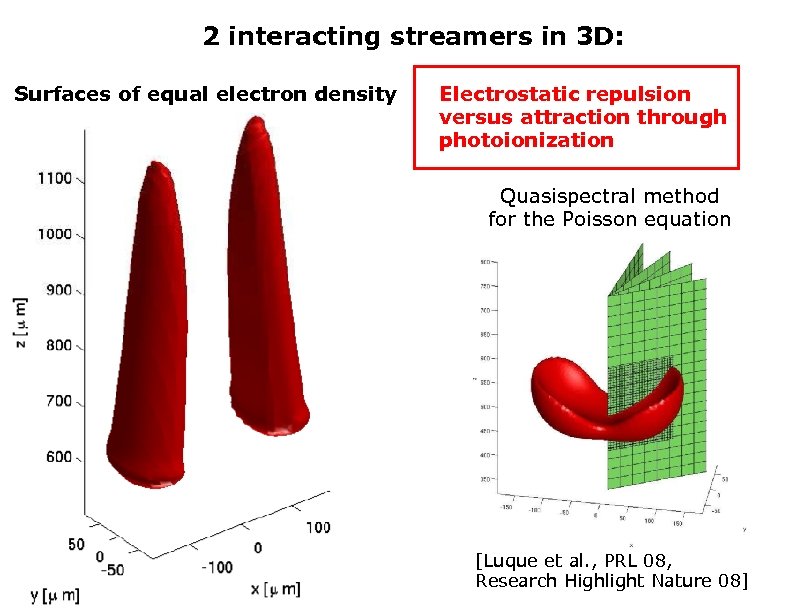 2 interacting streamers in 3 D: Surfaces of equal electron density Electrostatic repulsion versus attraction through photoionization Quasispectral method for the Poisson equation [Luque et al. , PRL 08, Research Highlight Nature 08]
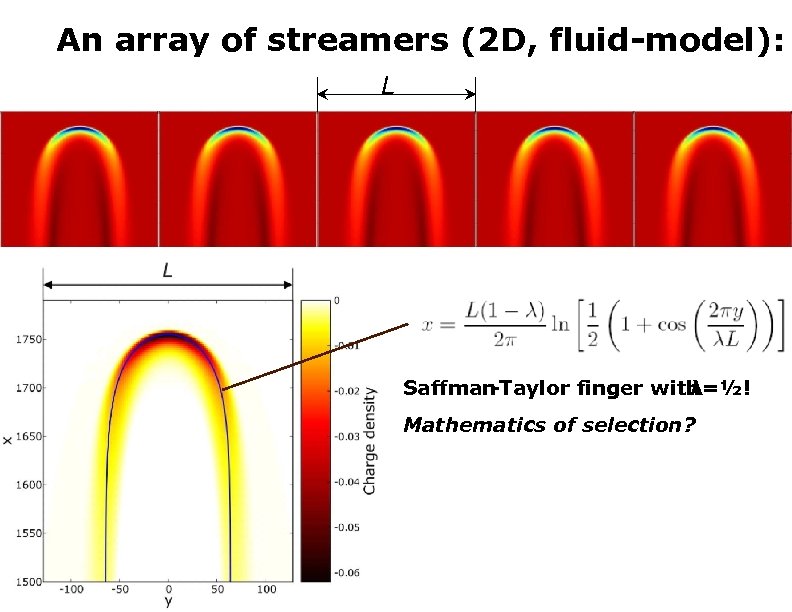
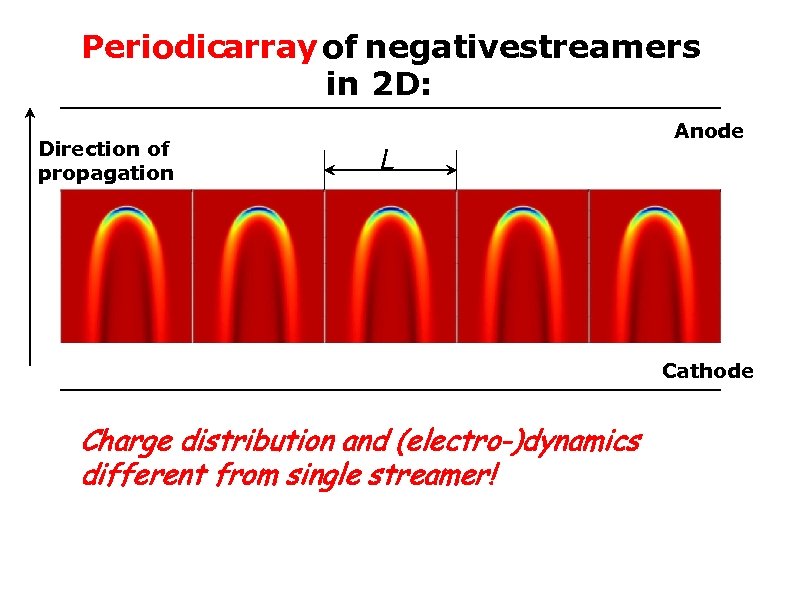 Periodicarray of negativestreamers in 2 D: Direction of propagation L Anode Cathode Charge distribution and (electro-)dynamics different from single streamer!
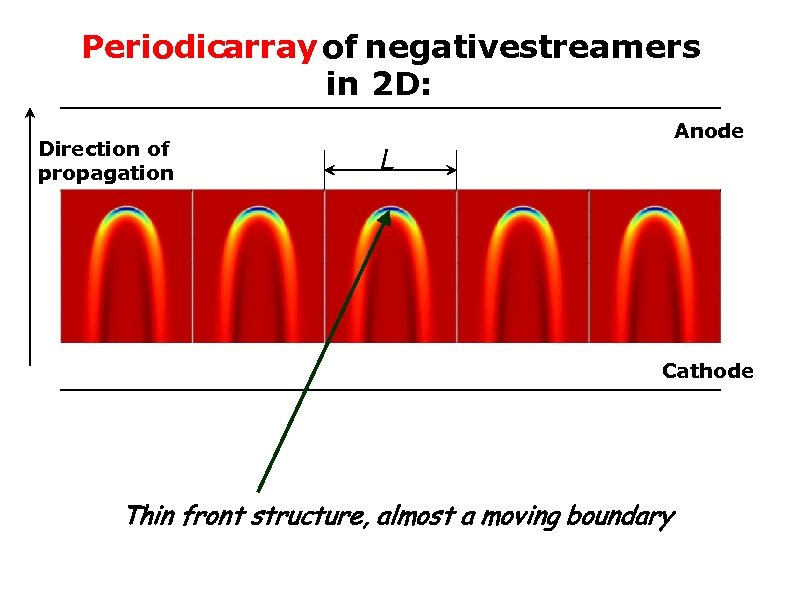 Periodicarray of negativestreamers in 2 D: Direction of propagation Anode L Cathode Thin front structure, almost a moving boundary
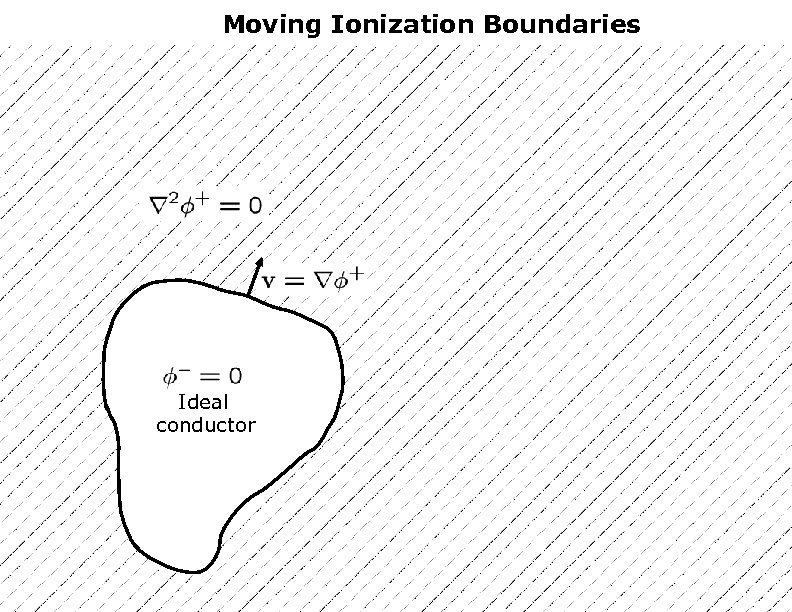 Moving Ionization Boundaries Ideal conductor
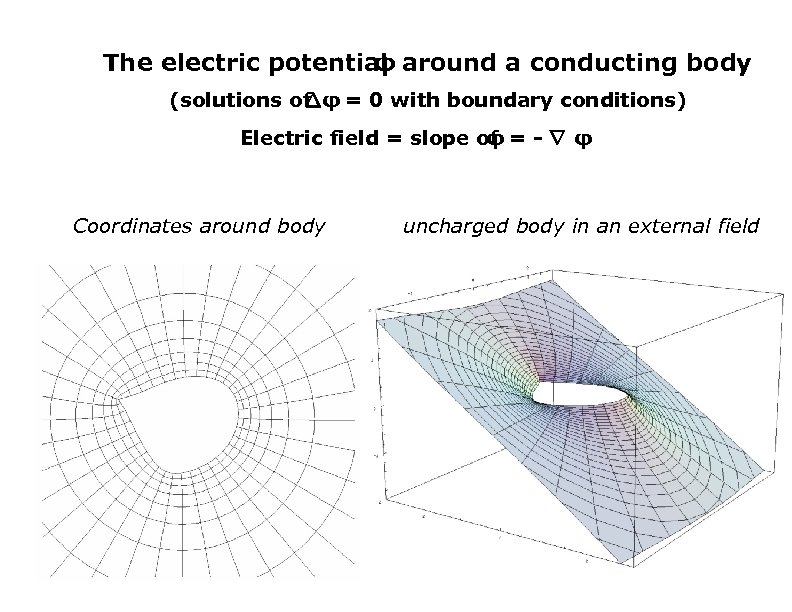 The electric potential around a conducting body φ (solutions of ¢φ = 0 with boundary conditions) Electric field = slope of = - r φ φ Coordinates around body uncharged body in an external field
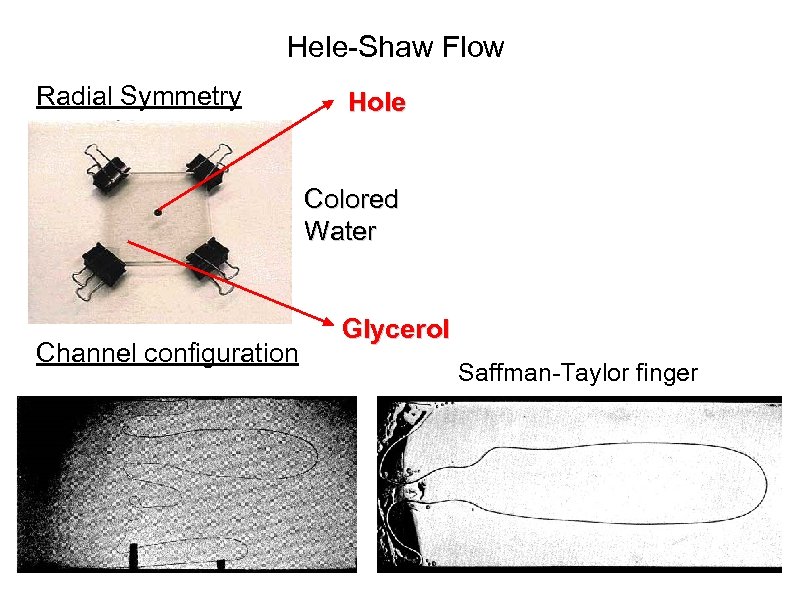
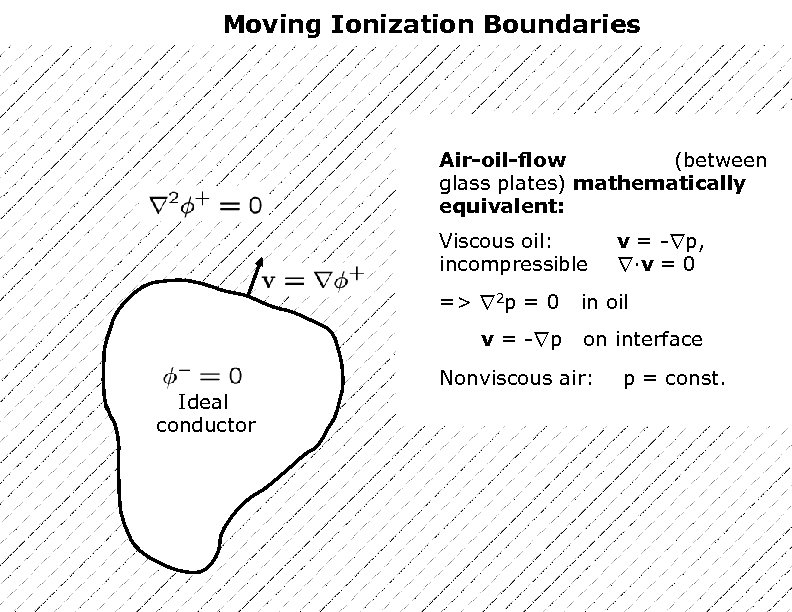 Moving Ionization Boundaries Air-oil-flow (between glass plates) mathematically equivalent: Viscous oil: incompressible => r 2 p = 0 v = -rp Ideal conductor v = -rp, r∙v = 0 in oil on interface Nonviscous air: p = const.
 Hele-Shaw Flow Radial Symmetry Hole Colored Water Channel configuration Glycerol Saffman-Taylor finger
 An array of streamers (2 D, fluid-model): L Saffman -Taylor finger with λ=½! Mathematics of selection?
 L From few channels to more. DBM
 Computational Science: adaptive grids, hybrid (MC-continuous) Nonlinear Dynamics: Fronts and interfaces, model reduction Spark formation in Nature and Technology geophysics: Sprite discharges Physics/ lectroengineering e. : 5 ns 5 µs Streamer discharges: experiments and applications
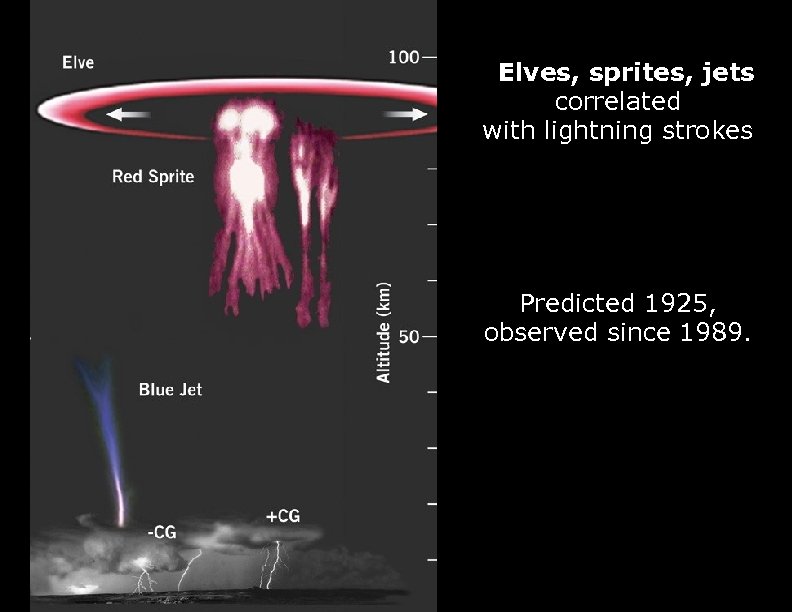 Elves, sprites, jets correlated with lightning strokes Predicted 1925, observed since 1989.
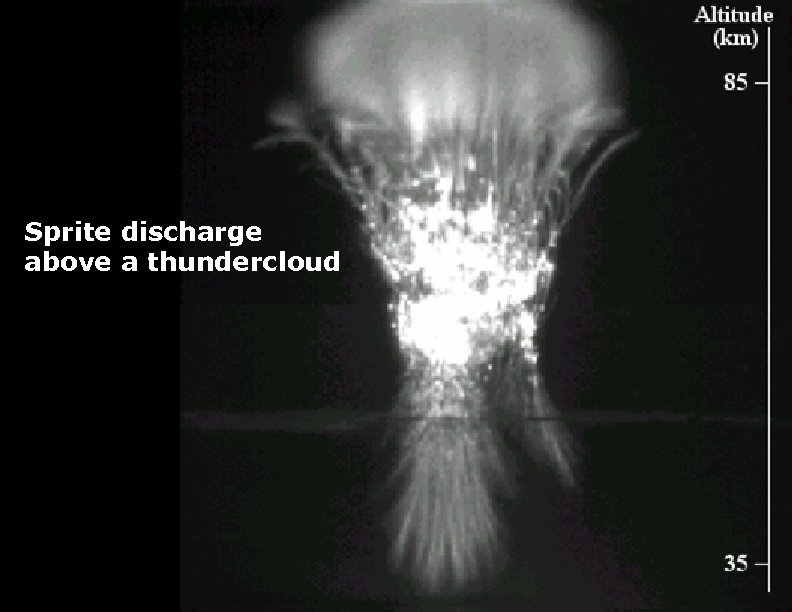 Sprite discharge above a thundercloud
![Telescopic images of sprite discharges [Gerken et al. , Geophys. Res. Lett. 2000] 4](https://present5.com/presentation/82874156884a0c82d2a588a3d0b4ecc3/image-38.jpg "Telescopic images of sprite discharges [Gerken et al. , Geophys. Res. Lett. 2000] 4") Telescopic images of sprite discharges [Gerken et al. , Geophys. Res. Lett. 2000] 4 cm 1 bar Approximate similarity between different gas densities, better than theory predicts
Telescopic images of sprite discharges [Gerken et al. , Geophys. Res. Lett. 2000] 4 cm 1 bar Approximate similarity between different gas densities, better than theory predicts
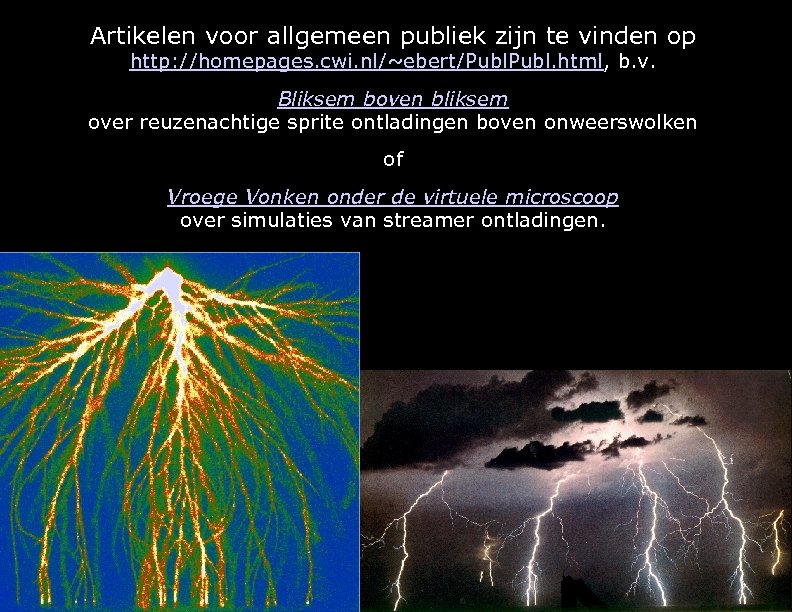 Artikelen voor allgemeen publiek zijn te vinden op http: //homepages. cwi. nl/~ebert/Publ. html, b. v. Bliksem boven bliksem over reuzenachtige sprite ontladingen boven onweerswolken of Vroege Vonken onder de virtuele microscoop over simulaties van streamer ontladingen.