 Скачать презентацию The Most Distant Quasars Probing the End of
0a8cf8df2328d5a18d946bcdae1542fd.ppt
- Количество слайдов: 39



The Most Distant Quasars: Probing the End of Cosmic Dark Ages Xiaohui Fan Steward Observatory The University of Arizona
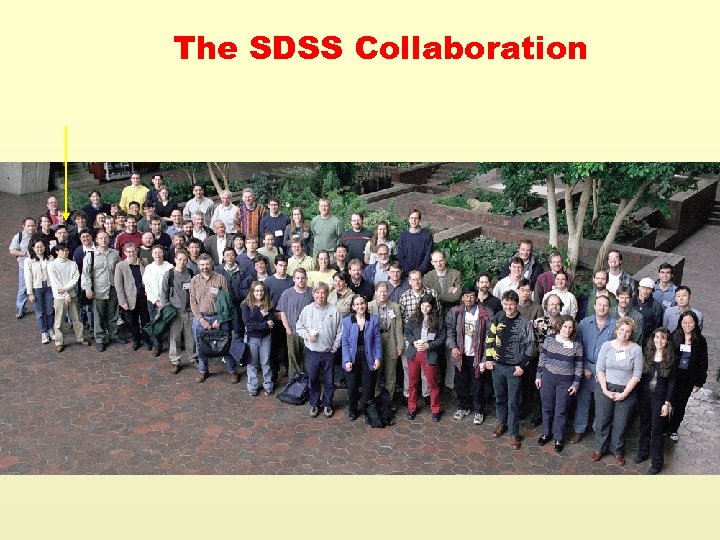
The SDSS Collaboration
The Most Distant Quasars: Probing the End of Cosmic Dark Ages Xiaohui Fan Steward Observatory The University of Arizona
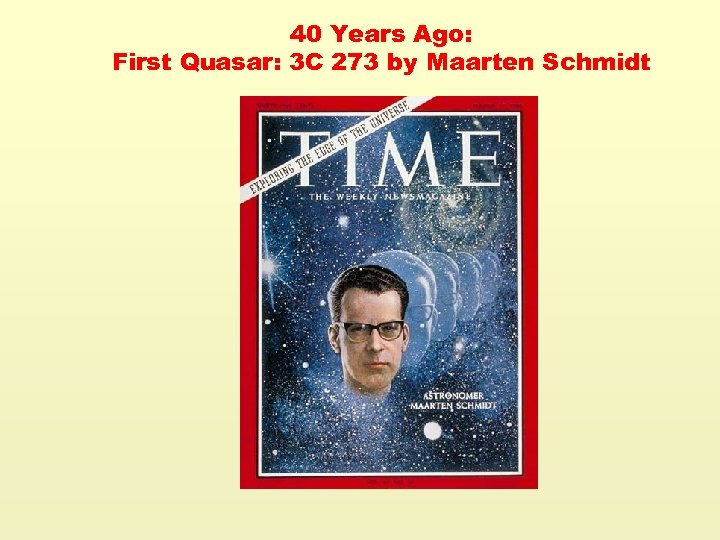
40 Years Ago: First Quasar: 3 C 273 by Maarten Schmidt
Quasars as Cosmology Probes • The Study of Highest-Redshift Quasars Probes: – – – The epoch of first generation of galaxies/quasars Models of black hole formation Role of quasar/BH activity in galaxy evolution State of intergalactic medium Ionizing background at high-z History of reionization probing the end of cosmic dark ages
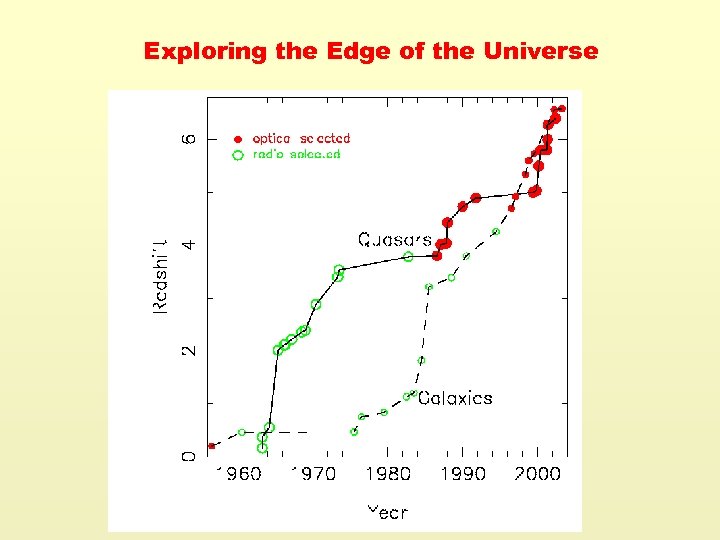
Exploring the Edge of the Universe

SDSS at Your Service Courtesy of Arizona graduate students
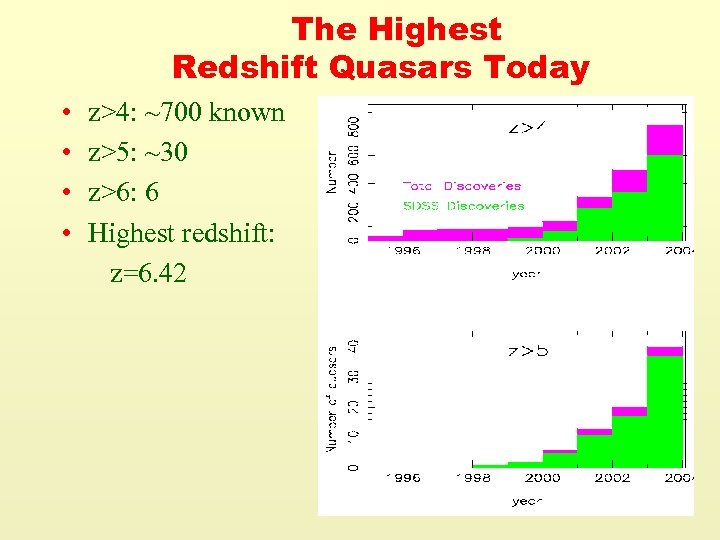
The Highest Redshift Quasars Today • • z>4: ~700 known z>5: ~30 z>6: 6 Highest redshift: z=6. 42 Total Discoveries SDSS Discoveries
Outline • • SDSS Quasar Survey Search for the First Quasars Co-formation of First Quasars and Galaxies Lyman Absorption of z~6 quasars – Discovery of complete Gunn-Peterson troughs – Implication on the epoch of reionization • Collaborators: Strauss, Schneider, Becker, White, Richards, Penterricci, Rix, Narayanan, Hennawi, Carilli, Bertoldi, Walter, Cox, Lo et al.
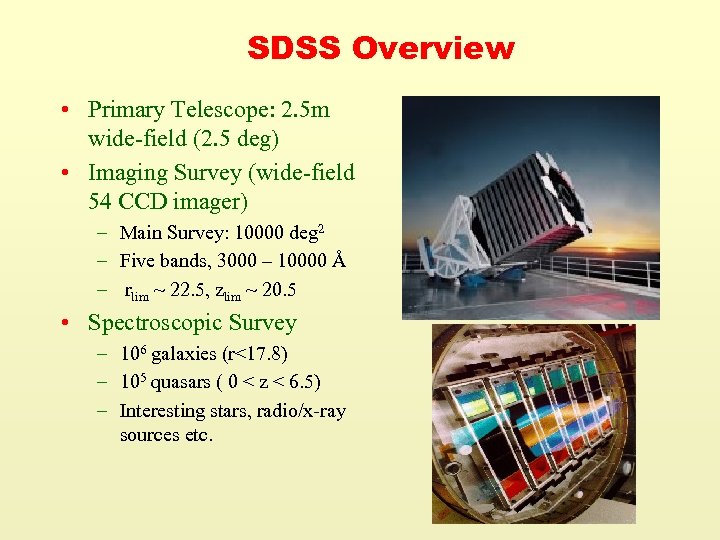
SDSS Overview • Primary Telescope: 2. 5 m wide-field (2. 5 deg) • Imaging Survey (wide-field 54 CCD imager) – Main Survey: 10000 deg 2 – Five bands, 3000 – 10000 Å – rlim ~ 22. 5, zlim ~ 20. 5 • Spectroscopic Survey – 106 galaxies (r<17. 8) – 105 quasars ( 0 < z < 6. 5) – Interesting stars, radio/x-ray sources etc.
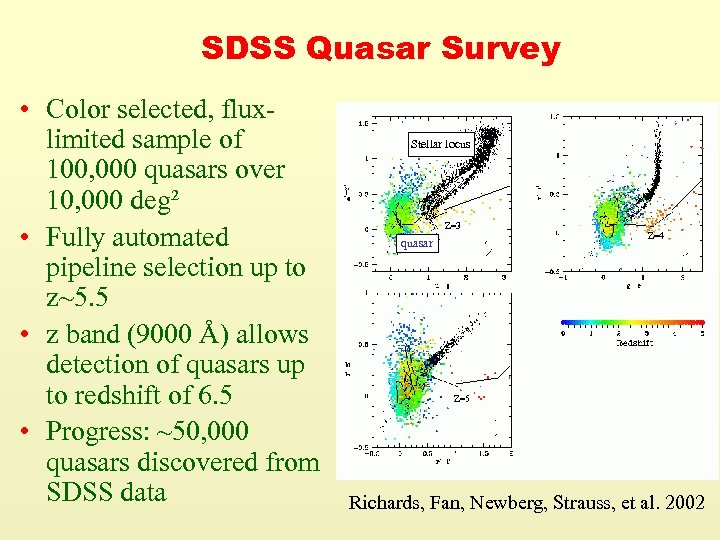
SDSS Quasar Survey • Color selected, fluxlimited sample of 100, 000 quasars over 10, 000 deg² • Fully automated pipeline selection up to z~5. 5 • z band (9000 Å) allows detection of quasars up to redshift of 6. 5 • Progress: ~50, 000 quasars discovered from SDSS data Stellar locus Z=3 quasar Z=4 Z=5 Richards, Fan, Newberg, Strauss, et al. 2002
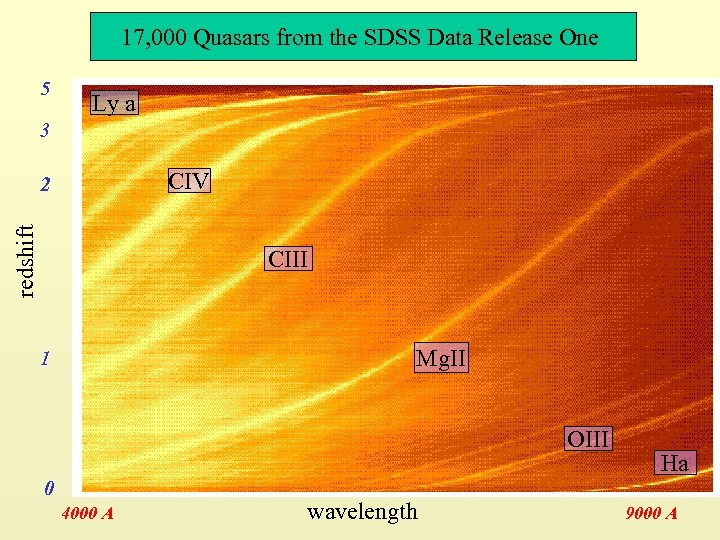
17, 000 Quasars from the SDSS Data Release One 5 Ly a 3 CIV redshift 2 CIII Mg. II 1 OIII 0 4000 A wavelength Ha 9000 A
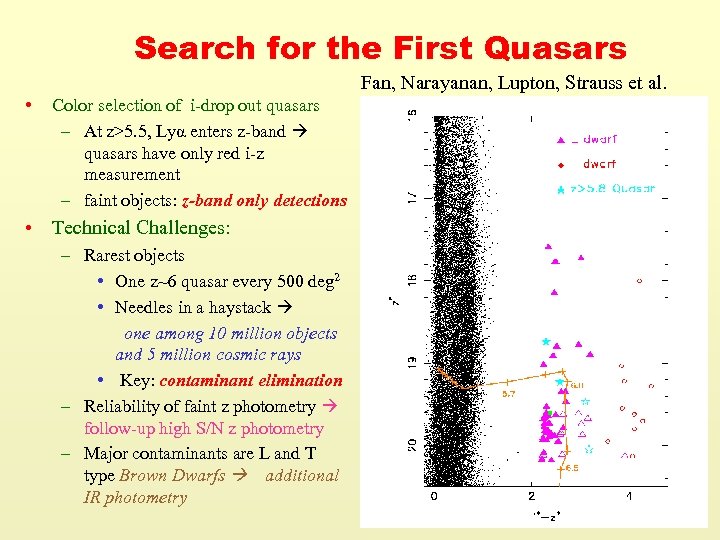
Search for the First Quasars Fan, Narayanan, Lupton, Strauss et al. • Color selection of i-drop out quasars – At z>5. 5, Lyα enters z-band quasars have only red i-z measurement – faint objects: z-band only detections • Technical Challenges: – Rarest objects • One z~6 quasar every 500 deg 2 • Needles in a haystack one among 10 million objects and 5 million cosmic rays • Key: contaminant elimination – Reliability of faint z photometry follow-up high S/N z photometry – Major contaminants are L and T type Brown Dwarfs additional IR photometry
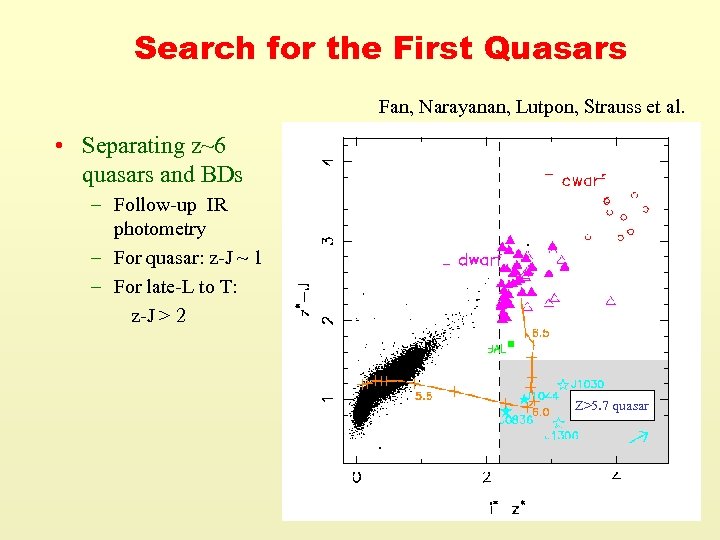
Search for the First Quasars Fan, Narayanan, Lutpon, Strauss et al. • Separating z~6 quasars and BDs – Follow-up IR photometry – For quasar: z-J ~ 1 – For late-L to T: z-J > 2 Z>5. 7 quasar
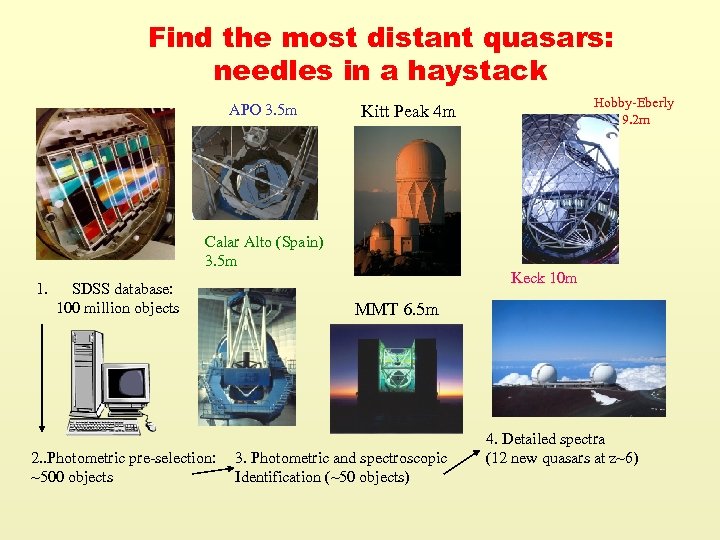
Find the most distant quasars: needles in a haystack APO 3. 5 m Calar Alto (Spain) 3. 5 m 1. SDSS database: 100 million objects 2. . Photometric pre-selection: ~500 objects Hobby-Eberly 9. 2 m Kitt Peak 4 m Keck 10 m MMT 6. 5 m 3. Photometric and spectroscopic Identification (~50 objects) 4. Detailed spectra (12 new quasars at z~6)
z~6 Quasars • SDSS i-dropout Survey: – By Dec 2003: 5000 deg 2 at z. AB<20 – Twelve luminous quasars at z>5. 7 – By product: > 30 T dwarfs and large number of L dwarfs • 20 – 40 at z~6 expected in the whole survey
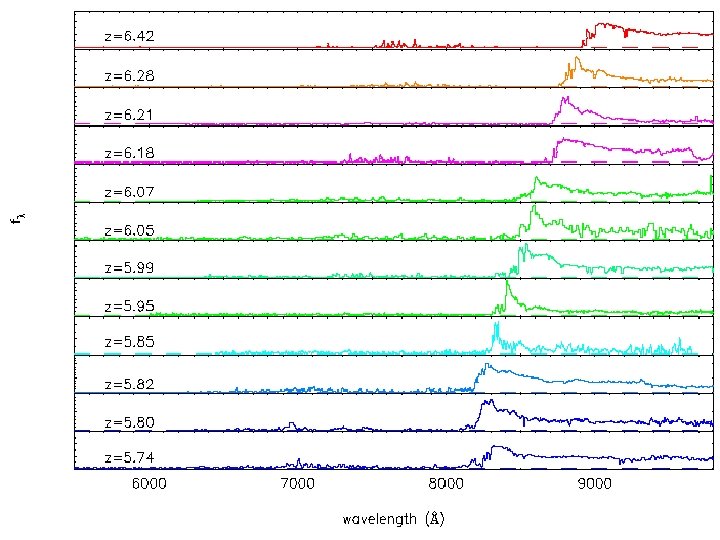
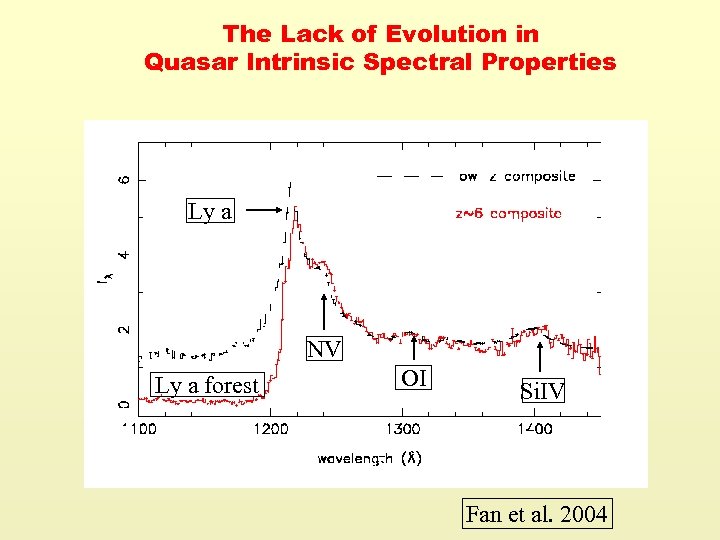
The Lack of Evolution in Quasar Intrinsic Spectral Properties Ly a NV Ly a forest OI Si. IV Fan et al. 2004
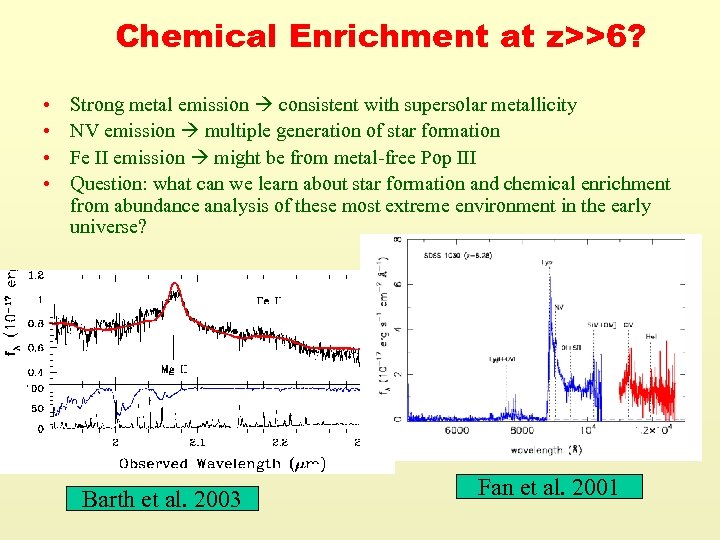
Chemical Enrichment at z>>6? • • Strong metal emission consistent with supersolar metallicity NV emission multiple generation of star formation Fe II emission might be from metal-free Pop III Question: what can we learn about star formation and chemical enrichment from abundance analysis of these most extreme environment in the early universe? Barth et al. 2003 Fan et al. 2001
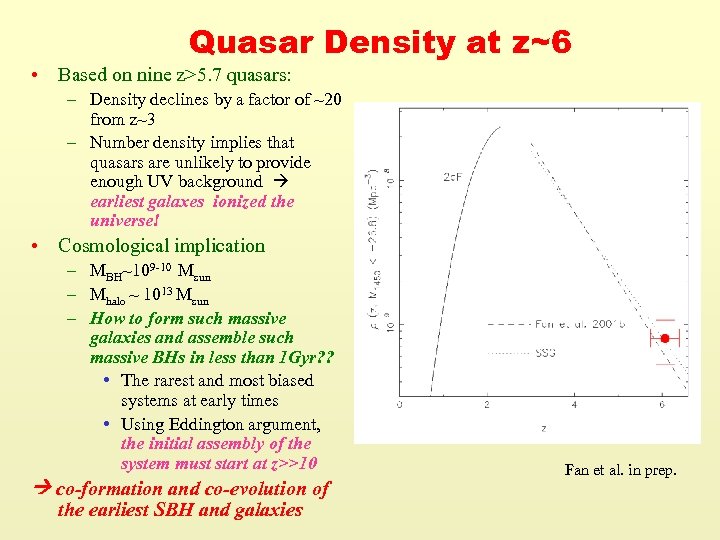
Quasar Density at z~6 • Based on nine z>5. 7 quasars: – Density declines by a factor of ~20 from z~3 – Number density implies that quasars are unlikely to provide enough UV background earliest galaxes ionized the universe! • Cosmological implication – MBH~109 -10 Msun – Mhalo ~ 1013 Msun – How to form such massive galaxies and assemble such massive BHs in less than 1 Gyr? ? • The rarest and most biased systems at early times • Using Eddington argument, the initial assembly of the system must start at z>>10 co-formation and co-evolution of the earliest SBH and galaxies Fan et al. in prep.
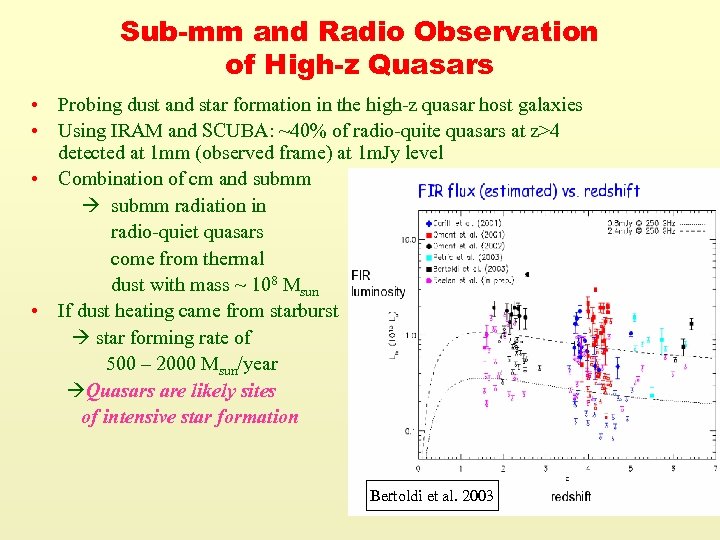
Sub-mm and Radio Observation of High-z Quasars • Probing dust and star formation in the high-z quasar host galaxies • Using IRAM and SCUBA: ~40% of radio-quite quasars at z>4 detected at 1 mm (observed frame) at 1 m. Jy level • Combination of cm and submm radiation in radio-quiet quasars come from thermal dust with mass ~ 108 Msun • If dust heating came from starburst star forming rate of 500 – 2000 Msun/year Quasars are likely sites of intensive star formation Bertoldi et al. 2003 Arp 220
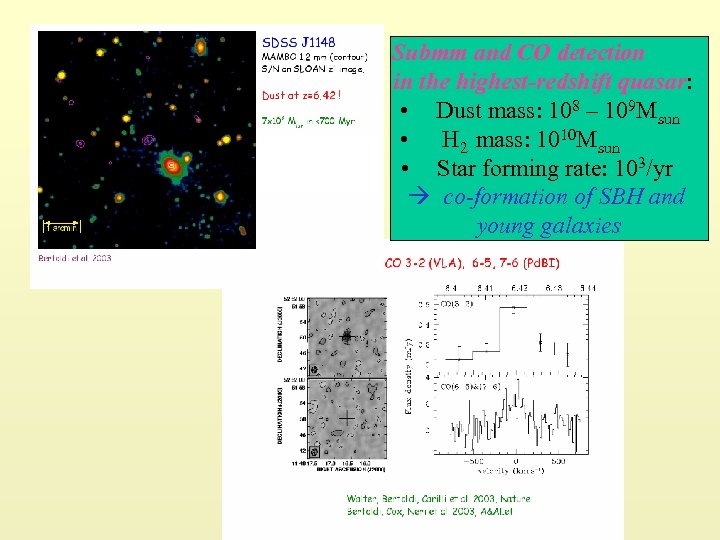
Submm and CO detection in the highest-redshift quasar: • Dust mass: 108 – 109 Msun • H 2 mass: 1010 Msun • Star forming rate: 103/yr co-formation of SBH and young galaxies
Co-evolution of early galaxies and supermassive BHs • Presence of 109 -10 solar mass BH at z>6 it has to begin the assemble at z>10 • High metallicity in the quasar environment recent star formation and chemical enrichment • Presence of heated dust (submm) and gas possible on-going star formation with rate of ~1000 solar mass/year The initial assembly of SBH coeval with the initial assemble of host galaxy • Spitzer and ALMA Probing the BH/galaxy formation connection
Searching for Gunn-Peterson Trough • Gunn and Peterson (1965) – “It is observed that the continuum of the source continues to the blue of Ly-α ( in quasar 3 C 9, z=2. 01)” – “only about one part of 5 x 10⁶ of the total mass at that time could have been in the form of intergalactic neutral hydrogen ” • Absence of G-P trough the universe is still highly ionized
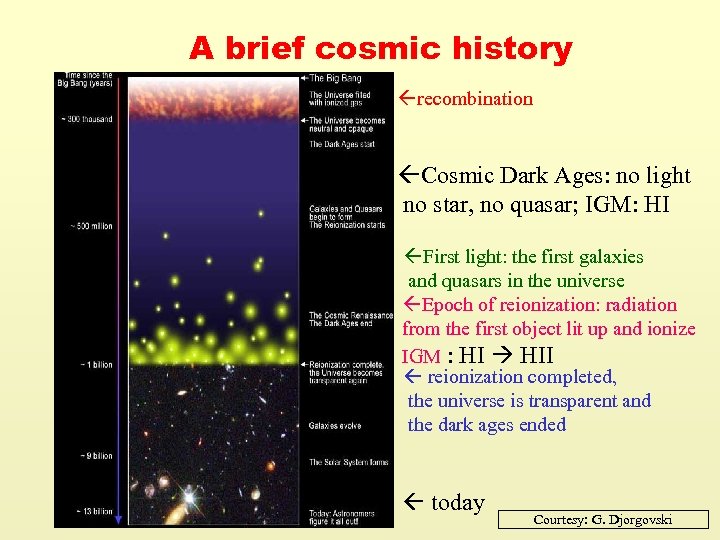
A brief cosmic history recombination Cosmic Dark Ages: no light no star, no quasar; IGM: HI First light: the first galaxies and quasars in the universe Epoch of reionization: radiation from the first object lit up and ionize IGM : HI HII reionization completed, the universe is transparent and the dark ages ended today Courtesy: G. Djorgovski
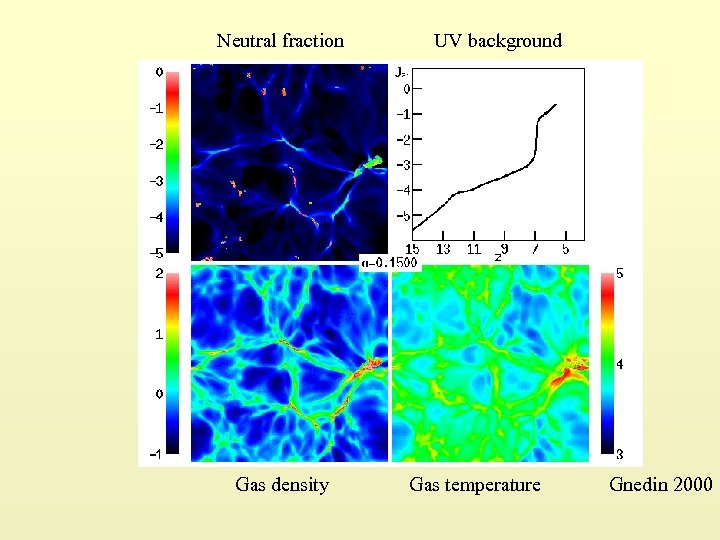
Neutral fraction Gas density UV background Gas temperature Gnedin 2000
The end of dark ages: Movie Courtesy of N. Gnedin
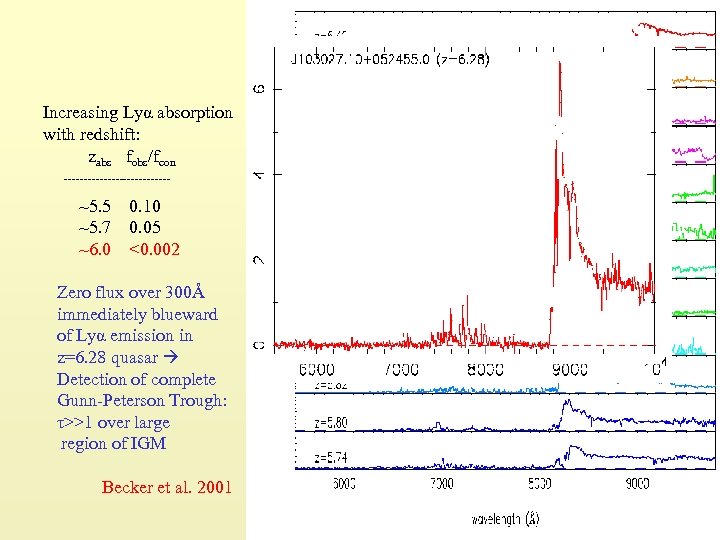
Increasing Lyα absorption with redshift: zabs fobs/fcon -------------- ~5. 5 0. 10 ~5. 7 0. 05 ~6. 0 <0. 002 Zero flux over 300Å immediately blueward of Lyα emission in z=6. 28 quasar Detection of complete Gunn-Peterson Trough: τ>>1 over large region of IGM Becker et al. 2001
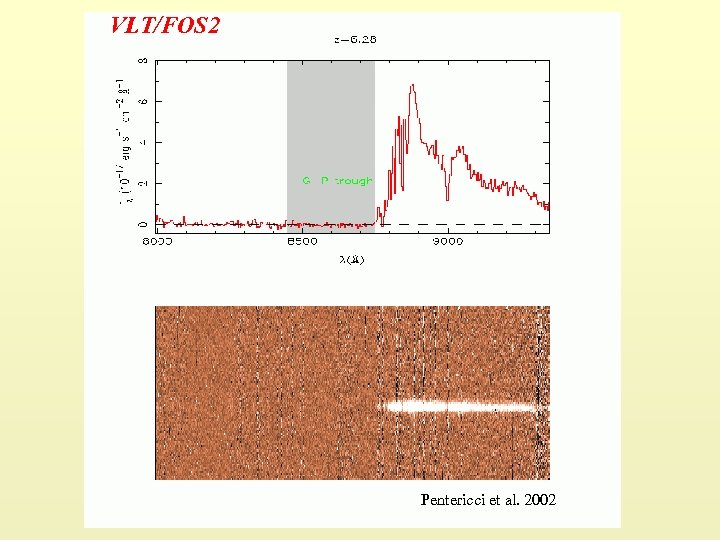
VLT/FOS 2 Pentericci et al. 2002
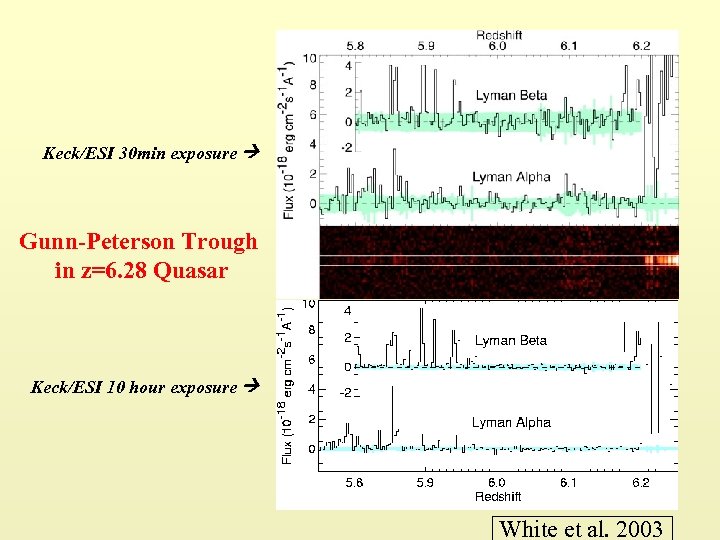
Keck/ESI 30 min exposure Gunn-Peterson Trough in z=6. 28 Quasar Keck/ESI 10 hour exposure White et al. 2003
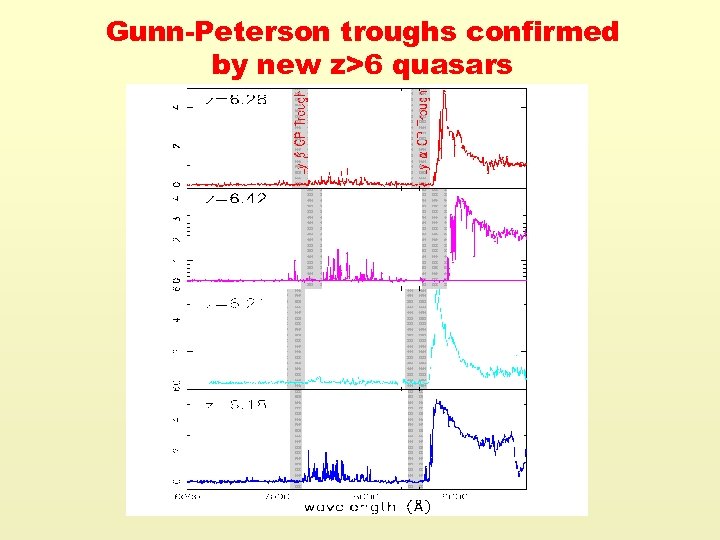
Gunn-Peterson troughs confirmed by new z>6 quasars
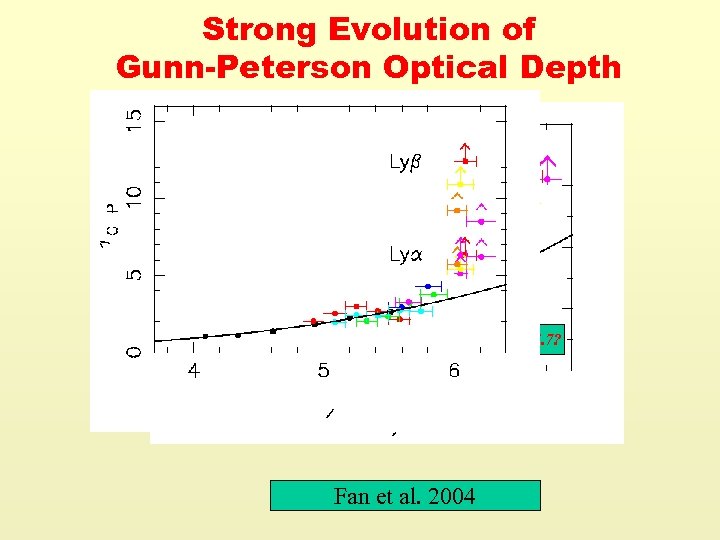
Strong Evolution of Gunn-Peterson Optical Depth Transition at z~5. 7? Fan et al. 2004
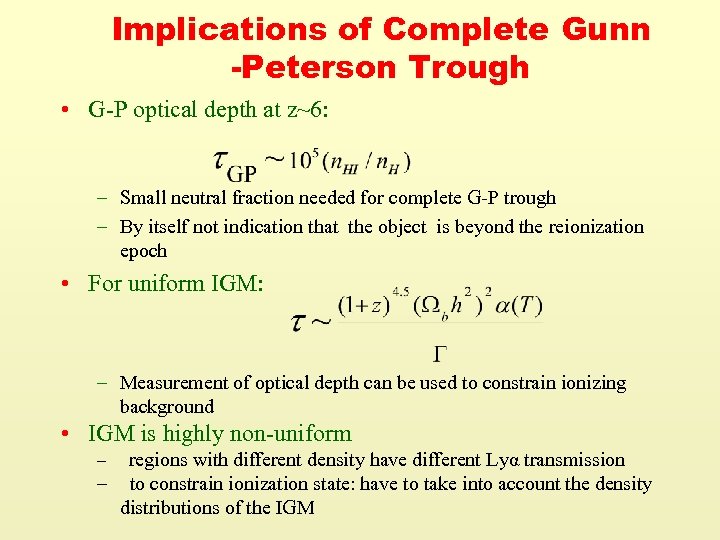
Implications of Complete Gunn -Peterson Trough • G-P optical depth at z~6: – Small neutral fraction needed for complete G-P trough – By itself not indication that the object is beyond the reionization epoch • For uniform IGM: – Measurement of optical depth can be used to constrain ionizing background • IGM is highly non-uniform regions with different density have different Lyα transmission – to constrain ionization state: have to take into account the density distributions of the IGM –
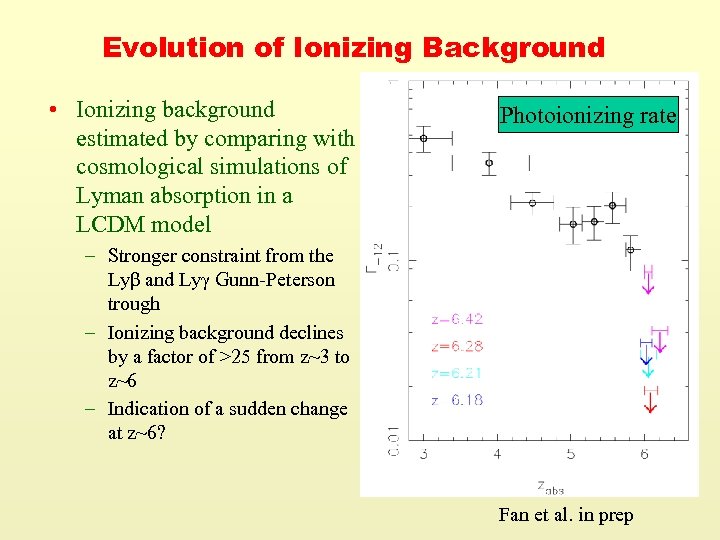
Evolution of Ionizing Background • Ionizing background estimated by comparing with cosmological simulations of Lyman absorption in a LCDM model Photoionizing rate – Stronger constraint from the Lyβ and Lyγ Gunn-Peterson trough – Ionizing background declines by a factor of >25 from z~3 to z~6 – Indication of a sudden change at z~6? Fan et al. in prep
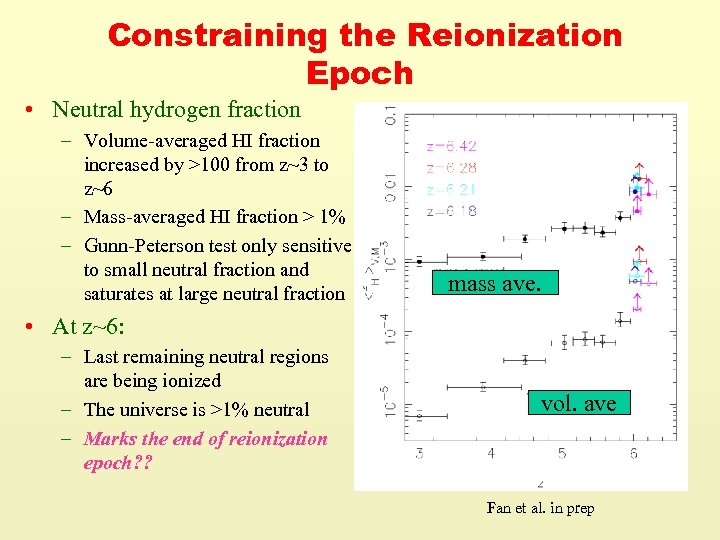
Constraining the Reionization Epoch • Neutral hydrogen fraction – Volume-averaged HI fraction increased by >100 from z~3 to z~6 – Mass-averaged HI fraction > 1% – Gunn-Peterson test only sensitive to small neutral fraction and saturates at large neutral fraction mass ave. • At z~6: – Last remaining neutral regions are being ionized – The universe is >1% neutral – Marks the end of reionization epoch? ? vol. ave Fan et al. in prep
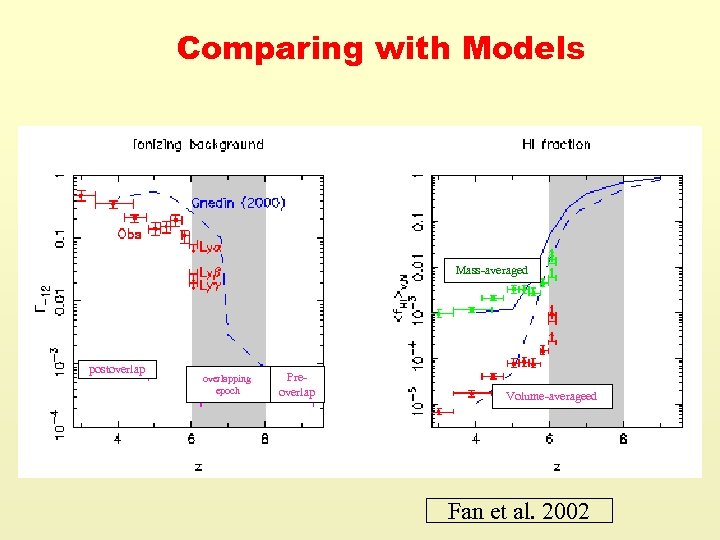
Comparing with Models Mass-averaged postoverlapping epoch Preoverlap Volume-averageed Fan et al. 2002
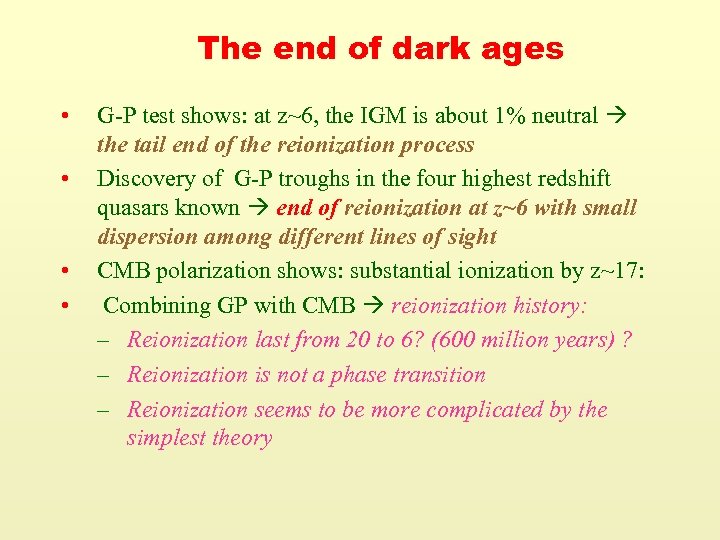
The end of dark ages • • G-P test shows: at z~6, the IGM is about 1% neutral the tail end of the reionization process Discovery of G-P troughs in the four highest redshift quasars known end of reionization at z~6 with small dispersion among different lines of sight CMB polarization shows: substantial ionization by z~17: Combining GP with CMB reionization history: – Reionization last from 20 to 6? (600 million years) ? – Reionization is not a phase transition – Reionization seems to be more complicated by the simplest theory
What’s next? • More quasars: understanding the topology of the reionization from multiple lines of sights • Evolution of heave element: chemical enrichment and feedback from the first galaxies • Pushing towards higher redshifts: IR surveys, JWST finding the first light • More sensitive to large neutral fraction – GRBs? 21 cm? – Detailed comparison with CMB polarization Mapping the reionization history and the end of the cosmic dark ages
Summary • High-redshift quasars evolve strongly with redshift: – – • High-redshift quasars are sites of spectacular star formation: – – • Density declines by ~20 from z~3 to z~6 Evolution much faster than normal galaxies Sub-mm and CO detections high star formation rate Possible supersolar metallicity at z>6 in quasar environment High-redshift quasars probe the end of reionization epoch: – – – Lyα absorption increases dramatically at z>5. 7 Consistent detections of complete Gunn-Peterson troughs in the highest-redshift objects At z~6: ionizing background much lower, neutral fraction >1%, moderately overdense regions still neutral it marks the end of the reionization epoch when the last remaining HI in the IGM is being ionized combining with CMB results: revealing the reionization history and the end of cosmic dark ages
Скачать презентацию The Most Distant Quasars Probing the End of
0a8cf8df2328d5a18d946bcdae1542fd.ppt