 Скачать презентацию The Moscow Interbank Currency Exchange The National Mercantile
8e64189b8e9e08f7f91a88bceaff0c0f.ppt
- Количество слайдов: 30



The Moscow Interbank Currency Exchange The National Mercantile Exchange Materials for the international conference «BLACK SEA BASIN GRAIN MARKET: Commodity Management, Financing, Trade and Investment» Pavel Ilichev Head of the NAMEX Exchange Technologies Division Sofia 2005 1
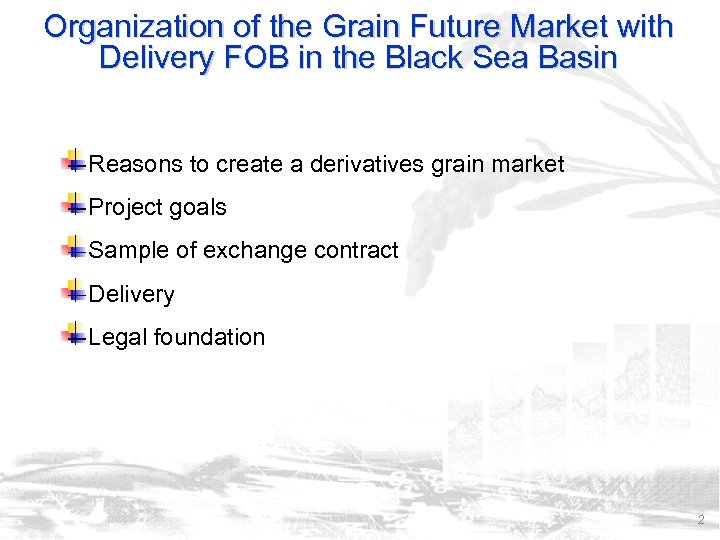
Organization of the Grain Future Market with Delivery FOB in the Black Sea Basin Reasons to create a derivatives grain market Project goals Sample of exchange contract Delivery Legal foundation 2
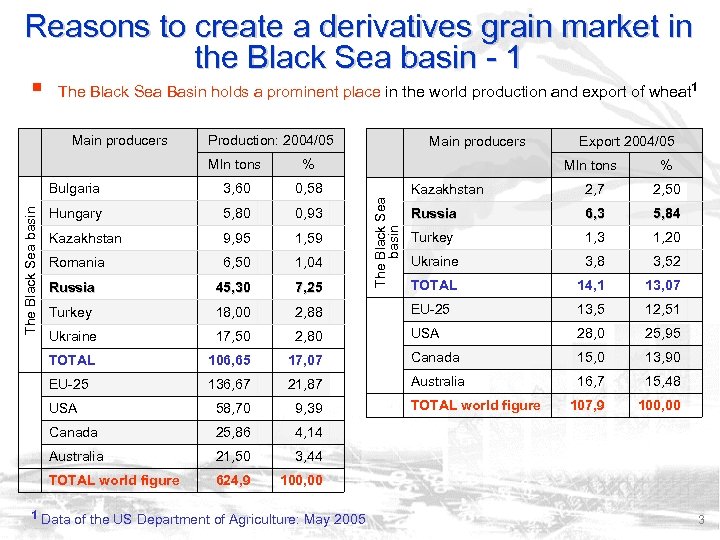
Reasons to create a derivatives grain market in the Black Sea basin - 1 § The Black Sea Basin holds a prominent place in the world production and export of wheat 1 Main producers Production: 2004/05 Mln tons % Bulgaria 3, 60 0, 58 Hungary 5, 80 0, 93 Kazakhstan 9, 95 1, 59 Romania 6, 50 1, 04 Russia 45, 30 7, 25 Turkey 18, 00 Ukraine Main producers Export 2004/05 Kazakhstan 2, 7 2, 50 Russia 6, 3 5, 84 Turkey 1, 3 1, 20 Ukraine 3, 8 3, 52 TOTAL 14, 1 13, 07 2, 88 EU-25 13, 5 12, 51 17, 50 2, 80 USA 28, 0 25, 95 106, 65 17, 07 Canada 15, 0 13, 90 EU-25 136, 67 21, 87 Australia 16, 7 15, 48 USA 58, 70 9, 39 107, 9 100, 00 Canada 25, 86 4, 14 Australia 21, 50 3, 44 TOTAL world figure 624, 9 100, 00 1 Data of the US Department of Agriculture: May 2005 The Black Sea basin % TOTAL The Black Sea basin Mln tons TOTAL world figure 3
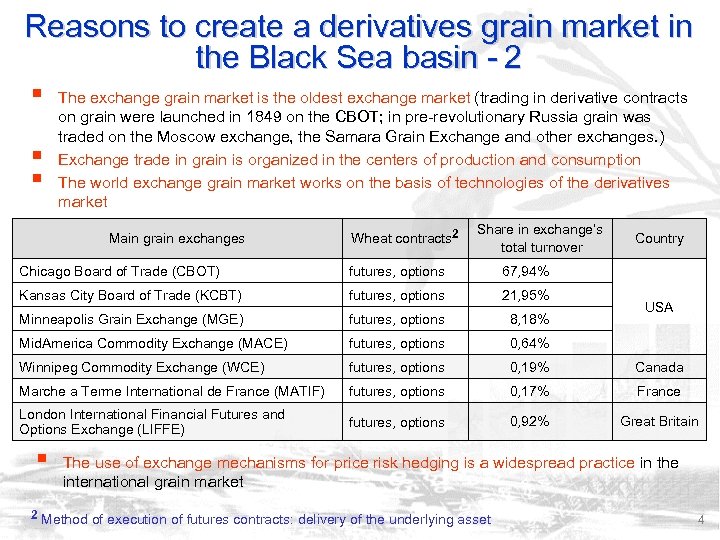
Reasons to create a derivatives grain market in the Black Sea basin - 2 § § § The exchange grain market is the oldest exchange market (trading in derivative contracts on grain were launched in 1849 on the CBOT; in pre-revolutionary Russia grain was traded on the Moscow exchange, the Samara Grain Exchange and other exchanges. ) Exchange trade in grain is organized in the centers of production and consumption The world exchange grain market works on the basis of technologies of the derivatives market Main grain exchanges Wheat contracts 2 Share in exchange’s total turnover Country Chicago Board of Trade (CBOT) futures, options 67, 94% Kansas City Board of Trade (KCBT) futures, options 21, 95% Minneapolis Grain Exchange (MGE) futures, options 8, 18% Mid. America Commodity Exchange (MACE) futures, options 0, 64% Winnipeg Commodity Exchange (WCE) futures, options 0, 19% Canada Marche a Terme International de France (MATIF) futures, options 0, 17% France London International Financial Futures and Options Exchange (LIFFE) futures, options 0, 92% Great Britain § USA The use of exchange mechanisms for price risk hedging is a widespread practice in the international grain market 2 Method of execution of futures contracts: delivery of the underlying asset 4
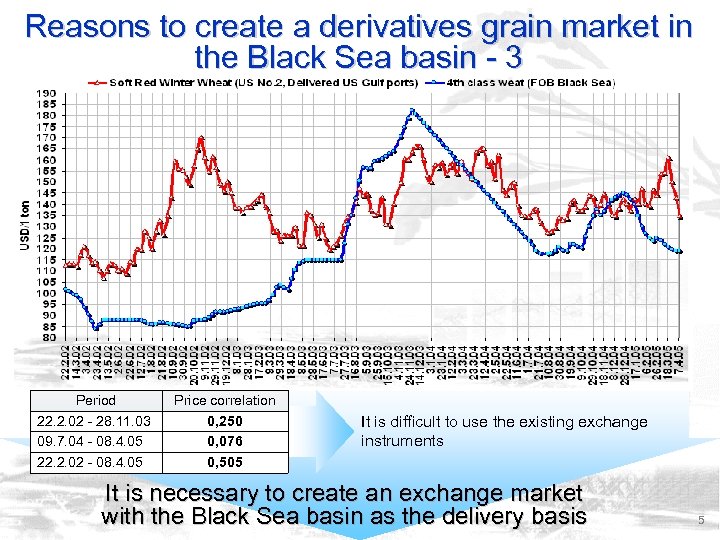
Reasons to create a derivatives grain market in the Black Sea basin - 3 Period 22. 2. 02 - 28. 11. 03 09. 7. 04 - 08. 4. 05 22. 2. 02 - 08. 4. 05 Price correlation 0, 250 0, 076 0, 505 It is difficult to use the existing exchange instruments It is necessary to create an exchange market with the Black Sea basin as the delivery basis 5
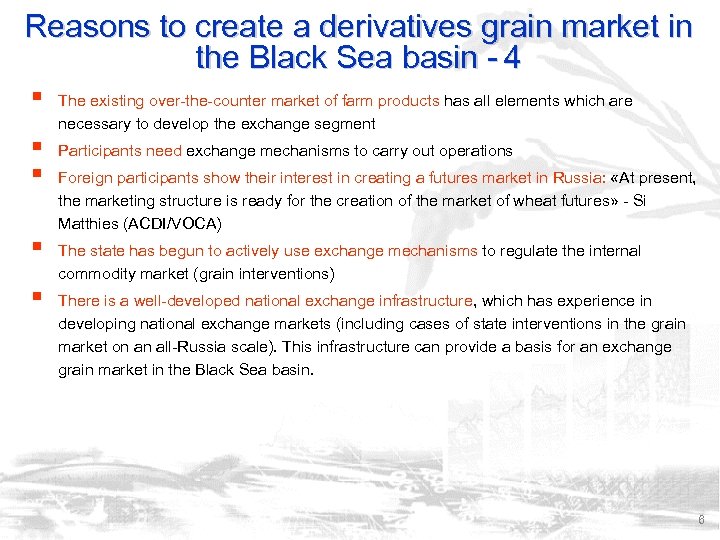
Reasons to create a derivatives grain market in the Black Sea basin - 4 § § § The existing over-the-counter market of farm products has all elements which are necessary to develop the exchange segment Participants need exchange mechanisms to carry out operations Foreign participants show their interest in creating a futures market in Russia: «At present, the marketing structure is ready for the creation of the market of wheat futures» - Si Matthies (ACDI/VOCA) The state has begun to actively use exchange mechanisms to regulate the internal commodity market (grain interventions) There is a well-developed national exchange infrastructure, which has experience in developing national exchange markets (including cases of state interventions in the grain market on an all-Russia scale). This infrastructure can provide a basis for an exchange grain market in the Black Sea basin. 6
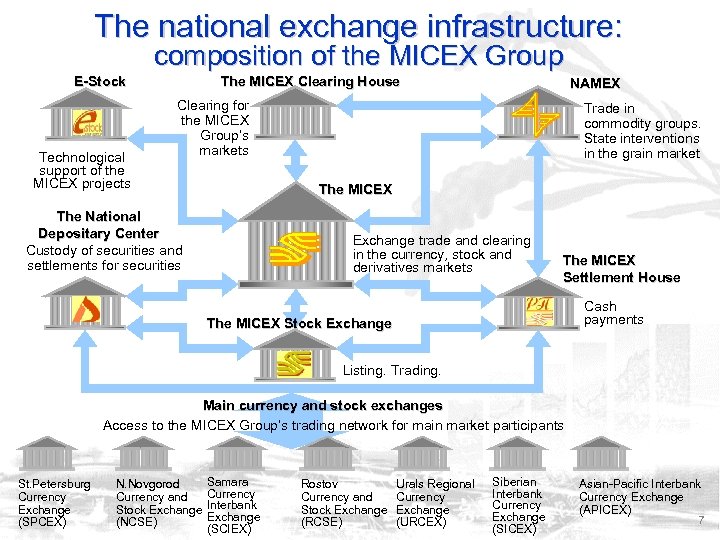
The national exchange infrastructure: composition of the MICEX Group E-Stock Technological support of the MICEX projects The MICEX Clearing House NAMEX Clearing for the MICEX Group’s markets Trade in commodity groups. State interventions in the grain market The MICEX The National Depositary Center Custody of securities and settlements for securities Exchange trade and clearing in the currency, stock and derivatives markets The MICEX Settlement House Cash payments The MICEX Stock Exchange Listing. Trading. Main currency and stock exchanges Access to the MICEX Group’s trading network for main market participants St. Petersburg Currency Exchange (SPCEX) N. Novgorod Currency and Stock Exchange (NCSE) Samara Currency Interbank Exchange (SCIEX) Rostov Currency and Stock Exchange (RCSE) Urals Regional Currency Exchange (URCEX) Siberian Interbank Currency Exchange (SICEX) Asian-Pacific Interbank Currency Exchange (АPICEX) 7
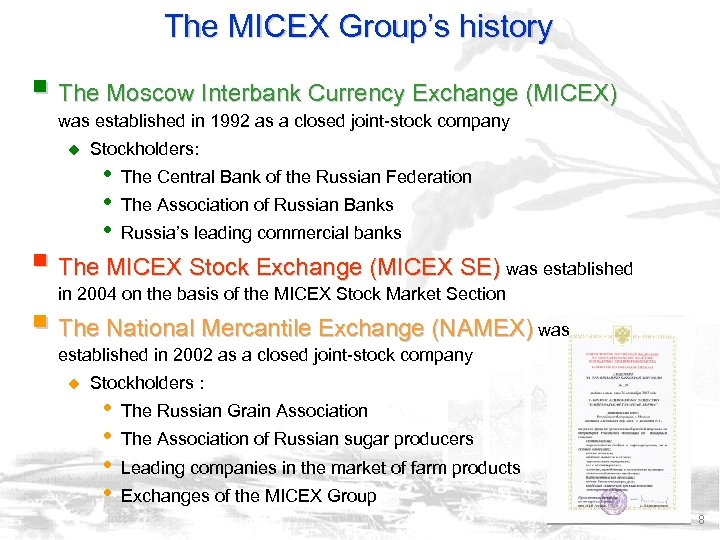
The MICEX Group’s history § The Moscow Interbank Currency Exchange (MICEX) was established in 1992 as a closed joint-stock company u Stockholders: • • • The Central Bank of the Russian Federation The Association of Russian Banks Russia’s leading commercial banks § The MICEX Stock Exchange (MICEX SE) was established in 2004 on the basis of the MICEX Stock Market Section § The National Mercantile Exchange (NAMEX) was established in 2002 as a closed joint-stock company u Stockholders : • • The Russian Grain Association The Association of Russian sugar producers Leading companies in the market of farm products Exchanges of the MICEX Group 8
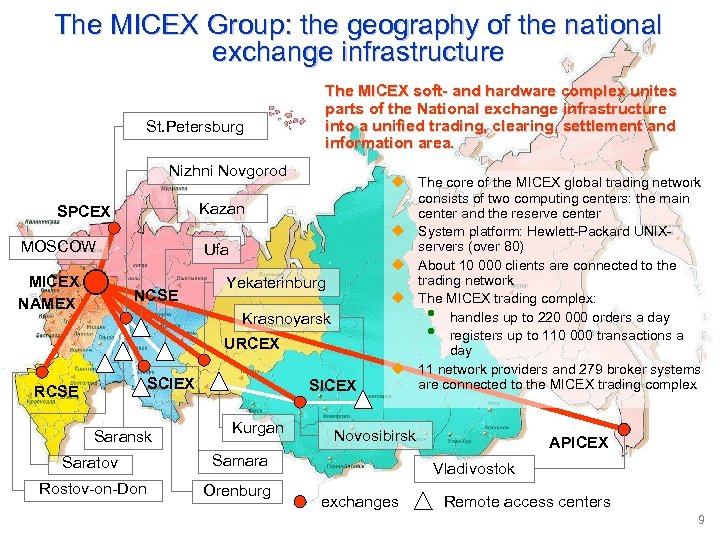
The MICEX Group: the geography of the national exchange infrastructure St. Petersburg The MICEX soft- and hardware complex unites parts of the National exchange infrastructure into a unified trading, clearing, settlement and information area. Nizhni Novgorod Kazan SPCEX MOSCOW MICEX NAMEX Ufa NCSE Yekaterinburg • • Krasnoyarsk URCEX SCIEX RCSE Saransk SICEX Kurgan Saratov Orenburg Novosibirsk Samara Rostov-on-Don u The core of the MICEX global trading network consists of two computing centers: the main center and the reserve center u System platform: Hewlett-Packard UNIXservers (over 80) u About 10 000 clients are connected to the trading network u The MICEX trading complex: handles up to 220 000 orders a day registers up to 110 000 transactions a day u 11 network providers and 279 broker systems are connected to the MICEX trading complex APICEX Vladivostok exchanges Remote access centers 9
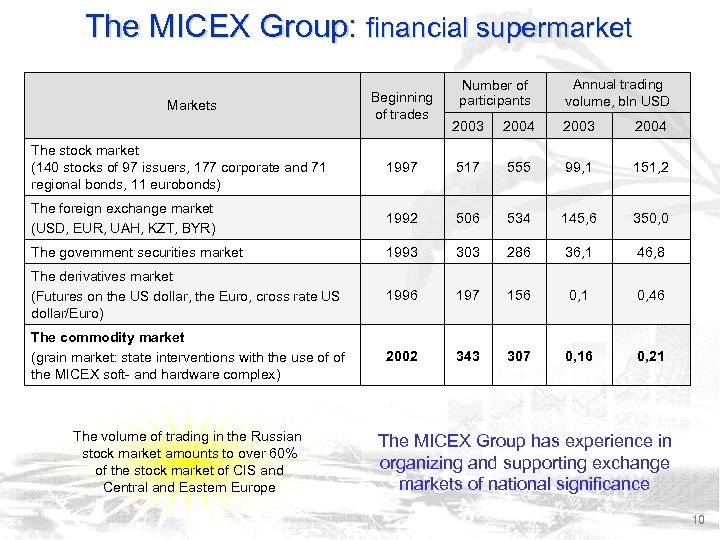
The MICEX Group: financial supermarket Markets Beginning of trades Number of participants Annual trading volume, bln USD 2003 2004 The stock market (140 stocks of 97 issuers, 177 corporate and 71 regional bonds, 11 eurobonds) 1997 517 555 99, 1 151, 2 The foreign exchange market (USD, EUR, UAH, KZT, BYR) 1992 506 534 145, 6 350, 0 The government securities market 1993 303 286 36, 1 46, 8 The derivatives market (Futures on the US dollar, the Euro, cross rate US dollar/Euro) 1996 197 156 0, 1 0, 46 The commodity market (grain market: state interventions with the use of of the MICEX soft- and hardware complex) 2002 343 307 0, 16 0, 21 The volume of trading in the Russian stock market amounts to over 60% of the stock market of CIS and Central and Eastern Europe The MICEX Group has experience in organizing and supporting exchange markets of national significance 10
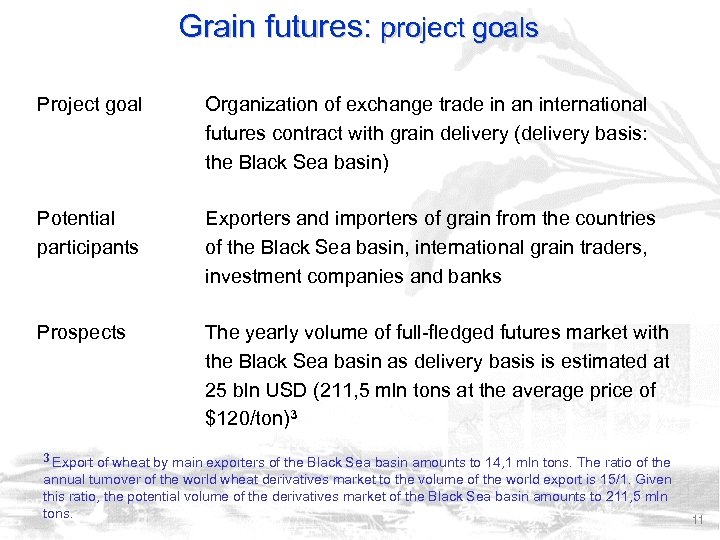
Grain futures: project goals Project goal Organization of exchange trade in an international futures contract with grain delivery (delivery basis: the Black Sea basin) Potential participants Exporters and importers of grain from the countries of the Black Sea basin, international grain traders, investment companies and banks Prospects The yearly volume of full-fledged futures market with the Black Sea basin as delivery basis is estimated at 25 bln USD (211, 5 mln tons at the average price of $120/ton)3 3 Export of wheat by main exporters of the Black Sea basin amounts to 14, 1 mln tons. The ratio of the annual turnover of the world wheat derivatives market to the volume of the world export is 15/1. Given this ratio, the potential volume of the derivatives market of the Black Sea basin amounts to 211, 5 mln tons. 11
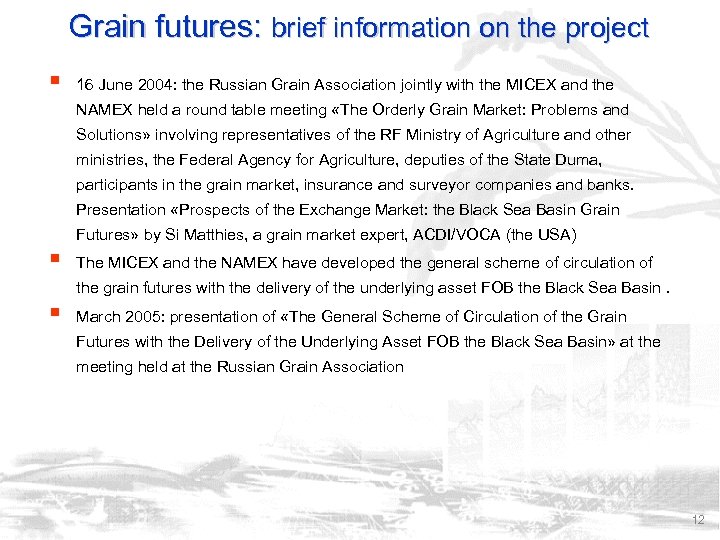
Grain futures: brief information on the project § 16 June 2004: the Russian Grain Association jointly with the MICEX and the NAMEX held a round table meeting «The Orderly Grain Market: Problems and Solutions» involving representatives of the RF Ministry of Agriculture and other ministries, the Federal Agency for Agriculture, deputies of the State Duma, participants in the grain market, insurance and surveyor companies and banks. Presentation «Prospects of the Exchange Market: the Black Sea Basin Grain Futures» by Si Matthies, a grain market expert, ACDI/VOCA (the USA) § The MICEX and the NAMEX have developed the general scheme of circulation of the grain futures with the delivery of the underlying asset FOB the Black Sea Basin. § March 2005: presentation of «The General Scheme of Circulation of the Grain Futures with the Delivery of the Underlying Asset FOB the Black Sea Basin» at the meeting held at the Russian Grain Association 12
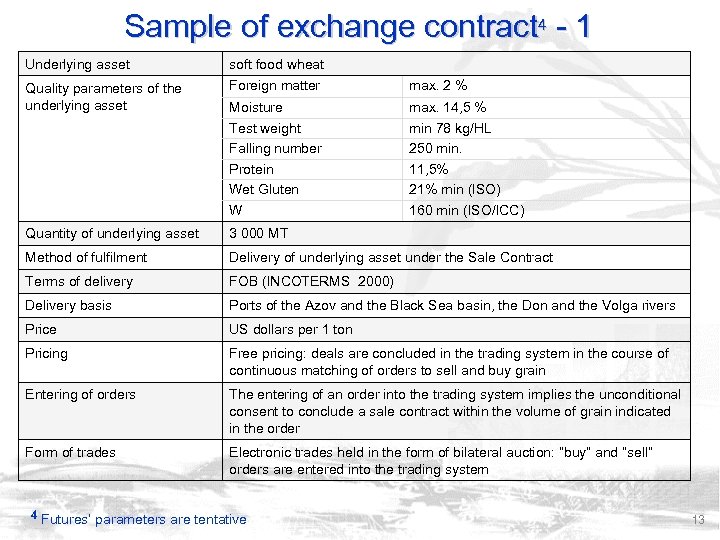
Sample of exchange contract 4 - 1 Underlying asset soft food wheat Quality parameters of the underlying asset Foreign matter max. 2 % Moisture Test weight Falling number Protein Wet Gluten W max. 14, 5 % min 78 kg/HL 250 min. 11, 5% 21% min (ISO) 160 min (ISO/ICC) Quantity of underlying asset 3 000 MT Method of fulfilment Delivery of underlying asset under the Sale Contract Terms of delivery FOB (INCOTERMS 2000) Delivery basis Ports of the Azov and the Black Sea basin, the Don and the Volga rivers Price US dollars per 1 ton Pricing Free pricing: deals are concluded in the trading system in the course of continuous matching of orders to sell and buy grain Entering of orders The entering of an order into the trading system implies the unconditional consent to conclude a sale contract within the volume of grain indicated in the order Form of trades Electronic trades held in the form of bilateral auction: “buy” and “sell” orders are entered into the trading system 4 Futures’ parameters are tentative 13
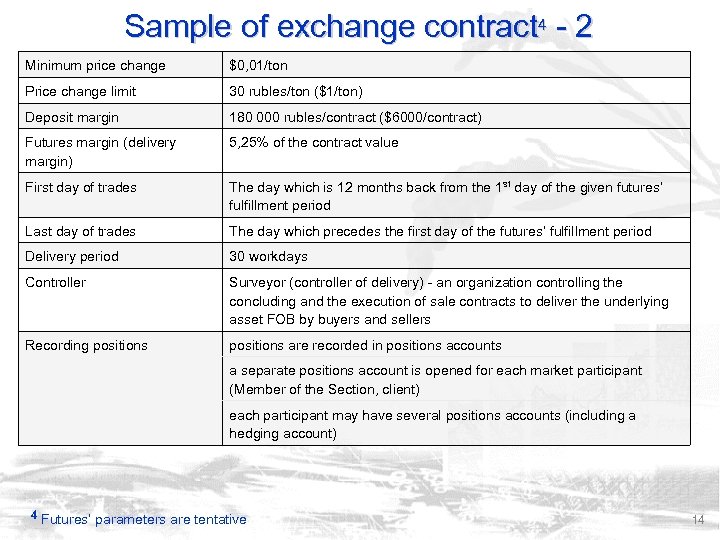
Sample of exchange contract 4 - 2 Minimum price change $0, 01/ton Price change limit 30 rubles/ton ($1/ton) Deposit margin 180 000 rubles/contract ($6000/contract) Futures margin (delivery margin) 5, 25% of the contract value First day of trades The day which is 12 months back from the 1 st day of the given futures’ fulfillment period Last day of trades The day which precedes the first day of the futures’ fulfillment period Delivery period 30 workdays Controller Surveyor (controller of delivery) - an organization controlling the concluding and the execution of sale contracts to deliver the underlying asset FOB by buyers and sellers Recording positions are recorded in positions accounts a separate positions account is opened for each market participant (Member of the Section, client) each participant may have several positions accounts (including a hedging account) 4 Futures’ parameters are tentative 14
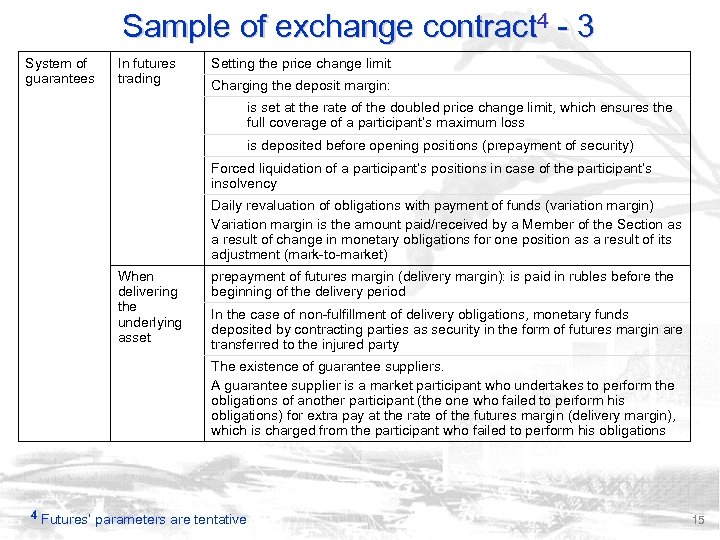
Sample of exchange contract 4 - 3 System of guarantees In futures trading Setting the price change limit Charging the deposit margin: is set at the rate of the doubled price change limit, which ensures the full coverage of a participant’s maximum loss is deposited before opening positions (prepayment of security) Forced liquidation of a participant’s positions in case of the participant’s insolvency Daily revaluation of obligations with payment of funds (variation margin) Variation margin is the amount paid/received by a Member of the Section as a result of change in monetary obligations for one position as a result of its adjustment (mark-to-market) When delivering the underlying asset prepayment of futures margin (delivery margin): is paid in rubles before the beginning of the delivery period In the case of non-fulfillment of delivery obligations, monetary funds deposited by contracting parties as security in the form of futures margin are transferred to the injured party The existence of guarantee suppliers. A guarantee supplier is a market participant who undertakes to perform the obligations of another participant (the one who failed to perform his obligations) for extra pay at the rate of the futures margin (delivery margin), which is charged from the participant who failed to perform his obligations 4 Futures’ parameters are tentative 15
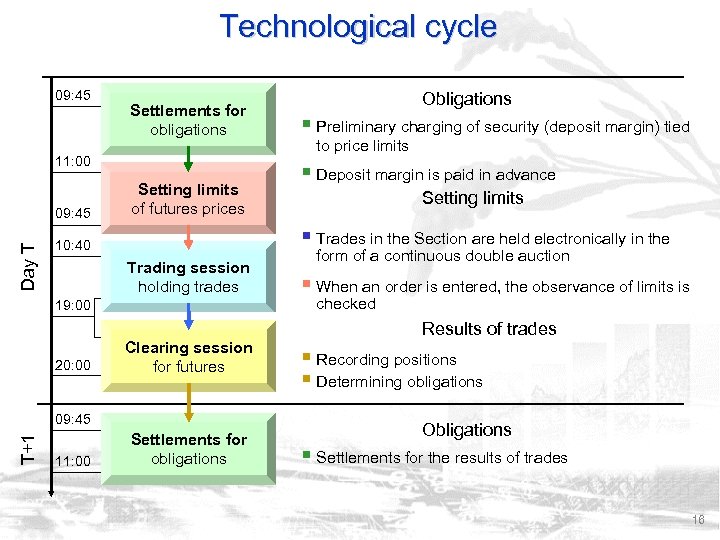
Technological cycle 09: 45 Settlements for obligations 11: 00 Day Т 09: 45 Setting limits of futures prices Trading session holding trades 19: 00 Clearing session for futures Т+1 09: 45 11: 00 § Preliminary charging of security (deposit margin) tied to price limits § Deposit margin is paid in advance Setting limits § Trades in the Section are held electronically in the 10: 40 20: 00 Obligations Settlements for obligations form of a continuous double auction § When an order is entered, the observance of limits is checked Results of trades § Recording positions § Determining obligations Obligations § Settlements for the results of trades 16
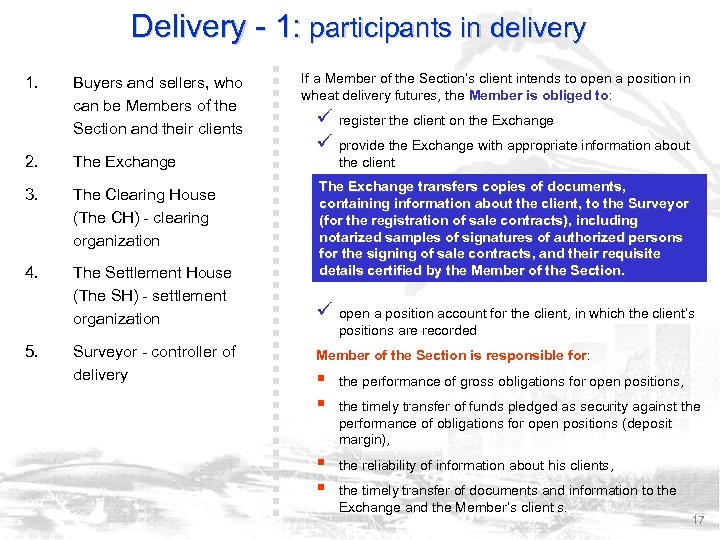
Delivery - 1: participants in delivery 1. Buyers and sellers, who can be Members of the Section and their clients 2. The Exchange 3. The Clearing House (The CH) - clearing organization 4. The Settlement House (The SH) - settlement organization 5. Surveyor - controller of delivery If a Member of the Section’s client intends to open a position in wheat delivery futures, the Member is obliged to: ü register the client on the Exchange ü provide the Exchange with appropriate information about the client The Exchange transfers copies of documents, containing information about the client, to the Surveyor (for the registration of sale contracts), including notarized samples of signatures of authorized persons for the signing of sale contracts, and their requisite details certified by the Member of the Section. ü open a position account for the client, in which the client’s positions are recorded Member of the Section is responsible for: § § the performance of gross obligations for open positions, § § the reliability of information about his clients, the timely transfer of funds pledged as security against the performance of obligations for open positions (deposit margin), the timely transfer of documents and information to the Exchange and the Member’s client s. 17
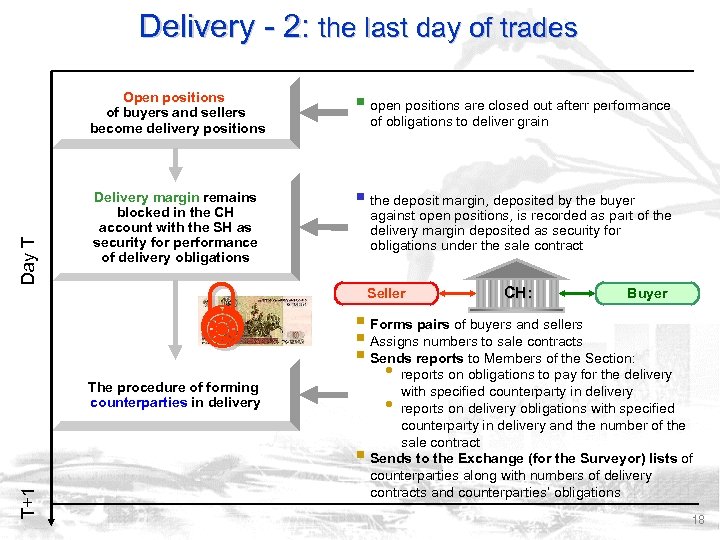
Delivery - 2: the last day of trades Day Т Open positions of buyers and sellers become delivery positions § open positions are closed out afterr performance Delivery margin remains blocked in the CH account with the SH as security for performance of delivery obligations § the deposit margin, deposited by the buyer Ï The procedure of forming counterparties in delivery of obligations to deliver grain against open positions, is recorded as part of the delivery margin deposited as security for obligations under the sale contract Seller Buyer § Forms pairs of buyers and sellers § Assigns numbers to sale contracts § Sends reports to Members of the Section: • reports on obligations to pay for the delivery with specified counterparty in delivery • reports on delivery obligations with specified § Т+1 CH: counterparty in delivery and the number of the sale contract Sends to the Exchange (for the Surveyor) lists of counterparties along with numbers of delivery contracts and counterparties’ obligations 18
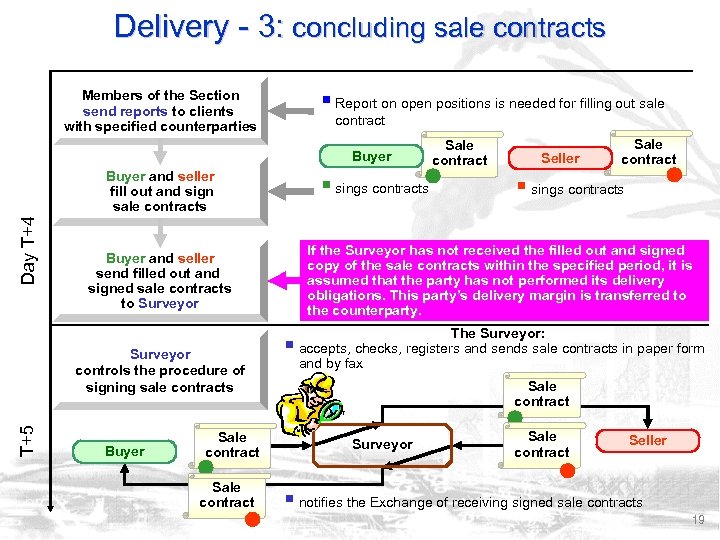
Delivery - 3: concluding sale contracts § Report on open positions is needed for filling out sale Members of the Section send reports to clients with specified counterparties contract Buyer Day Т+4 Buyer and seller fill out and sign sale contracts Buyer Sale contract Seller Sale contract § sings contracts If the Surveyor has not received the filled out and signed copy of the sale contracts within the specified period, it is assumed that the party has not performed its delivery obligations. This party’s delivery margin is transferred to the counterparty. Buyer and seller send filled out and signed sale contracts to Surveyor controls the procedure of signing sale contracts Т+5 § sings contracts Sale contract § The Surveyor: accepts, checks, registers and sends sale contracts in paper form and by fax Sale contract Surveyor Sale contract Seller § notifies the Exchange of receiving signed sale contracts 19
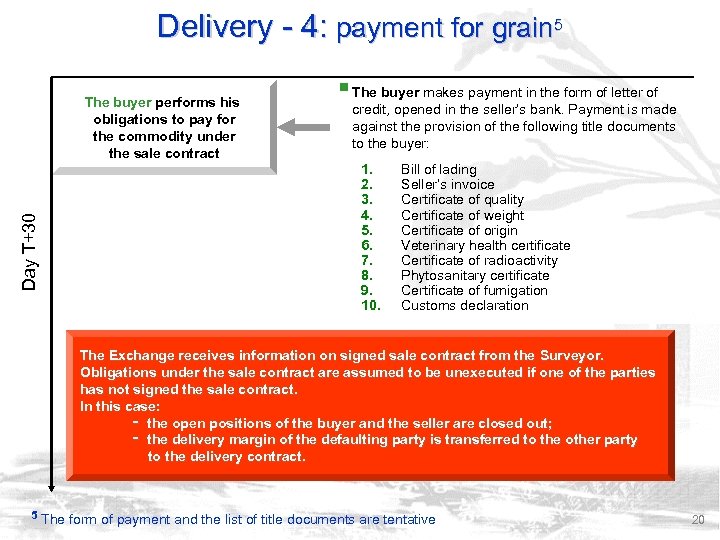
Delivery - 4: payment for grain 5 Day Т+30 The buyer performs his obligations to pay for the commodity under the sale contract § The buyer makes payment in the form of letter of credit, opened in the seller’s bank. Payment is made against the provision of the following title documents to the buyer: 1. 2. 3. 4. 5. 6. 7. 8. 9. 10. Bill of lading Seller’s invoice Certificate of quality Certificate of weight Certificate of origin Veterinary health certificate Certificate of radioactivity Phytosanitary certificate Certificate of fumigation Customs declaration The Exchange receives information on signed sale contract from the Surveyor. Obligations under the sale contract are assumed to be unexecuted if one of the parties has not signed the sale contract. In this case: - the open positions of the buyer and the seller are closed out; - the delivery margin of the defaulting party is transferred to the other party to the delivery contract. 5 The form of payment and the list of title documents are tentative 20
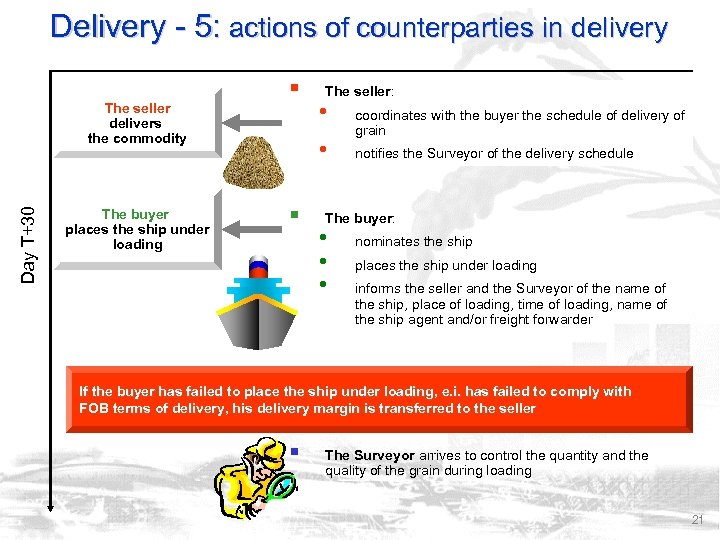
Delivery - 5: actions of counterparties in delivery Day Т+30 The seller delivers the commodity The buyer places the ship under loading § The seller: • • § coordinates with the buyer the schedule of delivery of grain notifies the Surveyor of the delivery schedule The buyer: • • • nominates the ship places the ship under loading informs the seller and the Surveyor of the name of the ship, place of loading, time of loading, name of the ship agent and/or freight forwarder If the buyer has failed to place the ship under loading, e. i. has failed to comply with FOB terms of delivery, his delivery margin is transferred to the seller § The Surveyor arrives to control the quantity and the quality of the grain during loading 21
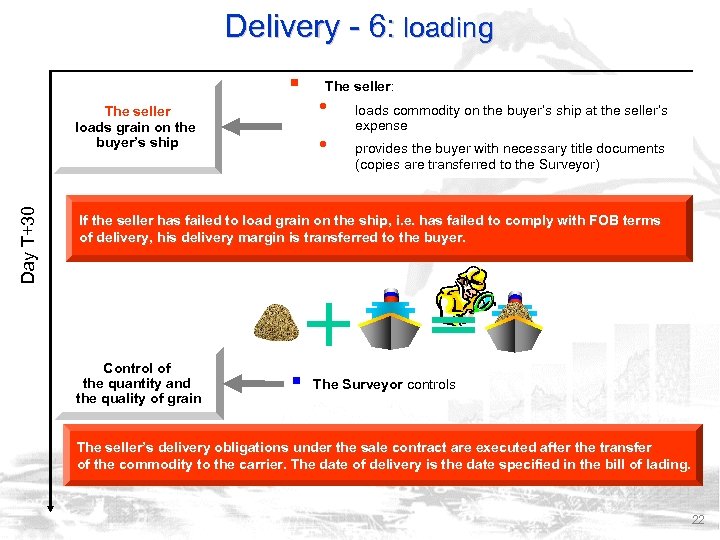
Delivery - 6: loading § Day Т+30 The seller loads grain on the buyer’s ship The seller: • • loads commodity on the buyer’s ship at the seller’s expense provides the buyer with necessary title documents (copies are transferred to the Surveyor) If the seller has failed to load grain on the ship, i. e. has failed to comply with FOB terms of delivery, his delivery margin is transferred to the buyer. Control of the quantity and the quality of grain § The Surveyor controls The seller’s delivery obligations under the sale contract are executed after the transfer of the commodity to the carrier. The date of delivery is the date specified in the bill of lading. 22
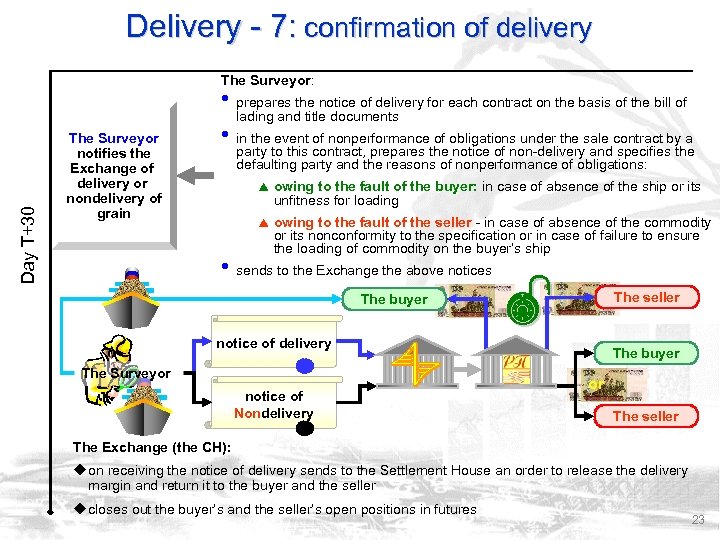
Delivery - 7: confirmation of delivery Day Т+30 The Surveyor: The Surveyor notifies the Exchange of delivery or nondelivery of grain • prepares the notice of delivery for each contract on the basis of the bill of lading and title documents • in the event of nonperformance of obligations under the sale contract by a party to this contract, prepares the notice of non-delivery and specifies the defaulting party and the reasons of nonperformance of obligations: p owing to the fault of the buyer: in case of absence of the ship or its unfitness for loading p owing to the fault of the seller - in case of absence of the commodity or its nonconformity to the specification or in case of failure to ensure the loading of commodity on the buyer’s ship • sends to the Exchange the above notices The buyer Ð The seller notice of delivery The Surveyor notice of Nondelivery The buyer or The seller The Exchange (the CH): u on receiving the notice of delivery sends to the Settlement House an order to release the delivery margin and return it to the buyer and the seller u closes out the buyer’s and the seller’s open positions in futures 23
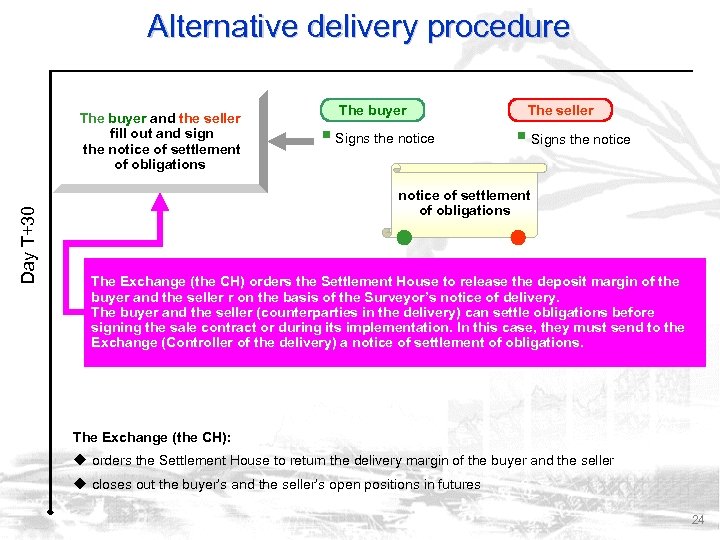
Alternative delivery procedure Day Т+30 The buyer and the seller fill out and sign the notice of settlement of obligations The buyer § Signs the notice The seller § Signs the notice of settlement of obligations The Exchange (the CH) orders the Settlement House to release the deposit margin of the buyer and the seller r on the basis of the Surveyor’s notice of delivery. The buyer and the seller (counterparties in the delivery) can settle obligations before signing the sale contract or during its implementation. In this case, they must send to the Exchange (Controller of the delivery) a notice of settlement of obligations. The Exchange (the CH): u orders the Settlement House to return the delivery margin of the buyer and the seller u closes out the buyer’s and the seller’s open positions in futures 24
The market of grain futures: new opportunities for participants q Own operations § Insurance against the risk of unfavorable price changes § Effective sales within a wide circle of participants in the grain market q Development of client business § A large number of market participants who do not have appropriate infrastructure to work in the derivatives market q Gains from acting as Guarantee Supplier § The possibility of selling (buying) grain at prices higher (lower) than market prices as a result of receiving delivery margin from the defaulting party 25
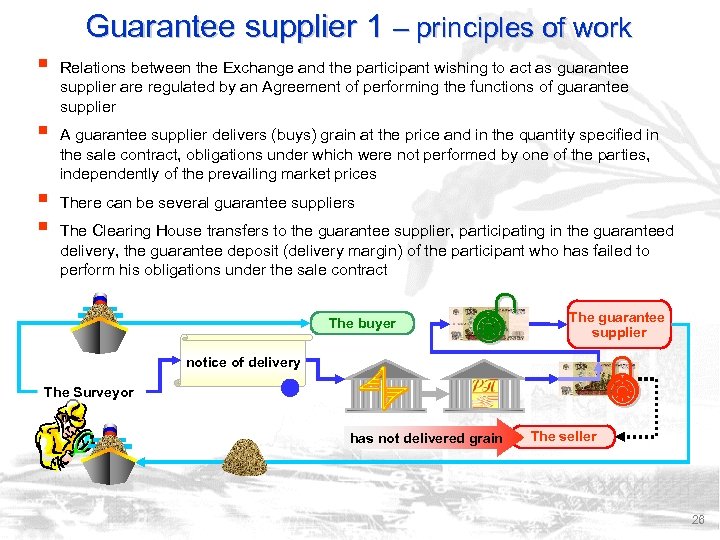
Guarantee supplier 1 – principles of work § § Relations between the Exchange and the participant wishing to act as guarantee supplier are regulated by an Agreement of performing the functions of guarantee supplier A guarantee supplier delivers (buys) grain at the price and in the quantity specified in the sale contract, obligations under which were not performed by one of the parties, independently of the prevailing market prices There can be several guarantee suppliers The Clearing House transfers to the guarantee supplier, participating in the guaranteed delivery, the guarantee deposit (delivery margin) of the participant who has failed to perform his obligations under the sale contract The buyer Ð The guarantee supplier Ï notice of delivery The Surveyor has not delivered grain The seller 26
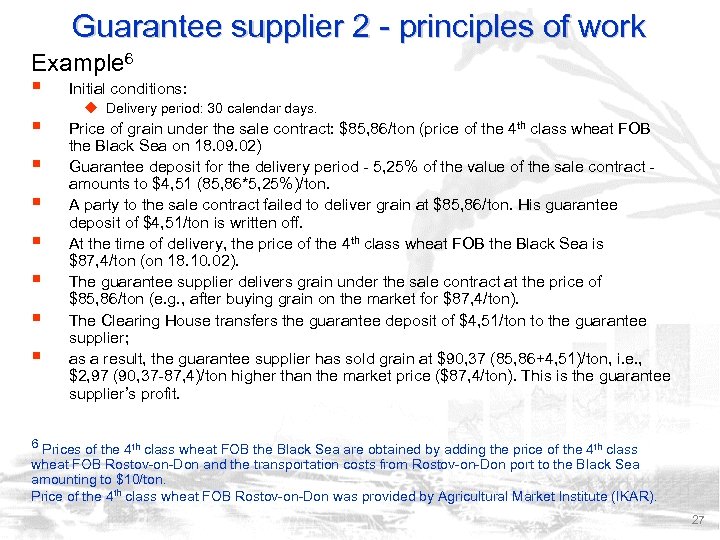
Guarantee supplier 2 - principles of work Example 6 § Initial conditions: § § § § u Delivery period: 30 calendar days. Price of grain under the sale contract: $85, 86/ton (price of the 4 th class wheat FOB the Black Sea on 18. 09. 02) Guarantee deposit for the delivery period - 5, 25% of the value of the sale contract amounts to $4, 51 (85, 86*5, 25%)/ton. A party to the sale contract failed to deliver grain at $85, 86/ton. His guarantee deposit of $4, 51/ton is written off. At the time of delivery, the price of the 4 th class wheat FOB the Black Sea is $87, 4/ton (on 18. 10. 02). The guarantee supplier delivers grain under the sale contract at the price of $85, 86/ton (e. g. , after buying grain on the market for $87, 4/ton). The Clearing House transfers the guarantee deposit of $4, 51/ton to the guarantee supplier; as a result, the guarantee supplier has sold grain at $90, 37 (85, 86+4, 51)/ton, i. e. , $2, 97 (90, 37 -87, 4)/ton higher than the market price ($87, 4/ton). This is the guarantee supplier’s profit. 6 Prices of the 4 th class wheat FOB the Black Sea are obtained by adding the price of the 4 th class wheat FOB Rostov-on-Don and the transportation costs from Rostov-on-Don port to the Black Sea amounting to $10/ton. Price of the 4 th class wheat FOB Rostov-on-Don was provided by Agricultural Market Institute (IKAR). 27
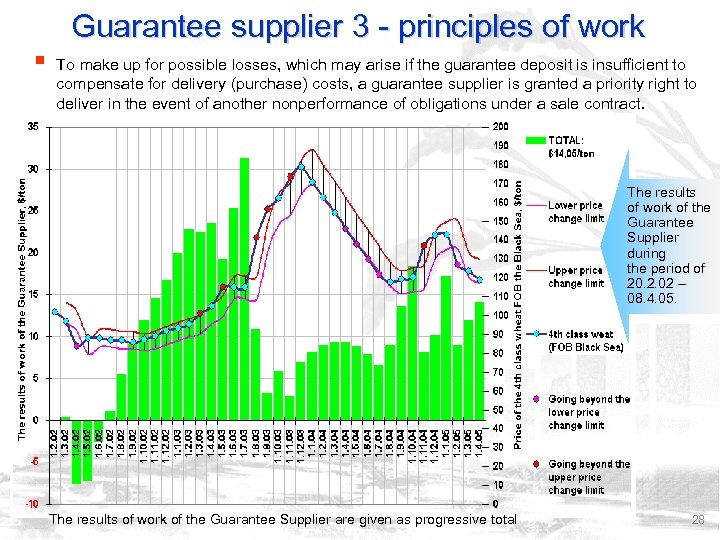
Guarantee supplier 3 - principles of work § To make up for possible losses, which may arise if the guarantee deposit is insufficient to compensate for delivery (purchase) costs, a guarantee supplier is granted a priority right to deliver in the event of another nonperformance of obligations under a sale contract. The results of work of the Guarantee Supplier during the period of 20. 2. 02 – 08. 4. 05. The results of work of the Guarantee Supplier are given as progressive total 28
Legal foundation of the market of derivative instruments on grain The market of derivative instruments on grain is regulated by the Law on Commodity Exchanges and Exchange Trade (#2383 -I, 20. 02. 92) There are no limitations on the work of foreign companies and organizations on the market of derivative instruments on grain in Russia 29
Contact information Address: 13. B. Kislovskiy per. Moscow. 125009. Russia telephone: (095) 705 -96 -76 (095) 203 -15 -10 (095) 202 -96 -28 fax: (095) 202 -75 -04 e-mail (MICEX): commodities@micex. com e-mail (NAMEX): namex@namex. org Web site (MICEX): www. micex. com Web site (NAMEX) www. namex. org 30
Скачать презентацию The Moscow Interbank Currency Exchange The National Mercantile
8e64189b8e9e08f7f91a88bceaff0c0f.ppt