 Скачать презентацию The Montgomery Bus Boycott and the emergence of
2f38e1ef5a2df3fe0a2bb37d3a6bca68.ppt
- Количество слайдов: 25



The Montgomery Bus Boycott and the emergence of Martin Luther King, 1955 -56
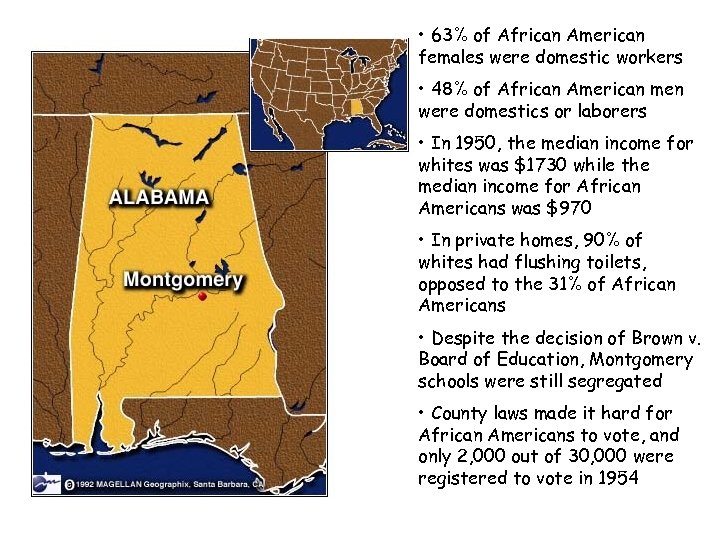
• 63% of African American females were domestic workers • 48% of African American men were domestics or laborers • In 1950, the median income for whites was $1730 while the median income for African Americans was $970 • In private homes, 90% of whites had flushing toilets, opposed to the 31% of African Americans • Despite the decision of Brown v. Board of Education, Montgomery schools were still segregated • County laws made it hard for African Americans to vote, and only 2, 000 out of 30, 000 were registered to vote in 1954
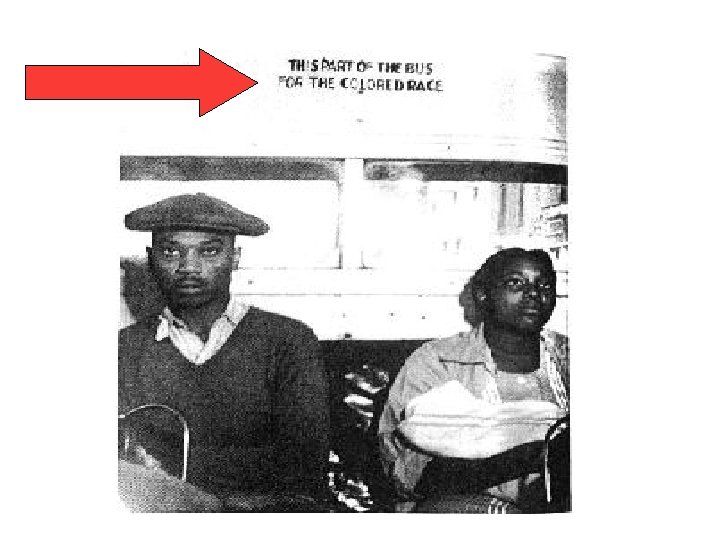
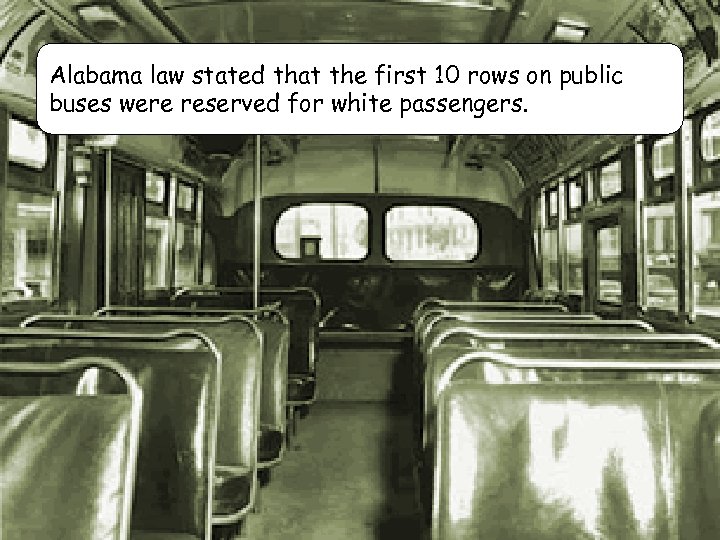
Alabama law stated that the first 10 rows on public buses were reserved for white passengers.
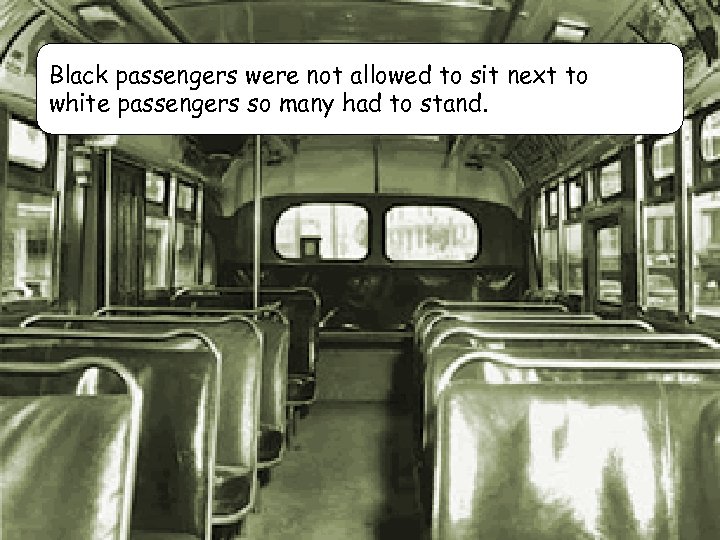
Black passengers were not allowed to sit next to white passengers so many had to stand.
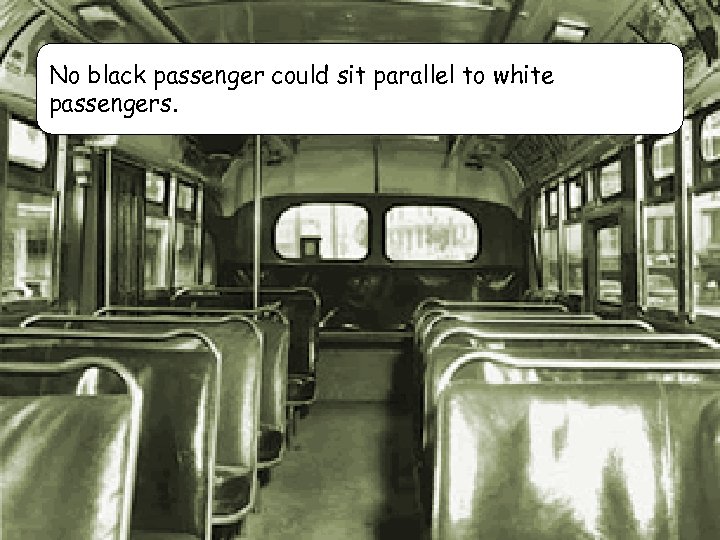
No black passenger could sit parallel to white passengers.
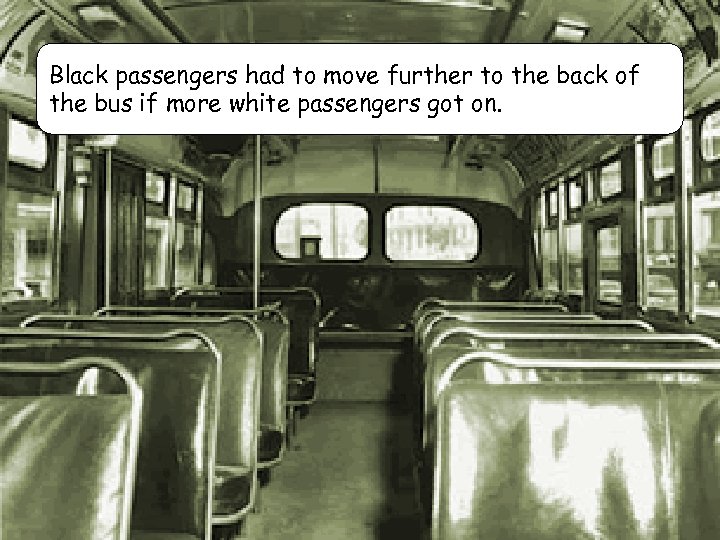
Black passengers had to move further to the back of the bus if more white passengers got on.
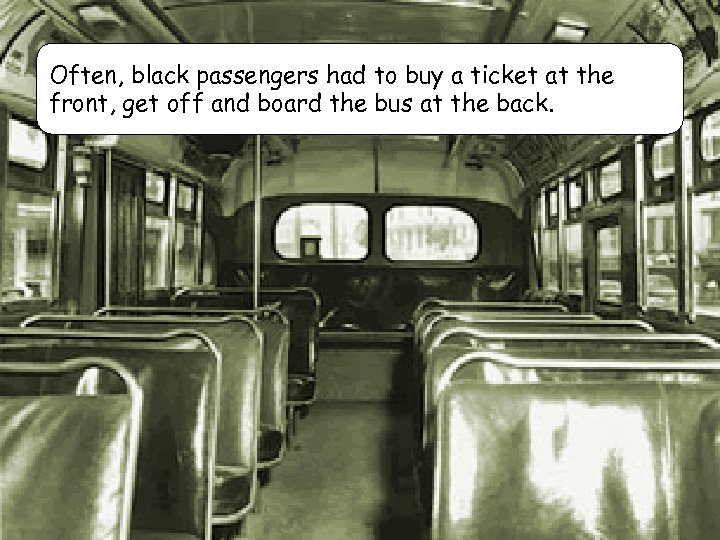
Often, black passengers had to buy a ticket at the front, get off and board the bus at the back.
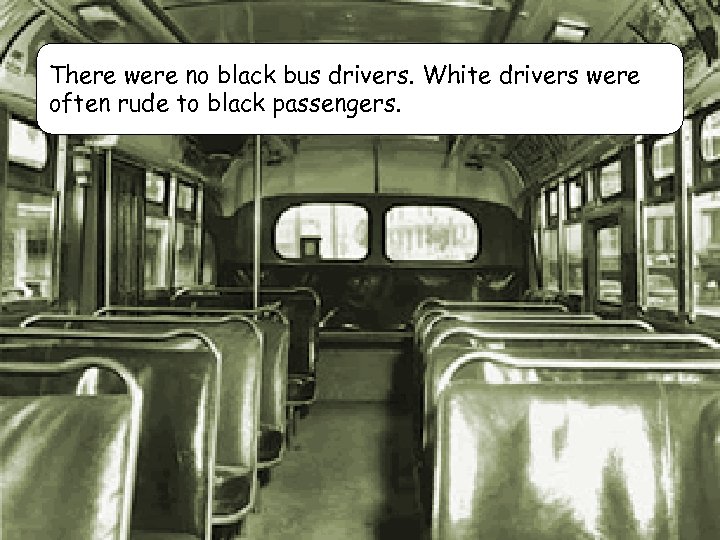
There were no black bus drivers. White drivers were often rude to black passengers.
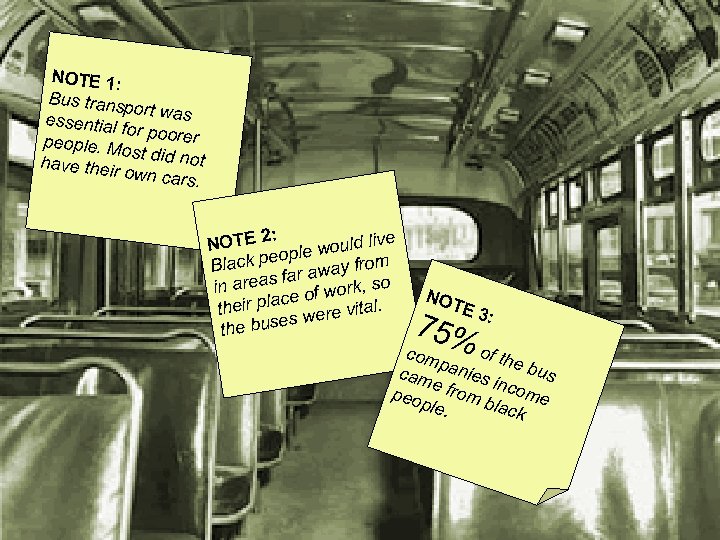
NOTE 1: Bus trans port was essential for poorer people. M ost did no t have their own cars. : NOTE 2 ple would live eo om Black p away fr far in areas rk, so e of wo c their pla were vital. es the bus NOT E 3: 75% o com pan f the bu cam ie s e fro s inco m peo ple. m blac e k
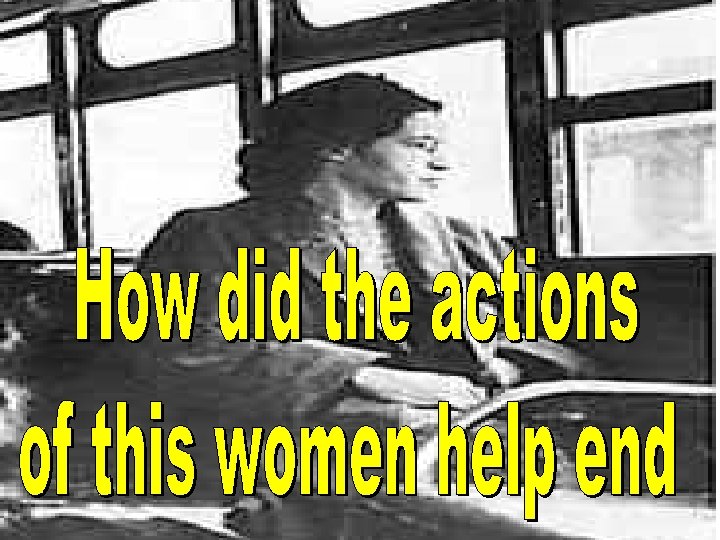
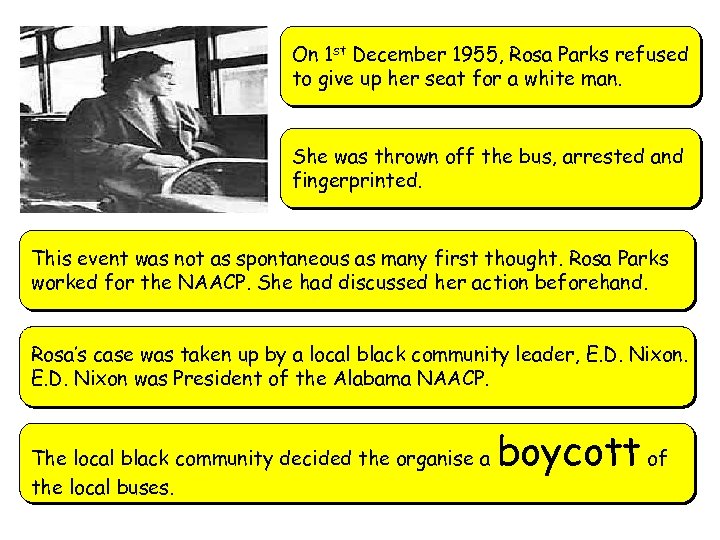
On 1 st December 1955, Rosa Parks refused to give up her seat for a white man. She was thrown off the bus, arrested and fingerprinted. This event was not as spontaneous as many first thought. Rosa Parks worked for the NAACP. She had discussed her action beforehand. Rosa’s case was taken up by a local black community leader, E. D. Nixon was President of the Alabama NAACP. The local black community decided the organise a the local buses. boycott of
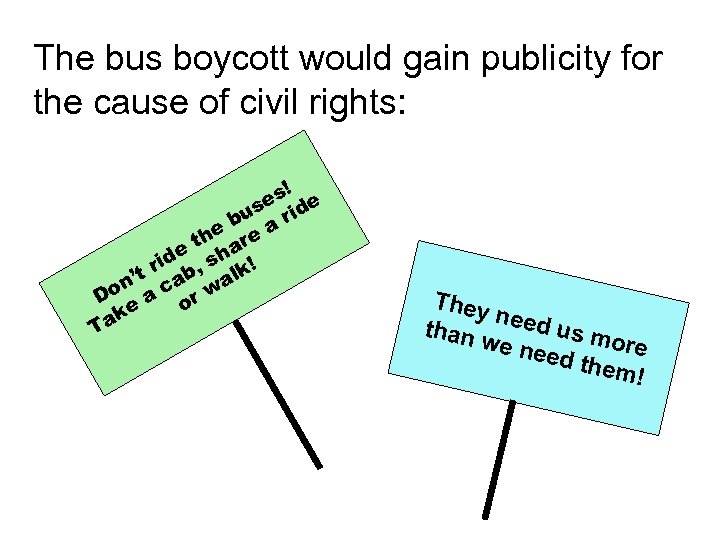
The bus boycott would gain publicity for the cause of civil rights: ! es de s bu a ri e th are ide , sh k! r ’t ab al on a c r w D e o k Ta They n than eed us m we ne o ed th re em!
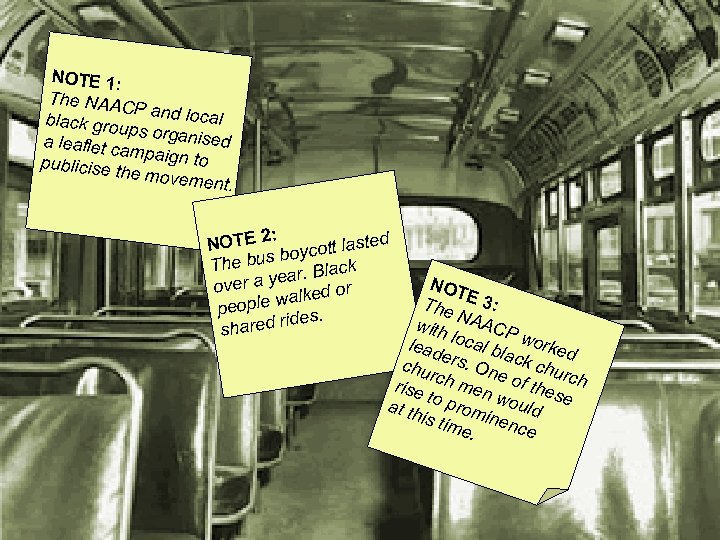
NOTE 1: The NAAC P black grou and local ps organis ed a leaflet c ampaign to publicise the move ment. : NOTE 2 oycott lasted b The bus r. Black ea over a y lked or wa people des. hared ri s NOT The E 3: with NAACP lead local bl worked a e chu rs. On ck chu rc r e rise h men of thes ch t at th o prom would e is tim inen ce e.
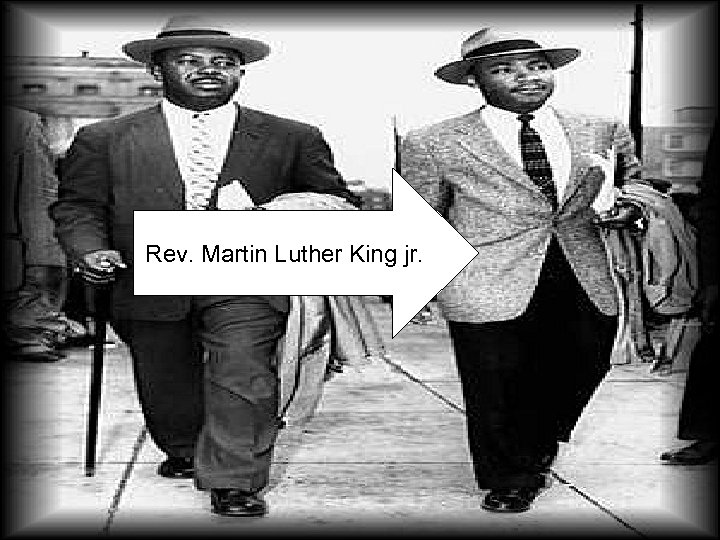
Rev. Martin Luther King jr.
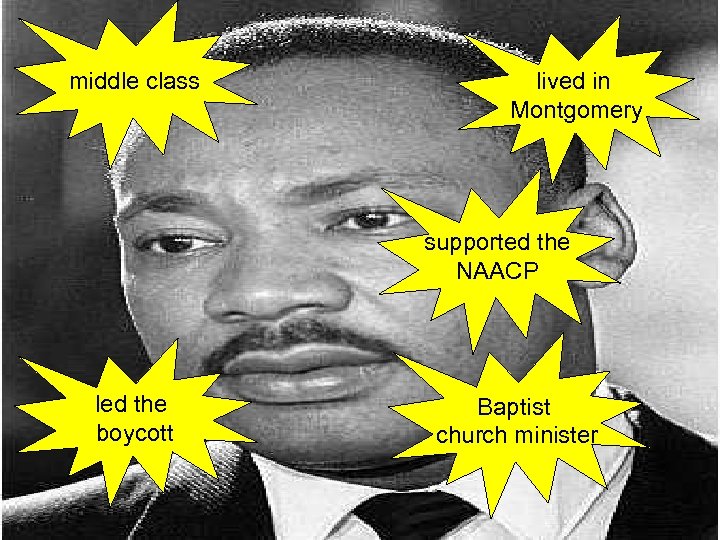
middle class lived in Montgomery supported the NAACP led the boycott Baptist church minister
King’s support • King’s church became the centre of organisation for the Montgomery Bus Boycott. • The church provided organisation, inspiration and financial support. • Church involvement was essential.
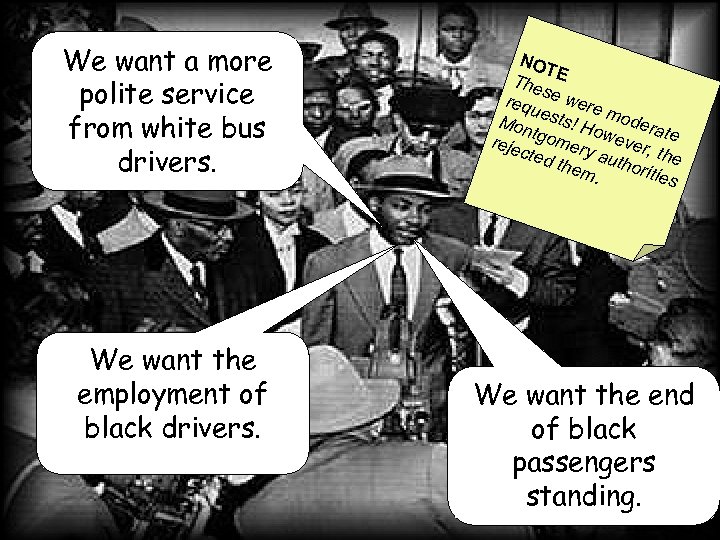
We want a more polite service from white bus drivers. We want the employment of black drivers. NOT The E s requ e were Mon ests! H modera o t t reje gomer wever, e y cted th them authori e ties. We want the end of black passengers standing.
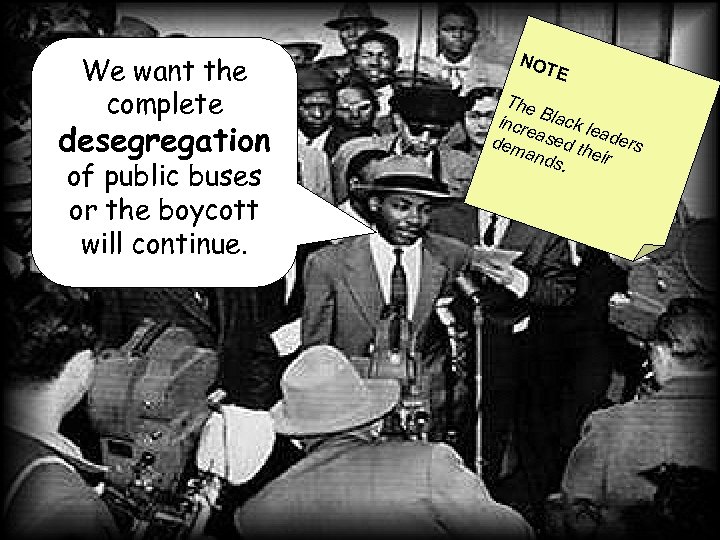
We want the complete desegregation of public buses or the boycott will continue. NOT E The incr Black le e dem ased th aders and eir s.
The white authorities strike back • Leading city officials ordered the harassment of blacks. • King was arrested for speeding (5 m. p. h. over the limit). • In January 1956, King’s home was bombed. • King continued to stress non-violent protest.
“If we are wrong, the Supreme Court of this nation is wrong. If we are wrong, the Constitution of the United States is wrong. If we are wrong, Jesus of Nazareth was merely a …. . dreamer. ” Martin Luther King
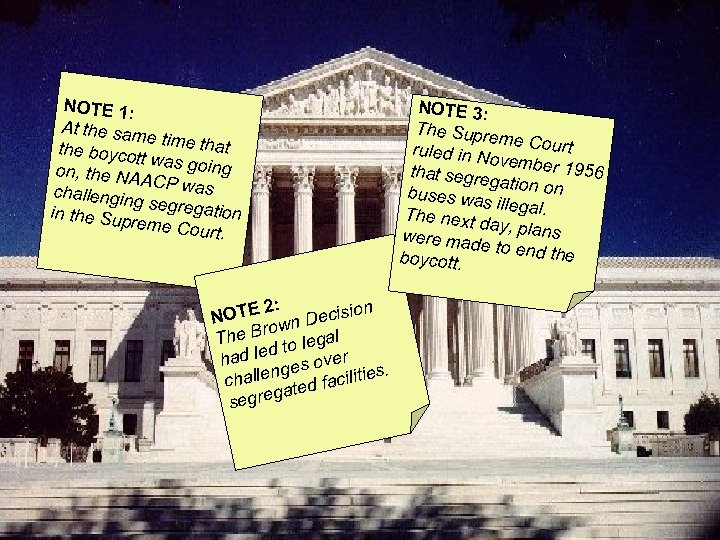
NOTE 1: At the sam e time tha t the boyco tt was goin g on, the NA ACP was challengin gs in the Sup egregation reme Cou rt. : OTE 2 n Decision N w he Bro legal T to d led ha ver ges o ilities. n challe ted fac ga segre NOTE 3: The Supr eme Cour t ruled in N ovember 1956 that segre gation on buses wa s illegal. The next day, plans were mad e to end t he boycott.
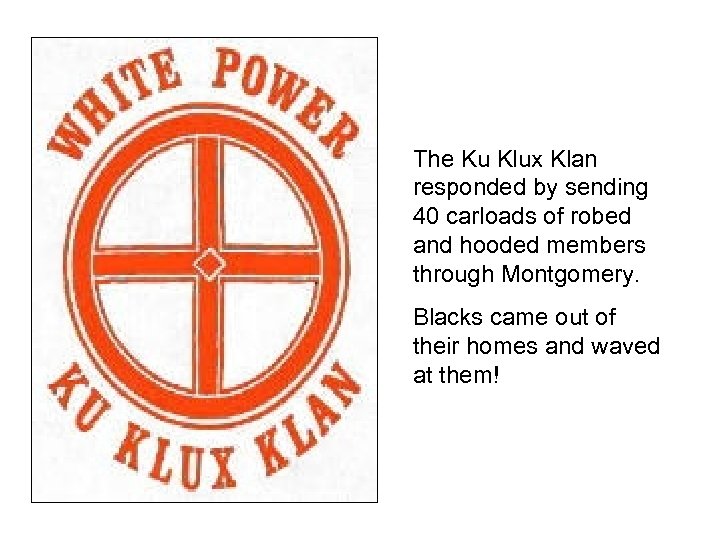
The Ku Klux Klan responded by sending 40 carloads of robed and hooded members through Montgomery. Blacks came out of their homes and waved at them!
It was a limited victory; the buses were desegregated; the rest of the city remained the same. Black morale was boosted by this victory. It showed how the black church community could co-operate with national organisations like the NAACP. It showed how non-violent direct action combined with the legal challenges in the courts worked well to end segregation.
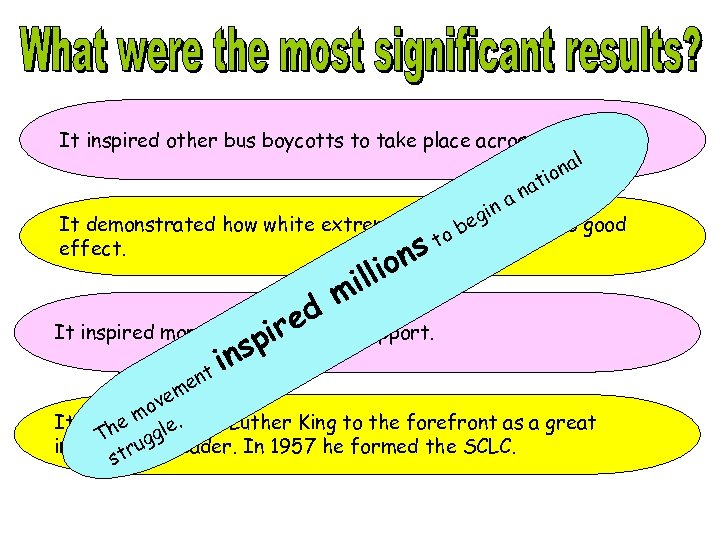
It inspired other bus boycotts to take place across the south. l na o ati an gin used to good e It demonstrated how white extremism could be ob effect. st ion ill m ed support. It inspired more northern white pir ins nt e em v mo Martin Luther King to the forefront as a great It brought le. e Th ugg inspirational leader. In 1957 he formed the SCLC. str
Скачать презентацию The Montgomery Bus Boycott and the emergence of
2f38e1ef5a2df3fe0a2bb37d3a6bca68.ppt