Скачать презентацию The monetary theory Monetarists argue that if the
Хамутова_21-12.pptx
- Количество слайдов: 14
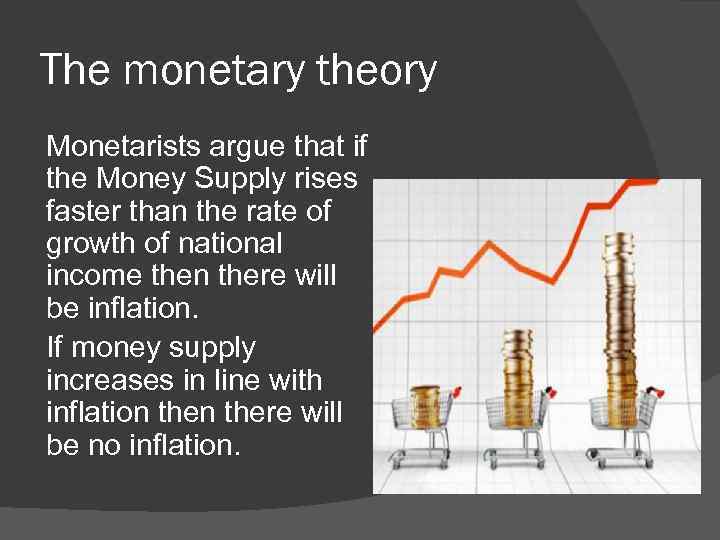 The monetary theory Monetarists argue that if the Money Supply rises faster than the rate of growth of national income then there will be inflation. If money supply increases in line with inflation there will be no inflation.
 Monetarists believe that in the short term velocity (V) is fixed This is because I The rate at which money circulates is determined by institutional factors e. g. how often workers are paid does not change very much.
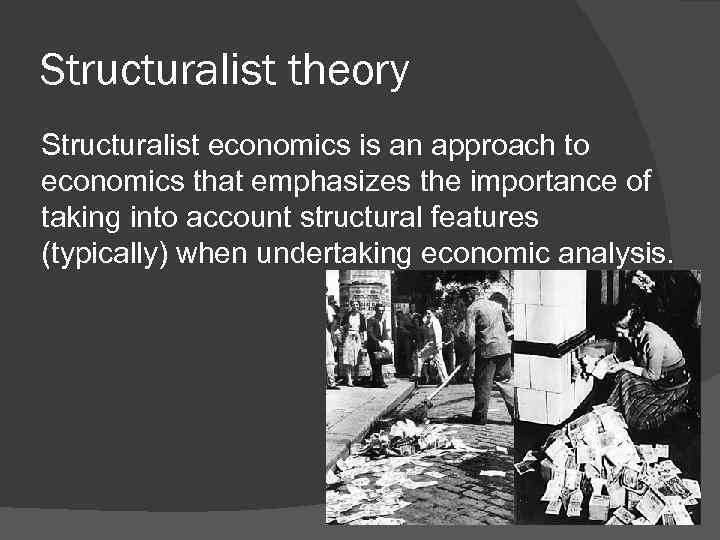 Structuralist theory Structuralist economics is an approach to economics that emphasizes the importance of taking into account structural features (typically) when undertaking economic analysis.
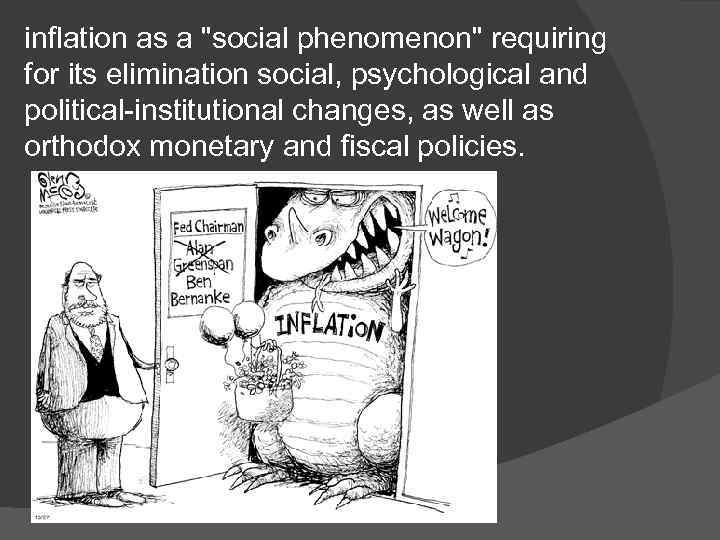 inflation as a "social phenomenon" requiring for its elimination social, psychological and political-institutional changes, as well as orthodox monetary and fiscal policies.
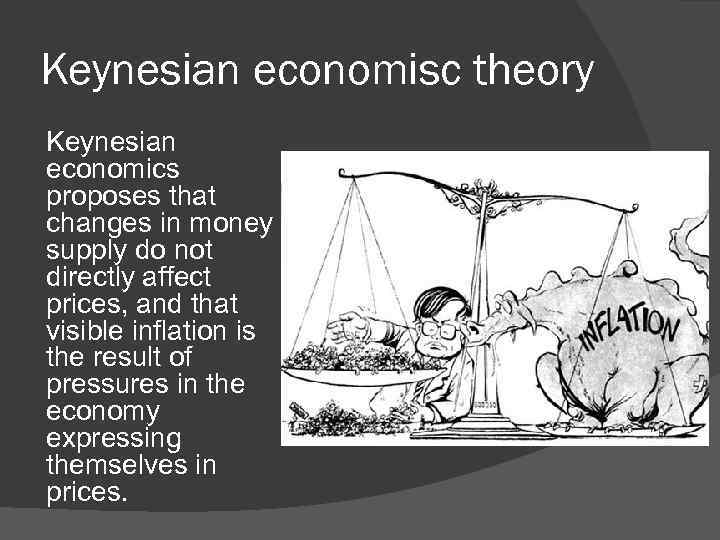 Keynesian economisc theory Keynesian economics proposes that changes in money supply do not directly affect prices, and that visible inflation is the result of pressures in the economy expressing themselves in prices.
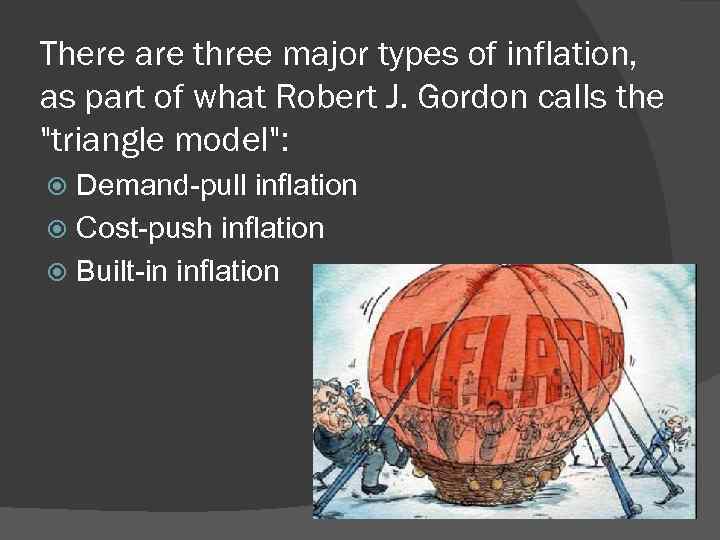 There are three major types of inflation, as part of what Robert J. Gordon calls the "triangle model": Demand-pull inflation Cost-push inflation Built-in inflation
 Demand-pull theory states that inflation accelerates when aggregate demand increases beyond the ability of the economy to produce (its potential output). Hence, any factor that increases aggregate demand can cause inflation. However, in the long run, aggregate demand can be held above productive capacity only by increasing the quantity of money in circulation faster than the real growth rate of the economy. Another (although much less common) cause can be a rapid decline in the demand for money, as happened in Europe during the Black Death, or in the Japanese occupied territories just before the defeat of Japan in 1945.
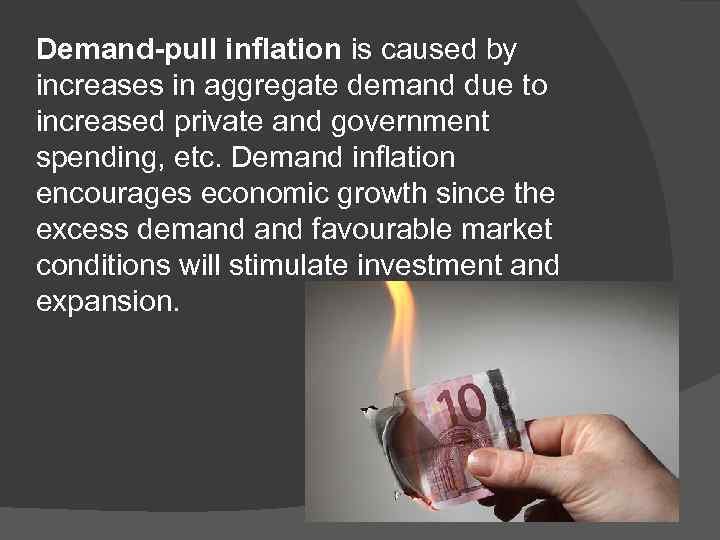 Demand-pull inflation is caused by increases in aggregate demand due to increased private and government spending, etc. Demand inflation encourages economic growth since the excess demand favourable market conditions will stimulate investment and expansion.
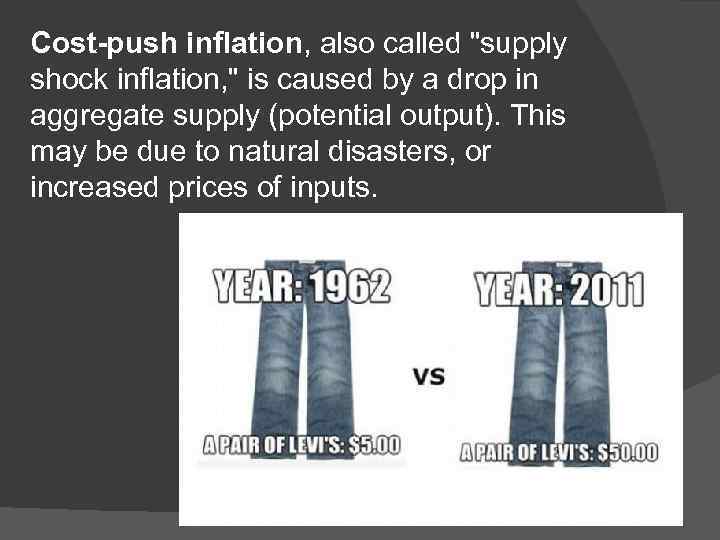 Cost-push inflation, also called "supply shock inflation, " is caused by a drop in aggregate supply (potential output). This may be due to natural disasters, or increased prices of inputs.
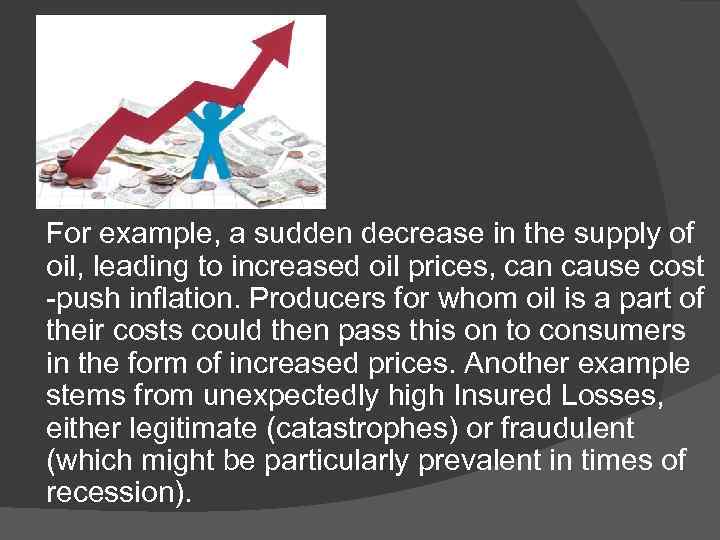 For example, a sudden decrease in the supply of oil, leading to increased oil prices, can cause cost -push inflation. Producers for whom oil is a part of their costs could then pass this on to consumers in the form of increased prices. Another example stems from unexpectedly high Insured Losses, either legitimate (catastrophes) or fraudulent (which might be particularly prevalent in times of recession).
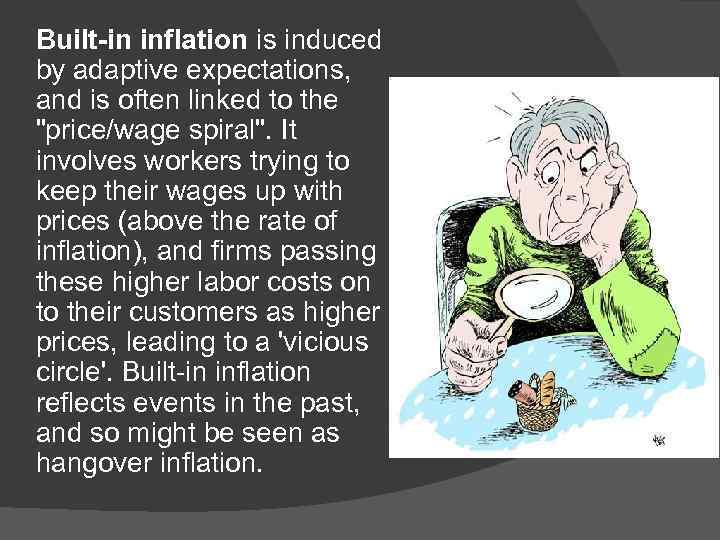 Built-in inflation is induced by adaptive expectations, and is often linked to the "price/wage spiral". It involves workers trying to keep their wages up with prices (above the rate of inflation), and firms passing these higher labor costs on to their customers as higher prices, leading to a 'vicious circle'. Built-in inflation reflects events in the past, and so might be seen as hangover inflation.