


 Скачать презентацию The Monarchs of Europe Section 1 The
b179553904f4a53a059f7633e65525eb.ppt
- Количество слайдов: 14
 The Monarchs of Europe Section 1
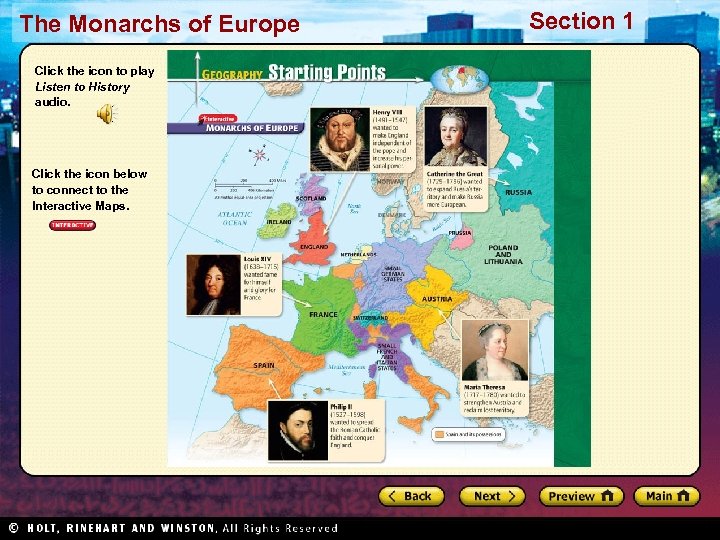 The Monarchs of Europe Click the icon to play Listen to History audio. Click the icon below to connect to the Interactive Maps. Section 1
 The Monarchs of Europe Section 1
 The Monarchs of Europe Section 1 The Power of Spain Main Idea Spain experienced a golden age during the 1500 s, but economic problems and military struggles decreased Spanish power by the 1600 s. Reading Focus • What challenges did King Charles I face when he became Emperor Charles V? • What were some artistic achievements of Spain’s golden age? • How did Spain rise and then decline under Philip II?
 The Monarchs of Europe Section 1 Charles V and the Empire When Charles became king of Spain, he inherited the Low Countries of Belgium and the Netherlands, along with colonies in the Americas. Emperor Charles V • 1519, throne of Holy Roman Empire became vacant • Position elective; Charles borrowed money to buy votes • Became Holy Roman Emperor Charles V – Holdings expanded to parts of Italy, Austria, various German states – So vast ‘the sun never set” over it Enemies Everywhere • Ruling vast territories not easy task for Charles • Faced enemies on all sides— Ottoman Turks, French, rebellious German princes • Also fought for religious control over Europe • Wanted Europe to be Roman Catholic • Growing Protestant movement threatened influence
 The Monarchs of Europe Section 1 Confrontation • 1521, Charles confronted Protestant leader Martin Luther directly • In spite of Charles’ efforts, Protestants gained influence • Rebellions against Catholic rulers spread • After years of warfare, Charles V had to sign Peace of Augsburg Peace • Agreement gave each German prince right to decide if his state would be Catholic or Protestant • Charles’ vision of a Catholic Europe never became reality • Constant warfare also brought Charles to brink of bankruptcy
 Section 1 The Monarchs of Europe Dividing the Empire Relinquished Thrones • Frustrated by failures in Europe • 1556, Charles V gave up thrones • Decided to divide large empire • Split between his brother and his son Imposing Their Will • Brother took over Hapsburg holdings in Austria • Son, Philip II, ruled Netherlands, Spain, Sicily, Spain’s colonies • Charles V moved to monastery, dream of unified empire unfulfilled
 The Monarchs of Europe Section 1 Draw Conclusions In what ways was Charles V successful as an emperor? In what ways was he unsuccessful? Answer(s): successful—exploration of the Americas, which brought fabulous wealth to Spain; unsuccessful—did not maintain religious control over Europe; constant wars brought financial problems
 Section 1 The Monarchs of Europe Spain under Philip II • Spain at peak of grandeur with reign of Philip II • One reason—stream of gold and silver from colonies in Americas • With wealth came power—but gold could not solve Spain’s problems Religion and Revolt • King Philip II devout Catholic • Saw himself as leader of Counter. Reformation • Marriage to Queen Mary I of England chance to spread Catholicism in Territories • Mary died before having heir to return England to Catholic faith • Philip also wanted to secure position of Catholicism in European territories Revolt in the Low Countries • Philip’s faith clashed with Calvinist Protestantism of northern Low Country provinces • 1560 s, bloody revolt began
 The Monarchs of Europe Section 1 Dutch Revolt Dutch refused to declare allegiance to Philip • To punish, Philip sent army under command of Duke of Alba • Alba set up court – Known locally as Court of Blood – Tortured, executed thousands suspected of being rebels – Cruelties made situation worse; rebellion broke out anew • Revolt dragged on for decades • 1609, truce reached • Seven northern provinces formed independent nation, the Netherlands • Southern provinces remained in Spanish hands
 The Monarchs of Europe Section 1 Spain and English Aid to Dutch • Dutch revolt deepened another rivalry, between Spain, England • As fellow Protestants, England sent aid to Dutch rebels • England’s assistance to Dutch infuriated Philip Attacks on Spanish Ships • Philip also worried about English attacks on his ships • England’s Queen Elizabeth I allowed ship captains to attack Spanish treasure ships, steal gold, silver for England Invasion Planned • King Philip II wanted to stop England from raiding ships, return England to Catholic Church • Decided to invade England
 Section 1 The Monarchs of Europe Philip’s Armada • Philip ordered navy to assemble great fleet, the Spanish Armada • Totaled about 130 ships, 20, 000 soldiers, sailors • 1588, invincible fleet sailed into English channel • Queen Elizabeth I rallied troops and prepared for attack Naval Battles Armada Not Invincible • Spanish packed ships with soldiers for land invasion • English aimed eight fire ships at remaining ships of Armada • Also planned to be joined by Spanish forces in Netherlands • Spanish ships fled in panic, disarray • Faced fierce naval battles that severely damaged fleet • As damaged ships made way home, several were wrecked
 Section 1 The Monarchs of Europe An Empire in Decline • The defeat of the Armada was not the end for Spain, which recovered from the loss. • But England remained Protestant, defiant, and undefeated. Internal Problems Americans Join the Battle Spain’s real problems internal Philip’s government centralized He trusted no one Court riddled by factions, suspicion • Government action practically came to standstill • Philip spent wealth from Americas on constant warfare • Borrowed money often; went bankrupt four times • Prices driven up, inflation • Spain did not develop industries • • Relying on traditional agricultural economy, Spain’s economy lagged behind that of other countries. Spain declined as a major power.
 Section 1 The Monarchs of Europe Recall What were two events that caused problems for Spain? Answer(s): revolt in the Netherlands; defeat of the Spanish Armada