


 Скачать презентацию The moment of truth the sudden emergence of
4c6cdacb75e9c9d92b76cb608d591496.ppt
- Количество слайдов: 54
 “The moment of truth, the sudden emergence of a new insight, is an act of intuition. Such intuitions give the appearance of miraculous flushes, or short-circuits of reasoning. In fact they may be likened to an immersed chain, of which only the beginning and the end are visible above the surface of consciousness. The diver vanishes at one end of the chain and comes up at the other end, guided by invisible links. ” Arthur Koestler
 INTERPRETATION: DEVELOPING CONSUMER INSIGHTS ERIC ARNOULD CIED_2017 -L 1 - DEVELOPING CONSUMER INSIGHTS
 “As the unity of the modern world becomes increasingly a technological rather than a social affair, the techniques of the arts provide the most valuable means of insight into the real direction of our own collective purposes. ” Marshall Macluan
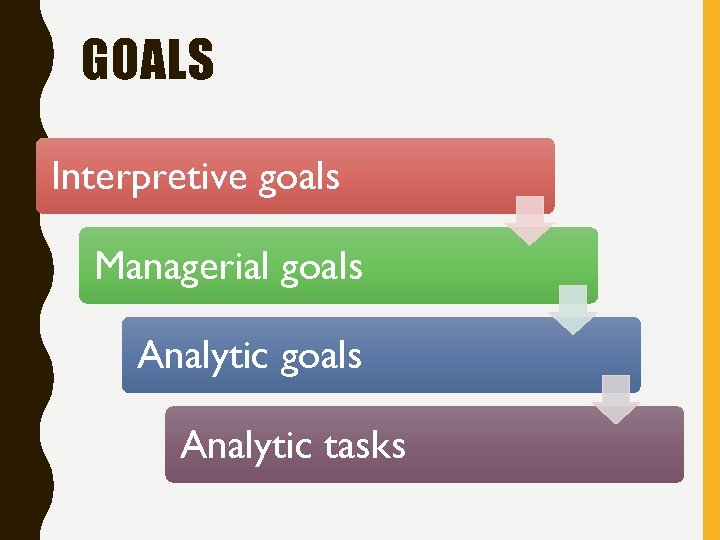 GOALS Interpretive goals Managerial goals Analytic tasks
 GOALS
GOALS
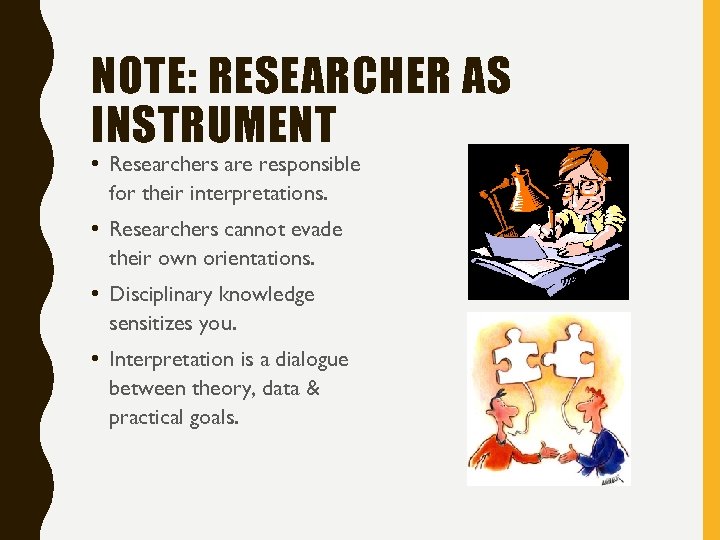 NOTE: RESEARCHER AS INSTRUMENT • Researchers are responsible for their interpretations. • Researchers cannot evade their own orientations. • Disciplinary knowledge sensitizes you. • Interpretation is a dialogue between theory, data & practical goals.
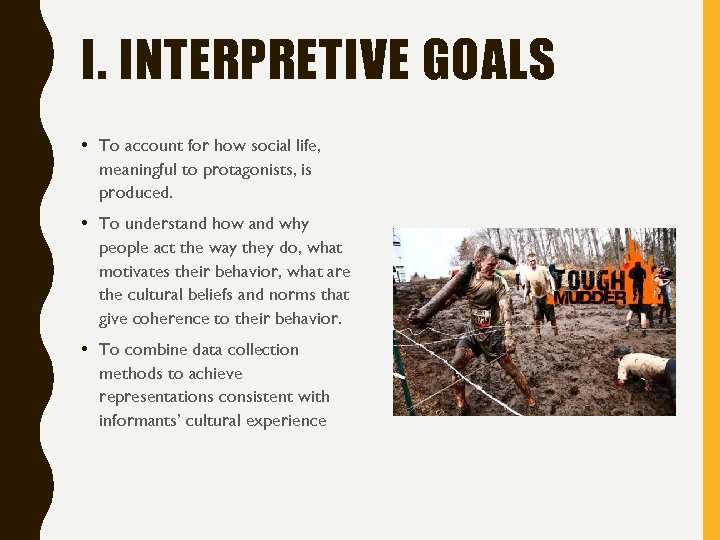 I. INTERPRETIVE GOALS • To account for how social life, meaningful to protagonists, is produced. • To understand how and why people act the way they do, what motivates their behavior, what are the cultural beliefs and norms that give coherence to their behavior. • To combine data collection methods to achieve representations consistent with informants’ cultural experience
 2. ANALYTIC GOALS • Deep contextual understanding • Identifying patterns, paradigms, myths • Unpacking disjunctures between words and deeds, beliefs & behaviors • Leveraging revelatory incidents, “ah-ha” moments • Cultural templates in belief and action – Metaphors – Hopes, dreams, aspirations and desires – Frustrations • Granular depictions of customer processes of acquisition, transport, storage, use, & disposal
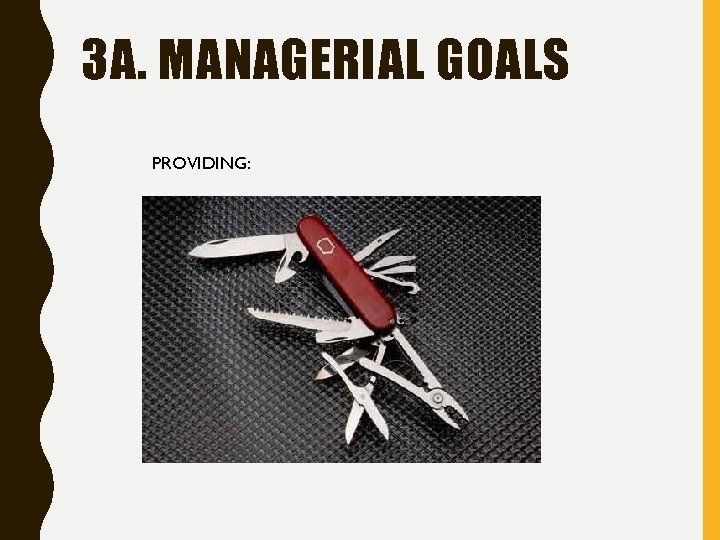 3 A. MANAGERIAL GOALS PROVIDING:
 3 B. MANAGERIAL GOALS • Detecting unexpected consumption connections – Understanding how contexts effect consumtion so as to respond to explicit and unstated consumer expectations • Mapping oportunity spaces – Identifying white space in markets for NPD, brand extensions • Creative segmenting and sub-segmenting consumer groups – Goals, life projects, brand relationships to connect, e. g. , Fiat 500 • Divining potential new target groups • Inner lives, everyday habits, social worlds, e. g. , start-up culture • « Decision graphing » • Sounds kind of grand; but really just assessing natural choice making under particular circumstances to improve targeted communications
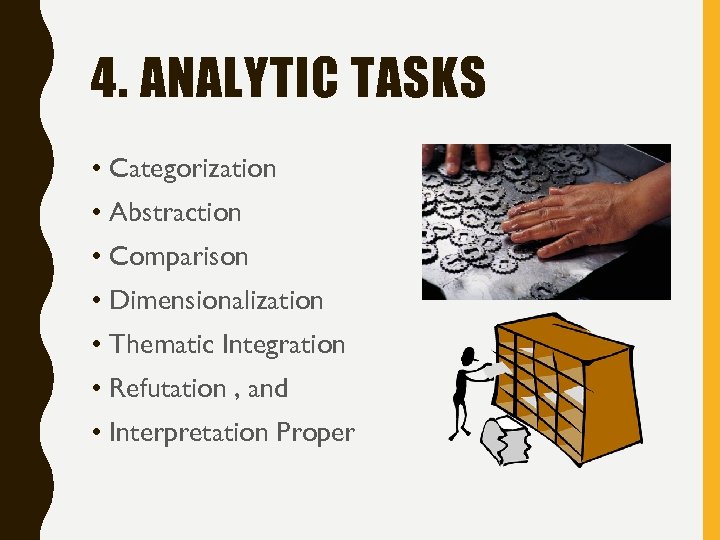 4. ANALYTIC TASKS • Categorization • Abstraction • Comparison • Dimensionalization • Thematic Integration • Refutation , and • Interpretation Proper
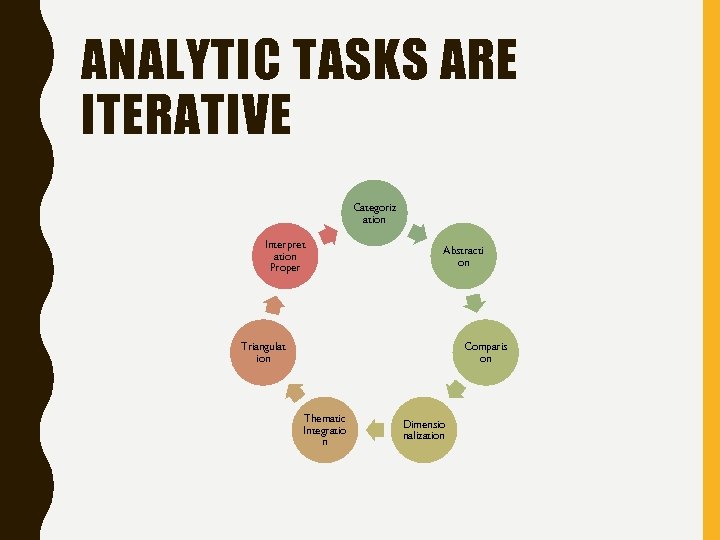 ANALYTIC TASKS ARE ITERATIVE Categoriz ation Interpret ation Proper Abstracti on Triangulat ion Comparis on Thematic Integratio n Dimensio nalization
 TASKS
TASKS
 CATEGORIZATION • The starting point is observational units of talk or action. • The process of classifying or labeling units of data through coding, either inductively or deductively. • The essence of categorization is identifying a chunk of data as belonging to, representing, or being an example of some more general phenomena.
 A KEY ASSERTION IN CATEGORIZATION • Words…contain images and metaphors that both assume and invoke the ways of being that the participants take themselves to be involved in (Moisander and Valtonen, p. 118) • And pictures too!
 CATEGORIZING PROCESSES • Codes are developed as the researcher reads the data and notices recurring word usage & phrases, behavioral sequences, or evoked meanings and sequences of meanings. • Codes may lead to higher order abstractions • Interpretation of the meanings of codes is elaborated by exploring additional connections to the data. • The researcher iterates between the codes and other data
 CATEGORIZING PROCESSES • Some behaviors may be marked with only one code, whereas others may be pertinent to several codes (e. g. , the emic statement "Every year, we have mom's famous, homemade lemon pie" might be marked with three codes: ALWAYS, HOMEMADE, and SPECIAL). • Some codes may apply only to one behavior, and others may be found to mark similarity in several different behaviors (e. g. , HOMEMADE codes observations and descriptions of the preparation of a variety of foods, dishes, as well as table decorations).
 WHAT TO CODE? • My Mini is finished! • Just got off the phone with Ask-Mini, My car is finishing assembly as I type this! woohoo!!! So. . . today is its last day of birth, and then it will be off to the harbor to catch a ride. Not sure which ship it will get on, the Ask-Mini person I spoke with told me that my dealer should have that information. Time to do some digging. • WOW! im excited!!!! • Minimizer, 5 th Gear, Las Vegas
 WHAT TO CODE • “But back home, if you've caught just a tiny fish, if there's a boy who've caught his first fish then there's a big party and kaffemik (coffee get-together) […] like when I caught my first fish there was kaffemik, when I shot my first seal there was kaffemik, the first grouse and there was kaffemik, it's always been like that, I suppose because in the old days everybody were hunters so it was of great importance whether you could catch something, that's probably were it comes from. ” (male, 24, migrant; emphasis added). • “I remember my first cultural clash in Greenland, it was my first seal. My grandparents (mother’s side) had a big party. So I didn’t come home for dinner, and my father made a big deal out of that. You had to be punctual for dinner. He could not accept that you can forget all about time when a big event like this one occurs. ” (male, 34, migrant).
 INTEGRATION OF THEMES • Two operations--axial coding and selective coding-- aid in integrating categories and constructs into theory. • In axial coding, the analyst develops a construct using a paradigm model that specifies the conditions giving rise to the construct, the context in which it is embedded, the action strategies through which it is enacted, and outcome of these strategies. An example of an elaborate consumer paradigm might be that of holistic healing (Thompson 2003). • Selective coding involves further abstraction, delineating core constructs around which other categories and constructs revolve and relating them to one another (Glaser and Strauss 1967).
![ATTITUDES TOWARD TECHNOLOGY • Interviewer: Where do you think it [technology] is going? •](https://present5.com/presentation/4c6cdacb75e9c9d92b76cb608d591496/image-21.jpg "ATTITUDES TOWARD TECHNOLOGY • Interviewer: Where do you think it [technology] is going? •") ATTITUDES TOWARD TECHNOLOGY • Interviewer: Where do you think it [technology] is going? • Ricky: You know, this is going to sound kind of Pollyannaish, too, as I’m saying it, cause I don’t know if I’ve ever made utterance of this hope for it before, but what I really look forward to is a day, probably within the next ten years, when the technology becomes so transparent and it is just so well developed that it can really break down barriers between cultures and people. And if I really want to chat with someone in Russia who only speaks Russian, they come up with a real time translation software where if I’m typing away it appears in Russian on their little chat screen in real time. Then I can • start trading ideas and doing business, or whatever, with that • person.
ATTITUDES TOWARD TECHNOLOGY • Interviewer: Where do you think it [technology] is going? • Ricky: You know, this is going to sound kind of Pollyannaish, too, as I’m saying it, cause I don’t know if I’ve ever made utterance of this hope for it before, but what I really look forward to is a day, probably within the next ten years, when the technology becomes so transparent and it is just so well developed that it can really break down barriers between cultures and people. And if I really want to chat with someone in Russia who only speaks Russian, they come up with a real time translation software where if I’m typing away it appears in Russian on their little chat screen in real time. Then I can • start trading ideas and doing business, or whatever, with that • person.
 ATTITUDES TOWARD TECHNOLOGY • Interviewer: What was it about? I mean, you said building something great. • Velma: I think it’s a kind of engineering pride. Trying to, for example, some, a lot of the people I associated with out in California during that period of time, the early 90 s, they were devotees of Richard Stahlman, who was basically a socialist. He was a tremendous programmer. A legend in the field. But he thinks it is wrong for programmers to profit from their programming…There’s this community of programmers all over the world that would write programs and kind of Stahlman and his devotees were kind of the keepers to make sure what is released and what isn’t. And a lot of this kind of snowballed into Linux
 ABSTRACTION • Collapses empirically-grounded categories into fewer, more general higher-order conceptual constructs. • Agents, norms, behavioral rules, rhetorical practices, heuristics, shorthands, what everyone knows… • Abstraction includes both incorporating concrete categories into fewer more general ones, also called pattern coding • In one ZMET study the metaphor of the nosy neighbor was employed to represent thematic category of advertising intrusiveness, in turn represented by a collection of activities
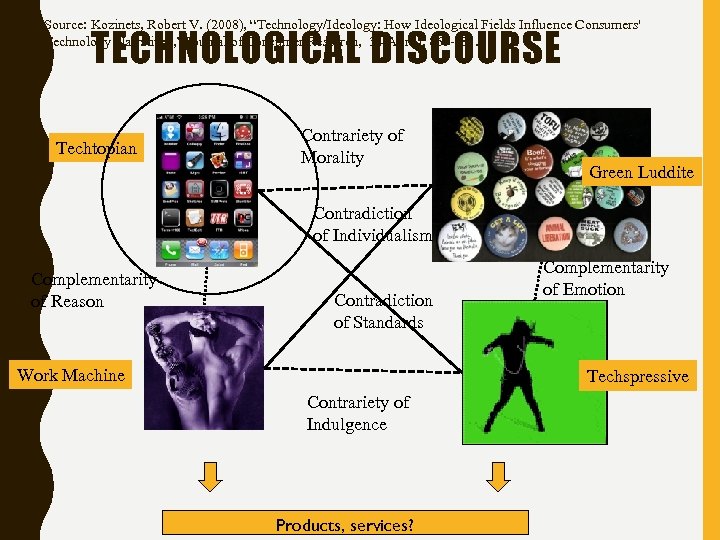
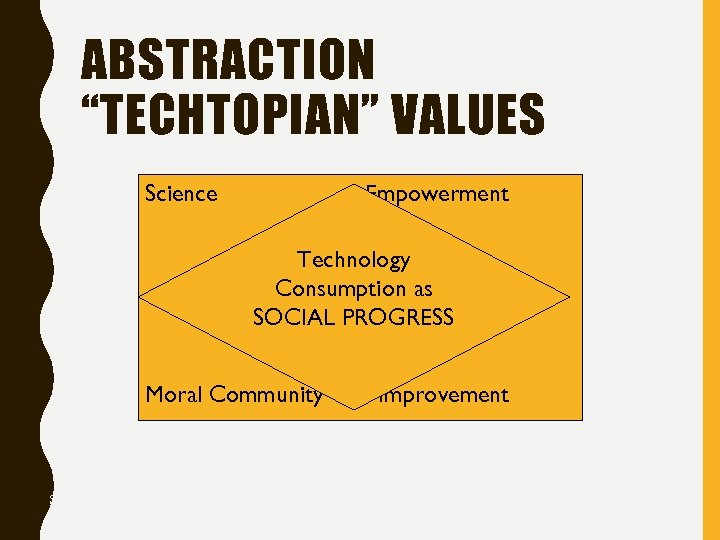 ABSTRACTION “TECHTOPIAN” VALUES Science Empowerment Technology Consumption as SOCIAL PROGRESS Moral Community Improvement Source: Kozinets, Robert V. (2008), “Technology/Ideology: How Ideological Fields Influence Consumers' Technology Narratives, ” Journal of Consumer Research, 34(April), 865 -881.
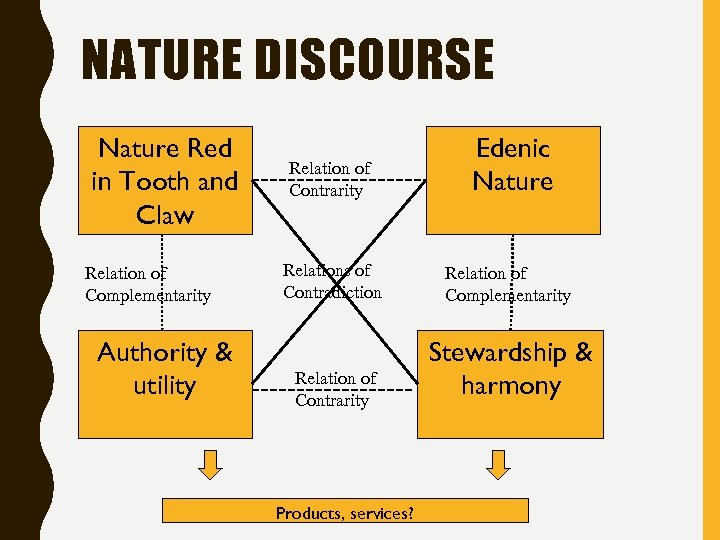
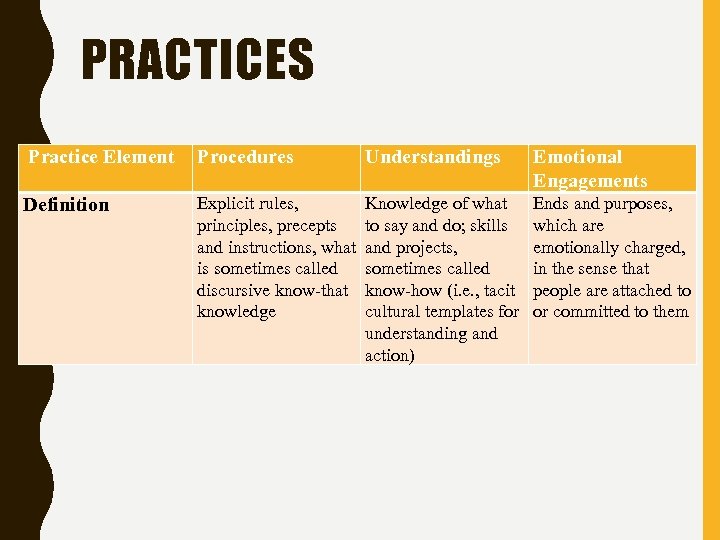
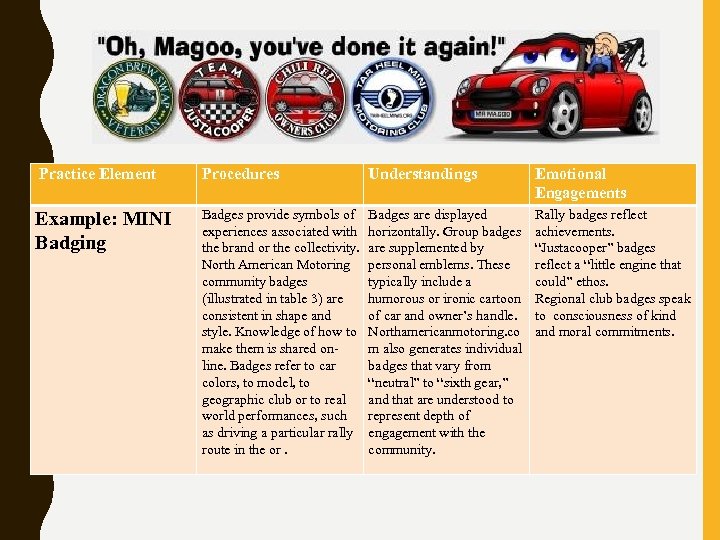
 DIMENSIONALIZING PROCESSES • Paradigmatic—A set of behavioral variants of a single type, such as various kinds of boiled root vegetable dishes, confirming the value placed on abundance of basics; Gremesian squares • Syntagmatic—Part of a culturally prescribed temporal or narrative sequence, such as interrupting the viewing of televised football games to eat the meal or the telling of Thanksgiving Day stories about bad times overcome; practice theory • Metaphoric—A figurative relationship of similarity, such as similarity between "stuffed“ Thanksgiving turkeys, pies, houses, and people and the cultural value of abundance being embodied; may also be termed indexical; • Metonymic—A relation in which part is taken as an emblematic representation of the whole domain, such as use of a stuffed turkey to imply the entirety of the Thanksgiving holiday; may also be termed iconic; see the family table in Epp and Price, or • Symbolic– A relation in which something is conventionally understood to stand for something else. An amateur football game represents the family as a team.
 DIMENSIONALIZATION • Identifying properties of categories and constructs along continua or dimensions, which vary depending upon the researcher’s theoretical frameworks. • Properties represent conceptual dimensions that vary empirically in the data across observations depicting the construct • Semiotic frameworks like Gremesian square • In a narrative analysis dimensional constructs might include plot, character, and theme.
 IDENTIFYING THEMES • Afflicted with an incurable pathology: • …there was a gentleman in the room that said, if you think that once you reach goal, you’re finished with Weight Watchers, you’re fooling yourself, because if you have a food issue, you’re always gonna have that food issue. You’re never gonna be done with it. And I think that’s why it’s so important me, for me to keep going to the meetings.
 IDENTIFYING THEMES • The necessary role of guardianship • It does help to have somebody there looking, Big Brother watching you over your shoulder. I have to go and weigh in; I get on my scale at home, and it’s like, oh yeah, this is okay. But to have to go and know that somebody else knows…is different.
 IDENTIFYING THEMES • Contagious property of confession • The group leader asks how the Thanksgiving holiday was for everyone and whether they managed to stay within their points. She herself recounts how she ‘blew off’ all her daily points, weekly flex points, and then just stopped counting the points at the Thanksgiving dinner party with her family, and the day after the Thanksgiving. The members in the room start chiming in that the Thanksgiving [sic] was not good for them. The leader asks to share [sic] what happened…
 BUILDING A TALE: DIY, PROVIDER ROLE, MASCULINE IDENTITY • I: What about doing home repair and improvements? • Joel: This is also a manly job. My wife always has these projects that she wants done around the house. It makes me feel good that she counts on me to take care of these things. She always wants them done a certain way, and it makes me feel like a great husband when I do them exactly the way she wants. It is like giving her a little present. I also think that it makes her look at me as more of a man, and that is more important than anything. • Dwayne: I take great pride in home repair and improvements mostly because I am good at doing things around the house and I love to use my power tools. It gives me a great sense of manhood because I know that I am doing something for my family and my house at the same time. • Gareth: When I come home and do these little projects around the house…I guess I’m helping out myself and my wife you know to some extent, ‘cause…I’m improving things around the house, and so it makes us happier. …at work I’m making a whole bunch of employees happy, and at home it’s, just, it’s kind of my, myself and my wife’s happy.
 TRIANGULATION: COMMUNITAS • We then made our way over to Bum Dam Falls. . . a little waterfall. . . and people dam it up with their butts, and stop up the water, build up the water pressure, and create a big wall of water to pour over those below. It's a lot of fun, Really a lot of fun. So, everybody took turns stripping down to the bathing suits, trunks, skivvies, or what have you, and getting wet. It was real fun because there was a big push to get [a female guide] to strip down to her suit and [a male guide] to jump in, so all the guides. . . got in the stream too. It was pretty cool, for the fans, there was a lot of cheering, clapping, hugging in the falls, and sputtering, laughing and running. So, it was kind of a play in nature phenomena going on. . . made up with people, of people, and it was certainly in nature (Arnould participant observation notes, 1995).
 TRIANGULATION: COMMUNITAS • And at the top of this hike there was a beautiful fresh spring waterfall. And it was fabulous. And it felt so good for everybody because everybody’s been in dirty water since yesterday when we embarked on this trip. . . one of the college girls organized a group shot. . . And in that group shot there was a clear intermingling of groups that included hugging and having arms around people who I think under other conditions would be considered strangers. . And we were all huddling in there and at the same time sharing space with each other so that no one was hogging the water (Price, participant observation notes 1990).
 MULTI-METHOD DATA: TRIANGULATION • Interview, guide, swm 40 s: I think, river magic. . I see it all the time. . . I saw it when I guided. Just the spell that the river environment can cast on people, and just bring them-pulling away from that urban 9 to 5 lifestyle that most people live -- and, you know, just bring them back to the basics. . The moon rise, listening to the water, sitting on a sandy beach and a warm breeze blowing through the cottonwoods, seeing wildlife. That, to me, is river magic. • Participant observation notes: It was really nice hiking up the trail, all the different rocks tumbled down, the gnarled, ancient junipers and stumps of old dead junipers gnarled into the rocks. I have to admit that I began to have kind of a flow feeling. . . a kind of little endorphin flowing kind of experience at this point. It seemed like others did too, the others were too. It certainly seemed like Sinead and [a female guide] were.
 TRIANGULATION: MULTI-METHOD DATA • Interview, river guide, mwm 30 s: Another thing about Day three is that, Day one everyone walks way upstream, or they walk way downstream to p**, by Day three, people are just p**ing right there. Sorta, that's what I think, when I think of Day three, people are just sorta given up anything that happened on Day one). • Participant observation notes: When I went down to the river bank just a few minutes ago, I said, "Hey, is this a public bath house? Can anyone come? " And, Sinead said, "Oh, you're very welcome. ". . . So, I noticed there is this kind of emotional opening up that goes on. Not everyone participates. . . But, I think some have hung back from doing things, some have also hung back emotionally - it's interesting
 MULTI-METHOD DATA: DISJUNCTURES • Participant observation notes: S (a river guide) went out [in the downpour] to check the tent. Had her rain gear handy, she was prepared. Came back and [I] asked how it was and she talked about oh, it's so beautiful up the canyon. The rain was coming down. But, uh, it was coming down in big sheets, it looked so beautiful. S is always like right on the surface with those kind of [very genuine] comments • Interview, river guide, swf 30 s: the last day of our last trip, . . . we stopped to go look at these wonderful petroglyphs. And we had to walk through knee high grass. . It was very wet, it had been raining for days. And, it started raining pretty hard when we started to go on the walk. . . And they were just like. . . and they went through the mud and moaned and complained about it. But I think that, too will add to their experience.
 INTERPRETATION Intuitive, subjective, holistic, and particularistic. More abstract reasoning to make sense of data driven analyses. Cannot be modeled in a linear fashion. Derives from a process of tacking between data and the researcher’s background theoretical knowledge and experience as an applied social scientist. • Note iterations between data collection efforts and iterative interpretations in the Moisander study of green consumers • We are not afraid to speak of the art of interpretation. • •
 ORGANIZING YOUR INSIGHTS 1. People: Who consumes the product or service? 2. Practices. What are the behaviors that accrete around purchase, consumption and disposal? 3. Processes. What are the stages people move through as they progress toward some goal? 4. Parlance. How do people talk about their acquisition, consumption, disposal of products & services? 5. Particulars. Where, when, what, who? 6. Problems. What sorts of frustrations and obstacles do consumers encounter in their lives?
 ORGANIZING YOUR INSIGHTS 1. 2. 3. 4. 5. 6. Plans. What do consumers wish for? Novelties, ideals, desires, imaginings Proxies. Who does what as part of a process practice or procedure? . Who plans; who shops; who pays; who uses; who stores; who maintains? Prosumption. How are commercial resources used to produce values outcomes? Singularization? Pairings. How do consumers assemble a consumption ensemble? What must be present? Partitions. How do consumers divide market offerings? How do they partition the consumption process? Pleasures. What different emotions surround aspects of the consumption process?
 CULTURAL PARADIGM THANKSGIVING IMAGES
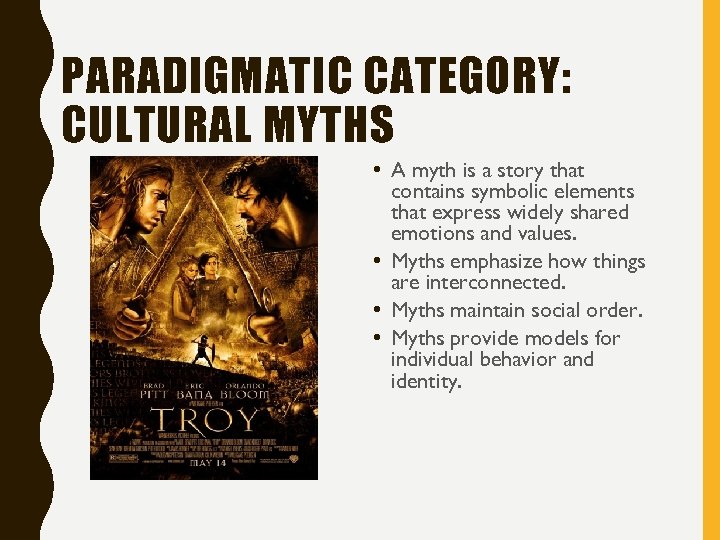 PARADIGMATIC CATEGORY: CULTURAL MYTHS • A myth is a story that contains symbolic elements that express widely shared emotions and values. • Myths emphasize how things are interconnected. • Myths maintain social order. • Myths provide models for individual behavior and identity.
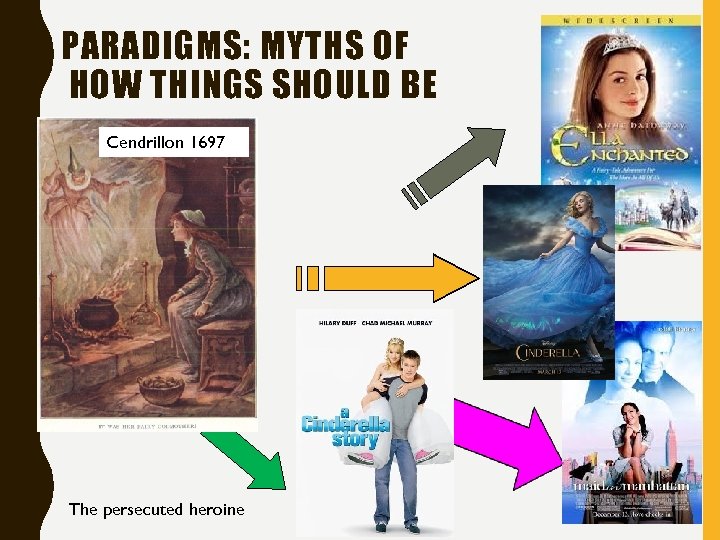 PARADIGMS: MYTHS OF HOW THINGS SHOULD BE Cendrillon 1697 The persecuted heroine
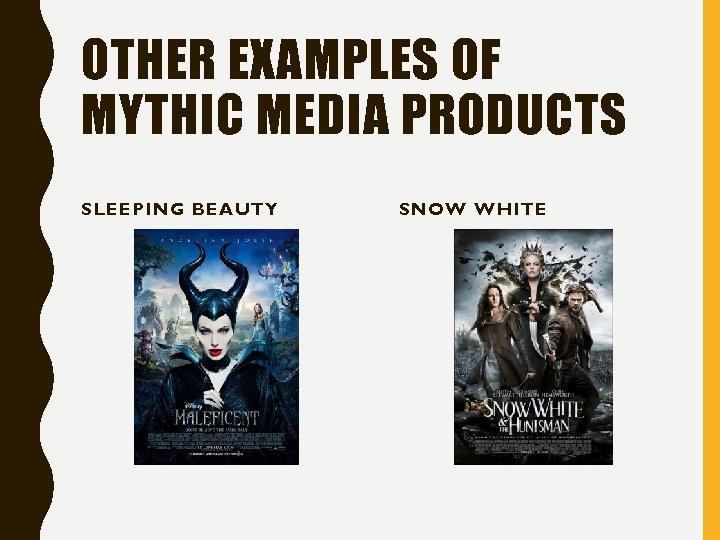 OTHER EXAMPLES OF MYTHIC MEDIA PRODUCTS SLEEPING BEAUTY SNOW WHITE
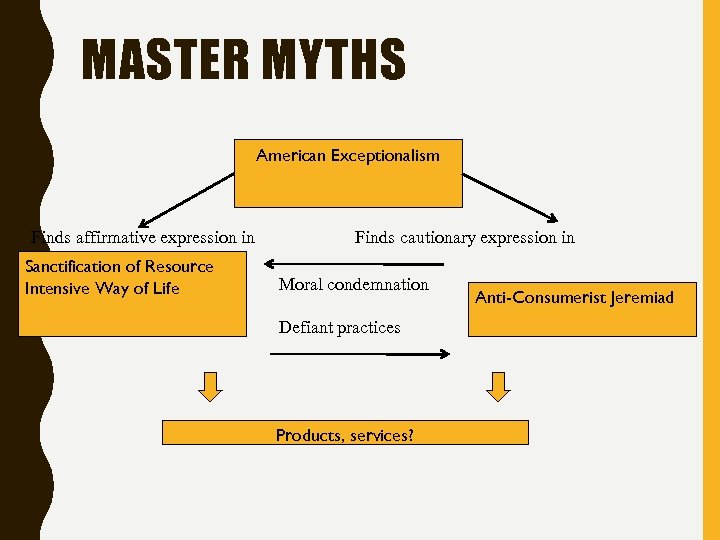 MASTER MYTHS American Exceptionalism Finds affirmative expression in Sanctification of Resource Intensive Way of Life Finds cautionary expression in Moral condemnation Defiant practices Products, services? Anti-Consumerist Jeremiad
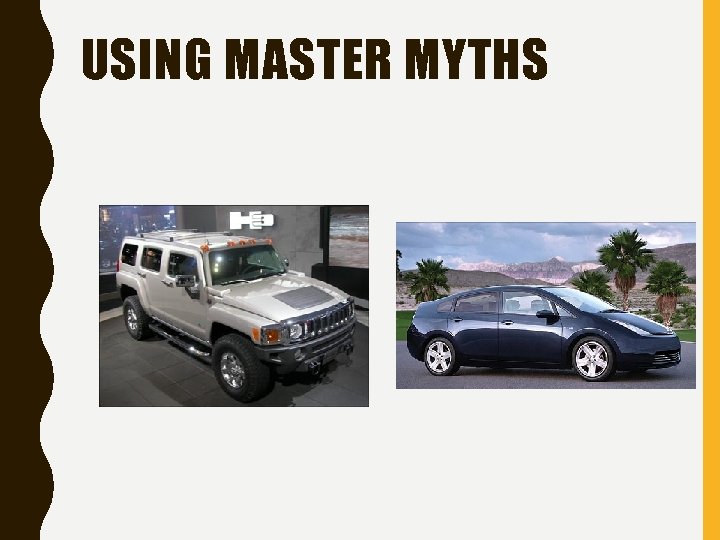 USING MASTER MYTHS
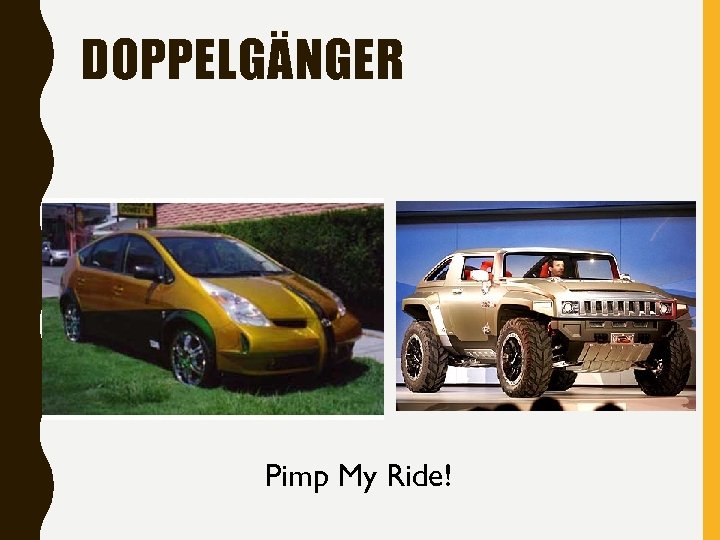 DOPPELGÄNGER Pimp My Ride!
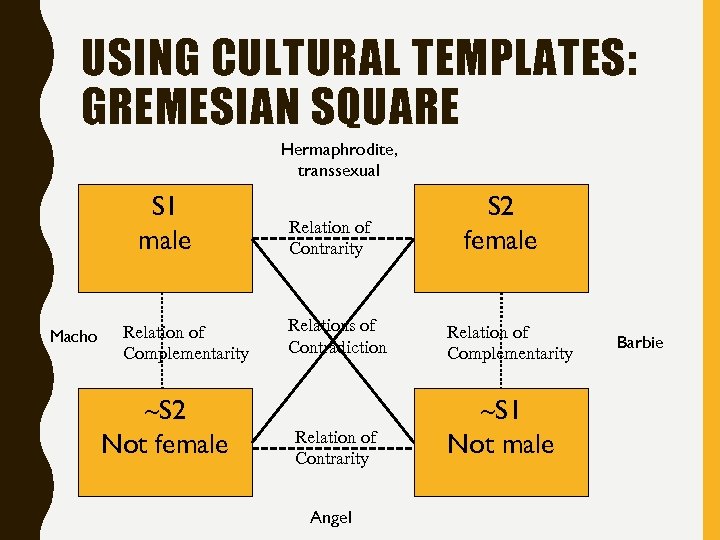 USING CULTURAL TEMPLATES: GREMESIAN SQUARE Hermaphrodite, transsexual S 1 male Macho Relation of Complementarity S 2 Not female Relation of Contrarity Relations of Contradiction Relation of Contrarity Angel S 2 female Relation of Complementarity S 1 Not male Barbie
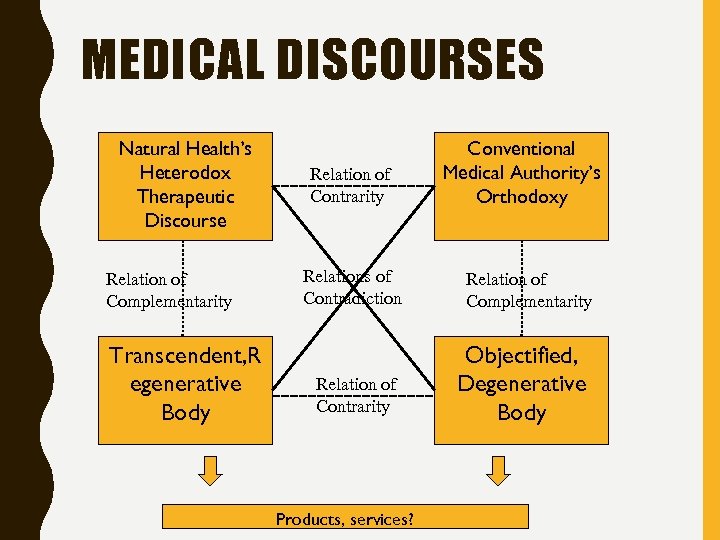 MEDICAL DISCOURSES Natural Health’s Heterodox Therapeutic Discourse Relation of Complementarity Transcendent, R egenerative Body Relation of Contrarity Relations of Contradiction Relation of Contrarity Products, services? Conventional Medical Authority’s Orthodoxy Relation of Complementarity Objectified, Degenerative Body
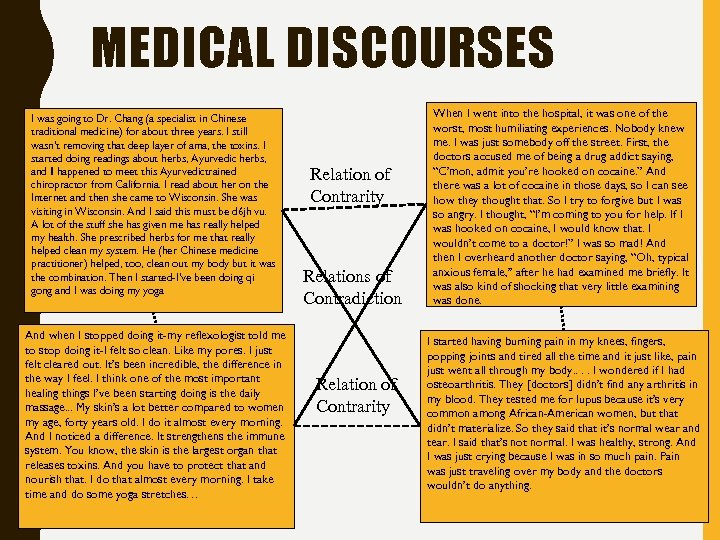 MEDICAL DISCOURSES I was going to Dr. Chang (a specialist in Chinese traditional medicine) for about three years. I still wasn’t removing that deep layer of ama, the toxins. 1 started doing readings about herbs, Ayurvedic herbs, and I happened to meet this Ayurvedictrained chiropractor from California. I read about her on the Internet and then she came to Wisconsin. She was visiting in Wisconsin. And I said this must be d 6 jh vu. A lot of the stuff she has given me has really helped my health. She prescribed herbs for me that really helped clean my system. He (her Chinese medicine practitioner) helped, too, clean out my body but it was the combination. Then I started-I’ve been doing qi gong and I was doing my yoga And when I stopped doing it-my reflexologist told me to stop doing it-I felt so clean. Like my pores. I just felt cleared out. It’s been incredible, the difference in the way I feel. I think one of the most important healing things I’ve been starting doing is the daily massage. . . My skin’s a lot better compared to women my age, forty years old. I do it almost every morning. And I noticed a difference. It strengthens the immune system. You know, the skin is the largest organ that releases toxins. And you have to protect that and nourish that. I do that almost every morning. I take time and do some yoga stretches… Relation of Contrarity Relations of Contradiction Relation of Contrarity When I went into the hospital, it was one of the worst, most humiliating experiences. Nobody knew me. I was just somebody off the street. First, the doctors accused me of being a drug addict saying, “C’mon, admit you’re hooked on cocaine. ” And there was a lot of cocaine in those days, so I can see how they thought that. So I try to forgive but I was so angry. I thought, “I’m coming to you for help. If I was hooked on cocaine, I would know that. I wouldn’t come to a doctor!” I was so mad! And then I overheard another doctor saying, “Oh, typical anxious female, ’’ after he had examined me briefly. It was also kind of shocking that very little examining was done. I started having burning pain in my knees, fingers, popping joints and tired all the time and it just like, pain just went all through my body. . I wondered if I had osteoarthritis. They [doctors] didn’t find any arthritis in my blood. They tested me for lupus because it’s very common among African-American women, but that didn’t materialize. So they said that it’s normal wear and tear. I said that’s not normal. I was healthy, strong. And I was just crying because I was in so much pain. Pain was just traveling over my body and the doctors wouldn’t do anything.
 WHITE WATER RAFTING
 NATURE DISCOURSE Nature Red in Tooth and Claw Relation of Complementarity Authority & utility Relation of Contrarity Edenic Nature Relations of Contradiction Relation of Complementarity Relation of Contrarity Products, services? Stewardship & harmony
 Source: Kozinets, Robert V. (2008), “Technology/Ideology: How Ideological Fields Influence Consumers' Technology Narratives, ” Journal of Consumer Research, 34(April), 865 -881. TECHNOLOGICAL DISCOURSE Techtopian Contrariety of Morality Green Luddite Contradiction of Individualism Complementarity of Reason Contradiction of Standards Work Machine Complementarity of Emotion Techspressive Contrariety of Indulgence Products, services?
 PRACTICES Practice Element Procedures Understandings Emotional Engagements Definition Explicit rules, principles, precepts and instructions, what is sometimes called discursive know-that knowledge Knowledge of what to say and do; skills and projects, sometimes called know-how (i. e. , tacit cultural templates for understanding and action) Ends and purposes, which are emotionally charged, in the sense that people are attached to or committed to them
 Practice Element Procedures Understandings Emotional Engagements Example: MINI Badging Badges provide symbols of experiences associated with the brand or the collectivity. North American Motoring community badges (illustrated in table 3) are consistent in shape and style. Knowledge of how to make them is shared online. Badges refer to car colors, to model, to geographic club or to real world performances, such as driving a particular rally route in the or. Badges are displayed horizontally. Group badges are supplemented by personal emblems. These typically include a humorous or ironic cartoon of car and owner’s handle. Northamericanmotoring. co m also generates individual badges that vary from “neutral” to “sixth gear, ” and that are understood to represent depth of engagement with the community. Rally badges reflect achievements. “Justacooper” badges reflect a “little engine that could” ethos. Regional club badges speak to consciousness of kind and moral commitments.
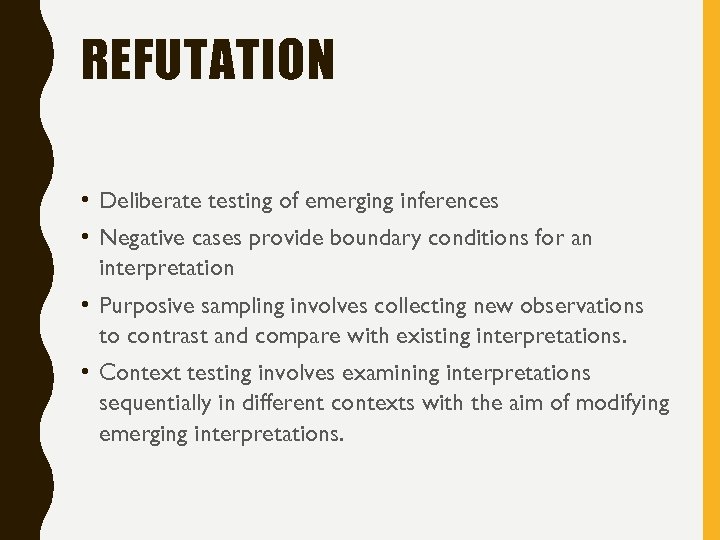 REFUTATION • Deliberate testing of emerging inferences • Negative cases provide boundary conditions for an interpretation • Purposive sampling involves collecting new observations to contrast and compare with existing interpretations. • Context testing involves examining interpretations sequentially in different contexts with the aim of modifying emerging interpretations.