


 Скачать презентацию The Mole Unit The Mole Topic Atomic
fc57f4c68504a6abf4749301db68cbe0.ppt
- Количество слайдов: 78
 The Mole
 Unit: The Mole Topic: Atomic Mass Objectives: Day 1 of 4 • To learn how atomic mass is calculated using the average natural abundance of isotopes • To understand the quantity of a mole and Avogadro's number
 Quickwrite Answer one of the questions below 1 -2 sentences: • 1 light year (the distance light travels in a year) is equal to 9. 5 trillion kilometers!!!!! Why do you think scientists use light years to measure distances to nearby stars in light years and not kilometers? ? ? • Your pencil uses graphite (pure carbon) to write with; how many atoms do you think are in 12 grams of graphite or carbon? ? ? ? • How many items make up a dozen? ? ? How many items make up a half dozen? ? How many items are in two dozen? ?
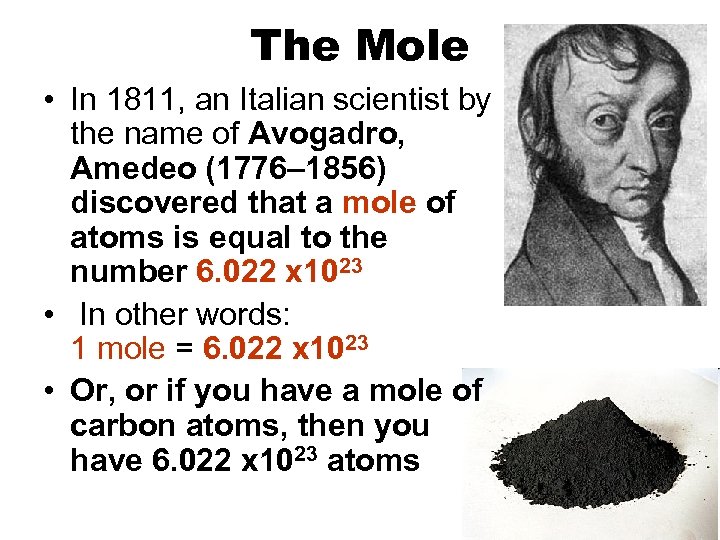 The Mole • In 1811, an Italian scientist by the name of Avogadro, Amedeo (1776– 1856) discovered that a mole of atoms is equal to the number 6. 022 x 1023 • In other words: 1 mole = 6. 022 x 1023 • Or, or if you have a mole of carbon atoms, then you have 6. 022 x 1023 atoms
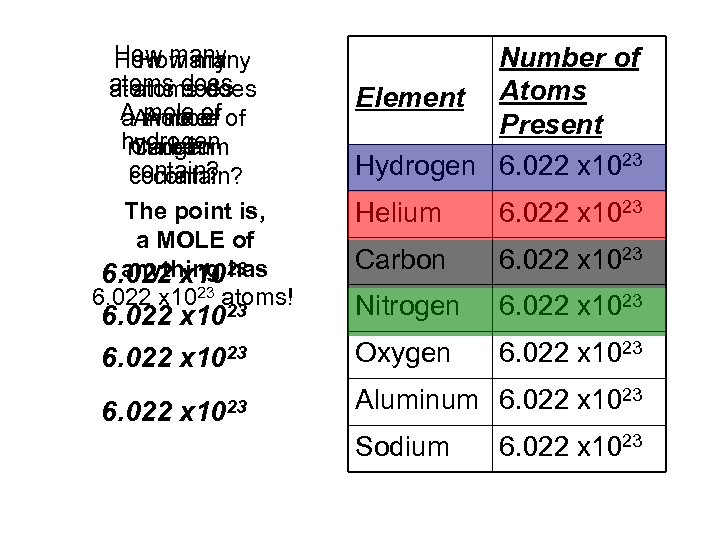 How many atoms does AA mole of a mole of A mole hydrogen nitrogen Carbon helium contain? The point is, a MOLE of anything has 6. 022 x 1023 atoms! 23 6. 022 x 1023 Number of Element Atoms Present Hydrogen 6. 022 x 1023 Helium 6. 022 x 1023 Carbon 6. 022 x 1023 Nitrogen 6. 022 x 1023 Oxygen 6. 022 x 1023 Aluminum 6. 022 x 1023 Sodium 6. 022 x 1023
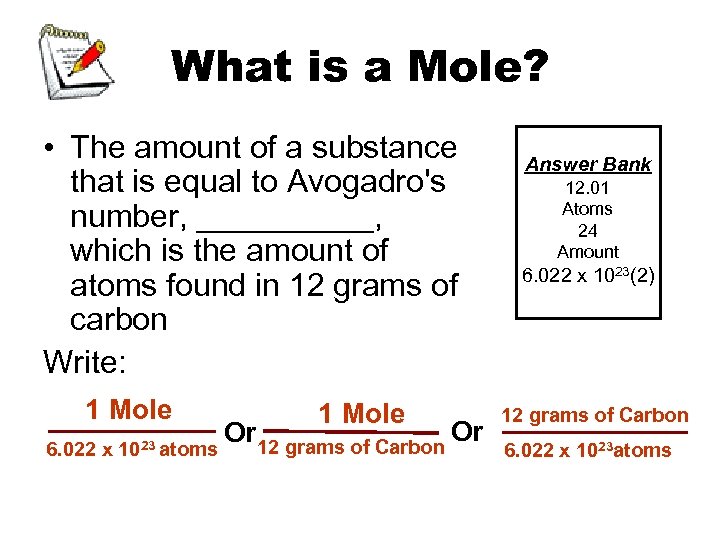 What is a Mole? • The amount of a substance that is equal to Avogadro's number, _____, which is the amount of atoms found in 12 grams of carbon Write: 1 Mole 6. 022 x 1023 atoms 1 Mole Or 12 grams of Carbon Or Answer Bank 12. 01 Atoms 24 Amount 6. 022 x 1023(2) 12 grams of Carbon 6. 022 x 1023 atoms
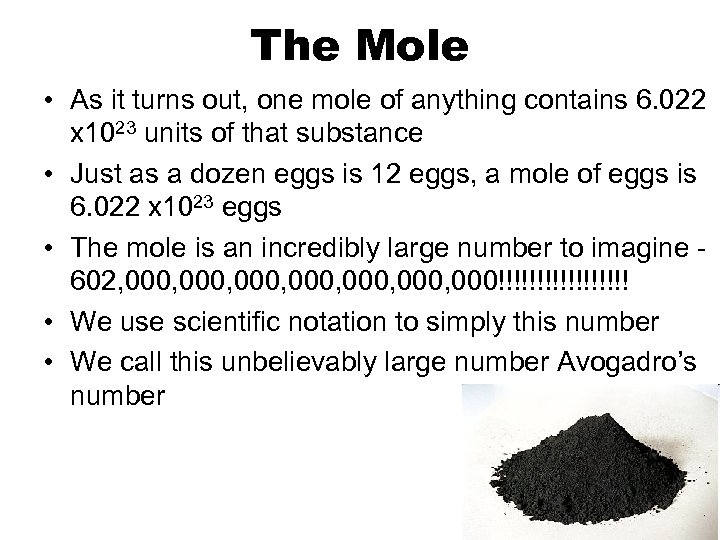 The Mole • As it turns out, one mole of anything contains 6. 022 x 1023 units of that substance • Just as a dozen eggs is 12 eggs, a mole of eggs is 6. 022 x 1023 eggs • The mole is an incredibly large number to imagine 602, 000, 000, 000!!!!!!!!! • We use scientific notation to simply this number • We call this unbelievably large number Avogadro’s number
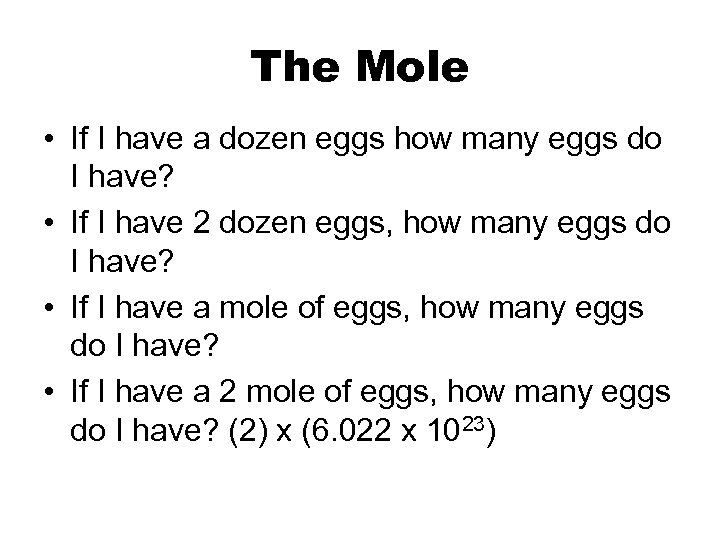 The Mole • If I have a dozen eggs how many eggs do I have? • If I have 2 dozen eggs, how many eggs do I have? • If I have a mole of eggs, how many eggs do I have? • If I have a 2 mole of eggs, how many eggs do I have? (2) x (6. 022 x 1023)
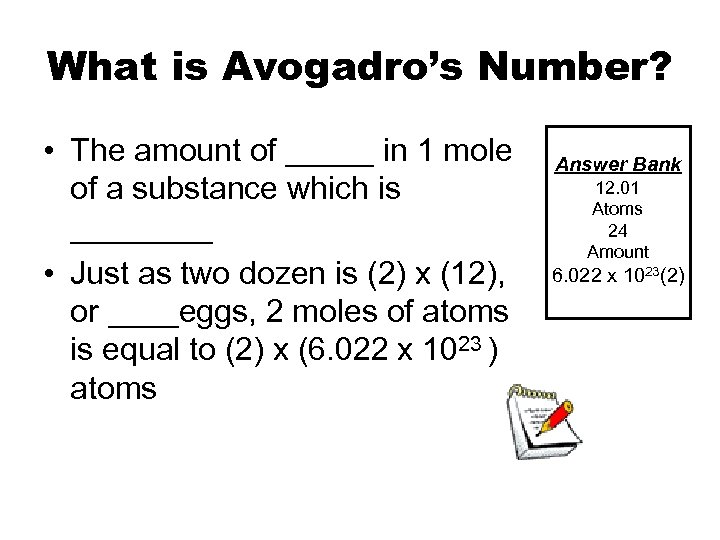 What is Avogadro’s Number? • The amount of _____ in 1 mole of a substance which is ____ • Just as two dozen is (2) x (12), or ____eggs, 2 moles of atoms is equal to (2) x (6. 022 x 1023 ) atoms Answer Bank 12. 01 Atoms 24 Amount 6. 022 x 1023(2)
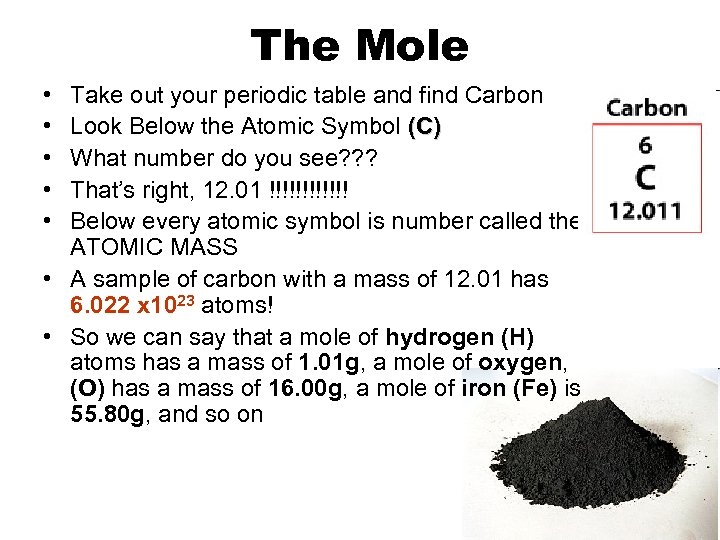 The Mole • • • Take out your periodic table and find Carbon Look Below the Atomic Symbol (C) What number do you see? ? ? That’s right, 12. 01 !!!!!! Below every atomic symbol is number called the ATOMIC MASS • A sample of carbon with a mass of 12. 01 has 6. 022 x 1023 atoms! • So we can say that a mole of hydrogen (H) atoms has a mass of 1. 01 g, a mole of oxygen, (O) has a mass of 16. 00 g, a mole of iron (Fe) is 55. 80 g, and so on
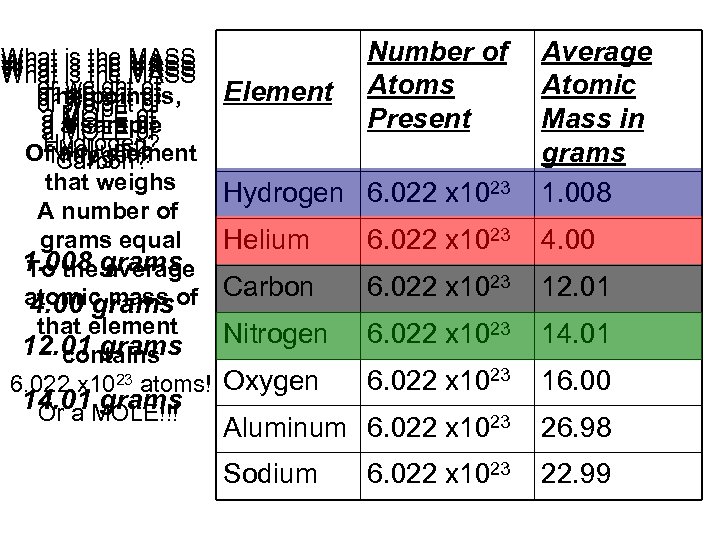 What is the MASS or weight of The point or weight of or MOLE ofis, weight of a a sample a MOLE of Hydrogen? Helium? Of. Nitrogen? any element Carbon? that weighs A number of grams equal 1. 008 grams To the average atomic mass of 4. 00 grams that element 12. 01 grams contains 6. 022 x 1023 atoms! 14. 01 MOLE!!! Or a grams Hydrogen 6. 022 x 1023 Average Atomic Mass in grams 1. 008 Helium 6. 022 x 1023 4. 00 Carbon 6. 022 x 1023 12. 01 Nitrogen 6. 022 x 1023 14. 01 Oxygen 6. 022 x 1023 16. 00 Aluminum 6. 022 x 1023 26. 98 Sodium 22. 99 Element Number of Atoms Present 6. 022 x 1023
 Atomic Mass • The average atomic mass for carbon is 12. 01 amu • Where does the 0. 01 come from? • 0. 01 is the percent abundance in nature of the carbon isotopes • For example, if we weighed 12 grams of carbon, 0. 01% percent is the amount of Carbon 14 and Carbon 13 isotopes that exist in nature
 Atomic Mass • It is the average mass of an element containing 6. 02 x 1023 atoms and calculated using the relative abundance of isotopes in a naturally-occurring element • It is based on AMU’s and the natural abundance of an elements isotopes
 What is atomic mass? • It is the _____ mass of an Answer Bank average element containing 6. 02 x 1023 1/12 atoms and calculated using the simplify relative abundance of isotopes in a Carbon 55. 8 naturally-occurring element abundance • For example a sample of Carbon Neutron 12. 01 23 atoms has a containing 6. 02 x 10 mass of ____grams and a sample of Iron containing 6. 02 x 1023 atoms has a mass of ____grams
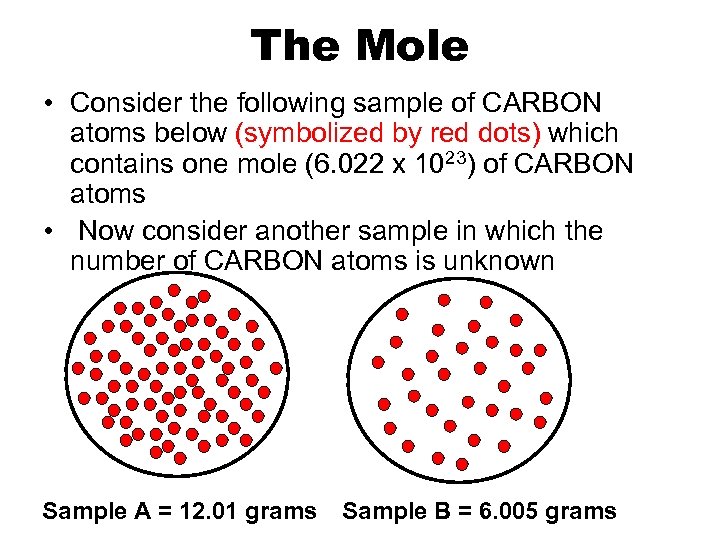 The Mole • Consider the following sample of CARBON atoms below (symbolized by red dots) which contains one mole (6. 022 x 1023) of CARBON atoms • Now consider another sample in which the number of CARBON atoms is unknown Sample A = 12. 01 grams Sample B = 6. 005 grams
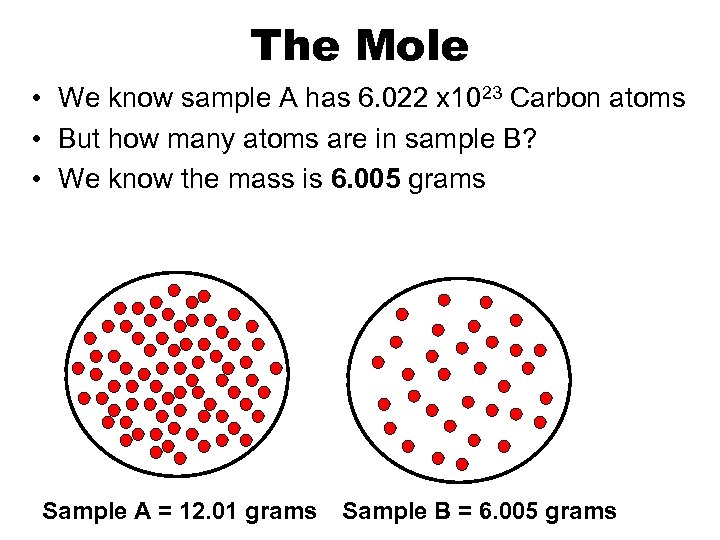 The Mole • We know sample A has 6. 022 x 1023 Carbon atoms • But how many atoms are in sample B? • We know the mass is 6. 005 grams Sample A = 12. 01 grams Sample B = 6. 005 grams
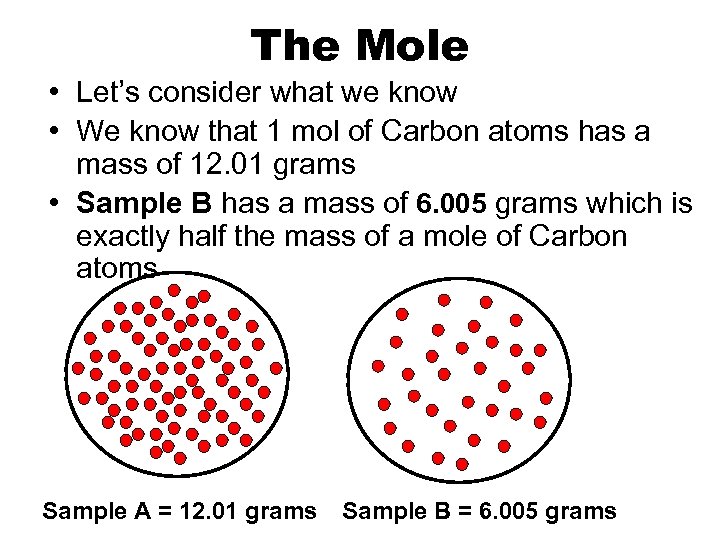 The Mole • Let’s consider what we know • We know that 1 mol of Carbon atoms has a mass of 12. 01 grams • Sample B has a mass of 6. 005 grams which is exactly half the mass of a mole of Carbon atoms Sample A = 12. 01 grams Sample B = 6. 005 grams
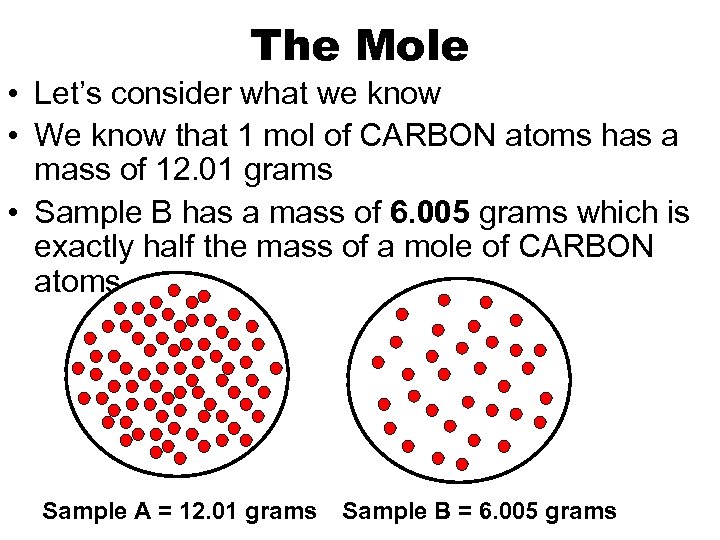 The Mole • Let’s consider what we know • We know that 1 mol of CARBON atoms has a mass of 12. 01 grams • Sample B has a mass of 6. 005 grams which is exactly half the mass of a mole of CARBON atoms Sample A = 12. 01 grams Sample B = 6. 005 grams
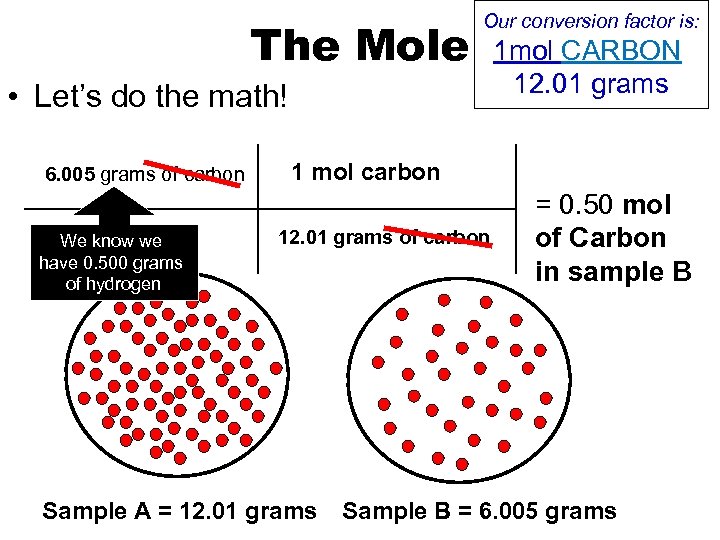 The Mole Our conversion factor is: • Let’s do the math! 6. 005 grams of carbon We know we have 0. 500 grams of hydrogen 1 mol CARBON 12. 01 grams 1 mol carbon 12. 01 grams of carbon Sample A = 12. 01 grams = 0. 50 mol of Carbon in sample B Sample B = 6. 005 grams
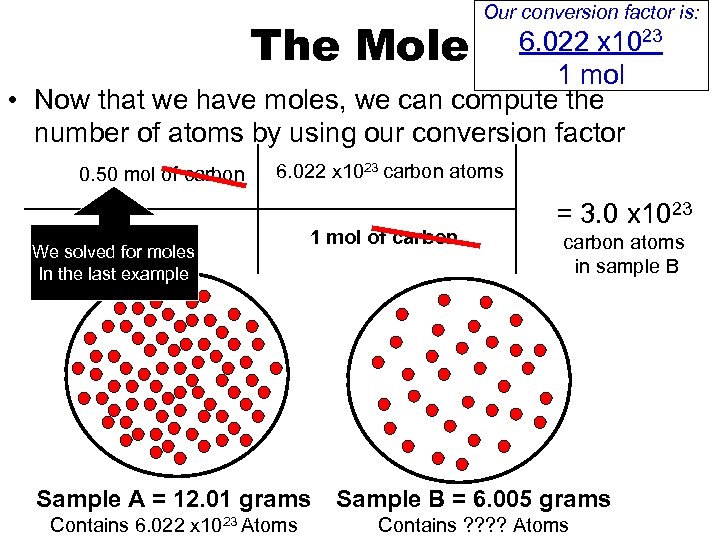 Our conversion factor is: 6. 022 x 1023 The Mole 1 mol • Now that we have moles, we can compute the number of atoms by using our conversion factor 0. 50 mol of carbon 6. 022 x 1023 carbon atoms We solved for moles In the last example 1 mol of carbon = 3. 0 x 1023 carbon atoms in sample B Sample A = 12. 01 grams Sample B = 6. 005 grams Contains 6. 022 x 1023 Atoms Contains ? ? Atoms
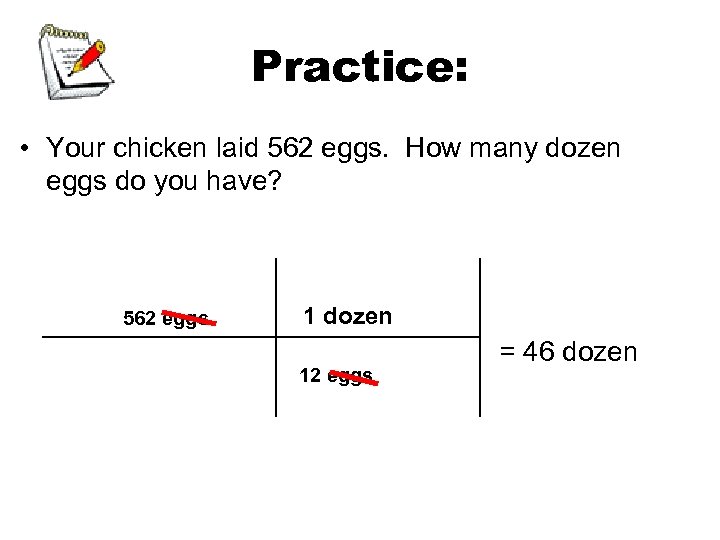 Practice: • Your chicken laid 562 eggs. How many dozen eggs do you have? 562 eggs 1 dozen 12 eggs = 46 dozen
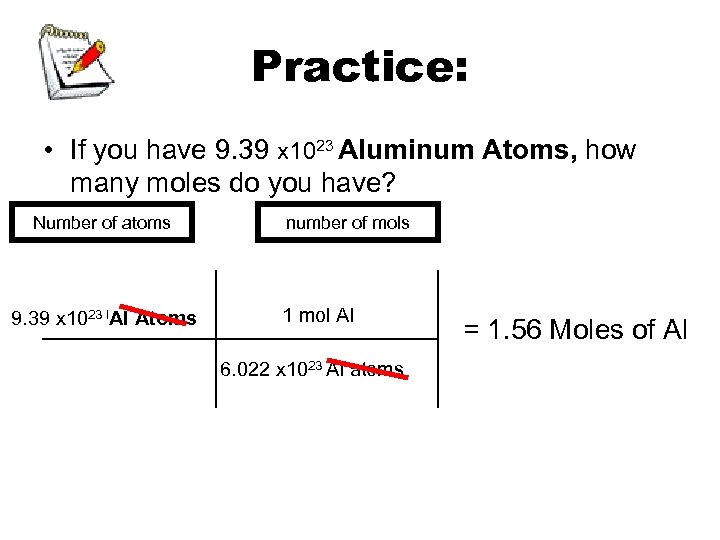 Practice: • If you have 9. 39 x 1023 Aluminum Atoms, how many moles do you have? Number of atoms of aluminum? of mols number • 1. 56 mol 9. 39 x 1023 l. Al Atoms 1 mol Al 6. 022 x 1023 Al atoms = 1. 56 Moles of Al
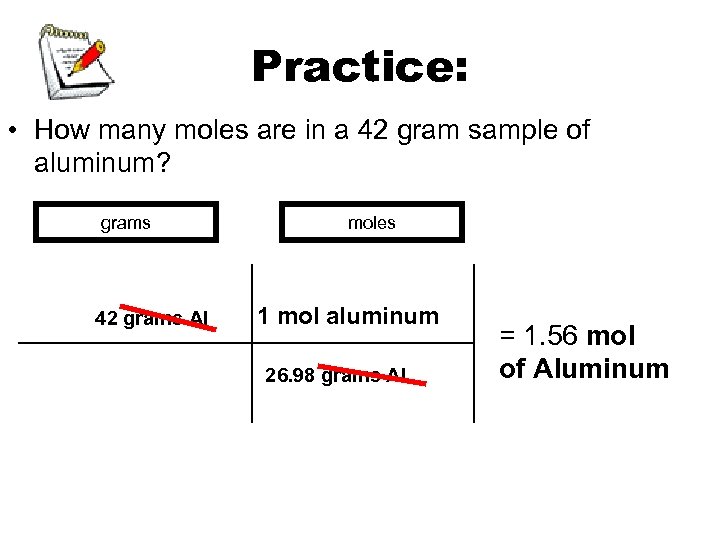 Practice: • How many moles are in a 42 gram sample of aluminum? grams 42 grams Al moles 1 mol aluminum 26. 98 grams Al = 1. 56 mol of Aluminum
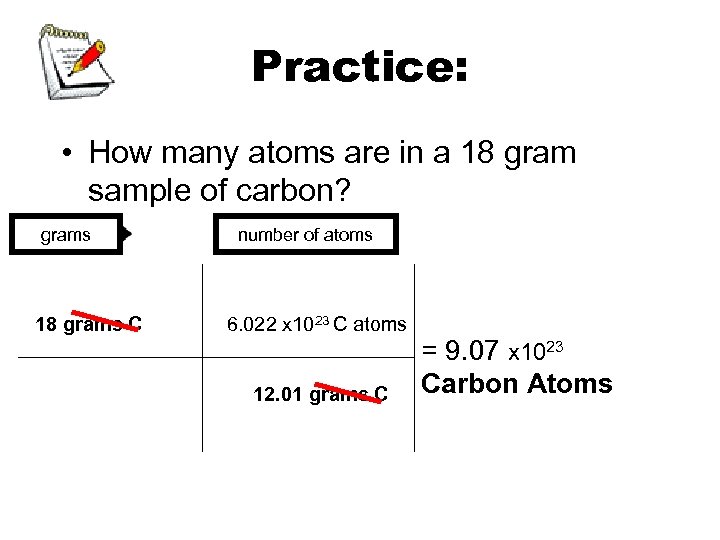 Practice: • How many atoms are in a 18 gram sample of carbon? grams 18 grams C number of atoms 6. 022 x 1023 C atoms 12. 01 grams C = 9. 07 x 1023 Carbon Atoms
 Summarize: Answer Bank • If I have a _____of something I 12. 01 have_______ particles Atoms isotope • Avogadro number is ______ Mole 24. 02 • A mole of carbon atoms weigh (mass) Amount ______ grams and contains ______ 6. 022 x 1023(2) atoms • 2 moles of carbons atoms weighs _____ grams • Review: An ______ is atom with a different amount of neutron than protons
 Unit: The Mole Topic: Molar Mass (Molecular Weight) Percent Composition & Objectives: Day 2 of 4 • To learn how to calculate Molar Mass • To learn how to convert between moles and grams • To learn how to calculate % composition
 Quickwrite Answer one of the questions below 1 -2 sentences: • Let’s say you want to find the weight of your dog, which is too big to stand on your bathroom scale; how could you find his weight? ? ? • Together, you and your dog weigh 100 kilograms, you know that you weigh 75 kilograms, what percent by weight does your dog weigh? ? • You know that a mole oxygen has a mass of 16 grams and a mole of hydrogen has a mass of 1. 0 grams, but how could you find the mass of 1 mole of water (H 2 O)
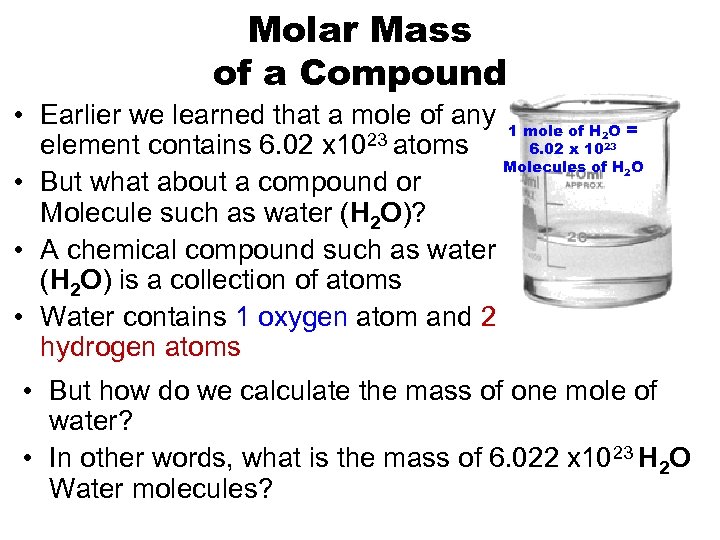 Molar Mass of a Compound • Earlier we learned that a mole of any 1 mole of H O = element contains 6. 02 x 1023 atoms 6. 02 x 10 Molecules of H O • But what about a compound or Molecule such as water (H 2 O)? • A chemical compound such as water (H 2 O) is a collection of atoms • Water contains 1 oxygen atom and 2 hydrogen atoms 2 23 2 • But how do we calculate the mass of one mole of water? • In other words, what is the mass of 6. 022 x 1023 H 2 O Water molecules?
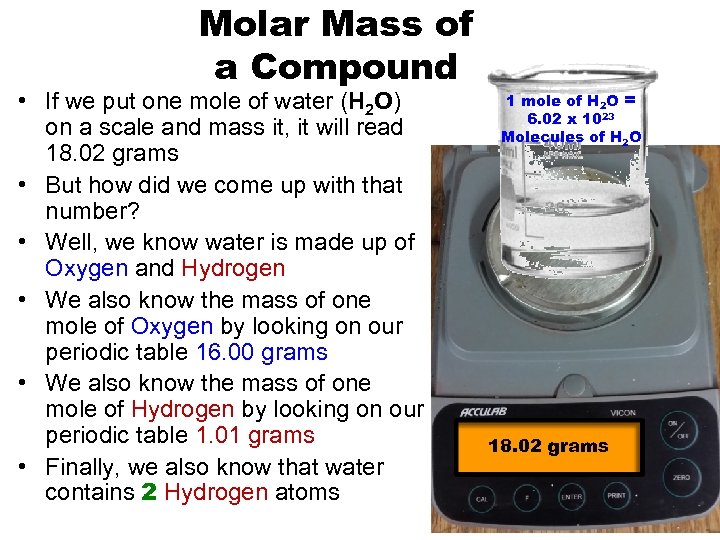 Molar Mass of a Compound • If we put one mole of water (H 2 O) on a scale and mass it, it will read 18. 02 grams • But how did we come up with that number? • Well, we know water is made up of Oxygen and Hydrogen • We also know the mass of one mole of Oxygen by looking on our periodic table 16. 00 grams • We also know the mass of one mole of Hydrogen by looking on our periodic table 1. 01 grams • Finally, we also know that water contains 2 Hydrogen atoms 1 mole of H 2 O = 6. 02 x 1023 Molecules of H 2 O 18. 02 grams
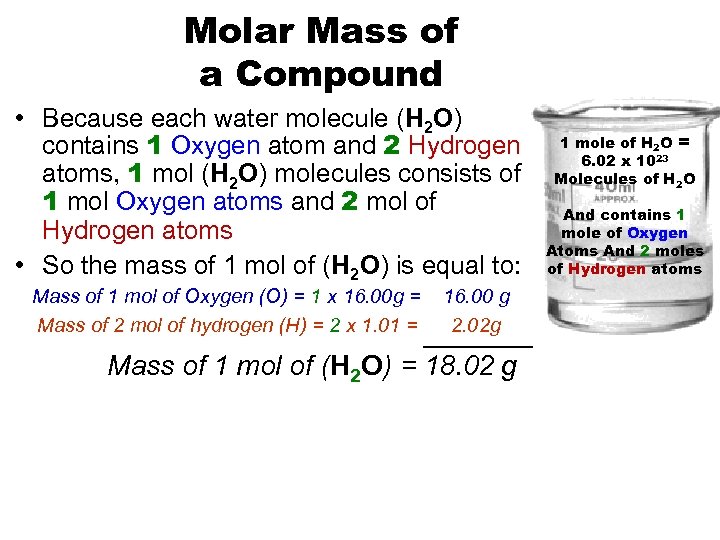 Molar Mass of a Compound • Because each water molecule (H 2 O) contains 1 Oxygen atom and 2 Hydrogen atoms, 1 mol (H 2 O) molecules consists of 1 mol Oxygen atoms and 2 mol of Hydrogen atoms • So the mass of 1 mol of (H 2 O) is equal to: Mass of 1 mol of Oxygen (O) = 1 x 16. 00 g = 16. 00 g Mass of 2 mol of hydrogen (H) = 2 x 1. 01 = _______ 2. 02 g Mass of 1 mol of (H 2 O) = 18. 02 g 1 mole of H 2 O = 6. 02 x 1023 Molecules of H 2 O And contains 1 mole of Oxygen Atoms And 2 moles of Hydrogen atoms
 Molar Mass of a Compound • Molar Mass is the mass in grams of 1 Mole of a substance or compound • It is calculated by the SUM of the atomic weights for every element that makes up the compound • Ex: H 2 O Mass of 1 mol of Oxygen (O) = 1 x 16. 00 g = Mass of 2 mol of Hydrogen (H) = 2 x 1. 01 = 16. 00 g 2. 02 g _______ Mass of 1 mol of (H 2 O) = 18. 02 g
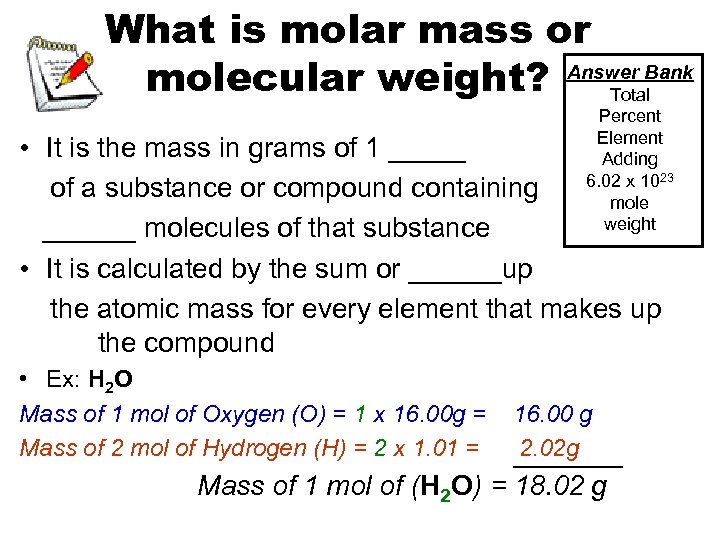 What is molar mass or molecular weight? Answer Bank Total Percent Element Adding 6. 02 x 1023 mole weight • It is the mass in grams of 1 _____ of a substance or compound containing ______ molecules of that substance • It is calculated by the sum or ______up the atomic mass for every element that makes up the compound • Ex: H 2 O Mass of 1 mol of Oxygen (O) = 1 x 16. 00 g = Mass of 2 mol of Hydrogen (H) = 2 x 1. 01 = 16. 00 g 2. 02 g _______ Mass of 1 mol of (H 2 O) = 18. 02 g
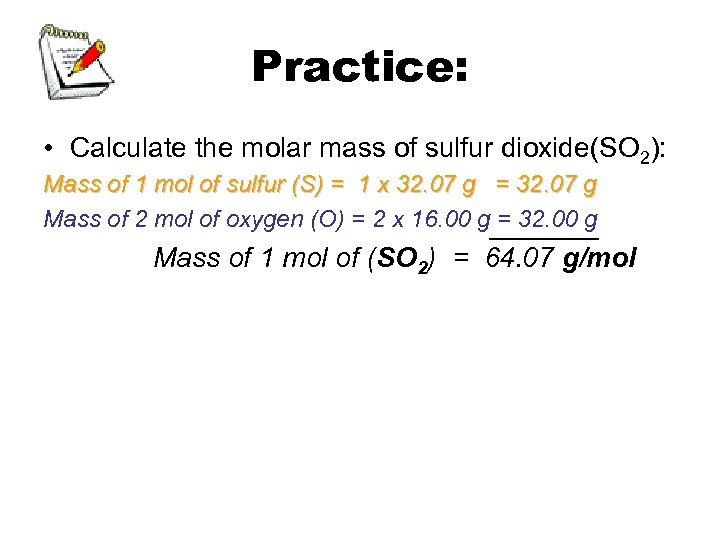 Practice: • Calculate the molar mass of sulfur dioxide(SO 2): Mass of 1 mol of sulfur (S) = 1 x 32. 07 g = 32. 07 g Mass of 2 mol of oxygen (O) = 2 x 16. 00 g_______ = 32. 00 g Mass of 1 mol of (SO 2) = 64. 07 g/mol
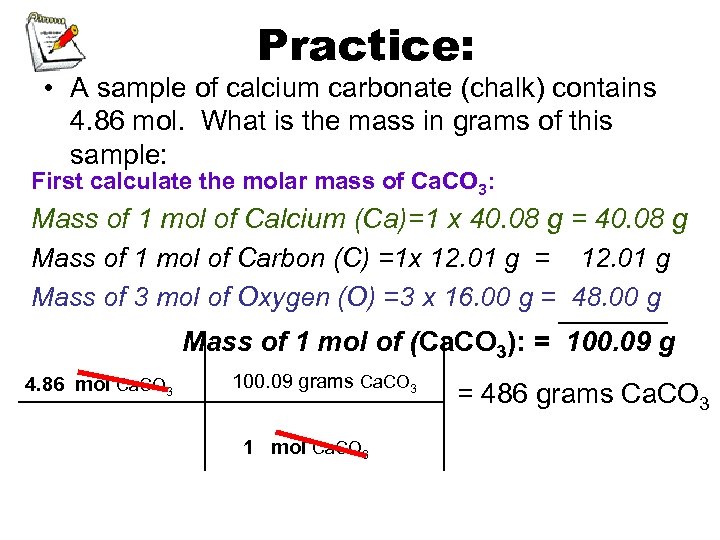 Practice: • A sample of calcium carbonate (chalk) contains 4. 86 mol. What is the mass in grams of this sample: First calculate the molar mass of Ca. CO 3: Mass of 1 mol of Calcium (Ca)=1 x 40. 08 g = 40. 08 g Mass of 1 mol of Carbon (C) =1 x 12. 01 g = 12. 01 g Mass of 3 mol of Oxygen (O) =3 x 16. 00 g = _______ 48. 00 g Mass of 1 mol of (Ca. CO 3): = 100. 09 g 4. 86 mol Ca. CO 3 100. 09 grams Ca. CO 3 1 mol Ca. CO 3 = 486 grams Ca. CO 3
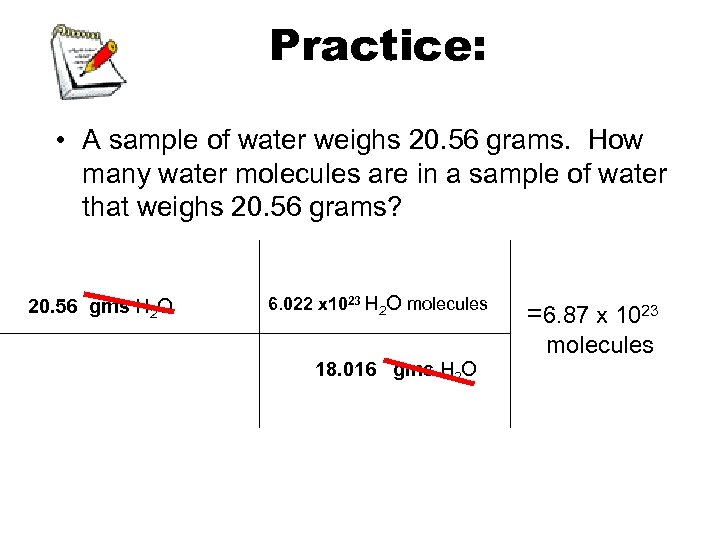 Practice: • A sample of water weighs 20. 56 grams. How many water molecules are in a sample of water that weighs 20. 56 grams? 20. 56 gms H 2 O 6. 022 x 1023 H 2 O molecules =6. 87 x 1023 molecules 18. 016 gms H 2 O
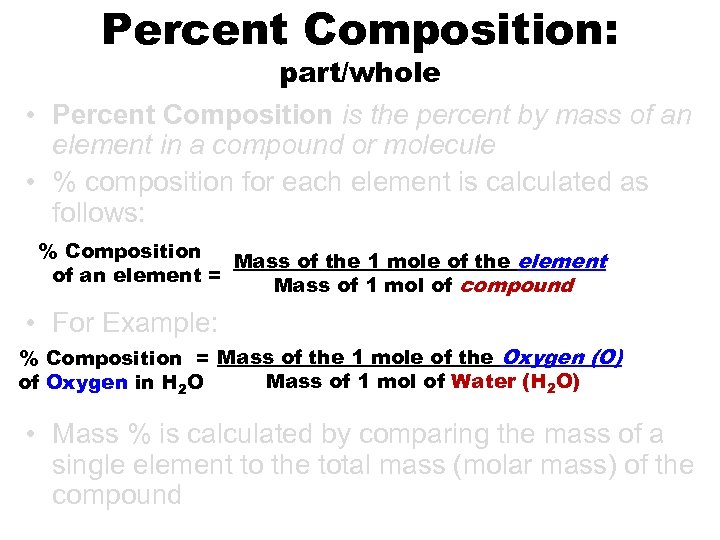 Percent Composition: part/whole • Percent Composition is the percent by mass of an element in a compound or molecule • % composition for each element is calculated as follows: % Composition Mass of the 1 mole of the element of an element = Mass of 1 mol of compound • For Example: % Composition = Mass of the 1 mole of the Oxygen (O) Mass of 1 mol of Water (H 2 O) of Oxygen in H 2 O • Mass % is calculated by comparing the mass of a single element to the total mass (molar mass) of the compound
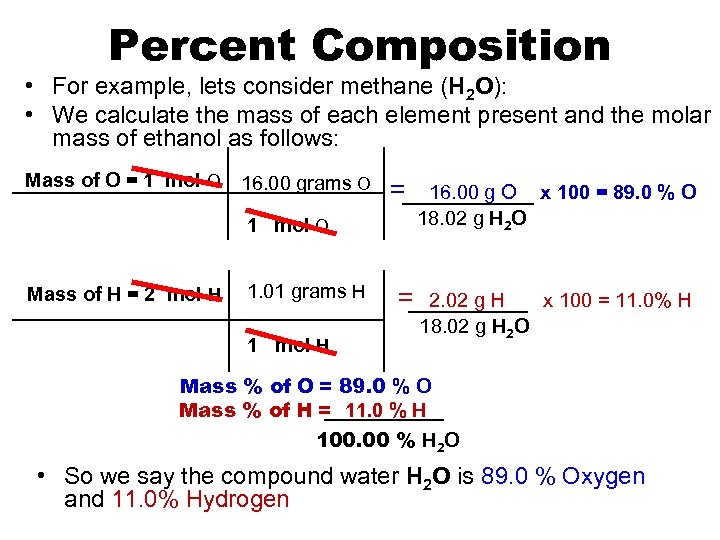 Percent Composition • For example, lets consider methane (H 2 O): • We calculate the mass of each element present and the molar mass of ethanol as follows: Mass of O = 1 mol O 16. 00 grams O = 1 mol O Mass of H = 2 mol H 1. 01 grams H 1 mol H = 16. 00 g O x 100 = 89. 0 % O 18. 02 g H 2 O 2. 02 g H x 100 = 11. 0% H 18. 02 g H 2 O Mass % of O = 89. 0 % O Mass % of H = 11. 0 % H 100. 00 % H 2 O • So we say the compound water H 2 O is 89. 0 % Oxygen and 11. 0% Hydrogen
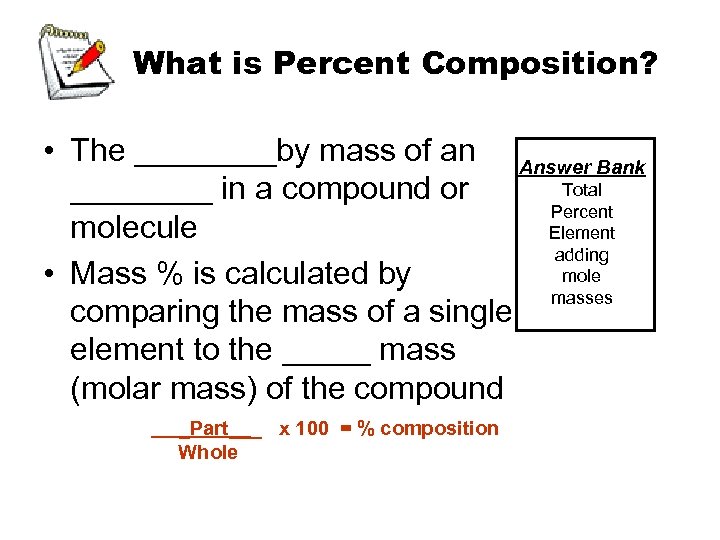 What is Percent Composition? • The ____by mass of an Answer Bank Total ____ in a compound or Percent molecule Element adding mole • Mass % is calculated by masses comparing the mass of a single element to the _____ mass (molar mass) of the compound _Part___ x 100 = % composition Whole
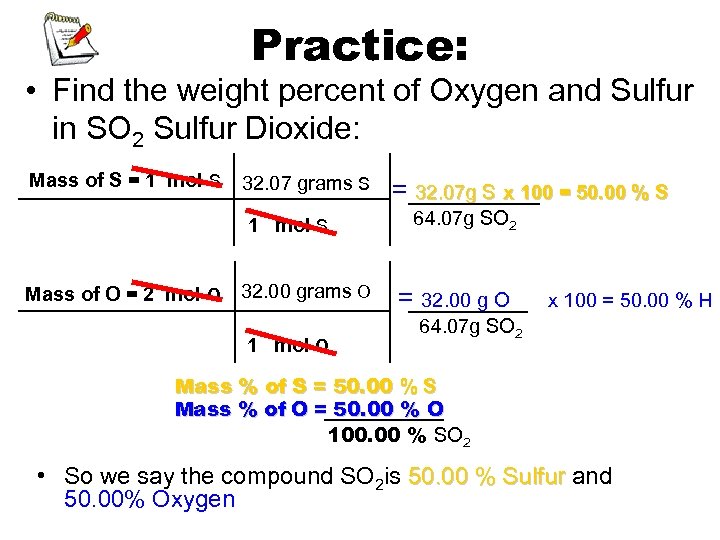 Practice: • Find the weight percent of Oxygen and Sulfur in SO 2 Sulfur Dioxide: Mass of S = 1 mol S 32. 07 grams S 1 mol S Mass of O = 2 mol O 32. 00 grams O 1 mol O = 32. 07 g S x 100 = 50. 00 % S 64. 07 g SO 2 = 32. 00 g O x 100 = 50. 00 % H 64. 07 g SO 2 Mass % of S = 50. 00 % S Mass % of O = 50. 00 % O 100. 00 % SO 2 • So we say the compound SO 2 is 50. 00 % Sulfur and 50. 00% Oxygen
 Summarize: • Explain Molar mass in your own words: • Describe and explain how you would calculate % compostion: • _____is the mass in grams of one mole of a compound which contains 6. 02 x 1023 molcules • To calculate Molar mass, you would add up the ______for each element that make up a molecule • The percent by mass of an element in a compound is called it’s ______ • Calculate the percentage of nitrogen in nitrogen dioxide NO 2
 Unit: The Mole Topic: Molecular and Empirical Formulas Objectives: Day 3 of 4 • To understand the difference between molecular and empirical formulas • To learn how to calculate empirical formulas and molecular formulas given percent composition and mass
 Quickwrite Answer one of the questions below 1 -2 sentences: • Review: In iron (III) oxide, Fe 2 O 3, how many iron atoms are present? How many oxygen atoms are present? • How do think scientists determine the subscripts on chemical formulas such as Fe 2 O 3? In other words how did they come up with the subscripts 2 and 3? • Can hydrogen peroxide (H 2 O 2) be simplified into a more basic chemical formula? If so, how?
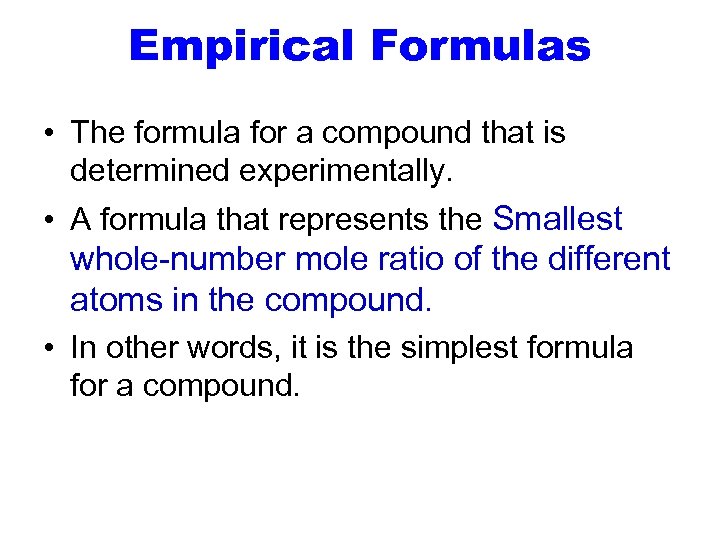 Empirical Formulas • The formula for a compound that is determined experimentally. • A formula that represents the Smallest whole-number mole ratio of the different atoms in the compound. • In other words, it is the simplest formula for a compound.
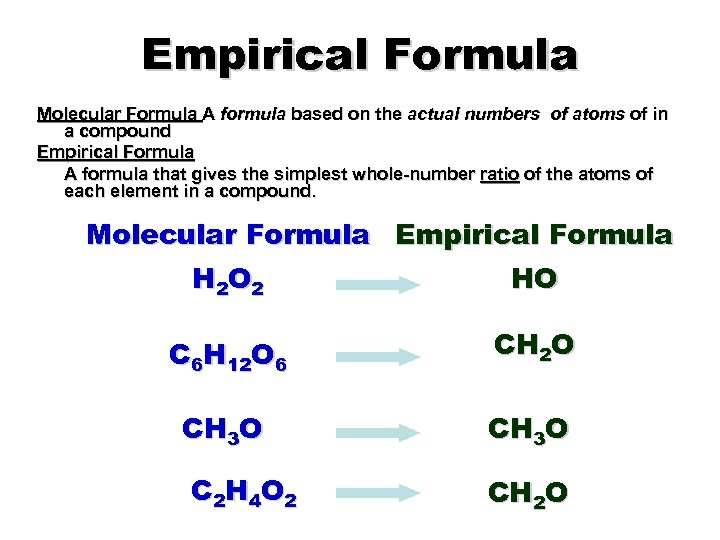 Empirical Formula Molecular Formula A formula based on the actual numbers of atoms of in a compound Empirical Formula A formula that gives the simplest whole-number ratio of the atoms of each element in a compound. Molecular Formula Empirical Formula H 2 O 2 HO C 6 H 12 O 6 CH 2 O CH 3 O C 2 H 4 O 2 CH 2 O
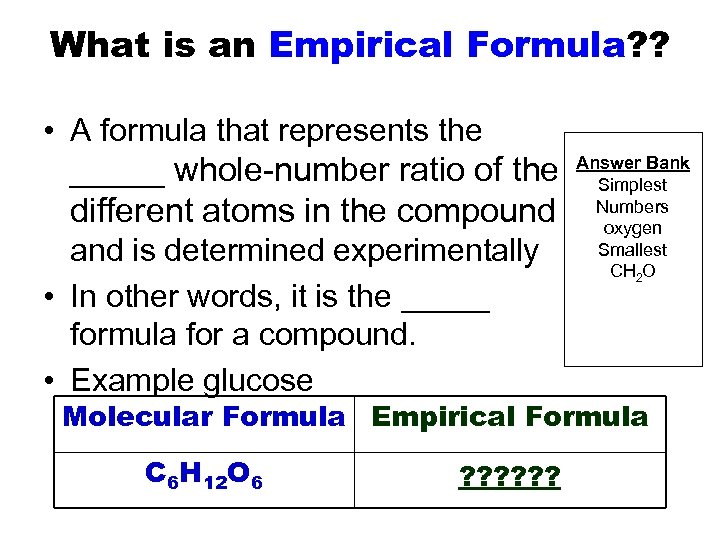 What is an Empirical Formula? ? • A formula that represents the _____ whole-number ratio of the different atoms in the compound and is determined experimentally • In other words, it is the _____ formula for a compound. • Example glucose Answer Bank Simplest Numbers oxygen Smallest CH 2 O Molecular Formula Empirical Formula C 6 H 12 O 6 ? ? ?
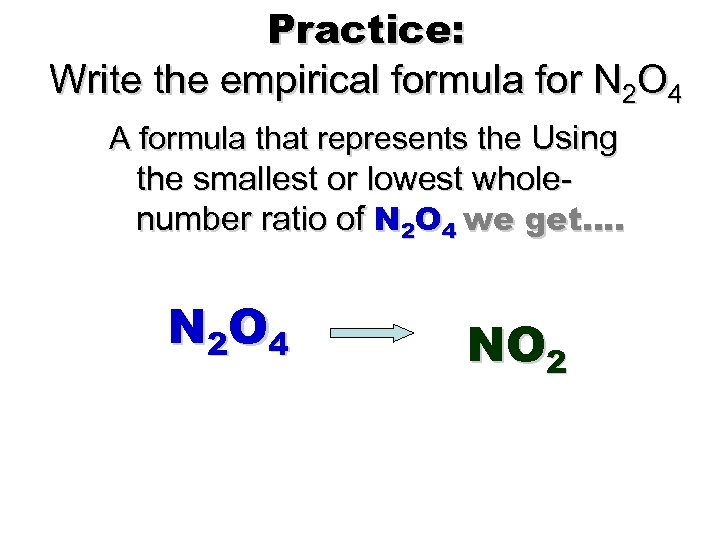 Practice: Write the empirical formula for N 2 O 4 A formula that represents the Using the smallest or lowest wholenumber ratio of N 2 O 4 we get…. N 2 O 4 NO 2
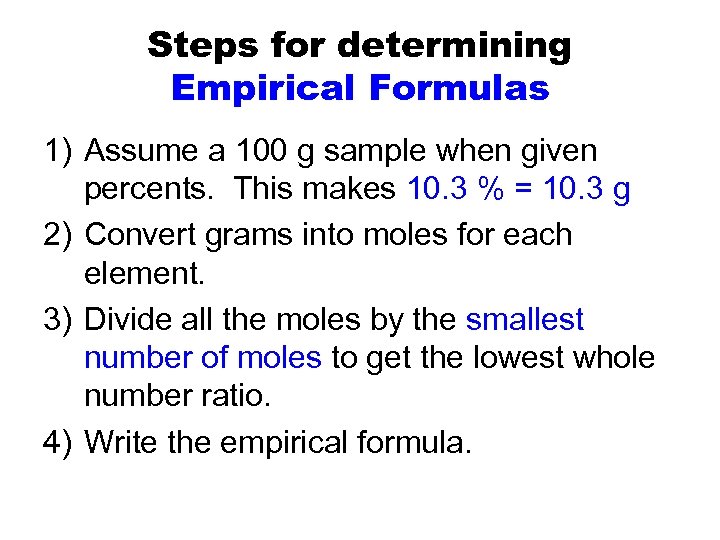 Steps for determining Empirical Formulas 1) Assume a 100 g sample when given percents. This makes 10. 3 % = 10. 3 g 2) Convert grams into moles for each element. 3) Divide all the moles by the smallest number of moles to get the lowest whole number ratio. 4) Write the empirical formula.
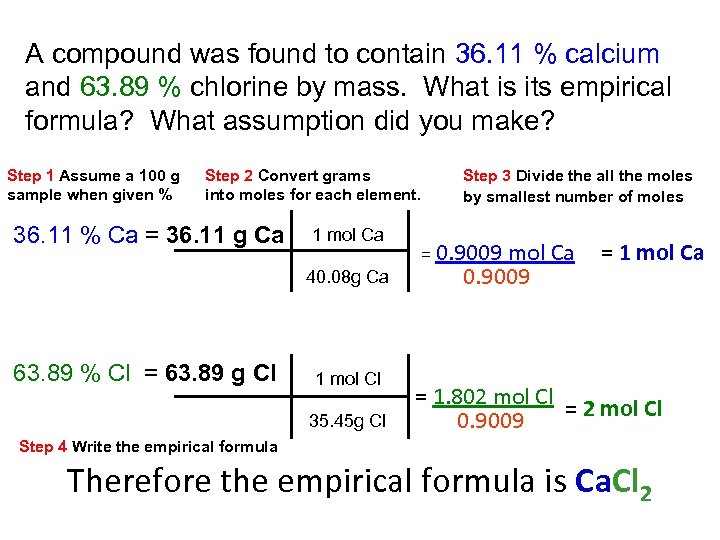 A compound was found to contain 36. 11 % calcium and 63. 89 % chlorine by mass. What is its empirical formula? What assumption did you make? Step 1 Assume a 100 g sample when given % Step 2 Convert grams into moles for each element. 36. 11 % Ca = 36. 11 g Ca 1 mol Ca 40. 08 g Ca 63. 89 % Cl = 63. 89 g Cl 1 mol Cl 35. 45 g Cl Step 3 Divide the all the moles by smallest number of moles = 0. 9009 mol Ca 0. 9009 = 1 mol Ca = 1. 802 mol Cl = 2 mol Cl 0. 9009 Step 4 Write the empirical formula Therefore the empirical formula is Ca. Cl 2
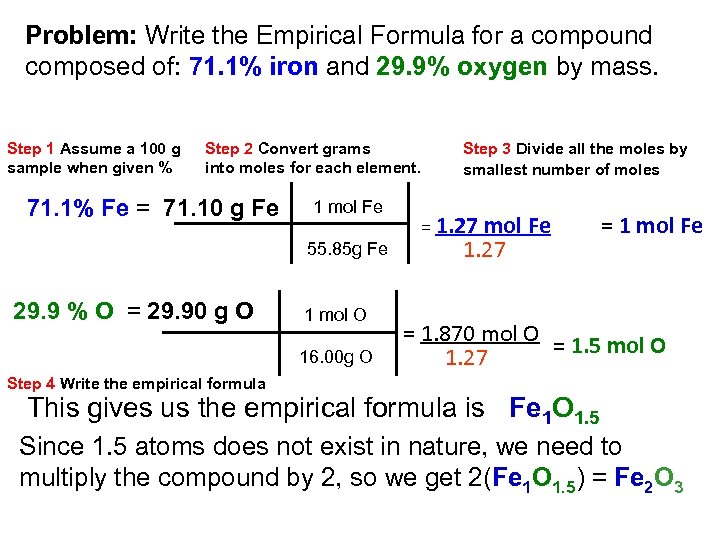 Problem: Write the Empirical Formula for a compound composed of: 71. 1% iron and 29. 9% oxygen by mass. Step 1 Assume a 100 g sample when given % Step 2 Convert grams into moles for each element. 71. 1% Fe = 71. 10 g Fe 1 mol Fe 55. 85 g Fe 29. 9 % O = 29. 90 g O 1 mol O 16. 00 g O Step 3 Divide all the moles by smallest number of moles = 1. 27 mol Fe 1. 27 = 1 mol Fe = 1. 870 mol O = 1. 5 mol O 1. 27 Step 4 Write the empirical formula This gives us the empirical formula is Fe 1 O 1. 5 Since 1. 5 atoms does not exist in nature, we need to multiply the compound by 2, so we get 2(Fe 1 O 1. 5) = Fe 2 O 3
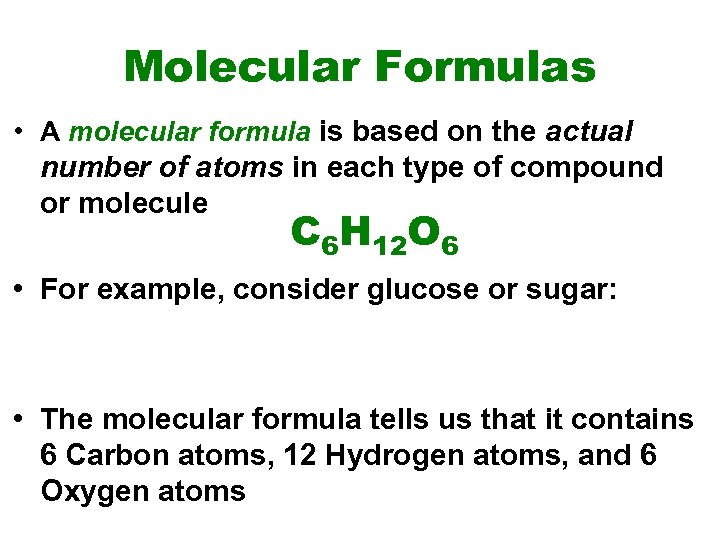 Molecular Formulas • A molecular formula is based on the actual number of atoms in each type of compound or molecule C 6 H 12 O 6 • For example, consider glucose or sugar: • The molecular formula tells us that it contains 6 Carbon atoms, 12 Hydrogen atoms, and 6 Oxygen atoms
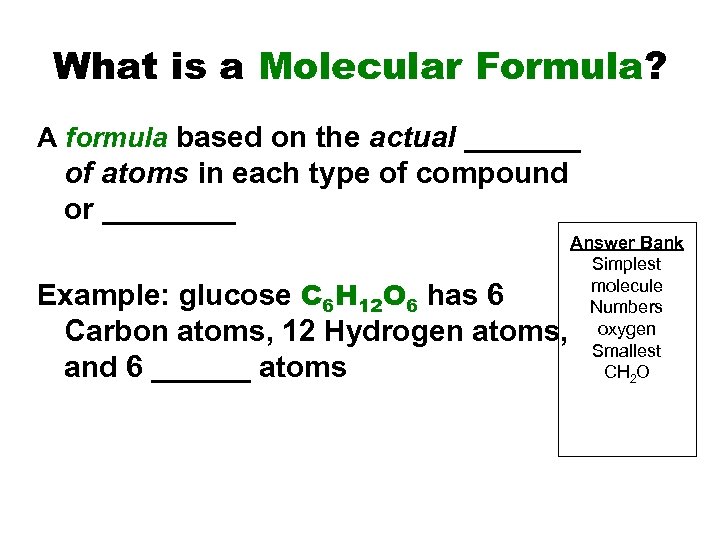 What is a Molecular Formula? A formula based on the actual _______ of atoms in each type of compound or ____ Example: glucose C 6 H 12 O 6 has 6 Carbon atoms, 12 Hydrogen atoms, and 6 ______ atoms Answer Bank Simplest molecule Numbers oxygen Smallest CH 2 O
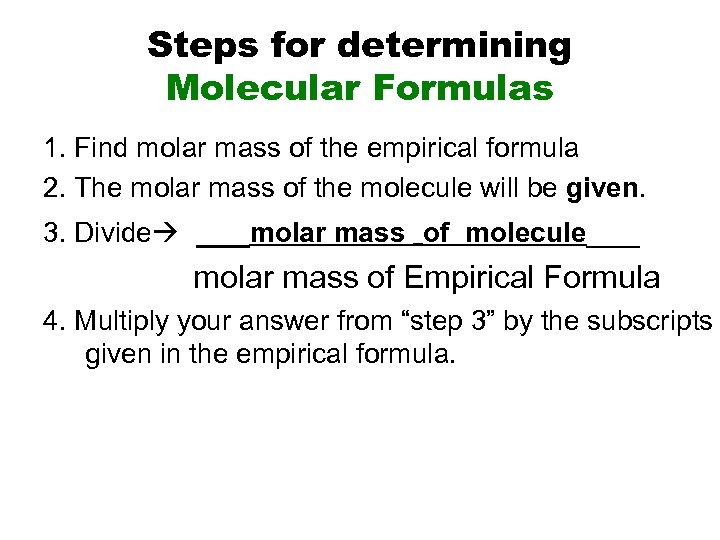 Steps for determining Molecular Formulas 1. Find molar mass of the empirical formula 2. The molar mass of the molecule will be given. 3. Divide ___molar mass _of molecule___ molar mass of Empirical Formula 4. Multiply your answer from “step 3” by the subscripts given in the empirical formula.
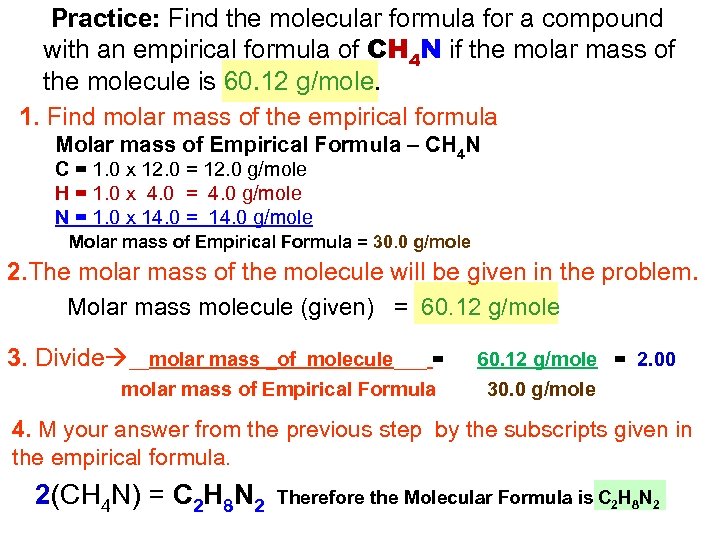 Practice: Find the molecular formula for a compound with an empirical formula of CH 4 N if the molar mass of the molecule is 60. 12 g/mole. 1. Find molar mass of the empirical formula Molar mass of Empirical Formula – CH 4 N C = 1. 0 x 12. 0 = 12. 0 g/mole H = 1. 0 x 4. 0 = 4. 0 g/mole N = 1. 0 x 14. 0 = 14. 0 g/mole Molar mass of Empirical Formula = 30. 0 g/mole 2. The molar mass of the molecule will be given in the problem. Molar mass molecule (given) = 60. 12 g/mole 3. Divide __molar mass _of molecule___ = molar mass of Empirical Formula 60. 12 g/mole = 2. 00 30. 0 g/mole 4. M your answer from the previous step by the subscripts given in the empirical formula. 2(CH 4 N) = C 2 H 8 N 2 Therefore the Molecular Formula is C 2 H 8 N 2
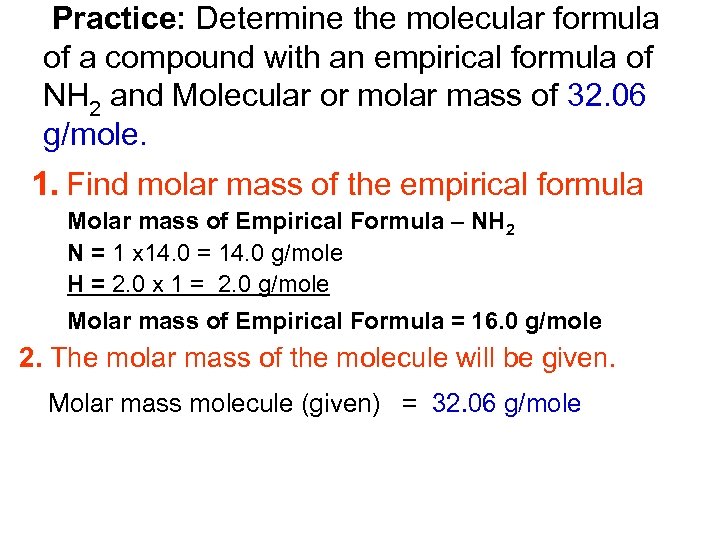 Practice: Determine the molecular formula of a compound with an empirical formula of NH 2 and Molecular or molar mass of 32. 06 g/mole. 1. Find molar mass of the empirical formula Molar mass of Empirical Formula – NH 2 N = 1 x 14. 0 = 14. 0 g/mole H = 2. 0 x 1 = 2. 0 g/mole Molar mass of Empirical Formula = 16. 0 g/mole 2. The molar mass of the molecule will be given. Molar mass molecule (given) = 32. 06 g/mole
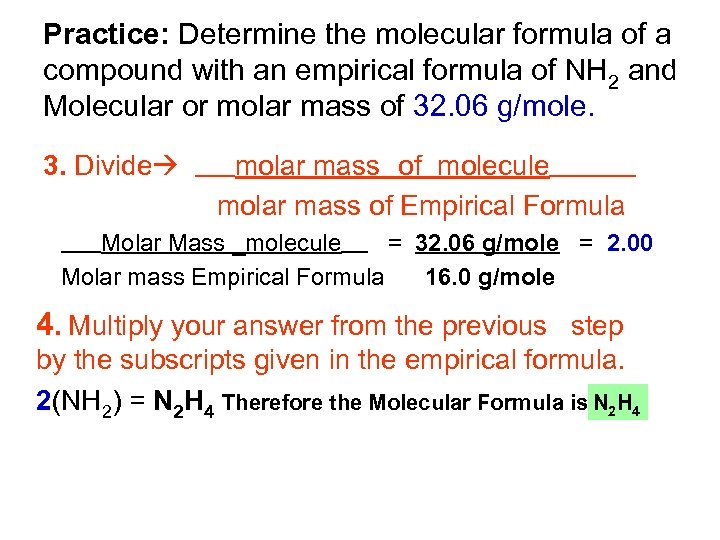 Practice: Determine the molecular formula of a compound with an empirical formula of NH 2 and Molecular or molar mass of 32. 06 g/mole. 3. Divide molar mass _of molecule_______ molar mass of Empirical Formula ______ Molar Mass _molecule____ = 32. 06 g/mole = 2. 00 Molar mass Empirical Formula 16. 0 g/mole __ __ 4. Multiply your answer from the previous step by the subscripts given in the empirical formula. 2(NH 2) = N 2 H 4 Therefore the Molecular Formula is N 2 H 4
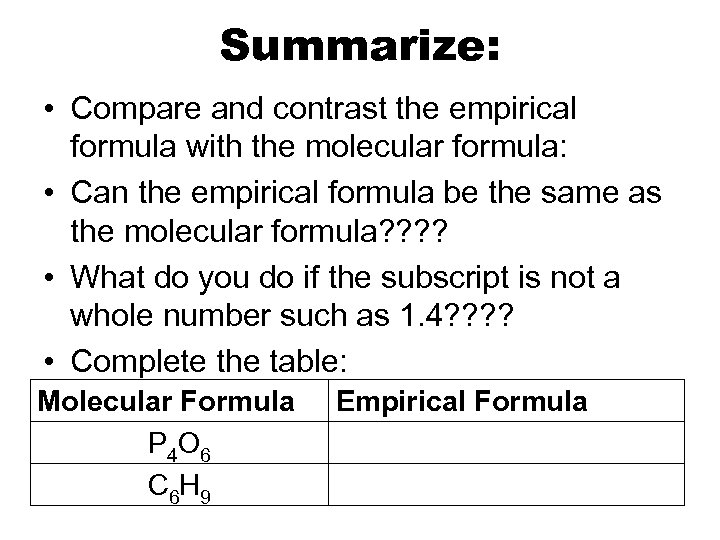 Summarize: • Compare and contrast the empirical formula with the molecular formula: • Can the empirical formula be the same as the molecular formula? ? • What do you do if the subscript is not a whole number such as 1. 4? ? • Complete the table: Molecular Formula P 4 O 6 C 6 H 9 Empirical Formula
 Unit: Topic: The Moles in Chemical Reactions Objectives: Day 4 of 4 • To learn how we go from moles of a reactant to moles of a product • To learn how to calculate between moles of reactants to moles of products
 Quickwrite Answer one of the questions below 1 -2 sentences: • A cake recipe requires 2 eggs, 2 cups of flour and 1 cup of sugar; you need to make 6 cakes for a friends birthday party, how many eggs, cups of flour and sugar should you buy? ? • Using the recipe below: 2 eggs + 2 cups of flour + 1 cup of sugar → 1 cake To make one cake, a recipe requires how many cups of flour? How could you write this as a ratio?
 Moles in Reactions • Chemistry is really all about reactions • Reactions involve the rearrangement of atoms • The calculation of the quantities of chemical elements or compounds involved in chemical reactions is called Stoichiometry (our next unit) • It is the coefficients in the balanced chemical equation that enables us to determine just how much product forms • What we once called coefficients are now called moles!!!!
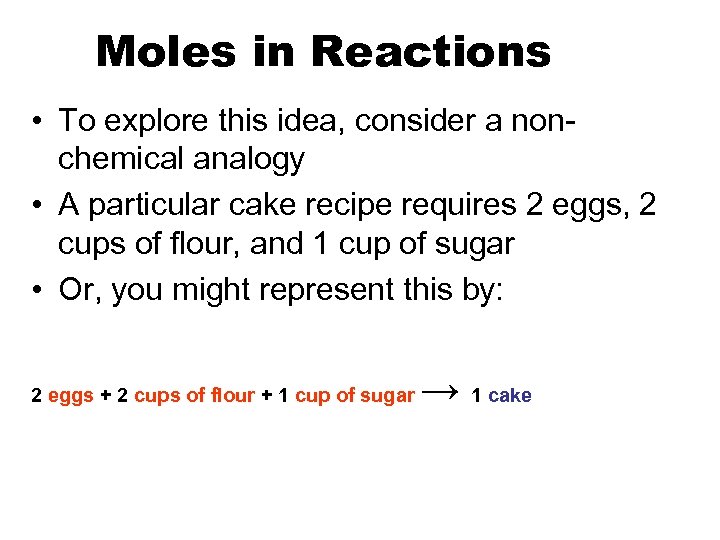 Moles in Reactions • To explore this idea, consider a nonchemical analogy • A particular cake recipe requires 2 eggs, 2 cups of flour, and 1 cup of sugar • Or, you might represent this by: 2 eggs + 2 cups of flour + 1 cup of sugar → 1 cake
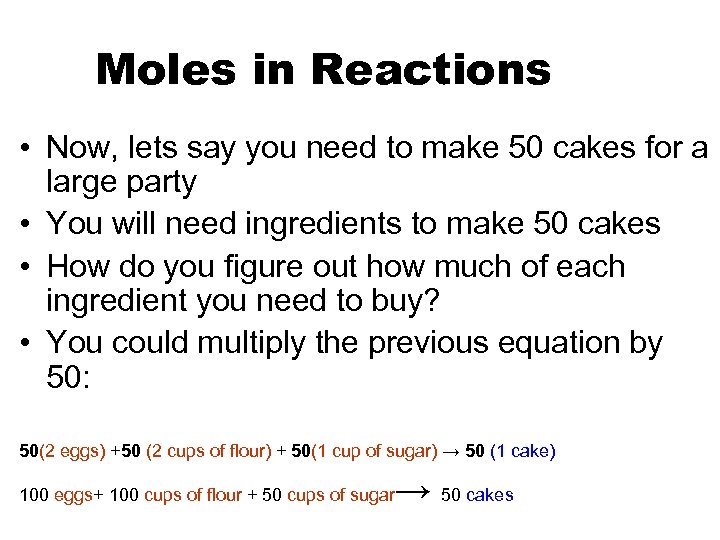 Moles in Reactions • Now, lets say you need to make 50 cakes for a large party • You will need ingredients to make 50 cakes • How do you figure out how much of each ingredient you need to buy? • You could multiply the previous equation by 50: 50(2 eggs) +50 (2 cups of flour) + 50(1 cup of sugar) → 50 (1 cake) 100 eggs+ 100 cups of flour + 50 cups of sugar → 50 cakes
 Moles in Reactions • Notice that the numbers 100: 50 correspond to the ratio 2: 2: 1 • The equation for chemical reaction gives you the same type of information • It indicates the relative numbers of reactant and product molecules required for the reaction to take place
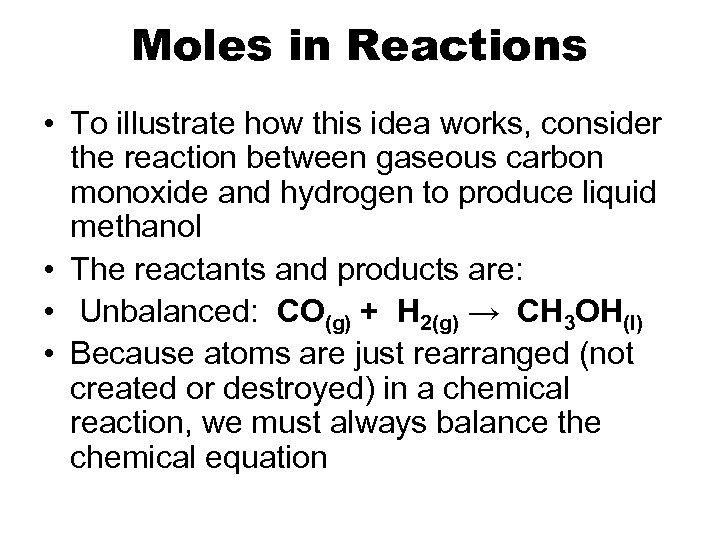 Moles in Reactions • To illustrate how this idea works, consider the reaction between gaseous carbon monoxide and hydrogen to produce liquid methanol • The reactants and products are: • Unbalanced: CO(g) + H 2(g) → CH 3 OH(l) • Because atoms are just rearranged (not created or destroyed) in a chemical reaction, we must always balance the chemical equation
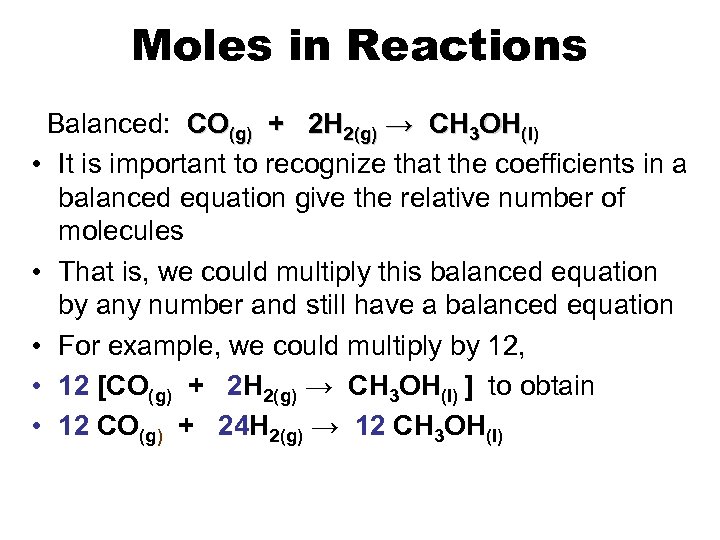 Moles in Reactions Balanced: CO(g) + 2 H 2(g) → CH 3 OH(l) • It is important to recognize that the coefficients in a balanced equation give the relative number of molecules • That is, we could multiply this balanced equation by any number and still have a balanced equation • For example, we could multiply by 12, • 12 [CO(g) + 2 H 2(g) → CH 3 OH(l) ] to obtain • 12 CO(g) + 24 H 2(g) → 12 CH 3 OH(l)
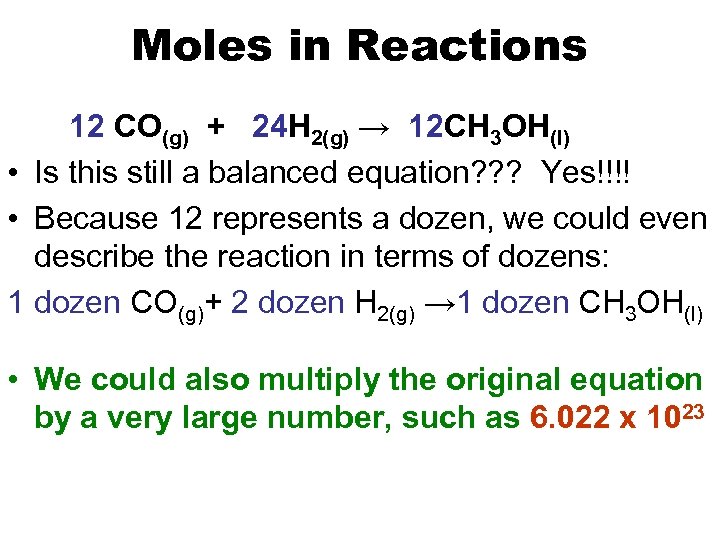 Moles in Reactions 12 CO(g) + 24 H 2(g) → 12 CH 3 OH(l) • Is this still a balanced equation? ? ? Yes!!!! • Because 12 represents a dozen, we could even describe the reaction in terms of dozens: 1 dozen CO(g)+ 2 dozen H 2(g) → 1 dozen CH 3 OH(l) • We could also multiply the original equation by a very large number, such as 6. 022 x 1023
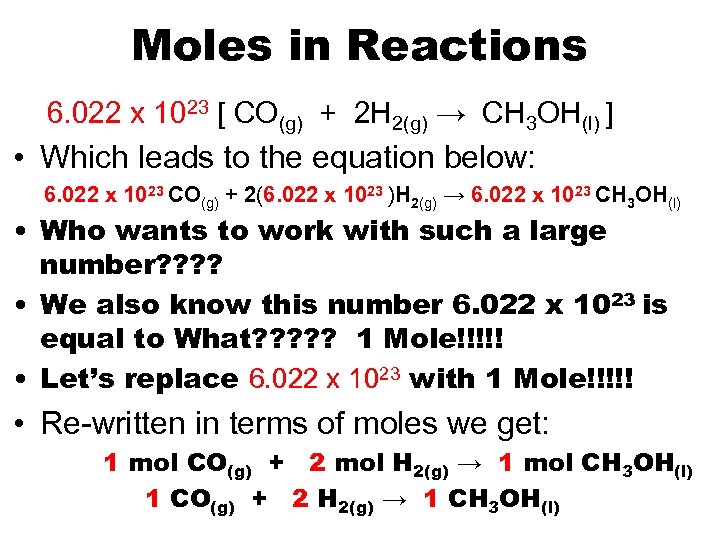 Moles in Reactions 6. 022 x 1023 [ CO(g) + 2 H 2(g) → CH 3 OH(l) ] • Which leads to the equation below: 6. 022 x 1023 CO(g) + 2(6. 022 x 1023 )H 2(g) → 6. 022 x 1023 CH 3 OH(l) • Who wants to work with such a large number? ? • We also know this number 6. 022 x 1023 is equal to What? ? ? 1 Mole!!!!! • Let’s replace 6. 022 x 1023 with 1 Mole!!!!! • Re-written in terms of moles we get: 1 mol CO(g) + 2 mol H 2(g) → 1 mol CH 3 OH(l) 1 CO(g) + 2 H 2(g) → 1 CH 3 OH(l)
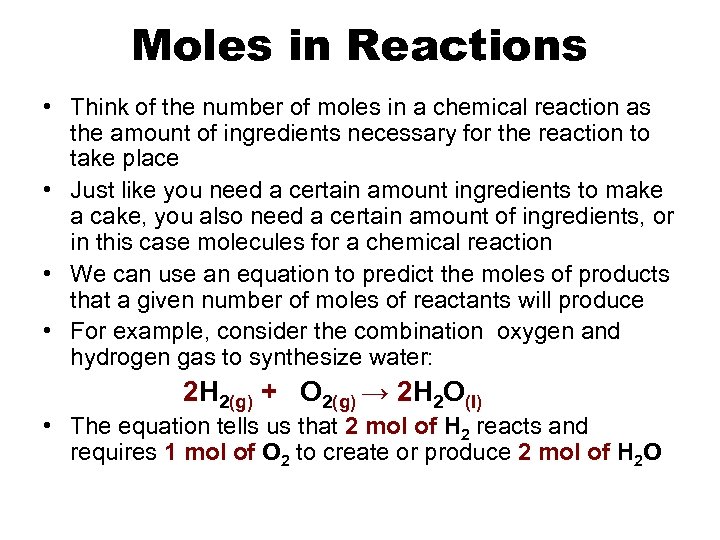 Moles in Reactions • Think of the number of moles in a chemical reaction as the amount of ingredients necessary for the reaction to take place • Just like you need a certain amount ingredients to make a cake, you also need a certain amount of ingredients, or in this case molecules for a chemical reaction • We can use an equation to predict the moles of products that a given number of moles of reactants will produce • For example, consider the combination oxygen and hydrogen gas to synthesize water: 2 H 2(g) + O 2(g) → 2 H 2 O(l) • The equation tells us that 2 mol of H 2 reacts and requires 1 mol of O 2 to create or produce 2 mol of H 2 O
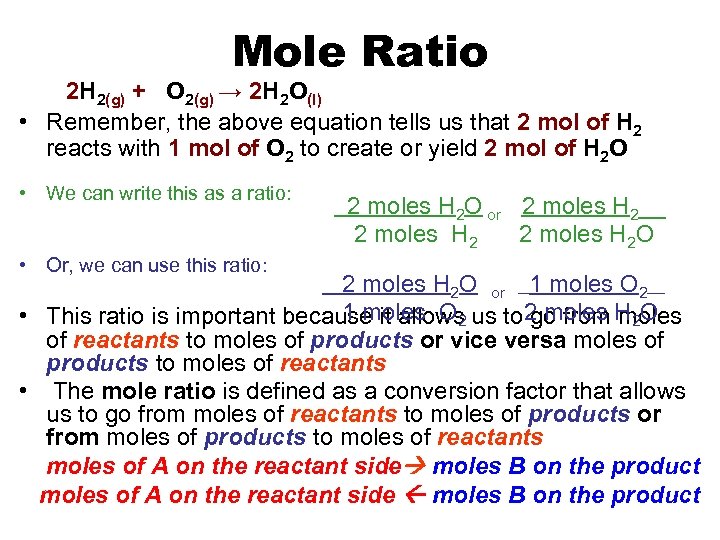 Mole Ratio 2 H 2(g) + O 2(g) → 2 H 2 O(l) • Remember, the above equation tells us that 2 mol of H 2 reacts with 1 mol of O 2 to create or yield 2 mol of H 2 O • We can write this as a ratio: • Or, we can use this ratio: 2 moles H 2 O or 2 moles H 2__ 2 moles H 2 O or __1 moles O 2___ 1 moles O 2 • This ratio is important because it allows us to 2 moles H 2 O go from moles of reactants to moles of products or vice versa moles of products to moles of reactants • The mole ratio is defined as a conversion factor that allows us to go from moles of reactants to moles of products or from moles of products to moles of reactants moles of A on the reactant side moles B on the product moles of A on the reactant side moles B on the product
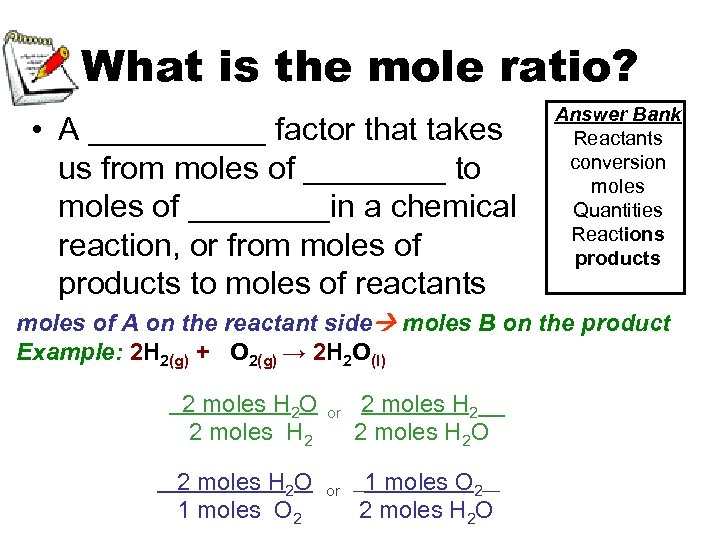 What is the mole ratio? • A _____ factor that takes us from moles of ____ to moles of ____in a chemical reaction, or from moles of products to moles of reactants Answer Bank Reactants conversion moles Quantities Reactions products moles of A on the reactant side moles B on the product Example: 2 H 2(g) + O 2(g) → 2 H 2 O(l) 2 moles H 2 O 1 moles O 2 or or 2 moles H 2__ 2 moles H 2 O 1 moles O 2___ 2 moles H 2 O __
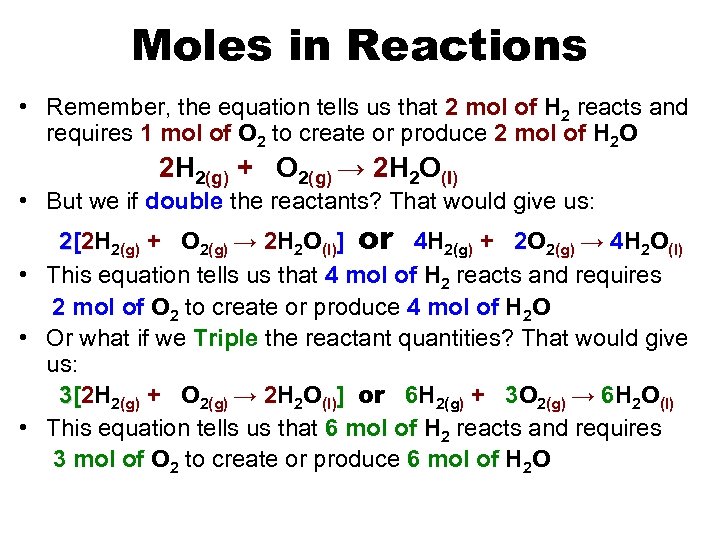 Moles in Reactions • Remember, the equation tells us that 2 mol of H 2 reacts and requires 1 mol of O 2 to create or produce 2 mol of H 2 O 2 H 2(g) + O 2(g) → 2 H 2 O(l) • But we if double the reactants? That would give us: 2[2 H 2(g) + O 2(g) → 2 H 2 O(l)] or 4 H 2(g) + 2 O 2(g) → 4 H 2 O(l) • This equation tells us that 4 mol of H 2 reacts and requires 2 mol of O 2 to create or produce 4 mol of H 2 O • Or what if we Triple the reactant quantities? That would give us: 3[2 H 2(g) + O 2(g) → 2 H 2 O(l)] or 6 H 2(g) + 3 O 2(g) → 6 H 2 O(l) • This equation tells us that 6 mol of H 2 reacts and requires 3 mol of O 2 to create or produce 6 mol of H 2 O
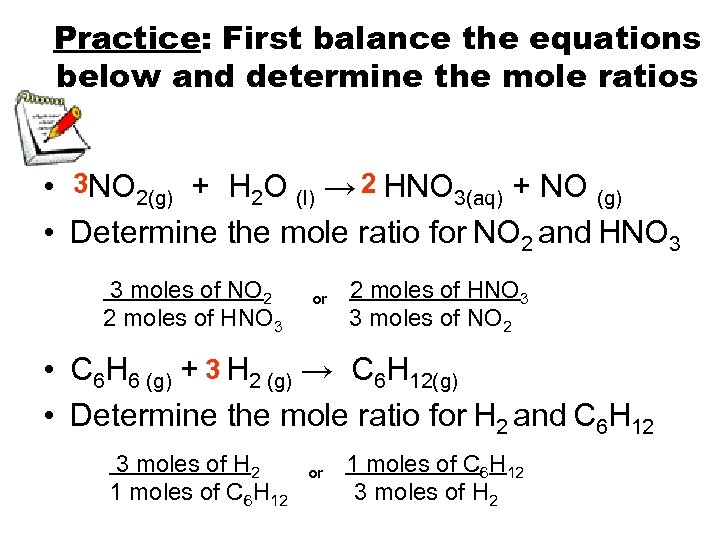 Practice: First balance the equations below and determine the mole ratios • 3 NO 2(g) + H 2 O (l) → 2 HNO 3(aq) + NO (g) • Determine the mole ratio for NO 2 and HNO 3 3 moles of NO 2 2 moles of HNO 3 or 2 moles of HNO 3 3 moles of NO 2 • C 6 H 6 (g) + 3 H 2 (g) → C 6 H 12(g) • Determine the mole ratio for H 2 and C 6 H 12 3 moles of H 2 1 moles of C 6 H 12 or 1 moles of C 6 H 12 3 moles of H 2
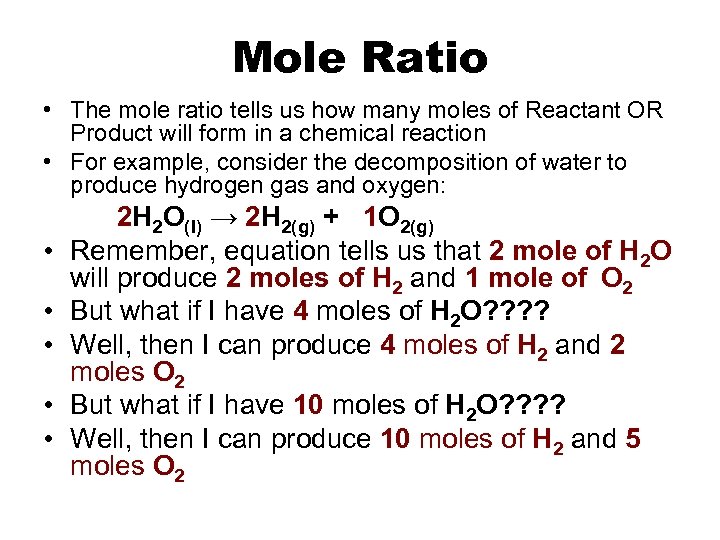 Mole Ratio • The mole ratio tells us how many moles of Reactant OR Product will form in a chemical reaction • For example, consider the decomposition of water to produce hydrogen gas and oxygen: • • • 2 H 2 O(l) → 2 H 2(g) + 1 O 2(g) Remember, equation tells us that 2 mole of H 2 O will produce 2 moles of H 2 and 1 mole of O 2 But what if I have 4 moles of H 2 O? ? Well, then I can produce 4 moles of H 2 and 2 moles O 2 But what if I have 10 moles of H 2 O? ? Well, then I can produce 10 moles of H 2 and 5 moles O 2
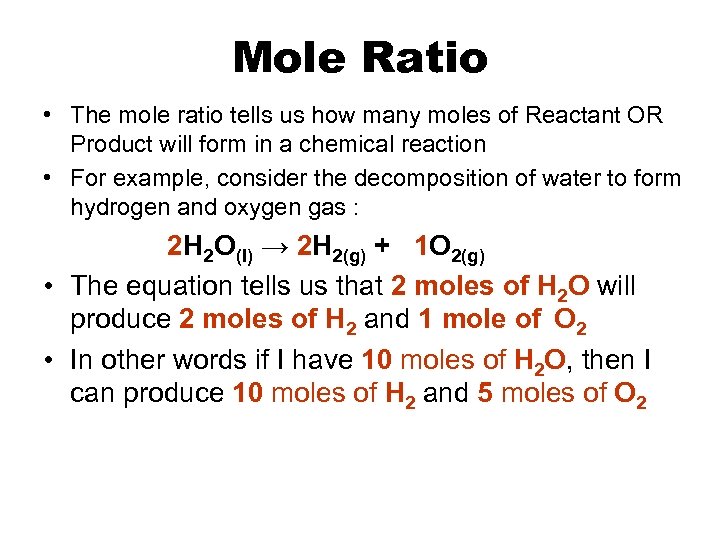 Mole Ratio • The mole ratio tells us how many moles of Reactant OR Product will form in a chemical reaction • For example, consider the decomposition of water to form hydrogen and oxygen gas : 2 H 2 O(l) → 2 H 2(g) + 1 O 2(g) • The equation tells us that 2 moles of H 2 O will produce 2 moles of H 2 and 1 mole of O 2 • In other words if I have 10 moles of H 2 O, then I can produce 10 moles of H 2 and 5 moles of O 2
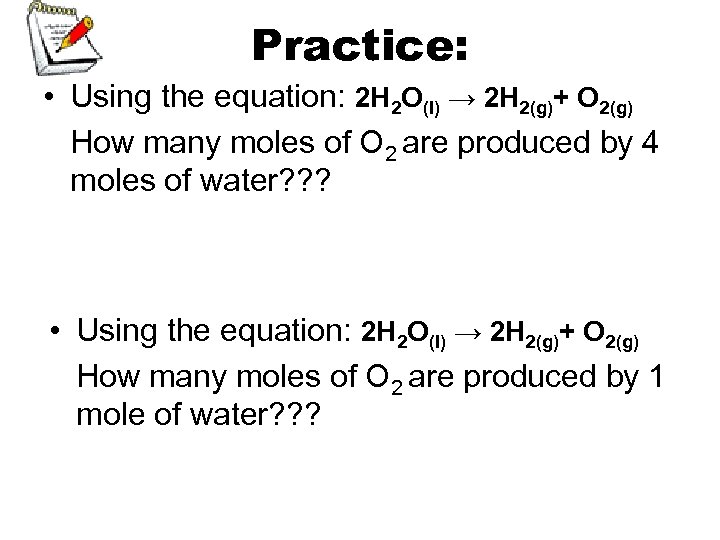 Practice: • Using the equation: 2 H 2 O(l) → 2 H 2(g)+ O 2(g) How many moles of O 2 are produced by 4 moles of water? ? ? • Using the equation: 2 H 2 O(l) → 2 H 2(g)+ O 2(g) How many moles of O 2 are produced by 1 mole of water? ? ?
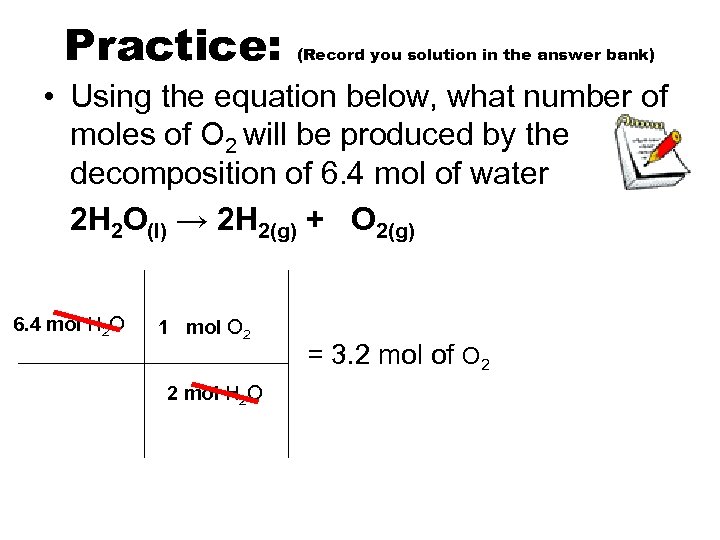 Practice: (Record you solution in the answer bank) • Using the equation below, what number of moles of O 2 will be produced by the decomposition of 6. 4 mol of water 2 H 2 O(l) → 2 H 2(g) + O 2(g) 6. 4 mol H 2 O 1 mol O 2 2 mol H 2 O = 3. 2 mol of O 2
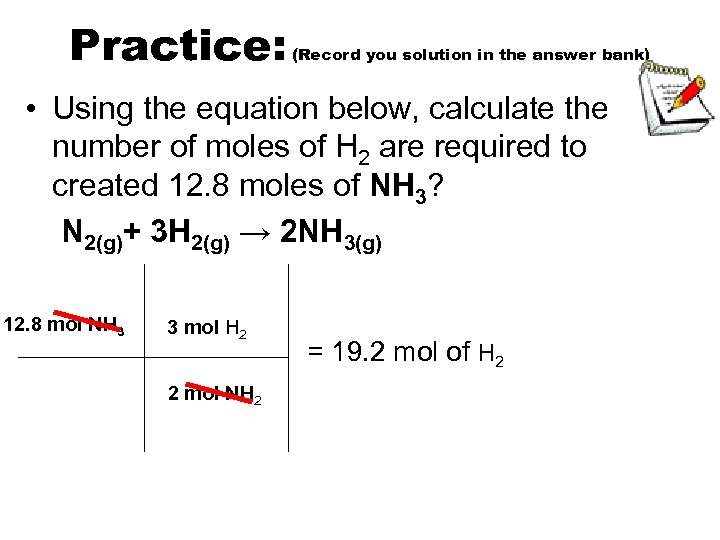 Practice: (Record you solution in the answer bank) • Using the equation below, calculate the number of moles of H 2 are required to created 12. 8 moles of NH 3? N 2(g)+ 3 H 2(g) → 2 NH 3(g) 12. 8 mol NH 3 3 mol H 2 2 mol NH 2 = 19. 2 mol of H 2
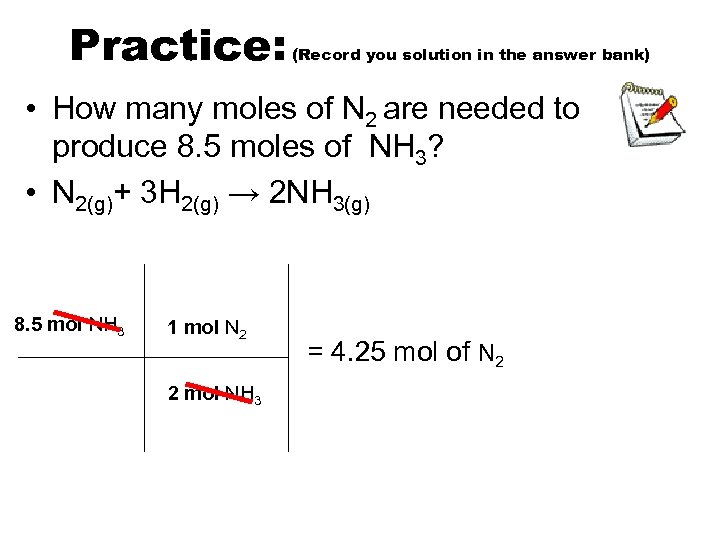 Practice: (Record you solution in the answer bank) • How many moles of N 2 are needed to produce 8. 5 moles of NH 3? • N 2(g)+ 3 H 2(g) → 2 NH 3(g) 8. 5 mol NH 3 1 mol N 2 2 mol NH 3 = 4. 25 mol of N 2
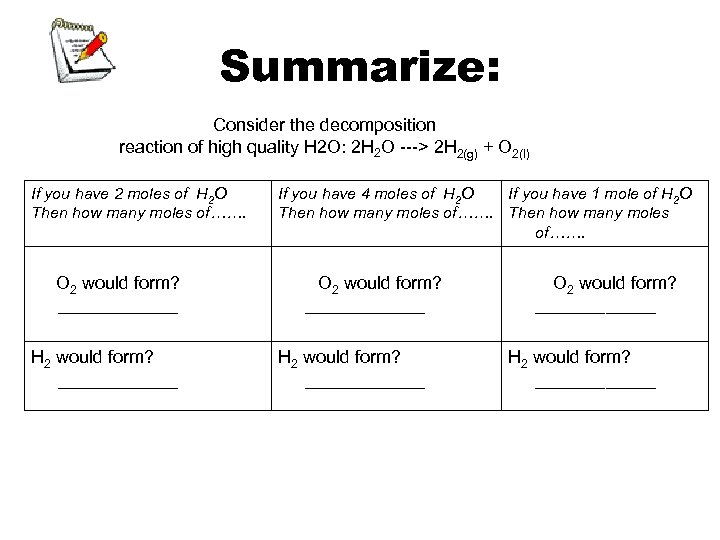 Summarize: Consider the decomposition reaction of high quality H 2 O: 2 H 2 O ---> 2 H 2(g) + O 2(l) If you have 2 moles of H 2 O Then how many moles of……. O 2 would form? ______ H 2 would form? ______ If you have 4 moles of H 2 O If you have 1 mole of H 2 O Then how many moles of……. O 2 would form? ____________ H 2 would form? ____________