


 Скачать презентацию The Modern Synthesis Populations are the units
ba4bf4000780d90cd264b6f4970c3b27.ppt
- Количество слайдов: 50
 The Modern Synthesis • Populations are the units of evolution • Natural selection plays an important role in evolution, but is not the only factor • Speciation is at the boundary between microevolution and macroevolution
 The Modern Synthesis • Integrates ideas from many different fields: * Comparative morphology & molecular biology * Taxonomy – relationships of taxa * Paleontology – study of fossils * Biogeography – distribution of species * Population genetics – Hardy-Weinberg Theorem * Darwin * Mendel
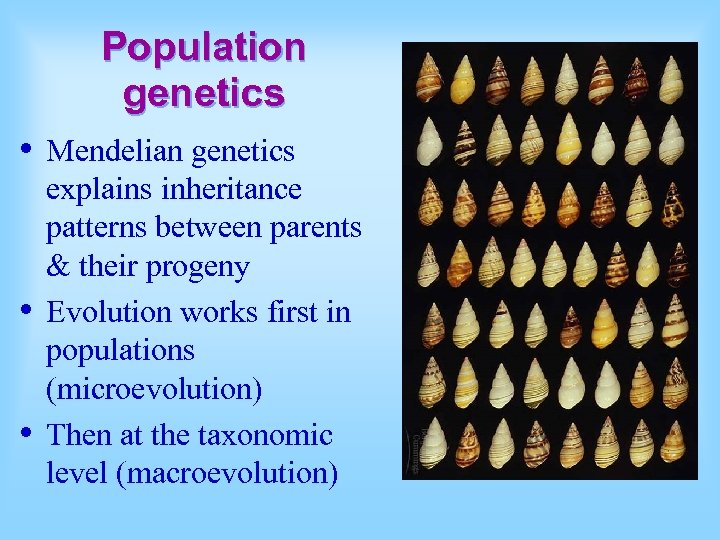 Population genetics • • • Mendelian genetics explains inheritance patterns between parents & their progeny Evolution works first in populations (microevolution) Then at the taxonomic level (macroevolution)
 • Mendel’s work rediscovered in early 1900 s • Seemed to be at odds with Darwin’s theory * Darwin felt that natural selection must operate on continuous (polygenic) traits * Mendel showed the inheritance of discrete traits • New theories dealing with populations, described next, reconciled the two views
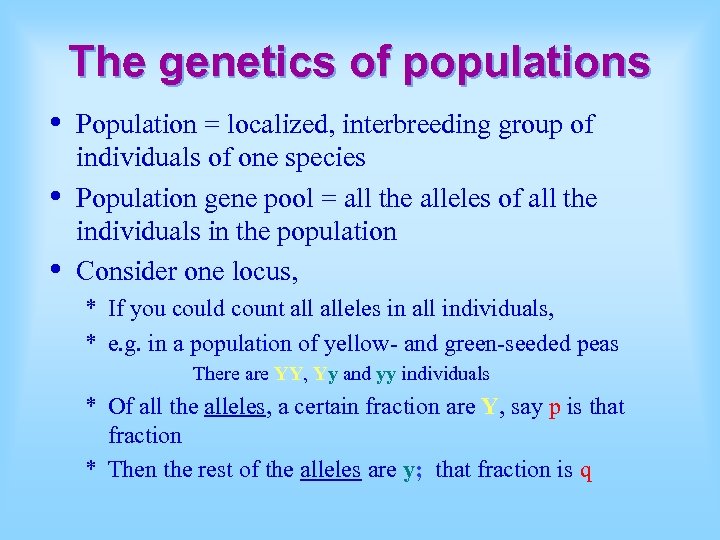 The genetics of populations • • • Population = localized, interbreeding group of individuals of one species Population gene pool = all the alleles of all the individuals in the population Consider one locus, * If you could count alleles in all individuals, * e. g. in a population of yellow- and green-seeded peas There are YY, Yy and yy individuals * Of all the alleles, a certain fraction are Y, say p is that fraction * Then the rest of the alleles are y; that fraction is q
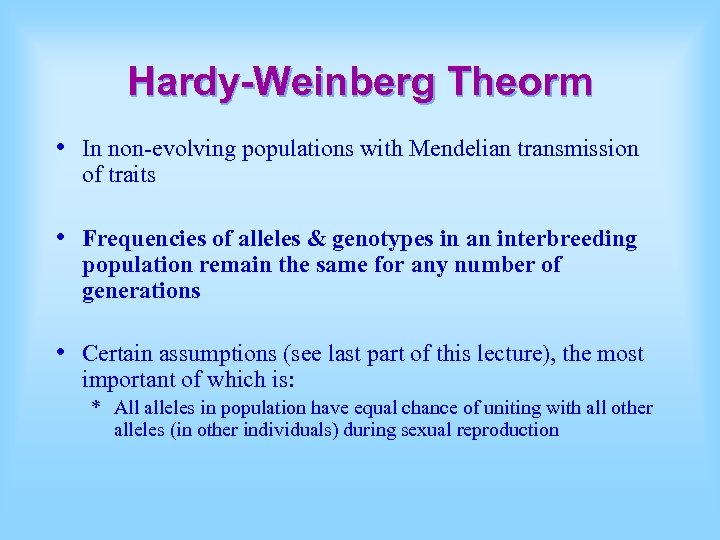 Hardy-Weinberg Theorm • In non-evolving populations with Mendelian transmission of traits • Frequencies of alleles & genotypes in an interbreeding population remain the same for any number of generations • Certain assumptions (see last part of this lecture), the most important of which is: * All alleles in population have equal chance of uniting with all other alleles (in other individuals) during sexual reproduction
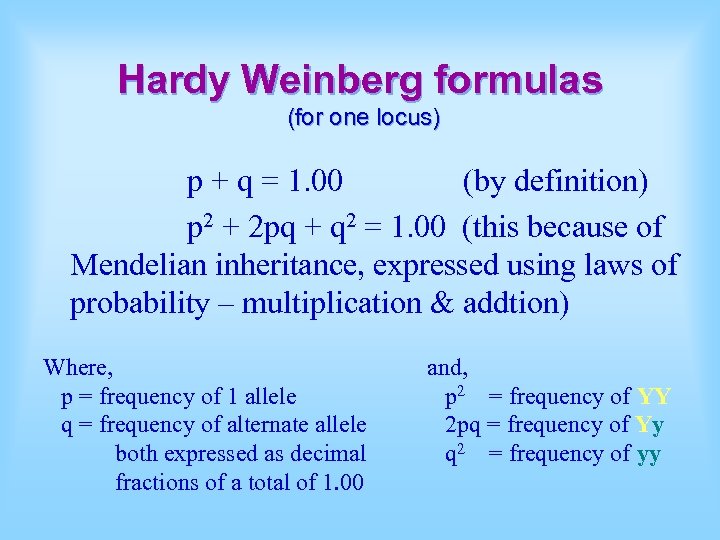 Hardy Weinberg formulas (for one locus) p + q = 1. 00 (by definition) p 2 + 2 pq + q 2 = 1. 00 (this because of Mendelian inheritance, expressed using laws of probability – multiplication & addtion) Where, p = frequency of 1 allele q = frequency of alternate allele both expressed as decimal fractions of a total of 1. 00 and, p 2 = frequency of YY 2 pq = frequency of Yy q 2 = frequency of yy
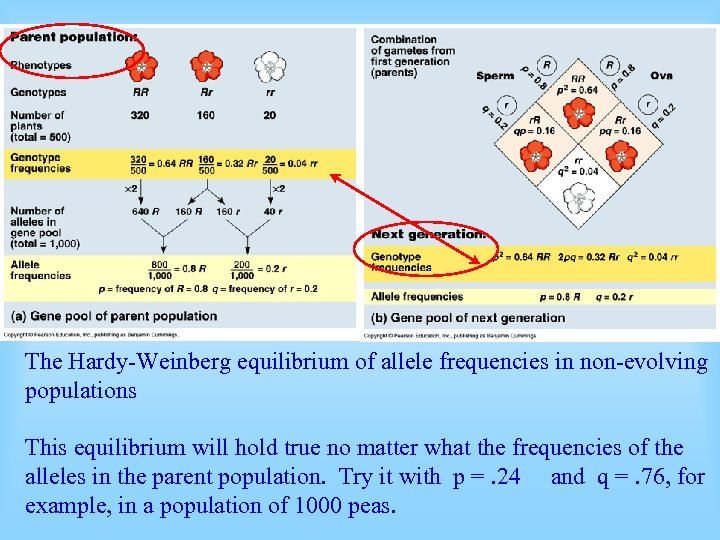 The Hardy-Weinberg equilibrium of allele frequencies in non-evolving populations This equilibrium will hold true no matter what the frequencies of the alleles in the parent population. Try it with p =. 24 and q =. 76, for example, in a population of 1000 peas.
 Why is theorem important? • Extends Mendelian genetics of individuals to population scale (where evolution works) • Shows that if Mendelian genetic processes are working, variation is maintained at the population level
 Assumptions of Hardy. Weinberg equilibrium • • • Very large population size (no genetic drift) Random mating No migration (no gene flow in or out) No mutations (change in form of an allele – the ultimate source of genetic change) No natural selection
 Microevolution • • • Generation-to-generation change in allele frequencies in populations The Hardy-Weinberg theory provides the baseline Microevolution occurs even if only a single locus in a population changes
 Causes of microevolution • • Genetic drift * Natural selection * Gene flow Mutation • All are departures from the conditions required for the Hardy-Weinberg equilibrium * The 2 most important factors
 Genetic Drift • • Changes in gene frequencies due to chance events in small populations Hardy Weinberg assumes reproduction works probabilistically on gene frequencies, (p + q = 1) Reproduction in small populations may not work this way Two similar situations lead to genetic drift * Bottleneck effect * Founder effect
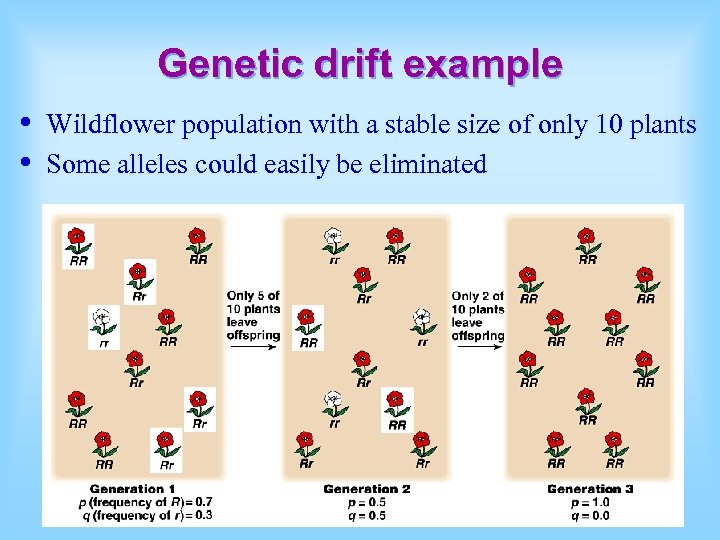 Genetic drift example • • Wildflower population with a stable size of only 10 plants Some alleles could easily be eliminated
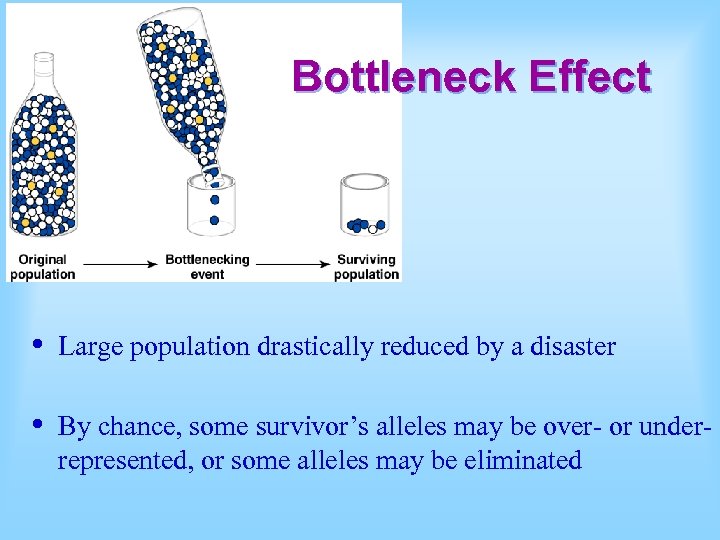 Bottleneck Effect • Large population drastically reduced by a disaster • By chance, some survivor’s alleles may be over- or underrepresented, or some alleles may be eliminated
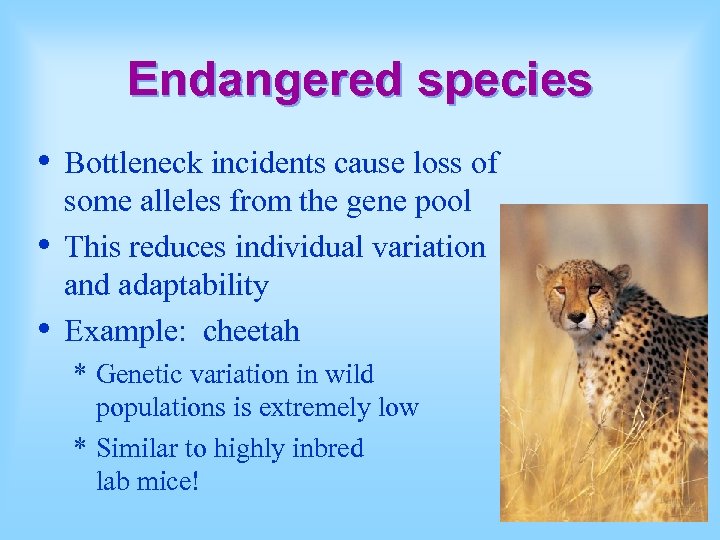 Endangered species • • • Bottleneck incidents cause loss of some alleles from the gene pool This reduces individual variation and adaptability Example: cheetah * Genetic variation in wild populations is extremely low * Similar to highly inbred lab mice!
 Founder effect • New population starts with a few genetically unrepresentative of a larger source population. * Extreme: single pregnant female or single seed * More often larger sample, but small • Genetic drift continues until the population is large enough to minimize sampling errors
 Natural selection • Review: overpopulation, unequal reproduction, survival of the fittest, microevolution • Only factor that generally adapts a population to its environment • The other three factors may effect populations in positive, negative, or neutral ways
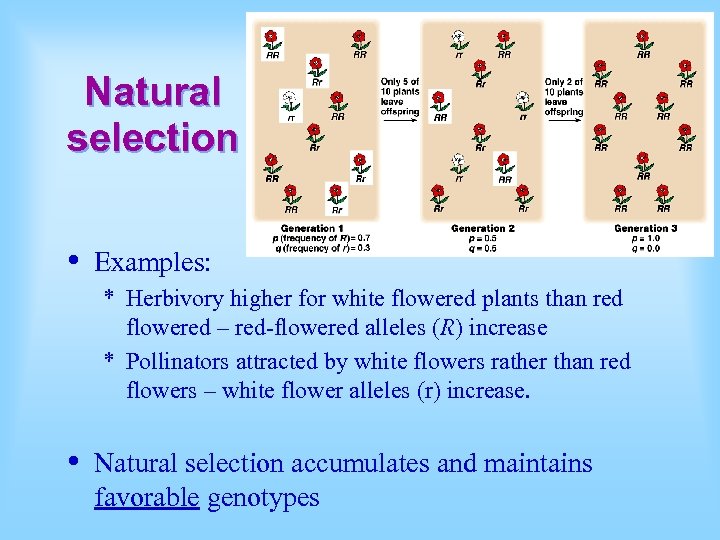 Natural selection • Examples: * Herbivory higher for white flowered plants than red flowered – red-flowered alleles (R) increase * Pollinators attracted by white flowers rather than red flowers – white flower alleles (r) increase. • Natural selection accumulates and maintains favorable genotypes
 Gene flow • Genetic exchange due to migration of alleles * Fertile individuals * Gametes or spores • Example: * Wildflower population has white flowered plants only * Pollen (with r alleles only) could be carried to another nearby population that lacks the allele. • Gene flow tends to reduce differences between populations
 Mutation • • Change in DNA * Rare and random * More likely to be harmful than beneficial Only mutations in cell lines that produce gametes can be passed along to offspring One mutation does not effect a large population in a single generation Very important to evolution over the long term * The only source of new alleles * Other causes of microevolution redistribute mutations
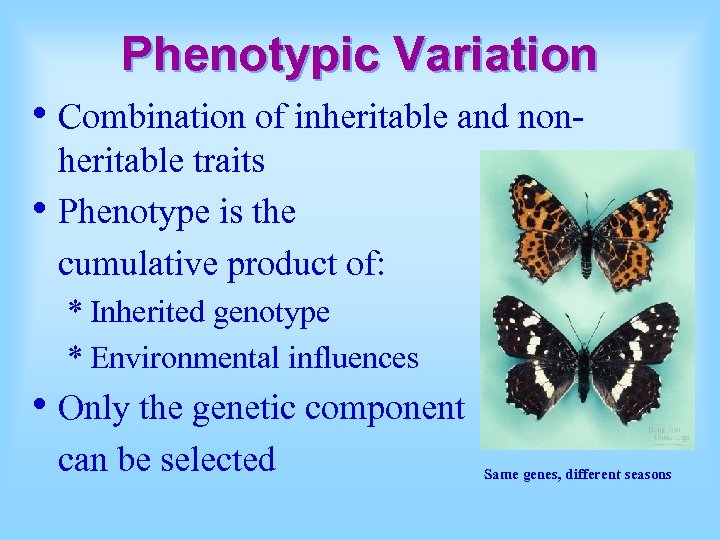 Phenotypic Variation • Combination of inheritable and non • heritable traits Phenotype is the cumulative product of: * Inherited genotype * Environmental influences • Only the genetic component can be selected Same genes, different seasons
 Genotypic variation • Expressed in these ways: * Quantitative (continuous – multilocus? ) • ex. plant height * Discrete (single locus? ) • • ex. flower color Measured by: * Gene diversity - % heterozygosity • Human – 14% * DNA base diversity • Human – 0. 1 %
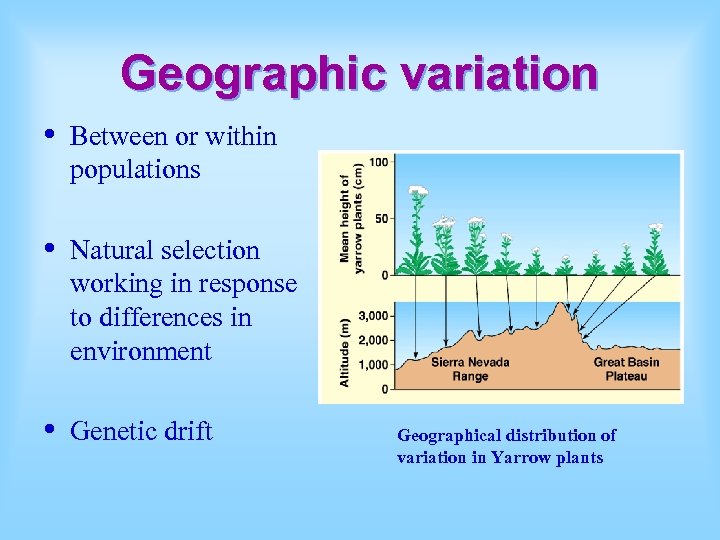 Geographic variation • Between or within populations • Natural selection working in response to differences in environment • Genetic drift Geographical distribution of variation in Yarrow plants
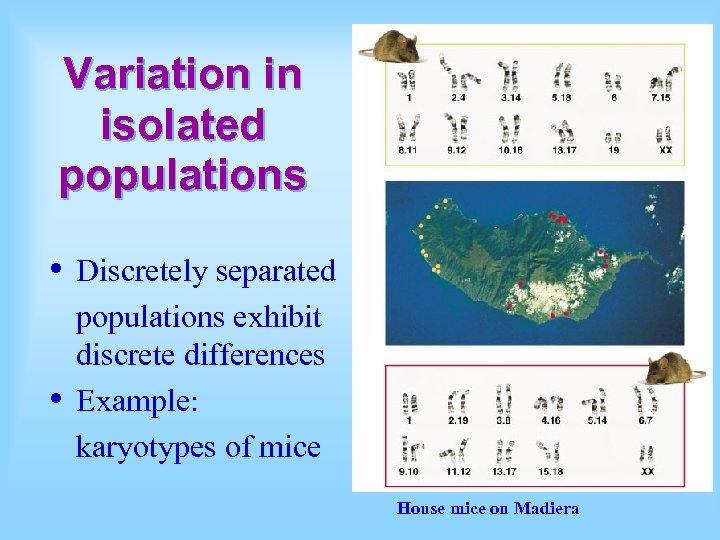 Variation in isolated populations • • Discretely separated populations exhibit discrete differences Example: karyotypes of mice House mice on Madiera
 What keeps mutations? • Diploidy – masks recessive alleles • Hardy-Weinberg Equilibrium says that, without natural selection, gene frequencies remain the same • A balance of recessive alleles can be kept even without Hardy-Weinberg * Heterozygote advantage * Frequency-dependent selection
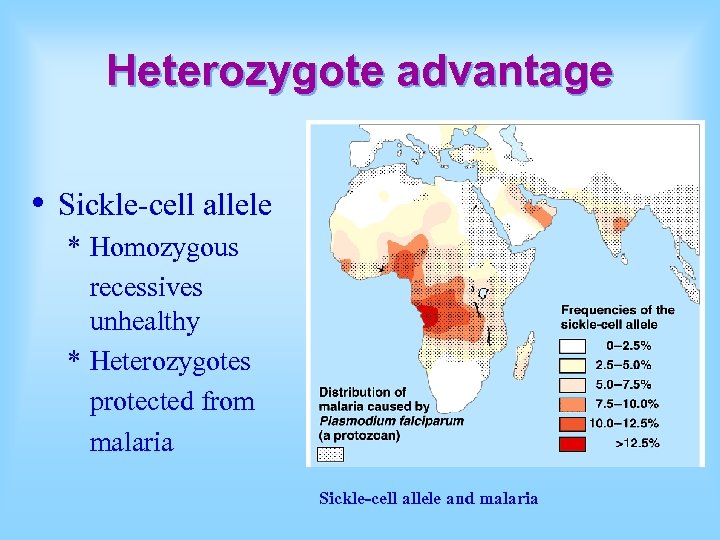 Heterozygote advantage • Sickle-cell allele * Homozygous recessives unhealthy * Heterozygotes protected from malaria Sickle-cell allele and malaria
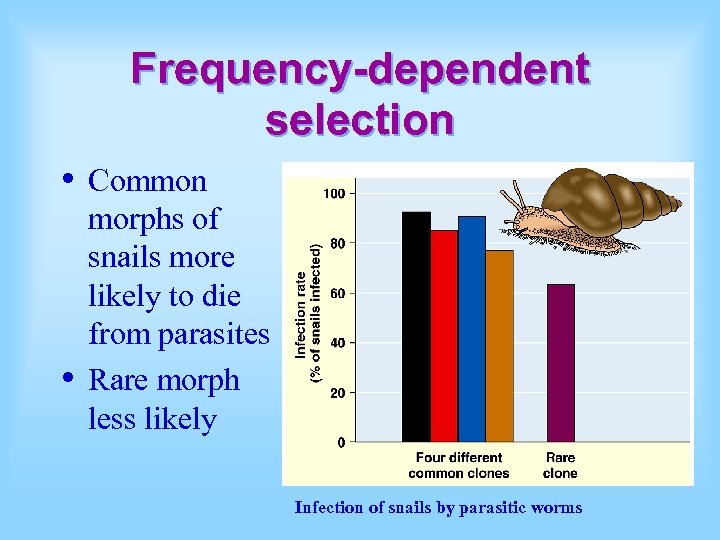 Frequency-dependent selection • • Common morphs of snails more likely to die from parasites Rare morph less likely Infection of snails by parasitic worms
 Neutral variation • Have negligible impact on reproductive success * Not selected by natural selection * But their gene frequencies can change • • • Hard to assess Some neutral alleles will increase and others will decrease by the chance effects of genetic drift May provide basis for future evolution
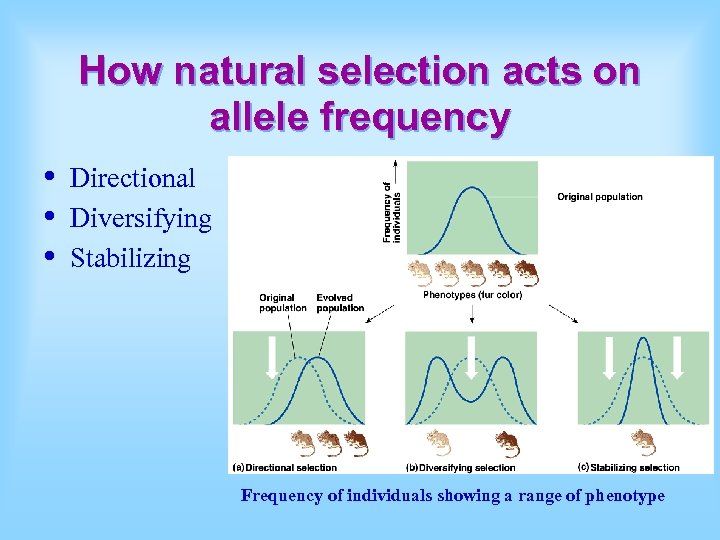 How natural selection acts on allele frequency • • • Directional Diversifying Stabilizing Frequency of individuals showing a range of phenotype
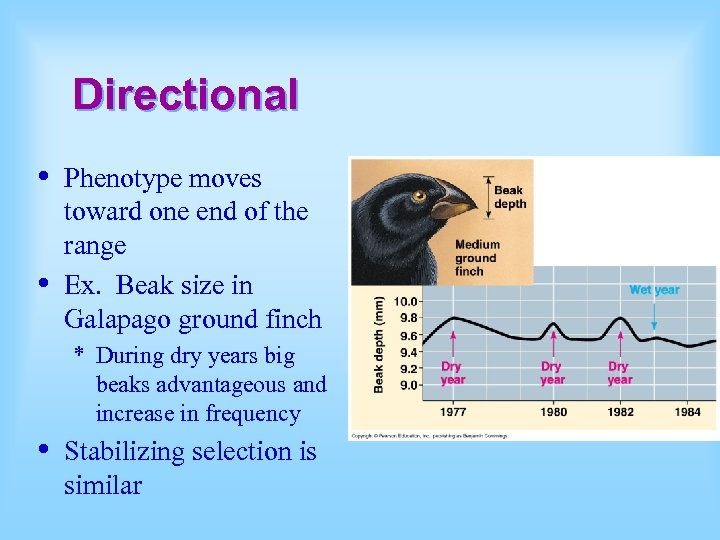 Directional • • Phenotype moves toward one end of the range Ex. Beak size in Galapago ground finch * During dry years big beaks advantageous and increase in frequency • Stabilizing selection is similar
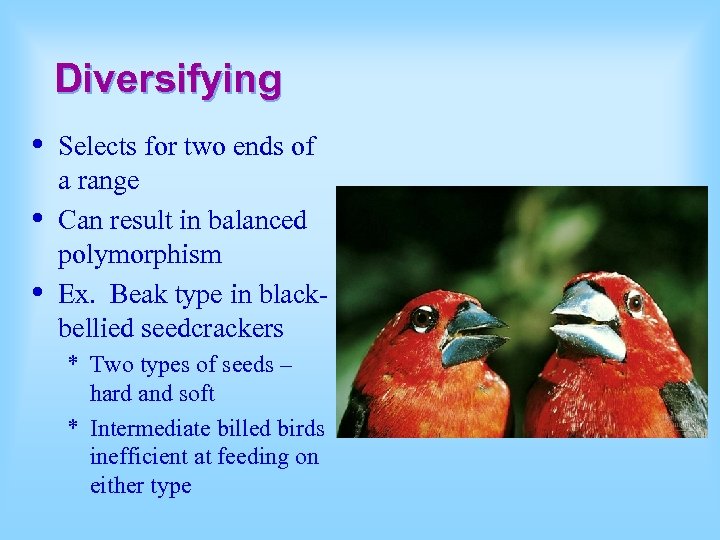 Diversifying • • • Selects for two ends of a range Can result in balanced polymorphism Ex. Beak type in blackbellied seedcrackers * Two types of seeds – hard and soft * Intermediate billed birds inefficient at feeding on either type
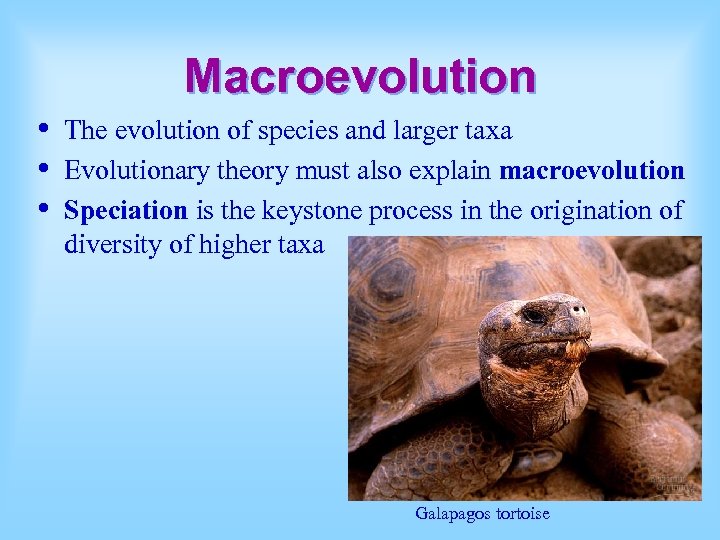 Macroevolution • • • The evolution of species and larger taxa Evolutionary theory must also explain macroevolution Speciation is the keystone process in the origination of diversity of higher taxa Galapagos tortoise
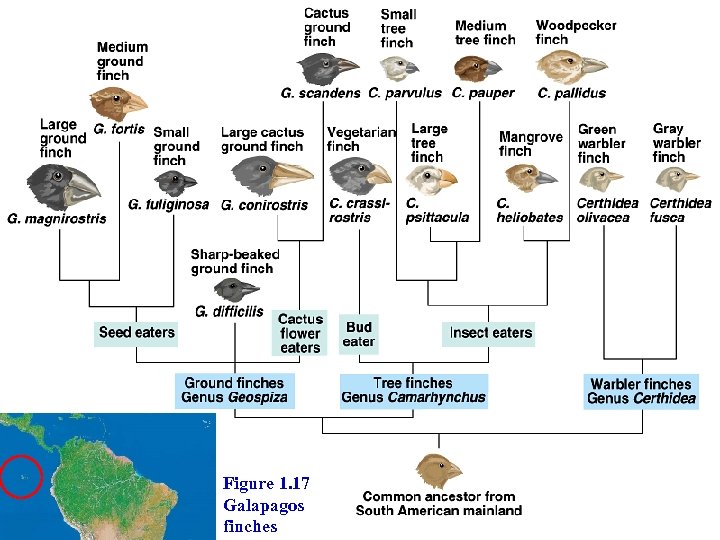 Figure 1. 17 Galapagos finches
 “Species” • Latin meaning “kind” or “appearance” • Traditionally distinguished by morphological differences • Today distinguished in addition by differences in body function, biochemistry, behavior, and genetic makeup
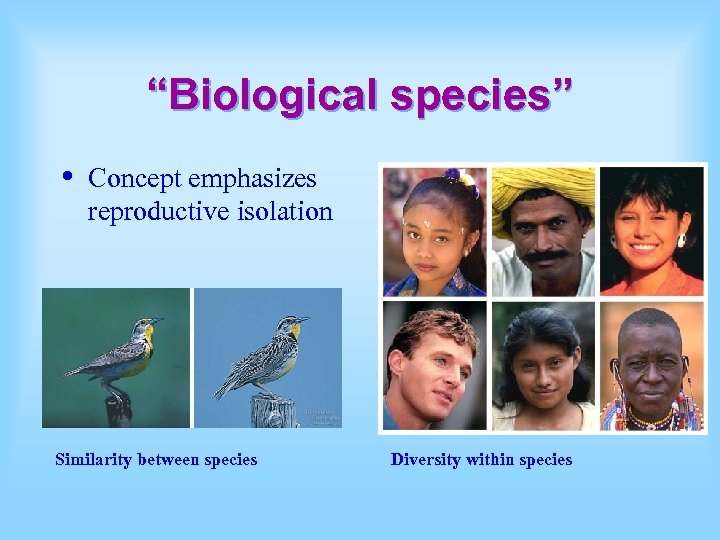 “Biological species” • Concept emphasizes reproductive isolation Similarity between species Diversity within species
 How are biological species isolated? • Prezygotic barriers – impede mating * habitat isolation, behavioral isolation, temporal isolation, mechanical isolation, and gametic isolation • Postzygotic barriers – prevent development * reduced hybrid viability, reduced hybrid fertility, and hybrid breakdown
 Alternative species concepts • Ecological species defined in terms of its ecological niche • Pluralistic species defined by combination of reproductive isolation and ecological niche • Morphological species defined by structure • Genealogical species defined as a set of organisms with a common and unique genetic history as shown by molecular patterns
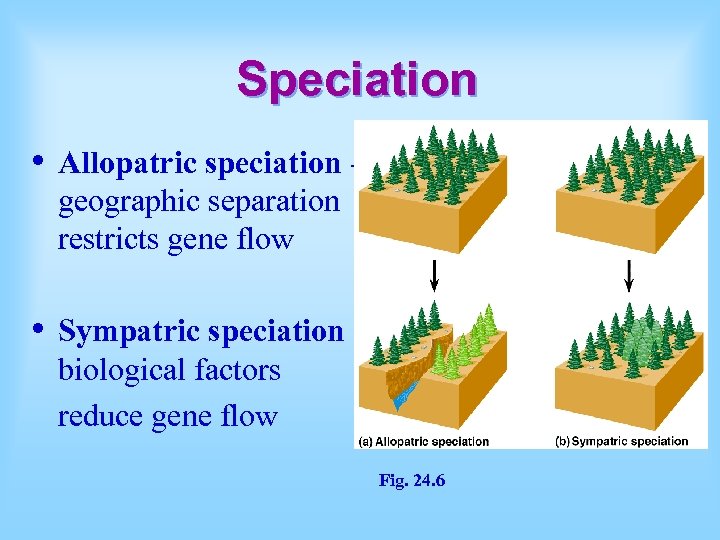 Speciation • Allopatric speciation geographic separation restricts gene flow • Sympatric speciation biological factors reduce gene flow Fig. 24. 6
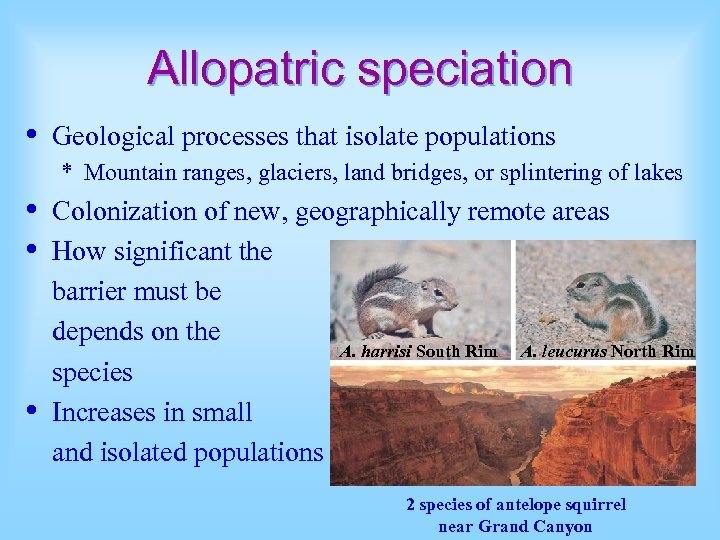 Allopatric speciation • Geological processes that isolate populations * Mountain ranges, glaciers, land bridges, or splintering of lakes • • • Colonization of new, geographically remote areas How significant the barrier must be depends on the A. harrisi South Rim A. leucurus North Rim species Increases in small and isolated populations 2 species of antelope squirrel near Grand Canyon
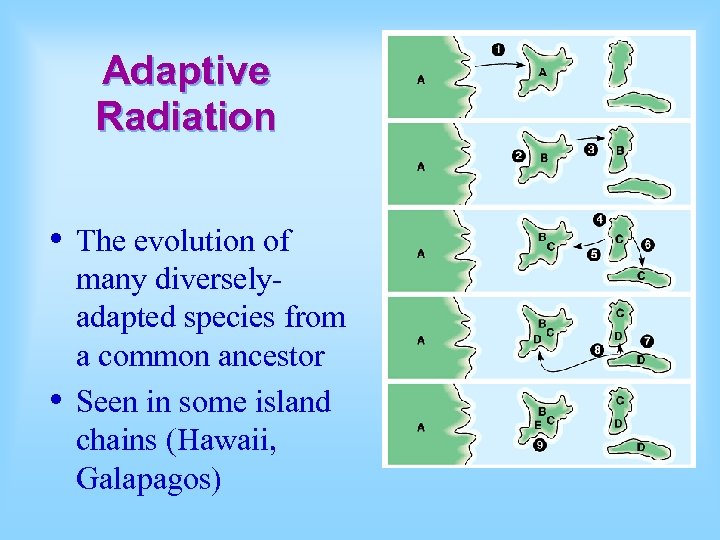 Adaptive Radiation • • The evolution of many diverselyadapted species from a common ancestor Seen in some island chains (Hawaii, Galapagos)
 Sympatric speciation • Reproductive barriers must evolve between sympatric populations • In plants, sympatric speciation often results from polyploidy • In animals, sympatric speciation may result from gene-based shifts in habitat or mate preference
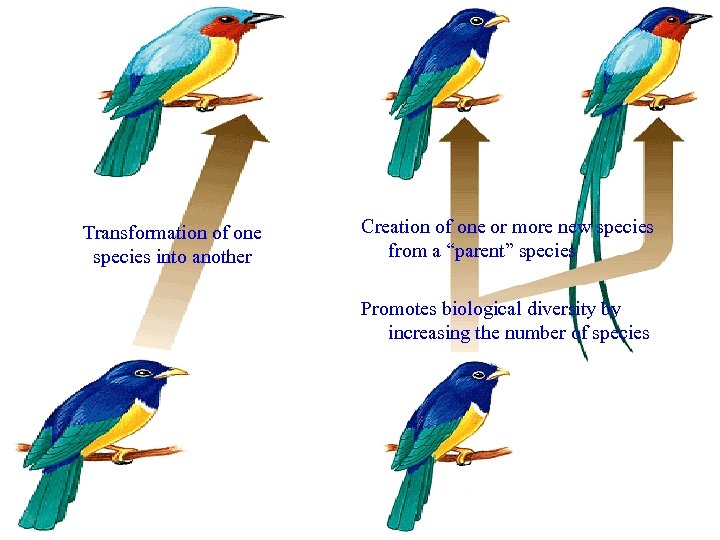 Transformation of one species into another Creation of one or more new species from a “parent” species Promotes biological diversity by increasing the number of species
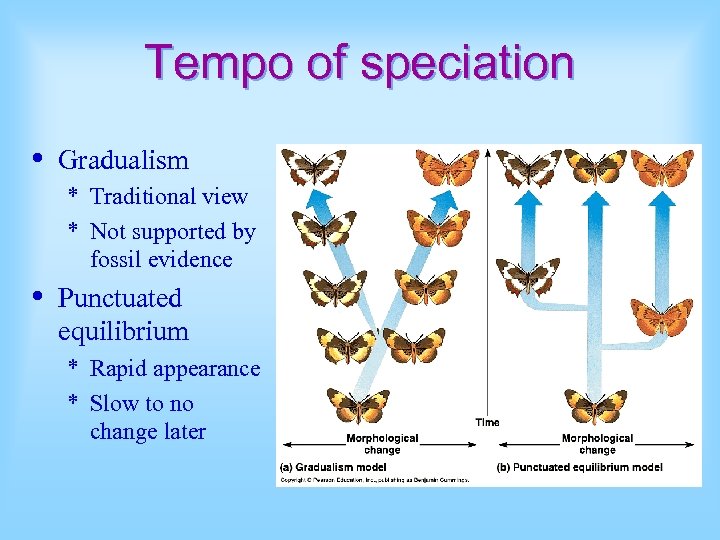 Tempo of speciation • Gradualism * Traditional view * Not supported by fossil evidence • Punctuated equilibrium * Rapid appearance * Slow to no change later
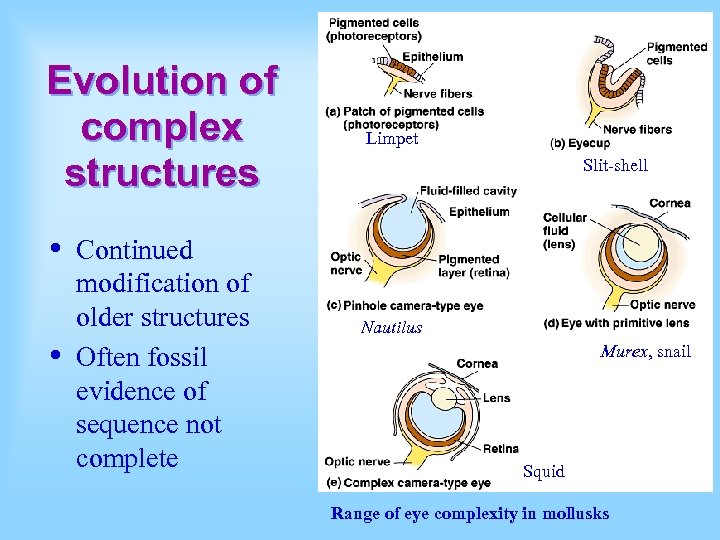 Evolution of complex structures • • Continued modification of older structures Often fossil evidence of sequence not complete Limpet Slit-shell Nautilus Murex, snail Squid Range of eye complexity in mollusks
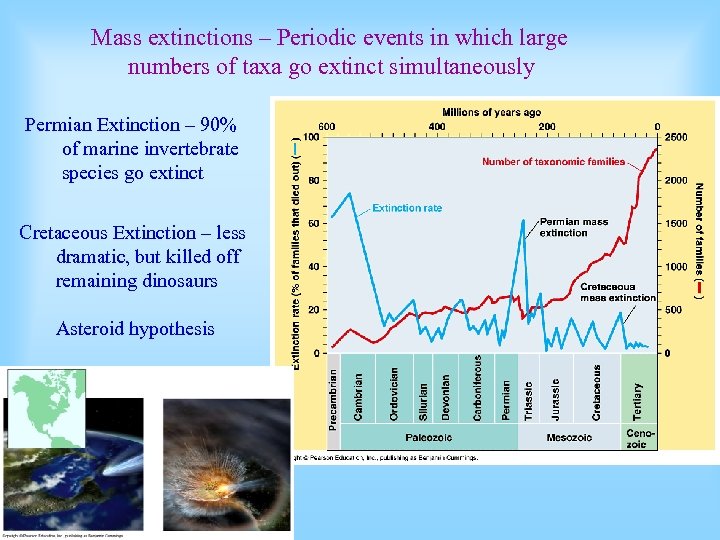 Mass extinctions – Periodic events in which large numbers of taxa go extinct simultaneously Permian Extinction – 90% of marine invertebrate species go extinct Cretaceous Extinction – less dramatic, but killed off remaining dinosaurs Asteroid hypothesis
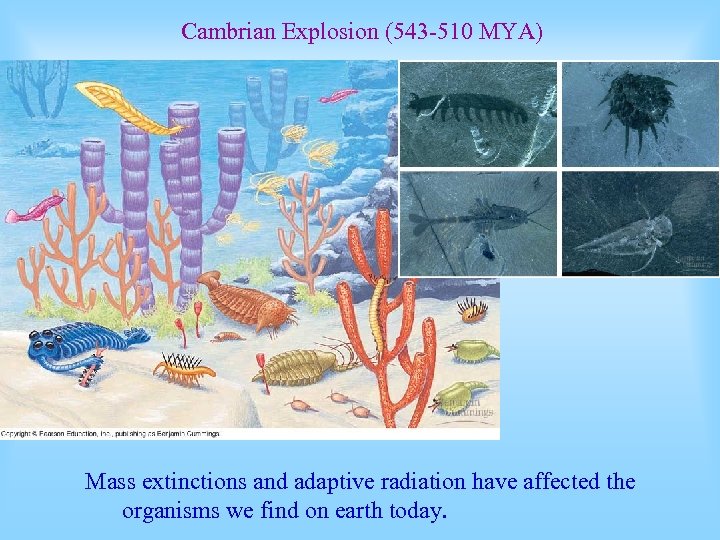 Cambrian Explosion (543 -510 MYA) Mass extinctions and adaptive radiation have affected the organisms we find on earth today.
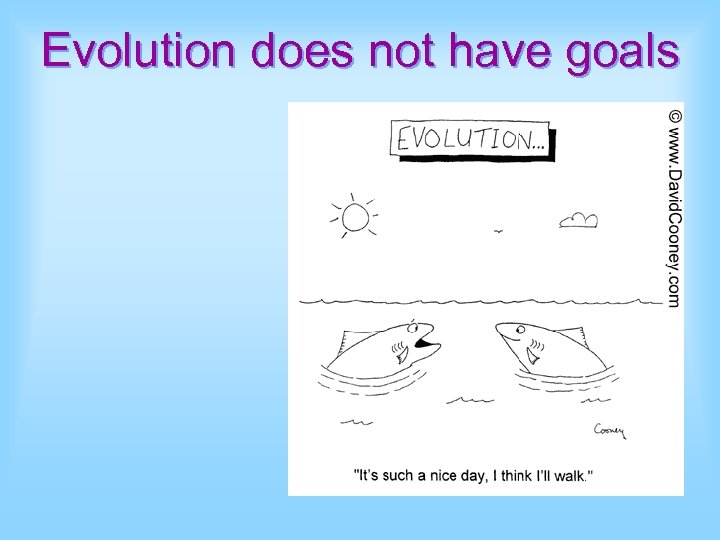 Evolution does not have goals
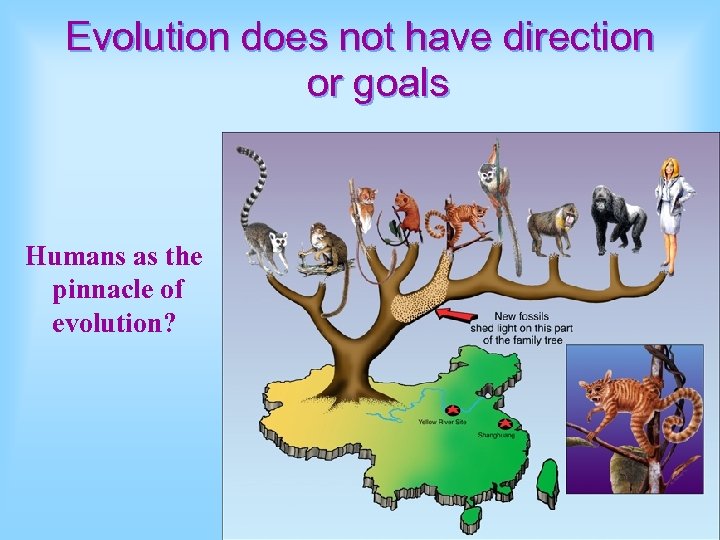 Evolution does not have direction or goals Humans as the pinnacle of evolution?
 Remember, evolution is the touchstone of biology • • a criterion for determining the quality or genuineness of a thing a fundamental or quintessential part or feature