


The modern symbols of Great Britain
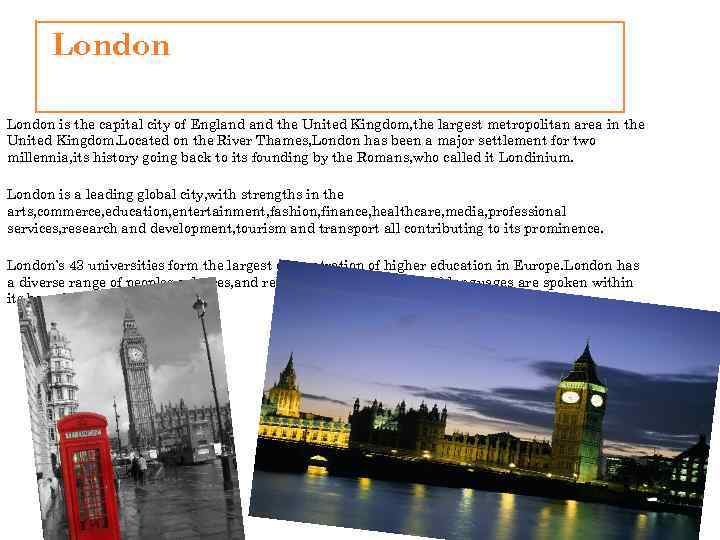
London is the capital city of England the United Kingdom, the largest metropolitan area in the United Kingdom. Located on the River Thames, London has been a major settlement for two millennia, its history going back to its founding by the Romans, who called it Londinium. London is a leading global city, with strengths in the arts, commerce, education, entertainment, fashion, finance, healthcare, media, professional services, research and development, tourism and transport all contributing to its prominence. London’s 43 universities form the largest concentration of higher education in Europe. London has a diverse range of peoples, cultures, and religions, and more than 300 languages are spoken within its boundaries.
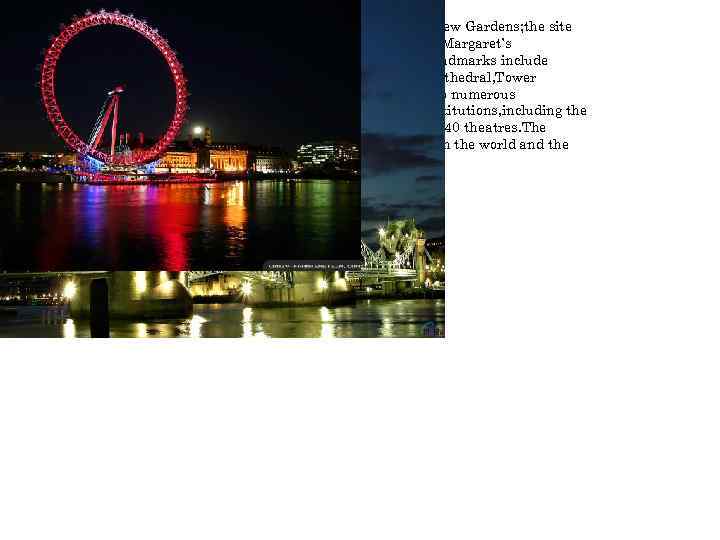
London contains four World Heritage Sites: the Tower of London; Kew Gardens; the site comprising the Palace of Westminster, Westminster Abbey, and St Margaret’s Church; and the historic settlement of Greenwich. Other famous landmarks include Buckingham Palace, the London Eye, Piccadilly Circus, St Paul’s Cathedral, Tower Bridge, Trafalgar Square and Wembley Stadium. London is home to numerous museums, galleries, libraries, sporting events and other cultural institutions, including the British Museum, National Gallery, British Library, Wimbledon and 40 theatres. The London Underground is the oldest underground railway network in the world and the second-most extensive.
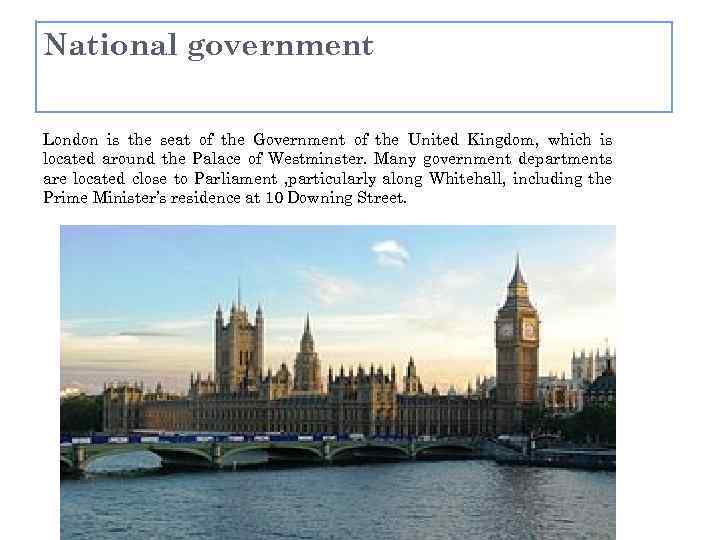
National government London is the seat of the Government of the United Kingdom, which is located around the Palace of Westminster. Many government departments are located close to Parliament , particularly along Whitehall, including the Prime Minister’s residence at 10 Downing Street.
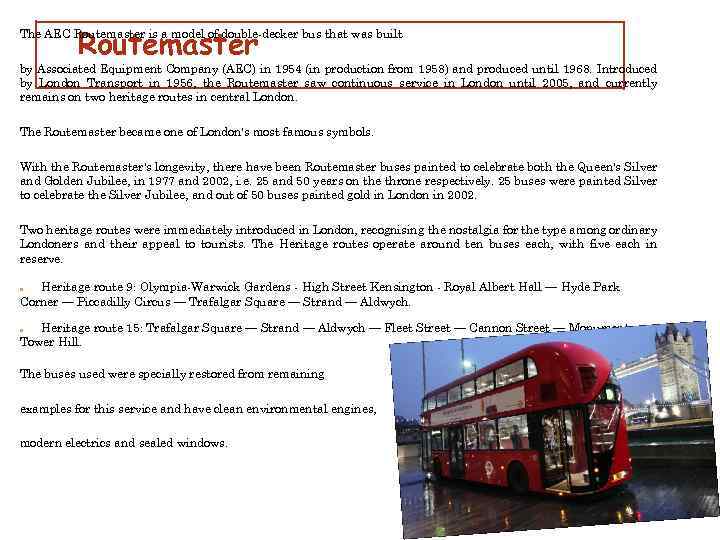
Routemaster The AEC Routemaster is a model of double-decker bus that was built by Associated Equipment Company (AEC) in 1954 (in production from 1958) and produced until 1968. Introduced by London Transport in 1956, the Routemaster saw continuous service in London until 2005, and currently remains on two heritage routes in central London. The Routemaster became one of London's most famous symbols. With the Routemaster's longevity, there have been Routemaster buses painted to celebrate both the Queen's Silver and Golden Jubilee, in 1977 and 2002, i. e. 25 and 50 years on the throne respectively. 25 buses were painted Silver to celebrate the Silver Jubilee, and out of 50 buses painted gold in London in 2002. Two heritage routes were immediately introduced in London, recognising the nostalgia for the type among ordinary Londoners and their appeal to tourists. The Heritage routes operate around ten buses each, with five each in reserve. Heritage route 9: Olympia-Warwick Gardens - High Street Kensington - Royal Albert Hall — Hyde Park Corner — Piccadilly Circus — Trafalgar Square — Strand — Aldwych. Heritage route 15: Trafalgar Square — Strand — Aldwych — Fleet Street — Cannon Street — Monument — Tower Hill. The buses used were specially restored from remaining examples for this service and have clean environmental engines, modern electrics and sealed windows.
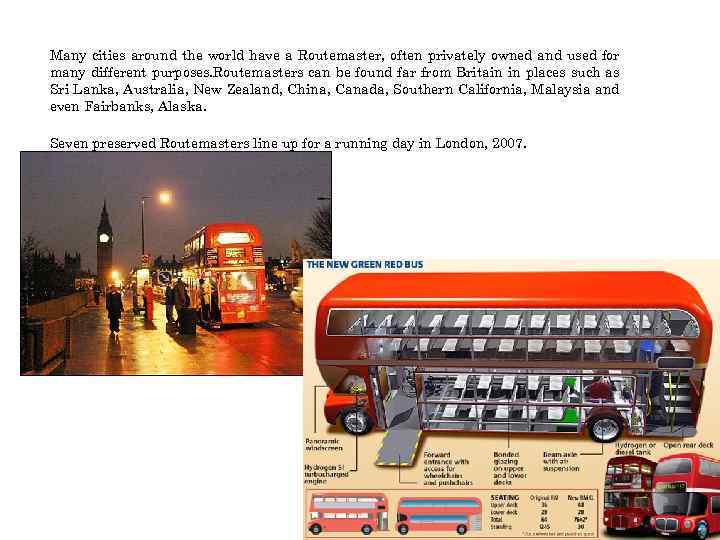
Many cities around the world have a Routemaster, often privately owned and used for many different purposes. Routemasters can be found far from Britain in places such as Sri Lanka, Australia, New Zealand, China, Canada, Southern California, Malaysia and even Fairbanks, Alaska. Seven preserved Routemasters line up for a running day in London, 2007.
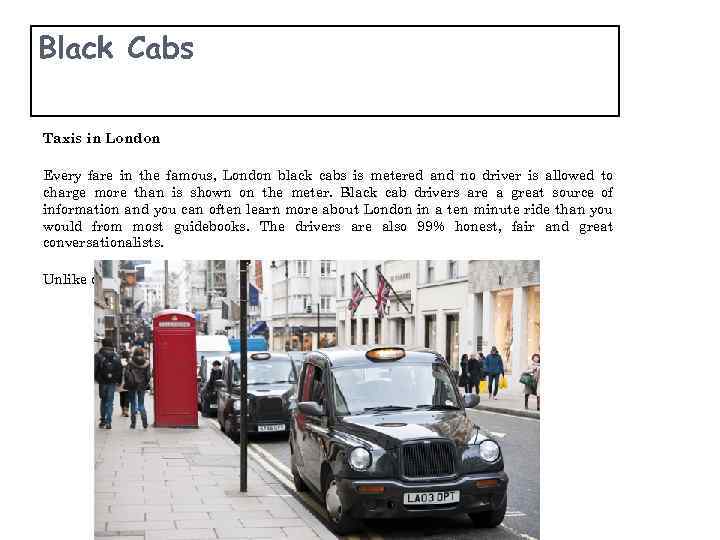
Black Cabs Taxis in London Every fare in the famous, London black cabs is metered and no driver is allowed to charge more than is shown on the meter. Black cab drivers are a great source of information and you can often learn more about London in a ten minute ride than you would from most guidebooks. The drivers are also 99% honest, fair and great conversationalists. Unlike other London taxis, London's black cabs are licensed by the police
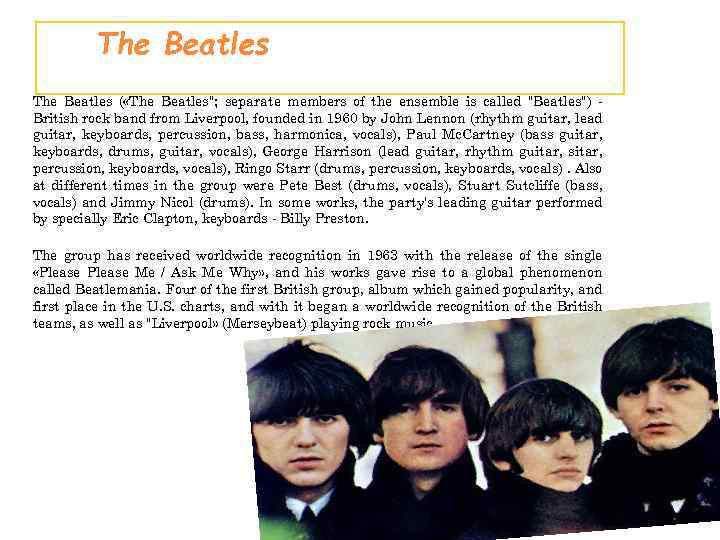
The Beatles ( «The Beatles"; separate members of the ensemble is called "Beatles") British rock band from Liverpool, founded in 1960 by John Lennon (rhythm guitar, lead guitar, keyboards, percussion, bass, harmonica, vocals), Paul Mc. Cartney (bass guitar, keyboards, drums, guitar, vocals), George Harrison (lead guitar, rhythm guitar, sitar, percussion, keyboards, vocals), Ringo Starr (drums, percussion, keyboards, vocals). Also at different times in the group were Pete Best (drums, vocals), Stuart Sutcliffe (bass, vocals) and Jimmy Nicol (drums). In some works, the party's leading guitar performed by specially Eric Clapton, keyboards - Billy Preston. The group has received worldwide recognition in 1963 with the release of the single «Please Me / Ask Me Why» , and his works gave rise to a global phenomenon called Beatlemania. Four of the first British group, album which gained popularity, and first place in the U. S. charts, and with it began a worldwide recognition of the British teams, as well as "Liverpool» (Merseybeat) playing rock music.
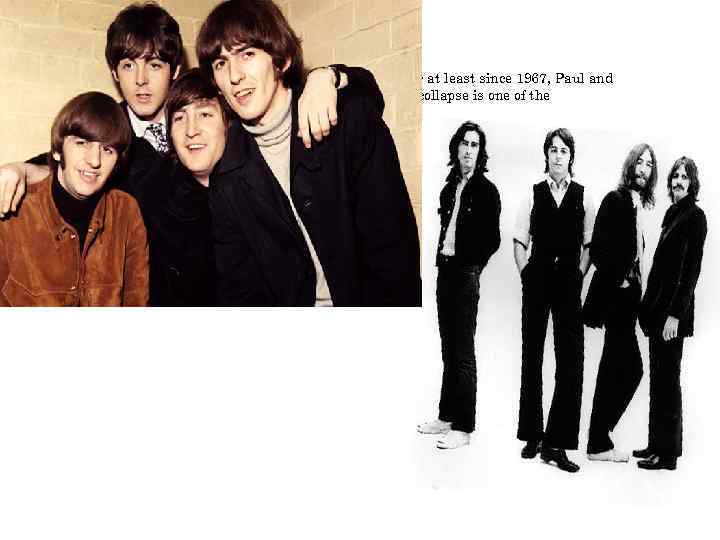
The Beatles stopped working together in 1970, but already at least since 1967, Paul and John were in show business, their own projects. After the collapse is one of the musicians went on a solo career.
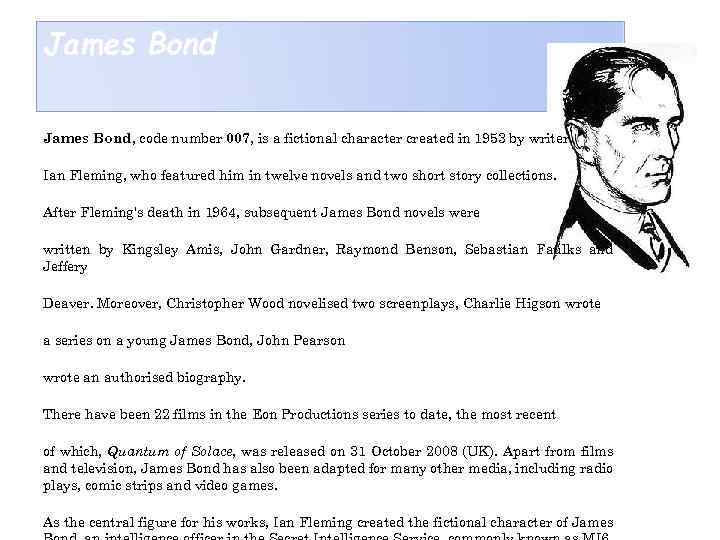
James Bond, code number 007, is a fictional character created in 1953 by writer Ian Fleming, who featured him in twelve novels and two short story collections. After Fleming's death in 1964, subsequent James Bond novels were written by Kingsley Amis, John Gardner, Raymond Benson, Sebastian Faulks and Jeffery Deaver. Moreover, Christopher Wood novelised two screenplays, Charlie Higson wrote a series on a young James Bond, John Pearson wrote an authorised biography. There have been 22 films in the Eon Productions series to date, the most recent of which, Quantum of Solace, was released on 31 October 2008 (UK). Apart from films and television, James Bond has also been adapted for many other media, including radio plays, comic strips and video games. As the central figure for his works, Ian Fleming created the fictional character of James
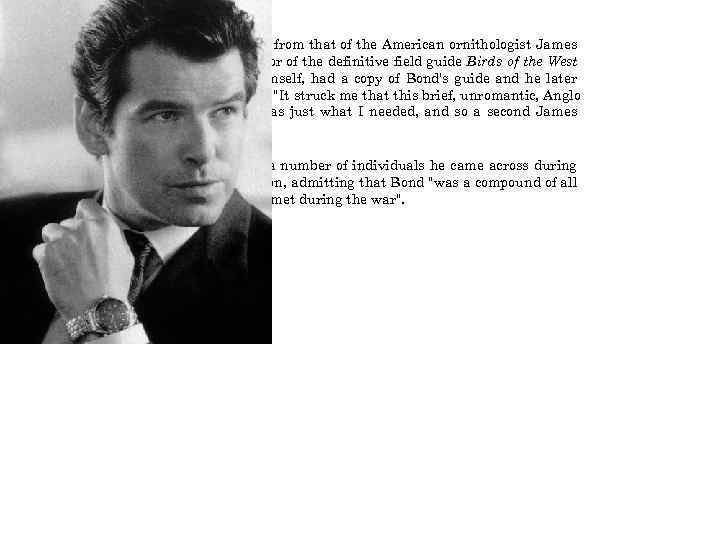
Fleming took the name for his character from that of the American ornithologist James Bond, a Caribbean bird expert and author of the definitive field guide Birds of the West Indies; Fleming, a keen birdwatcher himself, had a copy of Bond's guide and he later explained to the ornithologist’s wife that "It struck me that this brief, unromantic, Anglo -Saxon and yet very masculine name was just what I needed, and so a second James Bond was born". Fleming based his fictional creation on a number of individuals he came across during his time in the Naval Intelligence Division, admitting that Bond "was a compound of all the secret agents and commando types I met during the war".
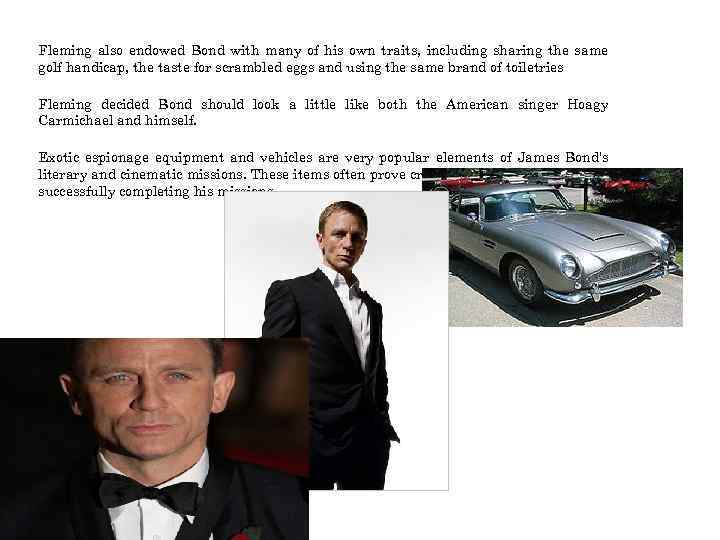
Fleming also endowed Bond with many of his own traits, including sharing the same golf handicap, the taste for scrambled eggs and using the same brand of toiletries Fleming decided Bond should look a little like both the American singer Hoagy Carmichael and himself. Exotic espionage equipment and vehicles are very popular elements of James Bond's literary and cinematic missions. These items often prove critically important to Bond in successfully completing his missions.
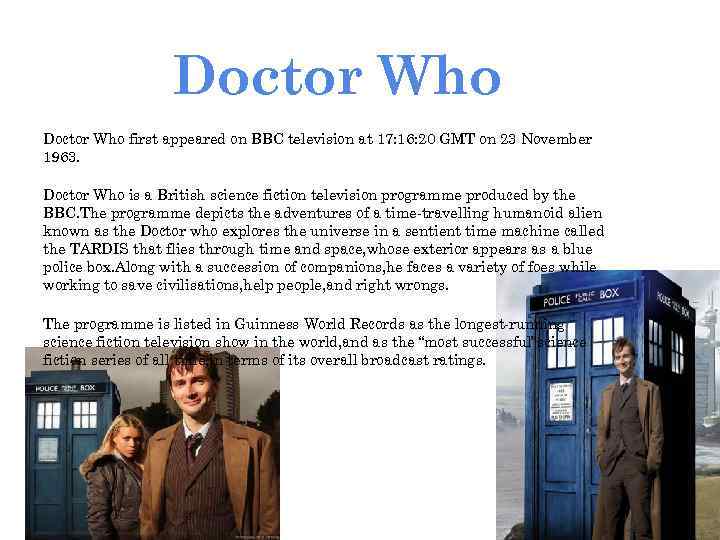
Doctor Who first appeared on BBC television at 17: 16: 20 GMT on 23 November 1963. Doctor Who is a British science fiction television programme produced by the BBC. The programme depicts the adventures of a time-travelling humanoid alien known as the Doctor who explores the universe in a sentient time machine called the TARDIS that flies through time and space, whose exterior appears as a blue police box. Along with a succession of companions, he faces a variety of foes while working to save civilisations, help people, and right wrongs. The programme is listed in Guinness World Records as the longest-running science fiction television show in the world, and as the “most successful”science fiction series of all time, in terms of its overall broadcast ratings.
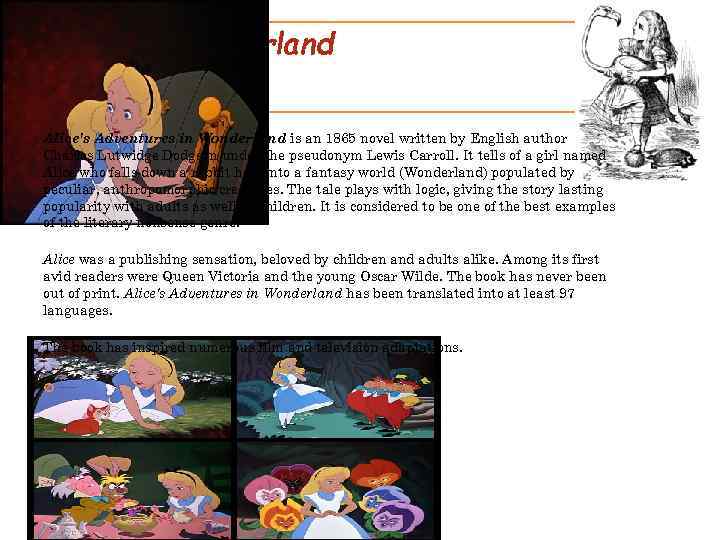
Alice in Wonderland Alice's Adventures in Wonderland is an 1865 novel written by English author Charles Lutwidge Dodgson under the pseudonym Lewis Carroll. It tells of a girl named Alice who falls down a rabbit hole into a fantasy world (Wonderland) populated by peculiar, anthropomorphic creatures. The tale plays with logic, giving the story lasting popularity with adults as well as children. It is considered to be one of the best examples of the literary nonsense genre. Alice was a publishing sensation, beloved by children and adults alike. Among its first avid readers were Queen Victoria and the young Oscar Wilde. The book has never been out of print. Alice's Adventures in Wonderland has been translated into at least 97 languages. The book has inspired numerous film and television adaptations.
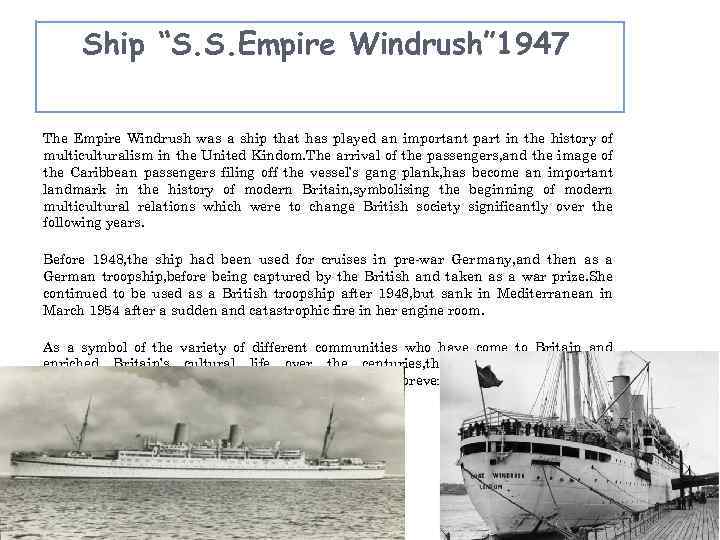
Ship “S. S. Empire Windrush” 1947 The Empire Windrush was a ship that has played an important part in the history of multiculturalism in the United Kindom. The arrival of the passengers, and the image of the Caribbean passengers filing off the vessel’s gang plank, has become an important landmark in the history of modern Britain, symbolising the beginning of modern multicultural relations which were to change British society significantly over the following years. Before 1948, the ship had been used for cruises in pre-war Germany, and then as a German troopship, before being captured by the British and taken as a war prize. She continued to be used as a British troopship after 1948, but sank in Mediterranean in March 1954 after a sudden and catastrophic fire in her engine room. As a symbol of the variety of different communities who have come to Britain and enriched Britain’s cultural life over the centuries, the Empire Windrush is unparalleled. It is for this that she will be remembered forever.
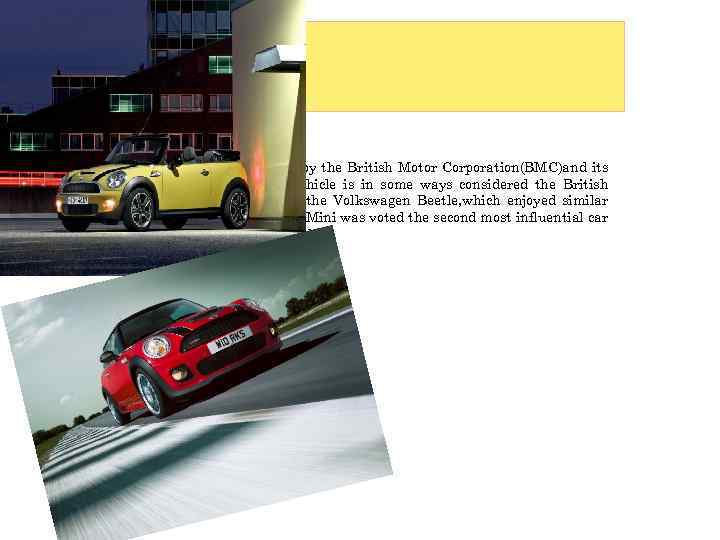
Mini Cooper The Mini is a small car that was made by the British Motor Corporation(BMC)and its successors from 1959 until 2000. The vehicle is in some ways considered the British equivalent to its German contemporary, the Volkswagen Beetle, which enjoyed similar popularity in North America. In 1999 the Mini was voted the second most influential car of the 20 th century, behind the Ford Model T.
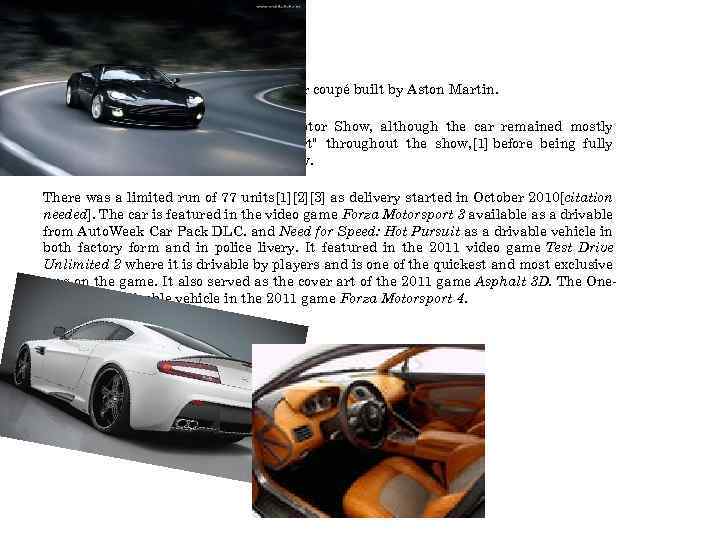
Aston Martin The Aston Martin One-77 is a two-door coupé built by Aston Martin. It first appeared at the 2008 Paris Motor Show, although the car remained mostly covered by a "Savile Row tailored skirt" throughout the show, [1] before being fully revealed at the 2009 Geneva Motor Show. There was a limited run of 77 units[1][2][3] as delivery started in October 2010[citation needed]. The car is featured in the video game Forza Motorsport 3 available as a drivable from Auto. Week Car Pack DLC. and Need for Speed: Hot Pursuit as a drivable vehicle in both factory form and in police livery. It featured in the 2011 video game Test Drive Unlimited 2 where it is drivable by players and is one of the quickest and most exclusive cars on the game. It also served as the cover art of the 2011 game Asphalt 3 D. The One 77 is also a drivable vehicle in the 2011 game Forza Motorsport 4.
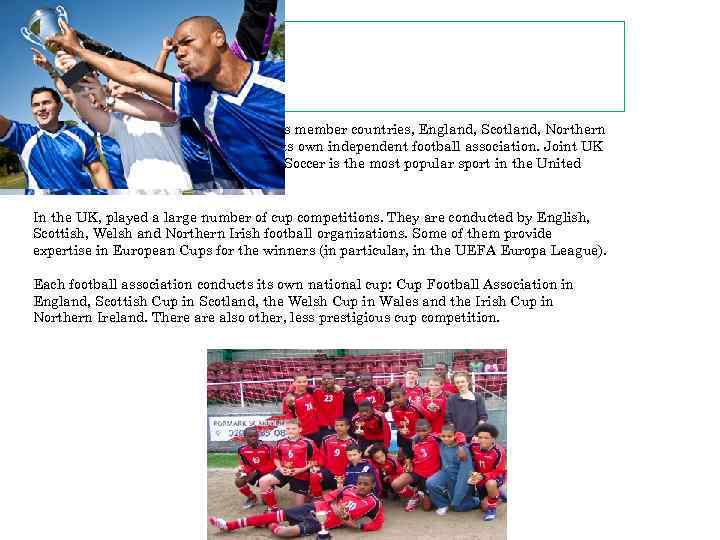
Football in the UK organized by four its member countries, England, Scotland, Northern Ireland Wales, each of which has its own independent football association. Joint UK football team is currently unavailable. Soccer is the most popular sport in the United Kingdom 1860. In the UK, played a large number of cup competitions. They are conducted by English, Scottish, Welsh and Northern Irish football organizations. Some of them provide expertise in European Cups for the winners (in particular, in the UEFA Europa League). Each football association conducts its own national cup: Cup Football Association in England, Scottish Cup in Scotland, the Welsh Cup in Wales and the Irish Cup in Northern Ireland. There also other, less prestigious cup competition.
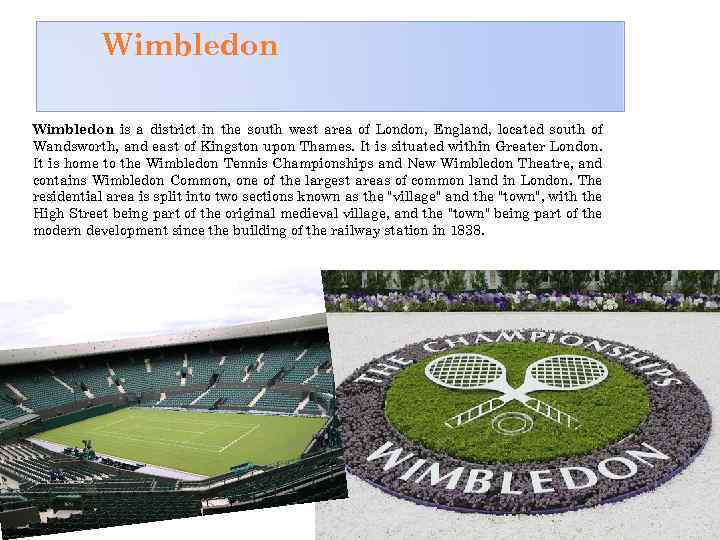
Wimbledon is a district in the south west area of London, England, located south of Wandsworth, and east of Kingston upon Thames. It is situated within Greater London. It is home to the Wimbledon Tennis Championships and New Wimbledon Theatre, and contains Wimbledon Common, one of the largest areas of common land in London. The residential area is split into two sections known as the "village" and the "town", with the High Street being part of the original medieval village, and the "town" being part of the modern development since the building of the railway station in 1838.
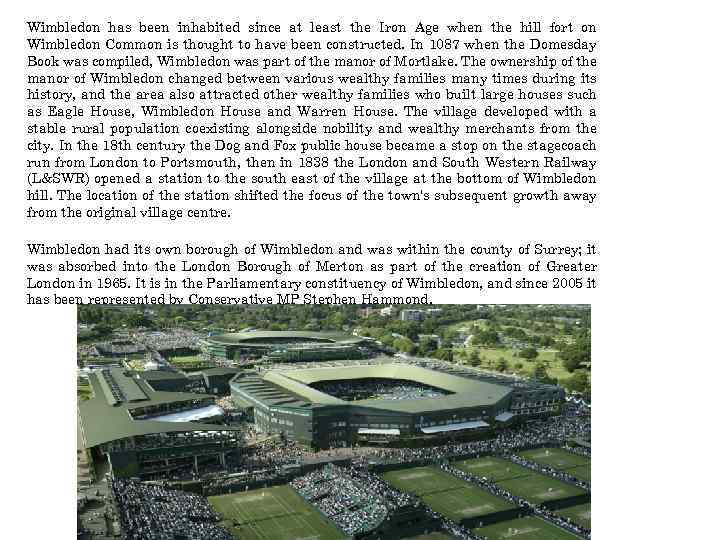
Wimbledon has been inhabited since at least the Iron Age when the hill fort on Wimbledon Common is thought to have been constructed. In 1087 when the Domesday Book was compiled, Wimbledon was part of the manor of Mortlake. The ownership of the manor of Wimbledon changed between various wealthy families many times during its history, and the area also attracted other wealthy families who built large houses such as Eagle House, Wimbledon House and Warren House. The village developed with a stable rural population coexisting alongside nobility and wealthy merchants from the city. In the 18 th century the Dog and Fox public house became a stop on the stagecoach run from London to Portsmouth, then in 1838 the London and South Western Railway (L&SWR) opened a station to the south east of the village at the bottom of Wimbledon hill. The location of the station shifted the focus of the town's subsequent growth away from the original village centre. Wimbledon had its own borough of Wimbledon and was within the county of Surrey; it was absorbed into the London Borough of Merton as part of the creation of Greater London in 1965. It is in the Parliamentary constituency of Wimbledon, and since 2005 it has been represented by Conservative MP Stephen Hammond.
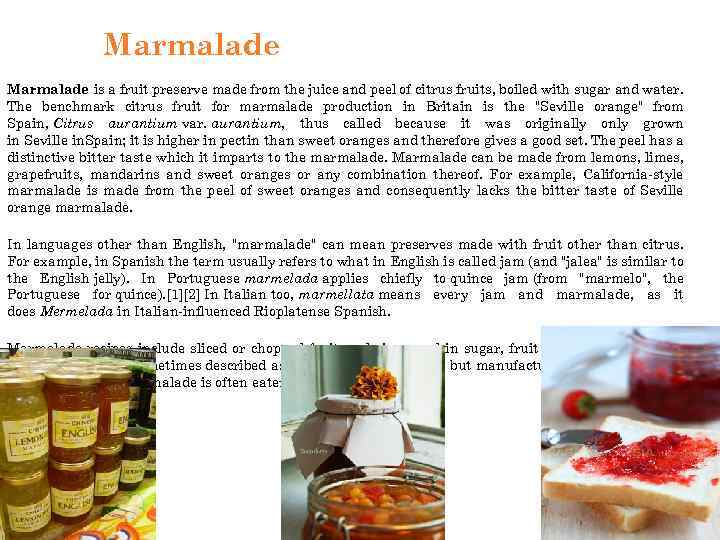
Marmalade is a fruit preserve made from the juice and peel of citrus fruits, boiled with sugar and water. The benchmark citrus fruit for marmalade production in Britain is the "Seville orange" from Spain, Citrus aurantium var. aurantium, thus called because it was originally only grown in Seville in. Spain; it is higher in pectin than sweet oranges and therefore gives a good set. The peel has a distinctive bitter taste which it imparts to the marmalade. Marmalade can be made from lemons, limes, grapefruits, mandarins and sweet oranges or any combination thereof. For example, California-style marmalade is made from the peel of sweet oranges and consequently lacks the bitter taste of Seville orange marmalade. In languages other than English, "marmalade" can mean preserves made with fruit other than citrus. For example, in Spanish the term usually refers to what in English is called jam (and "jalea" is similar to the English jelly). In Portuguese marmelada applies chiefly to quince jam (from "marmelo", the Portuguese for quince). [1][2] In Italian too, marmellata means every jam and marmalade, as it does Mermelada in Italian-influenced Rioplatense Spanish. Marmalade recipes include sliced or chopped fruit peel simmered in sugar, fruit juice and water until soft. Marmalade is sometimes described as jamcontaining fruit peel but manufacturers also produce peel -free marmalade. Marmalade is often eaten on toast for breakfast.
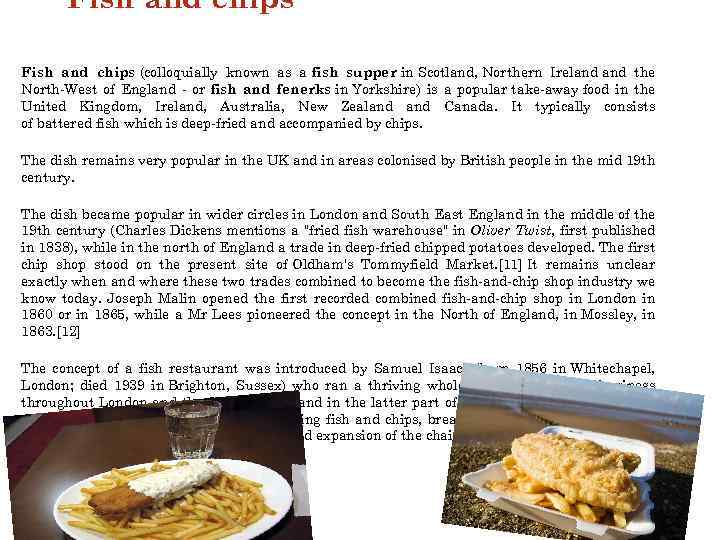
Fish and chips (colloquially known as a fish supper in Scotland, Northern Ireland the North-West of England - or fish and fenerks in Yorkshire) is a popular take-away food in the United Kingdom, Ireland, Australia, New Zealand Canada. It typically consists of battered fish which is deep-fried and accompanied by chips. The dish remains very popular in the UK and in areas colonised by British people in the mid 19 th century. The dish became popular in wider circles in London and South East England in the middle of the 19 th century (Charles Dickens mentions a "fried fish warehouse" in Oliver Twist, first published in 1838), while in the north of England a trade in deep-fried chipped potatoes developed. The first chip shop stood on the present site of Oldham's Tommyfield Market. [11] It remains unclear exactly when and where these two trades combined to become the fish-and-chip shop industry we know today. Joseph Malin opened the first recorded combined fish-and-chip shop in London in 1860 or in 1865, while a Mr Lees pioneered the concept in the North of England, in Mossley, in 1863. [12] The concept of a fish restaurant was introduced by Samuel Isaacs (born 1856 in Whitechapel, London; died 1939 in Brighton, Sussex) who ran a thriving wholesale and retail fish business throughout London and the South of England in the latter part of the 19 th century. Isaacs' first restaurant opened in London in 1896 serving fish and chips, bread and butter, and tea for nine pence, [13] and its popularity ensured a rapid expansion of the chain.
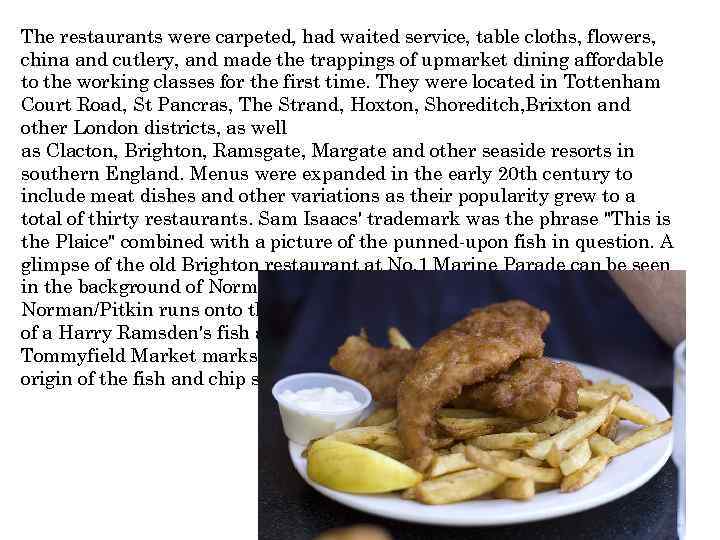
The restaurants were carpeted, had waited service, table cloths, flowers, china and cutlery, and made the trappings of upmarket dining affordable to the working classes for the first time. They were located in Tottenham Court Road, St Pancras, The Strand, Hoxton, Shoreditch, Brixton and other London districts, as well as Clacton, Brighton, Ramsgate, Margate and other seaside resorts in southern England. Menus were expanded in the early 20 th century to include meat dishes and other variations as their popularity grew to a total of thirty restaurants. Sam Isaacs' trademark was the phrase "This is the Plaice" combined with a picture of the punned-upon fish in question. A glimpse of the old Brighton restaurant at No. 1 Marine Parade can be seen in the background of Norman Wisdom's 1955 film One Good Turn just as Norman/Pitkin runs onto the seafront. Coincidentally, this is now the site of a Harry Ramsden's fish and chips restaurant. A blue plaque at. Oldham's Tommyfield Market marks the first chips fried in Britain in 1860, and the origin of the fish and chip shop and fast food industries in Britain.
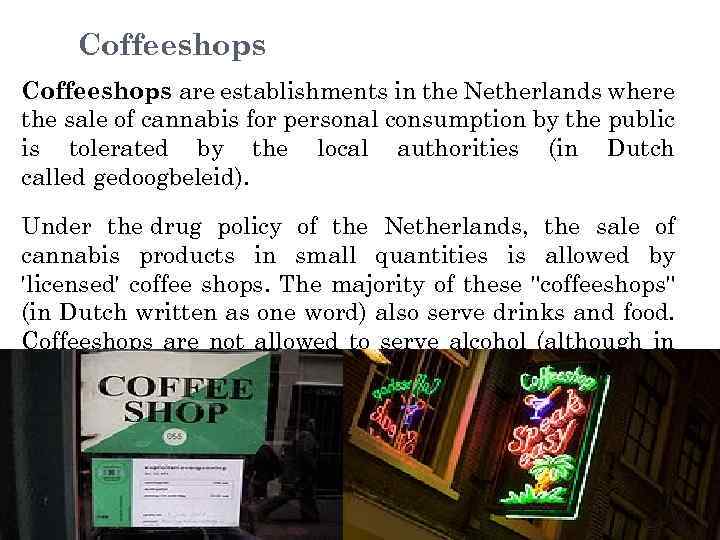
Coffeeshops are establishments in the Netherlands where the sale of cannabis for personal consumption by the public is tolerated by the local authorities (in Dutch called gedoogbeleid). Under the drug policy of the Netherlands, the sale of cannabis products in small quantities is allowed by 'licensed' coffee shops. The majority of these "coffeeshops" (in Dutch written as one word) also serve drinks and food. Coffeeshops are not allowed to serve alcohol (although in the past some coffeeshops in central Amsterdam have transgressed this law without reproach)[citation needed] or other drugs, and risk closure if they are found to be selling soft drugs to minors, hard drugs or selling alcohol without a license. The idea of coffeeshops was introduced in the 1970 s for the explicit purpose of keeping hard and soft
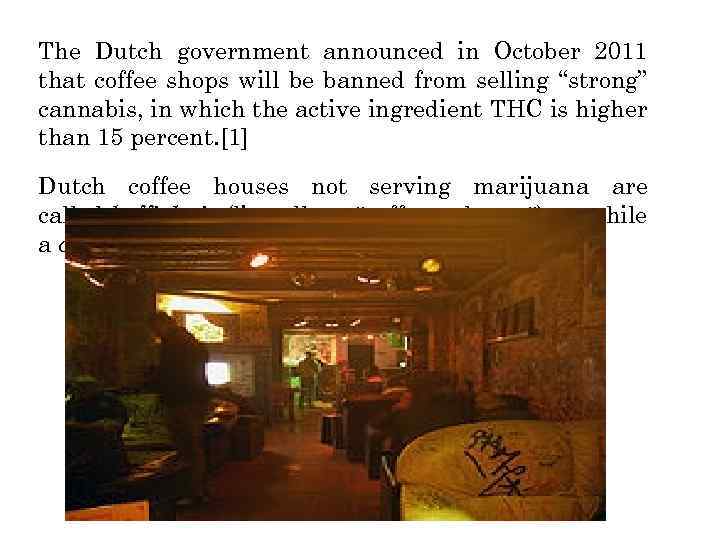
The Dutch government announced in October 2011 that coffee shops will be banned from selling “strong” cannabis, in which the active ingredient THC is higher than 15 percent. [1] Dutch coffee houses not serving marijuana are called koffiehuis (literally "coffee house"), while a café is the equivalent of a bar.
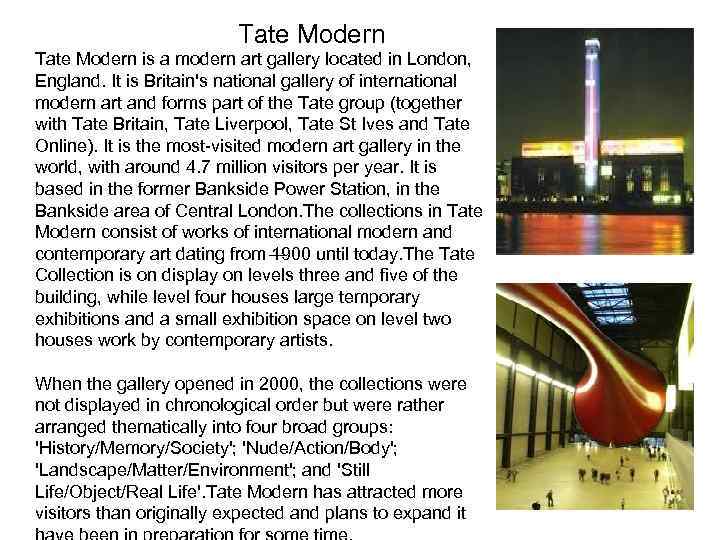
Tate Modern is a modern art gallery located in London, England. It is Britain's national gallery of international modern art and forms part of the Tate group (together with Tate Britain, Tate Liverpool, Tate St Ives and Tate Online). It is the most-visited modern art gallery in the world, with around 4. 7 million visitors per year. It is based in the former Bankside Power Station, in the Bankside area of Central London. The collections in Tate Modern consist of works of international modern and contemporary art dating from 1900 until today. The Tate Collection is on display on levels three and five of the building, while level four houses large temporary exhibitions and a small exhibition space on level two houses work by contemporary artists. When the gallery opened in 2000, the collections were not displayed in chronological order but were rather arranged thematically into four broad groups: 'History/Memory/Society'; 'Nude/Action/Body'; 'Landscape/Matter/Environment'; and 'Still Life/Object/Real Life'. Tate Modern has attracted more visitors than originally expected and plans to expand it
![Airplane war History A steam-powered unmanned fixed-wing aircraft, that weighed 9 lbs. [1], was](https://present5.com/presentation/138958174_141947237/image-27.jpg "Airplane war History A steam-powered unmanned fixed-wing aircraft, that weighed 9 lbs. [1], was")
Airplane war History A steam-powered unmanned fixed-wing aircraft, that weighed 9 lbs. [1], was built by John Stringfellow, in Chard, Somerset, England in 1848. It could fly by itself without needing to be dropped from high up. There were gliders before this, but they had to fly by being pushed off a building or hill. The first man who flew (that is: took off, steered and landed) a motor-powered fixed wing aircraft was Orville Wright in 1903 in Kitty Hawk, North Carolina, USA. Modern day Today, fixed-wing aircraft fly between many cities all over the world, bringing people and cargo. Big cities usually have an international airport, which is the place where fixed-wing aircraft can land take off safely. Some large cities like New York City and London have more than one airport. Two large makers of fixed-wing aircraft are Airbus and Boeing. Advances in technology have made fixed-wing aircraft more efficient in recent years. Things like winglets and more efficient turbofans have helped to do this.
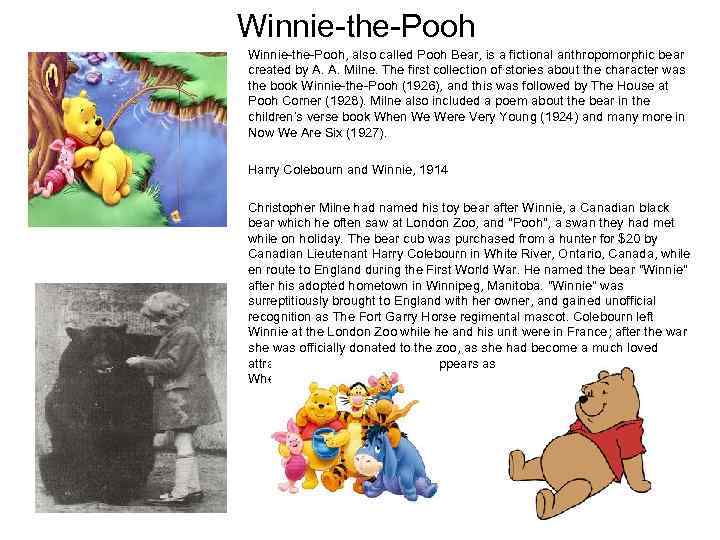
Winnie-the-Pooh, also called Pooh Bear, is a fictional anthropomorphic bear created by A. A. Milne. The first collection of stories about the character was the book Winnie-the-Pooh (1926), and this was followed by The House at Pooh Corner (1928). Milne also included a poem about the bear in the children’s verse book When We Were Very Young (1924) and many more in Now We Are Six (1927). Harry Colebourn and Winnie, 1914 Christopher Milne had named his toy bear after Winnie, a Canadian black bear which he often saw at London Zoo, and "Pooh", a swan they had met while on holiday. The bear cub was purchased from a hunter for $20 by Canadian Lieutenant Harry Colebourn in White River, Ontario, Canada, while en route to England during the First World War. He named the bear "Winnie" after his adopted hometown in Winnipeg, Manitoba. "Winnie" was surreptitiously brought to England with her owner, and gained unofficial recognition as The Fort Garry Horse regimental mascot. Colebourn left Winnie at the London Zoo while he and his unit were in France; after the war she was officially donated to the zoo, as she had become a much loved attraction there. Pooh the swan appears as a character in its own right in When We Were Very Young.
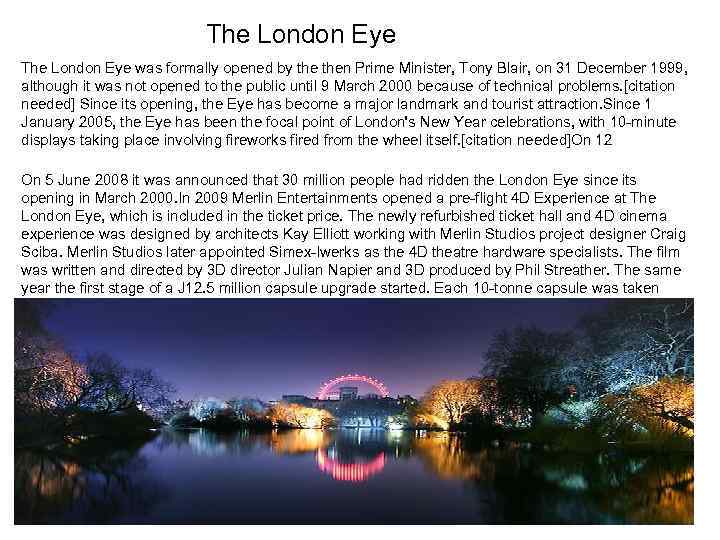
The London Eye was formally opened by then Prime Minister, Tony Blair, on 31 December 1999, although it was not opened to the public until 9 March 2000 because of technical problems. [citation needed] Since its opening, the Eye has become a major landmark and tourist attraction. Since 1 January 2005, the Eye has been the focal point of London's New Year celebrations, with 10 -minute displays taking place involving fireworks fired from the wheel itself. [citation needed]On 12 On 5 June 2008 it was announced that 30 million people had ridden the London Eye since its opening in March 2000. In 2009 Merlin Entertainments opened a pre-flight 4 D Experience at The London Eye, which is included in the ticket price. The newly refurbished ticket hall and 4 D cinema experience was designed by architects Kay Elliott working with Merlin Studios project designer Craig Sciba. Merlin Studios later appointed Simex-Iwerks as the 4 D theatre hardware specialists. The film was written and directed by 3 D director Julian Napier and 3 D produced by Phil Streather. The same year the first stage of a Ј12. 5 million capsule upgrade started. Each 10 -tonne capsule was taken down and floated down the river to Tilbury Docks in Essex.
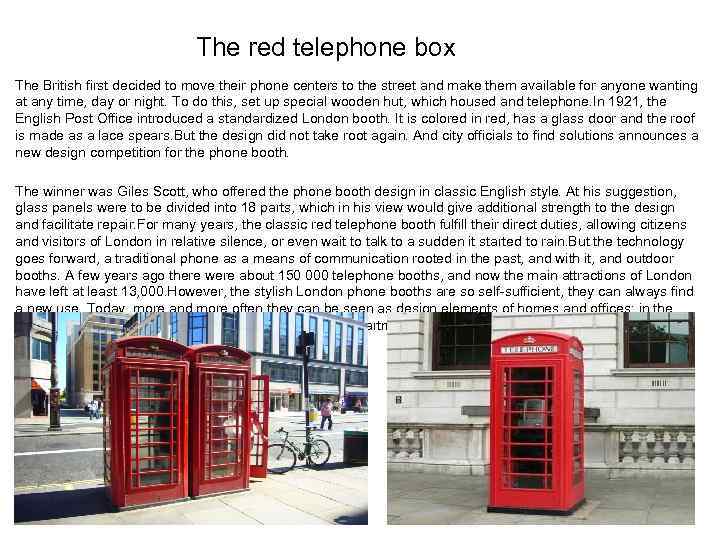
The red telephone box The British first decided to move their phone centers to the street and make them available for anyone wanting at any time, day or night. To do this, set up special wooden hut, which housed and telephone. In 1921, the English Post Office introduced a standardized London booth. It is colored in red, has a glass door and the roof is made as a lace spears. But the design did not take root again. And city officials to find solutions announces a new design competition for the phone booth. The winner was Giles Scott, who offered the phone booth design in classic English style. At his suggestion, glass panels were to be divided into 18 parts, which in his view would give additional strength to the design and facilitate repair. For many years, the classic red telephone booth fulfill their direct duties, allowing citizens and visitors of London in relative silence, or even wait to talk to a sudden it started to rain. But the technology goes forward, a traditional phone as a means of communication rooted in the past, and with it, and outdoor booths. A few years ago there were about 150 000 telephone booths, and now the main attractions of London have left at least 13, 000. However, the stylish London phone booths are so self-sufficient, they can always find a new use. Today, more and more often they can be seen as design elements of homes and offices: in the form of clothing, tank, or your own phone booth in the apartment
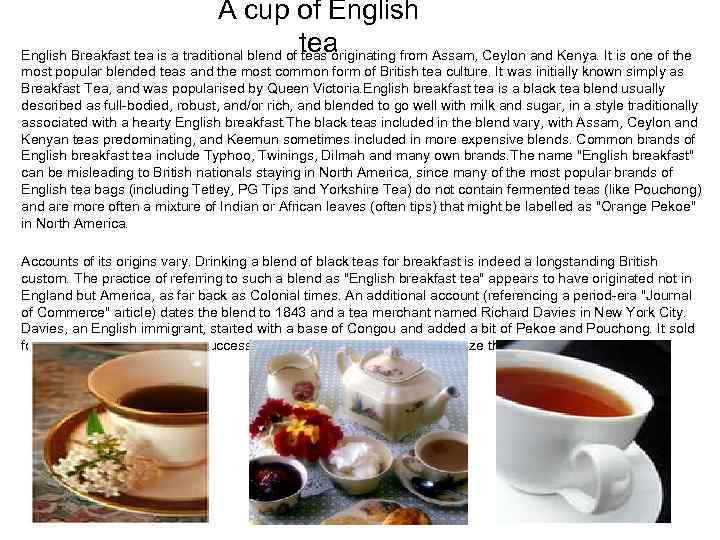
A cup of English tea English Breakfast tea is a traditional blend of teas originating from Assam, Ceylon and Kenya. It is one of the most popular blended teas and the most common form of British tea culture. It was initially known simply as Breakfast Tea, and was popularised by Queen Victoria. English breakfast tea is a black tea blend usually described as full-bodied, robust, and/or rich, and blended to go well with milk and sugar, in a style traditionally associated with a hearty English breakfast. The black teas included in the blend vary, with Assam, Ceylon and Kenyan teas predominating, and Keemun sometimes included in more expensive blends. Common brands of English breakfast tea include Typhoo, Twinings, Dilmah and many own brands. The name "English breakfast" can be misleading to British nationals staying in North America, since many of the most popular brands of English tea bags (including Tetley, PG Tips and Yorkshire Tea) do not contain fermented teas (like Pouchong) and are more often a mixture of Indian or African leaves (often tips) that might be labelled as "Orange Pekoe" in North America. Accounts of its origins vary. Drinking a blend of black teas for breakfast is indeed a longstanding British custom. The practice of referring to such a blend as "English breakfast tea" appears to have originated not in England but America, as far back as Colonial times. An additional account (referencing a period-era "Journal of Commerce" article) dates the blend to 1843 and a tea merchant named Richard Davies in New York City. Davies, an English immigrant, started with a base of Congou and added a bit of Pekoe and Pouchong. It sold for 50 cents a pound, and its success led to imitators, helping to popularize the name.
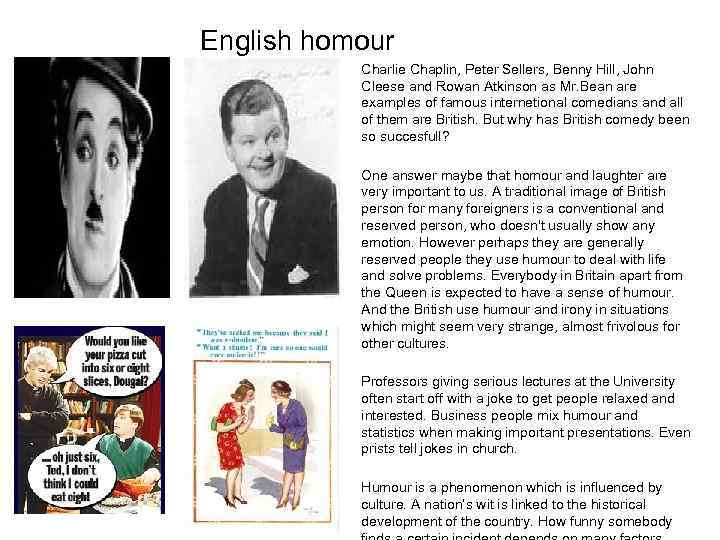
English homour Charlie Chaplin, Peter Sellers, Benny Hill, John Cleese and Rowan Atkinson as Mr. Bean are examples of famous internetional comedians and all of them are British. But why has British comedy been so succesfull? One answer maybe that homour and laughter are very important to us. A traditional image of British person for many foreigners is a conventional and reserved person, who doesn't usually show any emotion. However perhaps they are generally reserved people they use humour to deal with life and solve problems. Everybody in Britain apart from the Queen is expected to have a sense of humour. And the British use humour and irony in situations which might seem very strange, almost frivolous for other cultures. Professors giving serious lectures at the University often start off with a joke to get people relaxed and interested. Business people mix humour and statistics when making important presentations. Even prists tell jokes in church. Humour is a phenomenon which is influenced by culture. A nation’s wit is linked to the historical development of the country. How funny somebody

Thant’s for your attention! The END!
