 Скачать презентацию The Mobile Summer Institutes Evolution of the National
d9b43da096ce7ae1729699f6769c8a4b.ppt
- Количество слайдов: 1



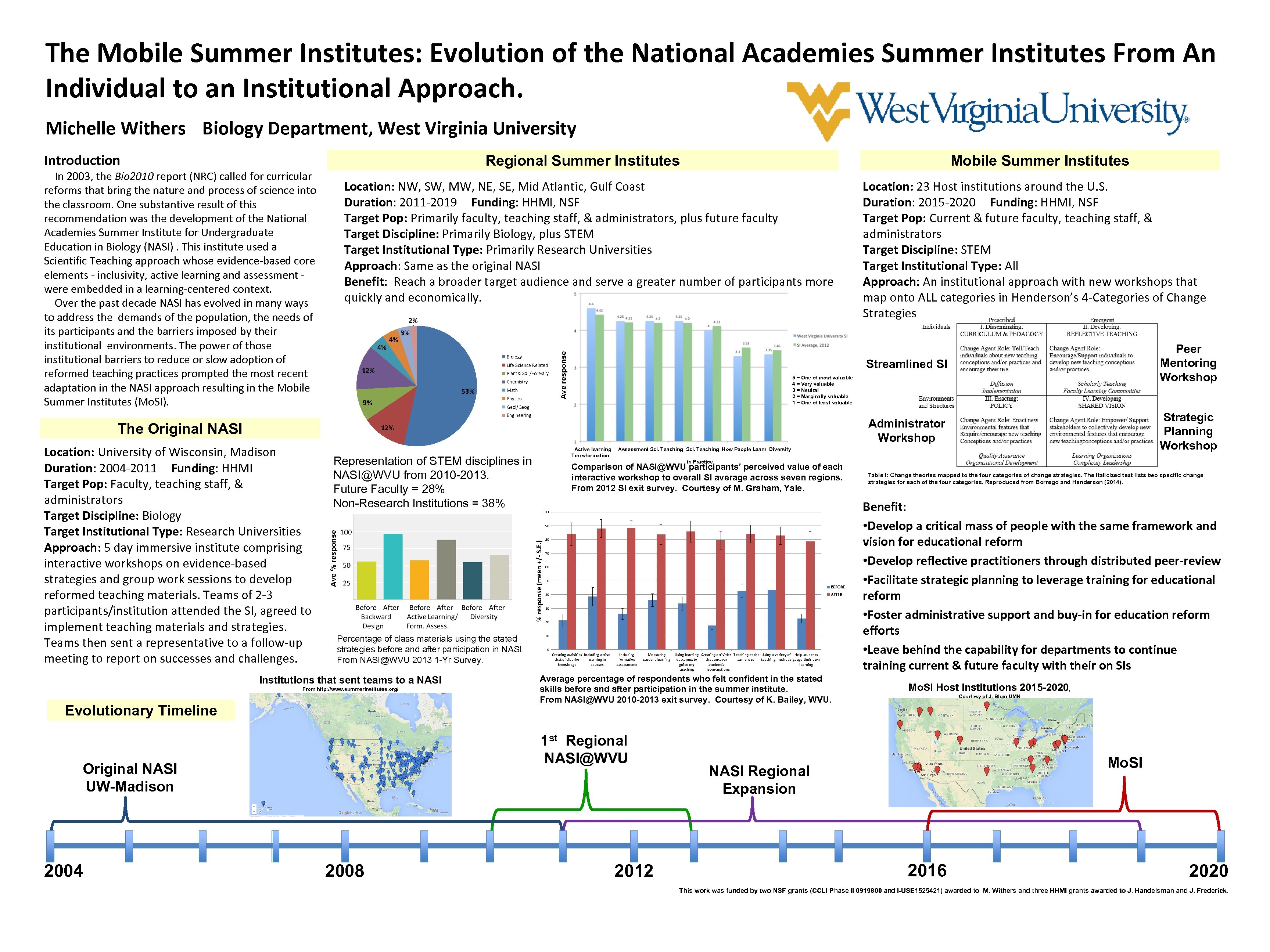
The Mobile Summer Institutes: Evolution of the National Academies Summer Institutes From An Individual to an Institutional Approach. Michelle Withers Biology Department, West Virginia University Introduction Regional Summer Institutes In 2003, the Bio 2010 report (NRC) called for curricular reforms that bring the nature and process of science into the classroom. One substantive result of this recommendation was the development of the National Academies Summer Institute for Undergraduate Education in Biology (NASI). This institute used a Scientific Teaching approach whose evidence-based core elements - inclusivity, active learning and assessment were embedded in a learning-centered context. Over the past decade NASI has evolved in many ways to address the demands of the population, the needs of its participants and the barriers imposed by their institutional environments. The power of those institutional barriers to reduce or slow adoption of reformed teaching practices prompted the most recent adaptation in the NASI approach resulting in the Mobile Summer Institutes (Mo. SI). Mobile Summer Institutes Location: NW, SW, MW, NE, SE, Mid Atlantic, Gulf Coast Duration: 2011 -2019 Funding: HHMI, NSF Target Pop: Primarily faculty, teaching staff, & administrators, plus future faculty Target Discipline: Primarily Biology, plus STEM Target Institutional Type: Primarily Research Universities Approach: Same as the original NASI Benefit: Reach a broader target audience and serve a greater number of participants more quickly and economically. 2% 3% Life Science Related 12% Plant& Soil/Forestry Chemistry 53% 9% Math Physics Streamlined SI Geol/Geog 12% Assessment Sci. Teaching How People Learn Diversity in Practice Comparison of NASI@WVU participants’ perceived value of each interactive workshop to overall SI average across seven regions. From 2012 SI exit survey. Courtesy of M. Graham, Yale. 100 Percentage of class materials using the stated strategies before and after participation in NASI. From NASI@WVU 2013 1 -Yr Survey. From http: //www. summerinstitutes. org/ Evolutionary Timeline % response (mean +/- S. E. ) 90 Institutions that sent teams to a NASI 80 70 60 50 BEFORE AFTER 40 30 20 10 0 Creating activities Including active that elicit prior learning in knowledge courses Including formative assessments Measuring student learning 2008 Using learning Creating activities Teaching at the Using a variety of Help students outcomes to that uncover same level teaching methods guage their own guide my student's learning teaching misconceptions Average percentage of respondents who felt confident in the stated skills before and after participation in the summer institute. From NASI@WVU 2010 -2013 exit survey. Courtesy of K. Bailey, WVU. 1 st Regional NASI@WVU Original NASI UW-Madison 2004 Active learning Transformation Representation of STEM disciplines in NASI@WVU from 2010 -2013. Future Faculty = 28% Non-Research Institutions = 38% Ave % response Location: University of Wisconsin, Madison Duration: 2004 -2011 Funding: HHMI Target Pop: Faculty, teaching staff, & administrators Target Discipline: Biology Target Institutional Type: Research Universities Approach: 5 day immersive institute comprising interactive workshops on evidence-based strategies and group work sessions to develop reformed teaching materials. Teams of 2 -3 participants/institution attended the SI, agreed to implement teaching materials and strategies. Teams then sent a representative to a follow-up meeting to report on successes and challenges. Strategic Planning Workshop 5 = One of most valuable 4 = Very valuable 3 = Neutral 2 = Marginally valuable 1 = One of least valuable Engineering The Original NASI Peer Mentoring Workshop Administrator Workshop Biology Ave response 4% 4% Location: 23 Host institutions around the U. S. Duration: 2015 -2020 Funding: HHMI, NSF Target Pop: Current & future faculty, teaching staff, & administrators Target Discipline: STEM Target Institutional Type: All Approach: An institutional approach with new workshops that map onto ALL categories in Henderson’s 4 -Categories of Change Strategies. 2012 Table I: Change theories mapped to the four categories of change strategies. The italicized text lists two specific change strategies for each of the four categories. Reproduced from Borrego and Henderson (2014). Benefit: • Develop a critical mass of people with the same framework and vision for educational reform • Develop reflective practitioners through distributed peer-review • Facilitate strategic planning to leverage training for educational reform • Foster administrative support and buy-in for education reform efforts • Leave behind the capability for departments to continue training current & future faculty with their on SIs Mo. SI Host Institutions 2015 -2020, Courtesy of J. Blum UMN Mo. SI NASI Regional Expansion 2016 2020 This work was funded by two NSF grants (CCLI Phase II 0919800 and I-USE 1525421) awarded to M. Withers and three HHMI grants awarded to J. Handelsman and J. Frederick.
Скачать презентацию The Mobile Summer Institutes Evolution of the National
d9b43da096ce7ae1729699f6769c8a4b.ppt