 Скачать презентацию The Mo U on e-Business Standards Working Together
9a848e16472122e429852afbefd97cf8.ppt
- Количество слайдов: 41



The Mo. U on e-Business Standards Working Together for Interoperability The IEC-ISO-ITU-UN/ECE Memorandum of Understanding (Mo. U) on e-Business Standards Mo. U/MG/05 N 0231 October 2005
The Mo. U on e-Business Standards The Business Requirement l l e-Business is becoming a cornerstone of the world economy Full benefits for consumers, industry and government demand a coherent set of Information and Communication Technology standards l open l interoperable l internationally accepted
The Mo. U on e-Business Standards The Role of Standards required to: l support dynamic development of e-business l across the manufacturing and service industries l along the global supply chain from supplier to consumer l throughout the lifecycle of products - may be decades l provide effective services to the citizen
The Mo. U on e-Business Standards The Mo. U Vision Our vision is to offer the environment in which all key international organizations can cooperate and contribute to the delivery and promotion of the evolving set of e-Business standards, and maximize their contribution to global commerce
The Mo. U on e-Business Standards The Mo. U Objective l The objective of the Mo. U is to encourage interoperability by: l Recognizing the risk of divergent or conflicting approaches to standardization l Avoiding duplication of efforts and, therefore, confusion amongst users l Ensuring intersectoral coherence
The Mo. U on e-Business Standards The Stakeholders l The Mo. U on e-Business Standards brings together: l The four global de jure standardisation bodies l Participating international user groups
The Mo. U on e-Business Standards The four global de jure bodies The International Electrotechnical Commission (IEC) l http: //www. iec. ch The International Organization for Standardization (ISO) l http: //www. iso. org The International Telecommunication Union (ITU) l http: //www. itu. int The United Nations Economic Commission for Europe (UN/ECE) l http: //www. unece. org/cefact
The Mo. U on e-Business Standards The four global de jure bodies l l l The de jure standards bodies are committed to operating by international consensus IEC and ISO are the “parents” of JTC 1 on IT standards ISO, IEC and ITU each have a number of technical groups developing standards relevant to e-Business UN/ECE also involves countries outside Europe such as Canada and the USA UN/ECE is the “parent” of UN/CEFACT – the UN’s Centre for Trade Facilitation and Electronic Business
The Mo. U on e-Business Standards Participating International User Groups CALS International l http: //www. iiceb. org NATO CALS l http: //www. dcnicn. com/ncmb OASIS l http: //www. oasis-open. org CEN/ISSS l http: //www. cenorm. be/isss GS 1 (formerly EAN. UCC) l http: //www. gs 1. org OAGI l http: //www. openapplications. org SWIFT l http: //www. swift. com
The Mo. U on e-Business Standards Criteria for a Participating User Group l l l l l Approved by the Mo. U signatories Legally "organized" group or registered consortium International in scope International in membership, and open to new members Multiple industry sectors, or a broad range of industry groups in a single sector Standards or specification development as a reason they were formed or exist Organized for at least one year Willing and interested to cooperate on interoperability and other common e-business technical issues Willing and able to send representatives to Mo. U/MG meetings
The Mo. U on e-Business Standards History of the Mo. U January, 1995 - original Mo. U was signed by IEC, ISO and UN/ECE l 17 November, 1998 - revised Mo. U established the need/ability to add Participating International User Group input l 24 March, 2000 - ITU signed l Actual PDF of the latest Mo. U is available from the web at http: //www. itu. int/ITU-T/e-business/mou/index. html l
The Mo. U on e-Business Standards The Commitment l Formal Memorandum of Understanding (Mo. U) commits participants to: l Avoid divergent and conflicting approaches to standardization l Eliminate duplication of efforts l Provide a clear roadmap for users l Ensure intersectoral coherence in the field of electronic business
The Mo. U on e-Business Standards The Principles l l l Information on work programmes will be shared openly The cooperation will focus on action, not discussion The process shall not represent an additional layer of bureaucracy in the standardization process Recommendations will be agreed by consensus among the participants Each organization will retain its own decision making process
The Mo. U on e-Business Standards What is consensus? l ISO/IEC Guide 2: 1996 "General agreement, characterized by the absence of sustained opposition to substantial issues by any important part of the concerned interests and by a process that involves seeking to take into account the views of all parties concerned and to reconcile any conflicting arguments. NOTE Consensus need not imply unanimity. "
The Mo. U on e-Business Standards Operations l l l Monitors new initiatives Identifies topics of mutual interest and potential overlaps/conflicts Makes recommendations for action to resolve issues and harmonise activities Monitors progress Facilitates expert participation in the most appropriate development programmes Promotes role of the Mo. U to external organisations
The Mo. U on e-Business Standards Organisation l l Management Group comprising representatives of participating organizations Meets twice a year Electronic dialogue between meetings Feedback into organizations
The Mo. U on e-Business Standards The Mo. U Management Group has no formal power but a great deal of moral authority !
The Mo. U on e-Business Standards Key successes to date - Technical coordination l Summit on business information objects, leading to increased cooperation between developers Joint ISO/CEFACT working group on EDIFACT syntax Framework for OASIS/CEFACT cooperation on eb. XML, including Joint Coordinating Committee Harmonisation strategy for Core Components Joint approach to UNTDED maintenance and update Recommendation on e-Business character sets Information exchange on XML usage Recommendation on XML schema languages l Integration of permanent part marking for aerospace l l l l
The Mo. U on e-Business Standards Key successes to date - Facilitation l l l l Facilitation of consortium involvement with standards bodies OASIS, OAGIS, GS 1, SWIFT Greater visibility of potential conflicts in standards work, leading to scope adjustments - eg TC 171 Recognition of value of coordination function Extension to collaboration between CEFACT and OASIS on eb. XML Mo. Us between standardisation groups to recognise shared activities - eg Freight Forwarding, e. Health Support for open information sources - eg DIFFUSE project Cross-organisational assessment of change management
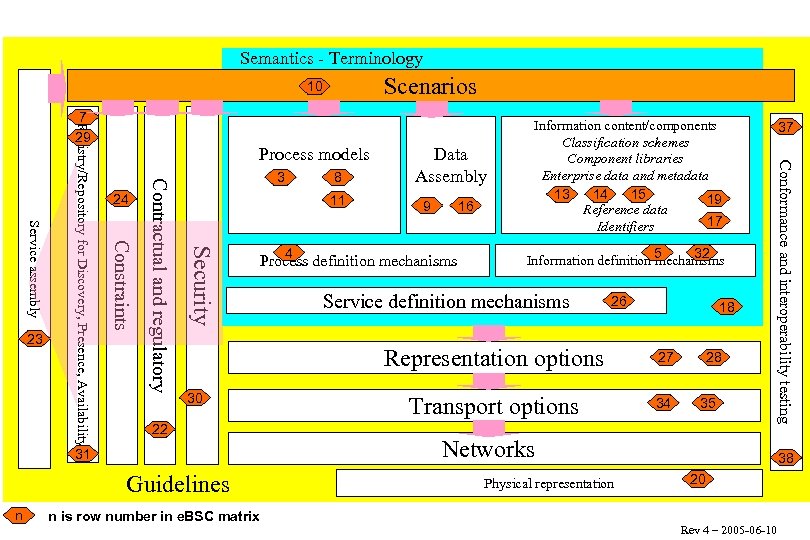
The Mo. U on e-Business Standards Active areas of coordination (1) l l Framework for e. Business standards l Includes CEFACT and OASIS models l Actively supported by NIST e. BSC activity l Aligned with open-edi model Open registry for e. Business standards work l Metadata and mechanism to be defined l Need federated approach, with moderation for consistency
Semantics - Terminology Scenarios 10 11 Security Contractual and regulatory 24 4 16 9 Process definition mechanisms 32 5 Information definition mechanisms Service definition mechanisms 26 18 Representation options 30 22 31 Guidelines n 8 3 Data Assembly Information content/components Classification schemes Component libraries Enterprise data and metadata 15 13 14 19 Reference data 17 Identifiers n is row number in e. BSC matrix 27 Transport options 34 28 35 37 Conformance and interoperability testing Process models Constraints Service assembly 23 Registry/Repository for Discovery, Presence, Availability 7 29 Networks Physical representation 38 20 Rev 4 – 2005 -06 -10
The Mo. U on e-Business Standards Active areas of coordination (2) l l Information architecture l Product classification schemes l e-Catalogues/Dictionaries - JWG 1 defining consistent structure and content based on PLIB (ISO 13584/IEC 61360) l Enterprise information models l Master data/code lists - repositories of valid values to support core components - multilingual support needed Terminology l Federated structure of definition databases l Appropriate business model for free downloads from the web
The Mo. U on e-Business Standards Active areas of coordination (3) l eb. XML Core Components methods and procedures l First four eb. XML specifications from OASIS adopted as ISO 15000 l CCTS 2. 01 from CEFACT adopted as ISO 15000 -5 l Agreement to focus core component development through CEFACT TBG 17 - OASIS, OAGIS 9. 0, AIAG, CEFACT, …. l Core component open development process to be clearly articulated by June 2005, based on initial experience with UBL and TDED components l Naming and Design Rules still open to debate – experiences from OAGI and UBL l Harmonisation of information modelling methods
The Mo. U on e-Business Standards Active areas of coordination (4) l l Universal Business Language (UBL) l Version 1. 0 accepted as OASIS standard - may go to ISO l Further development under CEFACT to be considered l Localisation in the Far East - opportunity for TC 37 l Seen as short term document oriented solution l Convergence with UNe. DOCS and TDED to be explored l Open tools for generating UN Layout Key documents and HTML forms Global name and address standards l Multiple approaches to be considered in detail at the next meeting
The Mo. U on e-Business Standards Active areas of coordination (5) l l l Biometrics l build on existing work l clear framework required l core component requirements to be identified Secure container transportation l All relevant standards available - except biometrics and seals l Need to implement them to achieve secure supply chain Cultural diversity l Recommendations to be taken into account on new standards, and incorporated in JWG 1 guidance l Lithuanian character sets
The Mo. U on e-Business Standards Active areas of coordination (6) l l l Web services l No clear definition l Multiple proprietary viewpoints l Results of ongoing JTC 1 working group to be reviewed at next meeting Consistent URN for standards l ISO proposal to be reviewed ISO/IEC Strategic Advisory Group on Security l e. Business related issues identified Data protection/privacy requirements to be defined by government bodies, for action by standards groups EU/US group on ICT regulation
The Mo. U on e-Business Standards Other highlights of Brussels meeting l l Participation from JTC 1, JWG 1, ISO TCs 37, 46, 154, 184, CEFACT, OASIS, OAGI, CEN/ISSS Presentations of SWIFT work programme Progress updates from participating organisations Mo. U Annexes to be updated to reflect latest organisations
The Mo. U on e-Business Standards Future Events l Next plenary meetings: l Beijing, 13 -14 October 2005 l Vancouver, March 2006 (following CEFACT)
The Mo. U on e-Business Standards The key message The e-Business Mo. U Management Group works to foster cooperation among standards developers, so as to minimize the risk of divergent and competing approaches to standardization, to avoid duplication of efforts, and to avoid confusion amongst users of e-Business standards
The Mo. U on e-Business Standards More information For more information on the Mo. U and the events that are being held under its umbrella, please see the website at: http: //www. itu. int/ITU-T/e_business/
The Mo. U on e-Business Standards Backup slides
The Mo. U on e-Business Standards groups involved (1) l ISO l TC 37 l TC 46 l TC 68 l l Terminology and language resources Information and documentation Banking, securities & other financial services TC 154 Processes, data elements & documents in commerce, industry & administration TC 184 Industrial automation systems and integration • TC 184/SC 4 Industrial Data • TC 184/SC 5 Architecture, communications and integration frameworks l l TC 204 TC 215 Intelligent transport systems Health informatics
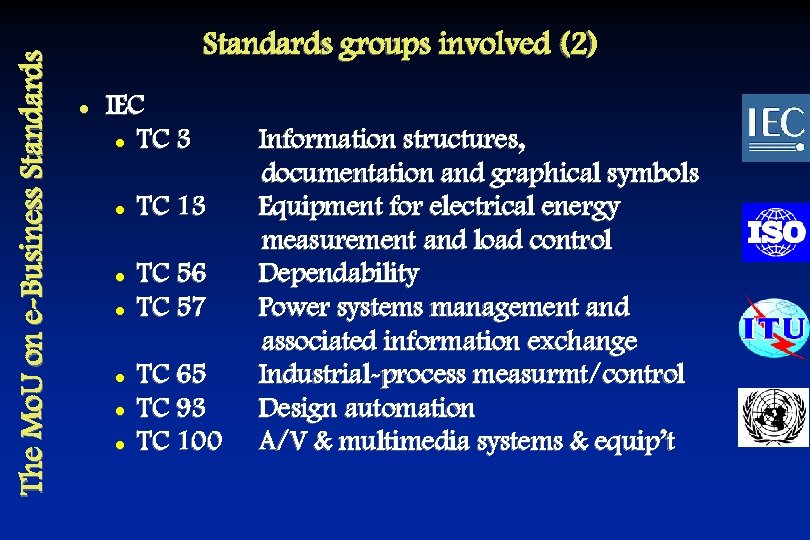
The Mo. U on e-Business Standards groups involved (2) l IEC l TC 3 l l l TC 13 TC 56 TC 57 TC 65 TC 93 TC 100 Information structures, documentation and graphical symbols Equipment for electrical energy measurement and load control Dependability Power systems management and associated information exchange Industrial-process measurmt/control Design automation A/V & multimedia systems & equip’t
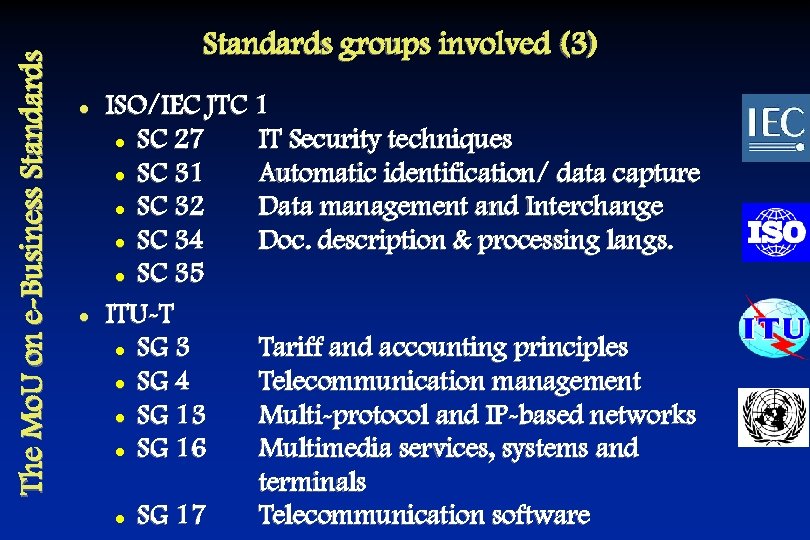
The Mo. U on e-Business Standards groups involved (3) l l ISO/IEC JTC 1 l SC 27 IT Security techniques l SC 31 Automatic identification/ data capture l SC 32 Data management and Interchange l SC 34 Doc. description & processing langs. l SC 35 ITU-T l SG 3 Tariff and accounting principles l SG 4 Telecommunication management Multi-protocol and IP-based networks l SG 13 l SG 16 Multimedia services, systems and terminals l SG 17 Telecommunication software
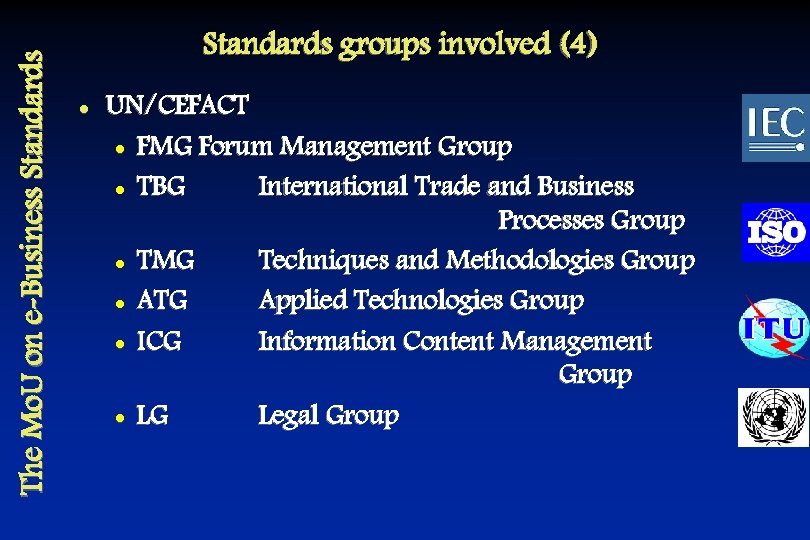
The Mo. U on e-Business Standards groups involved (4) l UN/CEFACT l FMG Forum Management Group l TBG International Trade and Business Processes Group l TMG Techniques and Methodologies Group l ATG Applied Technologies Group l ICG Information Content Management Group Legal Group l LG
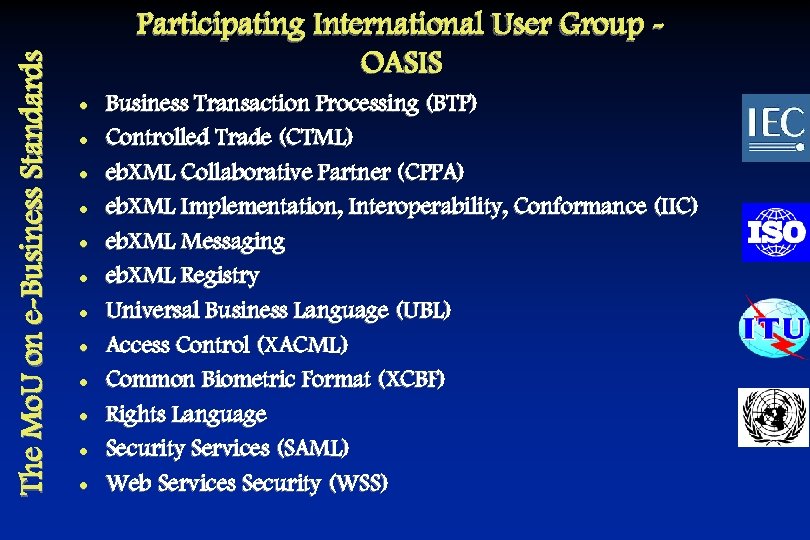
The Mo. U on e-Business Standards Participating International User Group OASIS l l l Business Transaction Processing (BTP) Controlled Trade (CTML) eb. XML Collaborative Partner (CPPA) eb. XML Implementation, Interoperability, Conformance (IIC) eb. XML Messaging eb. XML Registry Universal Business Language (UBL) Access Control (XACML) Common Biometric Format (XCBF) Rights Language Security Services (SAML) Web Services Security (WSS)
The Mo. U on e-Business Standards Participating International User Group OAGIS l OAGIS 9. 0 l CCTS 2. 01 Alignment l 68 Business Scenarios l Approx 360 Messages l 10 new Nouns for 71 total (Objects) l Web Services support l Run Time BOD option l Design enhancements l Defect removal
The Mo. U on e-Business Standards Participating International User Group – GS 1 (formerly EAN International) l l l l l Global Standards Management Process (GSMP) EAN. UCC Identification numbering system Bar coding standards Radio Frequency Identification (EPCglobal) Global Data Synchronisation Network (GDSN) E-Business Methodology Global Data Dictionary (GDD) EANCOM (subset of UN/EDIFACT) EAN • UCC XML standards
The Mo. U on e-Business Standards Participating International User Group – SWIFT l l l Standards for payments, treasury, securities and trade finance UML business modelling Automatic generation of XML schemas from UML models Financial repository UML/XML standards for l l l Customer to Bank Payments Interbank Retail Bulk Payments Cash Reporting and Management Securities Trading Investment Funds Business Registration Authority for l l l ISO 9362 - Bank Identifier Code (BIC) ISO 10383 - Market Identification Code (MIC) ISO 15022 - Scheme for Messages
The Mo. U on e-Business Standards Participating International User Group CEN/ISSS l l Electronic Commerce Workshop (WS/EC) e-Business Board for European Standardization (WS/e. BES) Workshop on Multilingual Catalogue Strategies for e-Commerce and e-Business (WS/ECAT) Sector Workshops on e-Business issues: l l l Footwear (WS/FINEC) Clothing and Textiles (WS/Tex-Spin) Construction (WS/e. Construct) Furniture Product and Business Data (WS/f. UN-STEP 2) Pre-standardization Focus Groups: l l e-Business standards roadmap, 2003 -2005 Electronic Invoicing
The Mo. U on e-Business Standards Key e-Business standards l l ISO 10303 STEP for product data ISO 13584/IEC 61360 for component libraries ISO 15000 eb. XML ISO 9735 EDIFACT
Скачать презентацию The Mo U on e-Business Standards Working Together
9a848e16472122e429852afbefd97cf8.ppt