 Скачать презентацию The minority is always right Henrik Ibsen Closing
a05686de4712bb832f5c7108bf54bb69.ppt
- Количество слайдов: 29



“The minority is always right” Henrik Ibsen Closing SWOT Analysis Topic Maps Norway / Emnekart 2006 Steve Pepper, Ontopia Coordinator RDF/TM Task Force Convenor SC 34/WG 3 Slide 1
The Shape of Topic Maps to Come • Issues I’d like to talk about: • The range of applications of Topic Maps • The untapped power of Topic Maps • The state of the ISO Topic Maps standard • The relationship to the Semantic Web • This presentation is structured as a SWOT analysis © 2006 Ontopia AS – www. ontopia. net Slide 2 Topic Maps Norway / Emnekart 2006
So wot’s a SWOT? • Word. Net (http: //wordnet. princeton. edu/perl/webwn? s=swot) – S: (n) swot, grind, nerd, wonk, dweeb (an insignificant student who is ridiculed as being affected or studying excessively) • Stupid Waste of Time • Stichting Wetenschappelijke Opleidingen Twente • Surface Warfare Over-the-horizon Targeting • Student With Outstanding Talent • Study Without Teachers • Semantic Web Ontology Train • Strengths – Weaknesses – Opportunities – Threats © 2006 Ontopia AS – www. ontopia. net Slide 3 Topic Maps Norway / Emnekart 2006
STRENGTHS • An elegant, flexible and intuitive model of knowledge • Status as an international standard under the democratic control of the member bodies of ISO • A passionate and committed community (장인) • No big players pushing their own agenda • Ready to go… • …and in use today, all around the world – Witness all the case studies today – Norway, at least, has pretty much “crossed the chasm” © 2006 Ontopia AS – www. ontopia. net Slide 4 Topic Maps Norway / Emnekart 2006
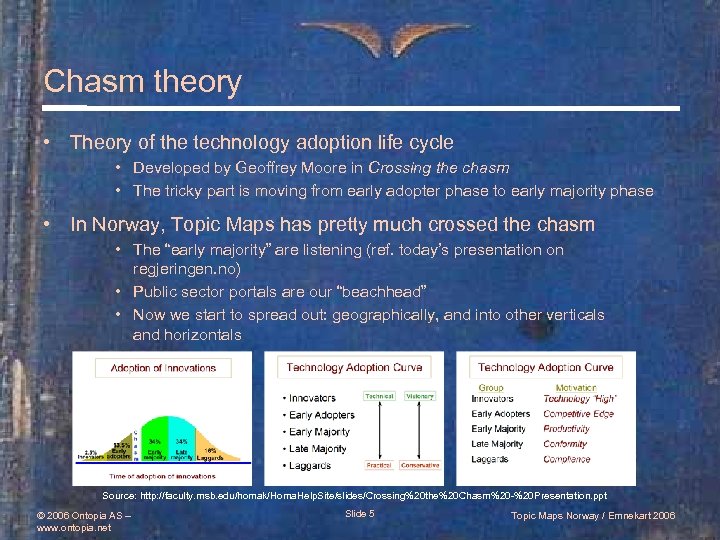
Chasm theory • Theory of the technology adoption life cycle • Developed by Geoffrey Moore in Crossing the chasm • The tricky part is moving from early adopter phase to early majority phase • In Norway, Topic Maps has pretty much crossed the chasm • The “early majority” are listening (ref. today’s presentation on regjeringen. no) • Public sector portals are our “beachhead” • Now we start to spread out: geographically, and into other verticals and horizontals Source: http: //faculty. msb. edu/homak/Homa. Help. Site/slides/Crossing%20 the%20 Chasm%20 -%20 Presentation. ppt © 2006 Ontopia AS – www. ontopia. net Slide 5 Topic Maps Norway / Emnekart 2006
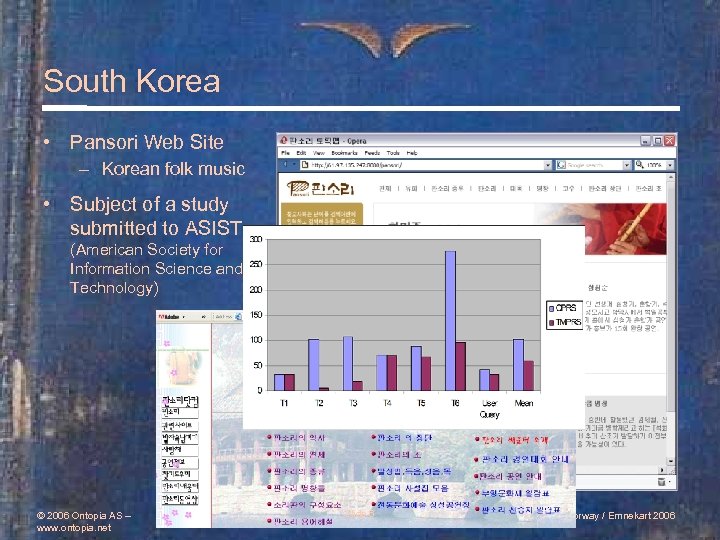
South Korea • Pansori Web Site – Korean folk music • Subject of a study submitted to ASIST (American Society for Information Science and Technology) © 2006 Ontopia AS – www. ontopia. net Slide 6 Topic Maps Norway / Emnekart 2006
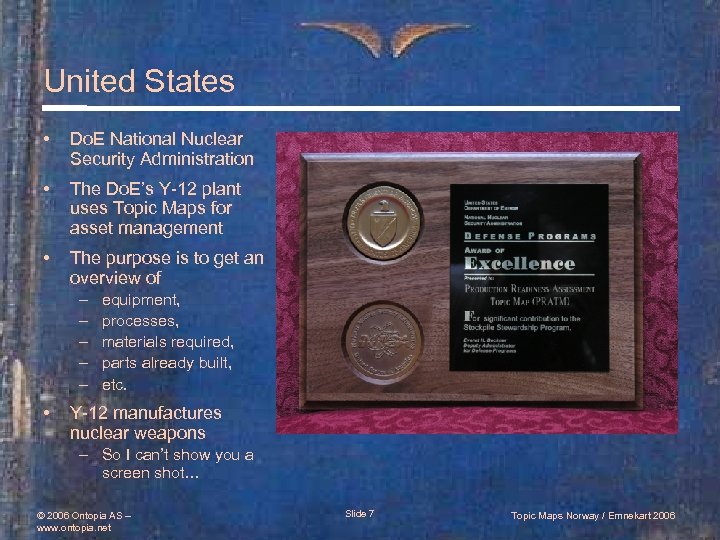
United States • Do. E National Nuclear Security Administration • The Do. E’s Y-12 plant uses Topic Maps for asset management • The purpose is to get an overview of – – – • equipment, processes, materials required, parts already built, etc. Y-12 manufactures nuclear weapons – So I can’t show you a screen shot… © 2006 Ontopia AS – www. ontopia. net Slide 7 Topic Maps Norway / Emnekart 2006
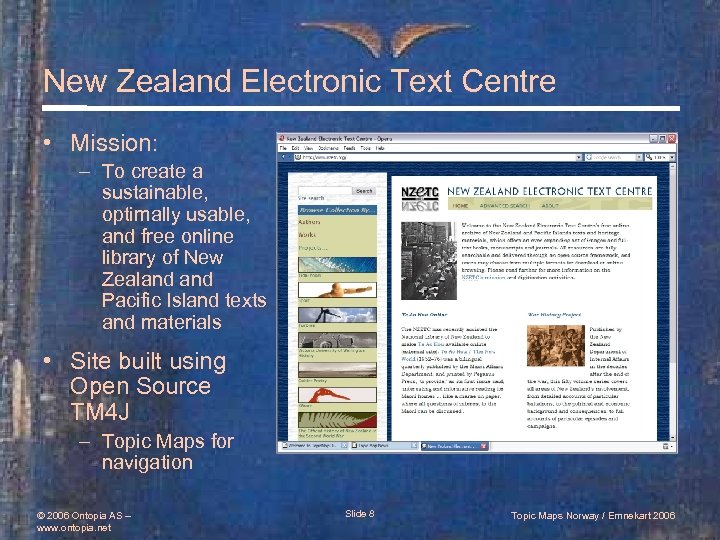
New Zealand Electronic Text Centre • Mission: – To create a sustainable, optimally usable, and free online library of New Zealand Pacific Island texts and materials • Site built using Open Source TM 4 J – Topic Maps for navigation © 2006 Ontopia AS – www. ontopia. net Slide 8 Topic Maps Norway / Emnekart 2006
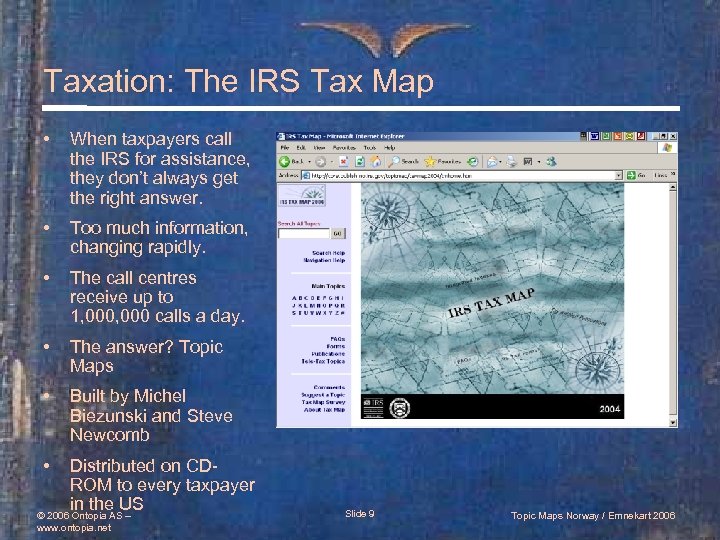
Taxation: The IRS Tax Map • When taxpayers call the IRS for assistance, they don’t always get the right answer. • Too much information, changing rapidly. • The call centres receive up to 1, 000 calls a day. • The answer? Topic Maps • Built by Michel Biezunski and Steve Newcomb • Distributed on CDROM to every taxpayer in the US © 2006 Ontopia AS – www. ontopia. net Slide 9 Topic Maps Norway / Emnekart 2006
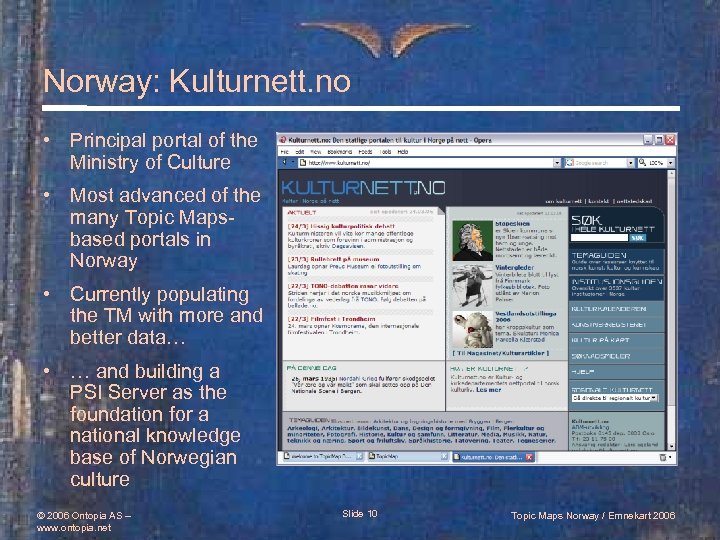
Norway: Kulturnett. no • Principal portal of the Ministry of Culture • Most advanced of the many Topic Mapsbased portals in Norway • Currently populating the TM with more and better data… • … and building a PSI Server as the foundation for a national knowledge base of Norwegian culture © 2006 Ontopia AS – www. ontopia. net Slide 10 Topic Maps Norway / Emnekart 2006
WEAKNESSES • Not enough tools (but those that are, are pretty good) • Insufficient penetration of industry (at least in Norway) • Meagre toehold in academia (as yet, but TMRA will help) • Lack of books on Topic Maps (mine is progressing) • No big players to fund the work • Too few active participants in standards work… © 2006 Ontopia AS – www. ontopia. net Slide 11 Topic Maps Norway / Emnekart 2006
Standards Work: Current State • ISO 13250 Topic Maps: New 7 -part version of on its way: – Part 2 (Data Model) undergoing final ballot – Part 3 (XTM 2. 0) to go to ballot in June – Parts 1 (Introduction), 4 (Canonicalization), 5 (Reference Model) in the works – Parts 6 (Compact Syntax) and 7 (Graphical Notation) proposed • ISO 18048 Topic Maps Query Language (TMQL) – In the works • ISO 19756 Topic Maps Constraint Language (TMCL) – Ditto • More experts needed: Get signed up with Standards Norway – More information: www. isotopicmaps. org © 2006 Ontopia AS – www. ontopia. net Slide 12 Topic Maps Norway / Emnekart 2006
OPPORTUNITIES • Enormous! • The market is ready – Witness all the talk about metadata, taxonomies and ontologies – Those that put all their bets on search engines are being disappointed • There exists a real need that Topic Maps can meet TODAY – The range of applications is staggering – Potential to become as important as RDBs • The topic mapping of the Norwegian National Curriculum is an event of global importance – Please tell the world about it ! 13 Slide © 2006 Ontopia AS – www. ontopia. net Topic Maps Norway / Emnekart 2006
THREATS (1 of 2) • #1: The mistaken belief that the TAO is all there is • Most Topic Maps applications we see today only use a fraction of the real potential; they are “Proto-Topic Maps” – Only use topics, associations, and occurrences – Limited number of topic types, association types, and occurrence types – Scope, reification, and merging yet to be fully exploited • You ain’t seen nothin’ yet • The biggest limitation is our own imaginations! © 2006 Ontopia AS – www. ontopia. net Slide 14 Topic Maps Norway / Emnekart 2006
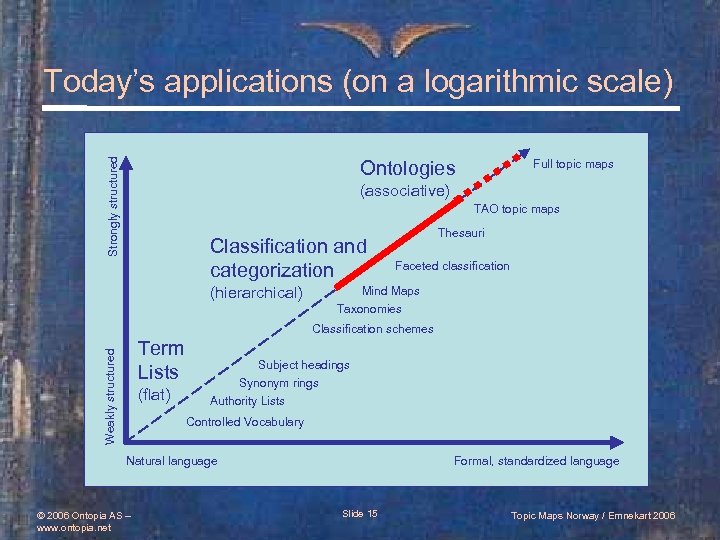
Strongly structured Today’s applications (on a logarithmic scale) Full topic maps Ontologies (associative) TAO topic maps Classification and categorization (hierarchical) Thesauri Faceted classification Mind Maps Taxonomies Classification schemes Weakly structured Term Lists (flat) Subject headings Synonym rings Authority Lists Controlled Vocabulary Natural language © 2006 Ontopia AS – www. ontopia. net Formal, standardized language Slide 15 Topic Maps Norway / Emnekart 2006
Scope • For handling the (very human) problem of context • Currently used mostly when topics have multiple names (to express the contexts in which to use which name) • But there are many other, very powerful, and as yet untapped uses: – – Multiple world views Contextual knowledge Traceable knowledge aggregation Personalized knowledge • One good Norwegian example: – www. hoyre. no uses scope to enable over 400 different web sites (one per local branch) from a single topic map © 2006 Ontopia AS – www. ontopia. net Slide 16 Topic Maps Norway / Emnekart 2006
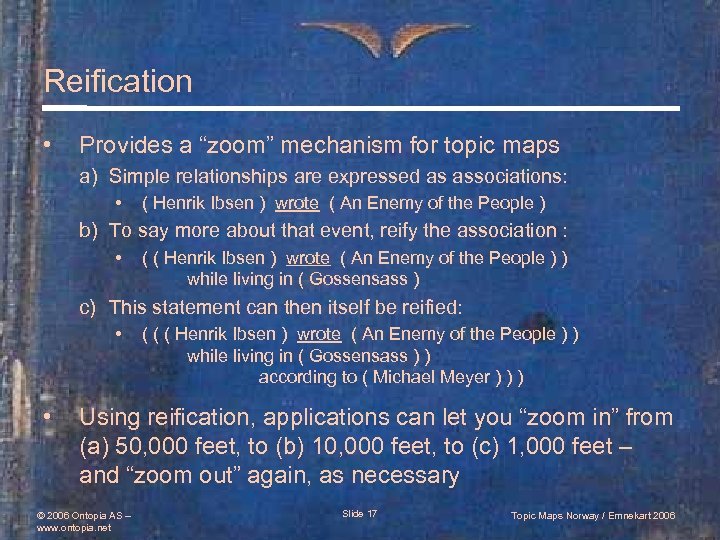
Reification • Provides a “zoom” mechanism for topic maps a) Simple relationships are expressed as associations: • ( Henrik Ibsen ) wrote ( An Enemy of the People ) b) To say more about that event, reify the association : • ( ( Henrik Ibsen ) wrote ( An Enemy of the People ) ) while living in ( Gossensass ) c) This statement can then itself be reified: • • ( ( ( Henrik Ibsen ) wrote ( An Enemy of the People ) ) while living in ( Gossensass ) ) according to ( Michael Meyer ) ) ) Using reification, applications can let you “zoom in” from (a) 50, 000 feet, to (b) 10, 000 feet, to (c) 1, 000 feet – and “zoom out” again, as necessary © 2006 Ontopia AS – www. ontopia. net Slide 17 Topic Maps Norway / Emnekart 2006
Merging • The most powerful feature of Topic Maps is the ability to automatically merge arbitrary topic maps • This makes it possible to – – Collate information from disparate sources Integrate legacy data systems Aggregate knowledge across different organizations Realize a Norwegian National Knowledge Base • See next slide (from 2001) and http: //www. aftenposten. no/meninger/kronikker/article 242930. ece • Successful merging requires careful use of identifiers – PSIs (Published Subject Indicators) are the key to this – Keep an eye on developments at psi. kulturnett. no – and follow their example © 2006 Ontopia AS – www. ontopia. net Slide 18 Topic Maps Norway / Emnekart 2006
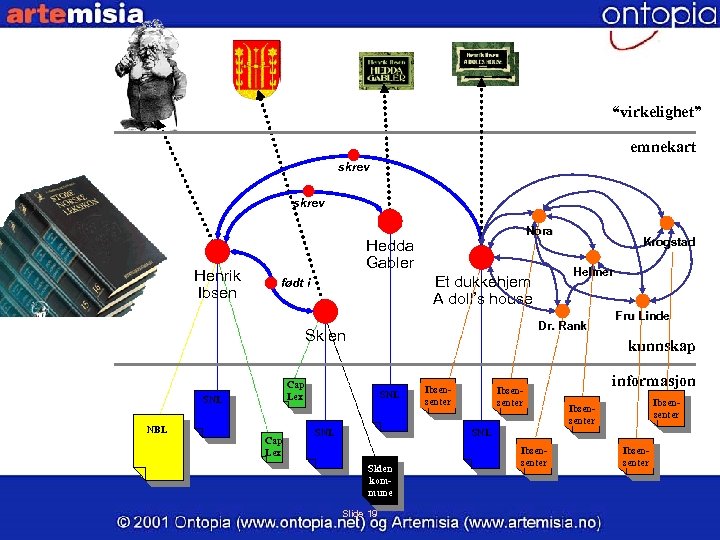
Det uunngåelige Ibsen-eksempelet “virkelighet” emnekart skrev Henrik Ibsen Nora Hedda Gabler Dr. Rank Skien NBL Cap Lex Fru Linde kunnskap Cap Lex SNL Helmer Et dukkehjem A doll’s house født i andre emnekart Krogstad flettes inn. . . SNL Ibsensenter informasjon Ibsensenter SNL Skien kommune Slide 19 Ibsensenter
THREATS (2 of 2) • #2 The widespread belief that RDF/OWL is a competitor – RDF/OWL are languages of the Semantic Web – Some people fear they might be betting on the wrong horse • Semantic Web gets much more of the limelight – Partly because the W 3 C can bask in the glamour of the Web – Partly because RDF and OWL appeal more to academics • Why the perceived competition with Topic Maps? – Partly because RDF/OWL and TMs have a number of similarities – Partly because they stem from rival organizations (W 3 C and ISO) – Partly because there a few bigots (in each camp) – Mostly because people do not fully understand the difference © 2006 Ontopia AS – www. ontopia. net Slide 20 Topic Maps Norway / Emnekart 2006
Yes, they are similar in many ways • Both “extend” XML into the realm of semantics • Both allow assertions to be made about subjects in the outside world • Both define abstract, associative (graph-based) models • Both are intensely concerned with “identity” • Both allow some measure of inferencing or reasoning • Both have XML-based interchange syntaxes • Both have constraint languages and query languages • und so weiter • But they are also different in some crucial respects… © 2006 Ontopia AS – www. ontopia. net Slide 21 Topic Maps Norway / Emnekart 2006
The Most Crucial Differences • RDF/OWL is for machines; Topic Maps is for humans. • RDF/OWL is optimized for inferencing; Topic Maps is optimized for findability. • RDF/OWL is based on formal logic; Topic Maps is not based on formal logic. • RDF/OWL is to mathematics as Topic Maps is to language. © 2006 Ontopia AS – www. ontopia. net Slide 22 Topic Maps Norway / Emnekart 2006
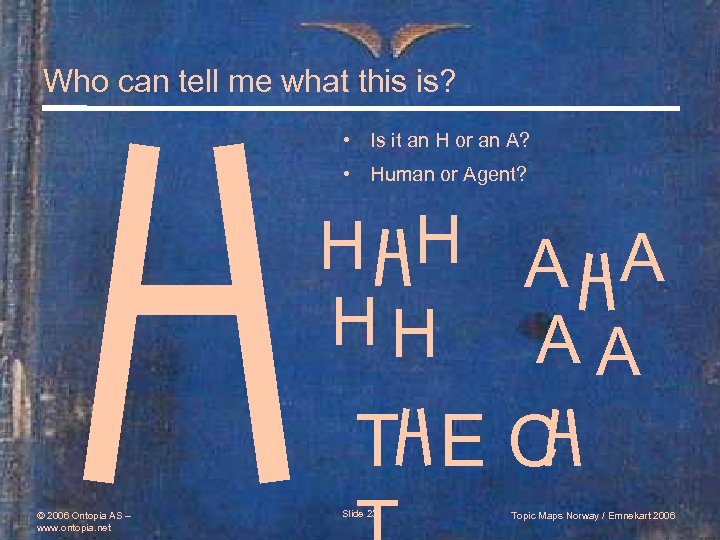
Who can tell me what this is? • Is it an H or an A? • Human or Agent? H H A A HH A A T EC © 2006 Ontopia AS – www. ontopia. net Slide 23 Topic Maps Norway / Emnekart 2006
Different capabilities • RDF/OWL, to support logic-based inferencing, cannot afford to be “fuzzy”; Topic Maps, because it is for humans, has to support fuzziness. • OWL ontologies tend to be very stringent and complex; Topic Maps ontologies tend to be simpler and less formal. • OWL has properties for things that Topic Maps doesn’t need; Topic Maps has features that would be too complex for OWL. • So you need to decide what it is you really need… © 2006 Ontopia AS – www. ontopia. net Slide 24 Topic Maps Norway / Emnekart 2006
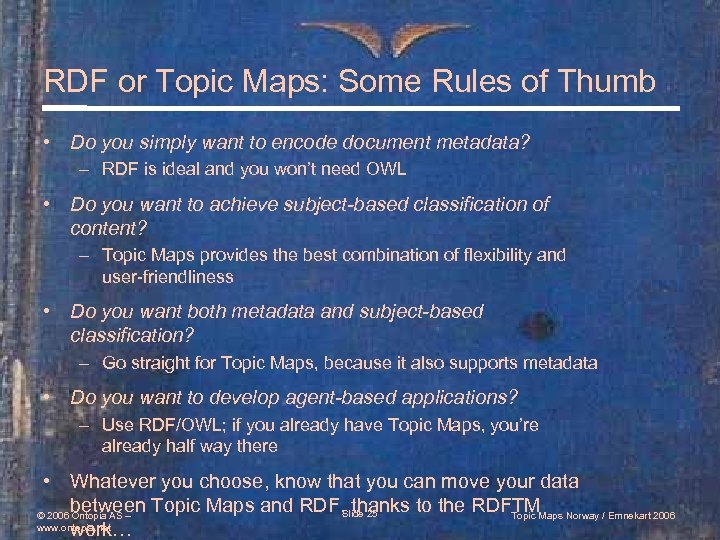
RDF or Topic Maps: Some Rules of Thumb • Do you simply want to encode document metadata? – RDF is ideal and you won’t need OWL • Do you want to achieve subject-based classification of content? – Topic Maps provides the best combination of flexibility and user-friendliness • Do you want both metadata and subject-based classification? – Go straight for Topic Maps, because it also supports metadata • Do you want to develop agent-based applications? – Use RDF/OWL; if you already have Topic Maps, you’re already half way there • Whatever you choose, know that you can move your data between Topic Maps and RDF, Slide 25 thanks to the RDFTMMaps Norway / Emnekart 2006 © 2006 Ontopia AS – Topic www. ontopia. net work…
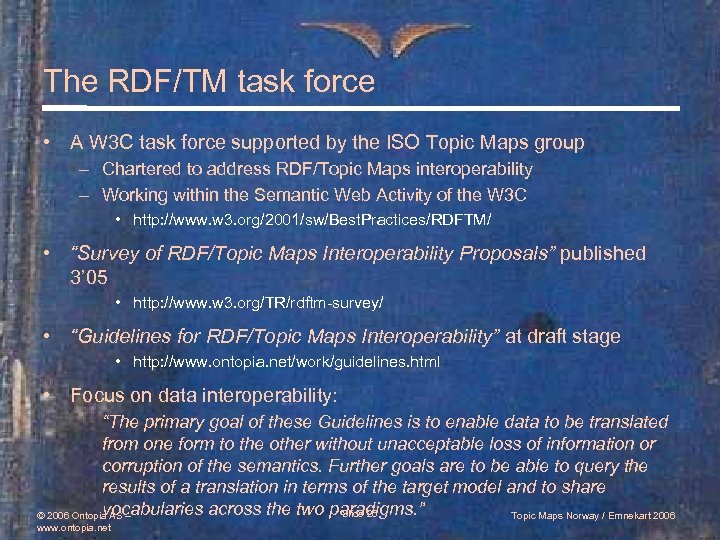
The RDF/TM task force • A W 3 C task force supported by the ISO Topic Maps group – Chartered to address RDF/Topic Maps interoperability – Working within the Semantic Web Activity of the W 3 C • http: //www. w 3. org/2001/sw/Best. Practices/RDFTM/ • “Survey of RDF/Topic Maps Interoperability Proposals” published 3’ 05 • http: //www. w 3. org/TR/rdftm-survey/ • “Guidelines for RDF/Topic Maps Interoperability” at draft stage • http: //www. ontopia. net/work/guidelines. html • Focus on data interoperability: “The primary goal of these Guidelines is to enable data to be translated from one form to the other without unacceptable loss of information or corruption of the semantics. Further goals are to be able to query the results of a translation in terms of the target model and to share vocabularies across the two paradigms. ” Slide 26 © 2006 Ontopia AS – Topic Maps Norway / Emnekart 2006 www. ontopia. net
SWOT Summary • We have a lot of strengths. • We still have some weaknesses. • The opportunities are immense. • The threats are mostly in our own minds. • As practitioners of Topic Maps, we are still a minority, but we have the future on our side • Which brings us back to Dr. Stockmann… © 2006 Ontopia AS – www. ontopia. net Slide 27 Topic Maps Norway / Emnekart 2006
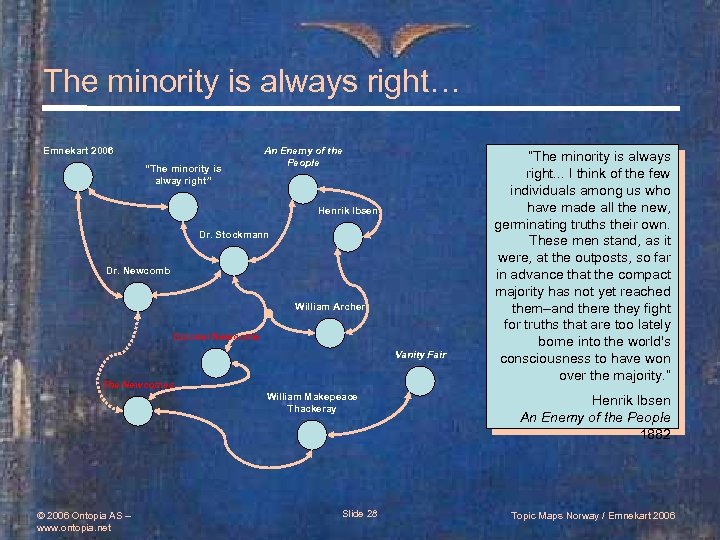
The minority is always right… Emnekart 2006 “The minority is alway right” An Enemy of the People Henrik Ibsen Dr. Stockmann Dr. Newcomb William Archer Colonel Newcome Vanity Fair The Newcomes William Makepeace Thackeray © 2006 Ontopia AS – www. ontopia. net Slide 28 “The minority is always right. . . I think of the few individuals among us who have made all the new, germinating truths their own. These men stand, as it were, at the outposts, so far in advance that the compact majority has not yet reached them–and there they fight for truths that are too lately borne into the world's consciousness to have won over the majority. ” Henrik Ibsen An Enemy of the People 1882 Topic Maps Norway / Emnekart 2006
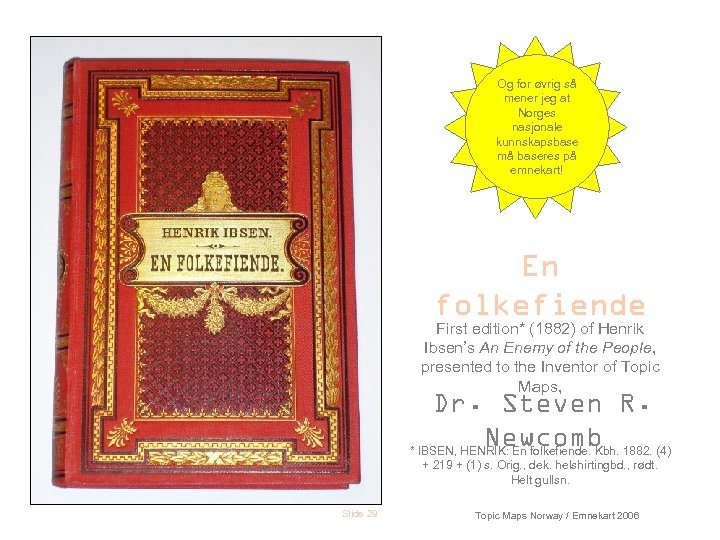
Og for øvrig så mener jeg at Norges nasjonale kunnskapsbase må baseres på emnekart! En folkefiende First edition* (1882) of Henrik Ibsen’s An Enemy of the People, presented to the Inventor of Topic Maps, Dr. Steven R. Newcomb * IBSEN, HENRIK: En folkefiende. Kbh. 1882. (4) + 219 + (1) s. Orig. , dek. helshirtingbd. , rødt. Helt gullsn. Slide 29 Topic Maps Norway / Emnekart 2006
Скачать презентацию The minority is always right Henrik Ibsen Closing
a05686de4712bb832f5c7108bf54bb69.ppt