 Скачать презентацию The ministry Science and Education The Republic of
китай.pptx
- Количество слайдов: 16



The ministry Science and Education The Republic of Kazakhstan Kazakh Ablai khan university of international relations and world languages Faculty of oriental studies Chair of World Cultures and civilizations Project work Theme: Traditional family in China, Korea and Japan Checked by: Bulekbayeva L. A. Done by: Sibatolla K. K. (group 105) Almaty-2014
Content I. Introduction………………. . 4 II. Traditional family in Asian countries 1. Traditional family in China……………. . 5 2. Traditional family in Korea……………. . 9 3. Traditional family in Japan……………. . 12 III. Conclusion………………. 15 IV. Bibliography………………. . . 16
Traditional family in China, Korea, Japan etc Aim: The aim of this project is to get more information about traditional family in China, Korea, Japan Objectives: 1. To get information about traditional family 2. To find out more information about traditional family
Introduction Traditional family in China, Korean and Japan are different. Cultures of the various societies in the region have historically been associated with a wide range of traditional family types. One can see a spatial continuum of those traditional family types, ranging from the extended patriarchal families of South and Central Asia and China, through variants of that ideal in South and East Asian countries. Despite the differences, there are important commonalties among the family types: * The concentration of family authority, based on control of productive resources, lies with family heads * An age-gap between spouses; women are usually younger. As a result of this pattern women are usually less experienced and more dependent on their husbands even when they contribute equally to the family's economic survival. Another result is that women are more likely to be widowed. More than 30% of Asian women older than 45, are widowed. * An ideology of sanctity and privacy surrounds the family, and this has made the legal system reluctant to intervene within the family-unit. In this atmosphere of privacy, violence among family-members often remains hidden and unpunished. • There is a strong son preference in some countries (China, India, Korea, Pakistan) resulting in bias against girls. Families tend to look after boys better than girls.
Traditional family in China • The Chinese word for "Nation" is made up of two characters: Guo means "Kingdom" and Jia means "Family. “ • The definition of a Chinese family is taking care of every member in the family, and not just your own family • The Chinese family is built on a hierarchy system. Commonly, the oldest male in the house will control all the family affairs. • The first born boy is the most important child in the household since when he gets older, the child will replace his grandfather or father as the head of the house. • The need for a head of the house figure in the family is because every member in the family expects to be in the family business and doesn't want any outsider to be a part of it. • The head of the house will take care of private family matters as well as marriage arrangements. • Even when a woman marries into her husband's household, she will always be considered an outsider and never have a voice in the family, unless she goes through her son. • Sometimes the relationship between a husband wife does not work, but the couple never gets divorced
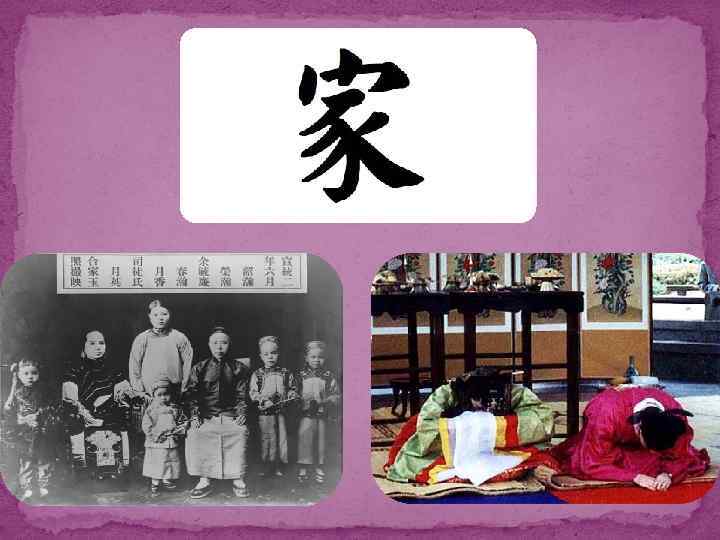
Nation cames first or family cames first? When the word family comes to mind, many people will think of tradition as well. Every family has its own weird tradition. Do you have any weird traditions in your family? The people of China have many family traditions. Chinese and Asians as a whole consider family a major aspect in everyone's life. Did you know that the word nation is created by two characters? The first character is Guo which means "Kingdom"; the second is Jia which means "Family. " Yes, family is that important. I will divide this section into two articles. The first article will relate to the traditional ways of families before the Communists gained control. Second will be the modern day view of the family after the Communist party took over. Traditionally, a Chinese family is built on a hierarchy system. The oldest male in the family will have the highest authority and power; this is usually one of the grandfathers. This is one of the reasons why the concept of boy is so important in China.
“I`m lover. I`m child, I`m mother…”by Meredith Brook a hen day ty, w e ocie ntil th s s se u i hine rn and ale she e to C In m bo rat n is , as a fe econd ter a n wom e dies ered s en e ws, id om sh a cons hen w eir in-l ys e. W th da alwa mal ly of nsidere s an ami the he f not co iewed a t into ey are re v ut a der. th r, b tsi mbe ou me A little side note, even today when a family may be scatter throughout the world, the people are still expected to help each other and contribute to the family. If a a v wo mu oic ma of st g e in n wa if t her o th the nts in here son. roug fam to h i a a ne wo is lo How h th ly, sh ve Yo ver ma t u eve e vo e th u ca (rar n's l nhap r, ev ice ma e rel n re ely) ife, t pin en le ati ad a d he ess an on m iv re d f sh ore orc is em ip a e. he ale betw bou re by ee t cl n ick For exa m very co ple, it is m when t mon that h do not e parents hav to pay e money for t own ch heir educat ild's uncle w ion, the il the tui l help with tio that un n. Even if cle doe s not live in China
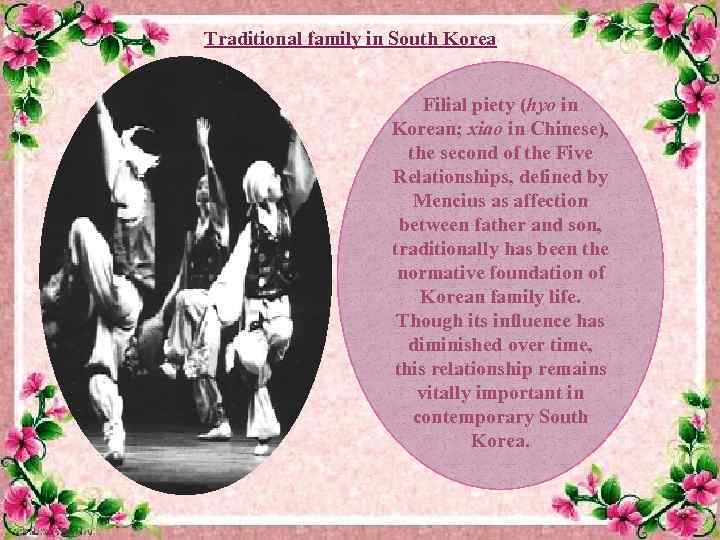
Traditional family in South Korea Filial piety (hyo in Korean; xiao in Chinese), the second of the Five Relationships, defined by Mencius as affection between father and son, traditionally has been the normative foundation of Korean family life. Though its influence has diminished over time, this relationship remains vitally important in contemporary South Korea.
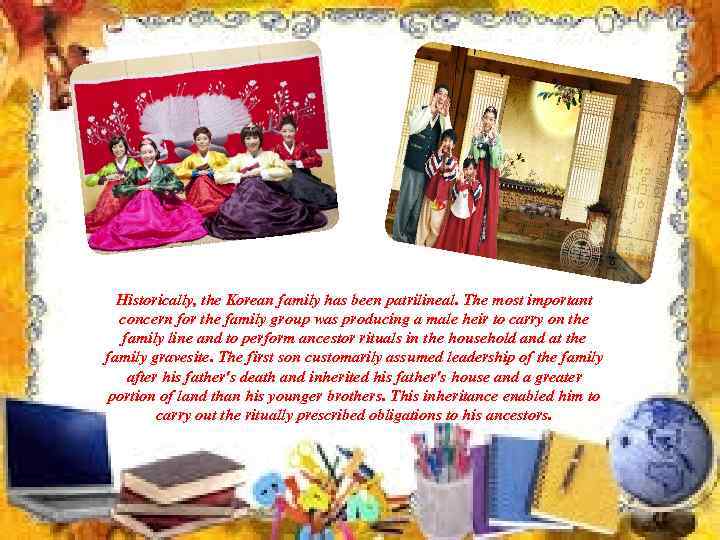
Historically, the Korean family has been patrilineal. The most important concern for the family group was producing a male heir to carry on the family line and to perform ancestor rituals in the household and at the family gravesite. The first son customarily assumed leadership of the family after his father's death and inherited his father's house and a greater portion of land than his younger brothers. This inheritance enabled him to carry out the ritually prescribed obligations to his ancestors.
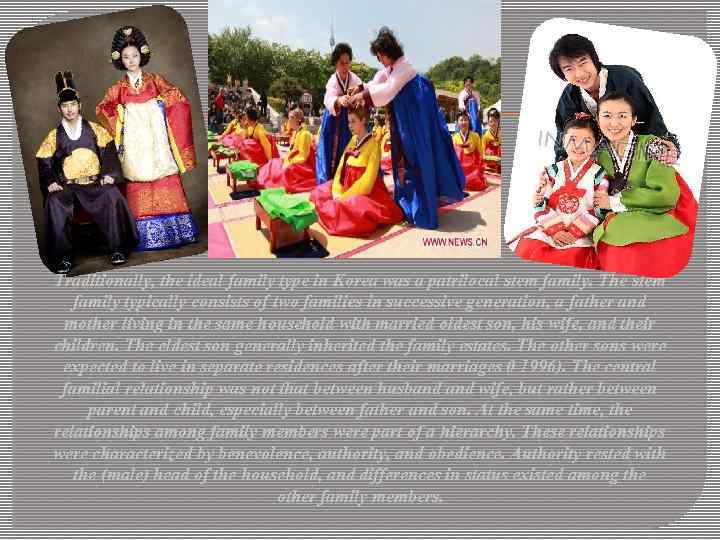
Traditionally, the ideal family type in Korea was a patrilocal stem family. The stem family typically consists of two families in successive generation, a father and mother living in the same household with married oldest son, his wife, and their children. The eldest son generally inherited the family estates. The other sons were expected to live in separate residences after their marriages 0 1996). The central familial relationship was not that between husband wife, but rather between parent and child, especially between father and son. At the same time, the relationships among family members were part of a hierarchy. These relationships were characterized by benevolence, authority, and obedience. Authority rested with the (male) head of the household, and differences in status existed among the other family members.
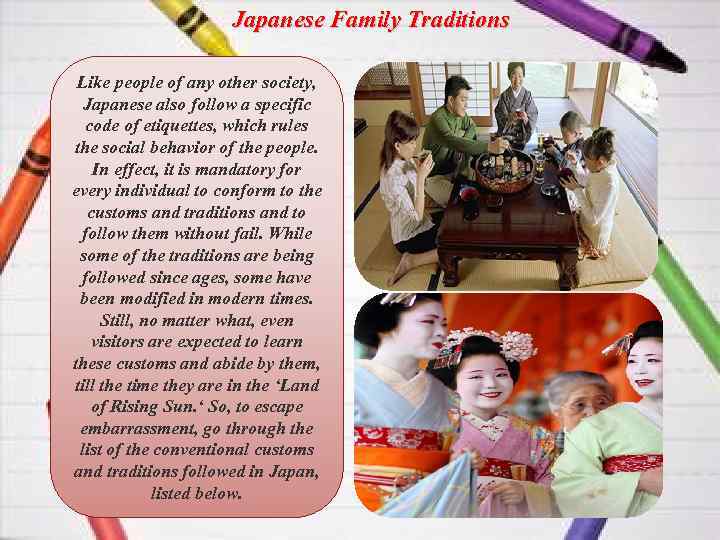
Japanese Family Traditions Like people of any other society, Japanese also follow a specific code of etiquettes, which rules the social behavior of the people. In effect, it is mandatory for every individual to conform to the customs and traditions and to follow them without fail. While some of the traditions are being followed since ages, some have been modified in modern times. Still, no matter what, even visitors are expected to learn these customs and abide by them, till the time they are in the ‘Land of Rising Sun. ‘ So, to escape embarrassment, go through the list of the conventional customs and traditions followed in Japan, listed below.
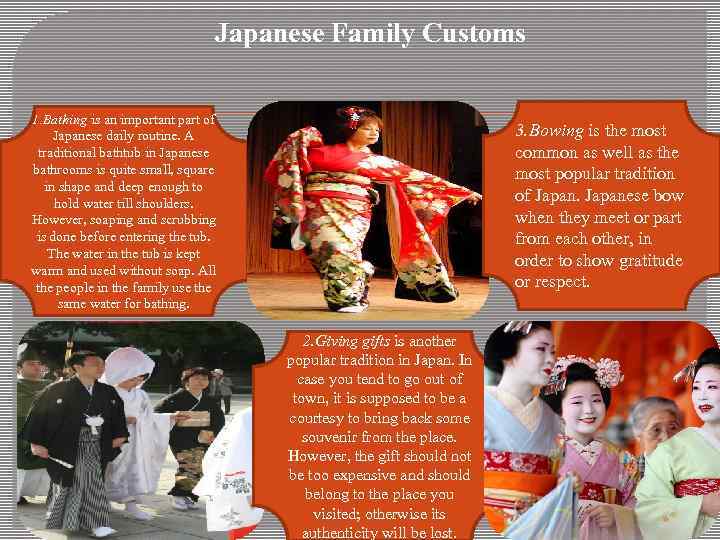
Japanese Family Customs 1. Bathing is an important part of Japanese daily routine. A traditional bathtub in Japanese bathrooms is quite small, square in shape and deep enough to hold water till shoulders. However, soaping and scrubbing is done before entering the tub. The water in the tub is kept warm and used without soap. All the people in the family use the same water for bathing. 3. Bowing is the most common as well as the most popular tradition of Japanese bow when they meet or part from each other, in order to show gratitude or respect. 2. Giving gifts is another popular tradition in Japan. In case you tend to go out of town, it is supposed to be a courtesy to bring back some souvenir from the place. However, the gift should not be too expensive and should belong to the place you visited; otherwise its authenticity will be lost.
4 • In Japan, exchange of business cards is the first step towards any business relationship. Thus, if you are in Japan or a business trip, make sure you have plenty of visiting cards available. Moreover, whenever, you receive a business card, read it with interest and also comment profusely. Simply taking the card and putting in pocket is considered rude in Japan 5 • Removing shoes is another prevalent practice in Japan. While entering houses, schools and many other buildings, people are expected to remove shoes. It is basically done to keep the house clean. Make sure you are wearing decent socks, as you will be expected to take off your slippers when seated on tatami mats. 6 7 8 • The use of chopsticks while eating is quite common in Japan. After you have finished your meal, keep your chopsticks across your dish or on the side. Never leave them in your bowl or standing in your rice. This is done only on funerals and is thus considered disrespectful. • 7. While going out with friends for a drink, do not just fill your own glass, as it is considered rude. Once you have drunk enough, leave the glass full or it will be filled again. It is also customary to split the bill amongst friends, irrespective of how much you have spent. • 8. It is customary to say "Itadakimasu" before starting to eat and drink or else it is considered rude.
Conclusion To sum up, there is no need to idealize the traditional family. "The traditional family in Asia and the Pacific was not necessarily superior to the types that emerge in today's world. Authoritarianism, discrimination, exploitation, violence, abandonment and other social evils were fully represented in traditional family systems throughout the region" A family lives in a household, but a household is not necessarily a family. However for the purpose of this paper, family and household are considered synonymous and are used interchangeably.
Bibliography http: //www. fao. org/docrep/X 5211 E/X 5211 e 04. htm http: //www. culture-4 -travel. com/chinese-family. html http: //www. buzzle. com/articles/chinese-traditions-andculture. htm http: //lifestyle. iloveindia. com/lounge/japanese-familytraditions-2550. htm http: //www. japanguide. com/forum/quereadisplay. html? 0+60413 http: //family. jrank. org/pages/1020/Korea-Traditional. Korean-Families. html http: //countrystudies. us/south-korea/38. htm
Скачать презентацию The ministry Science and Education The Republic of
китай.pptx