


 Скачать презентацию The Microscope The History Many people
The Microscope.ppt
- Количество слайдов: 25
 The Microscope
 The History • Many people experimented with making microscopes • Was the microscope originally made by accident? (Most people were creating telescopes) • The first microscope was 6 feet long!!! • The Greeks & Romans used “lenses” to magnify objects over 1000 years ago.
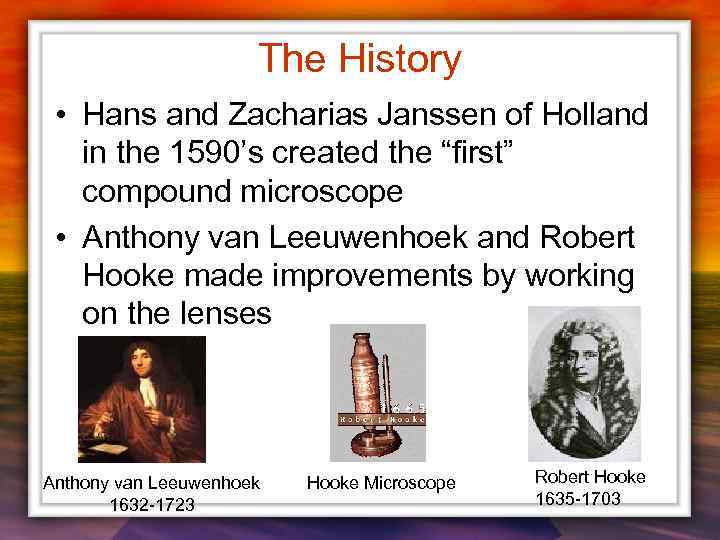 The History • Hans and Zacharias Janssen of Holland in the 1590’s created the “first” compound microscope • Anthony van Leeuwenhoek and Robert Hooke made improvements by working on the lenses Anthony van Leeuwenhoek 1632 -1723 Hooke Microscope Robert Hooke 1635 -1703
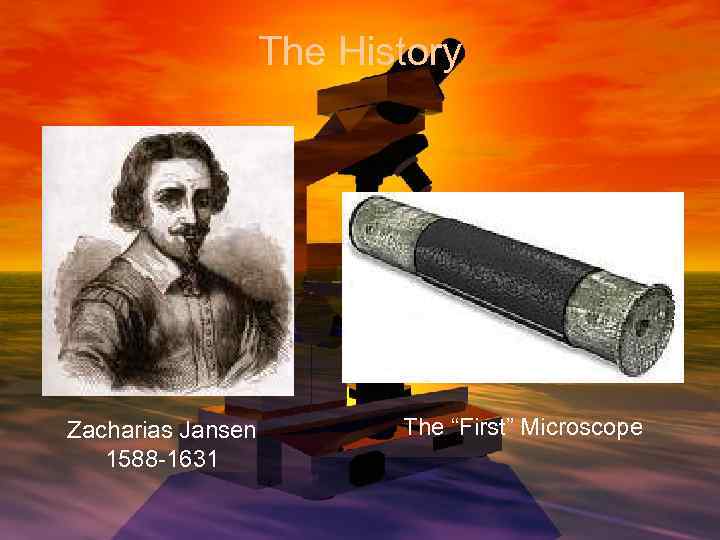 The History Zacharias Jansen 1588 -1631 The “First” Microscope
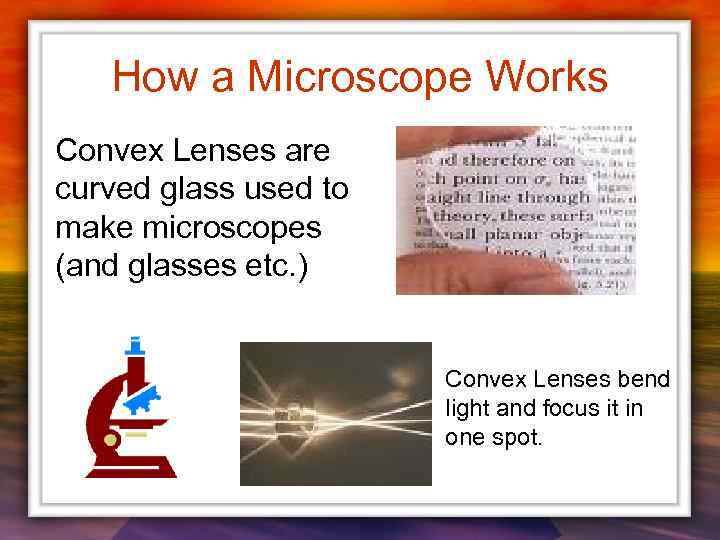 How a Microscope Works Convex Lenses are curved glass used to make microscopes (and glasses etc. ) Convex Lenses bend light and focus it in one spot.
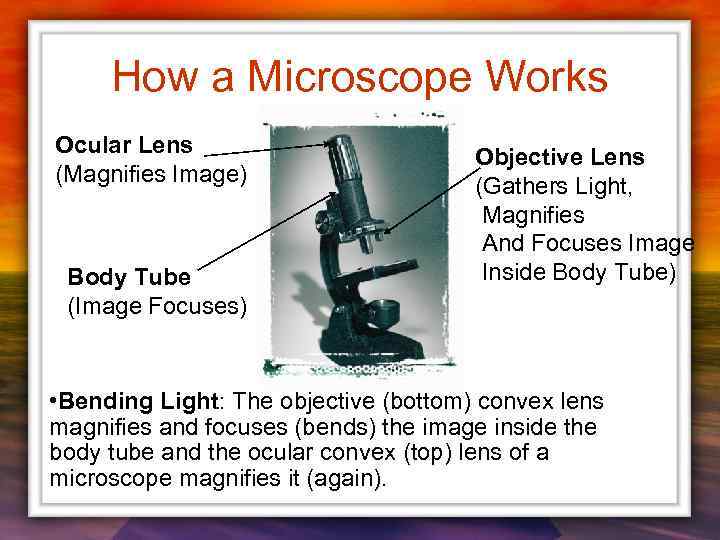 How a Microscope Works Ocular Lens (Magnifies Image) Body Tube (Image Focuses) Objective Lens (Gathers Light, Magnifies And Focuses Image Inside Body Tube) • Bending Light: The objective (bottom) convex lens magnifies and focuses (bends) the image inside the body tube and the ocular convex (top) lens of a microscope magnifies it (again).
 The Parts of a Microscope
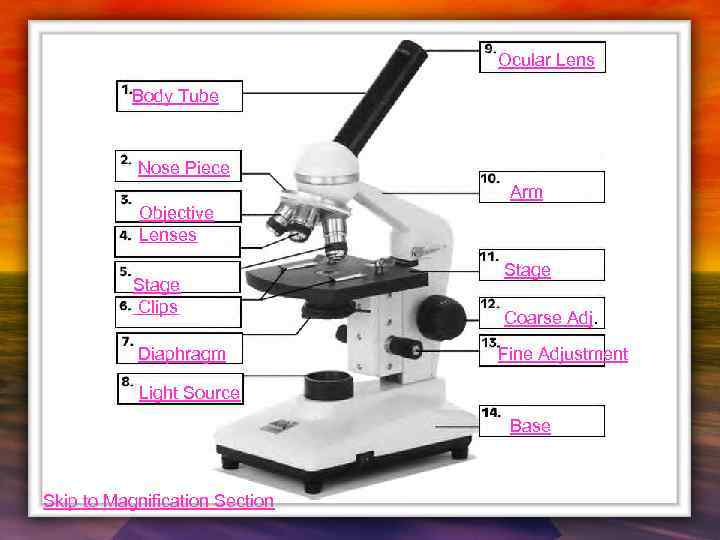 Ocular Lens Body Tube Nose Piece Arm Objective Lenses Stage Clips Diaphragm Stage Coarse Adj. Fine Adjustment Light Source Base Skip to Magnification Section
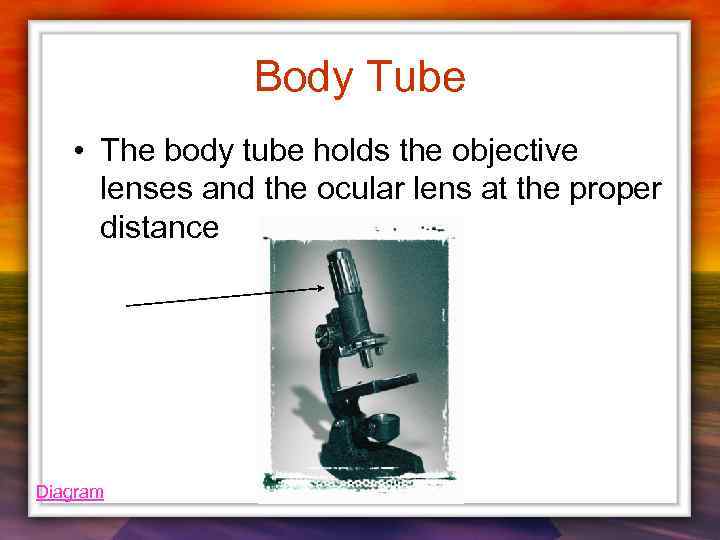 Body Tube • The body tube holds the objective lenses and the ocular lens at the proper distance Diagram
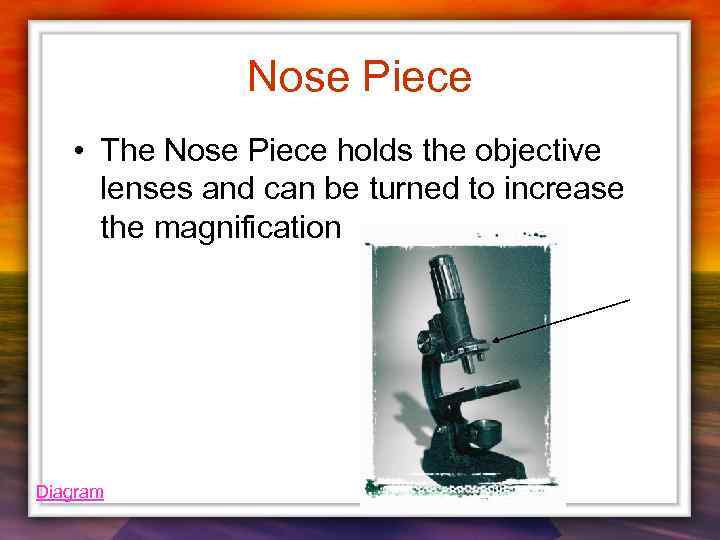 Nose Piece • The Nose Piece holds the objective lenses and can be turned to increase the magnification Diagram
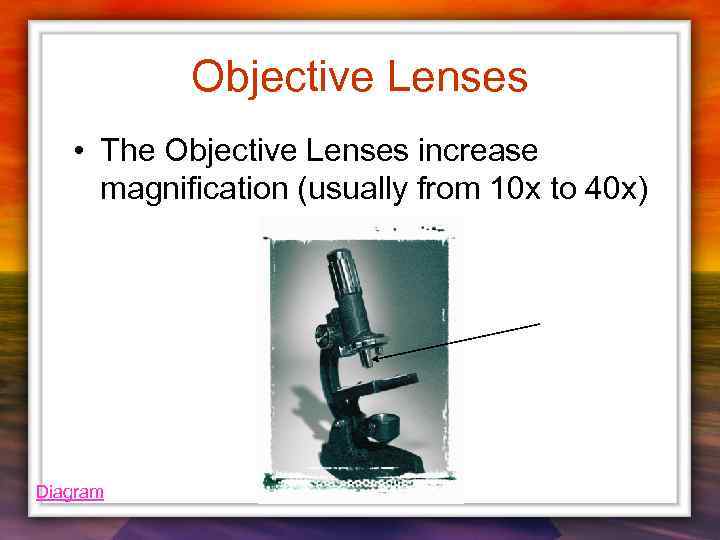 Objective Lenses • The Objective Lenses increase magnification (usually from 10 x to 40 x) Diagram
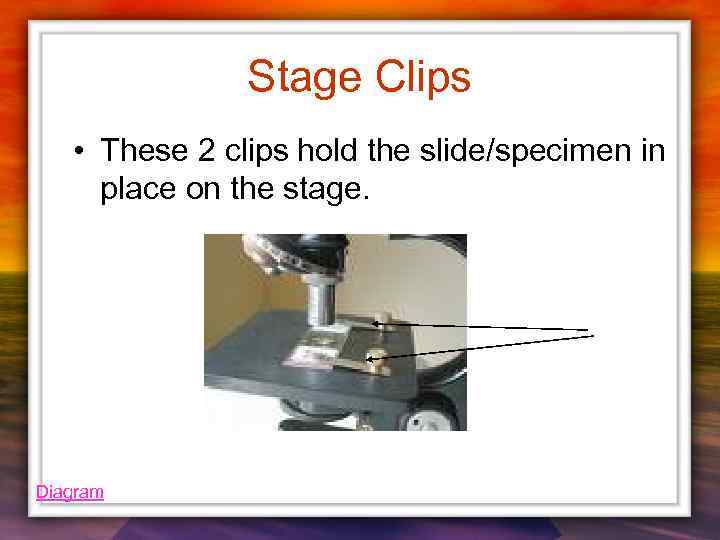 Stage Clips • These 2 clips hold the slide/specimen in place on the stage. Diagram
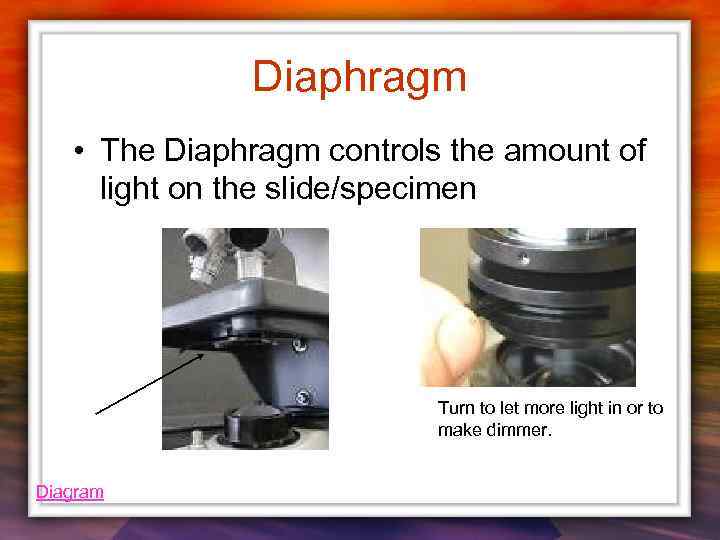 Diaphragm • The Diaphragm controls the amount of light on the slide/specimen Turn to let more light in or to make dimmer. Diagram
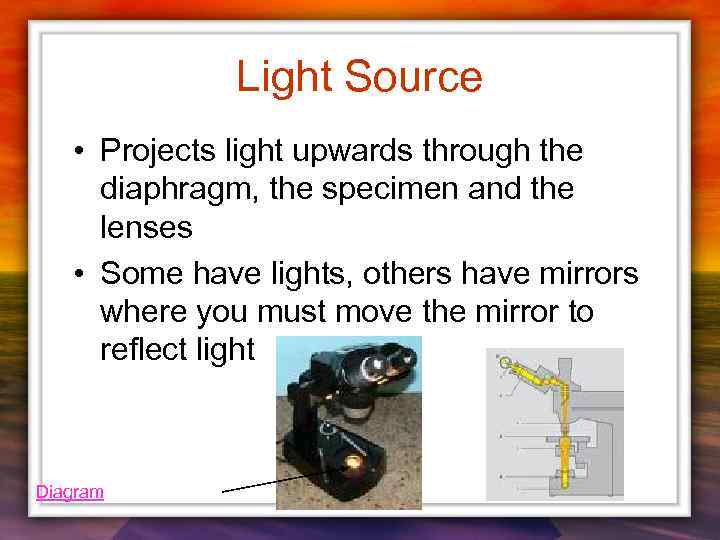 Light Source • Projects light upwards through the diaphragm, the specimen and the lenses • Some have lights, others have mirrors where you must move the mirror to reflect light Diagram
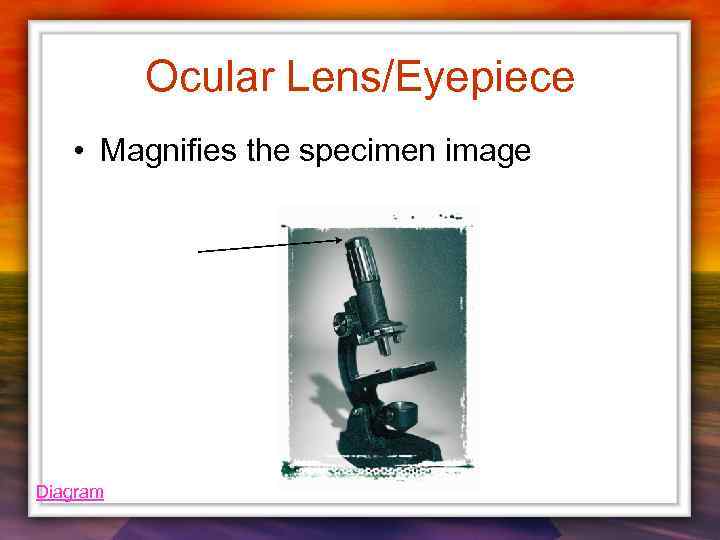 Ocular Lens/Eyepiece • Magnifies the specimen image Diagram
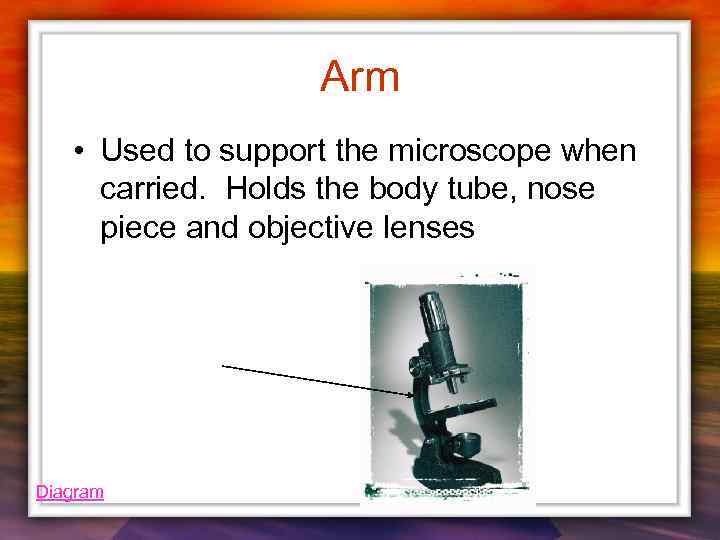 Arm • Used to support the microscope when carried. Holds the body tube, nose piece and objective lenses Diagram
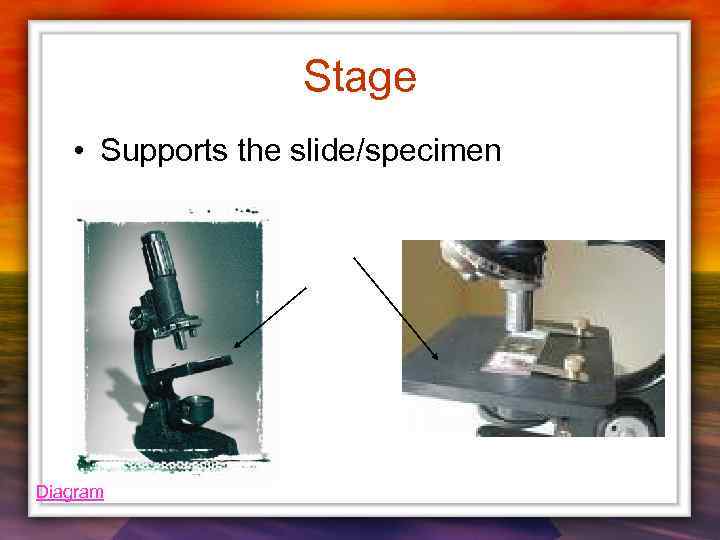 Stage • Supports the slide/specimen Diagram
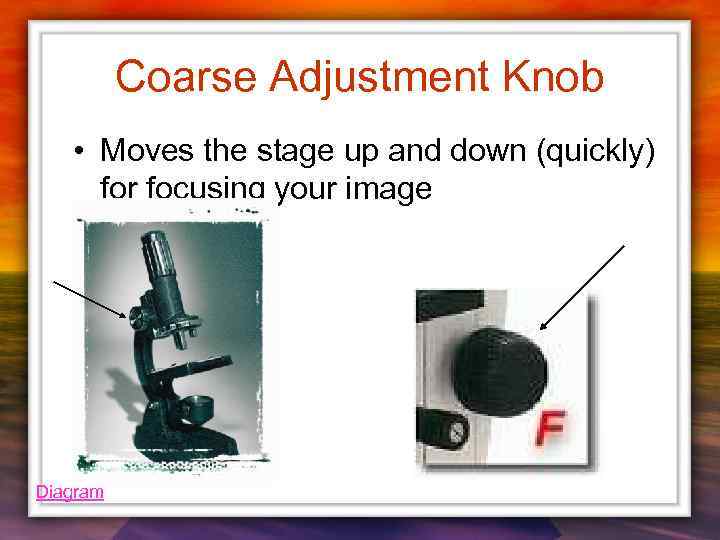 Coarse Adjustment Knob • Moves the stage up and down (quickly) for focusing your image Diagram
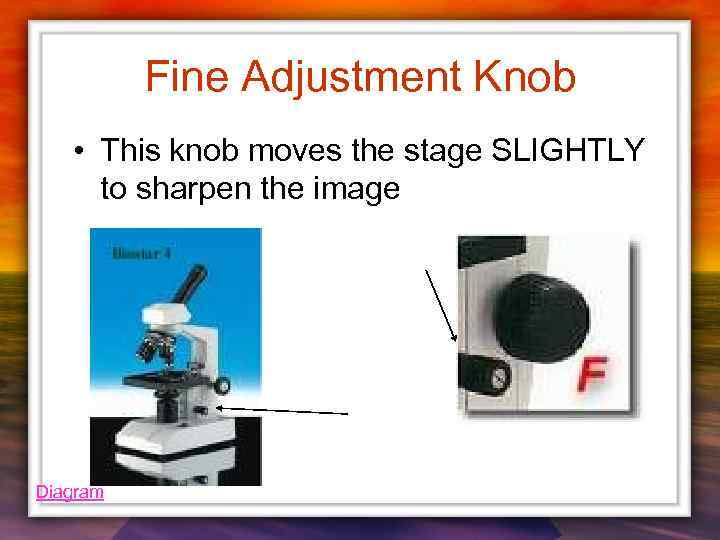 Fine Adjustment Knob • This knob moves the stage SLIGHTLY to sharpen the image Diagram
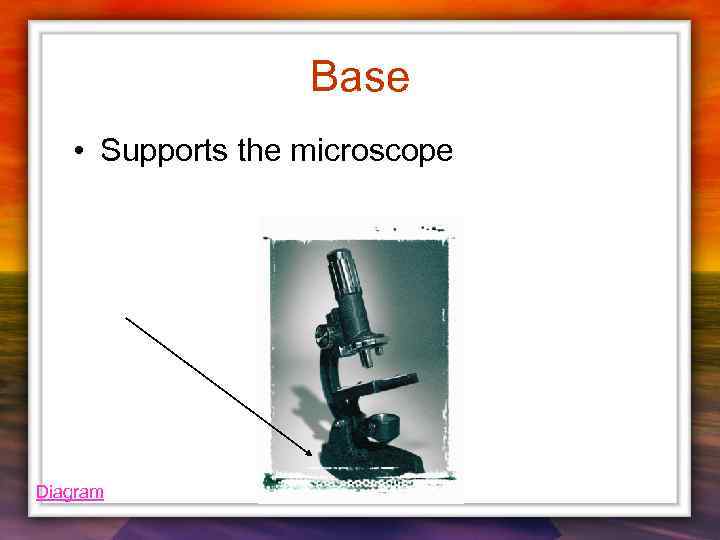 Base • Supports the microscope Diagram
 Magnification
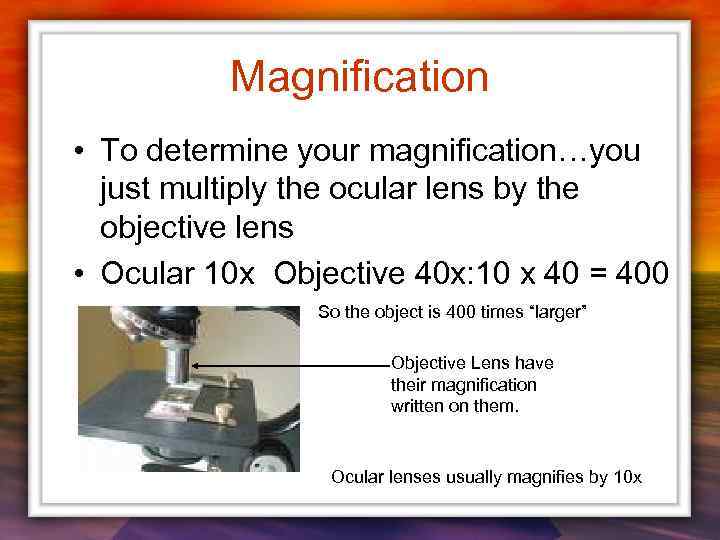 Magnification • To determine your magnification…you just multiply the ocular lens by the objective lens • Ocular 10 x Objective 40 x: 10 x 40 = 400 So the object is 400 times “larger” Objective Lens have their magnification written on them. Ocular lenses usually magnifies by 10 x
 Caring for a Microscope • Clean only with a soft cloth/tissue • Make sure it’s on a flat surface • Don’t bang it • Carry it with 2 HANDS…one on the arm and the other on the base
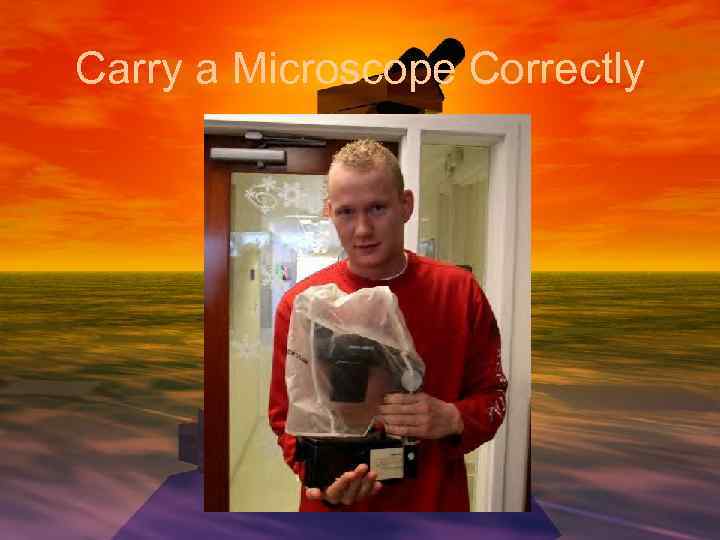 Carry a Microscope Correctly
 Using a Microscope • Start on the lowest magnification • Don’t use the coarse adjustment knob on high magnification…you’ll break the slide!!! • Place slide on stage and lock clips • Adjust light source (if it’s a mirror…don’t stand in front of it!) • Use fine adjustment to focus