 Скачать презентацию The Mental Health Tribunal for Scotland Russell Hunter
6cd69c59e6a3b9a2dcfd465e1891053b.ppt
- Количество слайдов: 24



The Mental Health Tribunal for Scotland Russell Hunter Solicitor Legal Secretary to the Tribunal SASW MHO Forum Annual Study Conference 26 October 2016
The Mental Health (Scotland) Act 2015 received Royal Assent on 4 August 2015
Background The Mental Health (Care and Treatment) (Scotland) Act 2003 Most of the Act came into force in October 2005 Mc. Manus Review of the Civil part of the 2003 Act January 2008: – establishment of group chaired by Professor Jim Mc. Manus to undertake a limited review of the 2003 Act announced by Scottish Ministers March 2009: – group report published, making 114 recommendations to Scottish Ministers November 2009: – Scottish Government issued consultation paper seeking views on the group’s recommendations and “some further options” offered by Ministers March 2010: – having considered 82 responses, Scottish Government published a Review of Mental Health Law Consultation Analysis and the Main Findings of that Analysis
Background The Mental Health (Scotland) Act 2015 December 2013: – Scottish Government published a consultation on proposals for a Mental Health (Scotland) Bill along with draft Bill provisions April 2014: – Scottish Government published Responses to the Consultation June 2014: – Bill introduced in the Scottish Parliament September – December 2014: – Health and Sport Committee heard evidence at Stage 1 May 2015: – over 2 days, Bill amended at Stage 2 24 June 2015: – Bill amended and passed at Stage 3 4 August 2015: – Bill received Royal Assent
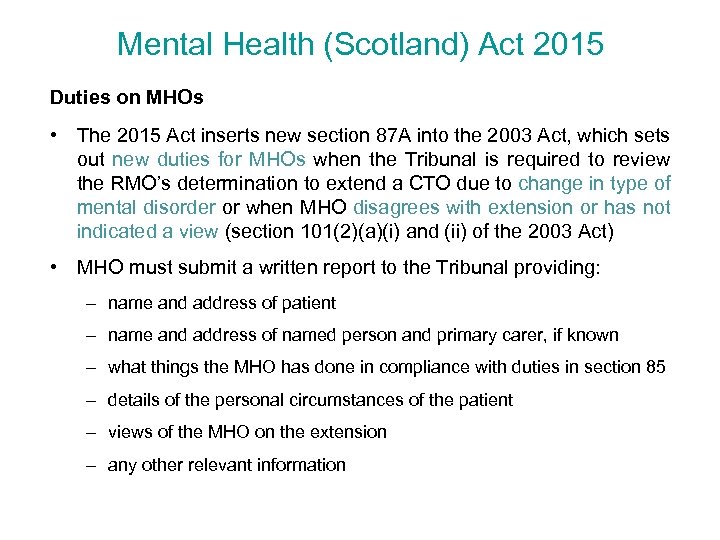
Mental Health (Scotland) Act 2015 Duties on MHOs • The 2015 Act inserts new section 87 A into the 2003 Act, which sets out new duties for MHOs when the Tribunal is required to review the RMO’s determination to extend a CTO due to change in type of mental disorder or when MHO disagrees with extension or has not indicated a view (section 101(2)(a)(i) and (ii) of the 2003 Act) • MHO must submit a written report to the Tribunal providing: – name and address of patient – name and address of named person and primary carer, if known – what things the MHO has done in compliance with duties in section 85 – details of the personal circumstances of the patient – views of the MHO on the extension – any other relevant information
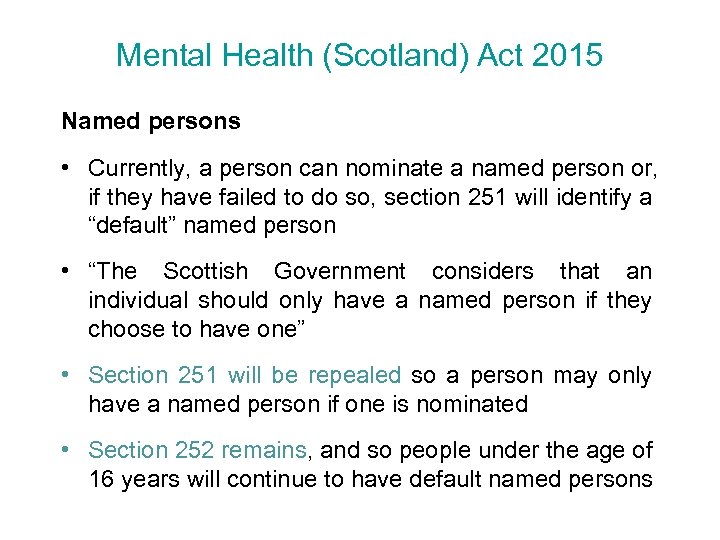
Mental Health (Scotland) Act 2015 Named persons • Currently, a person can nominate a named person or, if they have failed to do so, section 251 will identify a “default” named person • “The Scottish Government considers that an individual should only have a named person if they choose to have one” • Section 251 will be repealed so a person may only have a named person if one is nominated • Section 252 remains, and so people under the age of 16 years will continue to have default named persons
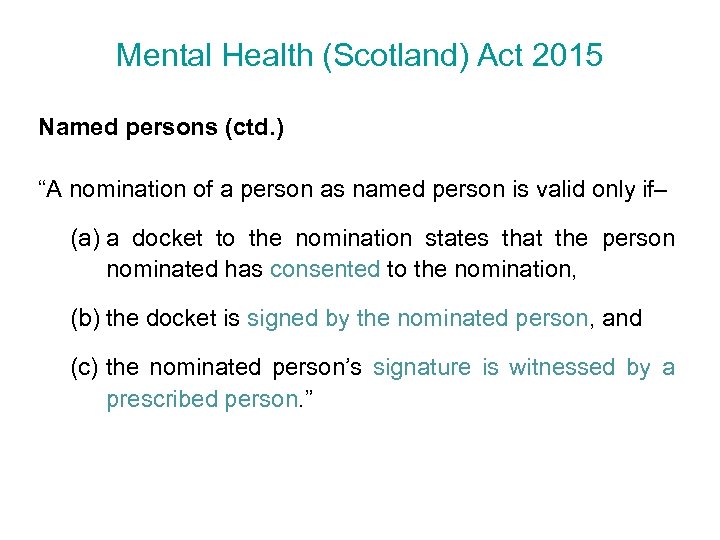
Mental Health (Scotland) Act 2015 Named persons (ctd. ) “A nomination of a person as named person is valid only if– (a) a docket to the nomination states that the person nominated has consented to the nomination, (b) the docket is signed by the nominated person, and (c) the nominated person’s signature is witnessed by a prescribed person. ”
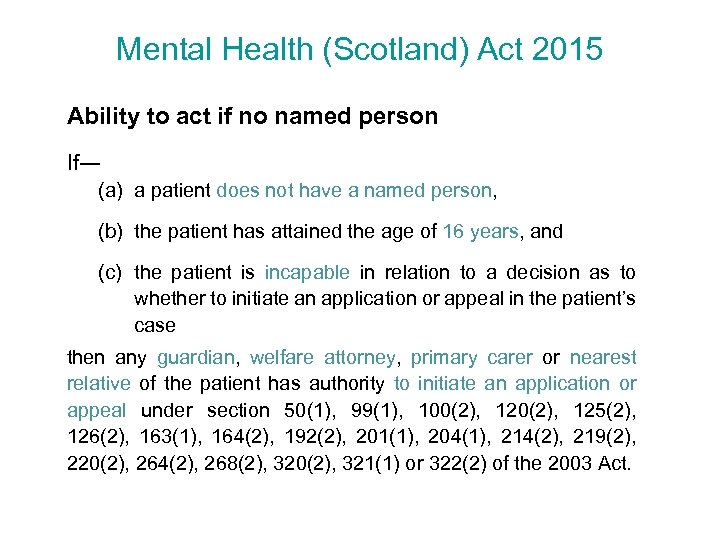
Mental Health (Scotland) Act 2015 Ability to act if no named person If― (a) a patient does not have a named person, (b) the patient has attained the age of 16 years, and (c) the patient is incapable in relation to a decision as to whether to initiate an application or appeal in the patient’s case then any guardian, welfare attorney, primary carer or nearest relative of the patient has authority to initiate an application or appeal under section 50(1), 99(1), 100(2), 125(2), 126(2), 163(1), 164(2), 192(2), 201(1), 204(1), 214(2), 219(2), 220(2), 264(2), 268(2), 320(2), 321(1) or 322(2) of the 2003 Act.
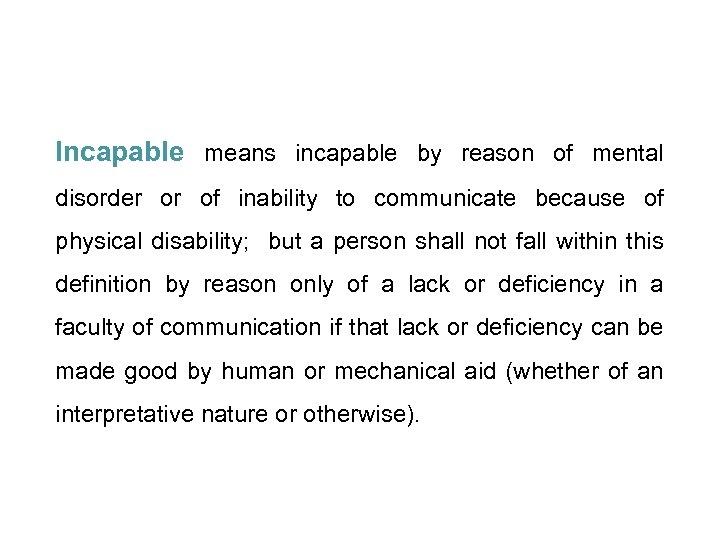
Incapable means incapable by reason of mental disorder or of inability to communicate because of physical disability; but a person shall not fall within this definition by reason only of a lack or deficiency in a faculty of communication if that lack or deficiency can be made good by human or mechanical aid (whether of an interpretative nature or otherwise).
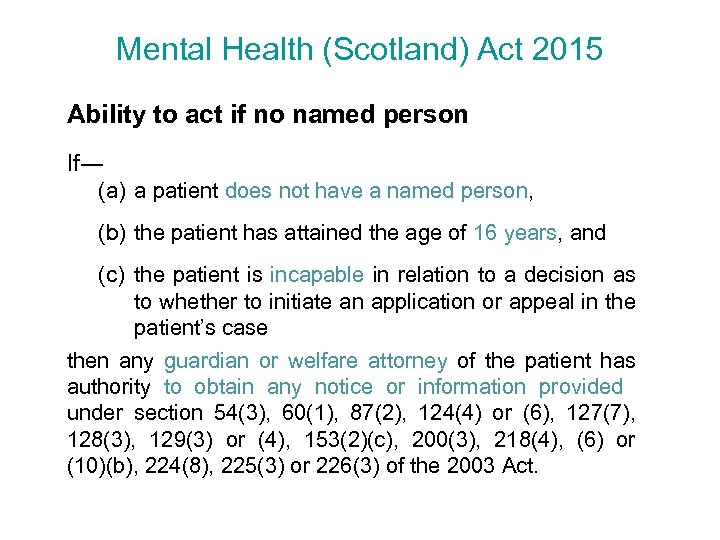
Mental Health (Scotland) Act 2015 Ability to act if no named person If― (a) a patient does not have a named person, (b) the patient has attained the age of 16 years, and (c) the patient is incapable in relation to a decision as to whether to initiate an application or appeal in the patient’s case then any guardian or welfare attorney of the patient has authority to obtain any notice or information provided under section 54(3), 60(1), 87(2), 124(4) or (6), 127(7), 128(3), 129(3) or (4), 153(2)(c), 200(3), 218(4), (6) or (10)(b), 224(8), 225(3) or 226(3) of the 2003 Act.
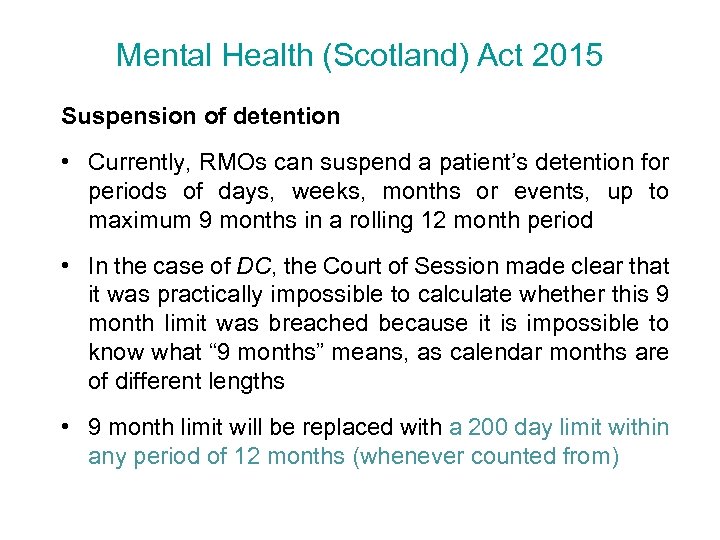
Mental Health (Scotland) Act 2015 Suspension of detention • Currently, RMOs can suspend a patient’s detention for periods of days, weeks, months or events, up to maximum 9 months in a rolling 12 month period • In the case of DC, the Court of Session made clear that it was practically impossible to calculate whether this 9 month limit was breached because it is impossible to know what “ 9 months” means, as calendar months are of different lengths • 9 month limit will be replaced with a 200 day limit within any period of 12 months (whenever counted from)
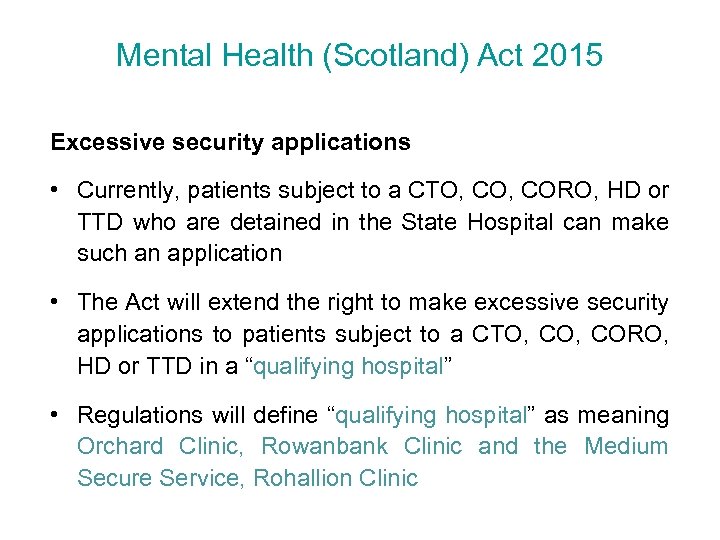
Mental Health (Scotland) Act 2015 Excessive security applications • Currently, patients subject to a CTO, CORO, HD or TTD who are detained in the State Hospital can make such an application • The Act will extend the right to make excessive security applications to patients subject to a CTO, CORO, HD or TTD in a “qualifying hospital” • Regulations will define “qualifying hospital” as meaning Orchard Clinic, Rowanbank Clinic and the Medium Secure Service, Rohallion Clinic
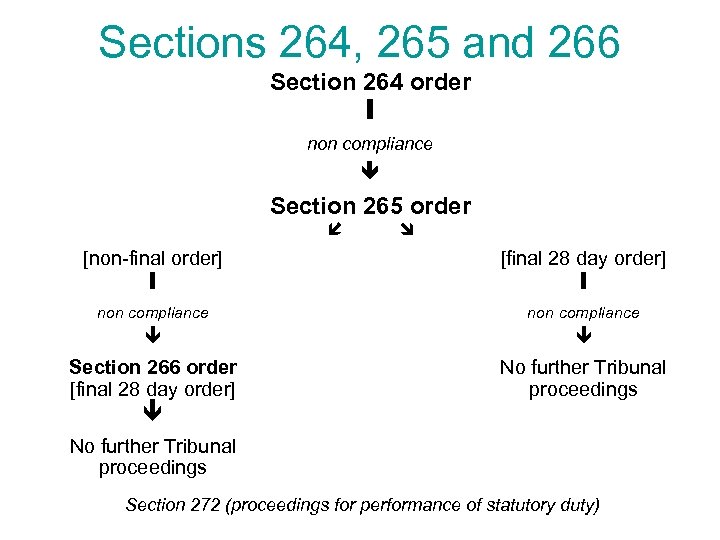
Sections 264, 265 and 266 Section 264 order I non compliance Section 265 order [non-final order] [final 28 day order] non compliance Section 266 order [final 28 day order] No further Tribunal proceedings I I No further Tribunal proceedings Section 272 (proceedings for performance of statutory duty)
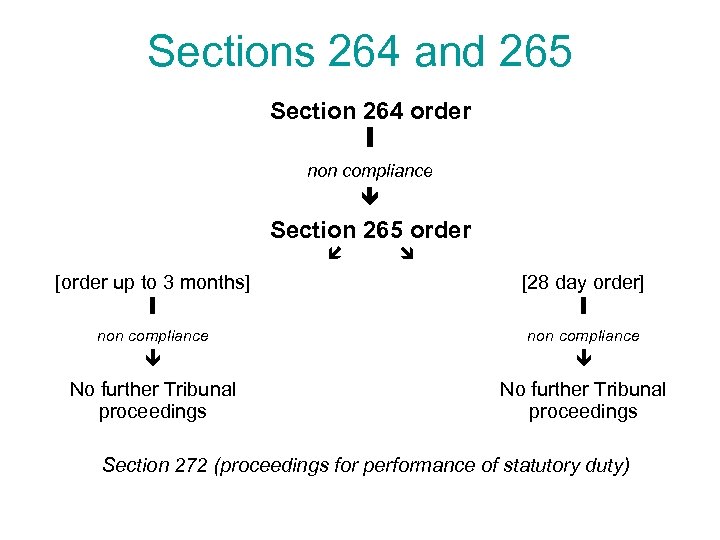
Sections 264 and 265 Section 264 order I non compliance Section 265 order [order up to 3 months] [28 day order] non compliance No further Tribunal proceedings I I Section 272 (proceedings for performance of statutory duty)
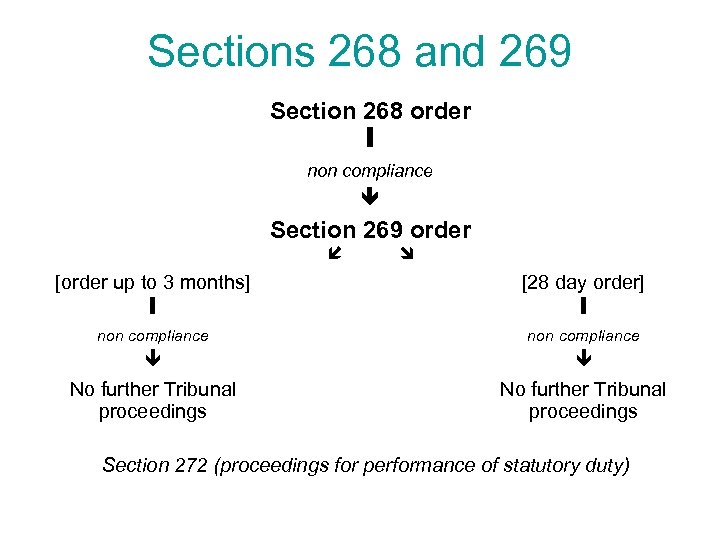
Sections 268 and 269 Section 268 order I non compliance Section 269 order [order up to 3 months] [28 day order] non compliance No further Tribunal proceedings I I Section 272 (proceedings for performance of statutory duty)
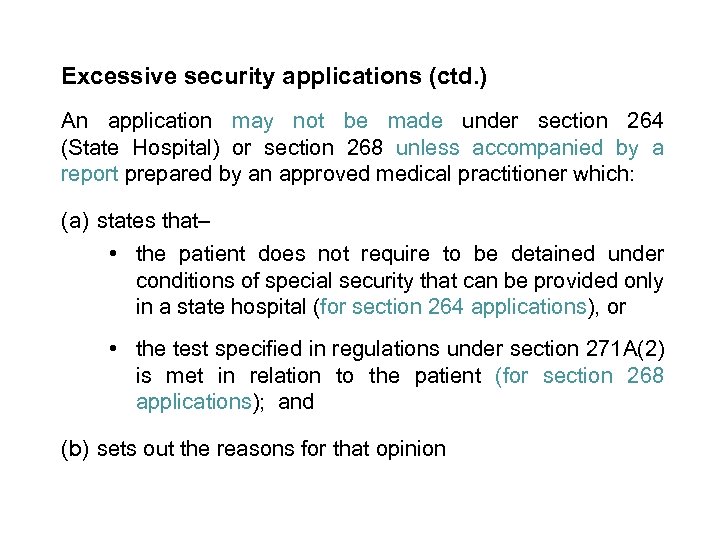
Excessive security applications (ctd. ) An application may not be made under section 264 (State Hospital) or section 268 unless accompanied by a report prepared by an approved medical practitioner which: (a) states that– • the patient does not require to be detained under conditions of special security that can be provided only in a state hospital (for section 264 applications), or • the test specified in regulations under section 271 A(2) is met in relation to the patient (for section 268 applications); and (b) sets out the reasons for that opinion
Section 271 A Regulation-making powers (2) Regulations may specify the test for the purposes of sections 268(2), 269(3) and 271(2)(a) of this Act (3) Regulations under subsection (2) above specifying the test― (a) must include as a requirement for the test to be met in relation to a patient that the Tribunal be satisfied that detention of the patient in the hospital in which the patient is being detained involves the patient being subject to a level of security that is excessive in the patient’s case, and (b) may include further requirements for the test to be met in relation to a patient. (4) Regulations may make provisions about when, for the purposes of― (a) any regulations made under subsection (2) above, and (b) sections 268 to 271 of this Act, a patient’s detention in a hospital is to be taken to involve the patient being subject to a level of security that is excessive in the patient’s case.
The Mental Health (Detention in Conditions of Excessive Security) (Scotland) Regulations 2015 Test to be applied under sections 268(2), 269(3) and 271(2)(a) of the 2003 Act 5 The test for the purposes of sections 268(2), 269(3) and 271(2)(a) of the 2003 Act is met in relation to a patient if detention of the patient in the hospital in which the patient is being detained involves the patient being subject to a level of security that is excessive in the patient’s case. Further provision about when a hospital’s level of security is excessive 6 (1) Paragraph (2) makes provision for the purposes of― (a) sections 268 to 271 of the 2003 Act; and (b) regulation 5. (2) A patient’s detention in a hospital is to be taken to involve the patient being subject to a level of security that is excessive in the patient’s case only when the security at the hospital is greater than is necessary to safely manage the risk that the patient may pose to― (a) the patient’s own safety; and (b) the safety of any other person.
Excessive Security Statistics Since 16 November 2016, 45 section 268 applications the Tribunal has received v 34 from restricted patients and 11 from civil patients v 17 applications returned as not accompanied by AMP report or report did not meet criteria in section 268(7 A) v 5 patients transferred before first hearing v 1 application refused v 1 application withdrawn v 1 application held by Tribunal to be misconceived v 5 awaiting outcome v 15 applications granted
Mental Health (Scotland) Act 2015 Victim notification scheme • Currently, the Tribunal requires to give victims and family members of victims the opportunity to make representations (orally or in writing) because the provisions of the 2003 Act require it to afford such rights to “any … person appearing to the Tribunal to have an interest” in the case before the Tribunal
Victim Notification Scheme (ctd. ) Victims will have the right to receive information about patients subject to a CORO. Victims • person who was subject of the offence • if that person is dead, then any or all of the four persons listed highest in this list: – spouse – cohabitee – son, daughter or person in respect of whom deceased had parental rights – father or mother or person who had parental rights in respect of the deceased – brother or sister – grandparent – grandchild – uncle or aunt – nephew or niece
Victim Notification Scheme (ctd. ) Information: – compulsion order revoked – restriction order revoked – compulsion order varied – conditional discharge granted – terms of the conditions of discharge – patient recalled to hospital – patient transferred outwith Scotland – date of patient’s death – patient unlawfully at large from hospital – patient returned to hospital after absconding – first certificate granting unaccompanied suspension of detention and revocation of that certificate
Victim Notification Scheme (ctd. ) Victims will have the right to make representations about patients subject to a CORO, a hospital direction (HD) or a transfer for treatment direction (TTD) Victims: as before Representations: • re HD and TTD patients – to RMO about granting for the first time unaccompanied suspension of detention • re CORO patients – to RMO about granting for the first time unaccompanied suspension of detention – to the Scottish Ministers before making decision to impose, alter or remove conditions of discharge relevant to the victim – to the Tribunal before making decision under section 193 of 2003 Act
Tribunal issues Ø Non-disclosure requests v provide detailed reasons Ø Curator requests Ø Adjournment requests Ø Data Protection Act 1998 v importance of providing correct contact details for named persons
Скачать презентацию The Mental Health Tribunal for Scotland Russell Hunter
6cd69c59e6a3b9a2dcfd465e1891053b.ppt