 Скачать презентацию The Medicare Drug Benefit Beyond the Basics Third
b0c7b9b523a85979c44ac12bcbab741b.ppt
- Количество слайдов: 70



The Medicare Drug Benefit: Beyond the Basics Third National Medicare Congress October 15, 2006 Avalere Health LLC | The intersection of business strategy and public policy
Welcome ¡ Third National Medicare Congress ¡ Powered by Avalere Health LLC ¡ Medicare Drug Benefit: Beyond the Basics © Avalere Health LLC Page 2
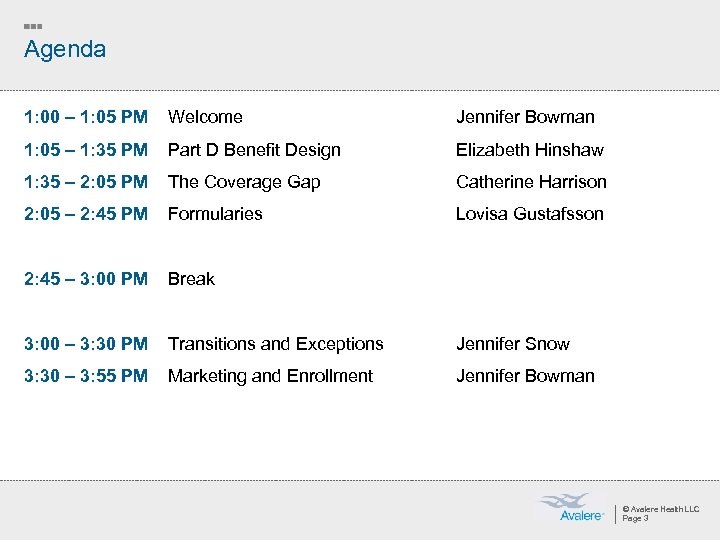
Agenda 1: 00 – 1: 05 PM Welcome Jennifer Bowman 1: 05 – 1: 35 PM Part D Benefit Design Elizabeth Hinshaw 1: 35 – 2: 05 PM The Coverage Gap Catherine Harrison 2: 05 – 2: 45 PM Formularies Lovisa Gustafsson 2: 45 – 3: 00 PM Break 3: 00 – 3: 30 PM Transitions and Exceptions 3: 30 – 3: 55 PM Marketing and Enrollment Jennifer Snow Jennifer Bowman © Avalere Health LLC Page 3
Beyond the Basics: Benefit Design The intersection of business strategy and public policy
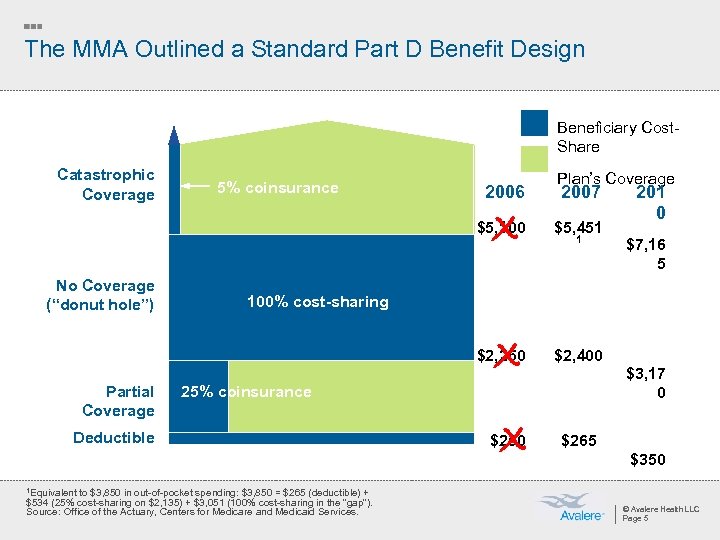
The MMA Outlined a Standard Part D Benefit Design Beneficiary Cost. Share Catastrophic Coverage 5% coinsurance 2006 Plan’s Coverage 2007 $5, 100 X X No Coverage (“donut hole”) $5, 451 $2, 400 1 $7, 16 5 100% cost-sharing $2, 250 Partial Coverage 201 0 $3, 17 0 25% coinsurance Deductible X $250 $265 $350 1 Equivalent to $3, 850 in out-of-pocket spending: $3, 850 = $265 (deductible) + $534 (25% cost-sharing on $2, 135) + $3, 051 (100% cost-sharing in the “gap”). Source: Office of the Actuary, Centers for Medicare and Medicaid Services. © Avalere Health LLC Page 5
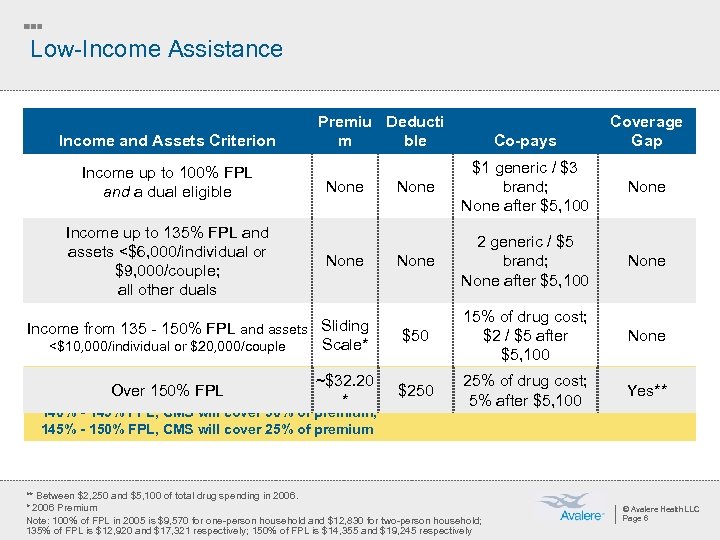
Low-Income Assistance Income and Assets Criterion Income up to 100% FPL and a dual eligible Income up to 135% FPL and assets <$6, 000/individual or $9, 000/couple; all other duals Premiu Deducti m ble None Income from 135 - 150% FPL and assets Sliding Scale* <$10, 000/individual or $20, 000/couple * Sliding scale premium defined ~$32. 20 Over 150% FPLcover 75% of premium; 135% - 140% FPL, CMS will * 140% - 145% FPL, CMS will cover 50% of premium; 145% - 150% FPL, CMS will cover 25% of premium Co-pays Coverage Gap None $1 generic / $3 brand; None after $5, 100 None 2 generic / $5 brand; None after $5, 100 None $50 15% of drug cost; $2 / $5 after $5, 100 None $250 25% of drug cost; 5% after $5, 100 Yes** ** Between $2, 250 and $5, 100 of total drug spending in 2006. * 2006 Premium Note: 100% of FPL in 2005 is $9, 570 for one-person household and $12, 830 for two-person household; 135% of FPL is $12, 920 and $17, 321 respectively; 150% of FPL is $14, 355 and $19, 245 respectively © Avalere Health LLC Page 6
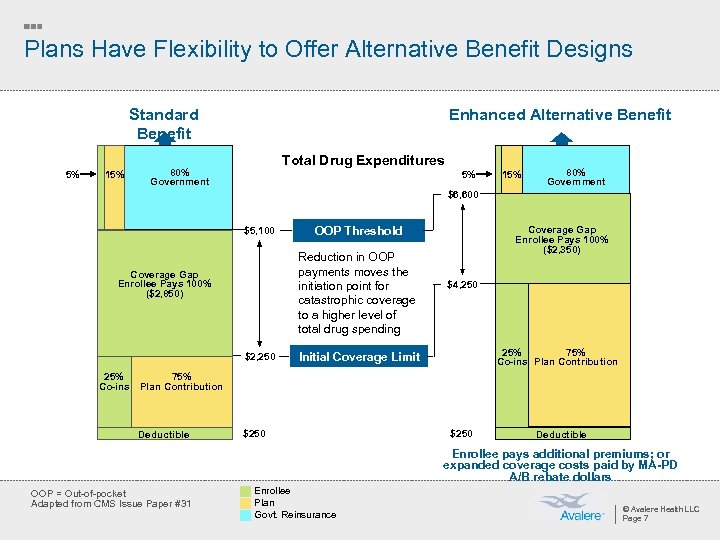
Plans Have Flexibility to Offer Alternative Benefit Designs Standard Benefit 5% 15% Enhanced Alternative Benefit Total Drug Expenditures 80% Government 5% 15% 80% Government $6, 600 $5, 100 Reduction in OOP payments moves the initiation point for catastrophic coverage to a higher level of total drug spending Coverage Gap Enrollee Pays 100% ($2, 850) $2, 250 25% Co-ins OOP Threshold Coverage Gap Enrollee Pays 100% ($2, 350) $4, 250 25% 75% Co-ins Plan Contribution Initial Coverage Limit 75% Plan Contribution Deductible $250 Deductible Enrollee pays additional premiums; or expanded coverage costs paid by MA-PD A/B rebate dollars OOP = Out-of-pocket Adapted from CMS Issue Paper #31 Enrollee Plan Govt. Reinsurance © Avalere Health LLC Page 7
Most Plans Altered Benefit Design ¡ Very few plans used the standard benefit design (with $250 deductible and 25% coinsurance) » Many offered actuarially equivalent or alternative coverage (e. g. , using tiered copays or reducing the deductible) » Some plans offered enhanced coverage, which may reduce the deductible or provide some coverage in the coverage gap © Avalere Health LLC Page 8
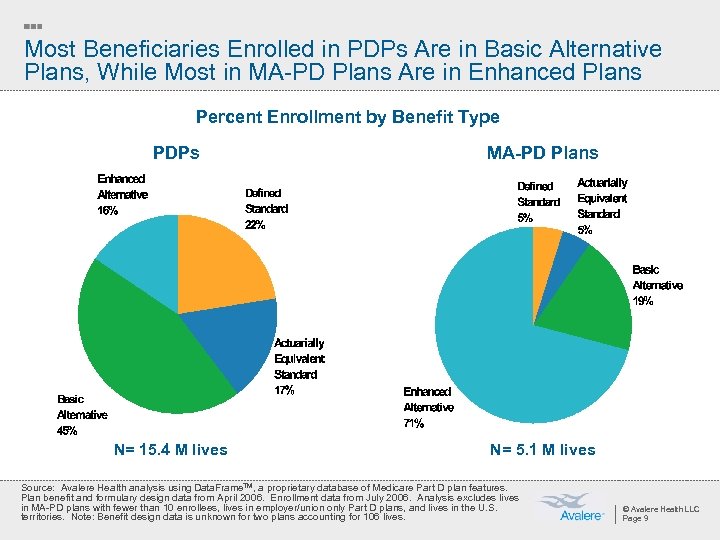
Most Beneficiaries Enrolled in PDPs Are in Basic Alternative Plans, While Most in MA-PD Plans Are in Enhanced Plans Percent Enrollment by Benefit Type PDPs N= 15. 4 M lives MA-PD Plans N= 5. 1 M lives Source: Avalere Health analysis using Data. Frame. TM, a proprietary database of Medicare Part D plan features. Plan benefit and formulary design data from April 2006. Enrollment data from July 2006. Analysis excludes lives in MA-PD plans with fewer than 10 enrollees, lives in employer/union only Part D plans, and lives in the U. S. territories. Note: Benefit design data is unknown for two plans accounting for 106 lives. © Avalere Health LLC Page 9
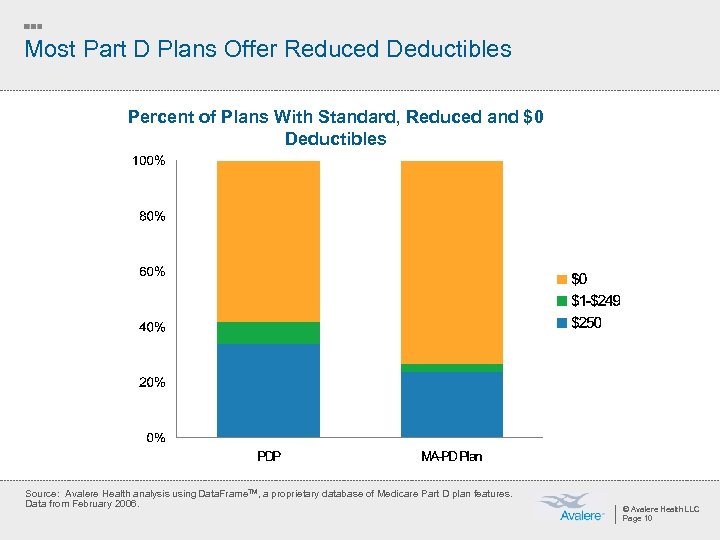
Most Part D Plans Offer Reduced Deductibles Percent of Plans With Standard, Reduced and $0 Deductibles Source: Avalere Health analysis using Data. Frame. TM, a proprietary database of Medicare Part D plan features. Data from February 2006. © Avalere Health LLC Page 10
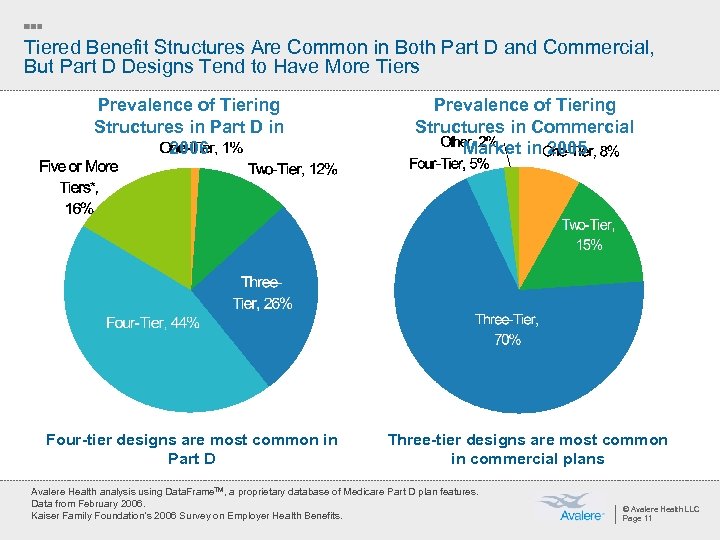
Tiered Benefit Structures Are Common in Both Part D and Commercial, But Part D Designs Tend to Have More Tiers Prevalence of Tiering Structures in Part D in 2006 Prevalence of Tiering Structures in Commercial Market in 2005 Four-tier designs are most common in Part D Three-tier designs are most common in commercial plans Avalere Health analysis using Data. Frame. TM, a proprietary database of Medicare Part D plan features. Data from February 2006. Kaiser Family Foundation’s 2006 Survey on Employer Health Benefits. © Avalere Health LLC Page 11
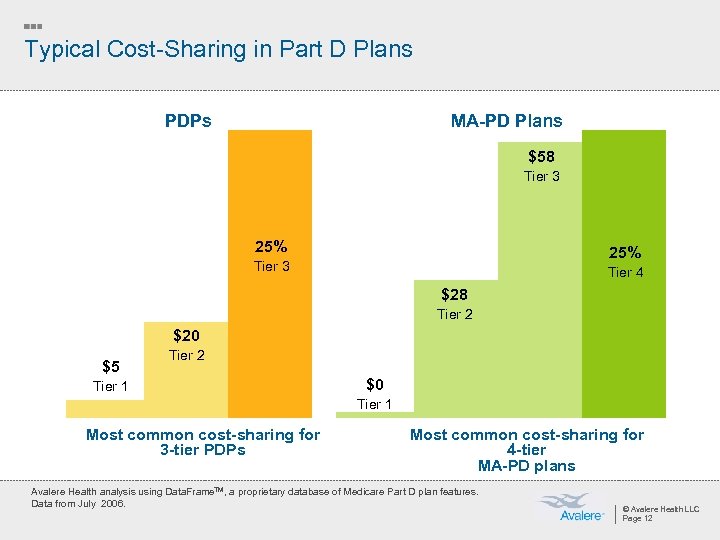
Typical Cost-Sharing in Part D Plans PDPs MA-PD Plans $58 Tier 3 25% Tier 3 Tier 4 $28 Tier 2 $20 $5 Tier 2 Tier 1 $0 Tier 1 Most common cost-sharing for 3 -tier PDPs Most common cost-sharing for 4 -tier MA-PD plans Avalere Health analysis using Data. Frame. TM, a proprietary database of Medicare Part D plan features. Data from July 2006. © Avalere Health LLC Page 12
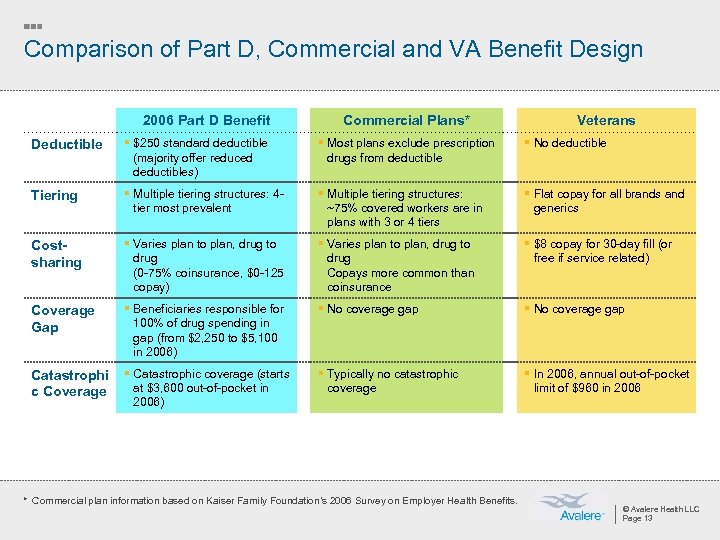
Comparison of Part D, Commercial and VA Benefit Design 2006 Part D Benefit Commercial Plans* Veterans Deductible § $250 standard deductible (majority offer reduced deductibles) § Most plans exclude prescription drugs from deductible § No deductible Tiering § Multiple tiering structures: 4 tier most prevalent § Multiple tiering structures: ~75% covered workers are in plans with 3 or 4 tiers § Flat copay for all brands and generics Costsharing § Varies plan to plan, drug to drug (0 -75% coinsurance, $0 -125 copay) § Varies plan to plan, drug to drug Copays more common than coinsurance § $8 copay for 30 -day fill (or free if service related) Coverage Gap § Beneficiaries responsible for 100% of drug spending in gap (from $2, 250 to $5, 100 in 2006) § No coverage gap Catastrophi c Coverage § Catastrophic coverage (starts at $3, 600 out-of-pocket in 2006) § Typically no catastrophic coverage § In 2006, annual out-of-pocket limit of $960 in 2006 * Commercial plan information based on Kaiser Family Foundation’s 2006 Survey on Employer Health Benefits. © Avalere Health LLC Page 13
Beyond the Basics: The Coverage Gap The intersection of business strategy and public policy
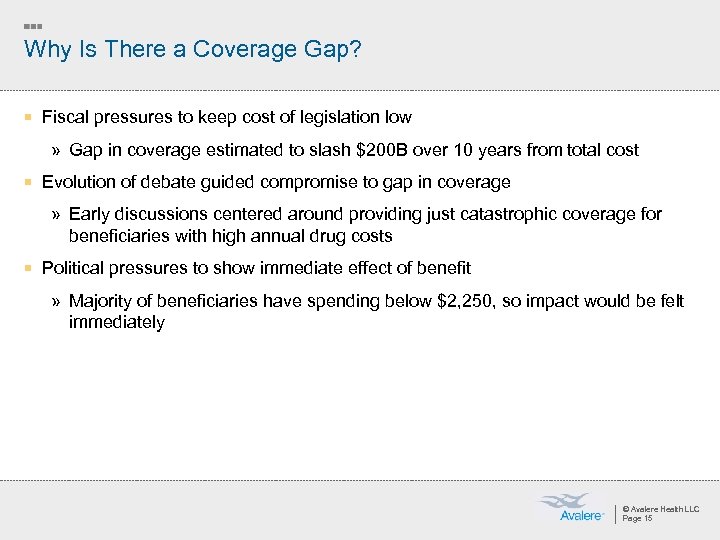
Why Is There a Coverage Gap? ¡ Fiscal pressures to keep cost of legislation low » Gap in coverage estimated to slash $200 B over 10 years from total cost ¡ Evolution of debate guided compromise to gap in coverage » Early discussions centered around providing just catastrophic coverage for beneficiaries with high annual drug costs ¡ Political pressures to show immediate effect of benefit » Majority of beneficiaries have spending below $2, 250, so impact would be felt immediately © Avalere Health LLC Page 15
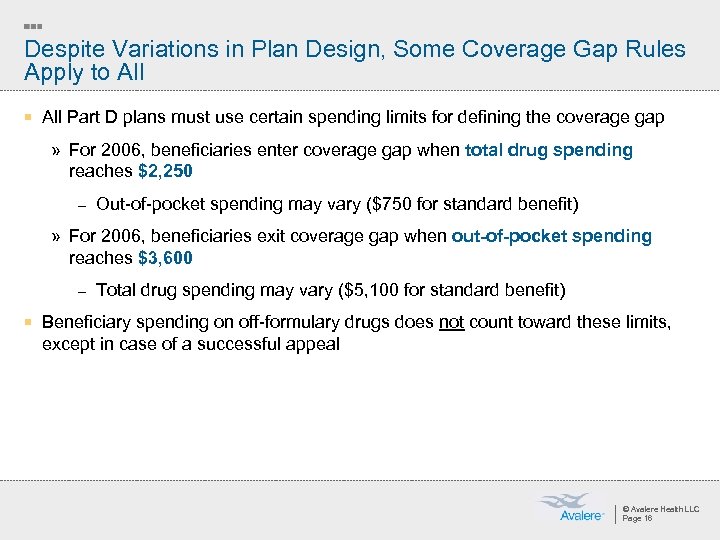
Despite Variations in Plan Design, Some Coverage Gap Rules Apply to All ¡ All Part D plans must use certain spending limits for defining the coverage gap » For 2006, beneficiaries enter coverage gap when total drug spending reaches $2, 250 – Out-of-pocket spending may vary ($750 for standard benefit) » For 2006, beneficiaries exit coverage gap when out-of-pocket spending reaches $3, 600 – Total drug spending may vary ($5, 100 for standard benefit) ¡ Beneficiary spending on off-formulary drugs does not count toward these limits, except in case of a successful appeal © Avalere Health LLC Page 16
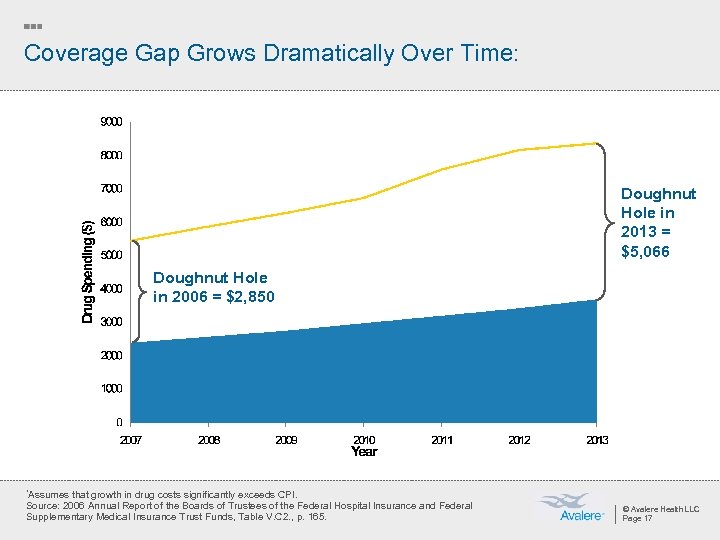
Coverage Gap Grows Dramatically Over Time: Doughnut Hole in 2013 = $5, 066 Doughnut Hole in 2006 = $2, 850 *Assumes that growth in drug costs significantly exceeds CPI. Source: 2006 Annual Report of the Boards of Trustees of the Federal Hospital Insurance and Federal Supplementary Medical Insurance Trust Funds, Table V. C 2. , p. 165. © Avalere Health LLC Page 17
Only “True Out of Pocket” Costs (Tr. OOP) Count Toward Meeting the $3, 600 Catastrophic Threshold Payments that count toward Tr. OOP include: ¡ Deductibles and cost-sharing formulary drugs paid by the Part D enrollee or another “person” (such as a family member) on their behalf ¡ Cost-sharing assistance from a qualified State Pharmaceutical Assistance Program (SPAP) ¡ Spending from HSAs, FSAs, and MSAs ¡ Copay assistance from certain charities or manufacturer patient assistance programs ¡ Waivers of Part D cost-sharing by pharmacies at the point of sale (must be unadvertised and non-routine) © Avalere Health LLC Page 18
Some Spending Does Not Count Toward the Tr. OOP Threshold Tr. OOP does NOT include: ¡ Spending on non-formulary drugs ¡ Spending on drugs not covered by Part D at all (e. g. weight loss agents, barbiturates, benzodiazepines, etc. ) ¡ Spending by a group health insurance plan (e. g. employer coverage, Medigap coverage) © Avalere Health LLC Page 19
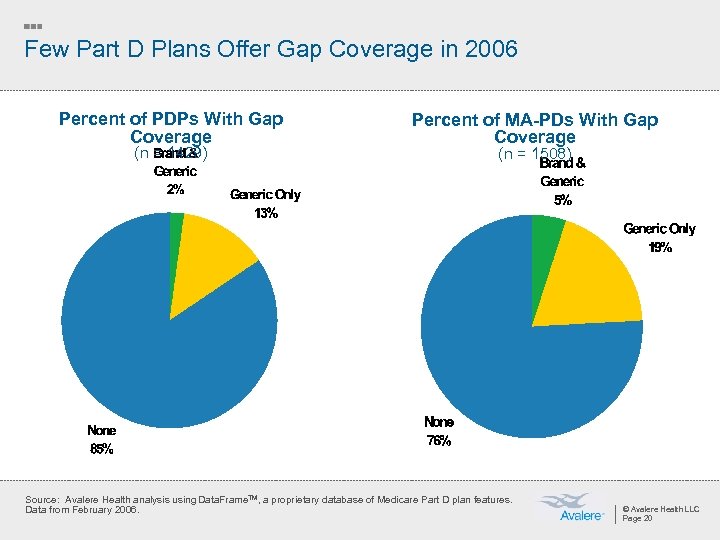
Few Part D Plans Offer Gap Coverage in 2006 Percent of PDPs With Gap Coverage (n = 1429) Percent of MA-PDs With Gap Coverage (n = 1508) Source: Avalere Health analysis using Data. Frame. TM, a proprietary database of Medicare Part D plan features. Data from February 2006. © Avalere Health LLC Page 20
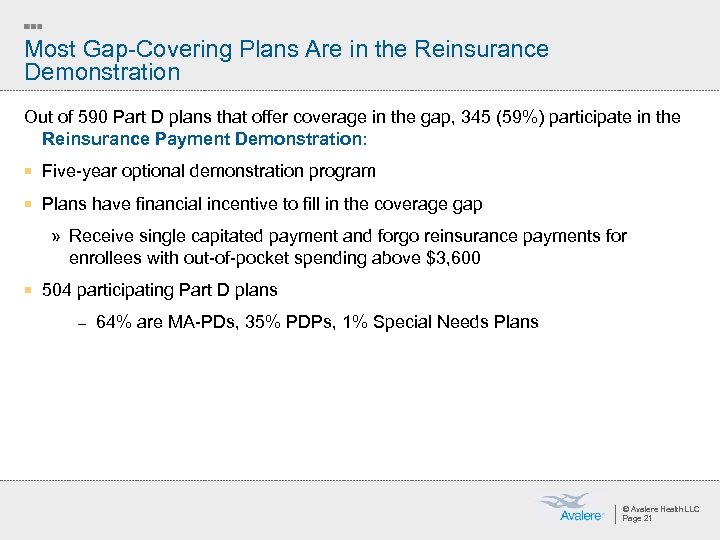
Most Gap-Covering Plans Are in the Reinsurance Demonstration Out of 590 Part D plans that offer coverage in the gap, 345 (59%) participate in the Reinsurance Payment Demonstration: ¡ Five-year optional demonstration program ¡ Plans have financial incentive to fill in the coverage gap » Receive single capitated payment and forgo reinsurance payments for enrollees with out-of-pocket spending above $3, 600 ¡ 504 participating Part D plans – 64% are MA-PDs, 35% PDPs, 1% Special Needs Plans © Avalere Health LLC Page 21
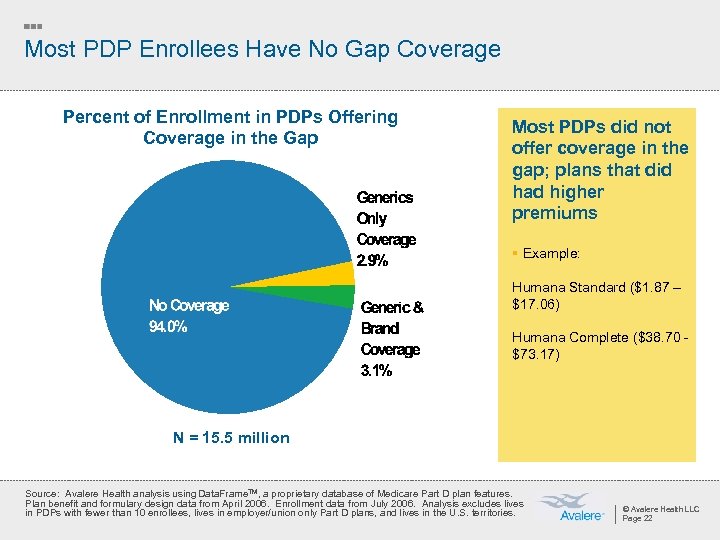
Most PDP Enrollees Have No Gap Coverage Percent of Enrollment in PDPs Offering Coverage in the Gap Most PDPs did not offer coverage in the gap; plans that did had higher premiums § Example: Humana Standard ($1. 87 – $17. 06) Humana Complete ($38. 70 - $73. 17) N = 15. 5 million Source: Avalere Health analysis using Data. Frame. TM, a proprietary database of Medicare Part D plan features. Plan benefit and formulary design data from April 2006. Enrollment data from July 2006. Analysis excludes lives in PDPs with fewer than 10 enrollees, lives in employer/union only Part D plans, and lives in the U. S. territories. © Avalere Health LLC Page 22
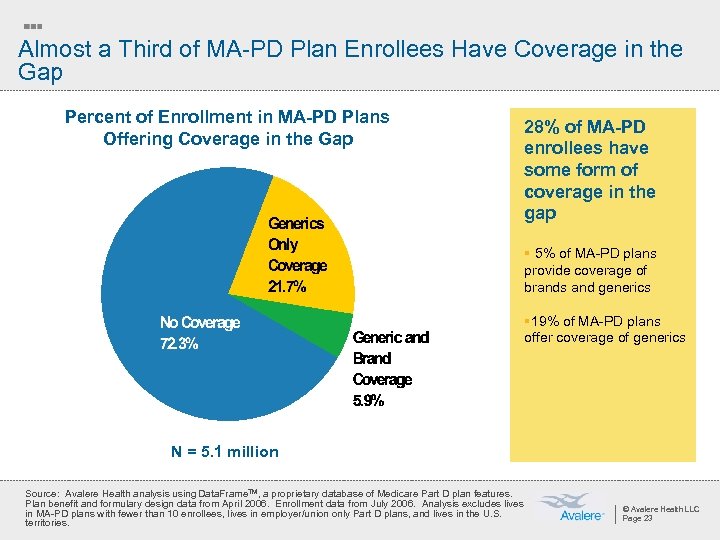
Almost a Third of MA-PD Plan Enrollees Have Coverage in the Gap Percent of Enrollment in MA-PD Plans Offering Coverage in the Gap 28% of MA-PD enrollees have some form of coverage in the gap § 5% of MA-PD plans provide coverage of brands and generics § 19% of MA-PD plans offer coverage of generics N = 5. 1 million Source: Avalere Health analysis using Data. Frame. TM, a proprietary database of Medicare Part D plan features. Plan benefit and formulary design data from April 2006. Enrollment data from July 2006. Analysis excludes lives in MA-PD plans with fewer than 10 enrollees, lives in employer/union only Part D plans, and lives in the U. S. territories. © Avalere Health LLC Page 23
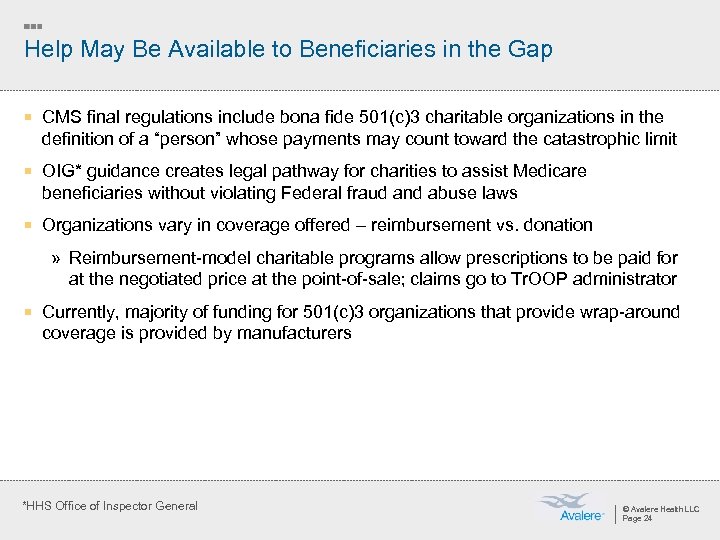
Help May Be Available to Beneficiaries in the Gap ¡ CMS final regulations include bona fide 501(c)3 charitable organizations in the definition of a “person” whose payments may count toward the catastrophic limit ¡ OIG* guidance creates legal pathway for charities to assist Medicare beneficiaries without violating Federal fraud and abuse laws ¡ Organizations vary in coverage offered – reimbursement vs. donation » Reimbursement-model charitable programs allow prescriptions to be paid for at the negotiated price at the point-of-sale; claims go to Tr. OOP administrator ¡ Currently, majority of funding for 501(c)3 organizations that provide wrap-around coverage is provided by manufacturers *HHS Office of Inspector General © Avalere Health LLC Page 24
Manufacturer PAPs’ Role in Part D Will Evolve ¡ Currently, PAPs must operate outside of Part D (i. e. , contributions don’t count towards Tr. OOP) ¡ Many manufacturer PAPs have limited enrollment to only those Medicare beneficiaries not enrolled in Part D ¡ OIG and CMS may clarify/refine their positions further ¡ Congress would like to see beneficiary cost-sharing decreased ¡ Legislation could mitigate OIG opinion © Avalere Health LLC Page 25
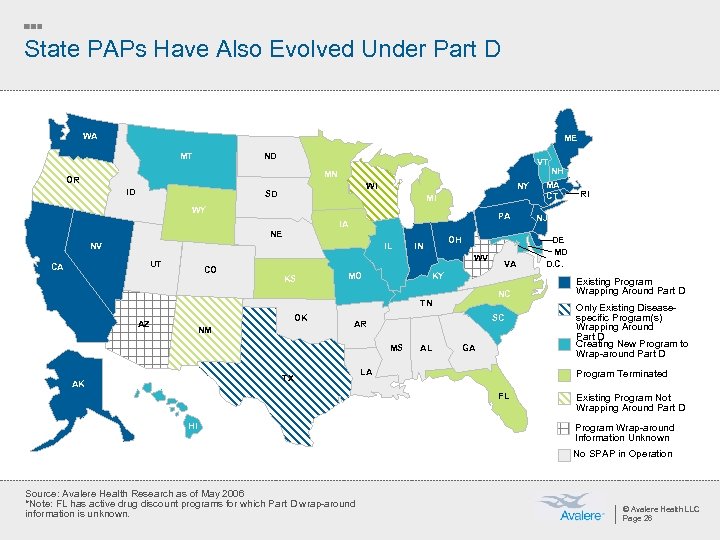
State PAPs Have Also Evolved Under Part D WA ME MT ND VT MN OR ID WI SD NY MI WY PA IA NE NV IL WV UT CA OH IN CO KS MO NC TN AZ OK NM SC AR MS TX AK VA KY AL GA LA RI NJ DE MD D. C. Existing Program Wrapping Around Part D Only Existing Diseasespecific Program(s) Wrapping Around Part D Creating New Program to Wrap-around Part D Program Terminated FL HI NH MA CT Existing Program Not Wrapping Around Part D Program Wrap-around Information Unknown No SPAP in Operation Source: Avalere Health Research as of May 2006 *Note: FL has active drug discount programs for which Part D wrap-around information is unknown. © Avalere Health LLC Page 26
Summary of SPAP and Part D Coordination ¡ 7 states (FL, IA, KS, MI, MN, NC, WY) ended their pharmacy assistance programs for Medicare beneficiaries and three (OR, NM, WI) programs are not wrapping around Part D ¡ 24 states and the US Virgin Islands are providing Part D wrap-around coverage » 9 states (HI, IL, KY, MD, MO, MT, NH, SC, VT) are creating new SPAPs to coordinate with Part D » 15 states with existing programs (AK, CA, CT, DE, IN, MA, ME, NJ, NV, NY, OH, PA, RI, TX, WA) will provide Part D wrap-around coverage ¡ 25 states (AK, CA, CT, DE, Fl, IL, IN, MA, MD, ME, MO, MT, NC, NJ, NV, NY, PA, RI, SC, TX, VT, WA, WI, WY) and the US Virgin Islands submitted qualified SPAP attestation forms for one or more programs in the state, but 3 states who submitted forms (NC, WY) have ended their SPAPs ¡ New CMS marketing guidelines will not hinder SPAP ability to co-brand with states © Avalere Health LLC Page 27
SPAP Coordination with Part D Continues to Evolve ¡ States will evaluate SPAP coordination with Part D over time » Administrative ease of coordinating with Part D plans » Total SPAP savings » Sustainability of program funding ¡ Majority of states rely on general revenues to fund SPAPs, which compete with other state programs for funding © Avalere Health LLC Page 28
Beyond the Basics: Formularies The intersection of business strategy and public policy
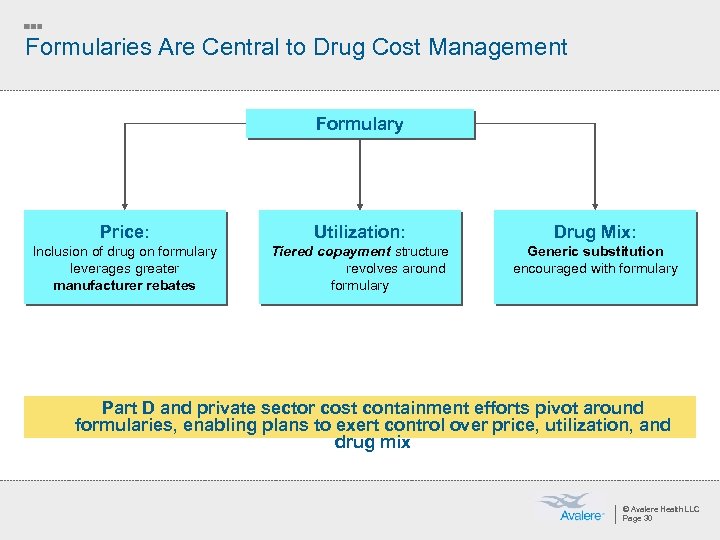
Formularies Are Central to Drug Cost Management Formulary Price: Utilization: Drug Mix: Inclusion of drug on formulary leverages greater manufacturer rebates Tiered copayment structure revolves around formulary Generic substitution encouraged with formulary Part D and private sector cost containment efforts pivot around formularies, enabling plans to exert control over price, utilization, and drug mix © Avalere Health LLC Page 30
Part D Plan Formularies Must Meet Basic Standards ¡ Plans must provide beneficiaries with choice of medications in each therapeutic class » Must include at least two drugs in each category that are not therapeutically equivalent and bioequivalent ¡ CMS must determine that a plan’s therapeutic classification system is not discriminatory against beneficiaries with certain medical conditions ¡ Plans will resubmit formularies and bids for approval by CMS every year © Avalere Health LLC Page 31
CMS Evaluation and Review of Formulary Designs: “Balancing Access and Cost” ¡ CMS formulary review includes: » Pharmacy and Therapeutics (P&T) committees » Formulary drug lists » Benefit management tools ¡ CMS’ review is to ensure formularies remain nondiscriminatory and meet minimum standards » Treatment guidelines (e. g. , diabetes, gastroesophageal reflux disease) » Certain classes (e. g. , proton pump inhibitors) » Six protected classes » Commercial best practices and Medicaid existing practices © Avalere Health LLC Page 32
USP Model Guidelines (MG) are “Safe Harbor” for Plans’ Therapeutic Classification System ¡ USP sought to protect beneficiary access to drugs while supporting cost- effectiveness goal ¡ Plans may propose alternative therapeutic classification systems (or adapt their commercial formularies for Part D use) for CMS approval ¡ CMS will check a plan’s proposed classification system that differs from the MGs to determine if it is similar to USP or other commonly used classification systems » Example: the American Hospital Formulary Service Pharmacologic. Therapeutic Classification © Avalere Health LLC Page 33
Formularies Can Be Changed During the Plan Year ¡ Formularies can be updated at certain times throughout the year » Medicare P&T committees will meet quarterly to consider changes to the plan’s drug list » Therapeutic categories will be reviewed annually » Formularies cannot be changed between November 15 and March 1 of each year (during open enrollment period + 60 days after) ¡ CMS must approve all formulary changes » Plans must submit changes between the 1 st and 7 th days of each month » CMS will review within 30 days of submission of plan’s request ¡ Plans must review new drugs within 90 days of approval, and make a coverage decision within 180 days © Avalere Health LLC Page 34
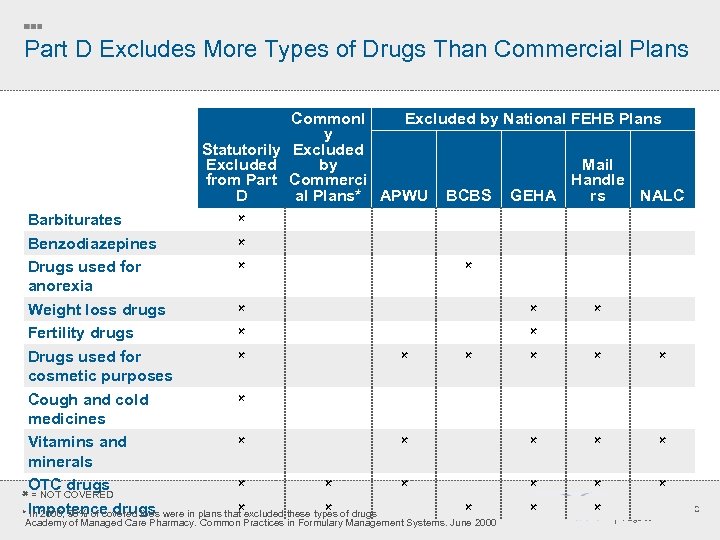
Part D Excludes More Types of Drugs Than Commercial Plans Commonl Excluded by National FEHB Plans y Statutorily Excluded Mail Excluded by Handle from Part Commerci rs NALC D al Plans* APWU BCBS GEHA Barbiturates Benzodiazepines Drugs used for anorexia Weight loss drugs Fertility drugs Drugs used for cosmetic purposes Cough and cold medicines Vitamins and minerals OTC drugs = NOT COVERED Impotence drugs * In 2000, 90% of covered lives were in plans that excluded these types of drugs Academy of Managed Care Pharmacy. Common Practices in Formulary Management Systems. June 2000 © Avalere Health LLC Page 35
Distinction Between Part D and Part B Varies By Drug, Patient ¡ Part D drugs are not limited to outpatient drugs; the definition of Part D drugs includes injectables such as IM, IV, infused, and vaccines ¡ Part D benefit does not alter Part B coverage ¡ Distinction between a Part D and a Part B drug is how the drug is prescribed, dispensed, or administered to a particular individual ¡ Injectable drugs that Medicare considers not usually self-administered should be paid for under Part A or Part B if provided in the physician’s office, and under Part D if dispensed by a network pharmacy © Avalere Health LLC Page 36
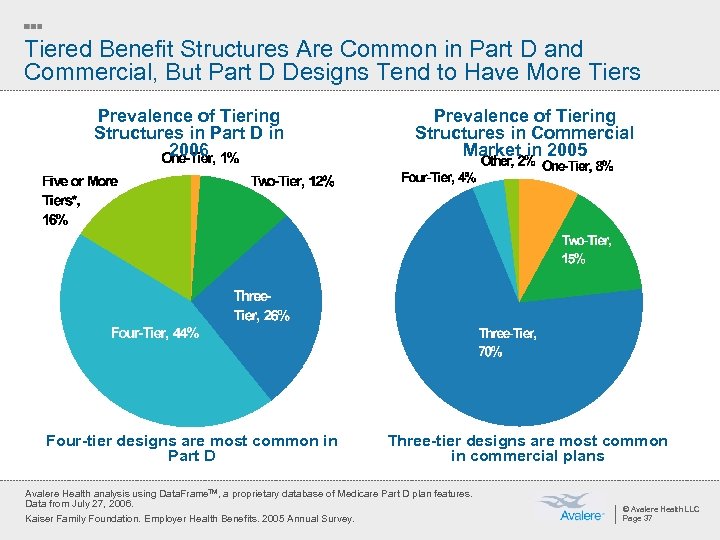
Tiered Benefit Structures Are Common in Part D and Commercial, But Part D Designs Tend to Have More Tiers Prevalence of Tiering Structures in Part D in 2006 Prevalence of Tiering Structures in Commercial Market in 2005 Four-tier designs are most common in Part D Three-tier designs are most common in commercial plans Avalere Health analysis using Data. Frame. TM, a proprietary database of Medicare Part D plan features. Data from July 27, 2006. Kaiser Family Foundation. Employer Health Benefits. 2005 Annual Survey. © Avalere Health LLC Page 37
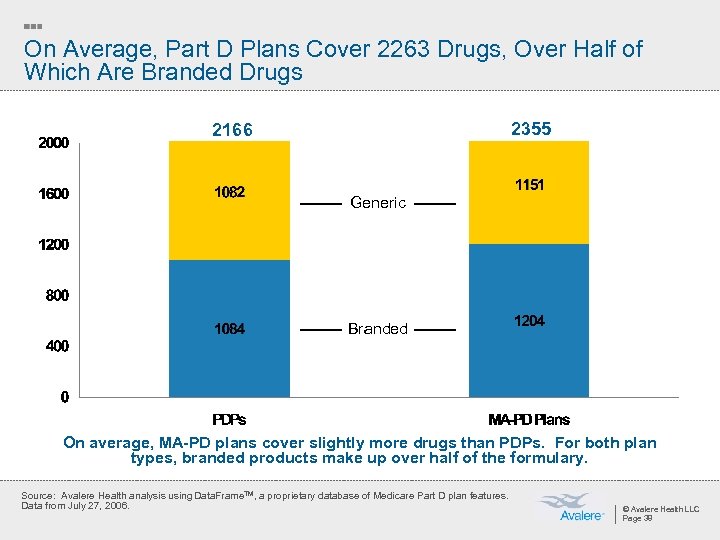
On Average, Part D Plans Cover 2263 Drugs, Over Half of Which Are Branded Drugs 2355 2166 Generic Branded On average, MA-PD plans cover slightly more drugs than PDPs. For both plan types, branded products make up over half of the formulary. Source: Avalere Health analysis using Data. Frame. TM, a proprietary database of Medicare Part D plan features. Data from July 27, 2006. © Avalere Health LLC Page 38
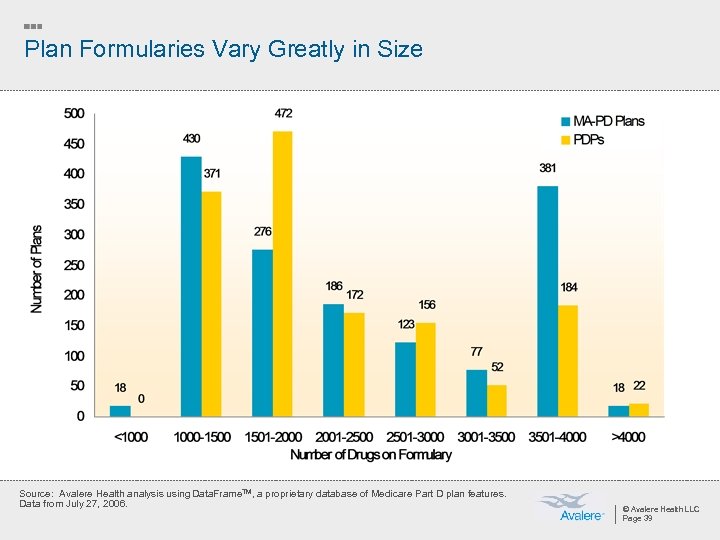
Plan Formularies Vary Greatly in Size Source: Avalere Health analysis using Data. Frame. TM, a proprietary database of Medicare Part D plan features. Data from July 27, 2006. © Avalere Health LLC Page 39
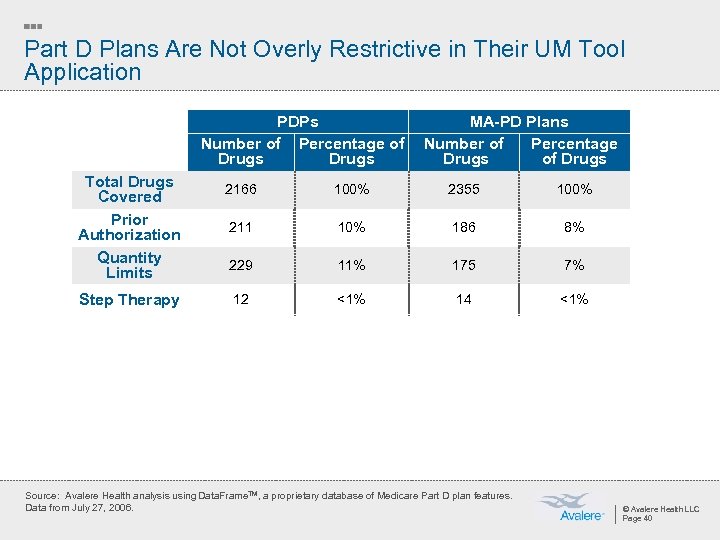
Part D Plans Are Not Overly Restrictive in Their UM Tool Application PDPs Number of Percentage of Drugs Total Drugs Covered Prior Authorization Quantity Limits Step Therapy MA-PD Plans Number of Percentage Drugs of Drugs 2166 100% 2355 100% 211 10% 186 8% 229 11% 175 7% 12 <1% 14 <1% Source: Avalere Health analysis using Data. Frame. TM, a proprietary database of Medicare Part D plan features. Data from July 27, 2006. © Avalere Health LLC Page 40
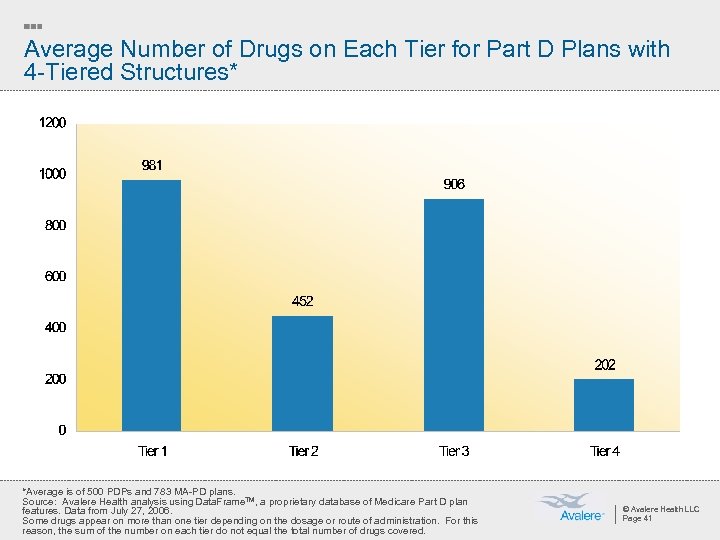
Average Number of Drugs on Each Tier for Part D Plans with 4 -Tiered Structures* *Average is of 500 PDPs and 783 MA-PD plans. Source: Avalere Health analysis using Data. Frame. TM, a proprietary database of Medicare Part D plan features. Data from July 27, 2006. Some drugs appear on more than one tier depending on the dosage or route of administration. For this reason, the sum of the number on each tier do not equal the total number of drugs covered. © Avalere Health LLC Page 41
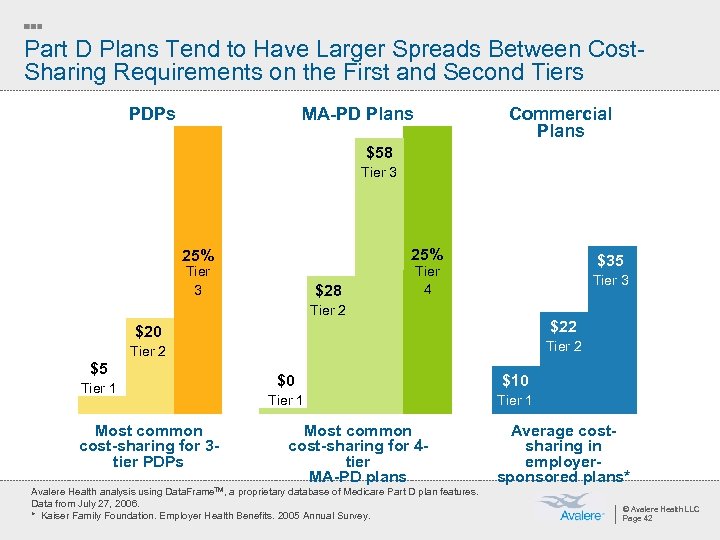
Part D Plans Tend to Have Larger Spreads Between Cost. Sharing Requirements on the First and Second Tiers PDPs MA-PD Plans Commercial Plans $58 Tier 3 25% Tier 3 $28 $35 Tier 4 Tier 3 Tier 2 $20 Tier 2 $5 Tier 1 Most common cost-sharing for 3 tier PDPs $0 $10 Tier 1 Most common cost-sharing for 4 tier MA-PD plans Avalere Health analysis using Data. Frame. TM, a proprietary database of Medicare Part D plan features. Data from July 27, 2006. * Kaiser Family Foundation. Employer Health Benefits. 2005 Annual Survey. Average costsharing in employersponsored plans* © Avalere Health LLC Page 42
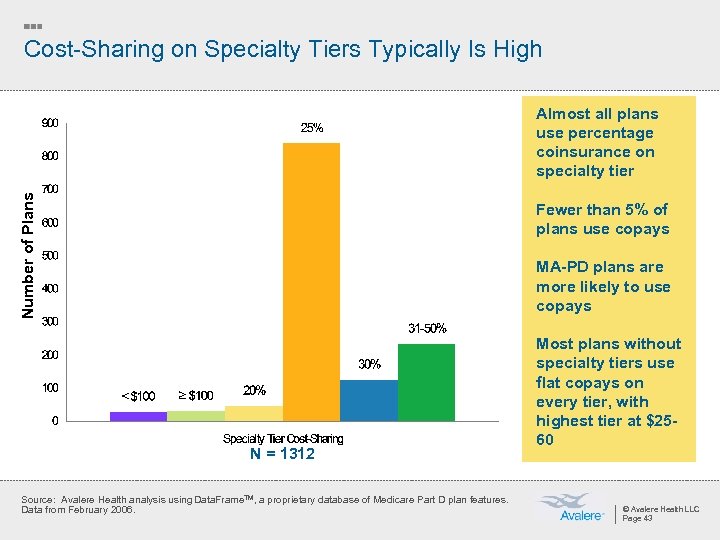
Cost-Sharing on Specialty Tiers Typically Is High Number of Plans Almost all plans use percentage coinsurance on specialty tier Fewer than 5% of plans use copays MA-PD plans are more likely to use copays N = 1312 Source: Avalere Health analysis using Data. Frame. TM, a proprietary database of Medicare Part D plan features. Data from February 2006. Most plans without specialty tiers use flat copays on every tier, with highest tier at $2560 © Avalere Health LLC Page 43
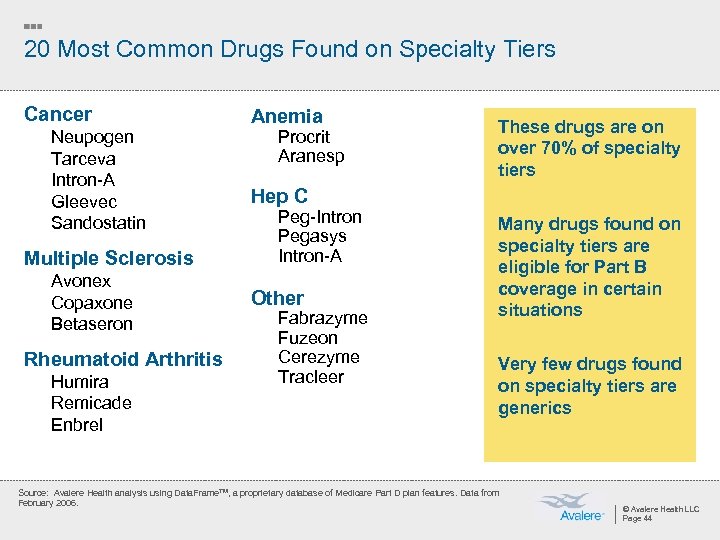
20 Most Common Drugs Found on Specialty Tiers Cancer Neupogen Tarceva Intron-A Gleevec Sandostatin Multiple Sclerosis Avonex Copaxone Betaseron Rheumatoid Arthritis Humira Remicade Enbrel Anemia Procrit Aranesp These drugs are on over 70% of specialty tiers Hep C Peg-Intron Pegasys Intron-A Other Fabrazyme Fuzeon Cerezyme Tracleer Many drugs found on specialty tiers are eligible for Part B coverage in certain situations Very few drugs found on specialty tiers are generics Source: Avalere Health analysis using Data. Frame. TM, a proprietary database of Medicare Part D plan features. Data from February 2006. © Avalere Health LLC Page 44
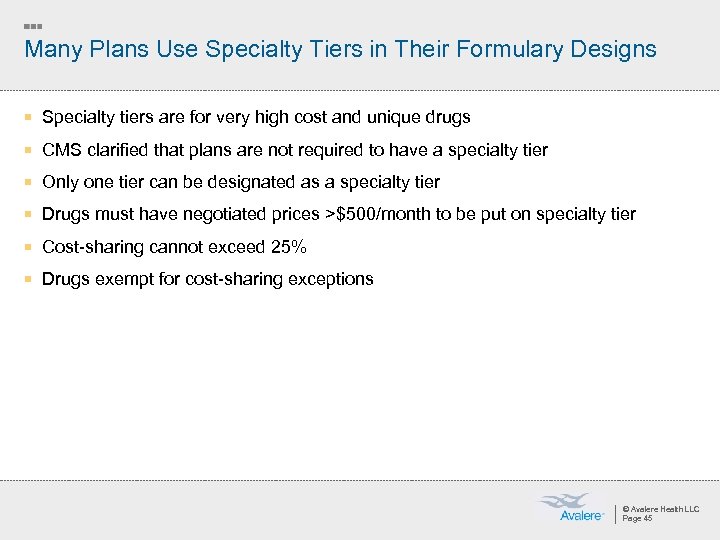
Many Plans Use Specialty Tiers in Their Formulary Designs ¡ Specialty tiers are for very high cost and unique drugs ¡ CMS clarified that plans are not required to have a specialty tier ¡ Only one tier can be designated as a specialty tier ¡ Drugs must have negotiated prices >$500/month to be put on specialty tier ¡ Cost-sharing cannot exceed 25% ¡ Drugs exempt for cost-sharing exceptions © Avalere Health LLC Page 45
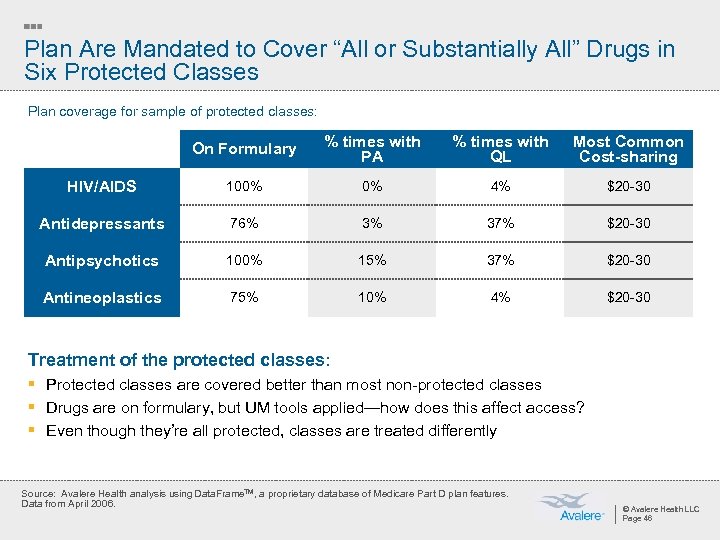
Plan Are Mandated to Cover “All or Substantially All” Drugs in Six Protected Classes Plan coverage for sample of protected classes: On Formulary % times with PA % times with QL Most Common Cost-sharing HIV/AIDS 100% 0% 4% $20 -30 Antidepressants 76% 3% 37% $20 -30 Antipsychotics 100% 15% 37% $20 -30 Antineoplastics 75% 10% 4% $20 -30 Treatment of the protected classes: § Protected classes are covered better than most non-protected classes § Drugs are on formulary, but UM tools applied—how does this affect access? § Even though they’re all protected, classes are treated differently Source: Avalere Health analysis using Data. Frame. TM, a proprietary database of Medicare Part D plan features. Data from April 2006. © Avalere Health LLC Page 46
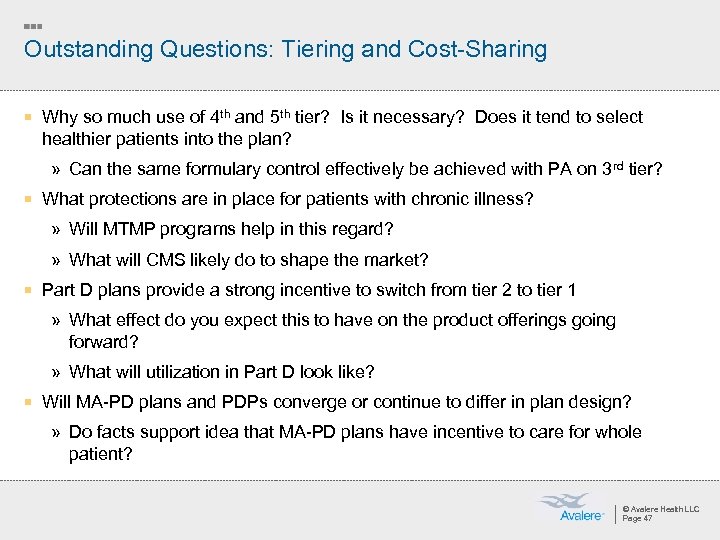
Outstanding Questions: Tiering and Cost-Sharing ¡ Why so much use of 4 th and 5 th tier? Is it necessary? Does it tend to select healthier patients into the plan? » Can the same formulary control effectively be achieved with PA on 3 rd tier? ¡ What protections are in place for patients with chronic illness? » Will MTMP programs help in this regard? » What will CMS likely do to shape the market? ¡ Part D plans provide a strong incentive to switch from tier 2 to tier 1 » What effect do you expect this to have on the product offerings going forward? » What will utilization in Part D look like? ¡ Will MA-PD plans and PDPs converge or continue to differ in plan design? » Do facts support idea that MA-PD plans have incentive to care for whole patient? © Avalere Health LLC Page 47
Beyond the Basics: Formulary Transitions, Exceptions and Appeals The intersection of business strategy and public policy
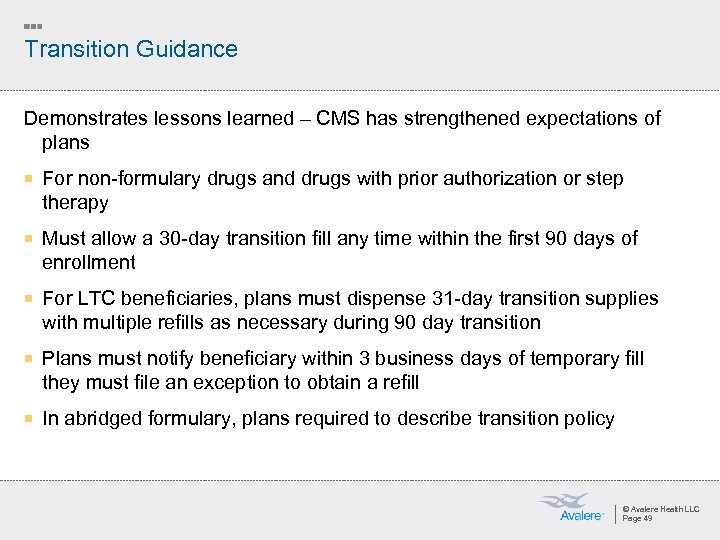
Transition Guidance Demonstrates lessons learned – CMS has strengthened expectations of plans ¡ For non-formulary drugs and drugs with prior authorization or step therapy ¡ Must allow a 30 -day transition fill any time within the first 90 days of enrollment ¡ For LTC beneficiaries, plans must dispense 31 -day transition supplies with multiple refills as necessary during 90 day transition ¡ Plans must notify beneficiary within 3 business days of temporary fill they must file an exception to obtain a refill ¡ In abridged formulary, plans required to describe transition policy © Avalere Health LLC Page 49
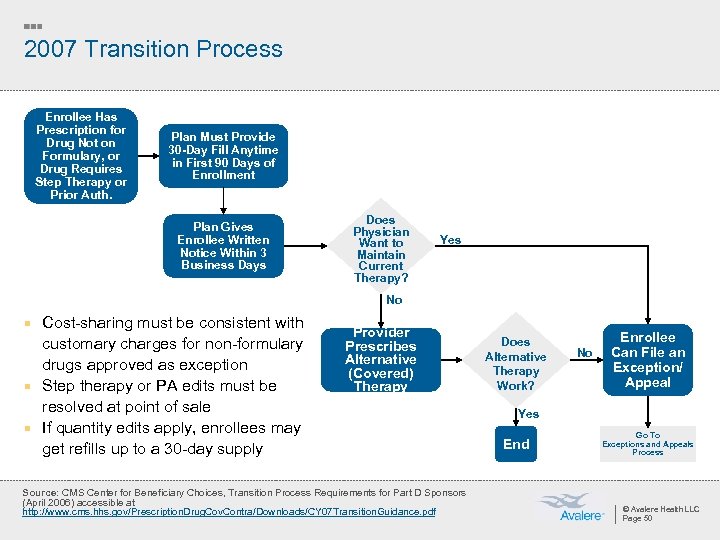
2007 Transition Process Enrollee Has Prescription for Drug Not on Formulary, or Drug Requires Step Therapy or Prior Auth. Plan Must Provide 30 -Day Fill Anytime in First 90 Days of Enrollment Plan Gives Enrollee Written Notice Within 3 Business Days Does Physician Want to Maintain Current Therapy? Yes No ¡ Cost-sharing must be consistent with customary charges for non-formulary drugs approved as exception ¡ Step therapy or PA edits must be resolved at point of sale ¡ If quantity edits apply, enrollees may get refills up to a 30 -day supply Provider Prescribes Alternative (Covered) Therapy Source: CMS Center for Beneficiary Choices, Transition Process Requirements for Part D Sponsors (April 2006) accessible at http: //www. cms. hhs. gov/Prescription. Drug. Cov. Contra/Downloads/CY 07 Transition. Guidance. pdf Does Alternative Therapy Work? No Enrollee Can File an Exception/ Appeal Yes End Go To Exceptions and Appeals Process © Avalere Health LLC Page 50
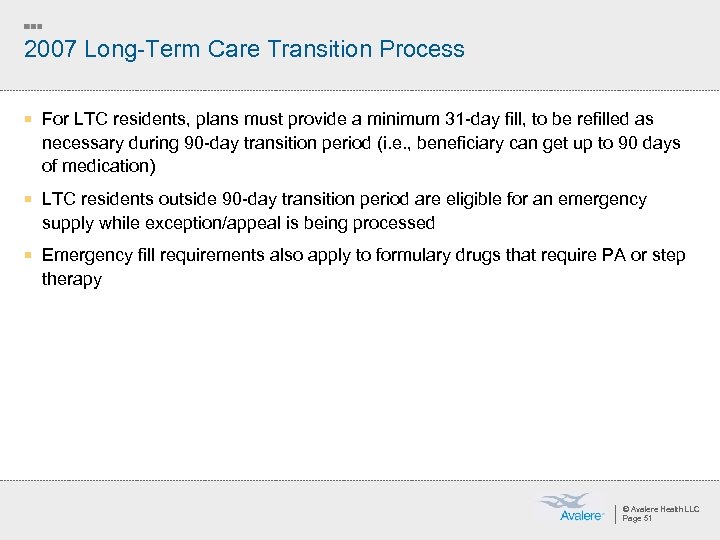
2007 Long-Term Care Transition Process ¡ For LTC residents, plans must provide a minimum 31 -day fill, to be refilled as necessary during 90 -day transition period (i. e. , beneficiary can get up to 90 days of medication) ¡ LTC residents outside 90 -day transition period are eligible for an emergency supply while exception/appeal is being processed ¡ Emergency fill requirements also apply to formulary drugs that require PA or step therapy © Avalere Health LLC Page 51
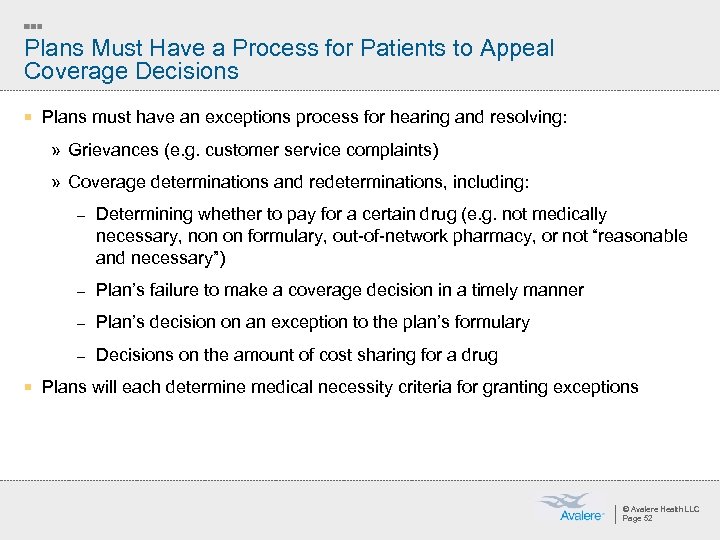
Plans Must Have a Process for Patients to Appeal Coverage Decisions ¡ Plans must have an exceptions process for hearing and resolving: » Grievances (e. g. customer service complaints) » Coverage determinations and redeterminations, including: – Determining whether to pay for a certain drug (e. g. not medically necessary, non on formulary, out-of-network pharmacy, or not “reasonable and necessary”) – Plan’s failure to make a coverage decision in a timely manner – Plan’s decision on an exception to the plan’s formulary – Decisions on the amount of cost sharing for a drug ¡ Plans will each determine medical necessity criteria for granting exceptions © Avalere Health LLC Page 52
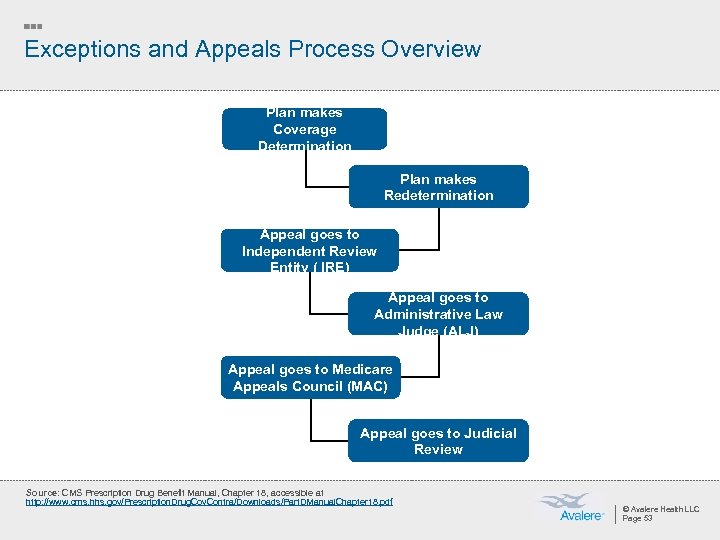
Exceptions and Appeals Process Overview Plan makes Coverage Determination Plan makes Redetermination Appeal goes to Independent Review Entity ( IRE) Appeal goes to Administrative Law Judge (ALJ) Appeal goes to Medicare Appeals Council (MAC) Appeal goes to Judicial Review Source: CMS Prescription Drug Benefit Manual, Chapter 18, accessible at http: //www. cms. hhs. gov/Prescription. Drug. Cov. Contra/Downloads/Part. DManual. Chapter 18. pdf © Avalere Health LLC Page 53
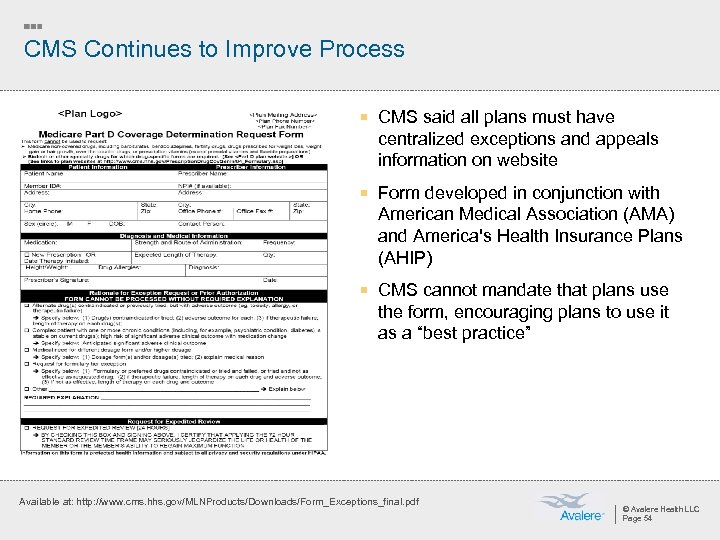
CMS Continues to Improve Process ¡ CMS said all plans must have centralized exceptions and appeals information on website ¡ Form developed in conjunction with American Medical Association (AMA) and America's Health Insurance Plans (AHIP) ¡ CMS cannot mandate that plans use the form, encouraging plans to use it as a “best practice” Available at: http: //www. cms. hhs. gov/MLNProducts/Downloads/Form_Exceptions_final. pdf © Avalere Health LLC Page 54
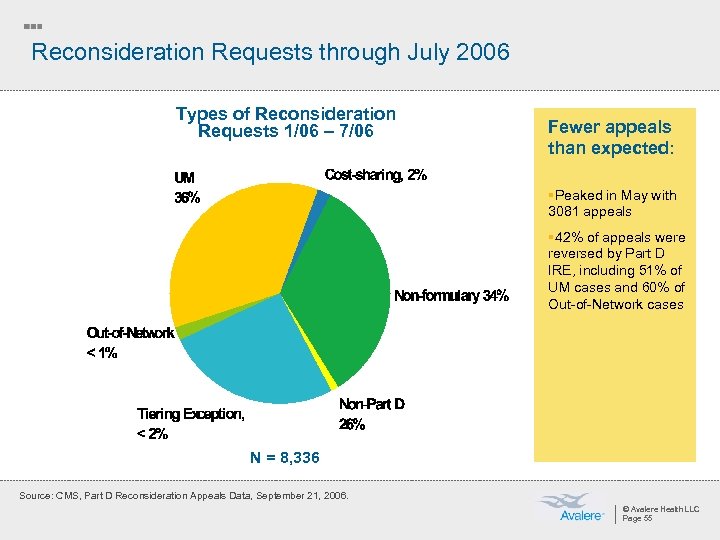
Reconsideration Requests through July 2006 Types of Reconsideration Requests 1/06 – 7/06 Fewer appeals than expected: §Peaked in May with 3081 appeals § 42% of appeals were reversed by Part D IRE, including 51% of UM cases and 60% of Out-of-Network cases N = 8, 336 Source: CMS, Part D Reconsideration Appeals Data, September 21, 2006. © Avalere Health LLC Page 55
Impact on Beneficiaries ¡ Beneficiaries may not be familiar with the appeals process or have difficulty finding and understanding plan-provided information on appeals ¡ Beneficiaries may not seek exceptions because of need for physician statements ¡ Difficult to ensure that appeal includes all necessary data elements; plans not specific on what constitutes medical necessity ¡ No information is provided on the outcomes of appeals – which might assist beneficiaries in picking a plan and move towards a consistent process © Avalere Health LLC Page 56
Beyond the Basics: Marketing & Enrollment The intersection of business strategy and public policy
Choosing to Enroll in the Medicare Drug Benefit Is a Complex Decision ¡ Initial open enrollment period with penalty for late enrollment ¡ Beneficiary decision to enroll involves assessing: » Current drug coverage’s formulary, premium and cost-sharing offerings » Eligibility and application for low-income subsidy (LIS) » Comparing plans ¡ Most beneficiaries had to decide whether to enroll, and pick a plan ¡ CMS created processes to ensure access for low-income groups » Auto-enrollment for dual eligibles » Facilitated enrollment for non-dual LIS enrollees who did not choose a plan voluntarily © Avalere Health LLC Page 58
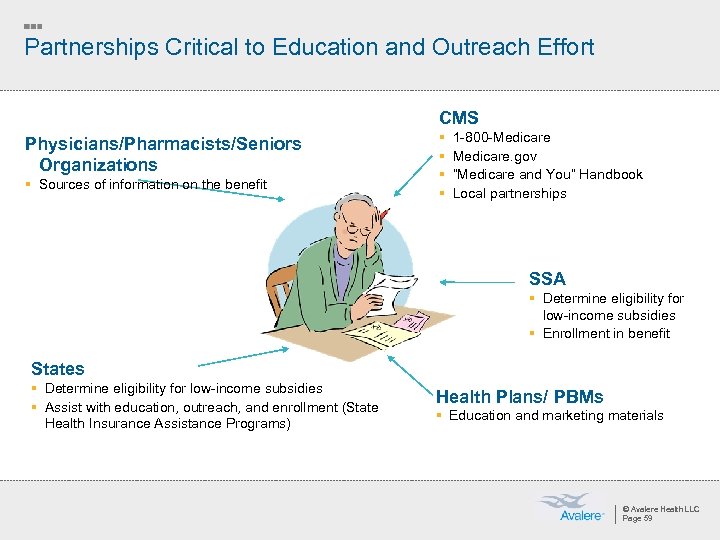
Partnerships Critical to Education and Outreach Effort CMS Physicians/Pharmacists/Seniors Organizations § Sources of information on the benefit § § 1 -800 -Medicare. gov “Medicare and You” Handbook Local partnerships SSA § Determine eligibility for low-income subsidies § Enrollment in benefit States § Determine eligibility for low-income subsidies § Assist with education, outreach, and enrollment (State Health Insurance Assistance Programs) Health Plans/ PBMs § Education and marketing materials © Avalere Health LLC Page 59
Plans Allowed to Market Directly to Beneficiaries ¡ Medicare plans must enroll beneficiaries one at a time (except retirees) ¡ Plans used a variety of strategies to attract potential enrollees in 2006 » Benefit design » Co-branding » Advertising ¡ For 2007, CMS modified some rules for plan marketing activities » No provider co-branding on member ID cards » Required information on plans’ websites » Additional detail in plan marketing materials » Restrictions on direct-mail advertising © Avalere Health LLC Page 60
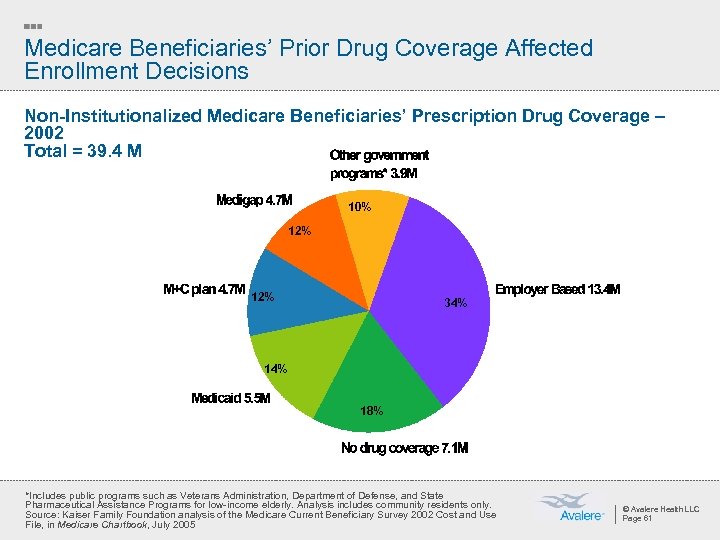
Medicare Beneficiaries’ Prior Drug Coverage Affected Enrollment Decisions Non-Institutionalized Medicare Beneficiaries’ Prescription Drug Coverage – 2002 Total = 39. 4 M 10% 12% 34% 18% *Includes public programs such as Veterans Administration, Department of Defense, and State Pharmaceutical Assistance Programs for low-income elderly. Analysis includes community residents only. Source: Kaiser Family Foundation analysis of the Medicare Current Beneficiary Survey 2002 Cost and Use File, in Medicare Chartbook, July 2005 © Avalere Health LLC Page 61
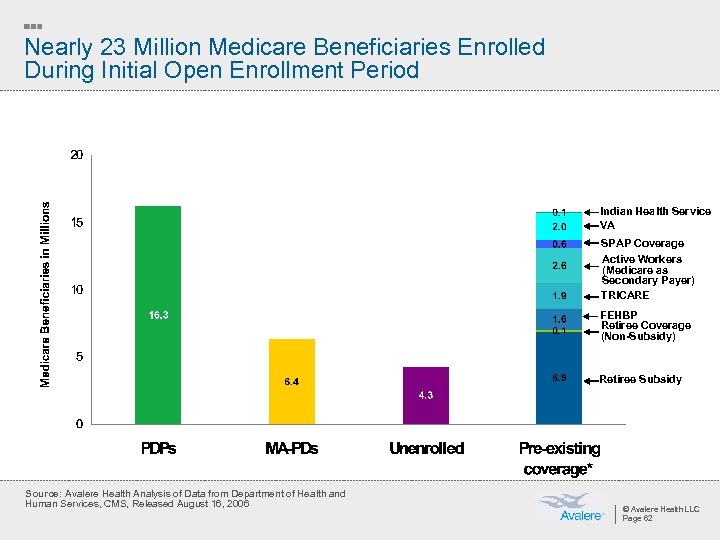
Nearly 23 Million Medicare Beneficiaries Enrolled During Initial Open Enrollment Period Indian Health Service VA SPAP Coverage Active Workers (Medicare as Secondary Payer) TRICARE FEHBP Retiree Coverage (Non-Subsidy) Retiree Subsidy Source: Avalere Health Analysis of Data from Department of Health and Human Services, CMS, Released August 16, 2006 © Avalere Health LLC Page 62
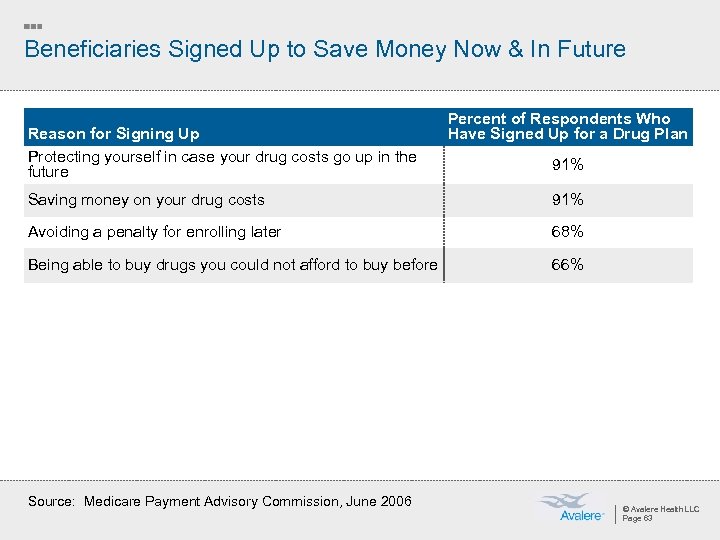
Beneficiaries Signed Up to Save Money Now & In Future Reason for Signing Up Protecting yourself in case your drug costs go up in the future Percent of Respondents Who Have Signed Up for a Drug Plan 91% Saving money on your drug costs 91% Avoiding a penalty for enrolling later 68% Being able to buy drugs you could not afford to buy before 66% Source: Medicare Payment Advisory Commission, June 2006 © Avalere Health LLC Page 63
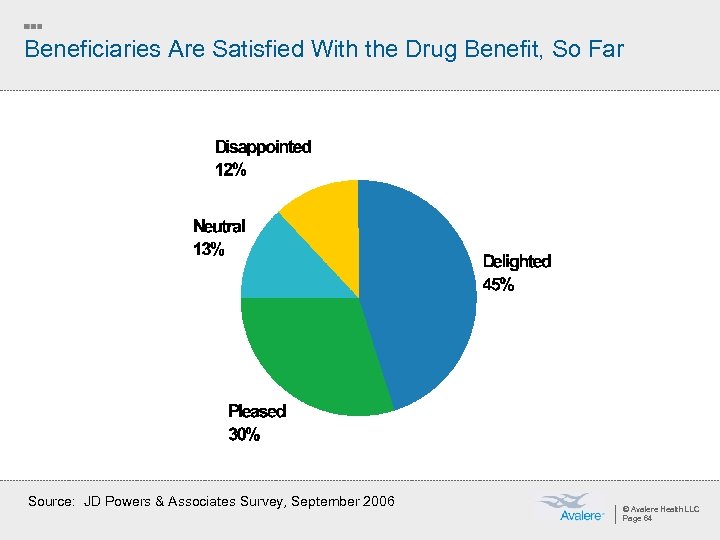
Beneficiaries Are Satisfied With the Drug Benefit, So Far Source: JD Powers & Associates Survey, September 2006 © Avalere Health LLC Page 64
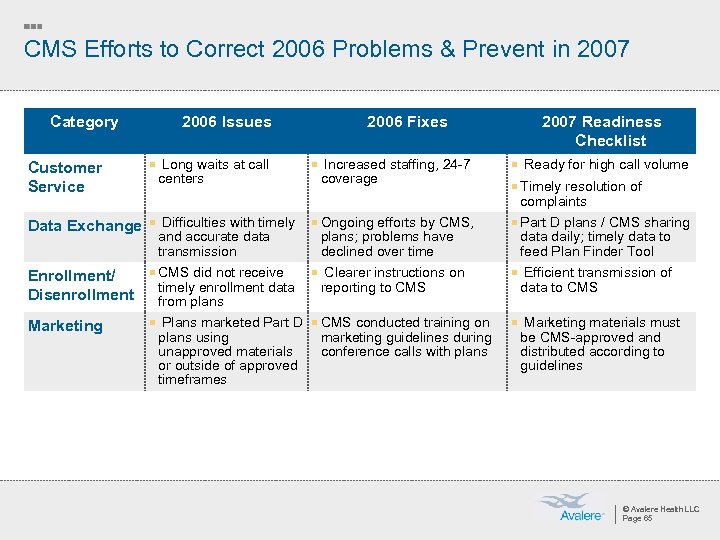
CMS Efforts to Correct 2006 Problems & Prevent in 2007 Category 2006 Issues 2006 Fixes Customer Service ¡ Long waits at call Data Exchange ¡ Difficulties with timely ¡ Ongoing efforts by CMS, ¡ Part D plans / CMS sharing Enrollment/ Disenrollment ¡ CMS did not receive ¡ Clearer instructions on ¡ Efficient transmission of Marketing ¡ Plans marketed Part D ¡ CMS conducted training on centers ¡ Increased staffing, 24 -7 2007 Readiness Checklist coverage ¡ Ready for high call volume ¡ Timely resolution of complaints and accurate data transmission timely enrollment data from plans using unapproved materials or outside of approved timeframes plans; problems have declined over time reporting to CMS marketing guidelines during conference calls with plans data daily; timely data to feed Plan Finder Tool data to CMS ¡ Marketing materials must be CMS-approved and distributed according to guidelines © Avalere Health LLC Page 65
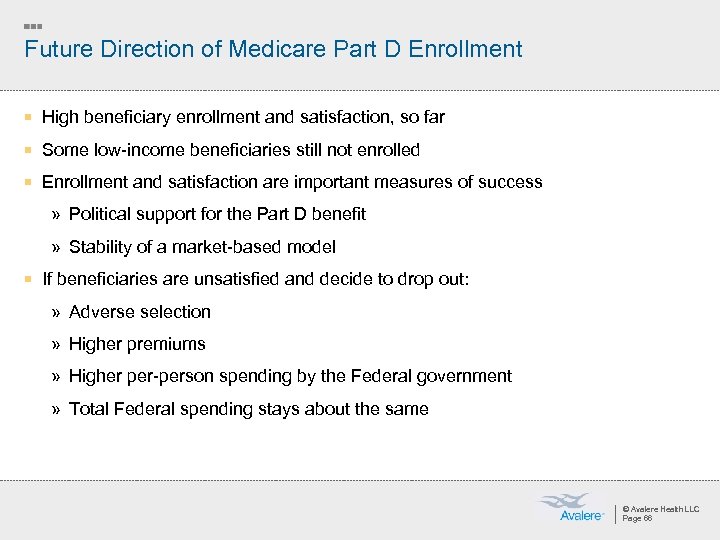
Future Direction of Medicare Part D Enrollment ¡ High beneficiary enrollment and satisfaction, so far ¡ Some low-income beneficiaries still not enrolled ¡ Enrollment and satisfaction are important measures of success » Political support for the Part D benefit » Stability of a market-based model ¡ If beneficiaries are unsatisfied and decide to drop out: » Adverse selection » Higher premiums » Higher per-person spending by the Federal government » Total Federal spending stays about the same © Avalere Health LLC Page 66
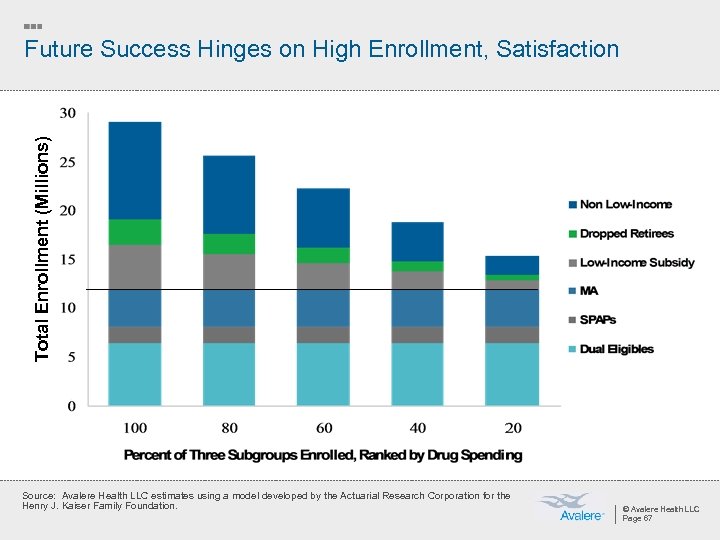
Total Enrollment (Millions) Future Success Hinges on High Enrollment, Satisfaction Source: Avalere Health LLC estimates using a model developed by the Actuarial Research Corporation for the Henry J. Kaiser Family Foundation. © Avalere Health LLC Page 67
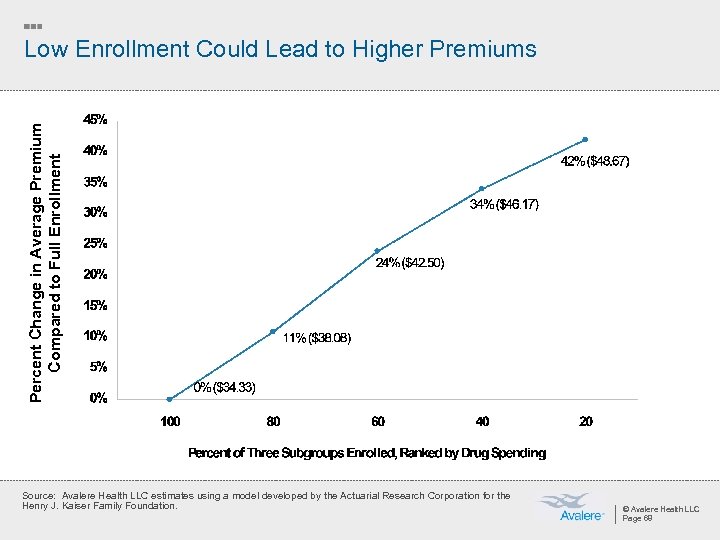
Percent Change in Average Premium Compared to Full Enrollment Low Enrollment Could Lead to Higher Premiums Source: Avalere Health LLC estimates using a model developed by the Actuarial Research Corporation for the Henry J. Kaiser Family Foundation. © Avalere Health LLC Page 68
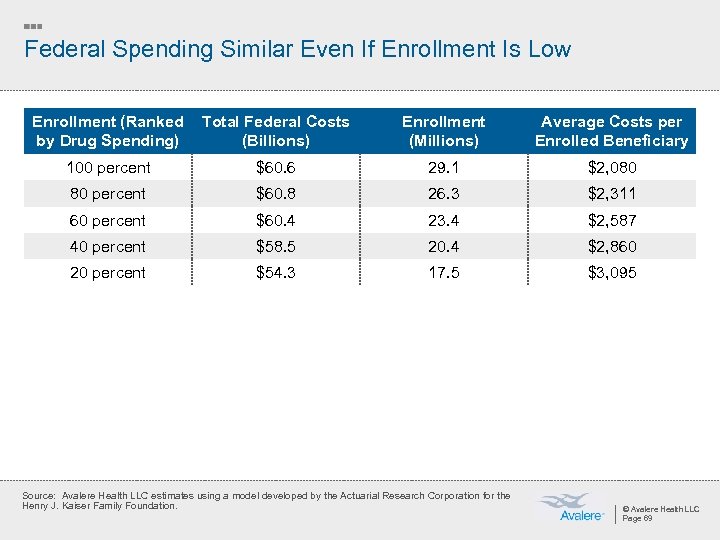
Federal Spending Similar Even If Enrollment Is Low Enrollment (Ranked by Drug Spending) Total Federal Costs (Billions) Enrollment (Millions) Average Costs per Enrolled Beneficiary 100 percent $60. 6 29. 1 $2, 080 80 percent $60. 8 26. 3 $2, 311 60 percent $60. 4 23. 4 $2, 587 40 percent $58. 5 20. 4 $2, 860 20 percent $54. 3 17. 5 $3, 095 Source: Avalere Health LLC estimates using a model developed by the Actuarial Research Corporation for the Henry J. Kaiser Family Foundation. © Avalere Health LLC Page 69
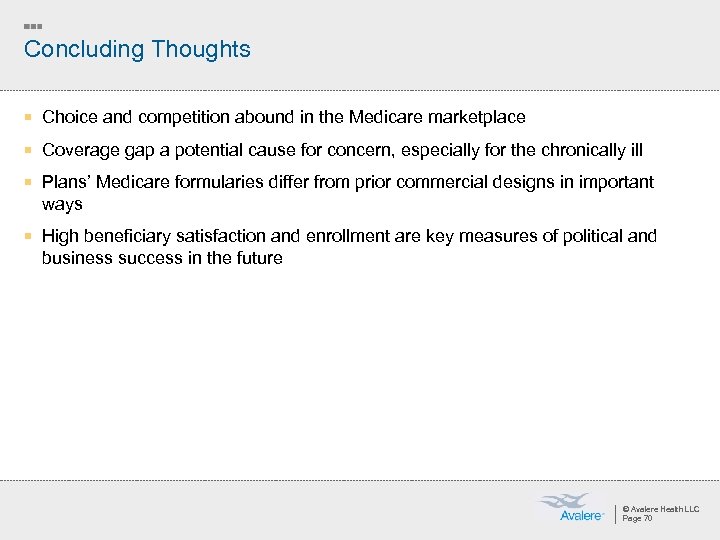
Concluding Thoughts ¡ Choice and competition abound in the Medicare marketplace ¡ Coverage gap a potential cause for concern, especially for the chronically ill ¡ Plans’ Medicare formularies differ from prior commercial designs in important ways ¡ High beneficiary satisfaction and enrollment are key measures of political and business success in the future © Avalere Health LLC Page 70
Скачать презентацию The Medicare Drug Benefit Beyond the Basics Third
b0c7b9b523a85979c44ac12bcbab741b.ppt