


 Скачать презентацию The Medical Innovation Prize Fund A new paradigm
5038d0799a459dc16b4350ab9dd861e1.ppt
- Количество слайдов: 34
 The Medical Innovation Prize Fund A new paradigm for R&D incentives James Love 29 April 2005
 The development of new drugs is expensive, and requires both investment and efficient management of investments Pre-clinical Clinical – Phase III
 Where does the money come from? • “Push” mechanisms – Public funding – Tax credits and other subsidies – New push mechanisms such as competitive intermediators • “Pull” mechanisms – Potential profits from marketing successful projects – New pull mechanisms such as “Prize” funds
 Problems of the current “pull” mechanism • Exclusive rights lead to pricing abuses and barriers to access • Low levels of investment in products that provide incremental health care benefits • Low levels of investment in treatments for the poor (neglected diseases) • Wasteful marketing outlays
 US FDA Priority and Standard NME Approvals Calendar Years 1993 -2002
 Number of patients in clinical trials cited in US FDA approval letters for NCEs 2000 - 2002
 • About 13 percent of global pharma sales are reinvested in R&D • Most R&D (11 of 13 percent) is invested in older products, or “me too” products • Approximately 2 percent is invested in products the US FDA considers significantly better than existing treatments
 US: Cancer Weapons, Out of Reach Robert Wittes, June 15, 2004, Washington Post Since most colorectal-cancer patients for whom these drugs are medically appropriate receive them not singly but in combination with other chemotherapeutics, the monthly AWP is more like $11, 000 for combinations including Avastin and $16, 000 for Erbitux. Providers pass these costs on to patients, along with charges that cover the costs of pharmacy and dispensing. Courses of treatment generally last several months, but they can be much longer for patients who respond favorably. In other words, the cumulative cost of treatment can be astronomical.
 US: Cancer Weapons, Out of Reach Robert Wittes, June 15, 2004, Washington Post • Although the uninsured and medically indigent may feel the effects of these pricing decisions most keenly, those with insurance will also face a nasty dilemma. The increasing co-pay percentages of most plans and the capping of benefits in others will compel a major financial outlay for those determined to have the treatments. And those who do not want their families to assume the financial burden will be left with bitter resentment.
 US: Cancer Weapons, Out of Reach Robert Wittes, June 15, 2004, Washington Post • Third-party payers will not react passively to pricing that increasingly threatens their balance sheets, especially as more drugs like these are commercialized over the next few years. They will carefully scrutinize all proposed uses of expensive new drugs. Historically, an FDA judgment of "safe and effective" -- the statutory criterion for drug approval -- has almost automatically triggered an agreement by payers to reimburse, which is the real gateway to widespread use and market success. We may now see payers deciding, for the first time, that certain novel "safe and effective" medicines are simply not worth paying for. In addition, payers will surely try to limit "off-label" uses of these drugs -- that is, uses other than the FDA-approved ones. Unlike other areas of medicine, physicians have commonly prescribed cancer drugs for a broader array of indications than specifically approved by the FDA, as clinical research routinely reveals additional uses after market introduction. A very high bar to new uses by payers is a virtual certainty.
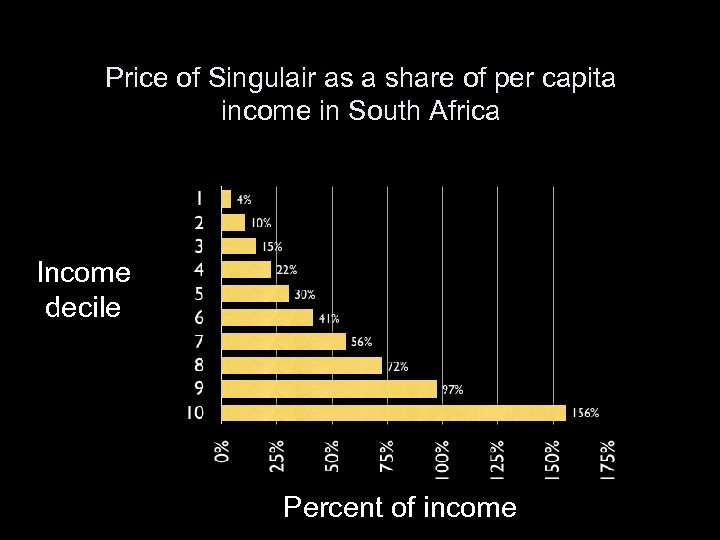 Price of Singulair as a share of per capita income in South Africa Income decile Percent of income
 Novartis at the World Bank in 2004 • We consider India to be a market of 50 million
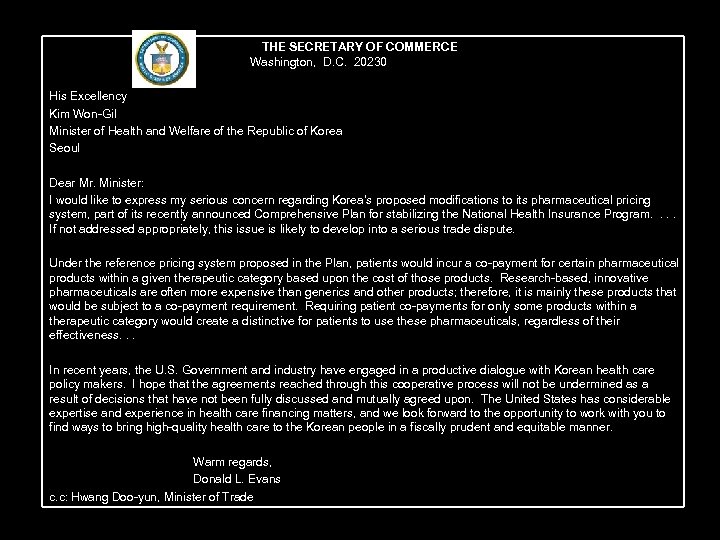 THE SECRETARY OF COMMERCE Washington, D. C. 20230 His Excellency Kim Won-Gil Minister of Health and Welfare of the Republic of Korea Seoul Dear Mr. Minister: I would like to express my serious concern regarding Korea’s proposed modifications to its pharmaceutical pricing system, part of its recently announced Comprehensive Plan for stabilizing the National Health Insurance Program. . If not addressed appropriately, this issue is likely to develop into a serious trade dispute. Under the reference pricing system proposed in the Plan, patients would incur a co-payment for certain pharmaceutical products within a given therapeutic category based upon the cost of those products. Research-based, innovative pharmaceuticals are often more expensive than generics and other products; therefore, it is mainly these products that would be subject to a co-payment requirement. Requiring patient co-payments for only some products within a therapeutic category would create a distinctive for patients to use these pharmaceuticals, regardless of their effectiveness. . . In recent years, the U. S. Government and industry have engaged in a productive dialogue with Korean health care policy makers. I hope that the agreements reached through this cooperative process will not be undermined as a result of decisions that have not been fully discussed and mutually agreed upon. The United States has considerable expertise and experience in health care financing matters, and we look forward to the opportunity to work with you to find ways to bring high-quality health care to the Korean people in a fiscally prudent and equitable manner. Warm regards, Donald L. Evans c. c: Hwang Doo-yun, Minister of Trade
 Paradigm Shift
 Change the trade framework from one that focuses solely on the protection of intellectual property rights or drug prices to a new mechanism that addresses directly the need to ensures adequate and sustainable global investment in medical R&D
 1. Separate the Market for Products from the Market for Innovation 2. Introduce more innovation and competition in the business methods we use to finance innovation
 Medical Innovation Prize Fund (US HR 417) • The Medical Innovation Prize Fund is created as an independent entity. • Trustees include some public officials (heads of NIH, Medicare, etc), and members of the public appointed by the President • The fund is supported by contributions equal to 50 basis points of US GDP (approximately 60 billion USD per year)
 How the MIPF works • Intellectual property rules, including patents, are left intact through the development of new medicines. • At point of FDA marketing approval, exclusive rights are eliminated, and generic competition is permitted. • Firms that register new products receive money from the Medical Innovation Prize Fund
 What are the Prizes? • For a 10 year period, the innovator is eligible for prize payments • The payments are based upon evidence of incremental benefits to health • It does not matter who sells the product - only the innovators receives the reward • Path breaking innovative products can receive payments even when replaced in market share by follow-on products
 Minimum allocations to priority research • 2 basis points for global neglected diseases ($2. 4 billion) • 5 basis points for orphan drugs ($6 billion) • 2 basis points for research on AIDS, including AIDS vaccines, global infectious diseases, and medicines to treat bio-terrorism ($2. 4 billion)
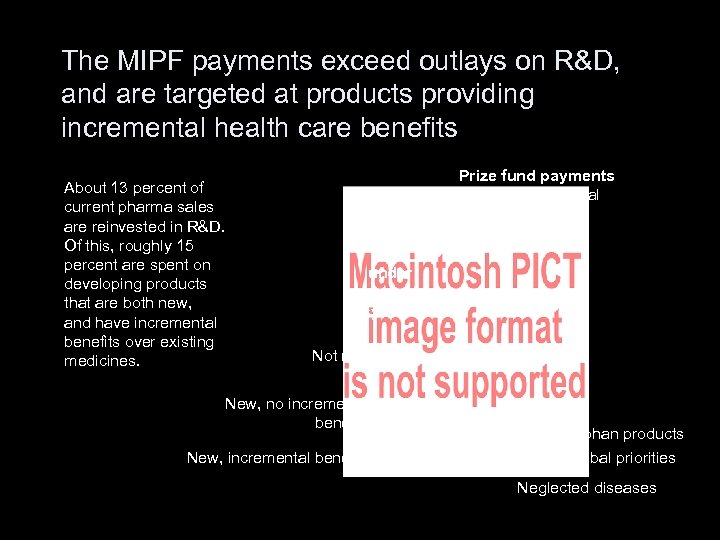 The MIPF payments exceed outlays on R&D, and are targeted at products providing incremental health care benefits About 13 percent of current pharma sales are reinvested in R&D. Of this, roughly 15 percent are spent on developing products that are both new, and have incremental benefits over existing medicines. Prize fund payments (new, incremental benefits) R&D under current system Not new New, no incremental benefits New, incremental benefits Orphan products Global priorities Neglected diseases
 Marginal Cost Pricing - “push approaches” - Competitive Intermediators, known as R&D Investment Funds) Employers are required to contribute to private R&D investment funds (RDIFs). RDIFs compete against each other. • Use different strategies to develop new products (prizes, direct funding, open source projects, etc) Government regulates FDIFs for transparency, etc
 More generally, Encourage and facilitate decentralized decision making and a diversity of financing mechanisms
 Create obligations and incentives to invest in priority research and public goods
 Priority Setting • TRIPS/Multilaterial/Regional/Bilaterial/ Unilateral trade and IPR agreements – Obligations to provide incentives to invest to products that fetch high prices • New Trade Framework – Obligations to support costs of R&D, regardless of public or private – Minimum quotas for investments in priority research – System of credits to provide incentives to invest in • Neglected diseases • Open public goods • Technology transfer and capacity building
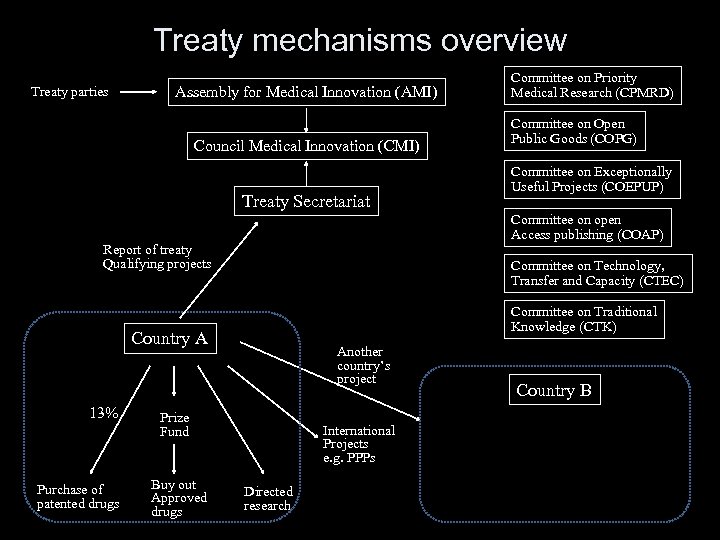 Treaty mechanisms overview Treaty parties Assembly for Medical Innovation (AMI) Council Medical Innovation (CMI) Treaty Secretariat Committee on Traditional Knowledge (CTK) Another country’s project Prize Fund Buy out Approved drugs Committee on Exceptionally Useful Projects (COEPUP) Committee on Technology, Transfer and Capacity (CTEC) Country A Purchase of patented drugs Committee on Open Public Goods (COPG) Committee on open Access publishing (COAP) Report of treaty Qualifying projects 13% Committee on Priority Medical Research (CPMRD) International Projects e. g. PPPs Directed research Country B
 Basic obligations • Fraction of GDP finances medical R&D – High income – Middle – Low
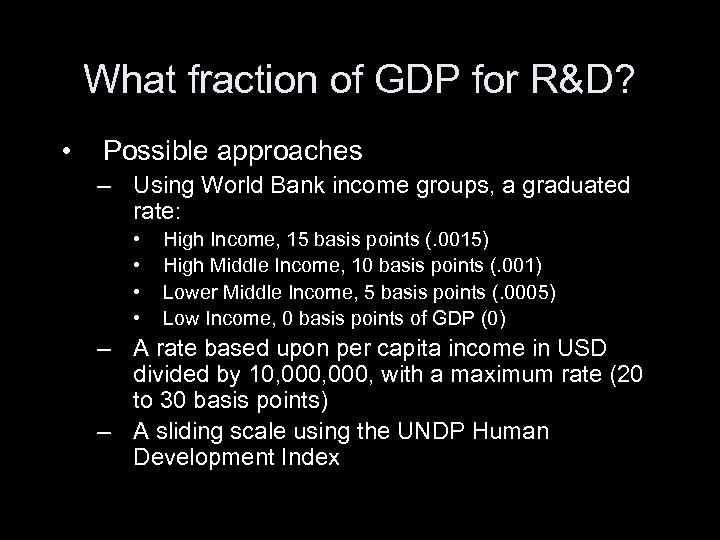 What fraction of GDP for R&D? • Possible approaches – Using World Bank income groups, a graduated rate: • • High Income, 15 basis points (. 0015) High Middle Income, 10 basis points (. 001) Lower Middle Income, 5 basis points (. 0005) Low Income, 0 basis points of GDP (0) – A rate based upon per capita income in USD divided by 10, 000, with a maximum rate (20 to 30 basis points) – A sliding scale using the UNDP Human Development Index
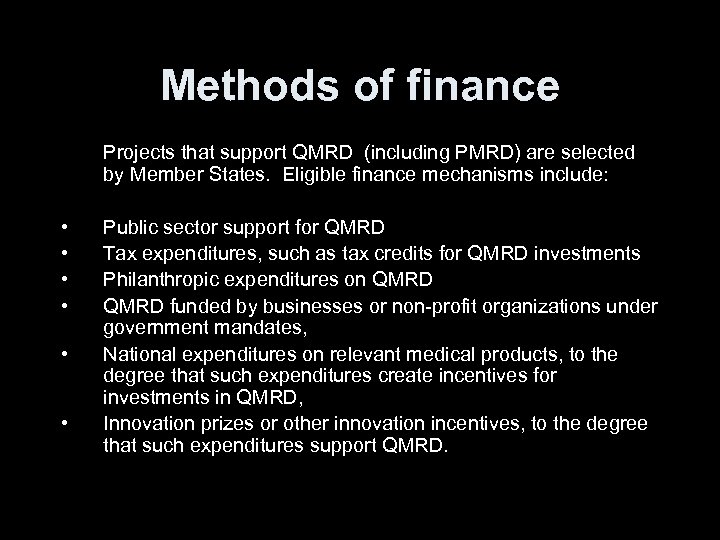 Methods of finance Projects that support QMRD (including PMRD) are selected by Member States. Eligible finance mechanisms include: • • • Public sector support for QMRD Tax expenditures, such as tax credits for QMRD investments Philanthropic expenditures on QMRD funded by businesses or non-profit organizations under government mandates, National expenditures on relevant medical products, to the degree that such expenditures create incentives for investments in QMRD, Innovation prizes or other innovation incentives, to the degree that such expenditures support QMRD.
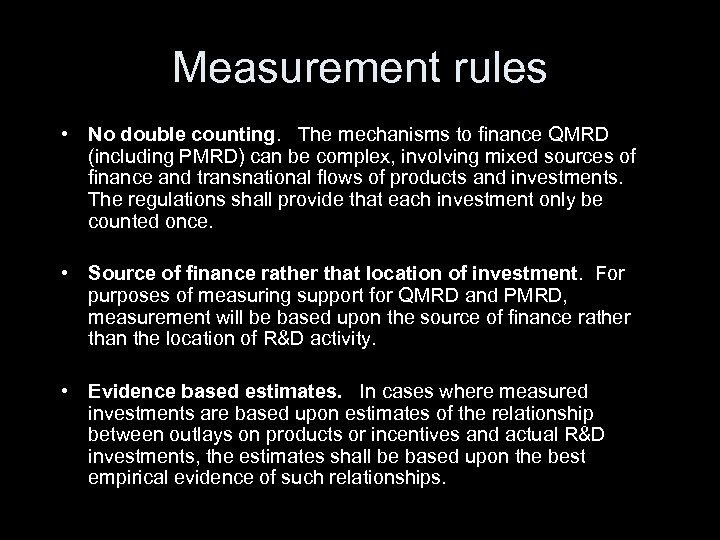 Measurement rules • No double counting. The mechanisms to finance QMRD (including PMRD) can be complex, involving mixed sources of finance and transnational flows of products and investments. The regulations shall provide that each investment only be counted once. • Source of finance rather that location of investment. For purposes of measuring support for QMRD and PMRD, measurement will be based upon the source of finance rather than the location of R&D activity. • Evidence based estimates. In cases where measured investments are based upon estimates of the relationship between outlays on products or incentives and actual R&D investments, the estimates shall be based upon the best empirical evidence of such relationships.
 What can we learn from efforts to cu rb global warming?

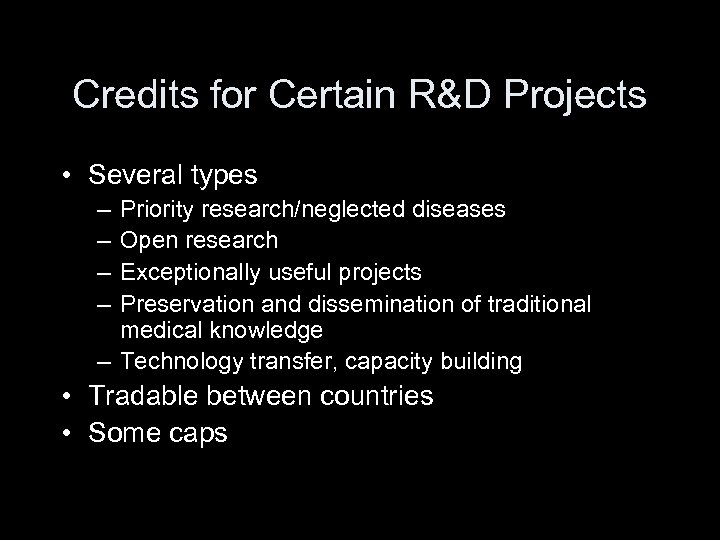 Credits for Certain R&D Projects • Several types – – Priority research/neglected diseases Open research Exceptionally useful projects Preservation and dissemination of traditional medical knowledge – Technology transfer, capacity building • Tradable between countries • Some caps
 For more information Consumer Project on Technology http: //www. cptech. org http: /www. cptech. org/workingdrafts/rndtreaty. html Subscribe to ip-health, or bellagio-rnd