


 Скачать презентацию The Measurement of Direct Value of Forage Production
ed0336a21f7dd1012252e52969a8ba81.ppt
- Количество слайдов: 12
 The Measurement of Direct Value of Forage Production Ken Belcher Department of Bioresource Policy, Business and Economics November 20, 2008
 Direct Value n Represents the value of production captured by output quantity and output prices. n Secondary effects are the values from the economic activity, spending and re-spending stimulated by the direct effect (multiplier effects).
 Production n To Quantify the economic value of an industry first need to calculate total production: n Data needs: Total quantity of production - depending on the sector/product (tonnes). n Average productivity converted to total production by area of production. n Time series of data to capture variation in production, average production and time trends. n
 Value n To convert total production to direct value of production need to determine output prices. n For each category and quality of output will have a specific output price. The more detailed the price data the more accurate the value estimate. n There will also be regional variation in prices with distribution of transportation costs.
 Value n In the absence of appropriate data may need to use average prices. n Important to apply the appropriate price data for the year of production to capture the interdependence of production quantity and price. n Therefore, will require a time series of output prices corresponding to the time series of production levels.
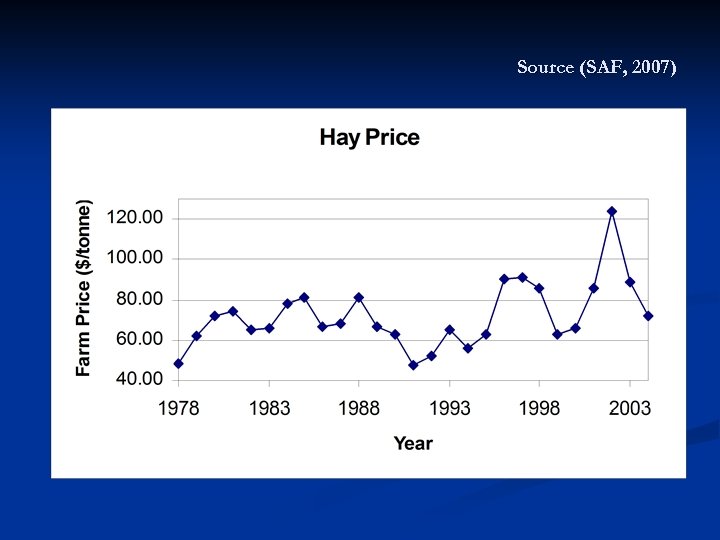 Source (SAF, 2007)
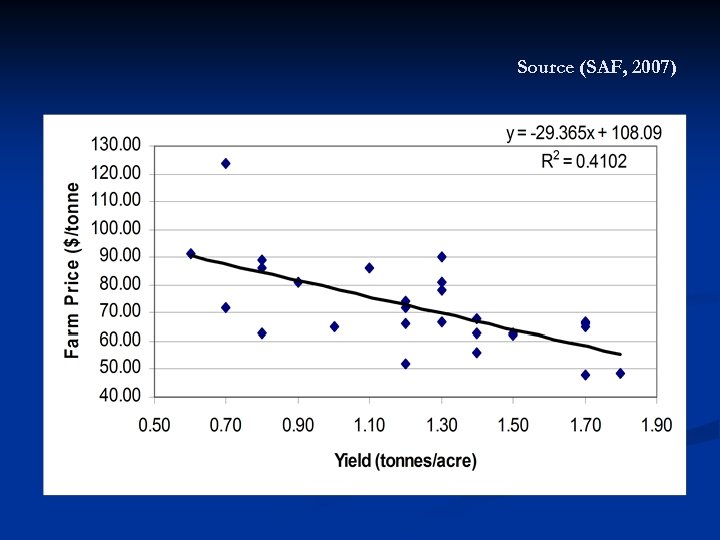 Source (SAF, 2007)
 Direct Value of Forage Industry n For the various sectors of the forage industry there will be a wide range of data quality for production and prices – area of production, quantity of sales, farm and industry prices, quality, time series. n Calculation of the value of the forage industry through n n n Existing data sets Transferable data sets from other regions – adjustment based on biophysical and socio-economic differences between data source and region to be applied. Collection of primary data.
 Secondary Effects n Secondary or multiplier effects of most industry is somewhat difficult as it represents the spending and respending stimulated by the forage industry. n Can include forage marketing services, equipment sales and service, input sales (e. g. Fertilizer, pesticides), processing facilities etc. n Can be based on primary data but may be estimated based on secondary effects of similar industries in different regions ($5 direct: $7. 5 secondary; 2. 5 multiplier).
 Other Considerations Changing transportation costs – influence viable markets, particularly for bulk products. n Alternative markets – biofuel production, fuel pellets. n Carbon sequestration values - Trading at $1. 10/tonne CO 2 n
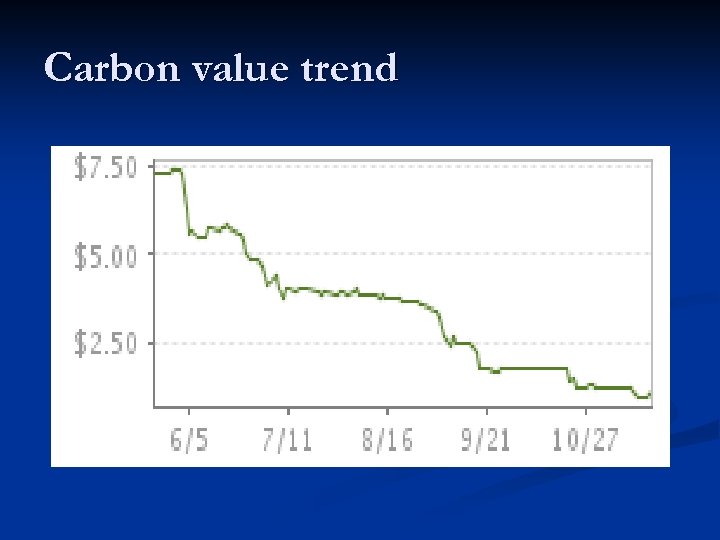 Carbon value trend
 Thank You