


 Скачать презентацию The Matrix List of Questions for Audience
54291b9a0272ca037aebb4b5504ea96d.ppt
- Количество слайдов: 59
 The Matrix
 List of Questions for Audience Participation • How many have seen the Matrix? • How many have seen the Matrix multiple times? • How many of you saw a different movie each time? • How many wish I would just show the Matrix?
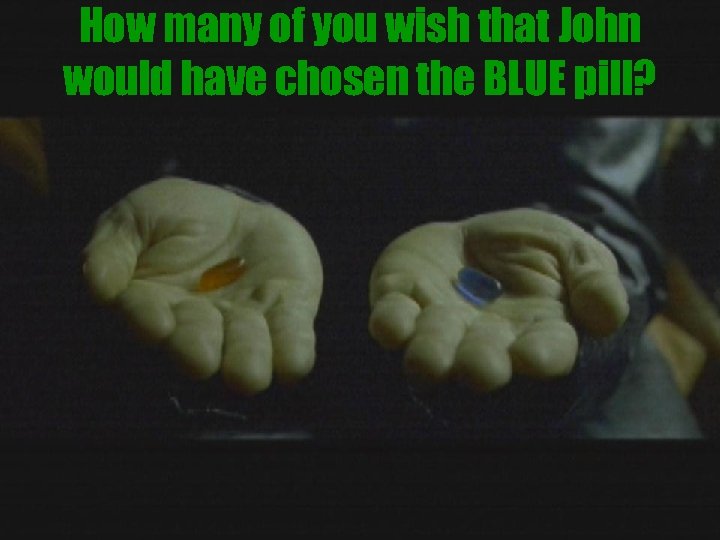 How many of you wish that John would have chosen the BLUE pill?
 Tank: Download me a Matrix Management 101 Primer
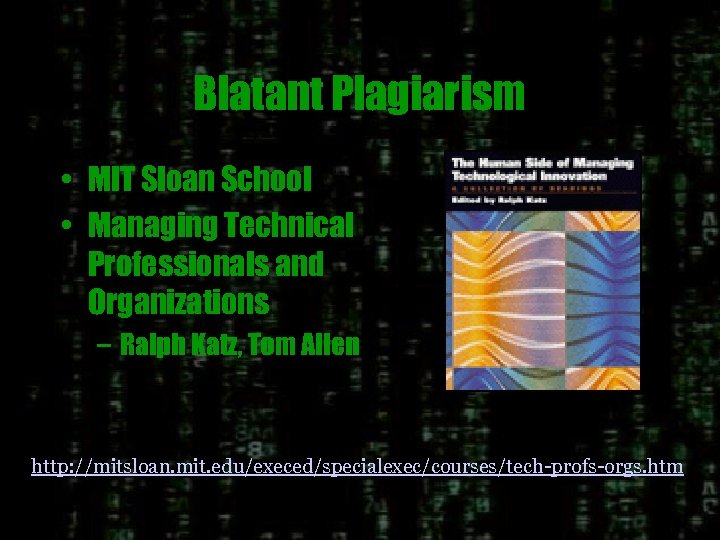 Blatant Plagiarism • MIT Sloan School • Managing Technical Professionals and Organizations – Ralph Katz, Tom Allen http: //mitsloan. mit. edu/execed/specialexec/courses/tech-profs-orgs. htm
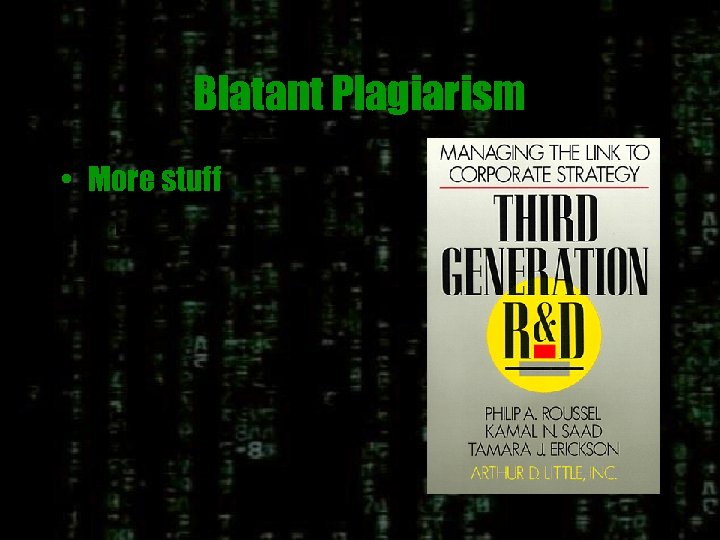 Blatant Plagiarism • More stuff
 Why a Matrix? • When Functional? • When Project? • What Balance?
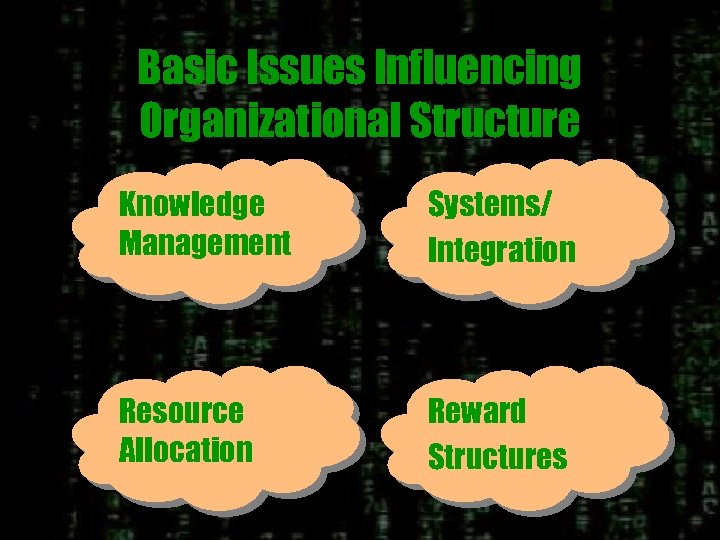 Basic Issues Influencing Organizational Structure Knowledge Management Systems/ Integration Resource Allocation Reward Structures
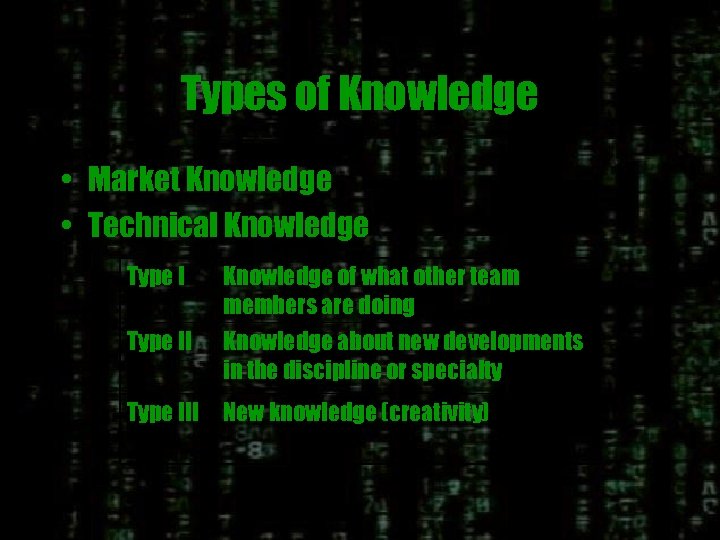 Types of Knowledge • Market Knowledge • Technical Knowledge Type I Knowledge of what other team members are doing Type II Knowledge about new developments in the discipline or specialty Type III New knowledge (creativity)
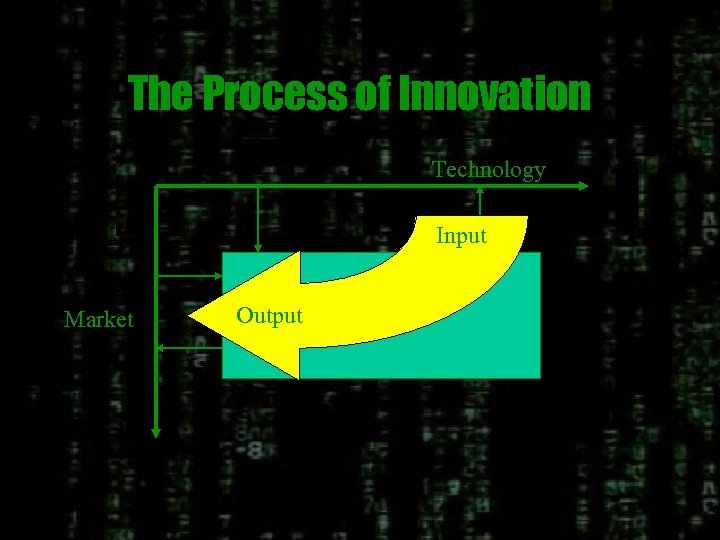 The Process of Innovation Technology Input Market Output Innovation
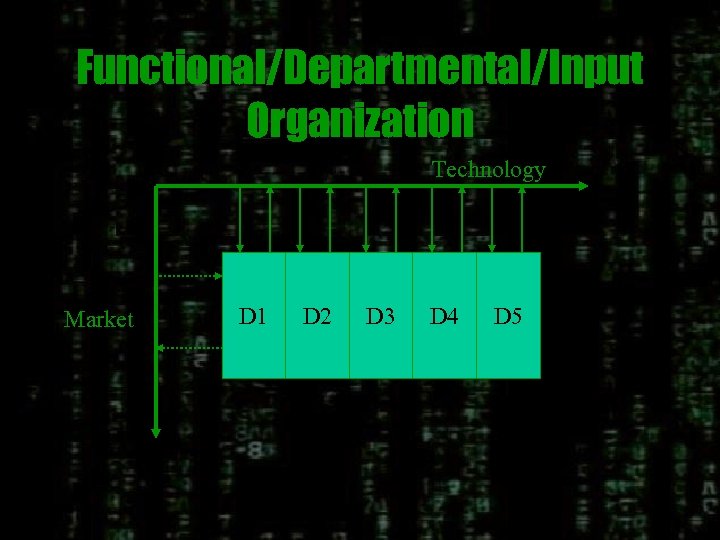 Functional/Departmental/Input Organization Technology Market D 1 D 2 D 3 D 4 D 5
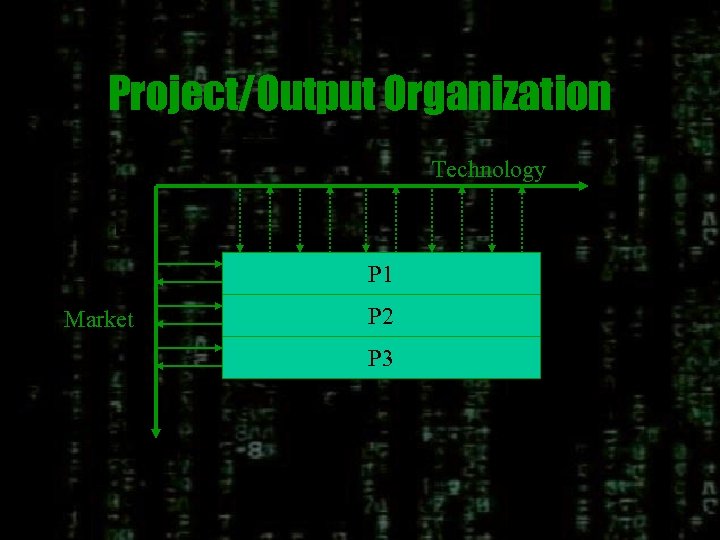 Project/Output Organization Technology P 1 Market P 2 P 3
 Department vs. Project • Departmental • Project – Closely mapped to the supporting technologies – Better connections to technological innovation – Less coordination of project tasks and less responsiveness to market change – Different disciplines united for a common purpose – Strong coordination of the project tasks and able to react to market dynamics – Accomplished at the cost of separation from the disciplinary knowledge. At an extreme, leads to technology erosion.
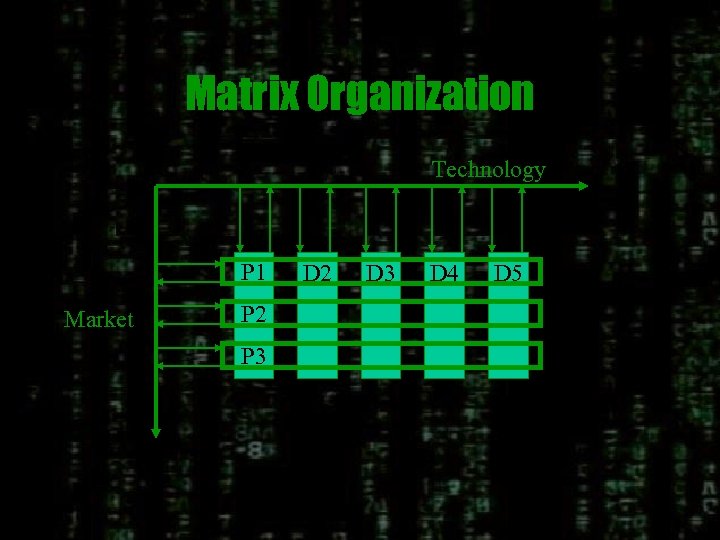 Matrix Organization Technology P 1 Market P 2 P 3 D 2 D 3 D 4 D 5
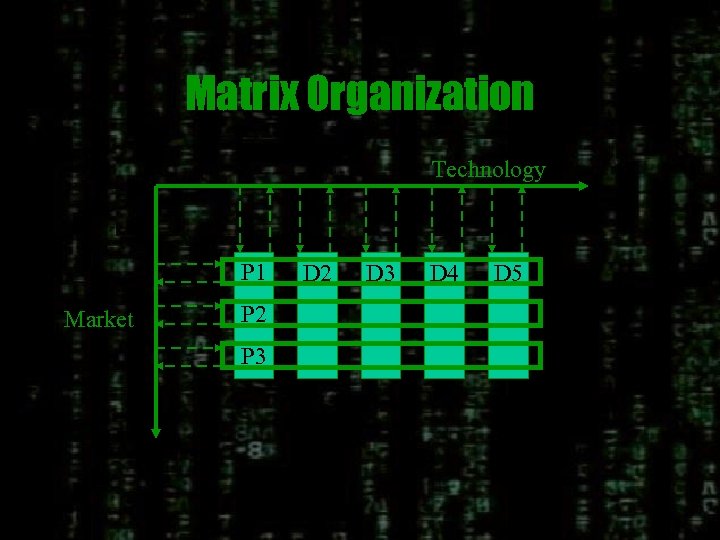 Matrix Organization Technology P 1 Market P 2 P 3 D 2 D 3 D 4 D 5
 Program Manager Discovers the Matrix
 Creative(? ) Tension • Functional managers want to improve technology – Shipping product gets in the way • Project managers want to ship product – Don’t give a damn about improving technology
 What are the drivers that determine Matrix balance? • • Rate of Change of Technology Rate of Change of Market Interdependence of Functional Groups Interdependence of Projects
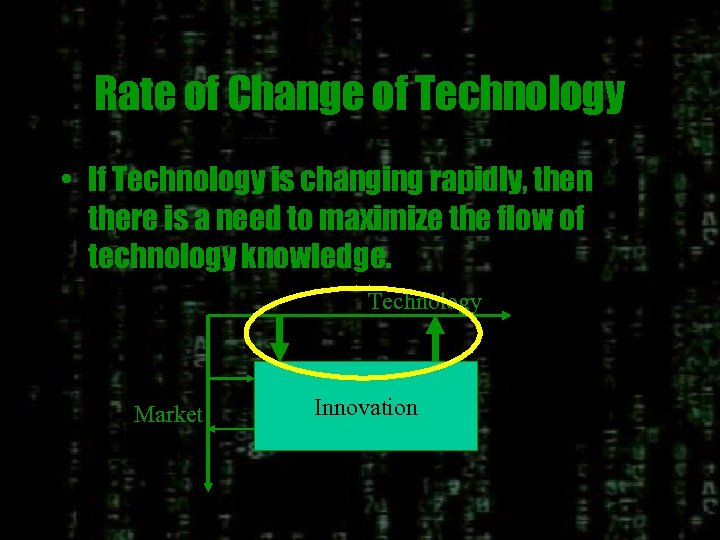 Rate of Change of Technology • If Technology is changing rapidly, then there is a need to maximize the flow of technology knowledge. Technology Market Innovation
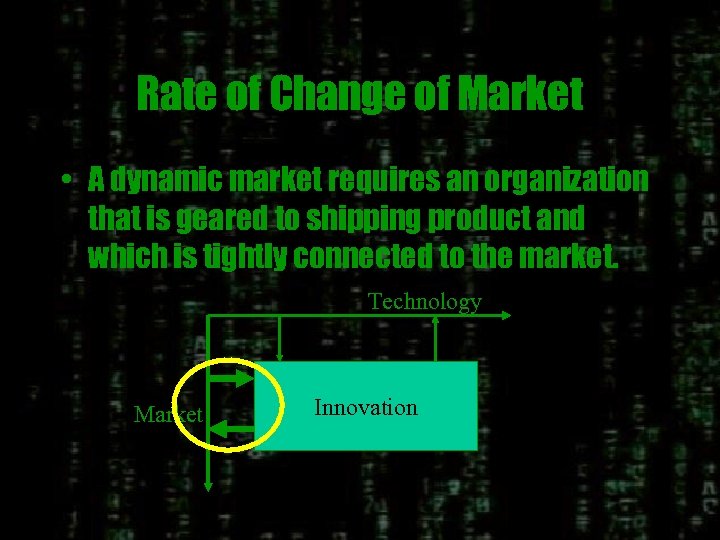 Rate of Change of Market • A dynamic market requires an organization that is geared to shipping product and which is tightly connected to the market. Technology Market Innovation
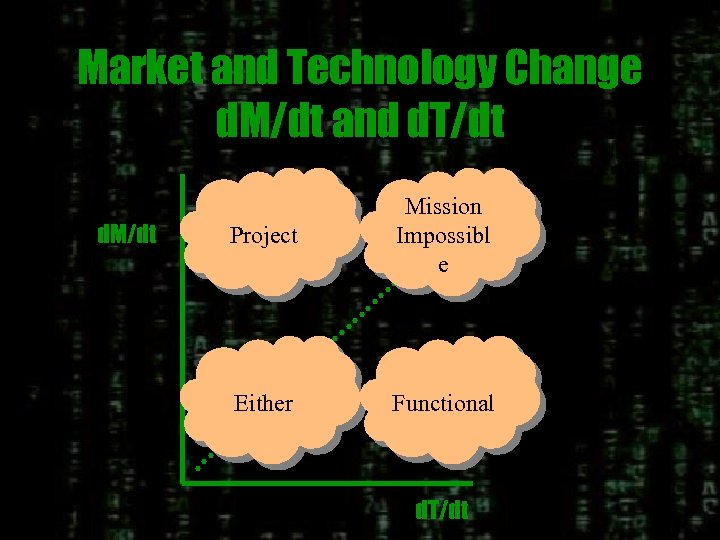 Market and Technology Change d. M/dt and d. T/dt d. M/dt Project Mission Impossibl e Either Functional d. T/dt
 Mission Impossible Options • Make do with more mature technology • Acknowledge that keeping up with technology is more critical than market pressures • High performing matrix organization • Reduce the project time and cycle people into and out of the project
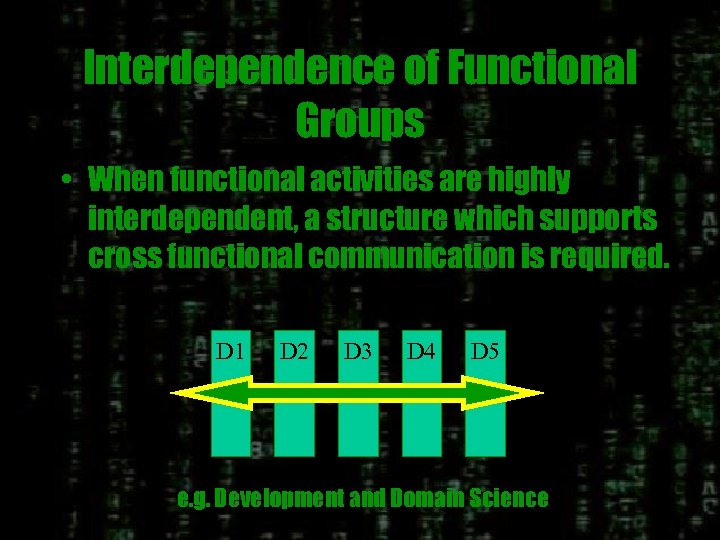 Interdependence of Functional Groups • When functional activities are highly interdependent, a structure which supports cross functional communication is required. D 1 D 2 D 3 D 4 D 5 e. g. Development and Domain Science
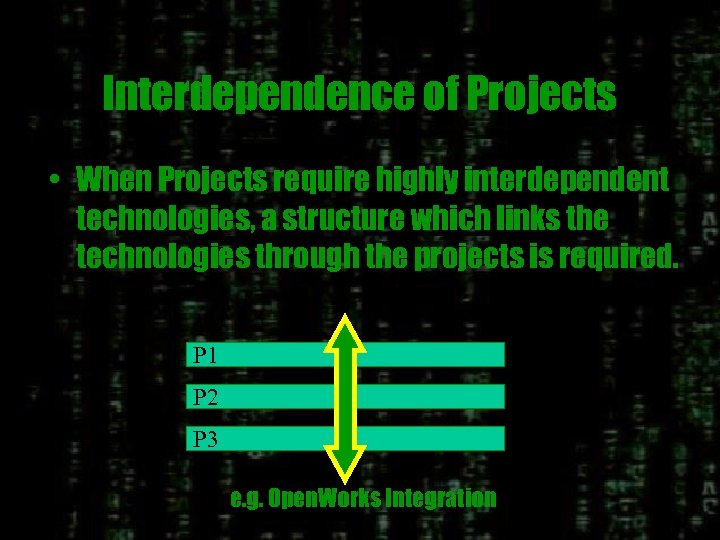 Interdependence of Projects • When Projects require highly interdependent technologies, a structure which links the technologies through the projects is required. P 1 P 2 P 3 e. g. Open. Works Integration
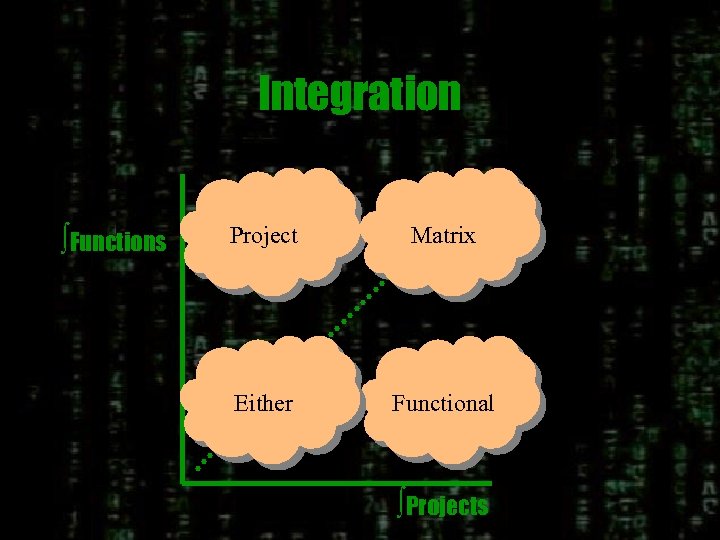 Integration Functions Project Matrix Either Functional Projects
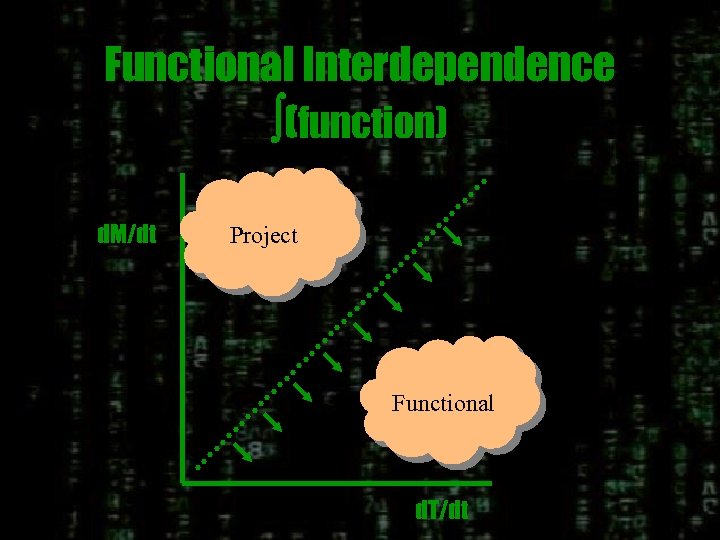 Functional Interdependence (function) d. M/dt Project Functional d. T/dt
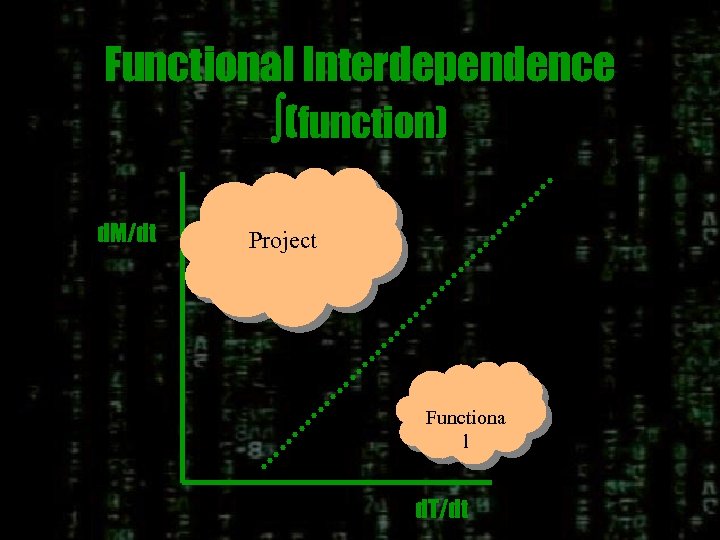 Functional Interdependence (function) d. M/dt Project Functiona l d. T/dt
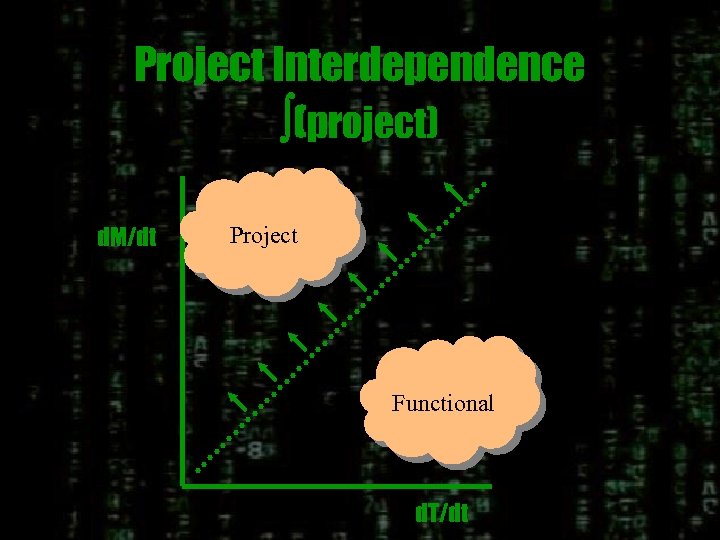 Project Interdependence (project) d. M/dt Project Functional d. T/dt
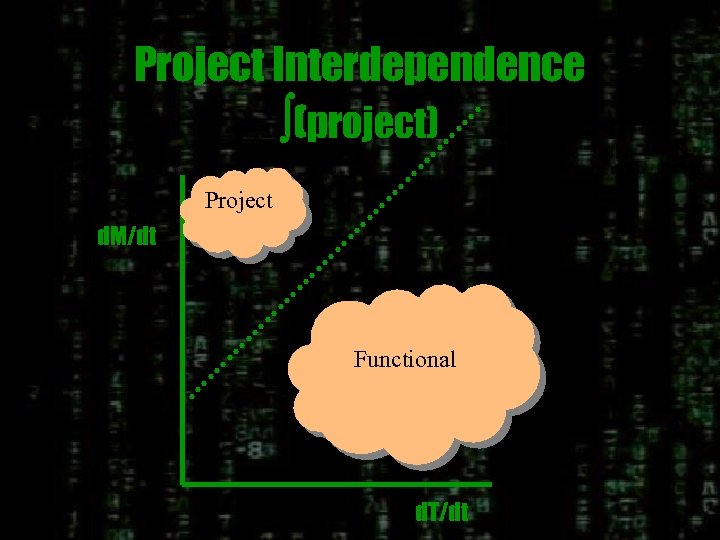 Project Interdependence (project) Project d. M/dt Functional d. T/dt
 Types of Teams • • • Functional Teams Lightweight Project Teams Heavyweight Project Teams Tiger Teams Hybrid Teams
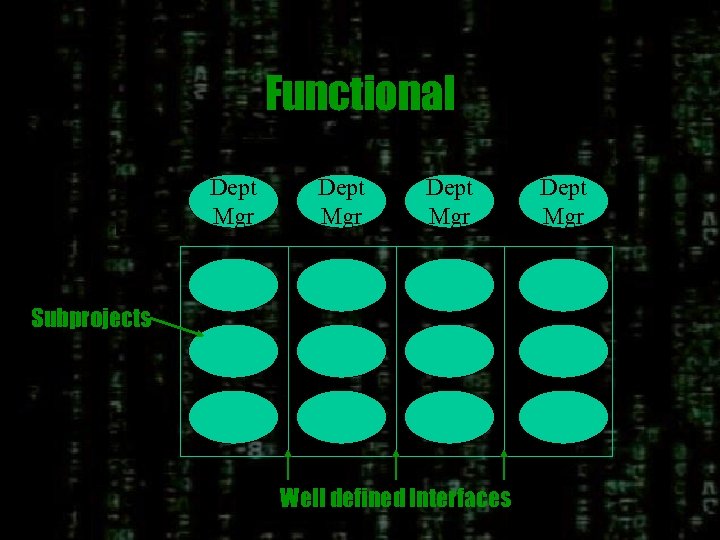 Functional Dept Mgr Subprojects Well defined Interfaces Dept Mgr
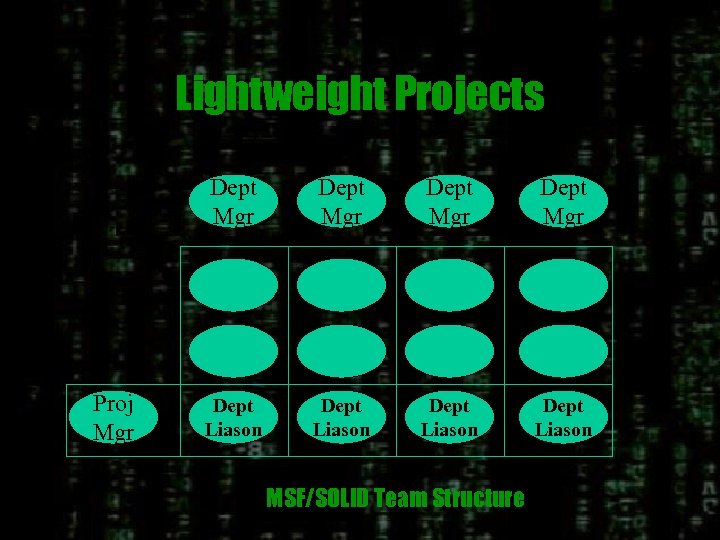 Lightweight Projects Dept Mgr Proj Mgr Dept Liason Dept Liason MSF/SOLID Team Structure
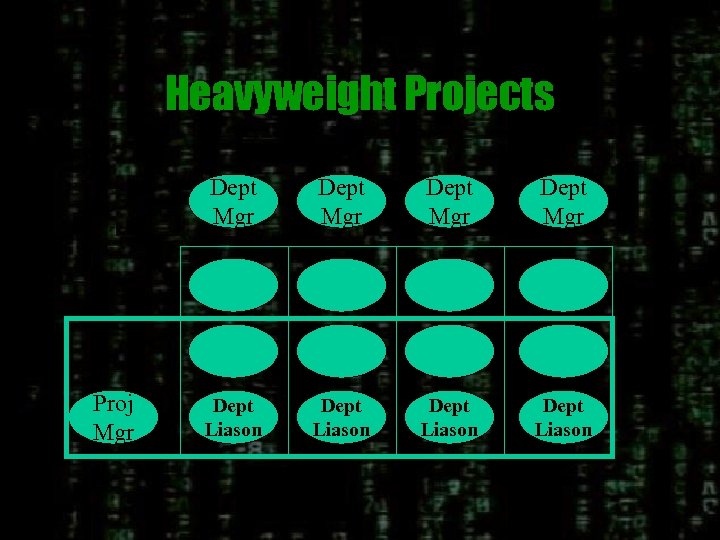 Heavyweight Projects Dept Mgr Proj Mgr Dept Liason Dept Liason
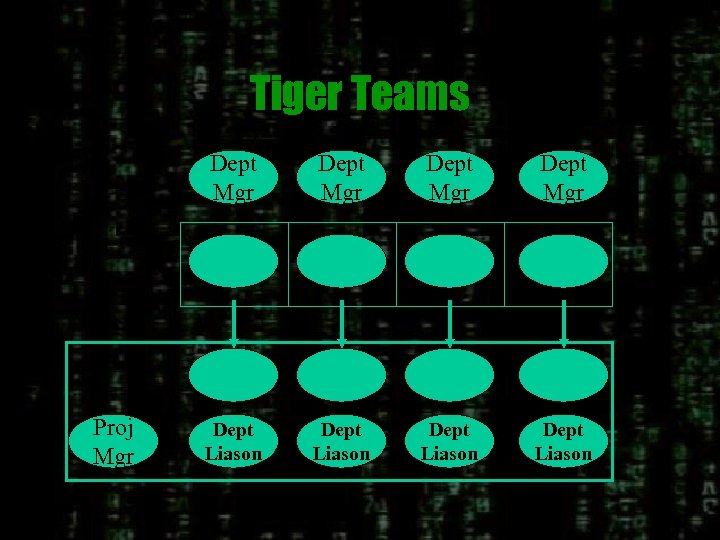 Tiger Teams Dept Mgr Proj Mgr Dept Liason Dept Liason
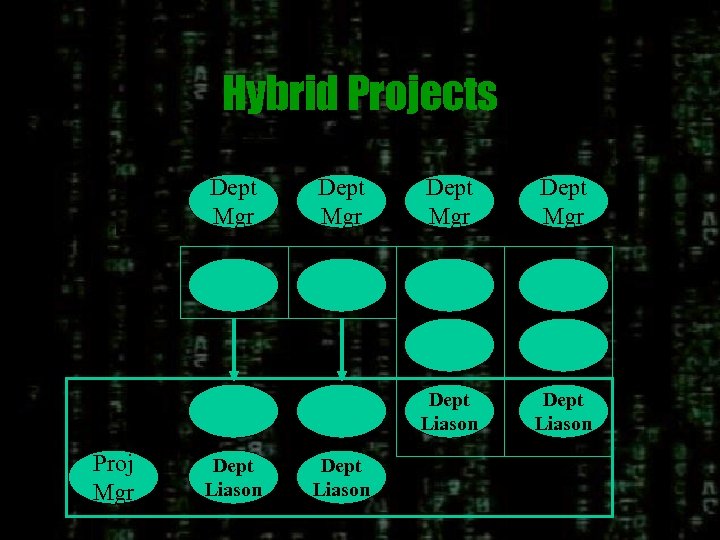 Hybrid Projects Dept Mgr Dept Liason Proj Mgr Dept Liason
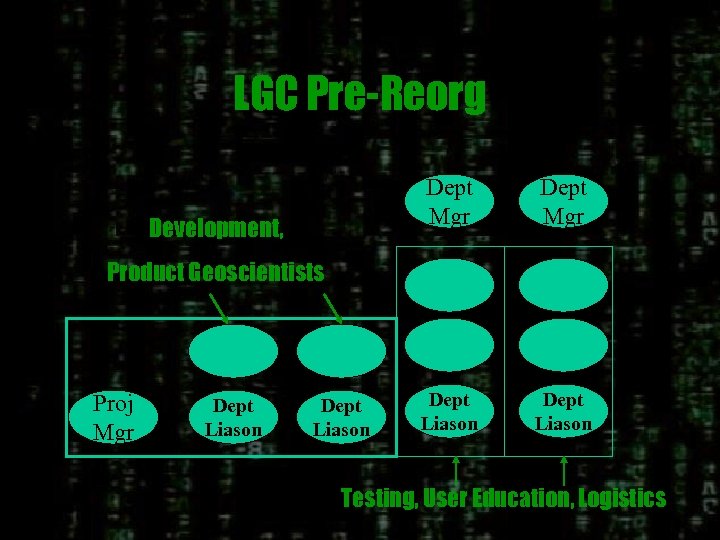 LGC Pre-Reorg Dept Mgr Development, Dept Mgr Dept Liason Product Geoscientists Proj Mgr Dept Liason Testing, User Education, Logistics
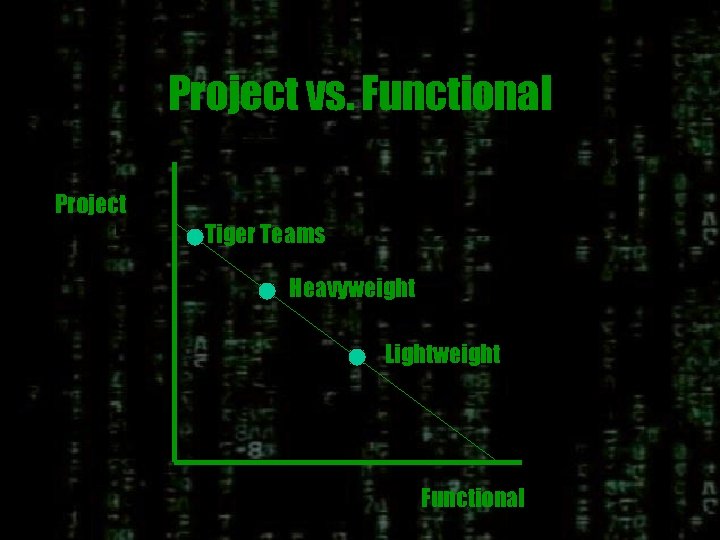 Project vs. Functional Project Tiger Teams Heavyweight Lightweight Functional
 Technology Transfer • It is a “people process” – Transferring documentation is, at best, an auxiliary process. – People must be in direct contact and understand each other to transfer knowledge. – Moving people is the most effective way to move knowledge • Organizationally or Geographically – Organizational boundaries generate different cultures which impose serious barriers to the transfer of technology.
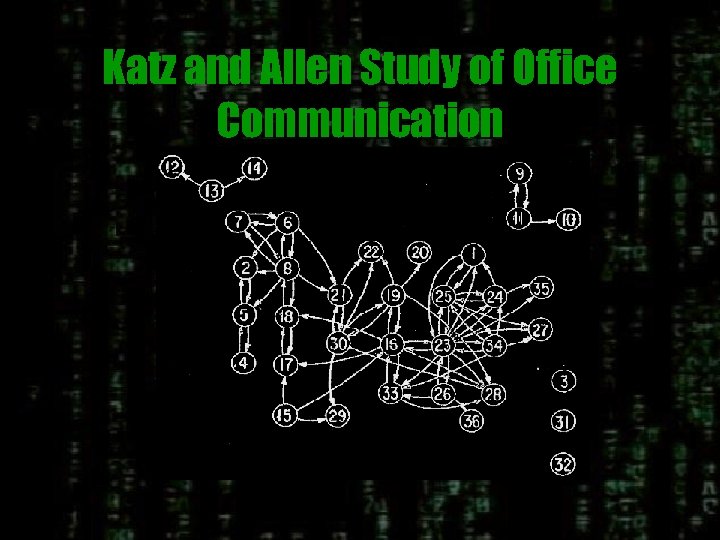 Katz and Allen Study of Office Communication
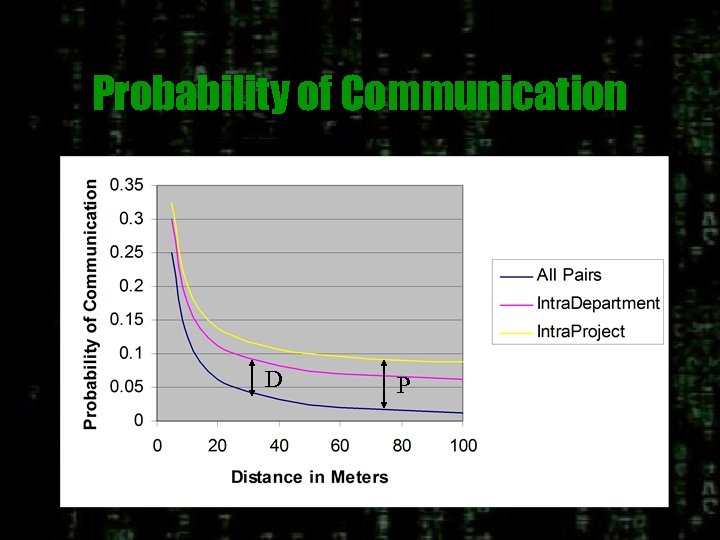 Probability of Communication D P
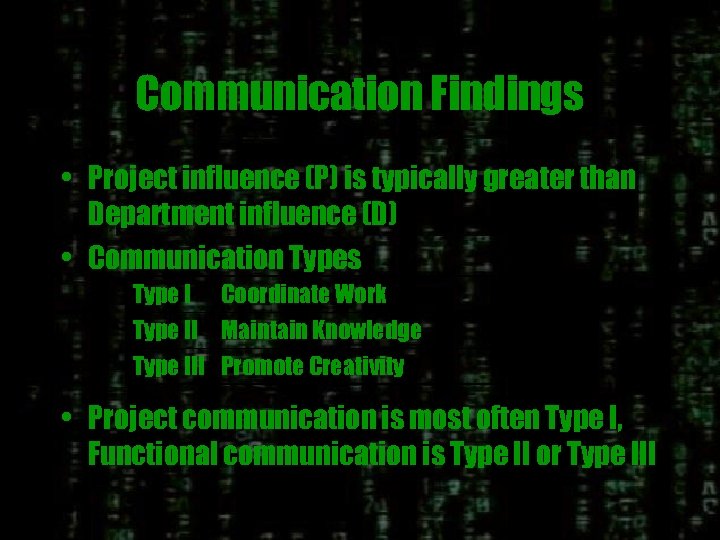 Communication Findings • Project influence (P) is typically greater than Department influence (D) • Communication Types Type I Coordinate Work Type II Maintain Knowledge Type III Promote Creativity • Project communication is most often Type I, Functional communication is Type II or Type III
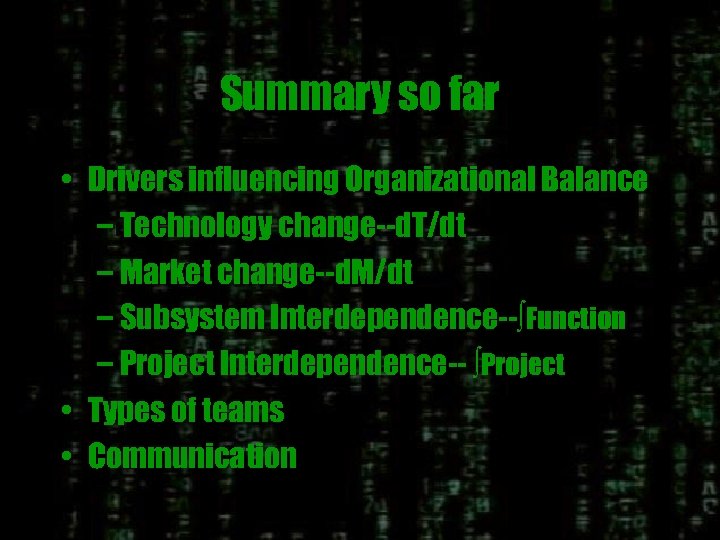 Summary so far • Drivers influencing Organizational Balance – Technology change--d. T/dt – Market change--d. M/dt – Subsystem Interdependence-- Function – Project Interdependence-- Project • Types of teams • Communication
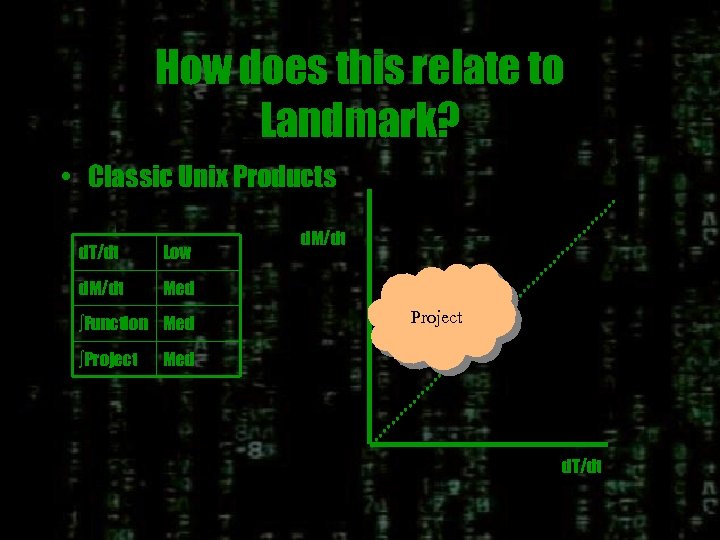 How does this relate to Landmark? • Classic Unix Products d. T/dt Low d. M/dt Med Function Med Project Med d. T/dt
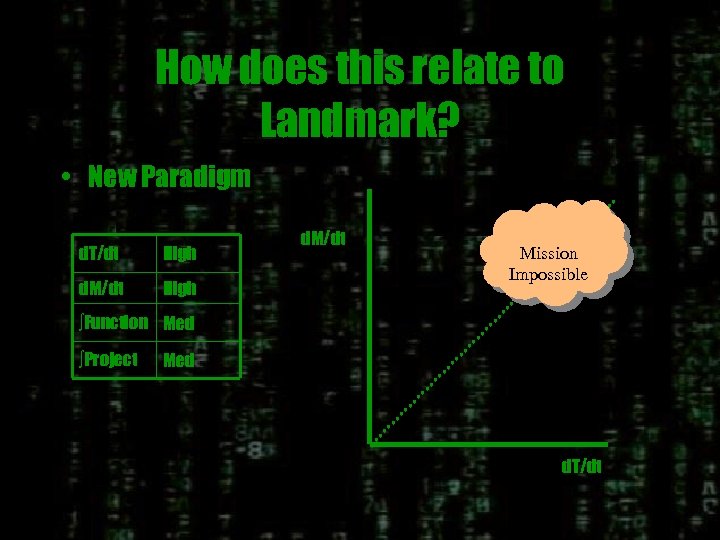 How does this relate to Landmark? • New Paradigm d. T/dt High d. M/dt Mission Impossible Function Med Project Med d. T/dt
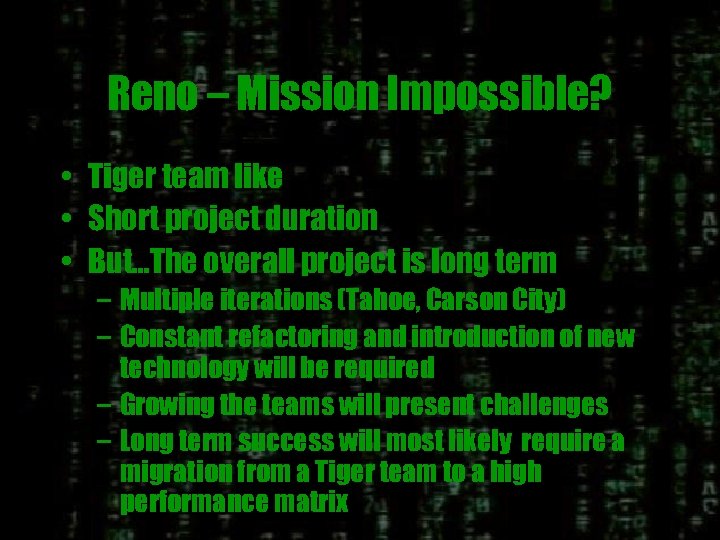 Reno – Mission Impossible? • Tiger team like • Short project duration • But…The overall project is long term – Multiple iterations (Tahoe, Carson City) – Constant refactoring and introduction of new technology will be required – Growing the teams will present challenges – Long term success will most likely require a migration from a Tiger team to a high performance matrix
 What Problems Do We See? • One size fits all – Different Technology Maturities – Different Market Maturities – Different Integration Needs • We are in danger of replacing product silos with functional silos
 Functional view of the Matrix
 Percy Barnevik, Former CEO of ABB “The Matrix is a fact of life. “ “If you deny the formal matrix you end up with an informal one—and that’s much harder to reckon with. ” “They (the functional and project mangers) must understand that they are complimenting each other, not competing”
 Roussel: 3 rd Generation R&D “Experience in R&D organizations across all industries shows that a project manager is accepted by the line departments only if he has a budget with which to “buy” services from the line departments. Access to money confers access to control, stature, and respect. ”
 Organizational Challenges • Team Issues – Create Teams • More than just putting a group of people together – The matrix provides flexibility for varying the Team organization balances, why not use it? – Office proximity should be guided by project and functional team needs – Empower Teams to Make Decisions – If Teams can’t reach a decision, make sure that the Escalation path is efficient and well defined
 Conclusions from Allen and Katz “Analyses show higher project performance when influence over salaries and promotions is perceived as balanced between project and functional managers. Performance reaches its highest level, however, when organizational influence is centered in the project manager and influence over the technical details of the work is centered in the functional manager"


 Questions?