


 Скачать презентацию THE MATHEMATICS OF CAUSE AND EFFECT Judea Pearl
d51c3354ccb7f104a6d07ab238e3e13e.ppt
- Количество слайдов: 48
 THE MATHEMATICS OF CAUSE AND EFFECT Judea Pearl University of California Los Angeles
 ANTIQUITY TO ROBOTICS “I would rather discover one causal relation than be King of Persia” Democritus (430 -380 BC) Development of Western science is based on two great achievements: the invention of the formal logical system (in Euclidean geometry) by the Greek philosophers, and the discovery of the possibility to find out causal relationships by systematic experiment (during the Renaissance). A. Einstein, April 23, 1953
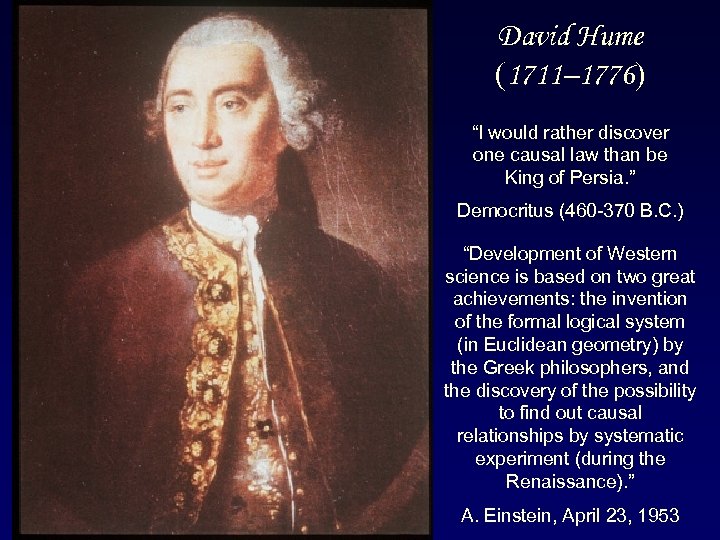 David Hume (1711– 1776) “I would rather discover one causal law than be King of Persia. ” Democritus (460 -370 B. C. ) “Development of Western science is based on two great achievements: the invention of the formal logical system (in Euclidean geometry) by the Greek philosophers, and the discovery of the possibility to find out causal relationships by systematic experiment (during the Renaissance). ” A. Einstein, April 23, 1953
 HUME’S LEGACY 1. Analytical vs. empirical claims 2. Causal claims are empirical 3. All empirical claims originate from experience.
 THE TWO RIDDLES OF CAUSATION l What empirical evidence legitimizes a cause-effect connection? l What inferences can be drawn from causal information? and how?

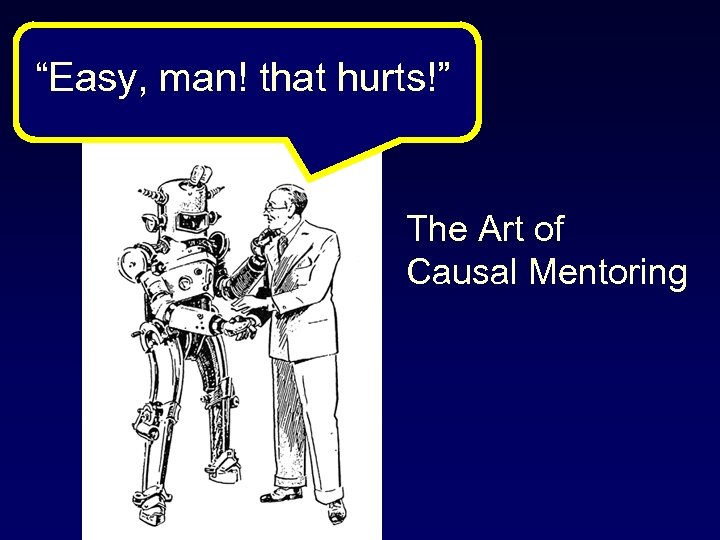 “Easy, man! that hurts!” The Art of Causal Mentoring
 OLD RIDDLES IN NEW DRESS 1. How should a robot acquire causal 1. information from the environment? 2. How should a robot process causal 3. information received from its 4. creator-programmer?
 CAUSATION AS A PROGRAMMER'S NIGHTMARE Input: 1. “If the grass is wet, then it rained” 2. “if we break this bottle, the grass will get wet” Output: “If we break this bottle, then it rained”
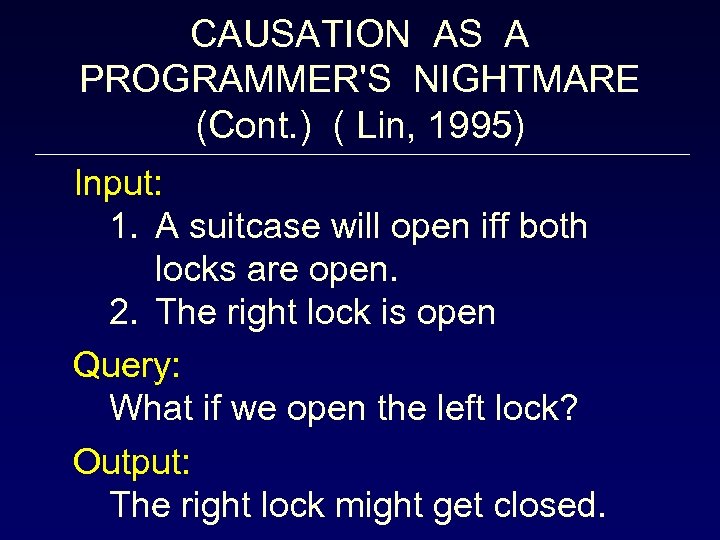 CAUSATION AS A PROGRAMMER'S NIGHTMARE (Cont. ) ( Lin, 1995) Input: 1. A suitcase will open iff both locks are open. 2. The right lock is open Query: What if we open the left lock? Output: The right lock might get closed.
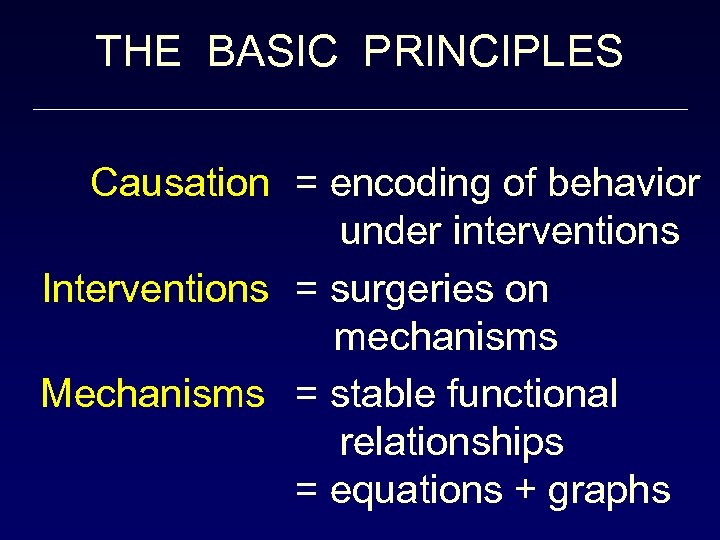 THE BASIC PRINCIPLES Causation = encoding of behavior under interventions Interventions = surgeries on mechanisms Mechanisms = stable functional relationships = equations + graphs
 CAUSATION AS A PROGRAMMER'S NIGHTMARE Input: 1. “If the grass is wet, then it rained” 2. “if we break this bottle, the grass will get wet” Output: “If we break this bottle, then it rained”
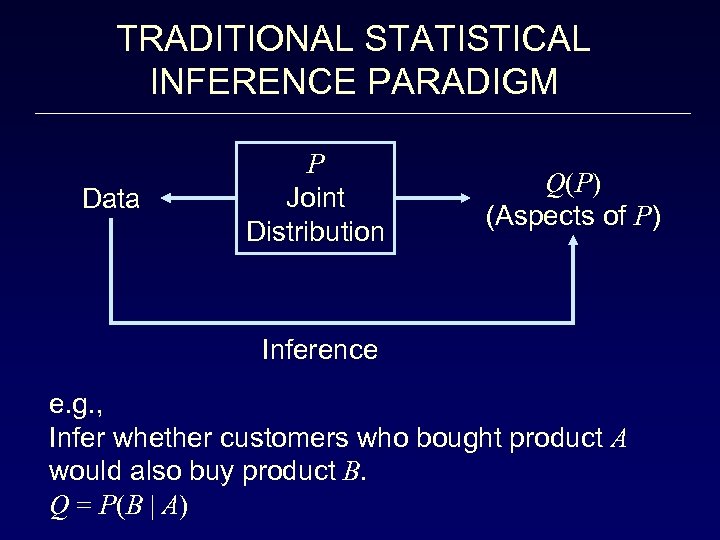 TRADITIONAL STATISTICAL INFERENCE PARADIGM Data P Joint Distribution Q(P) (Aspects of P) Inference e. g. , Infer whether customers who bought product A would also buy product B. Q = P(B | A)
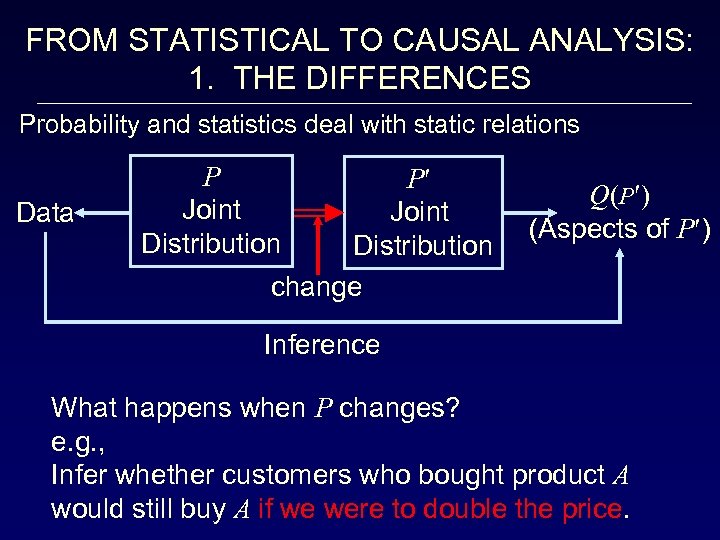 FROM STATISTICAL TO CAUSAL ANALYSIS: 1. THE DIFFERENCES Probability and statistics deal with static relations Data P Joint Distribution change Q(P ) (Aspects of P ) Inference What happens when P changes? e. g. , Infer whether customers who bought product A would still buy A if we were to double the price.
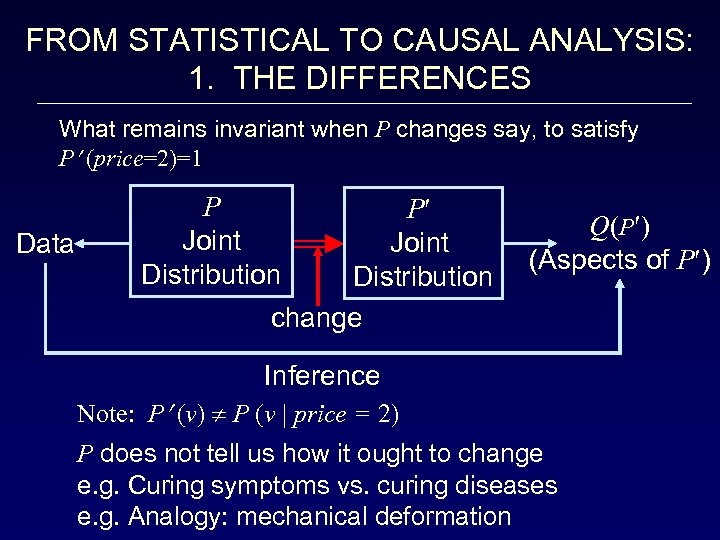 FROM STATISTICAL TO CAUSAL ANALYSIS: 1. THE DIFFERENCES What remains invariant when P changes say, to satisfy P (price=2)=1 Data P Joint Distribution change Q(P ) (Aspects of P ) Inference Note: P (v) P (v | price = 2) P does not tell us how it ought to change e. g. Curing symptoms vs. curing diseases e. g. Analogy: mechanical deformation
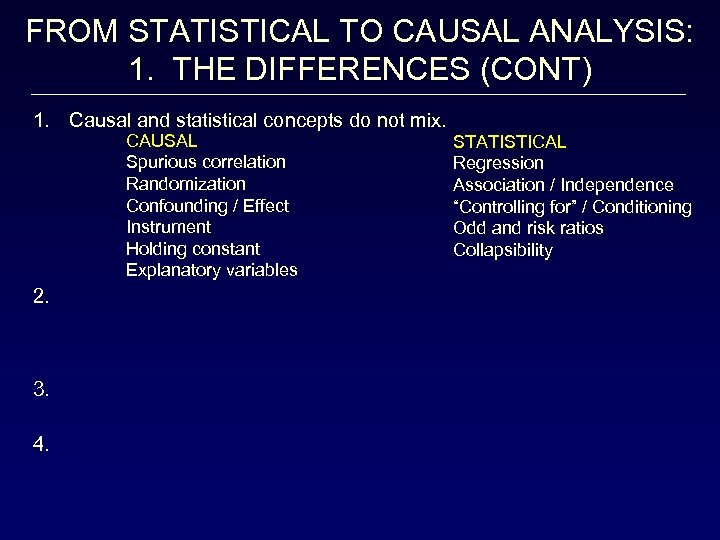 FROM STATISTICAL TO CAUSAL ANALYSIS: 1. THE DIFFERENCES (CONT) 1. Causal and statistical concepts do not mix. CAUSAL Spurious correlation Randomization Confounding / Effect Instrument Holding constant Explanatory variables 2. 3. 4. STATISTICAL Regression Association / Independence “Controlling for” / Conditioning Odd and risk ratios Collapsibility
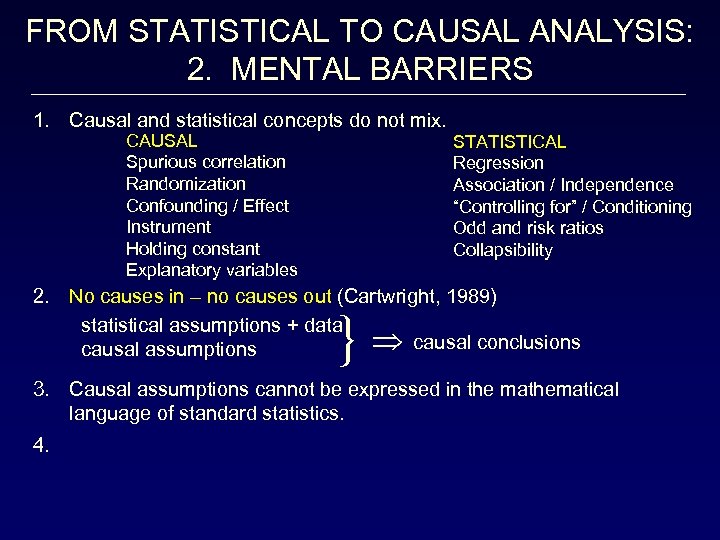 FROM STATISTICAL TO CAUSAL ANALYSIS: 2. MENTAL BARRIERS 1. Causal and statistical concepts do not mix. CAUSAL Spurious correlation Randomization Confounding / Effect Instrument Holding constant Explanatory variables STATISTICAL Regression Association / Independence “Controlling for” / Conditioning Odd and risk ratios Collapsibility 2. No causes in – no causes out (Cartwright, 1989) statistical assumptions + data causal conclusions causal assumptions } 3. Causal assumptions cannot be expressed in the mathematical language of standard statistics. 4.
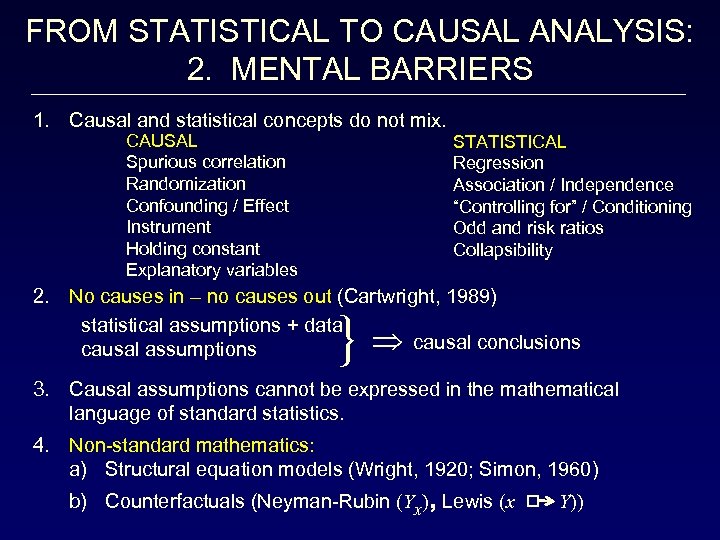 FROM STATISTICAL TO CAUSAL ANALYSIS: 2. MENTAL BARRIERS 1. Causal and statistical concepts do not mix. CAUSAL Spurious correlation Randomization Confounding / Effect Instrument Holding constant Explanatory variables STATISTICAL Regression Association / Independence “Controlling for” / Conditioning Odd and risk ratios Collapsibility 2. No causes in – no causes out (Cartwright, 1989) statistical assumptions + data causal conclusions causal assumptions } 3. Causal assumptions cannot be expressed in the mathematical language of standard statistics. 4. Non-standard mathematics: a) Structural equation models (Wright, 1920; Simon, 1960) b) Counterfactuals (Neyman-Rubin (Yx), Lewis (x Y))
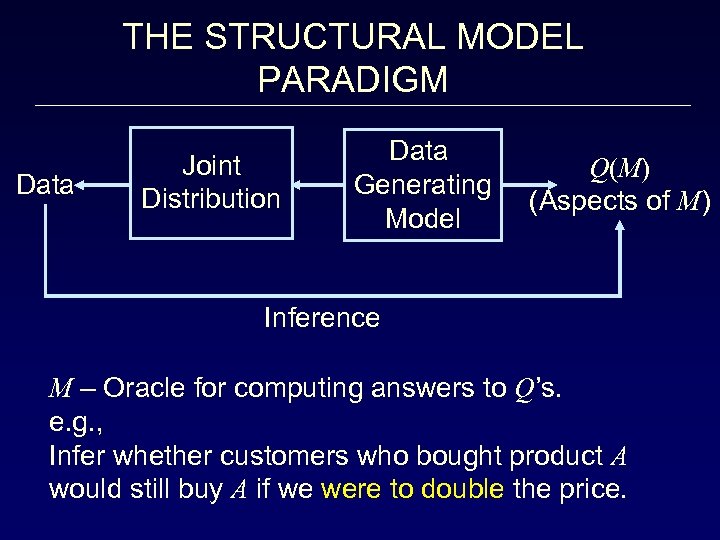 THE STRUCTURAL MODEL PARADIGM Data Joint Distribution Data Generating Model Q(M) (Aspects of M) Inference M – Oracle for computing answers to Q’s. e. g. , Infer whether customers who bought product A would still buy A if we were to double the price.
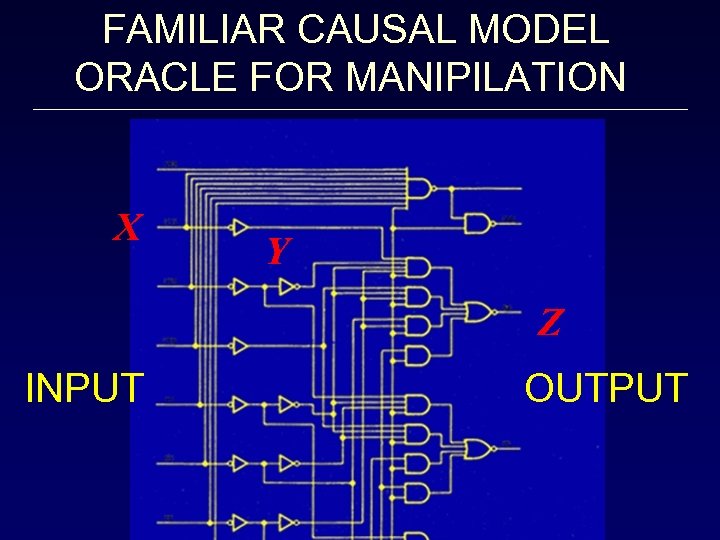 FAMILIAR CAUSAL MODEL ORACLE FOR MANIPILATION X Y Z INPUT OUTPUT
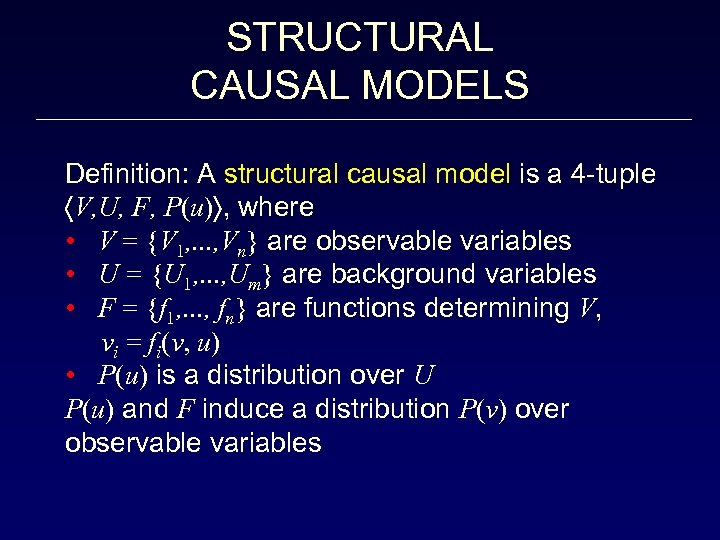 STRUCTURAL CAUSAL MODELS Definition: A structural causal model is a 4 -tuple V, U, F, P(u) , where • V = {V 1, . . . , Vn} are observable variables • U = {U 1, . . . , Um} are background variables • F = {f 1, . . . , fn} are functions determining V, vi = fi(v, u) • P(u) is a distribution over U P(u) and F induce a distribution P(v) over observable variables
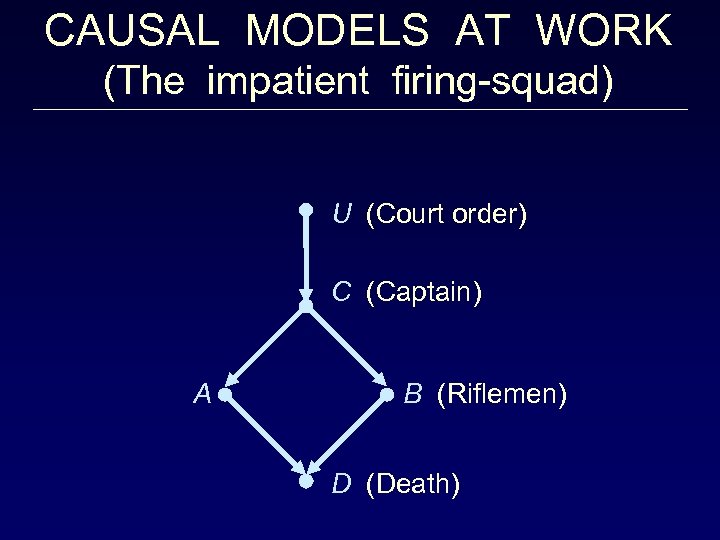 CAUSAL MODELS AT WORK (The impatient firing-squad) U (Court order) C (Captain) A B (Riflemen) D (Death)
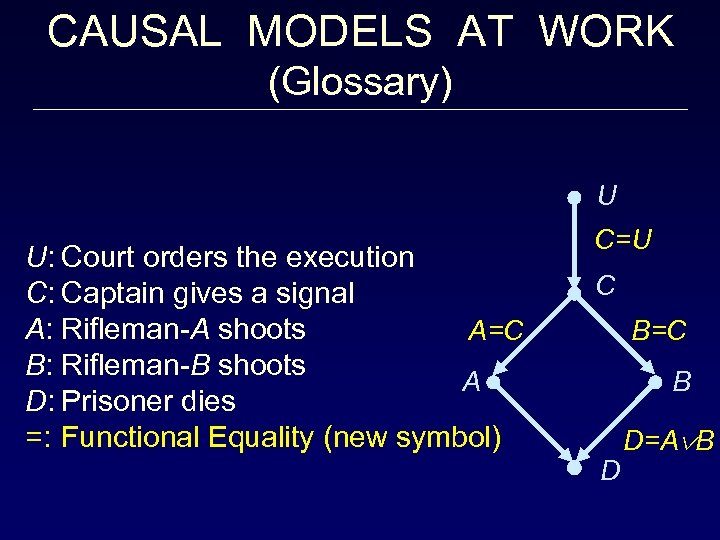 CAUSAL MODELS AT WORK (Glossary) U U: Court orders the execution C: Captain gives a signal A: Rifleman-A shoots A=C B: Rifleman-B shoots A D: Prisoner dies =: Functional Equality (new symbol) C=U C B=C B D D=A B
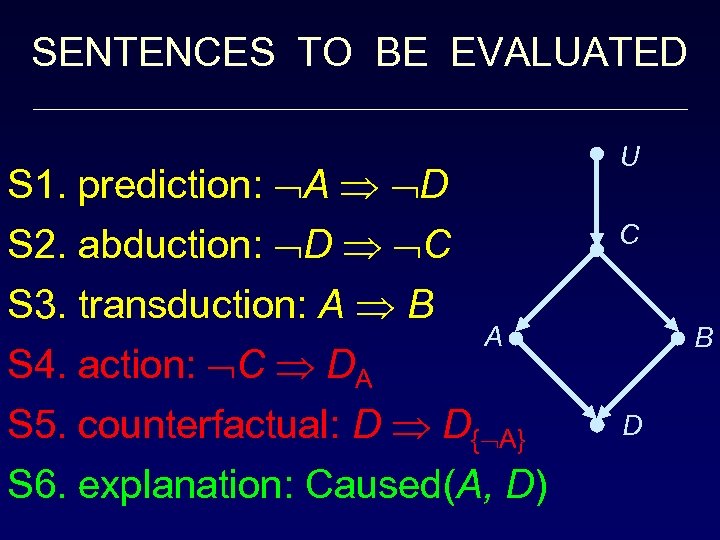 SENTENCES TO BE EVALUATED S 1. prediction: A D S 2. abduction: D C S 3. transduction: A B A S 4. action: C DA S 5. counterfactual: D D{ A} S 6. explanation: Caused(A, D) U C B D
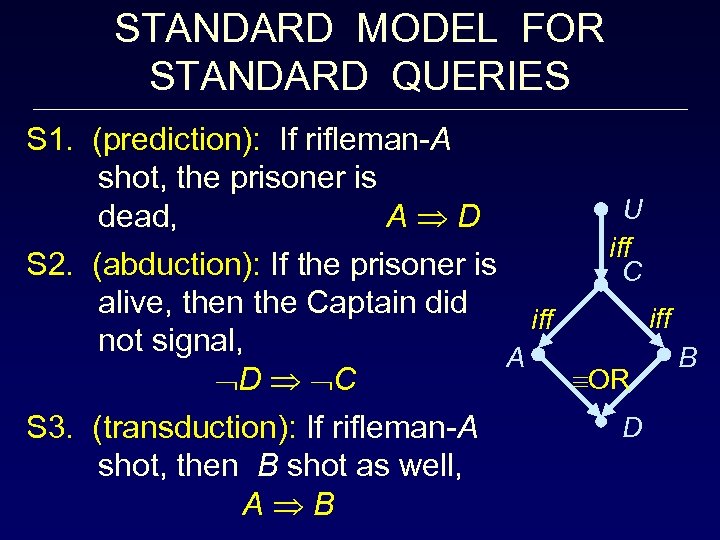 STANDARD MODEL FOR STANDARD QUERIES S 1. (prediction): If rifleman-A shot, the prisoner is U dead, A D iff S 2. (abduction): If the prisoner is C alive, then the Captain did iff not signal, A B OR D C D S 3. (transduction): If rifleman-A shot, then B shot as well, A B
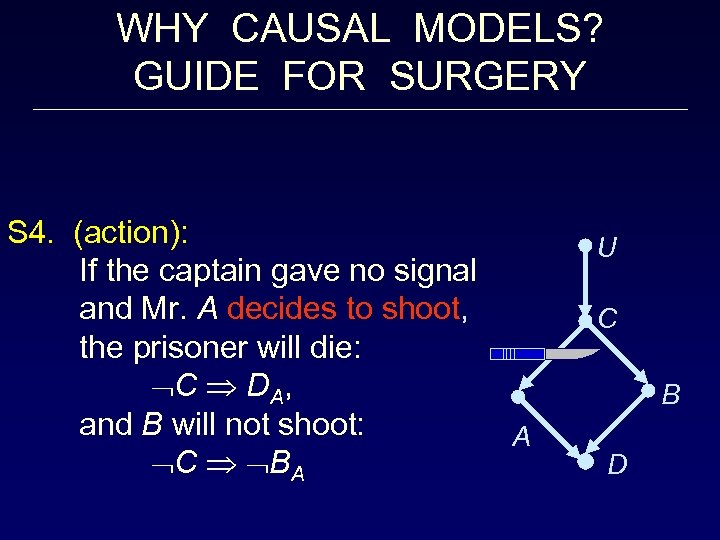 WHY CAUSAL MODELS? GUIDE FOR SURGERY S 4. (action): If the captain gave no signal and Mr. A decides to shoot, the prisoner will die: C DA, and B will not shoot: C BA U C B A D
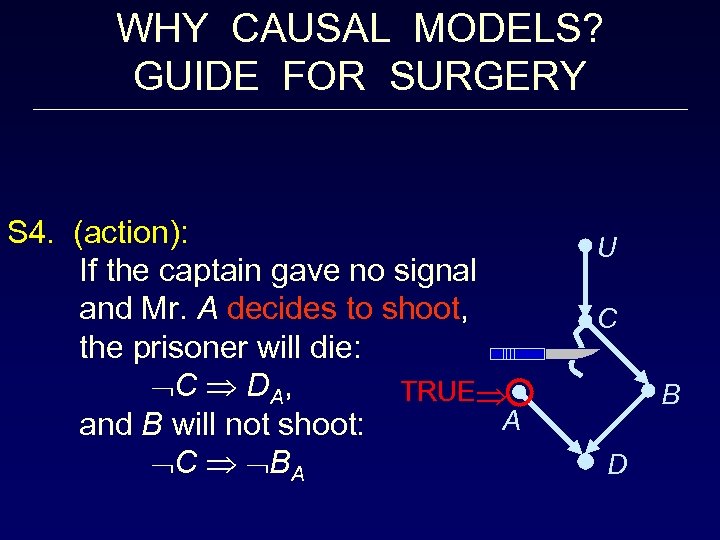 WHY CAUSAL MODELS? GUIDE FOR SURGERY S 4. (action): If the captain gave no signal and Mr. A decides to shoot, the prisoner will die: C DA, TRUE A and B will not shoot: C BA U C B D
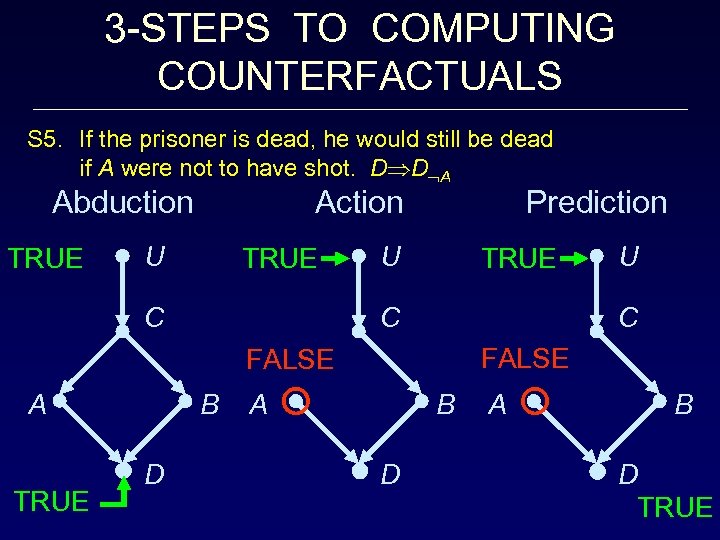 3 -STEPS TO COMPUTING COUNTERFACTUALS S 5. If the prisoner is dead, he would still be dead if A were not to have shot. D D A Abduction TRUE Action U TRUE C Prediction U TRUE C C FALSE A TRUE B D U A B D TRUE
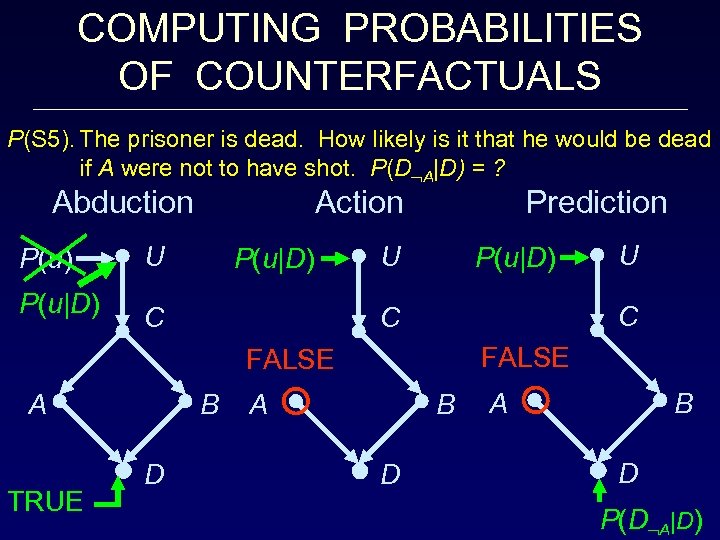 COMPUTING PROBABILITIES OF COUNTERFACTUALS P(S 5). The prisoner is dead. How likely is it that he would be dead if A were not to have shot. P(D A|D) = ? Abduction P(u) P(u|D) Action U P(u|D) C Prediction U P(u|D) C C FALSE A TRUE B D U A B D P(D A|D)
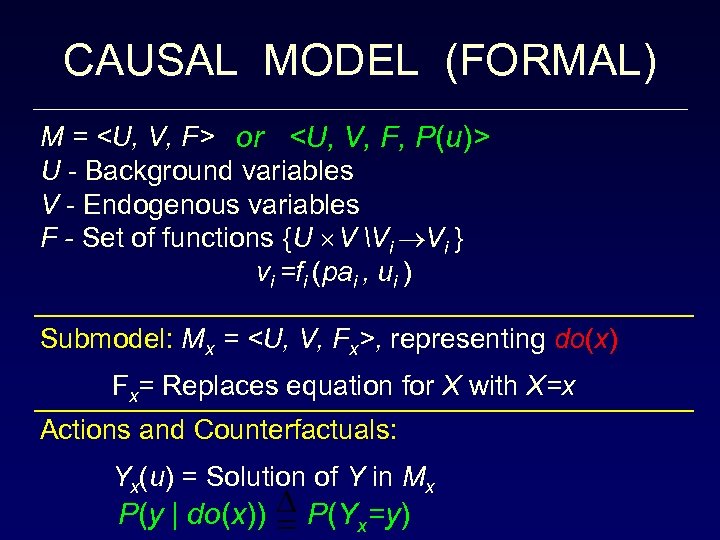 CAUSAL MODEL (FORMAL) M =
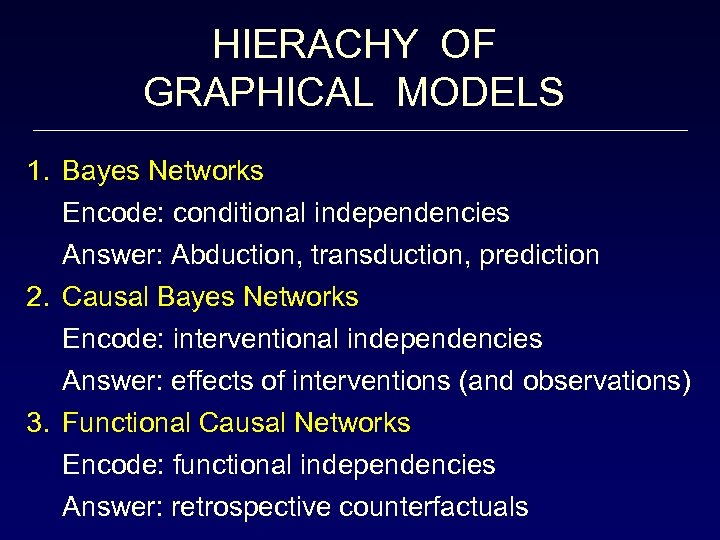 HIERACHY OF GRAPHICAL MODELS 1. Bayes Networks Encode: conditional independencies Answer: Abduction, transduction, prediction 2. Causal Bayes Networks Encode: interventional independencies Answer: effects of interventions (and observations) 3. Functional Causal Networks Encode: functional independencies Answer: retrospective counterfactuals
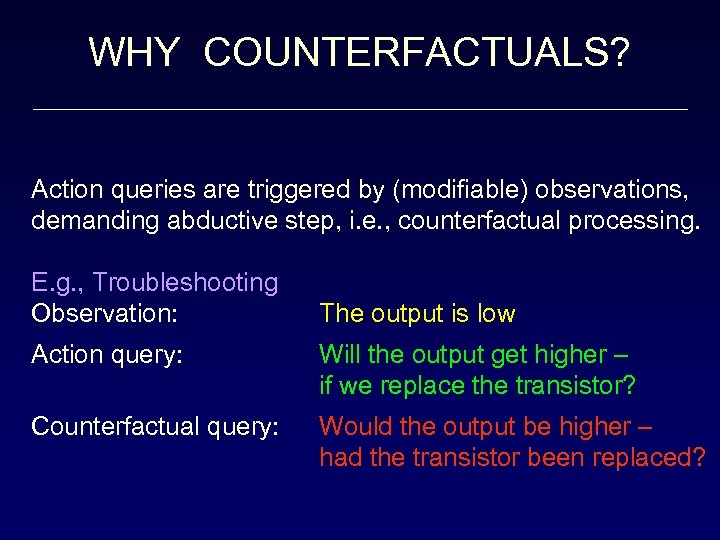 WHY COUNTERFACTUALS? Action queries are triggered by (modifiable) observations, demanding abductive step, i. e. , counterfactual processing. E. g. , Troubleshooting Observation: The output is low Action query: Will the output get higher – if we replace the transistor? Counterfactual query: Would the output be higher – had the transistor been replaced?
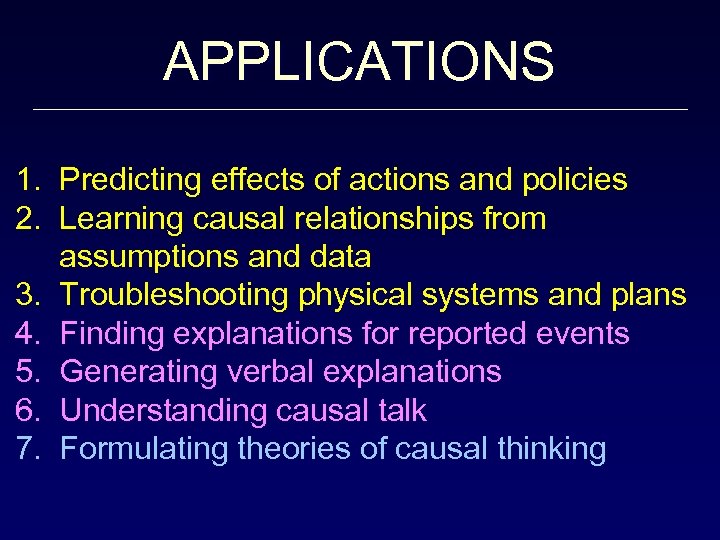 APPLICATIONS 1. Predicting effects of actions and policies 2. Learning causal relationships from assumptions and data 3. Troubleshooting physical systems and plans 4. Finding explanations for reported events 5. Generating verbal explanations 6. Understanding causal talk 7. Formulating theories of causal thinking
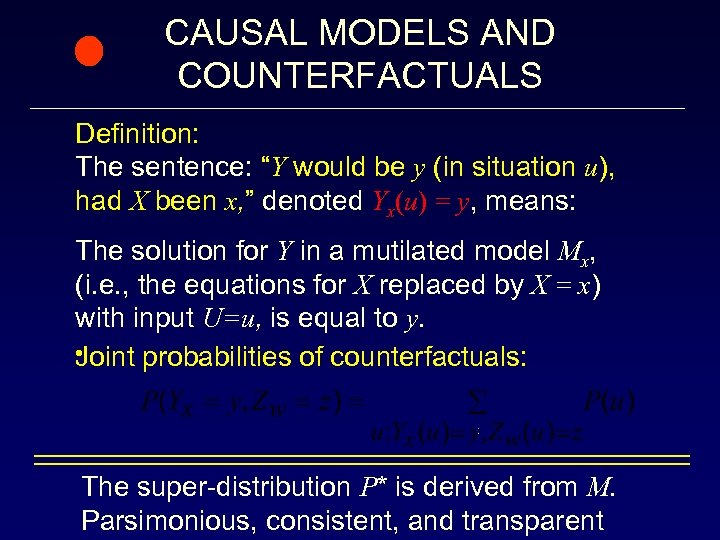 CAUSAL MODELS AND COUNTERFACTUALS Definition: The sentence: “Y would be y (in situation u), had X been x, ” denoted Yx(u) = y, means: The solution for Y in a mutilated model Mx, (i. e. , the equations for X replaced by X = x) with input U=u, is equal to y. • Joint probabilities of counterfactuals: The super-distribution P* is derived from M. Parsimonious, consistent, and transparent
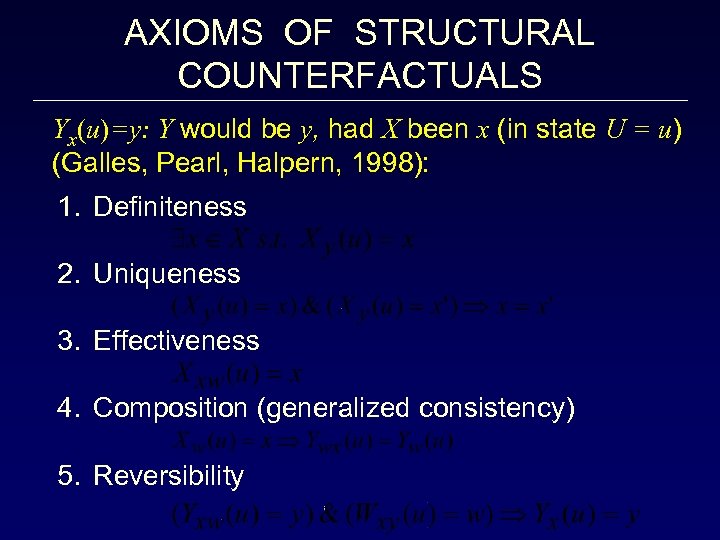 AXIOMS OF STRUCTURAL COUNTERFACTUALS Yx(u)=y: Y would be y, had X been x (in state U = u) (Galles, Pearl, Halpern, 1998): 1. Definiteness 2. Uniqueness 3. Effectiveness 4. Composition (generalized consistency) 5. Reversibility
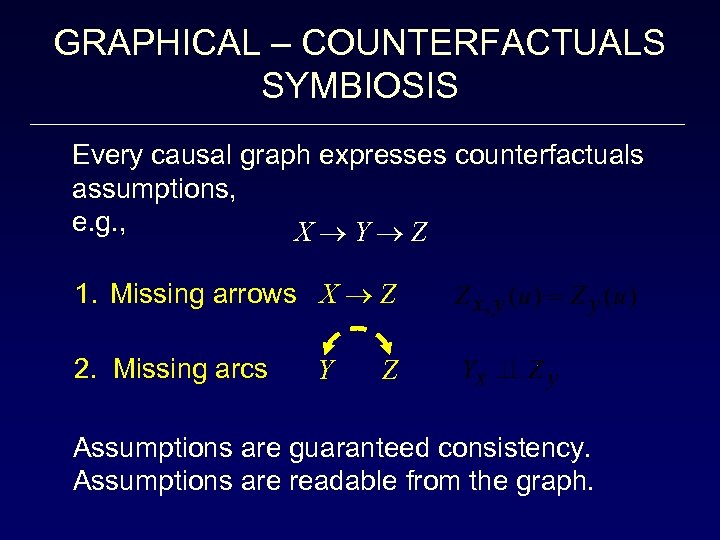 GRAPHICAL – COUNTERFACTUALS SYMBIOSIS Every causal graph expresses counterfactuals assumptions, e. g. , X Y Z 1. Missing arrows X Z 2. Missing arcs Y Z Assumptions are guaranteed consistency. Assumptions are readable from the graph.
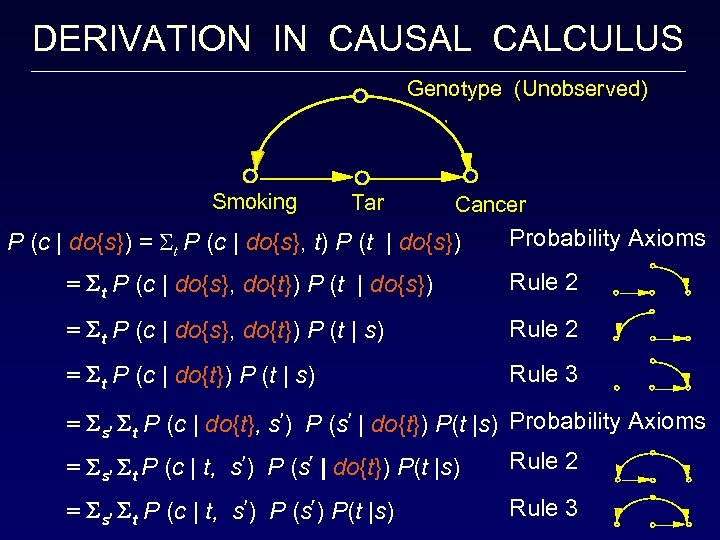 DERIVATION IN CAUSAL CALCULUS Genotype (Unobserved) Smoking Tar Cancer P (c | do{s}) = t P (c | do{s}, t) P (t | do{s}) Probability Axioms = t P (c | do{s}, do{t}) P (t | do{s}) Rule 2 = t P (c | do{s}, do{t}) P (t | s) Rule 2 = t P (c | do{t}) P (t | s) Rule 3 = s t P (c | do{t}, s ) P (s | do{t}) P(t |s) Probability Axioms = s t P (c | t, s ) P (s | do{t}) P(t |s) Rule 2 = s t P (c | t, s ) P (s ) P(t |s) Rule 3
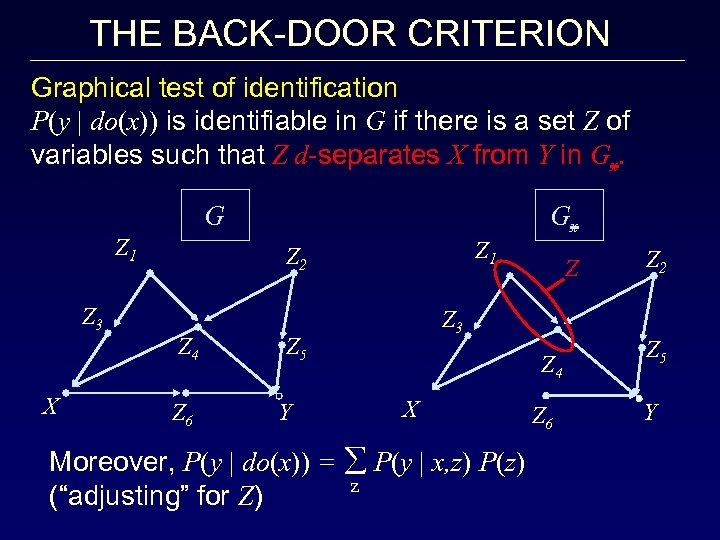 THE BACK-DOOR CRITERION Graphical test of identification P(y | do(x)) is identifiable in G if there is a set Z of variables such that Z d-separates X from Y in Gx. G Z 1 Z 3 X Gx Z 1 Z 2 Z 4 Z 6 Z 3 Z 5 Y Z Z 4 X Moreover, P(y | do(x)) = å P(y | x, z) P(z) z (“adjusting” for Z) Z 6 Z 2 Z 5 Y
 RECENT RESULTS ON IDENTIFICATION • do-calculus is complete • Complete graphical criterion for identifying causal effects (Shpitser and Pearl, 2006). • Complete graphical criterion for empirical testability of counterfactuals (Shpitser and Pearl, 2007).
 DETERMINING THE CAUSES OF EFFECTS (The Attribution Problem) • • Your Honor! My client (Mr. A) died BECAUSE he used that drug.
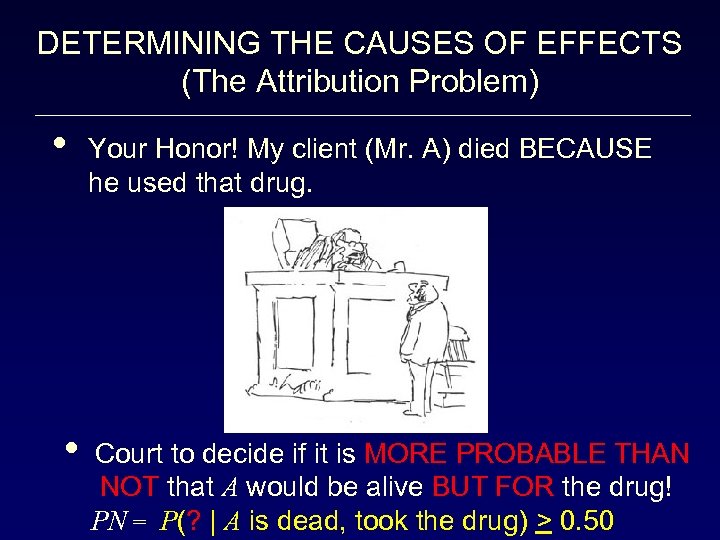 DETERMINING THE CAUSES OF EFFECTS (The Attribution Problem) • • Your Honor! My client (Mr. A) died BECAUSE he used that drug. Court to decide if it is MORE PROBABLE THAN NOT that A would be alive BUT FOR the drug! PN = P(? | A is dead, took the drug) > 0. 50
 THE PROBLEM Semantical Problem: 1. What is the meaning of PN(x, y): 2. “Probability that event y would not have occurred if it were not for event x, given that x and y did in fact occur. ” •
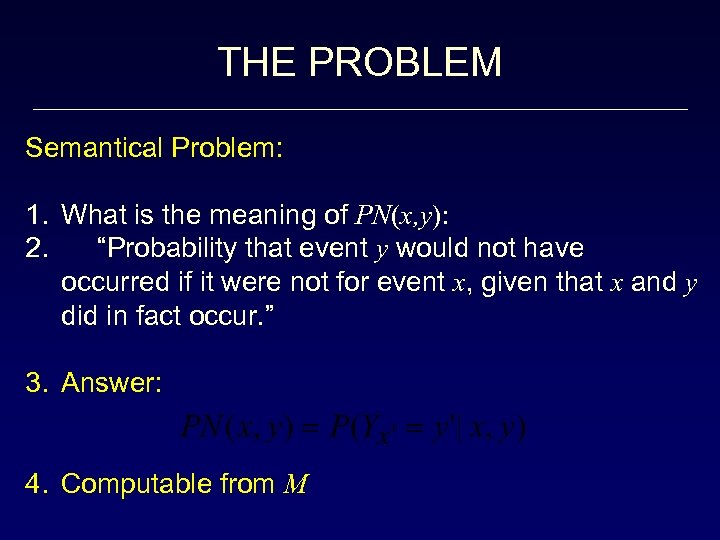 THE PROBLEM Semantical Problem: 1. What is the meaning of PN(x, y): 2. “Probability that event y would not have occurred if it were not for event x, given that x and y did in fact occur. ” 3. Answer: 4. Computable from M
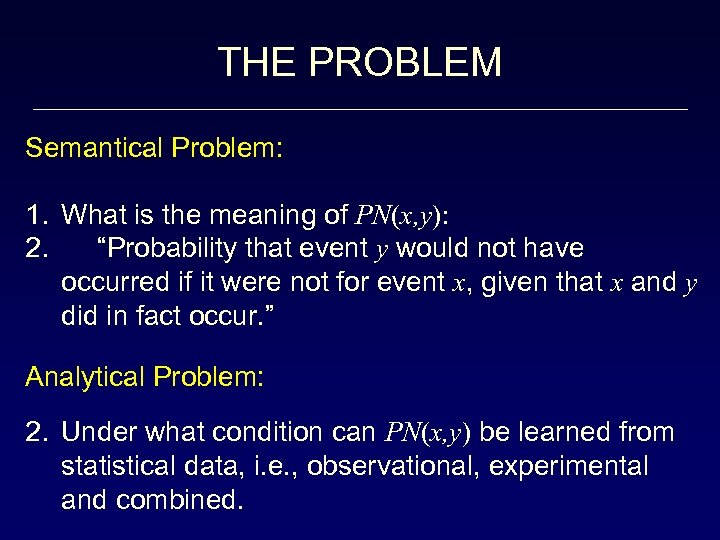 THE PROBLEM Semantical Problem: 1. What is the meaning of PN(x, y): 2. “Probability that event y would not have occurred if it were not for event x, given that x and y did in fact occur. ” Analytical Problem: 2. Under what condition can PN(x, y) be learned from statistical data, i. e. , observational, experimental and combined.
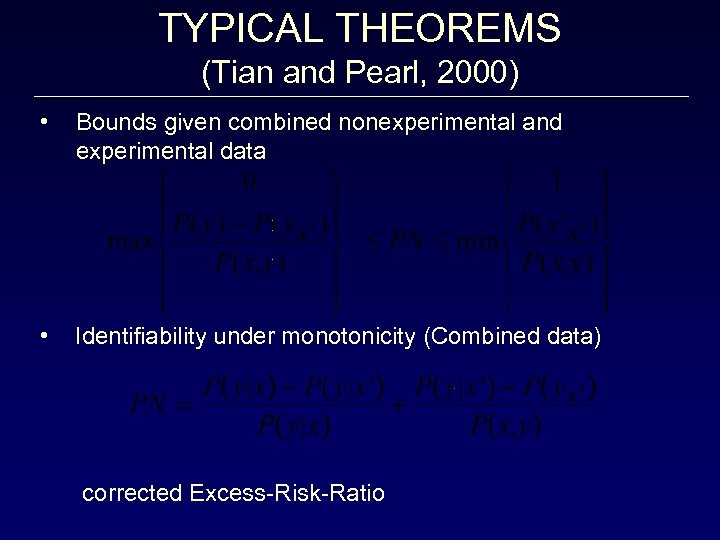 TYPICAL THEOREMS (Tian and Pearl, 2000) • Bounds given combined nonexperimental and experimental data • Identifiability under monotonicity (Combined data) corrected Excess-Risk-Ratio
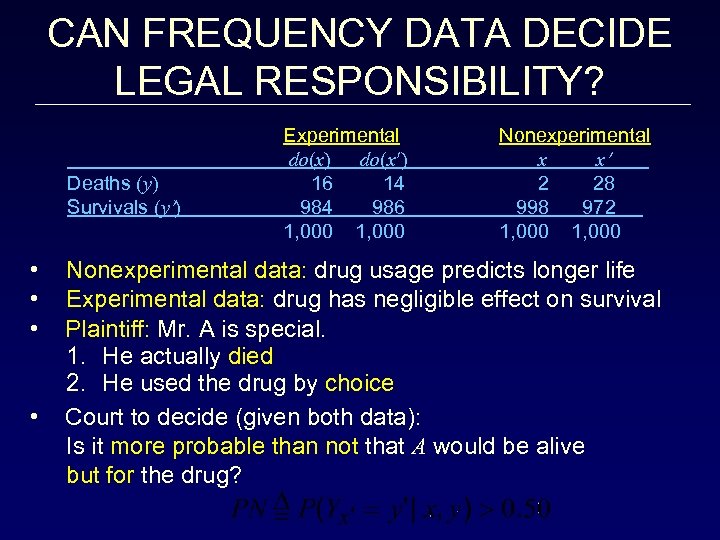 CAN FREQUENCY DATA DECIDE LEGAL RESPONSIBILITY? Deaths (y) Survivals (y ) • • Experimental do(x) do(x ) 16 14 986 1, 000 Nonexperimental x x 2 28 998 972 1, 000 Nonexperimental data: drug usage predicts longer life Experimental data: drug has negligible effect on survival Plaintiff: Mr. A is special. 1. He actually died 2. He used the drug by choice Court to decide (given both data): Is it more probable than not that A would be alive but for the drug?
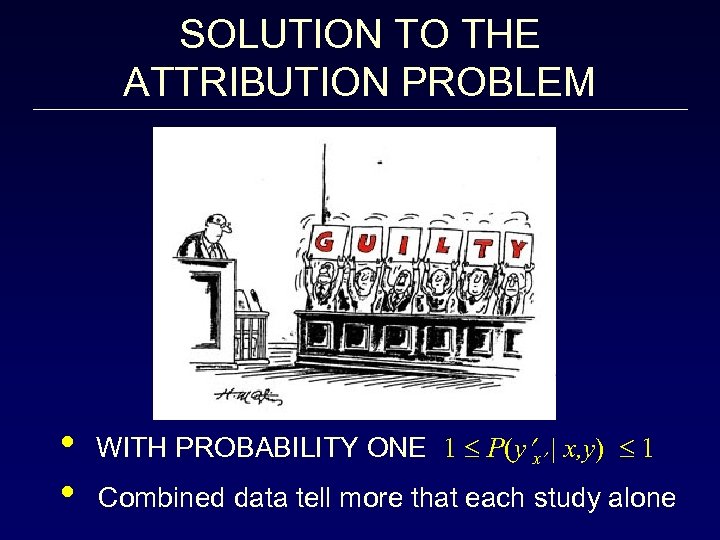 SOLUTION TO THE ATTRIBUTION PROBLEM • • WITH PROBABILITY ONE 1 P(y x | x, y) 1 Combined data tell more that each study alone
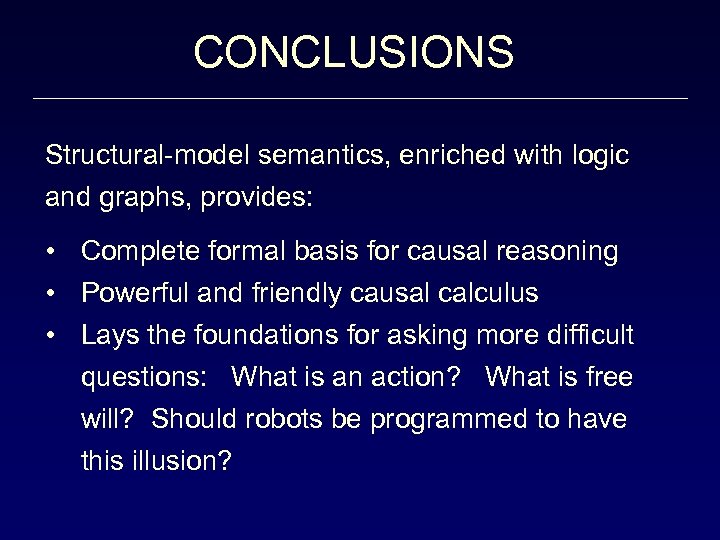 CONCLUSIONS Structural-model semantics, enriched with logic and graphs, provides: • Complete formal basis for causal reasoning • Powerful and friendly causal calculus • Lays the foundations for asking more difficult questions: What is an action? What is free will? Should robots be programmed to have this illusion?