


 Скачать презентацию The Market System Demand Supply and Price Determination
709d5b4491120b4fa6de7c56fa316c19.ppt
- Количество слайдов: 65
 The Market System Demand, Supply and Price Determination Commercial Economics Market System - Demand, Supply, Prices
 The Market System n Market consists of: – Consumers - create a demand for a product n Demand – the amount consumers desire to purchase at various prices – Not what they will buy, but what they would like to buy! n Effective demand – must be willing AND able to pay March-April 2008 Individual and Market Demand n Market demand – consists of the sum of all individual demand schedules in the market n Represented by a demand curve n At higher prices, consumers generally willing to purchase less than at lower prices n Demand curve – negative slope, downward sloping from left to right Commercial Economics Market System - Demand, Supply, 2
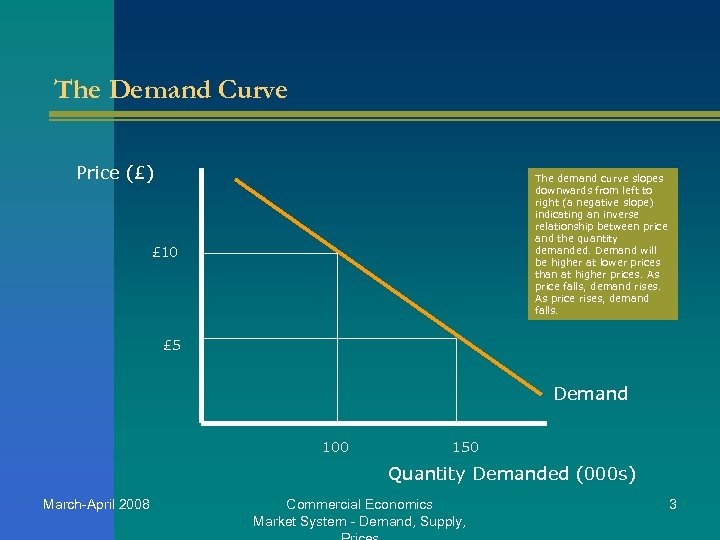 The Demand Curve Price (£) The demand curve slopes downwards from left to right (a negative slope) indicating an inverse relationship between price and the quantity demanded. Demand will be higher at lower prices than at higher prices. As price falls, demand rises. As price rises, demand falls. £ 10 £ 5 Demand 100 150 Quantity Demanded (000 s) March-April 2008 Commercial Economics Market System - Demand, Supply, 3
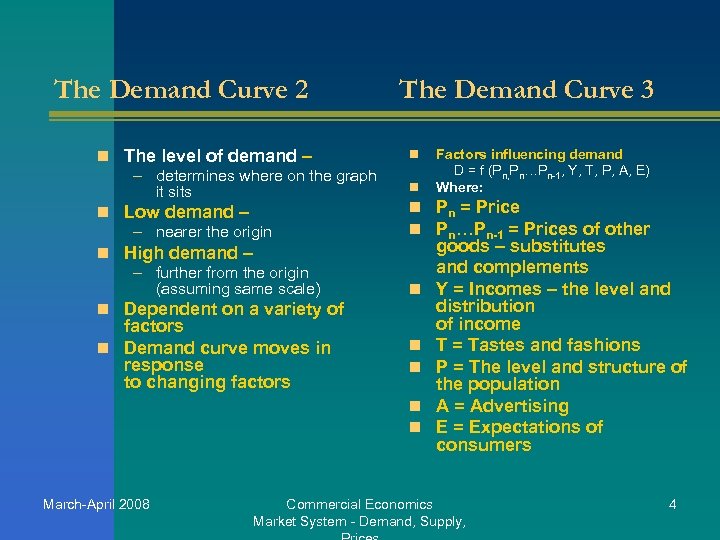 The Demand Curve 2 n The level of demand – – determines where on the graph it sits n Low demand – – nearer the origin n High demand – – further from the origin (assuming same scale) n Dependent on a variety of factors n Demand curve moves in response to changing factors The Demand Curve 3 n n n Pn = Price n Pn…Pn-1 = Prices of other n n n March-April 2008 Factors influencing demand D = f (Pn, Pn…Pn-1, Y, T, P, A, E) Where: goods – substitutes and complements Y = Incomes – the level and distribution of income T = Tastes and fashions P = The level and structure of the population A = Advertising E = Expectations of consumers Commercial Economics Market System - Demand, Supply, 4
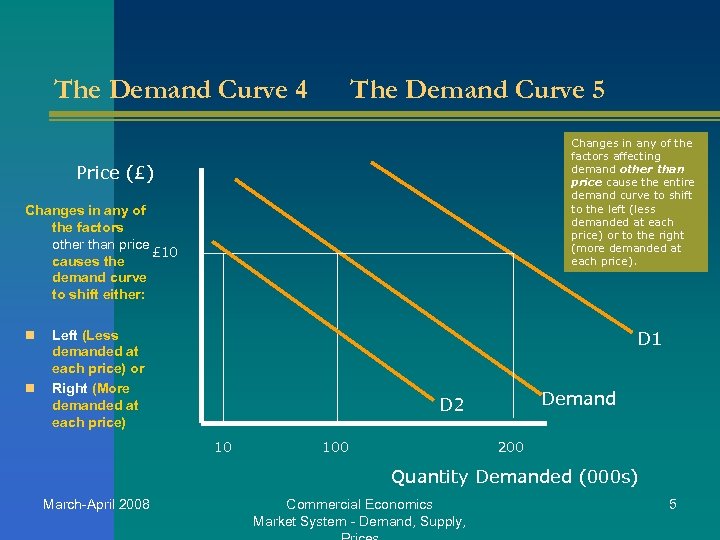 The Demand Curve 4 The Demand Curve 5 Changes in any of the factors affecting demand other than price cause the entire demand curve to shift to the left (less demanded at each price) or to the right (more demanded at each price). Price (£) Changes in any of the factors other than price £ 10 causes the demand curve to shift either: n n D 1 Left (Less demanded at each price) or Right (More demanded at each price) Demand D 2 10 100 200 Quantity Demanded (000 s) March-April 2008 Commercial Economics Market System - Demand, Supply, 5
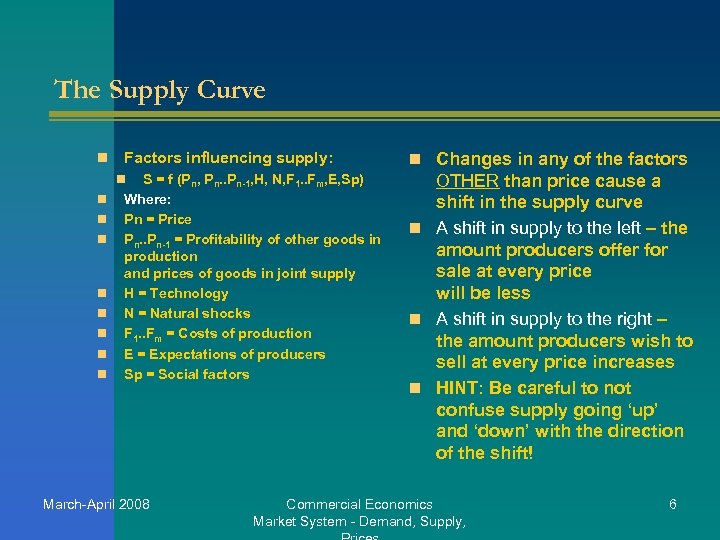 The Supply Curve n Factors influencing supply: n Changes in any of the factors S = f (Pn, Pn. . Pn-1, H, N, F 1. . Fm, E, Sp) Where: Pn = Price Pn. . Pn-1 = Profitability of other goods in production and prices of goods in joint supply H = Technology N = Natural shocks F 1. . Fm = Costs of production E = Expectations of producers Sp = Social factors OTHER than price cause a shift in the supply curve n A shift in supply to the left – the amount producers offer for sale at every price will be less n A shift in supply to the right – the amount producers wish to sell at every price increases n HINT: Be careful to not confuse supply going ‘up’ and ‘down’ with the direction of the shift! n n n n n March-April 2008 Commercial Economics Market System - Demand, Supply, 6
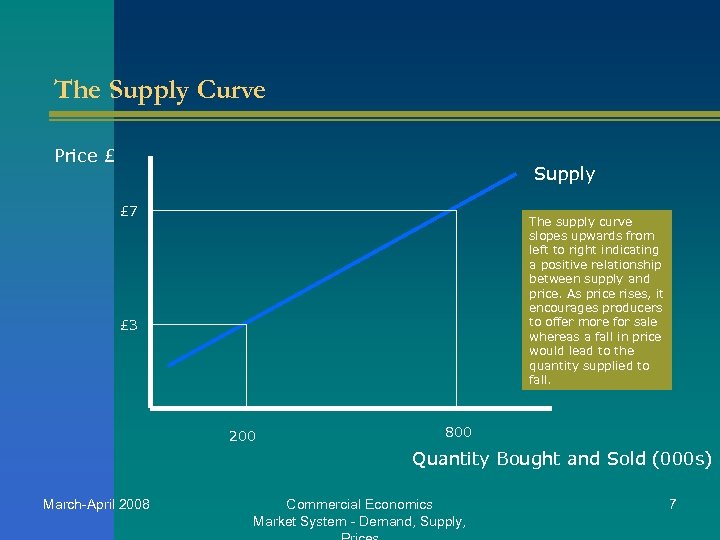 The Supply Curve Price £ Supply £ 7 The supply curve slopes upwards from left to right indicating a positive relationship between supply and price. As price rises, it encourages producers to offer more for sale whereas a fall in price would lead to the quantity supplied to fall. £ 3 200 800 Quantity Bought and Sold (000 s) March-April 2008 Commercial Economics Market System - Demand, Supply, 7
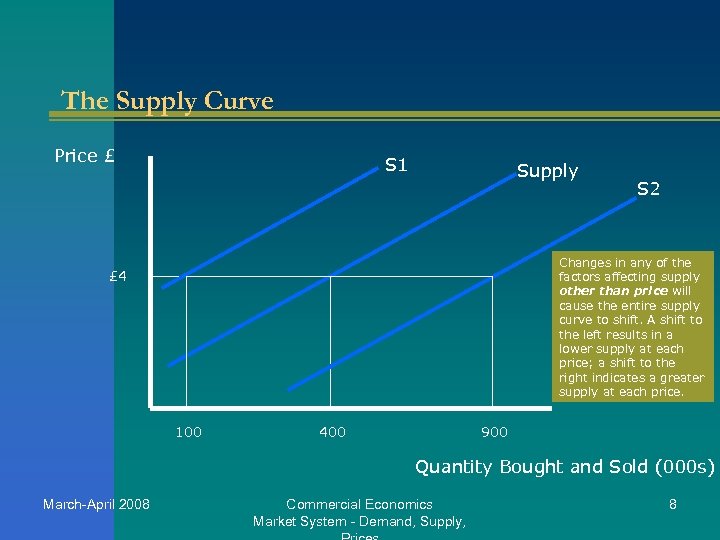 The Supply Curve Price £ S 1 Supply S 2 Changes in any of the factors affecting supply other than price will cause the entire supply curve to shift. A shift to the left results in a lower supply at each price; a shift to the right indicates a greater supply at each price. £ 4 100 400 900 Quantity Bought and Sold (000 s) March-April 2008 Commercial Economics Market System - Demand, Supply, 8
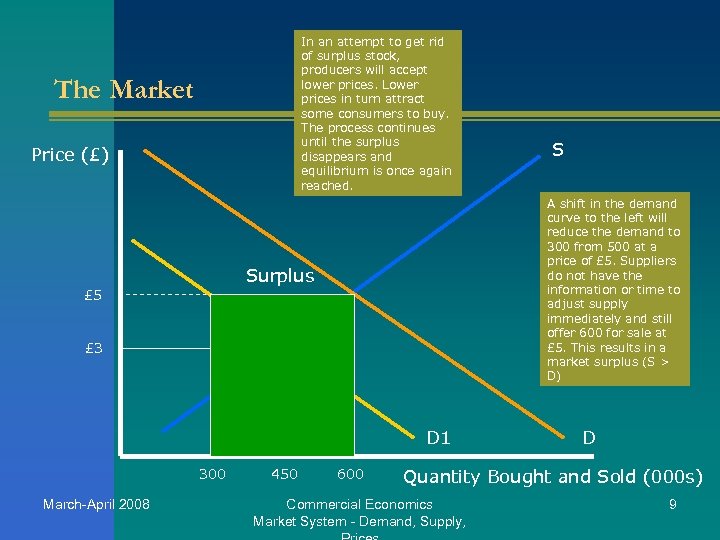 In an attempt to get rid of surplus stock, producers will accept lower prices. Lower prices in turn attract some consumers to buy. The process continues until the surplus disappears and equilibrium is once again reached. The Market Price (£) A shift in the demand curve to the left will reduce the demand to 300 from 500 at a price of £ 5. Suppliers do not have the information or time to adjust supply immediately and still offer 600 for sale at £ 5. This results in a market surplus (S > D) Surplus £ 5 £ 3 D 1 300 March-April 2008 450 S 600 D Quantity Bought and Sold (000 s) Commercial Economics Market System - Demand, Supply, 9
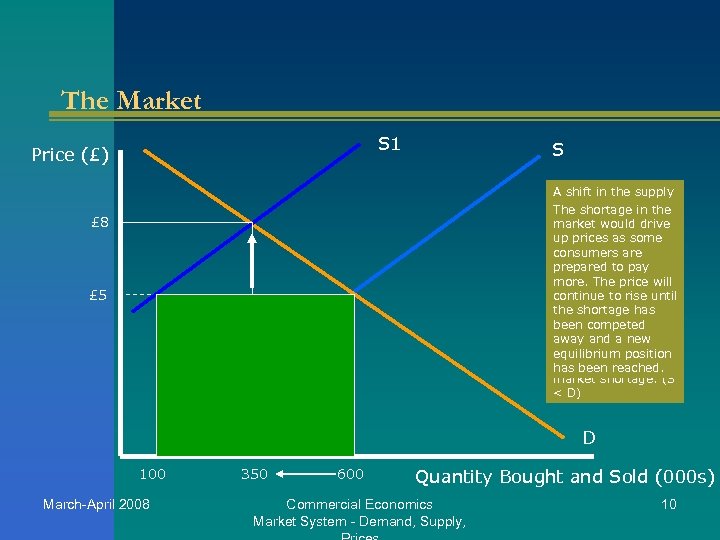 The Market S 1 Price (£) S A shift in the supply curve to the left the The shortage in would lead to less market would drive products being up prices as some available for sale at consumers are every price. pay prepared to Suppliers would will more. The price only be ableriseoffer continue to to until 100 shortage has at the units for sale a price of £ 5 but been competed consumers still away and a new desire to purchase equilibrium position 600. been reached. has This creates a market shortage. (S < D) £ 8 £ 5 Shortage D 100 March-April 2008 350 600 Quantity Bought and Sold (000 s) Commercial Economics Market System - Demand, Supply, 10
 Context of business Theories of price & competition The Entrepreneurial Role n n Superficially, microeconomics a settled field – Micro-economics = Neoclassical economics In depth, many possible approaches – Empirical: data contradicts neoclassical assumptions – Theoretical: Schumpeter & evolutionary views of behavior of firms – Analytic: multi-agent modeling of behavior of firms & consumers v A much more complex mosaic than “supply & demand” March-April 2008 n n n Manager’s most immediate concern is own market & competition But macroeconomic performance sets context for own market – Most markets rise & fall with general economic conditions v Some exceptions—e. g. , liquidators do well in slumps! “Boom” or “slump” conditions thus affect profitability Ability to foresee switch from one extreme to other also extremely important – Hence economists being paid to “forecast” So can you rely upon economists to predict the behavior of the macro economy? Commercial Economics Market System - Demand, Supply, 11
 … Acknowledged debate n Essentially “port” of micro framework to macro economy – Micro: “intersecting demand & supply curves explain everything” – Macro: “intersecting AD & AS curves explain everything” n But as we’ve seen… – Micro analysis has real flaws – Macro… v Similar problems v BUT some debate over “elasticity” of curves… – “Flexibility of wages & prices – Flexibility of aggregate supply – Role of expectations in working of market” March-April 2008 Commercial Economics Market System - Demand, Supply, 12
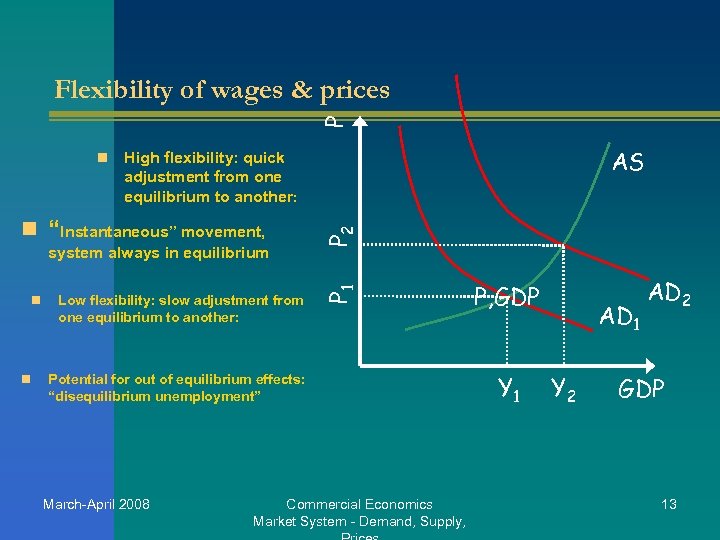 P Flexibility of wages & prices system always in equilibrium n Low flexibility: slow adjustment from one equilibrium to another: P 2 n “Instantaneous” movement, n AS High flexibility: quick adjustment from one equilibrium to another: P 1 n Potential for out of equilibrium effects: “disequilibrium unemployment” March-April 2008 Commercial Economics Market System - Demand, Supply, P, GDP Y 1 AD 1 Y 2 AD 2 GDP 13
 … Acknowledged debate n Flexibility of aggregate supply – “… flexible … aggregate supply does not respond … to changes in aggregate demand. Aggregate supply … depends on the quantity and productivity of factors of production, not on the level of aggregate demand. An expansion of aggregate demand will merely lead to (demand-pull) inflation… – If the government, therefore, wants to expand aggregate supply and get more rapid economic growth… it should concentrate directly on supply by encouraging enterprise and competition, and generally by encouraging markets to operate more freely…. supply-side economics. – Other … argue that rises in aggregate demand will cause aggregate supply to rise… However, these conditions will not be achieved, they argue, if the government pursues a non-interventionist, laissez-faire policy. The government instead must seek to control aggregate demand, to ensure that it continues to grow, and at a steady, nonfluctuating rate. ” (383) March-April 2008 Commercial Economics Market System - Demand, Supply, 14
 More … Acknowledged debate n Role of expectations in working of market – “Some economists argue that people's [price change expectations] adjust rapidly … v If aggregate demand expands … people will expect higher prices… all firms will raise their prices in response to the demand increase… price rises will fully choke off the extra demand… no increase in sales, … output and employment. v … increased aggregate demand merely fuels inflation… – Others believe that the formation of expectations is more complex … If there is a lot of slack in the economy—if unemployment is very high and there are many idle resources…—then output and employment may quickly rise…” (384) March-April 2008 Commercial Economics Market System - Demand, Supply, 15
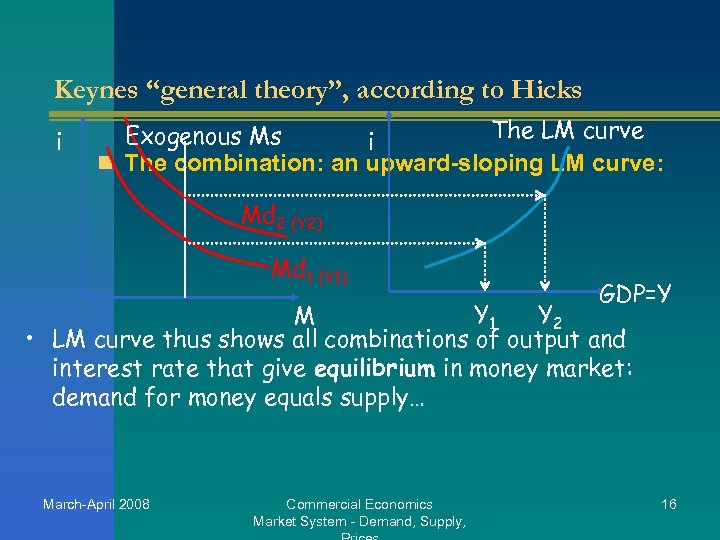 Keynes “general theory”, according to Hicks i The LM curve Exogenous Ms i n The combination: an upward-sloping LM curve: Md 2 (Y 2) Md 1 (Y 1) GDP=Y Y 1 Y 2 M • LM curve thus shows all combinations of output and interest rate that give equilibrium in money market: demand for money equals supply… March-April 2008 Commercial Economics Market System - Demand, Supply, 16
 Keynes “general theory”, according to Hicks n Next, the IS curve: – Investment demand a negative function of i [I=I(i)] v Lower interest rate makes more projects NPV positive v Investment rises as interest rate falls – Savings supply a positive function of Income [S=S(Y)] v Savings a residual after consumption v Savings rise as income rise March-April 2008 Commercial Economics Market System - Demand, Supply, 17
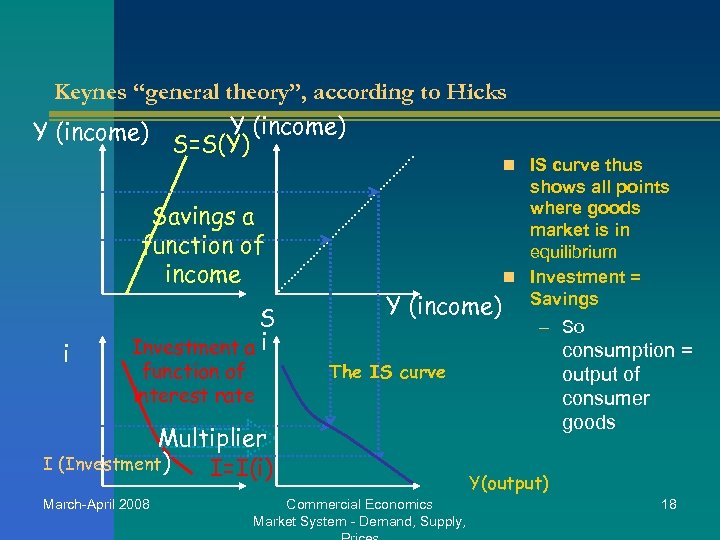 Keynes “general theory”, according to Hicks Y (income) S=S(Y) n IS curve thus Savings a function of income i S Investment a i function of interest rate Y (income) – So consumption = output of consumer goods The IS curve Multiplier I (Investment) I=I(i) March-April 2008 shows all points where goods market is in equilibrium n Investment = Savings Commercial Economics Market System - Demand, Supply, Y(output) 18
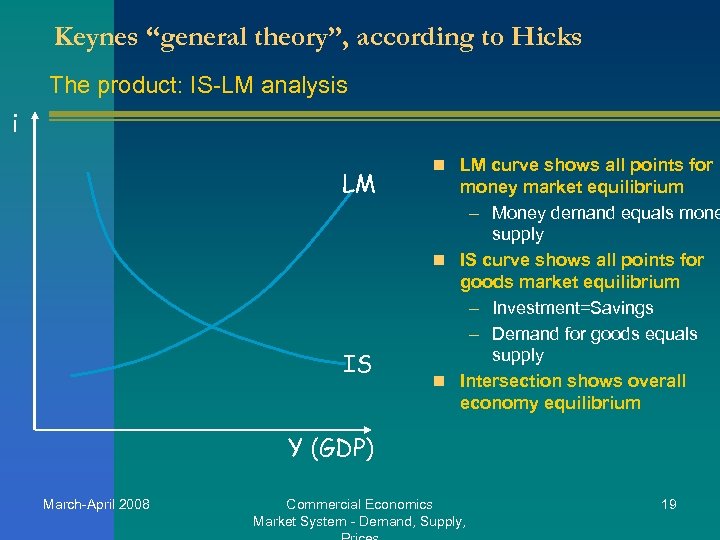 Keynes “general theory”, according to Hicks The product: IS-LM analysis i LM IS n LM curve shows all points for money market equilibrium – Money demand equals mone supply n IS curve shows all points for goods market equilibrium – Investment=Savings – Demand for goods equals supply n Intersection shows overall economy equilibrium Y (GDP) March-April 2008 Commercial Economics Market System - Demand, Supply, 19
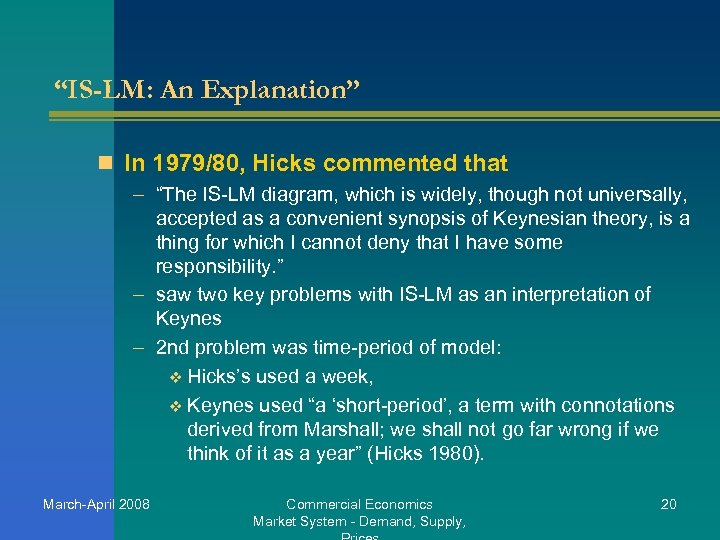 “IS-LM: An Explanation” n In 1979/80, Hicks commented that – “The IS-LM diagram, which is widely, though not universally, accepted as a convenient synopsis of Keynesian theory, is a thing for which I cannot deny that I have some responsibility. ” – saw two key problems with IS-LM as an interpretation of Keynes – 2 nd problem was time-period of model: v Hicks’s used a week, v Keynes used “a ‘short-period’, a term with connotations derived from Marshall; we shall not go far wrong if we think of it as a year” (Hicks 1980). March-April 2008 Commercial Economics Market System - Demand, Supply, 20
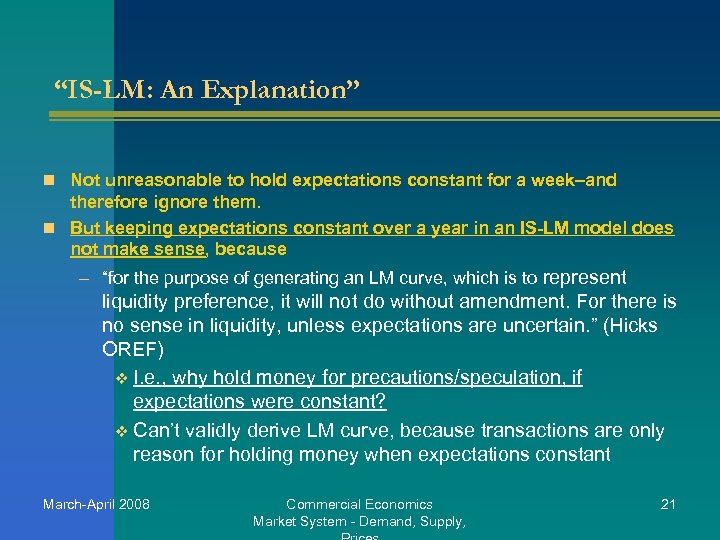 “IS-LM: An Explanation” n Not unreasonable to hold expectations constant for a week–and therefore ignore them. n But keeping expectations constant over a year in an IS-LM model does not make sense, because – “for the purpose of generating an LM curve, which is to represent liquidity preference, it will not do without amendment. For there is no sense in liquidity, unless expectations are uncertain. ” (Hicks OREF) v I. e. , why hold money for precautions/speculation, if expectations were constant? v Can’t validly derive LM curve, because transactions are only reason for holding money when expectations constant March-April 2008 Commercial Economics Market System - Demand, Supply, 21
 Macroeconomics: what the debate ignores n Empirical record hardly indicates “equilibrium”: n There is a “disequilibrium” interpretation too: – Schumpeter and cycles – Minsky’s “Financial Instability Hypothesis” n But first, empirical investigation of cycles in USA data… next week March-April 2008 Commercial Economics Market System - Demand, Supply, 22
 Other theories of pricing n If rising costs of production & falling don’t determine how much firms produce, what does? – According to some economists, things conventional (neoclassical) theory of firm omits: v Product differentiation – Theory assumes firms compete only on price v Uncertainty – Theory assumes costs, demand, etc. , known by firms – Also probably no “one size fits all” pricing model v Different price models needed for different – Industries (Ag & Mining vs. . Manufacturing) – Products (established vs. . new) – Uses (consumables vs. assets [houses, shares, etc. ]) March-April 2008 Commercial Economics Market System - Demand, Supply, 23
 Manufacturing: Operation within capacity n Alternative theories of manufacturing pricing emphasize: – Uncertainty v Can’t know future v Excess capacity gives room to react to unforeseeable events – Rivalry with other producers v Output not homogeneous v Firms compete on product differentiation v Try to “steal” market share from competitors by non-price competition v Extra sales profitable because – “Marginal revenue” high: Price doesn’t have to drop when non-price competition expands sales – “Marginal cost” low & fixed costs high March-April 2008 Commercial Economics Market System - Demand, Supply, 24
 Alternative models of firm behavior n In manufacturing – Few very large firms – Differentiated products: quality and feature variation – Competition mainly on product development, marketing, services (availability, after-sales support) – Price “banding”: price reflects quality so market segmented n Product diversity & non-price competition limit output, not costs n Income distribution also limits potential sales – Main problem not producing with “DMP”, but selling output given constrained effective demand March-April 2008 Commercial Economics Market System - Demand, Supply, 25
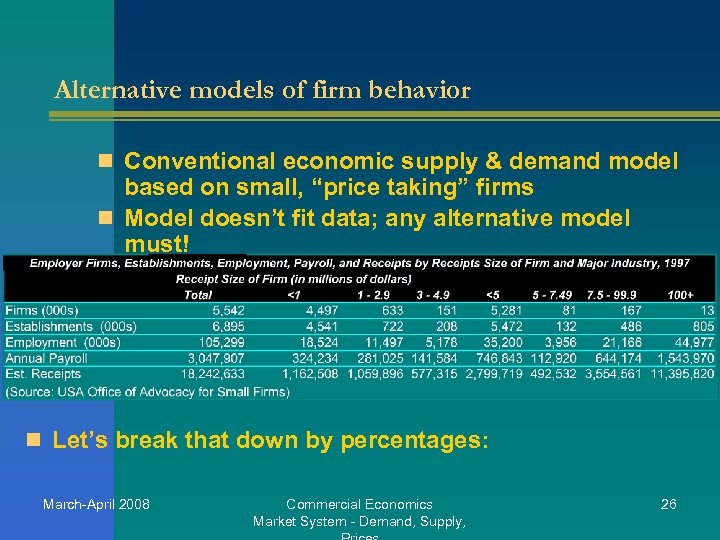 Alternative models of firm behavior n Conventional economic supply & demand model based on small, “price taking” firms n Model doesn’t fit data; any alternative model must! – Basic fact: wide dispersion of firm sizes, but – Most industries dominated by few large firms – E. g. , US industry aggregate data: n Let’s break that down by percentages: March-April 2008 Commercial Economics Market System - Demand, Supply, 26
 Galbraith & Institutional Analysis n One alternative: “Institutional economics” view n Focuses on institutions of society n Sees dominant institution as large manufacturing firm – Some competition good & necessary v Restrains prices (e. g. , Goodyear’s experience) v Encourages innovation (Apple v IBM v Dell) – But small firms/“competitive industries” not automatically superior to concentrated industries v Too small scale of operation v Inability to plan for technology/market v Institutionally inferior to large firms because less effective manager of vagaries of market March-April 2008 Commercial Economics Market System - Demand, Supply, 27
 Galbraith & Institutional Analysis n Focus of Galbraith’s “institutional” analysis of firms: – “Nothing so characterizes the industrial system as the scale of the modern corporate enterprise. In 1969, the five largest industrial corporations, with combined assets of $59 billion, had just under 11 per cent of all assets used in manufacturing. The 50 largest manufacturing corporations had 38 per cent of all assets. The 500 largest had 74 per cent…” (89) n Companies achieve scale because it facilitates planning of technology, and “control” of the market: March-April 2008 Commercial Economics Market System - Demand, Supply, 28
![Post Keynesian Price Theory n Prices set by markup on input costs: – “[P]rice](https://present5.com/presentation/709d5b4491120b4fa6de7c56fa316c19/image-29.jpg "Post Keynesian Price Theory n Prices set by markup on input costs: – “[P]rice") Post Keynesian Price Theory n Prices set by markup on input costs: – “[P]rice is set by adding together direct material and labor costs per unit output, plus overhead costs determined at standard volume output, plus a predetermined (conventional) profit margin. Because the pricing procedure is not explicitly designed to maximize profits, the full cost price is no a profit maximizing price or, in fact, a price that maximizes anything. Rather the pricing procedure is designed to enable the firm to reproduce itself and grow. ” (Lee 1984: 1108) March-April 2008 Commercial Economics Market System - Demand, Supply, 29
Post Keynesian Price Theory n Prices set by markup on input costs: – “[P]rice is set by adding together direct material and labor costs per unit output, plus overhead costs determined at standard volume output, plus a predetermined (conventional) profit margin. Because the pricing procedure is not explicitly designed to maximize profits, the full cost price is no a profit maximizing price or, in fact, a price that maximizes anything. Rather the pricing procedure is designed to enable the firm to reproduce itself and grow. ” (Lee 1984: 1108) March-April 2008 Commercial Economics Market System - Demand, Supply, 29
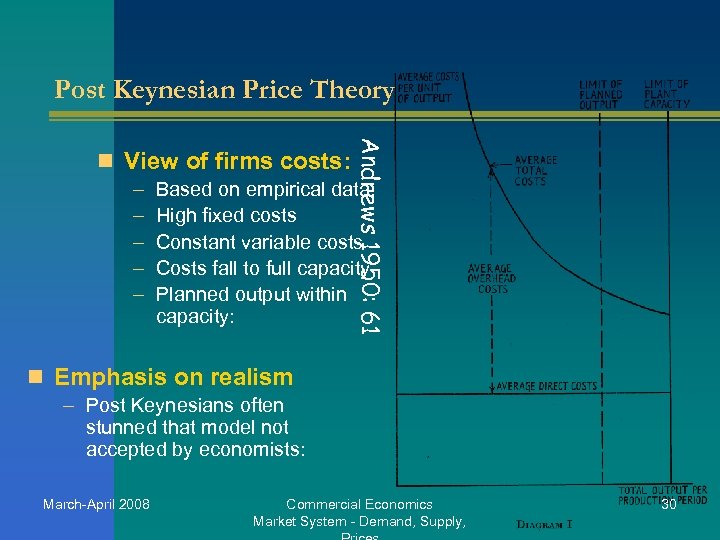 Post Keynesian Price Theory – – – Andrews 1950: 61 n View of firms costs: Based on empirical data; High fixed costs Constant variable costs Costs fall to full capacity Planned output within capacity: n Emphasis on realism – Post Keynesians often stunned that model not accepted by economists: March-April 2008 Commercial Economics Market System - Demand, Supply, 30
 Post Keynesian Price Theory n “Granted that the principle is so generally adhered to in manufacture, the mystery is that it has not yet emerged as a postulate of economic analysis. It should obviously be an accepted principle in pricing-theory. Those economists who have thought about it have been too concerned with trying to explain it on the basis of the existing theory, instead of accepting it… Scientific method would suggest that the right thing to do at the existing state of knowledge would be at least to accept the principle as a basis for further theory in its own field—the analysis of price-policy. ” (Andrews 1950: 82) n Main danger for firm is that target sales will not be met – If sales below target then costs (including debt servicing) can exceed revenue – Sales above target greatly increase profit March-April 2008 Commercial Economics Market System - Demand, Supply, 31
 Post Keynesian Price Theory n Main focus of competition between firms then non-price – Attempt to alter profile of demand towards own product and away from competitors v Hence advertising, marketing, etc. – Attempt to lower/control costs & increase quality v Research & development key focus of firm n Non-manufacturing prices quite different – Minerals, foodstuffs etc. subject to very different dynamics v Products much more homogeneous than manufactures v Supply less under control of producer (esp. agriculture) v Often more difficult to stockpile v Productive capacity more difficult to alter March-April 2008 Commercial Economics Market System - Demand, Supply, 32
 Post Keynesian Price Theory n As a result, manufacturing prices “administered” while minerals/agriculture “market” n Administered: – – Price set by firm on target output costs plus markup Changed rarely Changes in demand met by changes in output Increase in output can allow drop in markup n Market – – – Price set by some market mechanism, mainly demand-determined Changed often Changes in demand initially met by change in price Change in supply only after sustained change in demand Prices will rise & fall with the trade cycle March-April 2008 Commercial Economics Market System - Demand, Supply, 33
 Post Keynesian Price Theory n In PK theory, volatile market prices tend to rise in boom, fall in slump relative to stable administered prices n Distinction between “administered” and “market” prices set by frequency of price changes – – March-April 2008 1935 study (Means) “Administered” < 3 changes/year or less “Market” ≈ 1 change/month or more On this basis, following classification of administered vs. market prices by industry: Commercial Economics Market System - Demand, Supply, 34
 Summing up alternatives n Some guidance from Post Keynesians & Sraffians re pricing for managers – “Supply & demand” can’t explain 95% of prices – In general, prices set by markup on costs – Markup constrained by v Competitive pressures v Productivity of industry – Minerals/agriculture largely demand-determined prices n But theories don’t explain all prices – Pricing theory for new products – Pricing theory for assets (Finance section of subject) March-April 2008 Commercial Economics Market System - Demand, Supply, 35
 New products n Doesn’t fit Post Keynesian or Sraffian models because – Both refer to established products – Sraffian (in particular) considers equilibrium positions n Can’t fit into neoclassical model either – Model flawed for all products – More importantly, even if model was OK v Model fits equilibrium only when new products are “disequilibrium” phenomena – In equilibrium, profits are zero – Best understood by “Austrian” school of economics – In particular, Joseph Schumpeter: “in an exchange economy … the prices of all products must, under free competition, be equal to the prices of the services of labor and nature embodied in them…” (30) March-April 2008 Commercial Economics Market System - Demand, Supply, 36
 New products n “The businessman considers as his costs those sums of money which he must pay to other individuals, in order to procure his wares or the means of producing them, that is his expenses of production. We complete his calculation in that we also include in costs the money value of his personal efforts. Then costs are in their essence price totals of the services of labor and of nature. And these price totals must always equal the receipts obtained for the products. To this extent, therefore, production must flow on essentially profitless. ” (31) n But profit the driving motive of production in capitalist economy! – Yes, but not in equilibrium (argues Schumpeter) March-April 2008 Commercial Economics Market System - Demand, Supply, 37
 New products n Schumpeter builds model of economic development that – Uses neoclassical as description of equilibrium – Adds process of qualitative change – Explains profit as outcome of one of 5 types of qualitative change caused by entrepreneurial activity v “(1) The introduction of a new good … v (2) The introduction of a new method of production… v (3) The opening of a new market… v (4) The conquest of a new source of supply of raw materials or halfmanufactured goods… v (5) The carrying out of the new organization of any industry” (66) – Explains introduction (& pricing) of new products v In doing so, overturns many conventional economic beliefs not as false, but as only applying in equilibrium March-April 2008 Commercial Economics Market System - Demand, Supply, 38
 Alternative perspectives on globalization n Theory of comparative advantage – Appeals to economists because v Fits within age-old paradigm of specialization v Consistent with usual static equilibrium method – But fails as empirical model (“a flop”) v Some “better” recent results really test absolute advantage because drop “factor price equalization” v Dynamic model & analysis rejects “zero tariff” bias – Porter’s “Competitive Advantage of Nations” March-April 2008 Commercial Economics Market System - Demand, Supply, 39
 Competitive Advantage n Direct attack on relevance of conventional economics: – “Why do some nations succeed and others fail in international competition? This question is perhaps the most frequently asked … of our times… – Yet … it is the wrong question… We must focus instead on another, much narrower one… – why does a nation become the home base for successful international competitors in an industry? . . . – why is one nation often the home for so many of an industry’s world leaders? v How can we explain why Germany is the home base for so many of the world’s leading makers of printing presses, luxury cars, & chemicals? v Why is tiny Switzerland the home base for international leaders in pharmaceuticals, chocolate…? ” (1) March-April 2008 Commercial Economics Market System - Demand, Supply, 40
 Competitive Advantage n Focus not on “natural endowment” (comparative advantage) & broadly defined industries (labour-intensive, capital intensive) but – Innovation & very specific industries v Luxury cars (Germany) v Ski boots (Italy) v Mobile phones (Finland!) n Porter’s theory aware of recent economic trends: – “The long-dominant paradigm … is inadequate… v the rise of the multinational corporation … [has] weakened the traditional explanations of why and where a nation exports…” (2) n Porter instead “seeks to isolate … the national attributes that foster competitive advantage in an industry…” (3) March-April 2008 Commercial Economics Market System - Demand, Supply, 41
 Competitive Advantage n Dismisses other conventional explanations for trade – Good macroeconomic policies? v “Nations have enjoyed rapidly rising living standards despite budget deficits (Japan, Italy & Korea), appreciating currencies (Germany & Switzerland), and high interest rates (Italy & Korea)…” (3) – Cheap labor? v “The ability to compete despite paying high wages would seem to represent a far more desirable national target. ” – Natural resources? v Even “within nations such as Korea, the United Kingdom, and Germany, it is the resource-poor regions that are prospering relative to the resourcerich ones” (4) – Government intervention? v “has occurred only in a subset of industries, and is far from universally successful even in Japan and Korea. ” March-April 2008 Commercial Economics Market System - Demand, Supply, 42
 Competitive Advantage n Management style? – “What is celebrated as good management practice in one industry would be disastrous in another. ” (4) n Labor relations? (An Australian favorite…) – “Unions are very powerful in Germany and Sweden, with representation by law in management (Germany) and on boards of directors (Sweden)… both nations … contain some of the most internationally preeminent firms and industries of any country. ” (5) n Rejects characterization of nations as competitive – “We must abandon the whole notion of a ‘competitive nation’…” – And focus instead on “specific industries and industry segments…” (9) March-April 2008 Commercial Economics Market System - Demand, Supply, 43
 Competitive Advantage n Rejects comparative advantage: – “the assumptions underlying factor comparative advantage … are unrealistic in many industries. – The standard theory assumes that there are no economies of scale, that technologies everywhere are identical, that products are undifferentiated, and that the pool of national factors is fixed. ” (12) v (same reservations as early Samuelson—last week) – “The theory … is also frustrating for firms because … [it] assumes away a role for firm strategy, such as improving technology or differentiating products … most managers exposed to theory find that it assumes away what they find to be most important and provides little guidance for appropriate company strategy. ” (12 -13) March-April 2008 Commercial Economics Market System - Demand, Supply, 44
 Competitive Advantage n Old theory wrongly emphasizes country & factors n New theory emphasizes companies BUT still has clear role for countries: – “the leaders in particular industries … tend to be concentrated in a few nations… – Competitive advantage is created and sustained through a highly localized process… While globalization of competition might appear to make the nation less important, instead it seems to make it more so. ” (19) n Basic elements of theory turn false comparative advantage theory on its head: March-April 2008 Commercial Economics Market System - Demand, Supply, 45
 Competitive Advantage n “firms can and do choose strategies that differ… n successful international competitors often compete with global strategies in which trade and foreign investment are integrated…” (19) n “a nation’s firms gain competitive advantage in all its forms, not only the limited types of factor-based advantage contemplated in theory of comparative advantage…” (20) n Acknowledges inspiration by Schumpeter but he “stopped short of answering the question … Why do some firms, based in some nations, innovate more than others? ” (20) n Theory developed by empirical research: – 10 countries examined at deep industry level: Denmark (5. 1 million people in 1987); Germany (61 m); Italy 57; Japan 122; Korea 42; Singapore 2. 6; Sweden 8. 4; Switzerland 6. 5; UK 57; USA 244 m March-April 2008 Commercial Economics Market System - Demand, Supply, 46
 Competitive Advantage March-April 2008 Commercial Economics Market System - Demand, Supply, 47
 n Historical study of industry undertaken – Global history as well as specific to successful country v “In printing presses … we sought to understand why Germany and Switzerland had sustained advantage but also why the United States had lost ground and Japan was gaining. ” (28) n Found “country” far from relevant scale of analysis: March-April 2008 Commercial Economics Market System - Demand, Supply, 48
 Competitive Advantage n “Successful firms are frequently concentrated in particular cities or states within a nation. In the United States … – many of the nation’s leading real estate developers are based in Houston, Texas; – oil & gas equipment suppliers in Houston; – hospital management chains in … Nashville…; – carpet producers in Dalton, Georgia; … – Something about these locations provides a fertile environment for firms in these particular industries. ” (29) March-April 2008 Commercial Economics Market System - Demand, Supply, 49
 Competitive Advantage n Narrow and meaningful definition of industry used: – “Many discussions of competition … employ overly broad definitions such as banking, chemicals, or machinery. – These are not strategically meaningful industries because both the nature of competition and the sources of competitive advantage vary a great deal within them. – Machinery, for example, is not one industry but dozens of strategically distinct industries such as weaving machinery, rubber processing equipment, and printing machinery … each with its own unique requirements for competitive success. ” (34) March-April 2008 Commercial Economics Market System - Demand, Supply, 50
 n Delineates 5 forces shaping an industry: Competitive Advantage – – – “The threat of new entrants; The threat of substitute products or services; The bargaining power of suppliers; The bargaining power of buyers; and The rivalry among existing competitors” (35) n Two basic determinants of competitive advantage: – “lower cost and differentiation” (37) v “It is difficult, though not impossible, to be both lower-cost and differentiated relative to competitors. ” (38) v “Any successful strategy, however, must pay close attention to both types of advantage while maintaining a clear commitment to superiority on one. ” (38) – 3 rd important factor is “competitive scope”—how broad industry is & how much of it firm covers March-April 2008 Commercial Economics Market System - Demand, Supply, 51
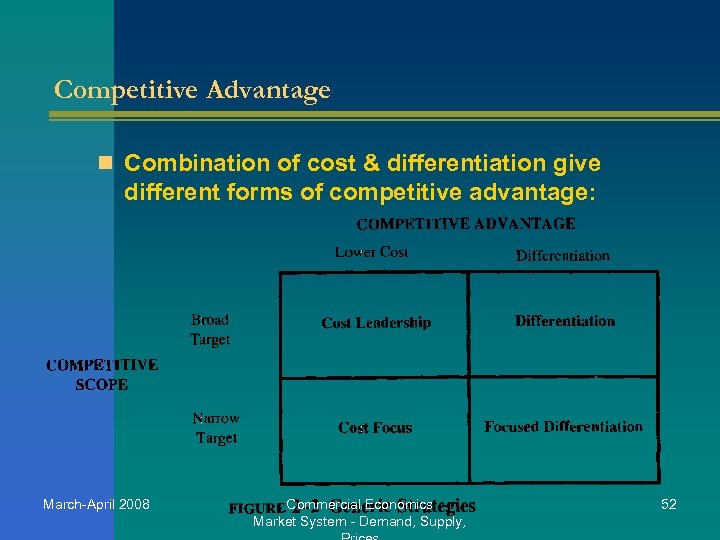 Competitive Advantage n Combination of cost & differentiation give different forms of competitive advantage: March-April 2008 Commercial Economics Market System - Demand, Supply, 52
 Competitive Advantage n Innovation crucial – First mover advantage can last well past “short run” v “German and Swiss dye companies (Bayer, Hoecsht, BASF, Sandoz, … Ciba-Geigy) have sustained their positions as international leaders since before World War I…” (47) v “Early movers gain advantages such as being first to reap economies of scale, reducing costs through cumulative learning…” (47) n Schumpeter’s assumption confirmed: “Often, innovators are ‘outsiders’ … to existing industry. ” (48) Also… – “larger companies were often supplanted by smaller ones…” (49) March-April 2008 Commercial Economics Market System - Demand, Supply, 53
 Competitive Advantage n 4 key determinants of Competitive Advantage: – Factor conditions v Only one considered by comparative advantage v Concerns innovation as well as “endowment” – Demand conditions… – Related & supporting industries… – Firm strategy, structure, and rivalry. ” (71) March-April 2008 Commercial Economics Market System - Demand, Supply, 54
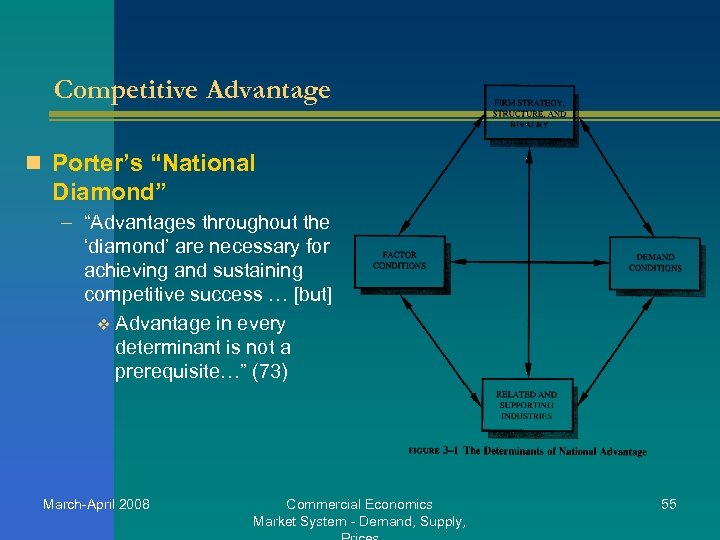 Competitive Advantage n Porter’s “National Diamond” – “Advantages throughout the ‘diamond’ are necessary for achieving and sustaining competitive success … [but] v Advantage in every determinant is not a prerequisite…” (73) March-April 2008 Commercial Economics Market System - Demand, Supply, 55
 Competitive Advantage n Factors matter but may enhance CA through their absence: – “an abundance of factors may undermine instead of enhance competitive advantage. Selective disadvantages in factors, through influencing strategy and innovation, often contribute to sustained competitive success. ” (74) v Opposite of economic theory belief – Gives example of Holland’s advantage in flowers “despite its cold, grey climate”… n Second factor also important for Dutch flowers: – Home demand v Quality more important than quantity v Discerning consumers drive product innovation March-April 2008 Commercial Economics Market System - Demand, Supply, 56
 Competitive Advantage n “Nations gain competitive advantage … where the home demand gives local firms a clearer or earlier picture of buyer needs… n if home buyers pressure local firms to innovate faster…” (86) n “A product’s fundamental or core design nearly always reflects home market needs. ” (87) – “small nations can be competitive in segments which represent an important share of local demand but a smaller share of demand elsewhere, even if the absolute size of the segment is greater in other nations. ” (88) March-April 2008 Commercial Economics Market System - Demand, Supply, 57
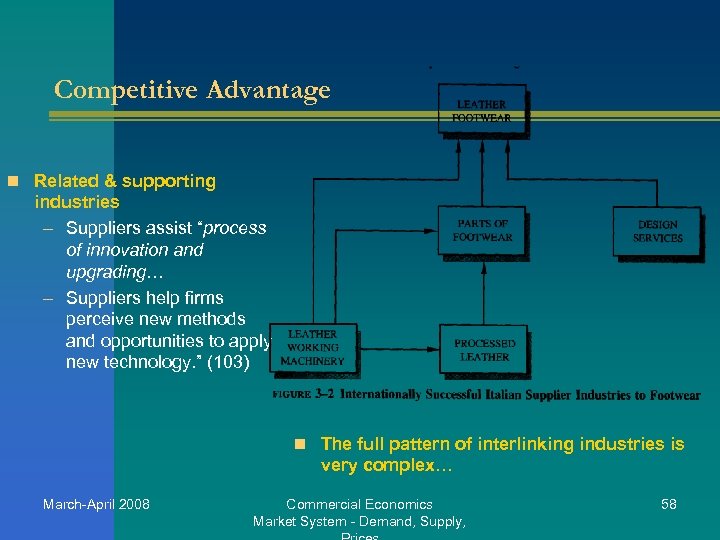 Competitive Advantage n Related & supporting industries – Suppliers assist “process of innovation and upgrading… – Suppliers help firms perceive new methods and opportunities to apply new technology. ” (103) n The full pattern of interlinking industries is very complex… March-April 2008 Commercial Economics Market System - Demand, Supply, 58
 Competitive Advantage – Competitive advantage in suppliers means spin-offs from one industry can be means to develop new ones – “Italian world leadership in gold and silver jewelry has been sustained … because other Italian firms produce two-thirds of the world’s jewelry-making machinery. ” (101) – Related industries give strength to each other… March-April 2008 Commercial Economics Market System - Demand, Supply, 59
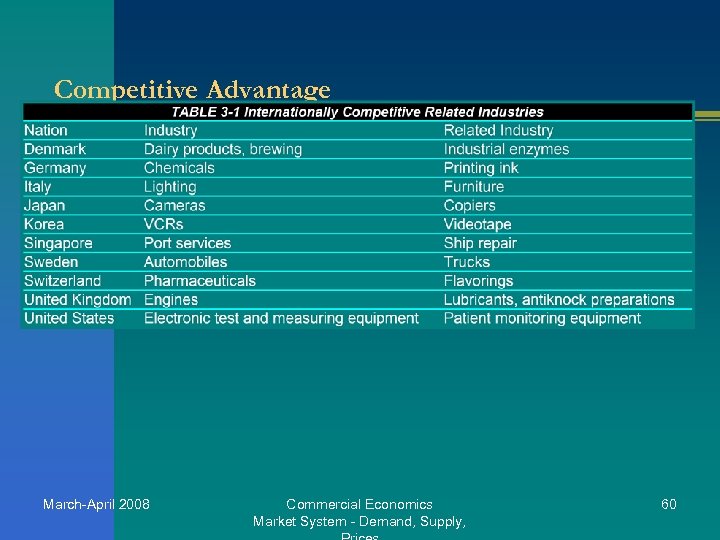 Competitive Advantage n Competitive advantage in related industries March-April 2008 Commercial Economics Market System - Demand, Supply, 60
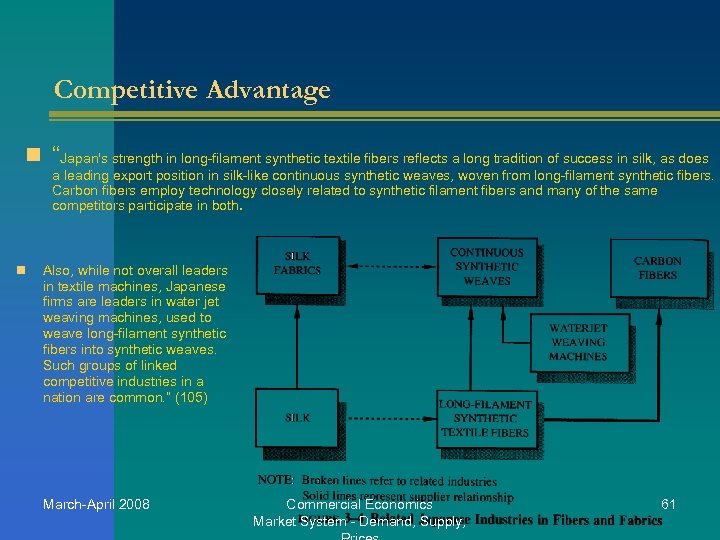 Competitive Advantage n “Japan's strength in long-filament synthetic textile fibers reflects a long tradition of success in silk, as does a leading export position in silk-like continuous synthetic weaves, woven from long-filament synthetic fibers. Carbon fibers employ technology closely related to synthetic filament fibers and many of the same competitors participate in both. n Also, while not overall leaders in textile machines, Japanese firms are leaders in water jet weaving machines, used to weave long-filament synthetic fibers into synthetic weaves. Such groups of linked competitive industries in a nation are common. ” (105) March-April 2008 Commercial Economics Market System - Demand, Supply, 61
 Competitive Advantage n Firm strategy structure & rivalry – “No one management system is universally appropriate” – But character of national management structure needs to suit needs of industry. v “Nations will tend to succeed … where the management practices and modes of organization favored by the national environment are well suited to the industries’ sources of competitive advantage. v Italian firms … are world leaders in a range of fragmented industries … operating in small niches… v In Germany … the engineering and technical background of many senior executives produces a strong inclination towards methodical product and process improvement…” (108) March-April 2008 Commercial Economics Market System - Demand, Supply, 62
 Competitive Advantage n National competitive advantage therefore tends to occur in clusters – Geographic clusters: “Many of the Italian jewelry firms, for example, are located around two towns, Arezzo and Valenca Po…” (120) – Industry clusters v Related industries and supplier-buyer chains March-April 2008 Commercial Economics Market System - Demand, Supply, 63
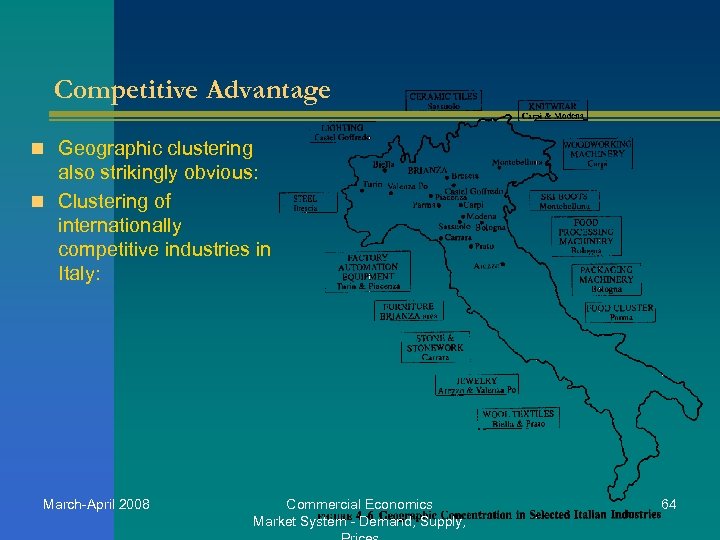 Competitive Advantage n Geographic clustering also strikingly obvious: n Clustering of internationally competitive industries in Italy: March-April 2008 Commercial Economics Market System - Demand, Supply, 64
 Competitive Advantage n Interactions in the “Diamond” for Italian Ski Boot industry: March-April 2008 Commercial Economics Market System - Demand, Supply, 65