


 Скачать презентацию The Market Revolution Changes in transportation and methods
6bc4046c623bef304cd8b6c1b9686db9.ppt
- Количество слайдов: 70
 The Market Revolution Changes in transportation, and methods of production and the movement to production for market social revolution
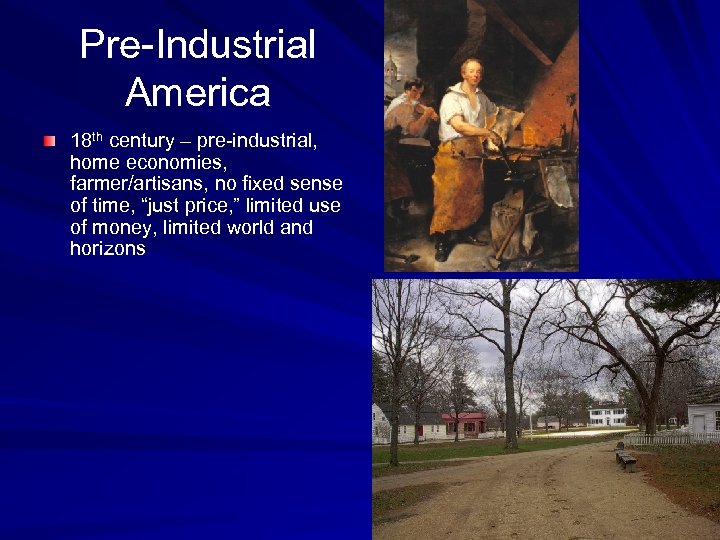 Pre-Industrial America 18 th century – pre-industrial, home economies, farmer/artisans, no fixed sense of time, “just price, ” limited use of money, limited world and horizons
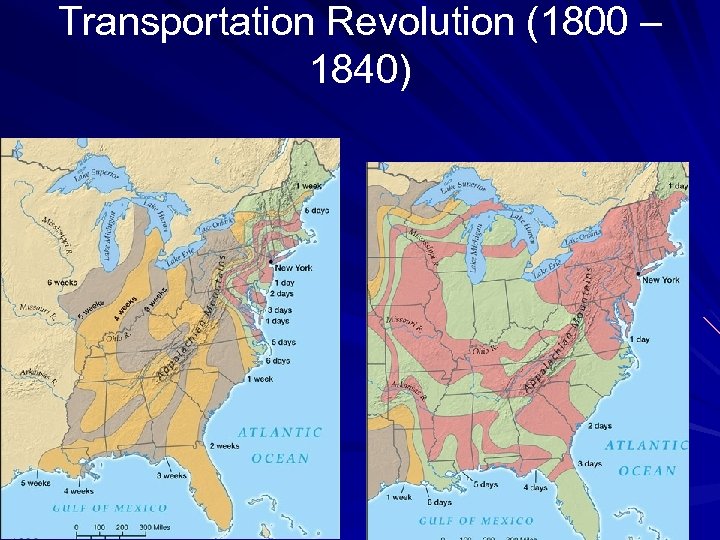 Transportation Revolution (1800 – 1840)
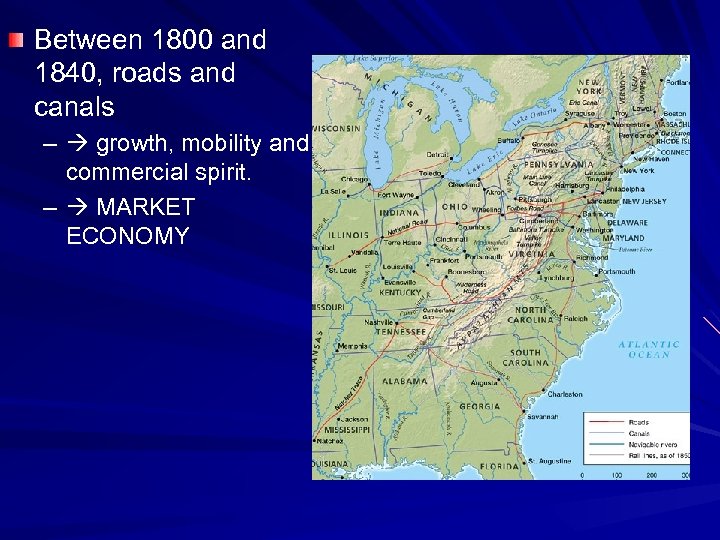 Between 1800 and 1840, roads and canals – growth, mobility and commercial spirit. – MARKET ECONOMY
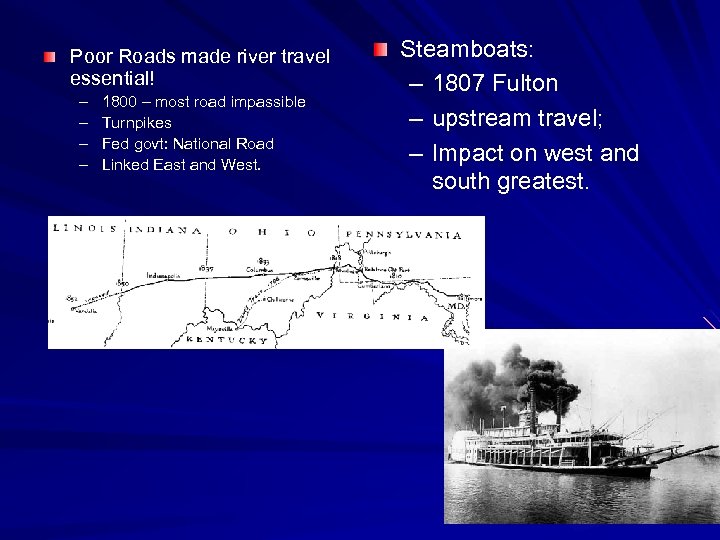 Poor Roads made river travel essential! – – 1800 – most road impassible Turnpikes Fed govt: National Road Linked East and West. Steamboats: – 1807 Fulton – upstream travel; – Impact on west and south greatest.
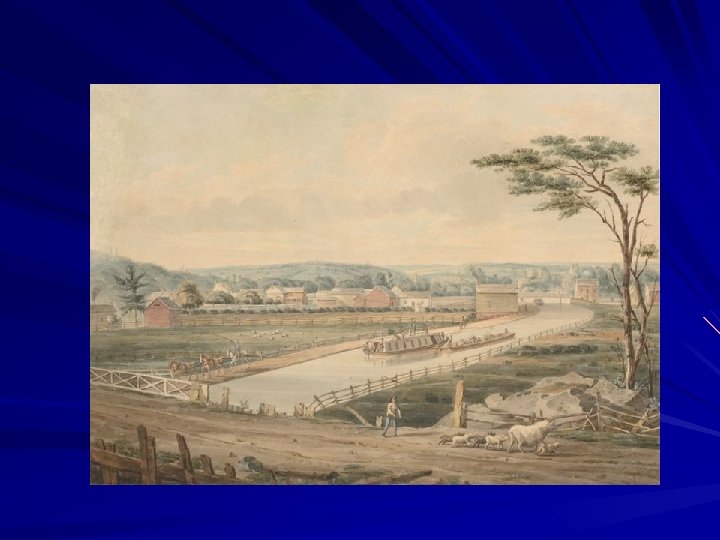
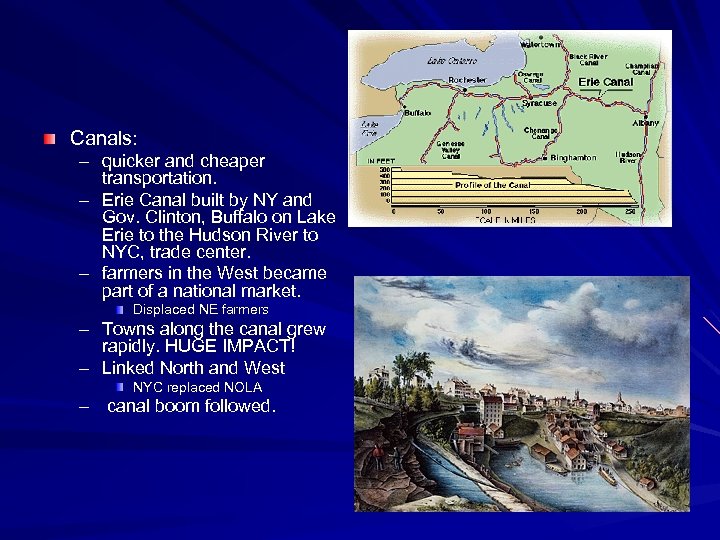 Canals: – quicker and cheaper transportation. – Erie Canal built by NY and Gov. Clinton, Buffalo on Lake Erie to the Hudson River to NYC, trade center. – farmers in the West became part of a national market. Displaced NE farmers – Towns along the canal grew rapidly. HUGE IMPACT! – Linked North and West NYC replaced NOLA – canal boom followed.
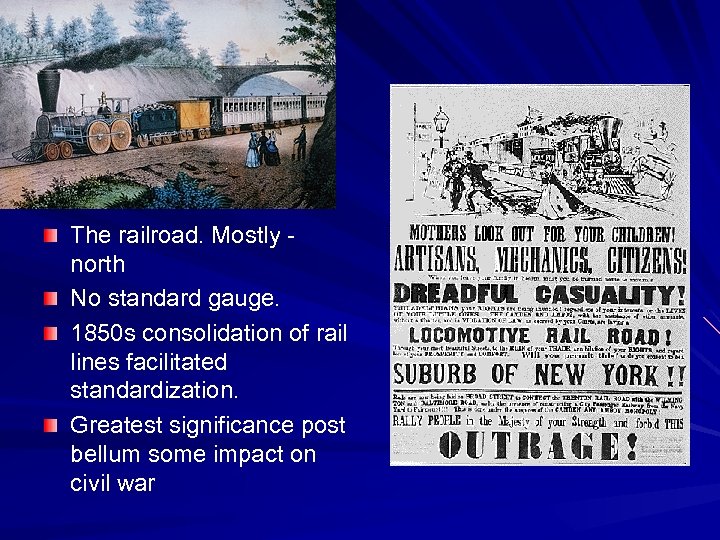 The railroad. Mostly - north No standard gauge. 1850 s consolidation of rail lines facilitated standardization. Greatest significance post bellum some impact on civil war
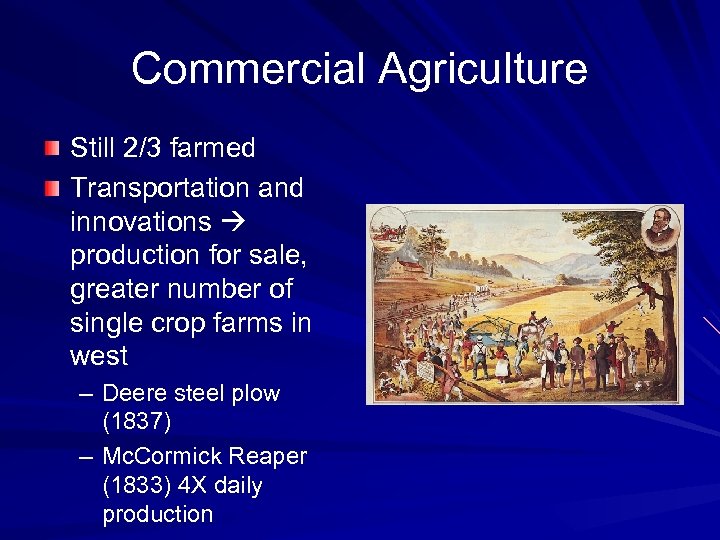 Commercial Agriculture Still 2/3 farmed Transportation and innovations production for sale, greater number of single crop farms in west – Deere steel plow (1837) – Mc. Cormick Reaper (1833) 4 X daily production
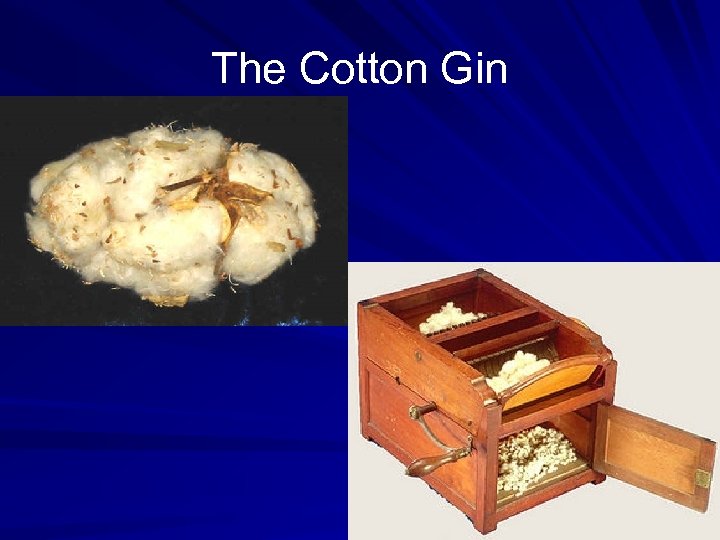 The Cotton Gin
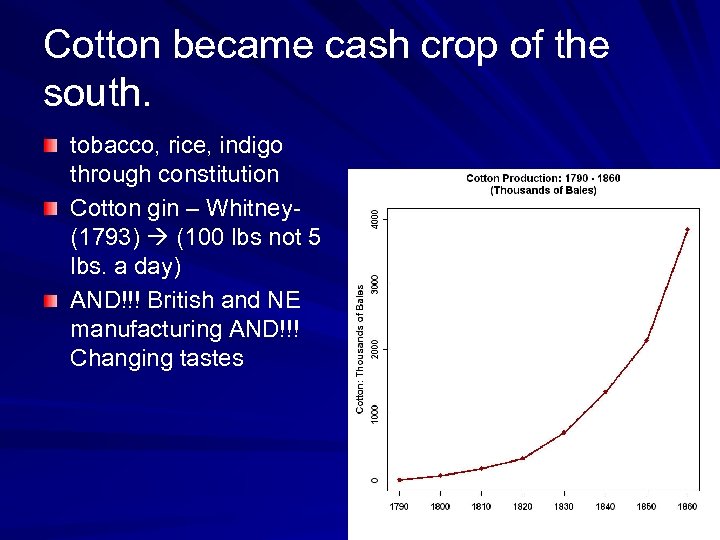 Cotton became cash crop of the south. tobacco, rice, indigo through constitution Cotton gin – Whitney- (1793) (100 lbs not 5 lbs. a day) AND!!! British and NE manufacturing AND!!! Changing tastes
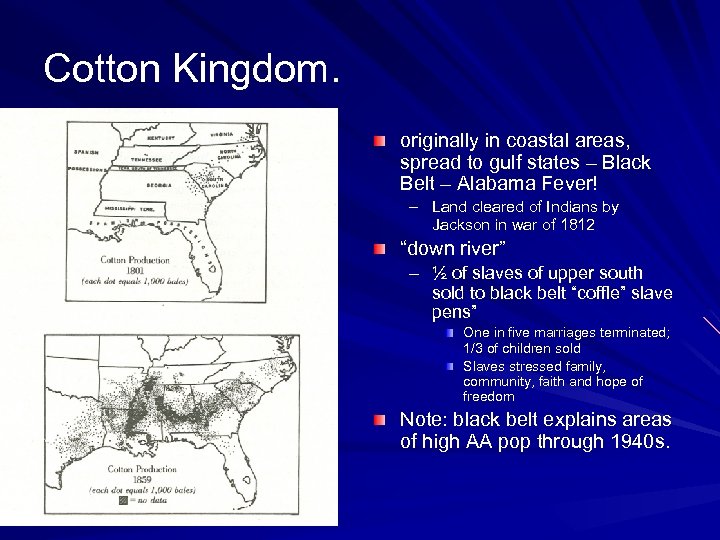 Cotton Kingdom. originally in coastal areas, spread to gulf states – Black Belt – Alabama Fever! – Land cleared of Indians by Jackson in war of 1812 “down river” – ½ of slaves of upper south sold to black belt “coffle” slave pens” One in five marriages terminated; 1/3 of children sold Slaves stressed family, community, faith and hope of freedom Note: black belt explains areas of high AA pop through 1940 s.
 Manufacturing transportation revolution, innovations, the factory system, resources (cotton), water power and work force Manufacturing on a new scale IN NE MOSTLY, ALSO NY
 Support of Government for Manufacturing Embargo and War “buy American” National Bank and Tariff State infrastructure projects (75%) Court decisions – Charles River Bridge v. Warren Bridge (1837) the rights of community outweigh monopoly and privilege! – Laws of free incorporation – Support of patents
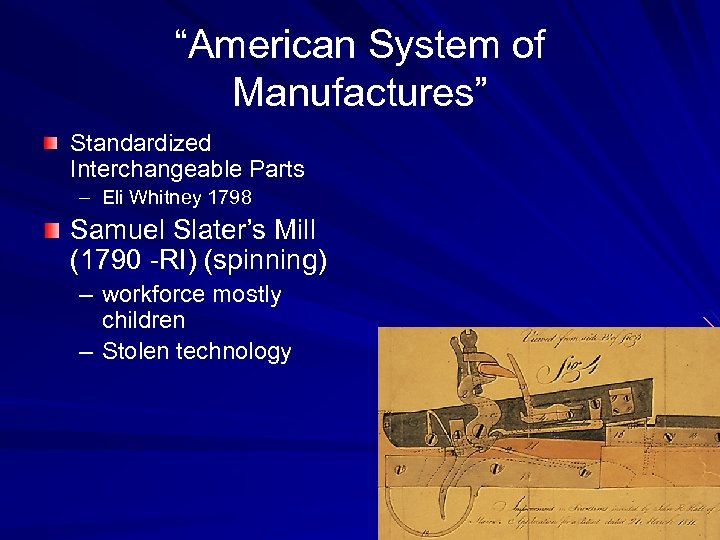 “American System of Manufactures” Standardized Interchangeable Parts – Eli Whitney 1798 Samuel Slater’s Mill (1790 -RI) (spinning) – workforce mostly children – Stolen technology
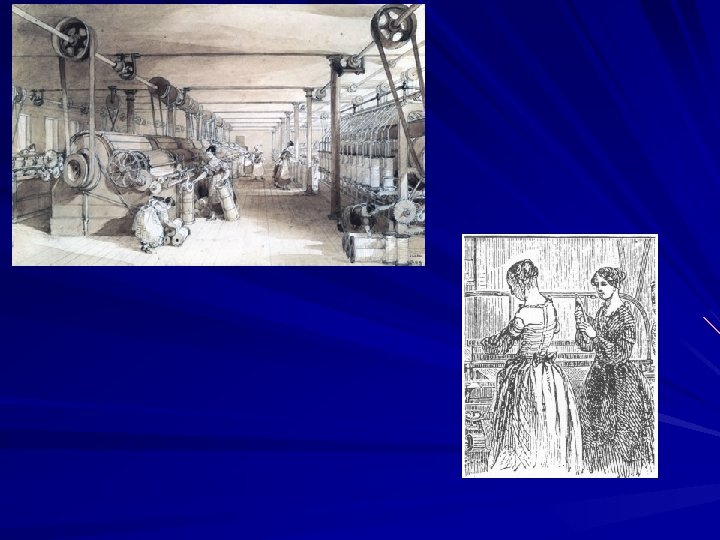
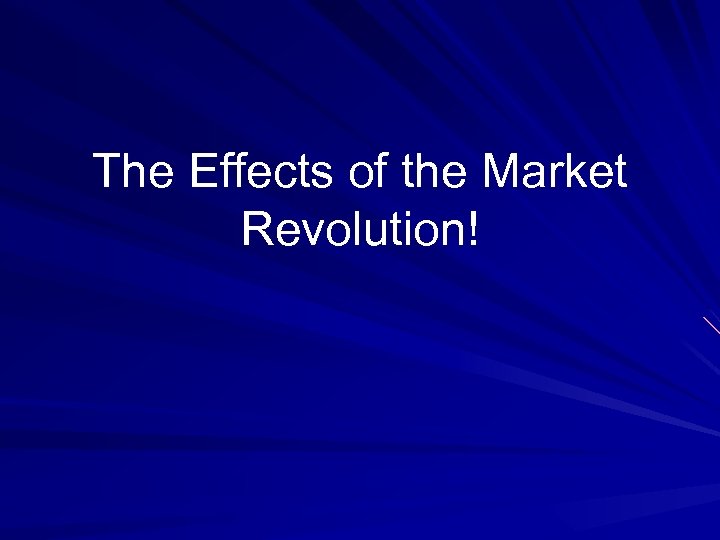
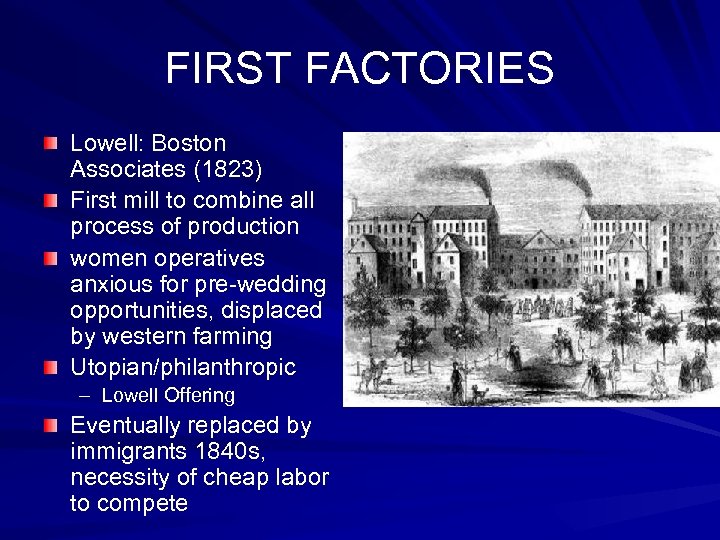 FIRST FACTORIES Lowell: Boston Associates (1823) First mill to combine all process of production women operatives anxious for pre-wedding opportunities, displaced by western farming Utopian/philanthropic – Lowell Offering Eventually replaced by immigrants 1840 s, necessity of cheap labor to compete
 The Effects of the Market Revolution!
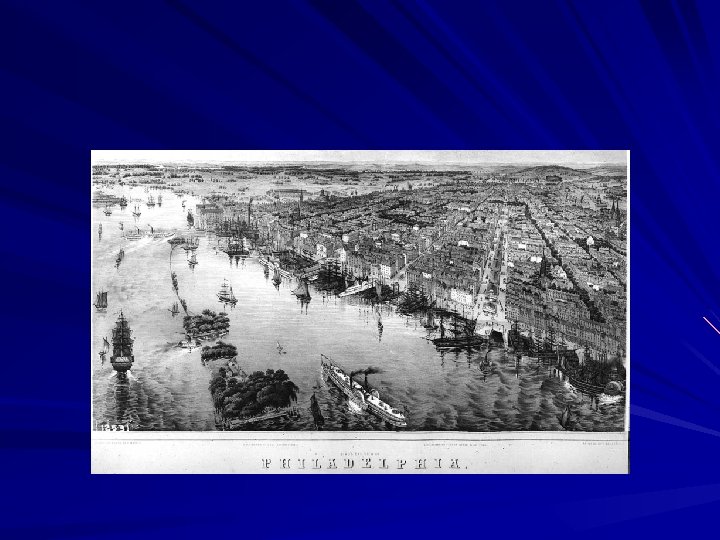
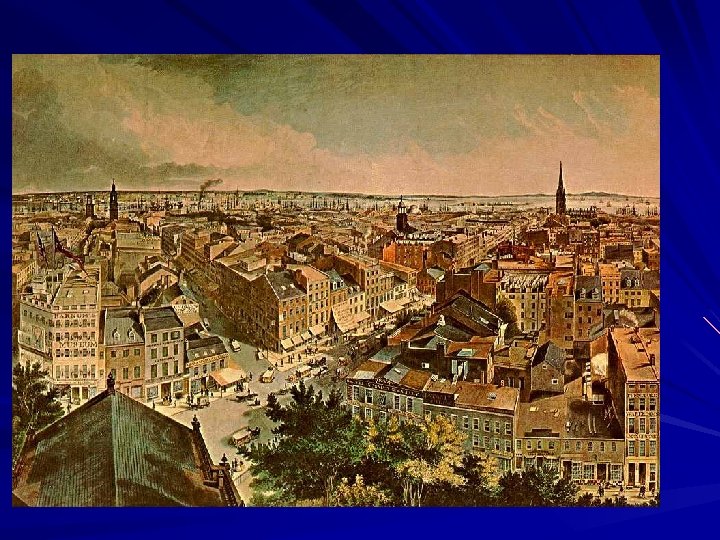
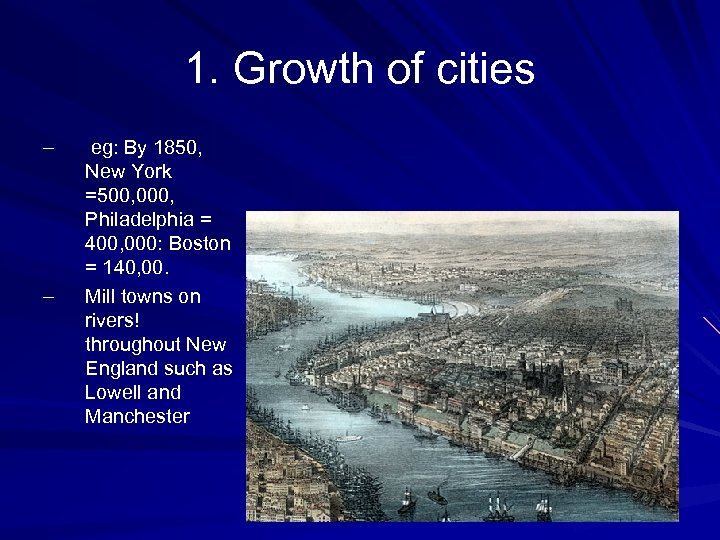 1. Growth of cities – – eg: By 1850, New York =500, 000, Philadelphia = 400, 000: Boston = 140, 00. Mill towns on rivers! throughout New England such as Lowell and Manchester
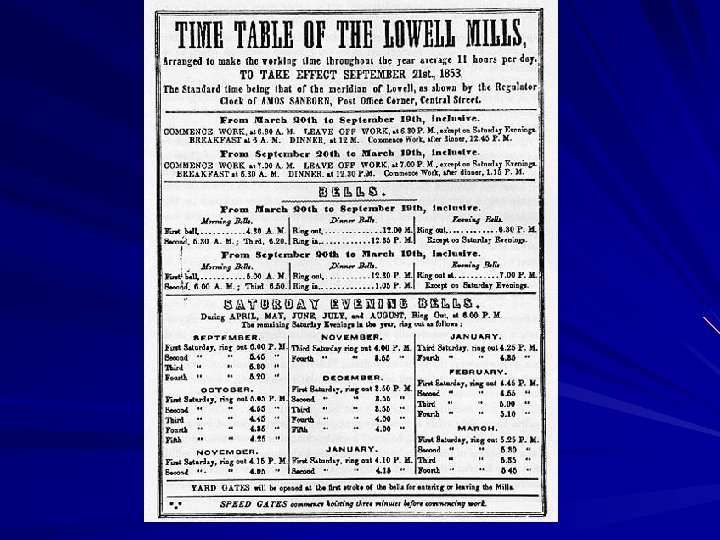
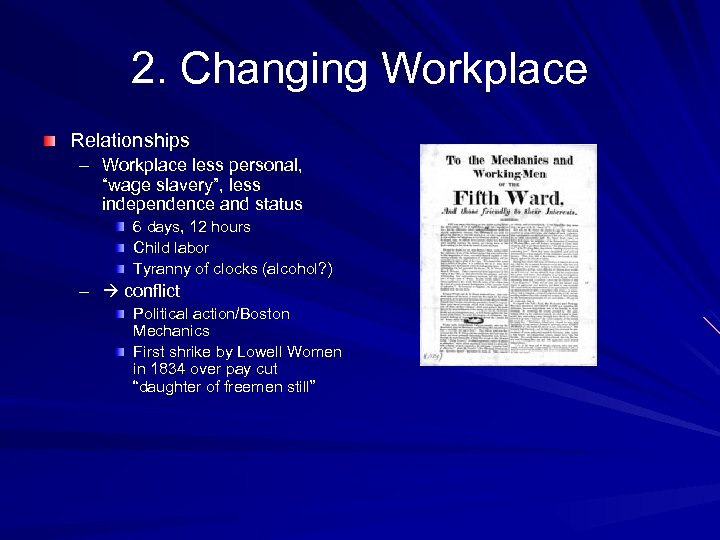 2. Changing Workplace Relationships – Workplace less personal, “wage slavery”, less independence and status 6 days, 12 hours Child labor Tyranny of clocks (alcohol? ) – conflict Political action/Boston Mechanics First shrike by Lowell Women in 1834 over pay cut “daughter of freemen still”
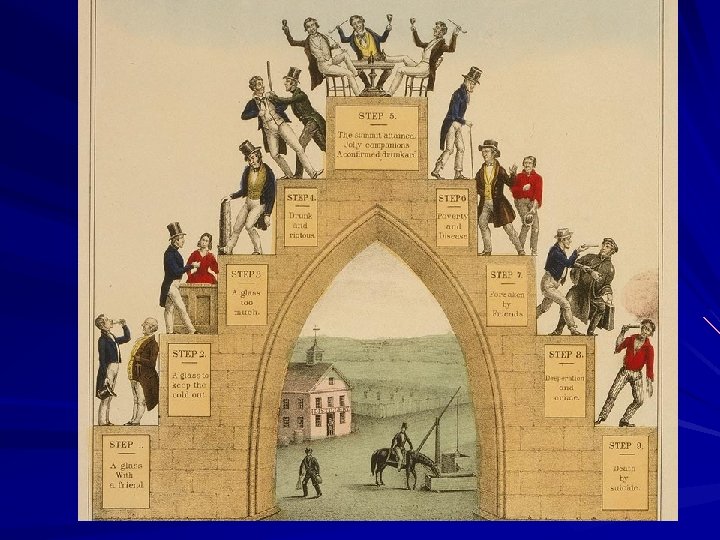
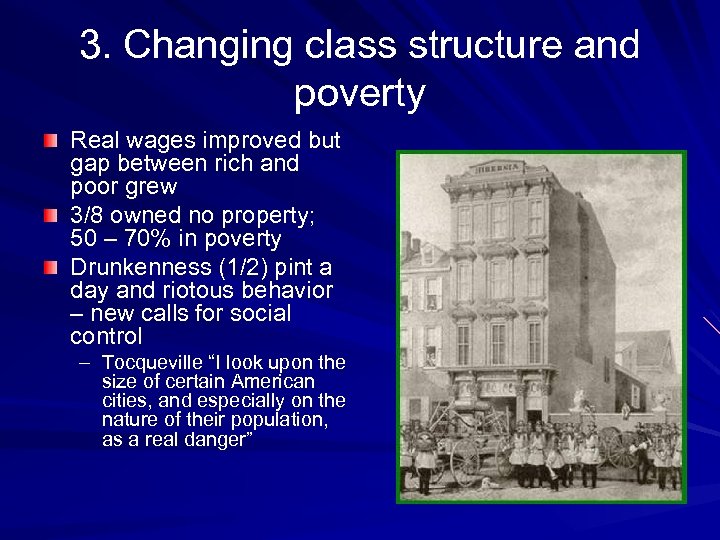 3. Changing class structure and poverty Real wages improved but gap between rich and poor grew 3/8 owned no property; 50 – 70% in poverty Drunkenness (1/2) pint a day and riotous behavior – new calls for social control – Tocqueville “I look upon the size of certain American cities, and especially on the nature of their population, as a real danger”
 4. Changes at Home (Bushnell) – declining birth rate among middle elite classes (7 to 5 births) discovery of children – “spoilage” – – – Few women worked in factories – certainly not married women; poor women worked as domestics Women no longer shared in production! new ideas of separate spheres and cult of domesticity Catherine Beecher “A Treatise of Domestic Economy” Men’s sphere: income and family decisions; the public sphere Women’s sphere = the home, nurturing husband kids – – – Independence in the home (but granted by husband) Legal status still that of a minor, no right to vote, own property, hold office Aimed toward middle-class, white native born women
 it is needful that certain relations be sustained, that involve the duties of subordination. There must be the magistrate and the subject, one of whom is the superior, and the other the inferior. There must be the relations of husband wife, parent and child, teacher and pupil, employer and employed, each involving the relative duties of subordination. The superior in certain particulars is to direct, and the inferior is to yield obedience. Society could never go forward, harmoniously, nor could any craft or profession be successfully pursued, unless these superior and subordinate relations be instituted and sustained. In this Country, it is established, both by opinion and by practice, that women have an equal interest in all social and civil concerns; and that no domestic, civil, or political, institution, is right, that sacrifices her interest to promote that of the other sex. But in order to secure her the more firmly in all these privileges, it is decided, that, in the domestic relation, she take a subordinate station, and that, in civil and political concerns, her interests be entrusted to the other sex, without her taking any part in voting, or in making and administering laws.
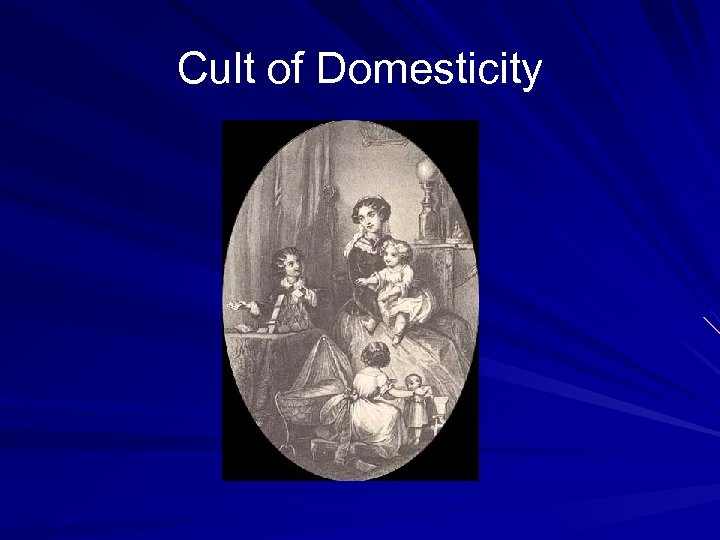 Cult of Domesticity
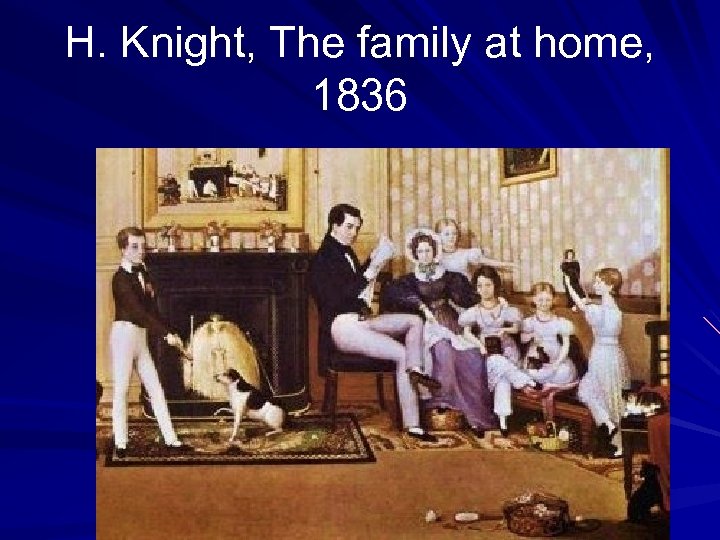 H. Knight, The family at home, 1836
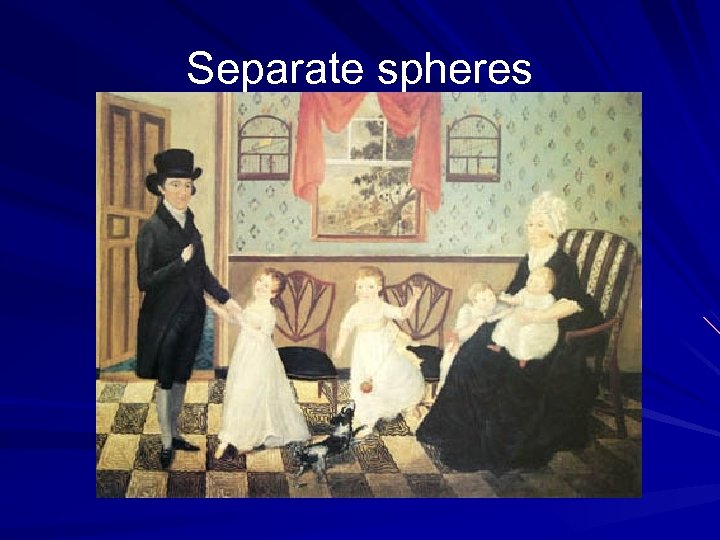 Separate spheres
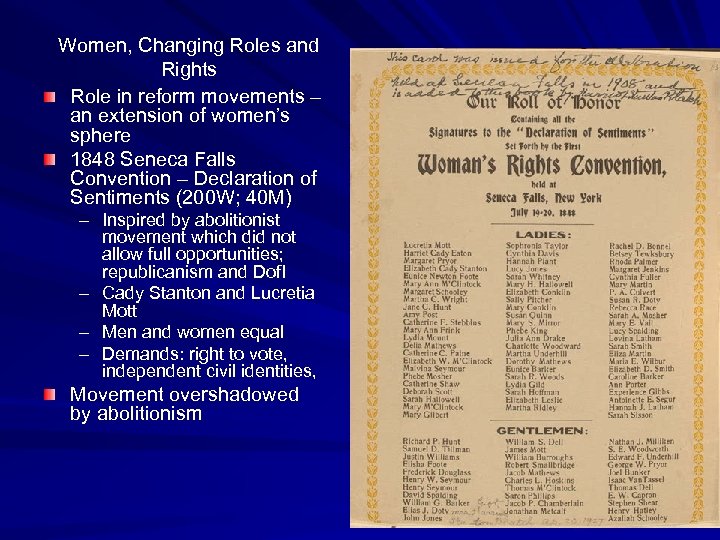 Women, Changing Roles and Rights Role in reform movements – an extension of women’s sphere 1848 Seneca Falls Convention – Declaration of Sentiments (200 W; 40 M) – Inspired by abolitionist movement which did not allow full opportunities; republicanism and Dof. I – Cady Stanton and Lucretia Mott – Men and women equal – Demands: right to vote, independent civil identities, Movement overshadowed by abolitionism
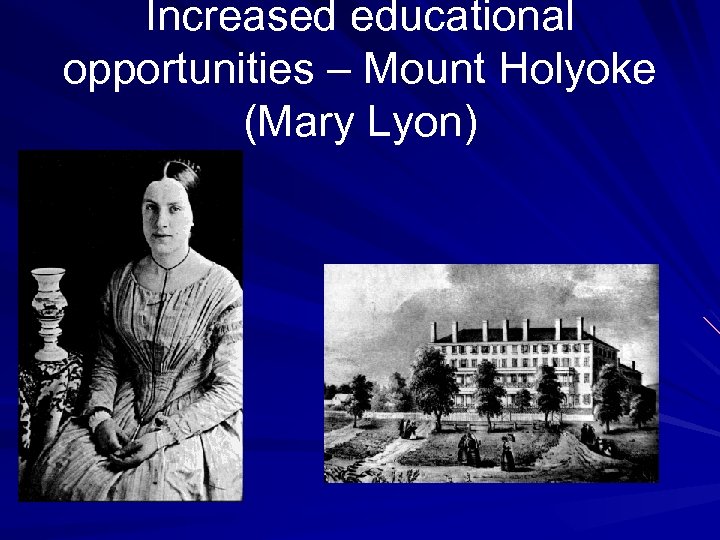 Increased educational opportunities – Mount Holyoke (Mary Lyon)
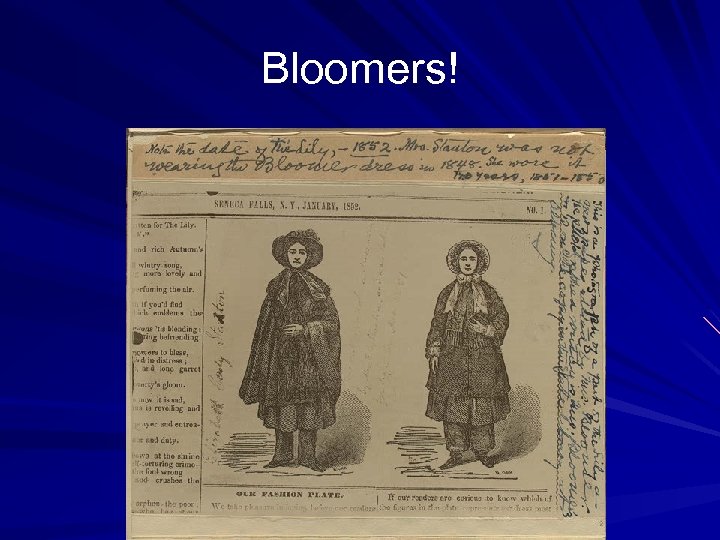 Bloomers!
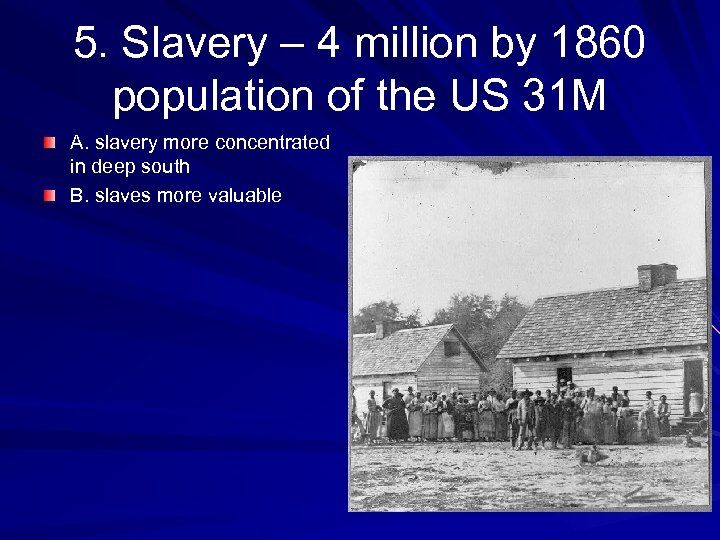 5. Slavery – 4 million by 1860 population of the US 31 M A. slavery more concentrated in deep south B. slaves more valuable
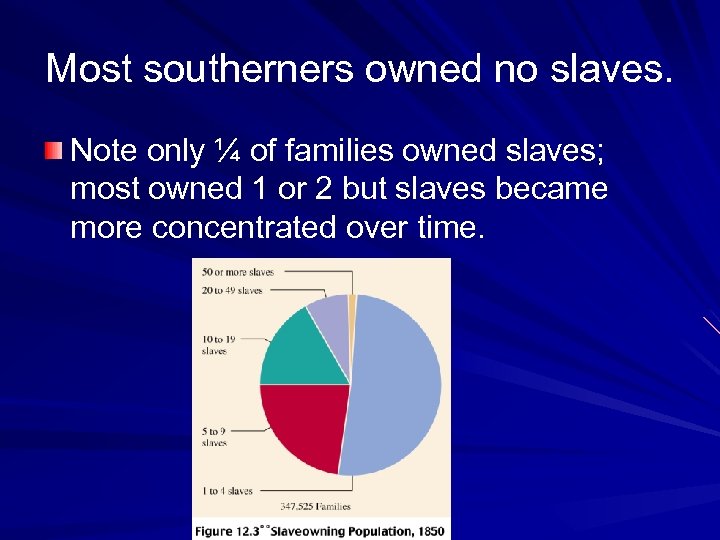 Most southerners owned no slaves. Note only ¼ of families owned slaves; most owned 1 or 2 but slaves became more concentrated over time.
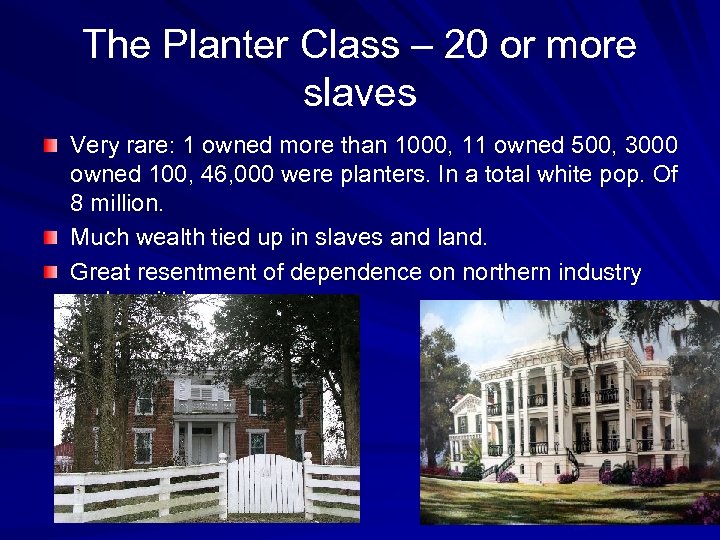 The Planter Class – 20 or more slaves Very rare: 1 owned more than 1000, 11 owned 500, 3000 owned 100, 46, 000 were planters. In a total white pop. Of 8 million. Much wealth tied up in slaves and land. Great resentment of dependence on northern industry and capital.
 IMPORTANT!!! Cotton is king! Cotton in 1840 = 1/2 US exports Northern economic benefits: shipping, banking, insurance, growing textile manufacturing England: 1/5 population engaged in textiles. Source of southern confidence but… The south counted on cotton to coerce support.
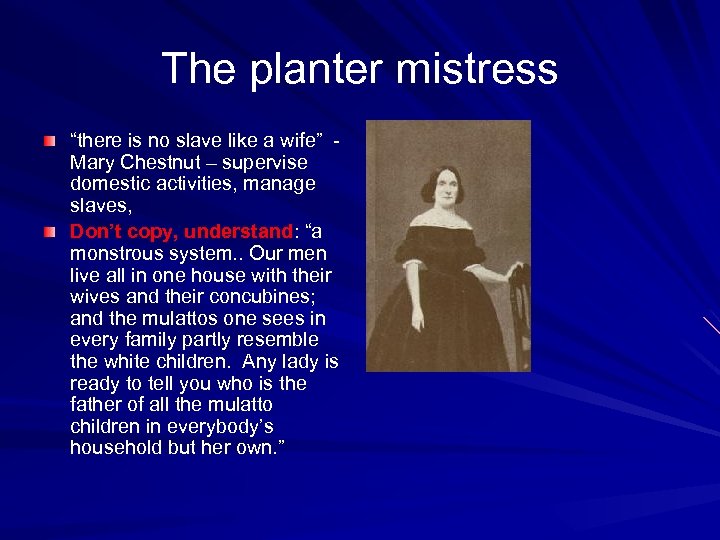 The planter mistress “there is no slave like a wife” - Mary Chestnut – supervise domestic activities, manage slaves, Don’t copy, understand: “a monstrous system. . Our men live all in one house with their wives and their concubines; and the mulattos one sees in every family partly resemble the white children. Any lady is ready to tell you who is the father of all the mulatto children in everybody’s household but her own. ”
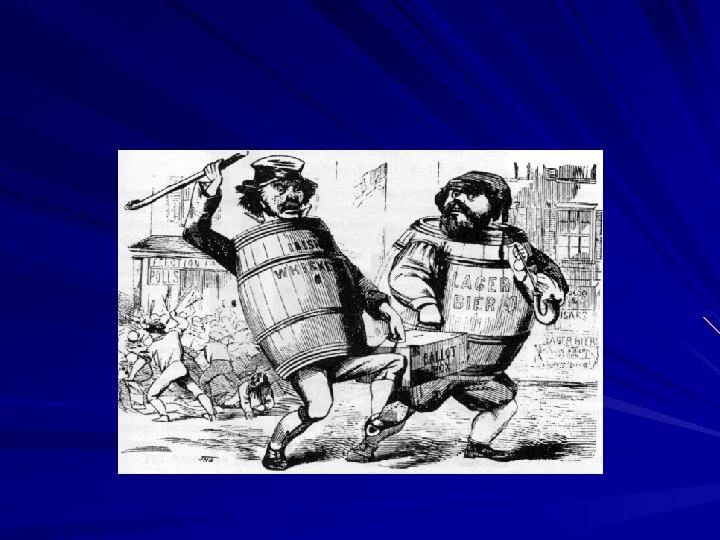
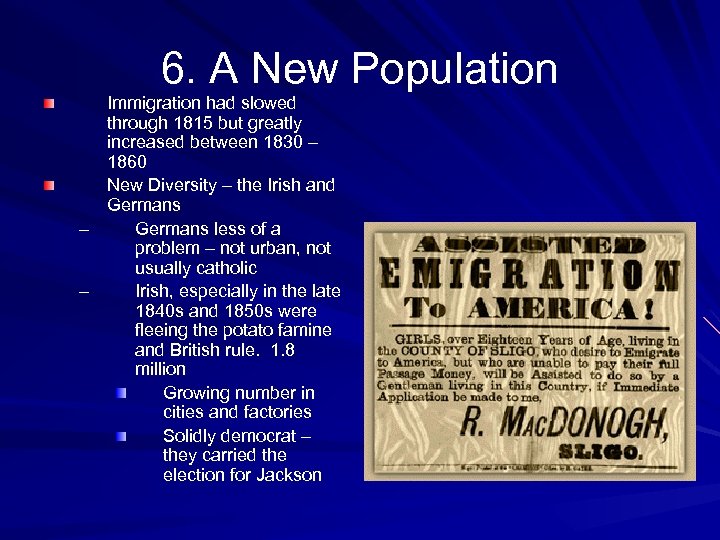 6. A New Population Immigration had slowed through 1815 but greatly increased between 1830 – 1860 New Diversity – the Irish and Germans – Germans less of a problem – not urban, not usually catholic – Irish, especially in the late 1840 s and 1850 s were fleeing the potato famine and British rule. 1. 8 million Growing number in cities and factories Solidly democrat – they carried the election for Jackson
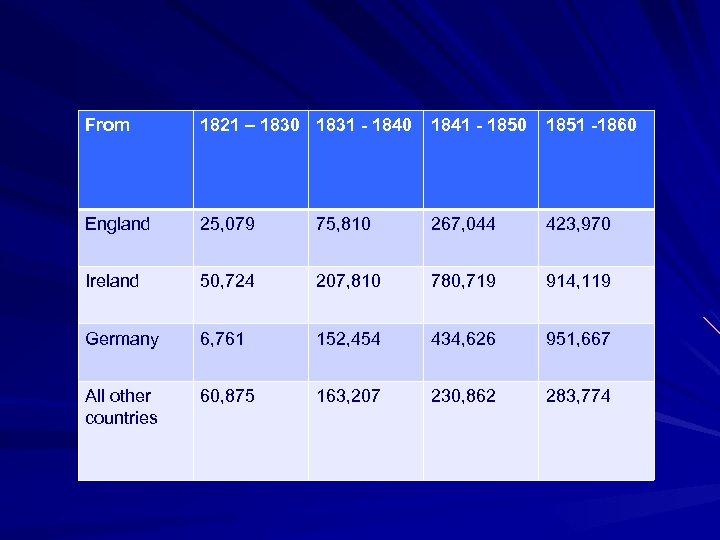 From 1821 – 1830 1831 - 1840 1841 - 1850 1851 -1860 England 25, 079 75, 810 267, 044 423, 970 Ireland 50, 724 207, 810 780, 719 914, 119 Germany 6, 761 152, 454 434, 626 951, 667 All other countries 60, 875 163, 207 230, 862 283, 774
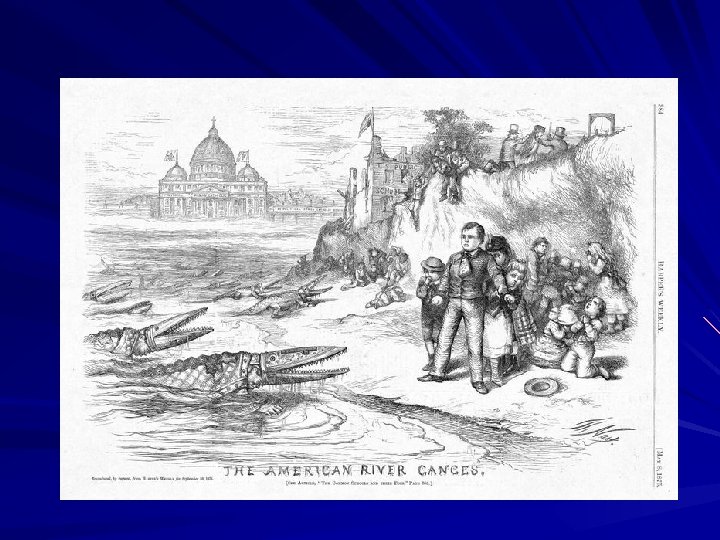
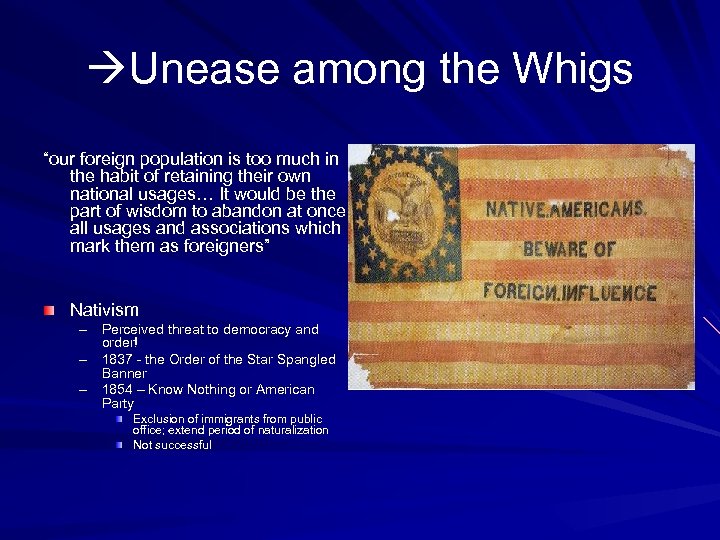 Unease among the Whigs “our foreign population is too much in the habit of retaining their own national usages… It would be the part of wisdom to abandon at once all usages and associations which mark them as foreigners” Nativism – Perceived threat to democracy and order! – 1837 - the Order of the Star Spangled Banner – 1854 – Know Nothing or American Party Exclusion of immigrants from public office; extend period of naturalization Not successful
 Review of religion in early America 1. In what important ways did religion shape New England? 2. In what important ways did religion shape Pennsylvania? 3. What was the First Great Awakening and how did it influence the American Revolution and American nationalism? 4. How did the Puritan ideas of human nature influence the Constitution?
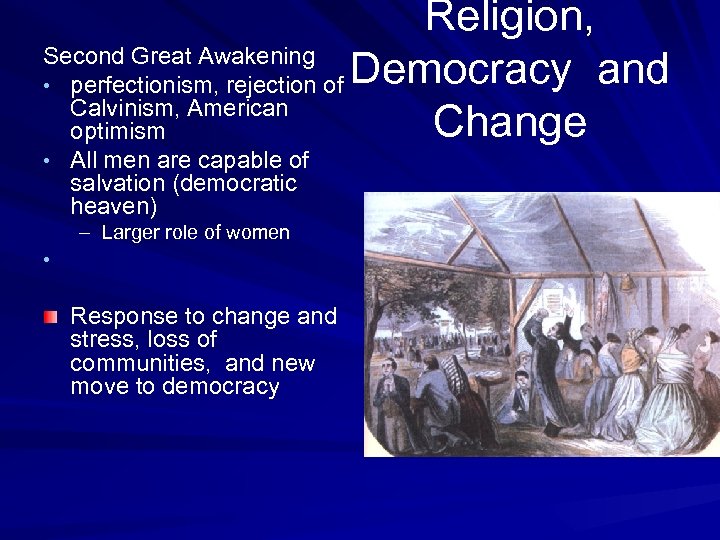 Religion, Second Great Awakening • perfectionism, rejection of Democracy and Calvinism, American Change optimism • All men are capable of salvation (democratic heaven) – Larger role of women • Response to change and stress, loss of communities, and new move to democracy
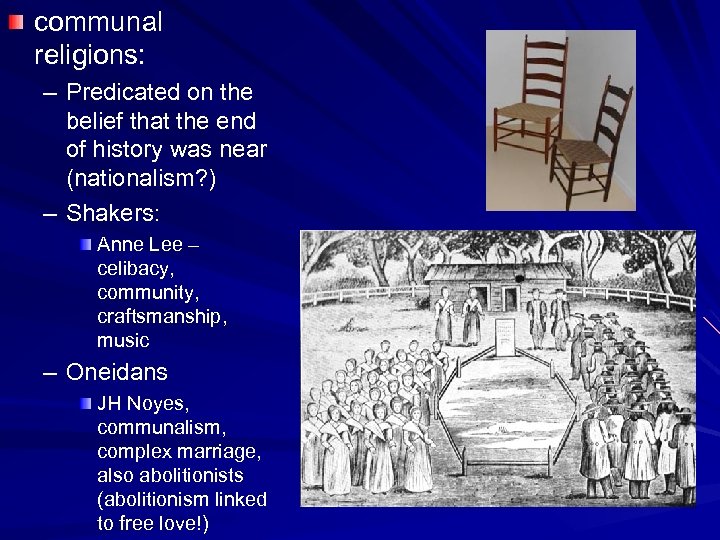 communal religions: – Predicated on the belief that the end of history was near (nationalism? ) – Shakers: Anne Lee – celibacy, community, craftsmanship, music – Oneidans JH Noyes, communalism, complex marriage, also abolitionists (abolitionism linked to free love!)
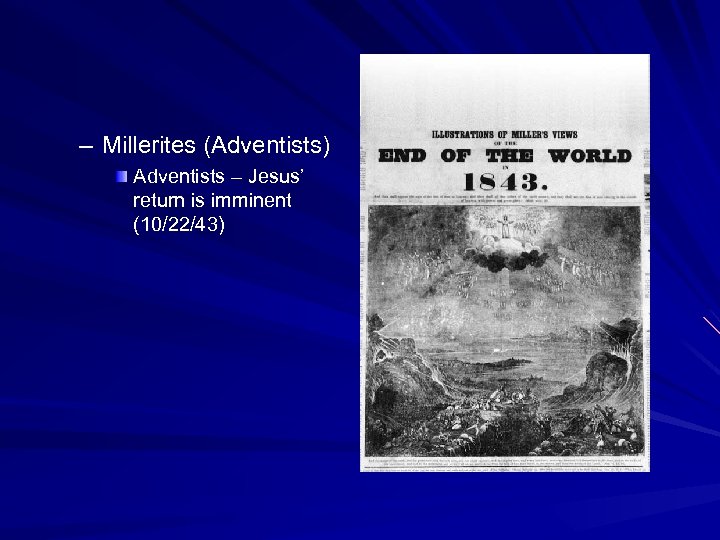 – Millerites (Adventists) Adventists – Jesus’ return is imminent (10/22/43)
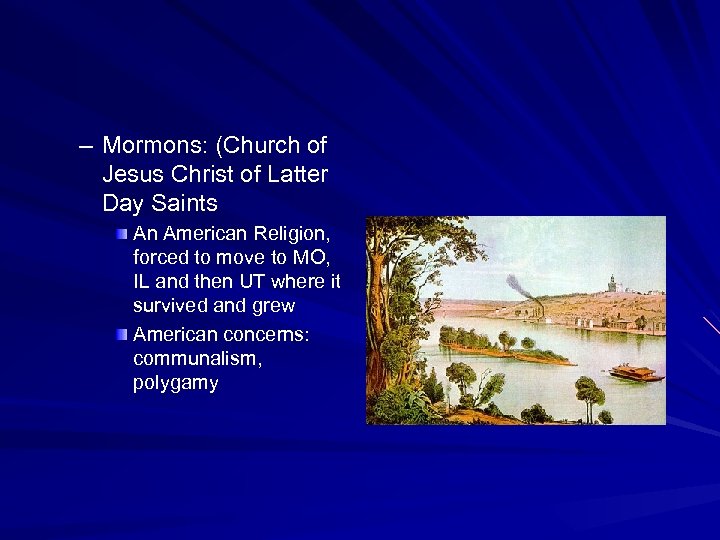 – Mormons: (Church of Jesus Christ of Latter Day Saints An American Religion, forced to move to MO, IL and then UT where it survived and grew American concerns: communalism, polygamy
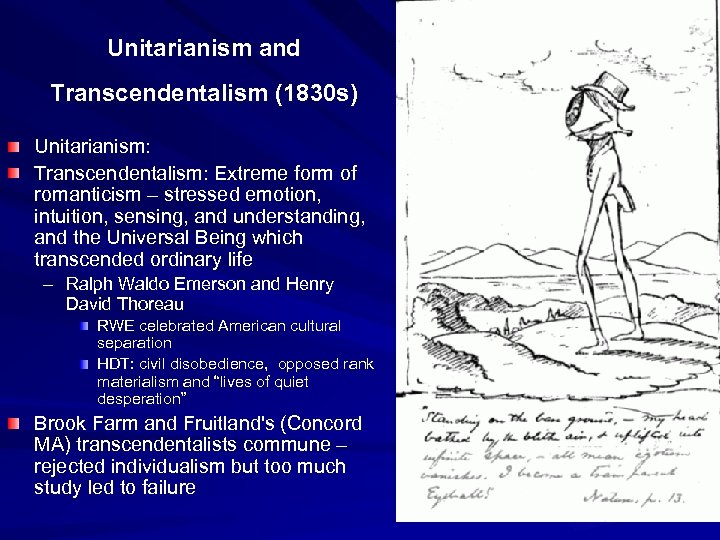 Unitarianism and Transcendentalism (1830 s) Unitarianism: Transcendentalism: Extreme form of romanticism – stressed emotion, intuition, sensing, and understanding, and the Universal Being which transcended ordinary life – Ralph Waldo Emerson and Henry David Thoreau RWE celebrated American cultural separation HDT: civil disobedience, opposed rank materialism and “lives of quiet desperation” Brook Farm and Fruitland's (Concord MA) transcendentalists commune – rejected individualism but too much study led to failure
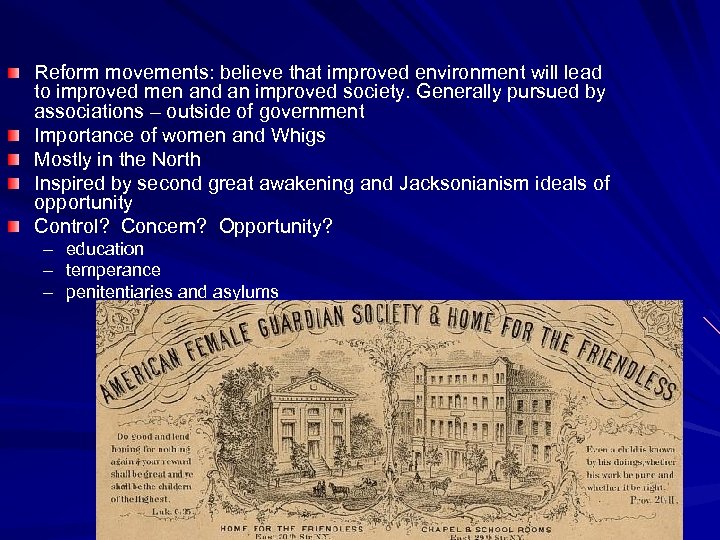 Reform movements: believe that improved environment will lead to improved men and an improved society. Generally pursued by associations – outside of government Importance of women and Whigs Mostly in the North Inspired by second great awakening and Jacksonianism ideals of opportunity Control? Concern? Opportunity? – education – temperance – penitentiaries and asylums
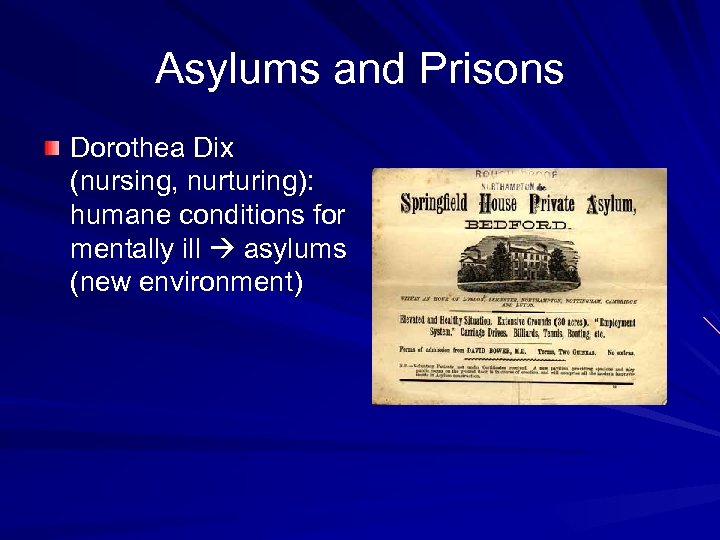 Asylums and Prisons Dorothea Dix (nursing, nurturing): humane conditions for mentally ill asylums (new environment)
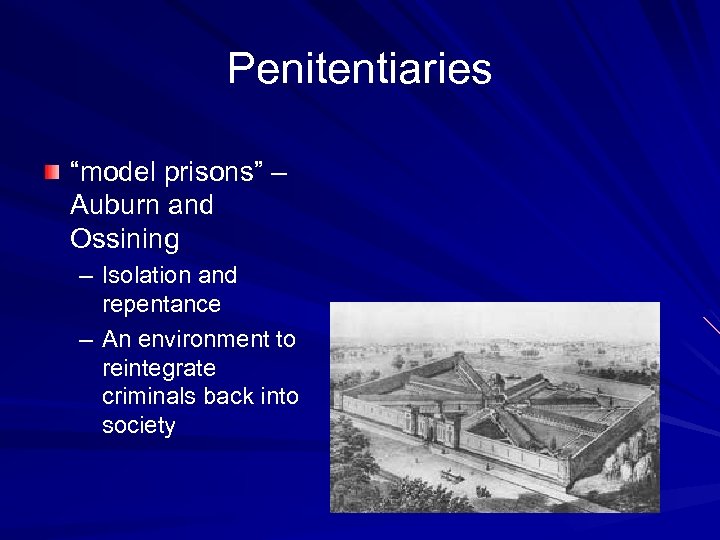 Penitentiaries “model prisons” – Auburn and Ossining – Isolation and repentance – An environment to reintegrate criminals back into society
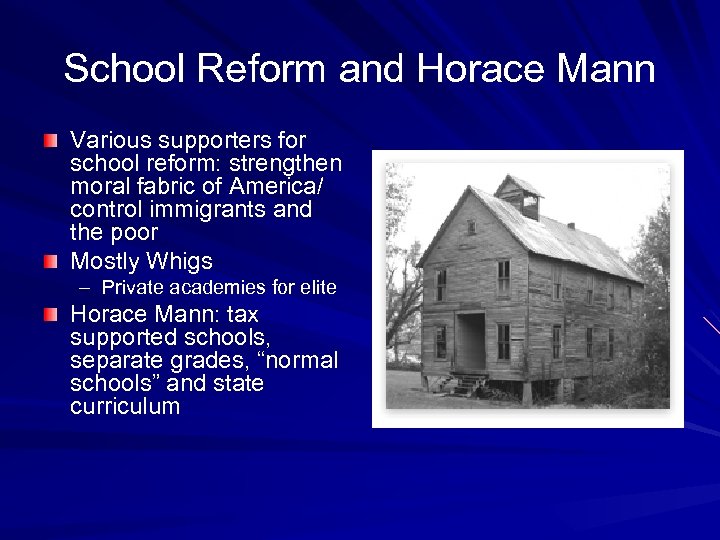 School Reform and Horace Mann Various supporters for school reform: strengthen moral fabric of America/ control immigrants and the poor Mostly Whigs – Private academies for elite Horace Mann: tax supported schools, separate grades, “normal schools” and state curriculum
 Mc. Guffey Reader - 1836 1. 2. 3. 4. 5. The good boy, whose parents are poor, rises very early in the morning , and ll day long does as much as he can to help his father and mother. When he goes to school he walks quickly, and does not lose time on the road. I must learn as fast as I can; if anybody has any time to lose, I am sure I have not. When he has finished his lessons, he does not stay to play, but runs home; he wants to see his father and mother and to help them. When he sees little boys and girls riding on pretty horses or in coaches, or walking with ladies and gentlemen and having or very fine clothes, he does not envy them, nor wish to be like them. He says, ”I have often been told, and I have read, that it is God who makes some poor and other rich; that the rich have many troubles which we know nothing of; and that the poor, if they are but good, may be very happy, indeed, I think that when I am good, nobody can be happier. ”
 Temperance Alcohol linked to domestic violence, loss of family income, poor work, public rowdiness, threat to democracy Temperance not prohibition – – – American Society for the Promotion of Temperance Martha Washington Societies “take the pledge” 1851 Maine Laws
 The Evolution of Abolitionism NOT ALL ABOLITIONISTS WERE ALIKE! They varied greatly in beliefs and programs! Early abolition efforts – 1770 s slavery “contrary to the idea of liberty” – Abolition Society of PA, – Southern manumission
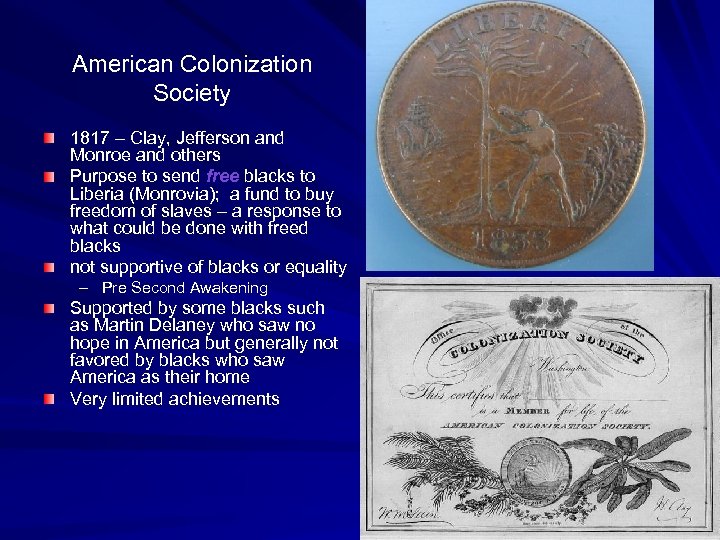 American Colonization Society 1817 – Clay, Jefferson and Monroe and others Purpose to send free blacks to Liberia (Monrovia); a fund to buy freedom of slaves – a response to what could be done with freed blacks not supportive of blacks or equality – Pre Second Awakening Supported by some blacks such as Martin Delaney who saw no hope in America but generally not favored by blacks who saw America as their home Very limited achievements
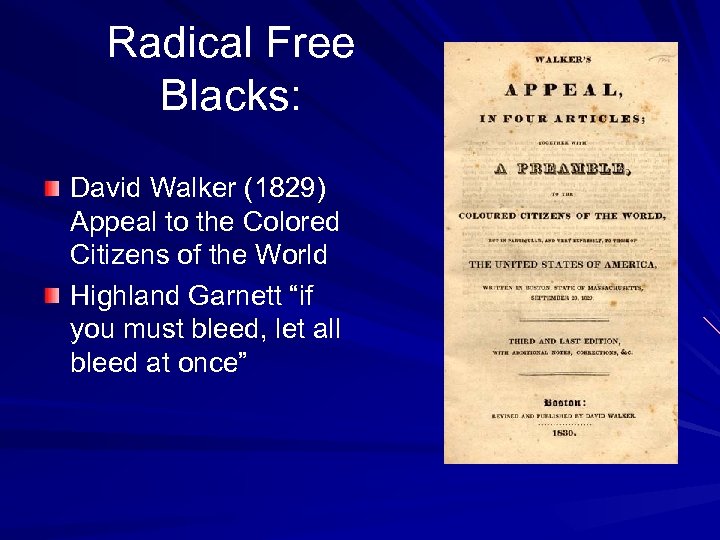 Radical Free Blacks: David Walker (1829) Appeal to the Colored Citizens of the World Highland Garnett “if you must bleed, let all bleed at once”
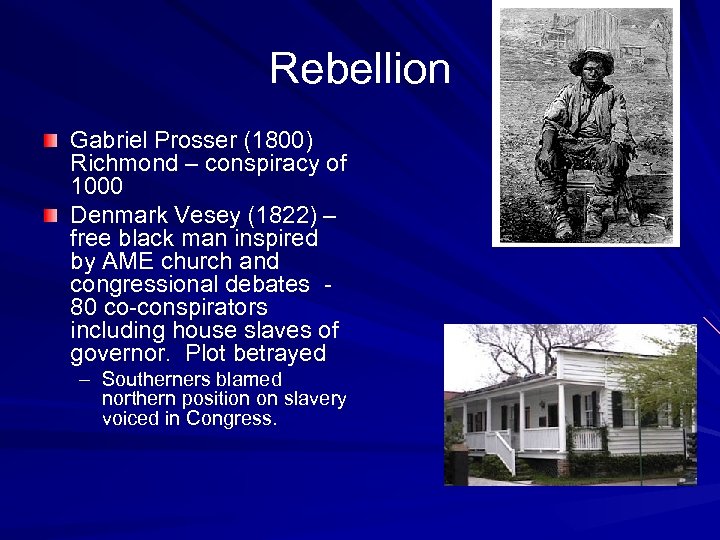 Rebellion Gabriel Prosser (1800) Richmond – conspiracy of 1000 Denmark Vesey (1822) – free black man inspired by AME church and congressional debates - 80 co-conspirators including house slaves of governor. Plot betrayed – Southerners blamed northern position on slavery voiced in Congress.
![South Hampton VA (1831) [year of Liberator, post. Walker] Inspired by religious visions, Turner](https://present5.com/presentation/6bc4046c623bef304cd8b6c1b9686db9/image-60.jpg "South Hampton VA (1831) [year of Liberator, post. Walker] Inspired by religious visions, Turner") South Hampton VA (1831) [year of Liberator, post. Walker] Inspired by religious visions, Turner and followers killed 55 – Turner on his master “a kind master and placed the greatest confidence in me; in fact, I had no cause to complain…” – Turner when asked: “Do you not see yourself mistaken now? Was not Christ crucified? laws forbidding teaching slaves to read, manumisison made illegal, abolitionist mail stopped, 1836 “gag rule” Nat Turner
South Hampton VA (1831) [year of Liberator, post. Walker] Inspired by religious visions, Turner and followers killed 55 – Turner on his master “a kind master and placed the greatest confidence in me; in fact, I had no cause to complain…” – Turner when asked: “Do you not see yourself mistaken now? Was not Christ crucified? laws forbidding teaching slaves to read, manumisison made illegal, abolitionist mail stopped, 1836 “gag rule” Nat Turner
 William Lloyd Garrison – The Liberator Rejection of gradualism (Lundy – The Genius of Universal Emancipation – no new slave states, repeal of 3/5 compromise, congressional abolition) Slavery = sin. Society and the individual were incapable of salvation until they abandoned slavery. Emancipation and equality, not through violence but – moral suasion “I will not equivocate; I will not excuse; I will not retreat a single inch; and I will be heard! American Anti-slavery Society – perfectionist party. No politics, no direct action
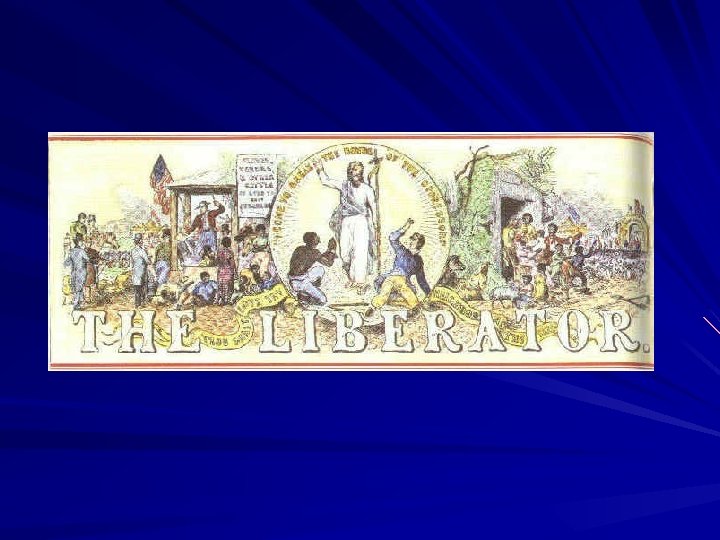
 Do not copy… Garrison’s extremism I determined, at every hazard, to lift up the standard of emancipation in the eyes of the nation, within sight of Bunker Hill and in the birthplace of liberty. That standard is now unfurled; and long may it float, unhurt by the spoliations of time or the missiles of a desperate foe -- yea, till every chain be broken, and every bondman set free! Let Southern oppressors tremble -- let their secret abettors tremble -- let their Northern apologists tremble -- let all the enemies of the persecuted blacks tremble.
 Do not copy… Garrison’s extremism the U. S. Constitution was the result of a terrible bargain between freedom and slavery. Calling the Constitution a "covenant with death" and "an agreement with Hell, " he refused to participate in American electoral politics because to do so meant supporting "the pro-slavery, war sanctioning Constitution of the United States. " Instead, under the slogan "No Union with Slaveholders, " the Garrisonians repeatedly argued for a dissolution of the Union. Political activity in a government that supported slavery would be corrupting as well as fruitless.
 Do not copy… Garrison’s extremism I determined, at every hazard, to lift up the standard of emancipation in the eyes of the nation, within sight of Bunker Hill and in the birthplace of liberty. That standard is now unfurled; and long may it float, unhurt by the spoliations of time or the missiles of a desperate foe -- yea, till every chain be broken, and every bondman set free! Let Southern oppressors tremble -- let their secret abettors tremble -- let their Northern apologists tremble -- let all the enemies of the persecuted blacks tremble.
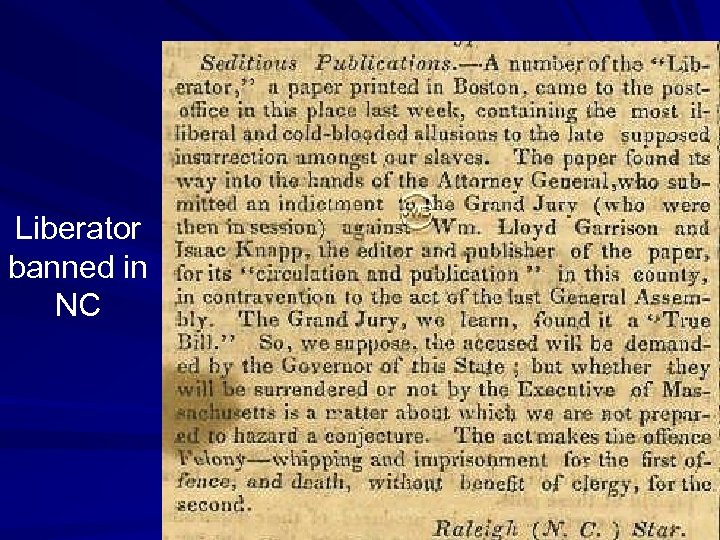 Liberator banned in NC
 Liberty Party – political approach James Birney 1840 – 1844 “Nor can we consent to sacrifice the cause of the slave, by voting for men who are devoted to the interest of the great proslavery parties. Great influence on the election of 1844
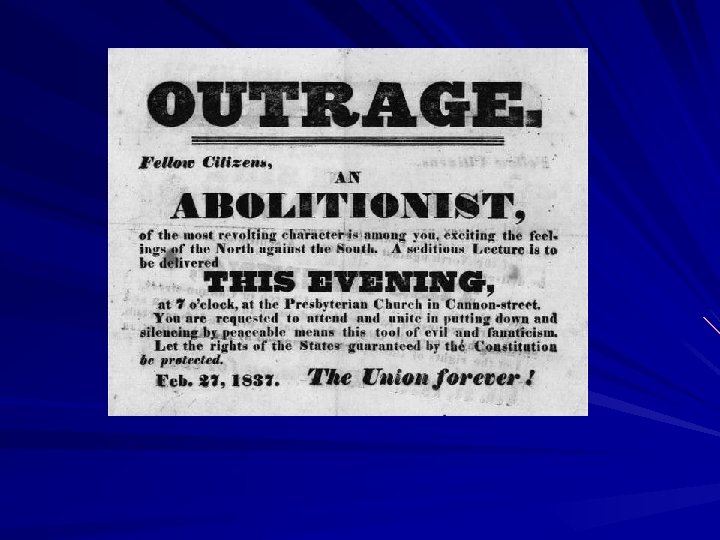
 Responses to Abolitionists Opposed in North And South: – – No discussion of emancipation after 1831 Gag rule 1836 – 1844 in Congress Southern states banned distribution of anti-slavery tracts GA legislature offered $5000 to anyone who would kidnap Garrison for trial in GA – Slavery defended as a positive good! No longer a necessary evil! North – 1837 E. Lovejoy killed after his presses had been destroyed four times – 1835 Garrison dragged through Boston with noose around neck – Even Lincoln denounced abolitionists.
 The Constitution guarantees citizens the right "to petition the government for a redress of grievances. " Nineteenth-century Americans exercised this right vigorously. Each session, Congress received petitions "respectfully, " but "earnestly praying" for action. In 1834 the American Anti-Slavery Society began an antislavery petition drive. Over the next few years the number of petitions sent to Congress increased sharply. In 1837— 38, for example, abolitionists sent more than 130, 000 petitions to Congress asking for the abolition of slavery in Washington, DC. As antislavery opponents became more insistent, Southern members of Congress were increasingly adamant in their defense of slavery. In May of 1836 the House passed a resolution that automatically "tabled, " or postponed action on all petitions relating to slavery without hearing them. Stricter versions of this gag rule passed in succeeding Congresses. At first, only a small group of congressmen, led by Representative John Quincy Adams of Massachusetts, opposed the rule. Adams used a variety of parliamentary tactics to try to read slavery petitions on the floor of the House, but each time he fell victim to the rule. Gradually, as antislavery sentiment in the North grew, more Northern congressmen supported Adams’s argument that, whatever one’s view on slavery, stifling the right to petition was wrong. In 1844 the House rescinded the gag rule on a motion made by John Quincy Adams.