


 Скачать презентацию The market driving the models Practical applications of
e4734ed9a9d9d1ca33a67c784c4448af.ppt
- Количество слайдов: 35
 The market driving the models Practical applications of credit derivatives models February 2008 Helen Haworth helen. haworth@credit-suisse. com ANALYST CERTIFICATIONS AND IMPORTANT DISCLOSURES ARE IN THE DISCLOSURE APPENDIX. FOR OTHER IMPORTANT DISCLOSURES, PLEASE REFER TO https: //firesearchdisclosure. credit-suisse. com.
 Outline 1. Credit market overview Ø 2. Market characteristics, credit default swaps, indices, … Credit-equity models Ø Ø 3. Merton and beyond Application to portfolio theory The tranche market Ø Factors to consider Ø Types of trade 1
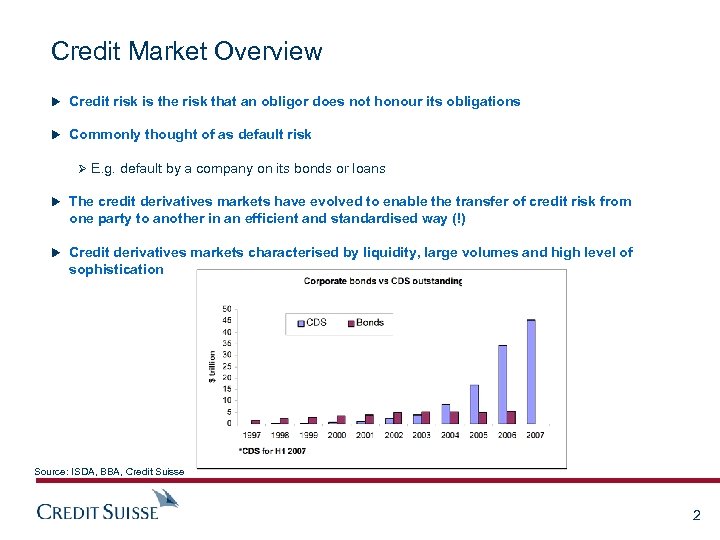 Credit Market Overview u Credit risk is the risk that an obligor does not honour its obligations u Commonly thought of as default risk Ø E. g. default by a company on its bonds or loans u The credit derivatives markets have evolved to enable the transfer of credit risk from one party to another in an efficient and standardised way (!) u Credit derivatives markets characterised by liquidity, large volumes and high level of sophistication Source: ISDA, BBA, Credit Suisse 2
 Credit Modelling Challenges u Credit events are Ø Rare Ø Usually unexpected Ø Involve significant losses, the size of which are unknown u Factors that must be taken into account are Ø Default risk – both the number and the timing of defaults Ø Spread risk Ø Correlation/dependency structure Ø Recovery risk 3
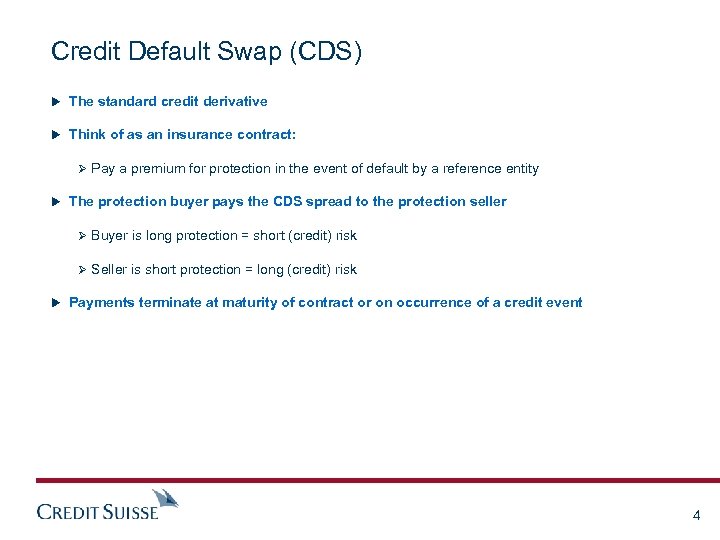 Credit Default Swap (CDS) u The standard credit derivative u Think of as an insurance contract: Ø Pay a premium for protection in the event of default by a reference entity u The protection buyer pays the CDS spread to the protection seller Ø Buyer is long protection = short (credit) risk Ø Seller is short protection = long (credit) risk u Payments terminate at maturity of contract or on occurrence of a credit event 4
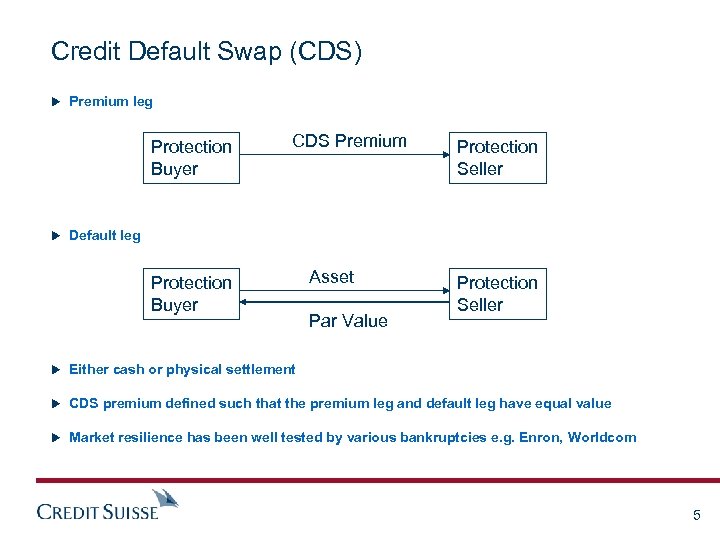 Credit Default Swap (CDS) u Premium leg Protection Buyer CDS Premium Protection Seller u Default leg Protection Buyer Asset Par Value Protection Seller u Either cash or physical settlement u CDS premium defined such that the premium leg and default leg have equal value u Market resilience has been well tested by various bankruptcies e. g. Enron, Worldcom 5
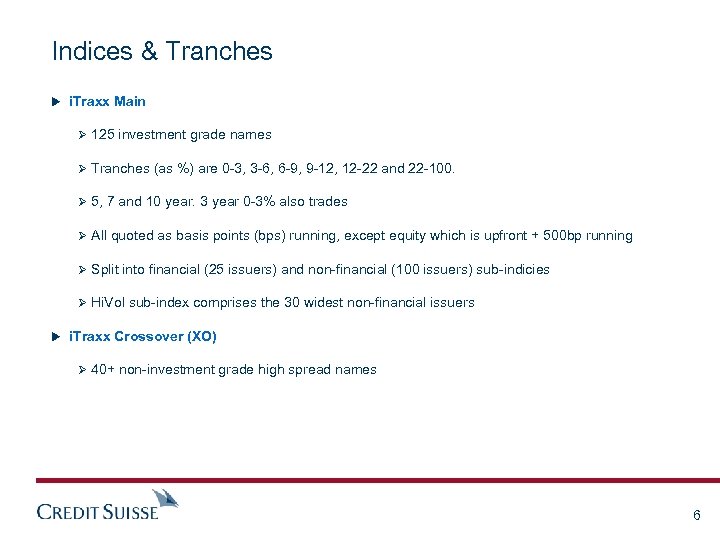 Indices & Tranches u i. Traxx Main Ø 125 investment grade names Ø Tranches (as %) are 0 -3, 3 -6, 6 -9, 9 -12, 12 -22 and 22 -100. Ø 5, 7 and 10 year. 3 year 0 -3% also trades Ø All quoted as basis points (bps) running, except equity which is upfront + 500 bp running Ø Split into financial (25 issuers) and non-financial (100 issuers) sub-indicies Ø Hi. Vol sub-index comprises the 30 widest non-financial issuers u i. Traxx Crossover (XO) Ø 40+ non-investment grade high spread names 6
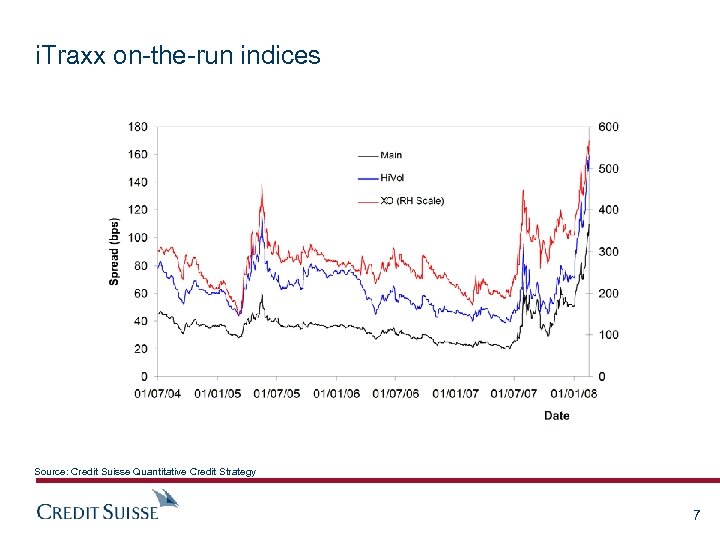 i. Traxx on-the-run indices Source: Credit Suisse Quantitative Credit Strategy 7
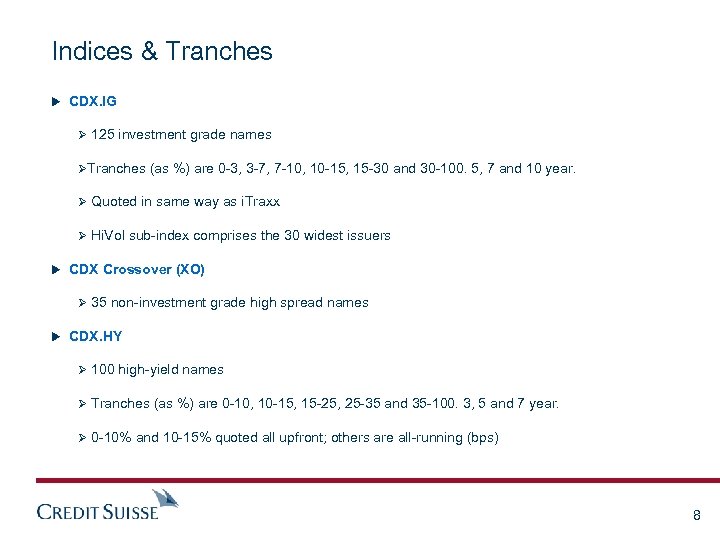 Indices & Tranches u CDX. IG Ø 125 investment grade names ØTranches (as %) are 0 -3, 3 -7, 7 -10, 10 -15, 15 -30 and 30 -100. 5, 7 and 10 year. Ø Quoted in same way as i. Traxx Ø Hi. Vol sub-index comprises the 30 widest issuers u CDX Crossover (XO) Ø 35 non-investment grade high spread names u CDX. HY Ø 100 high-yield names Ø Tranches (as %) are 0 -10, 10 -15, 15 -25, 25 -35 and 35 -100. 3, 5 and 7 year. Ø 0 -10% and 10 -15% quoted all upfront; others are all-running (bps) 8
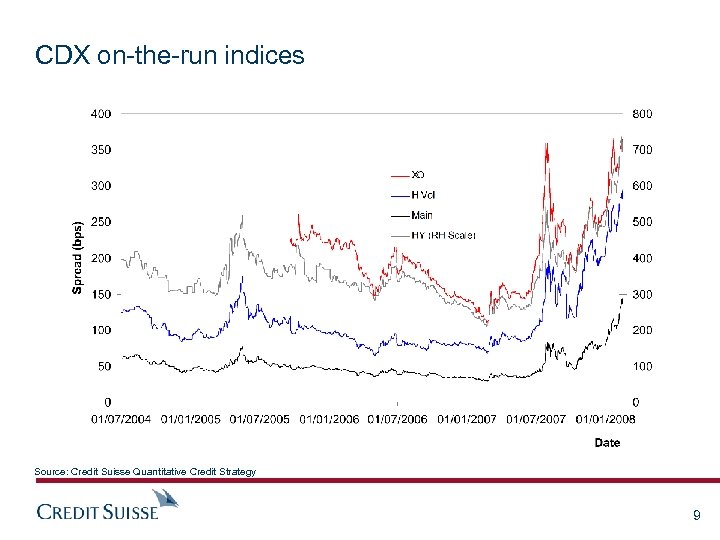 CDX on-the-run indices Source: Credit Suisse Quantitative Credit Strategy 9
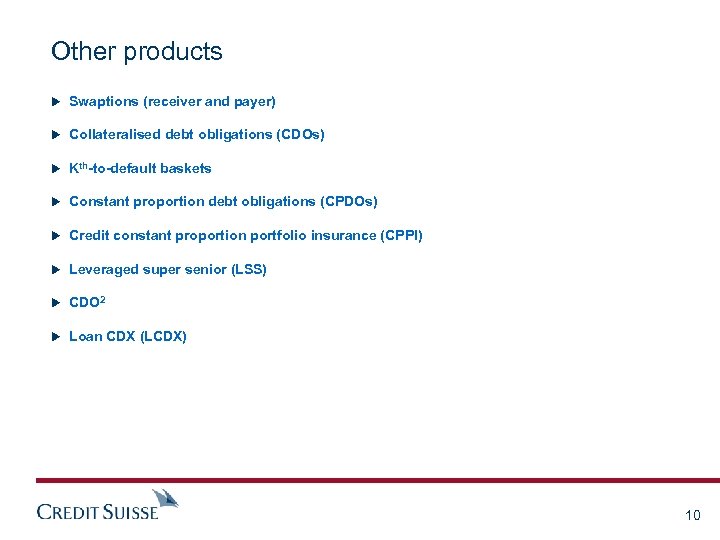 Other products u Swaptions (receiver and payer) u Collateralised debt obligations (CDOs) u Kth-to-default baskets u Constant proportion debt obligations (CPDOs) u Credit constant proportion portfolio insurance (CPPI) u Leveraged super senior (LSS) u CDO 2 u Loan CDX (LCDX) 10
 Single Name Market
 Single Name Models Aim: to model the value of a corporate bond or a CDS on one underlying entity u Huge academic literature u Structural or firm value type models Ø Merton, Black & Cox, Longstaff & Schwartz, Leland & Toft, Hull & White, Zhou, … Ø Area of my academic research u Intensity or hazard rate models Ø Jarrow & Turnbull, Duffie & Singleton, Lando, … Ø Standard in the market for converting credit default swap spreads to survival probabilities 12
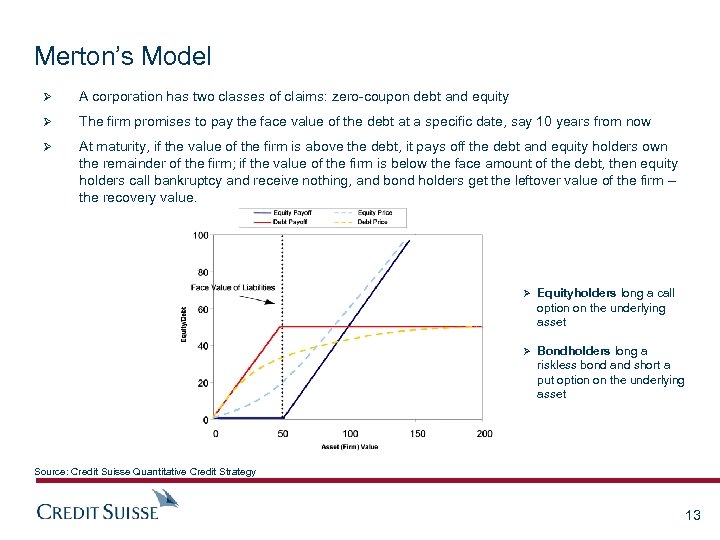 Merton’s Model Ø A corporation has two classes of claims: zero-coupon debt and equity Ø The firm promises to pay the face value of the debt at a specific date, say 10 years from now Ø At maturity, if the value of the firm is above the debt, it pays off the debt and equity holders own the remainder of the firm; if the value of the firm is below the face amount of the debt, then equity holders call bankruptcy and receive nothing, and bond holders get the leftover value of the firm – the recovery value. Ø Equityholders long a call option on the underlying asset Ø Bondholders long a riskless bond and short a put option on the underlying asset Source: Credit Suisse Quantitative Credit Strategy 13
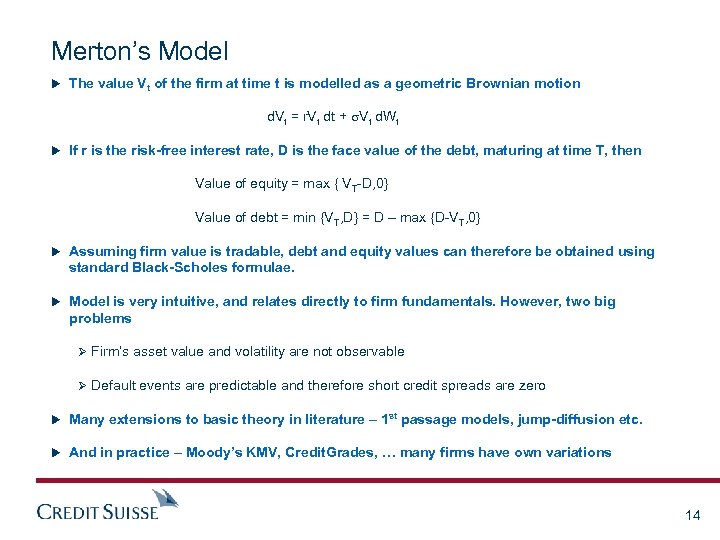 Merton’s Model u The value Vt of the firm at time t is modelled as a geometric Brownian motion d. Vt = r. Vt dt + Vt d. Wt u If r is the risk-free interest rate, D is the face value of the debt, maturing at time T, then Value of equity = max { VT-D, 0} Value of debt = min {VT, D} = D – max {D-VT, 0} u Assuming firm value is tradable, debt and equity values can therefore be obtained using standard Black-Scholes formulae. u Model is very intuitive, and relates directly to firm fundamentals. However, two big problems Ø Firm’s asset value and volatility are not observable Ø Default events are predictable and therefore short credit spreads are zero u Many extensions to basic theory in literature – 1 st passage models, jump-diffusion etc. u And in practice – Moody’s KMV, Credit. Grades, … many firms have own variations 14
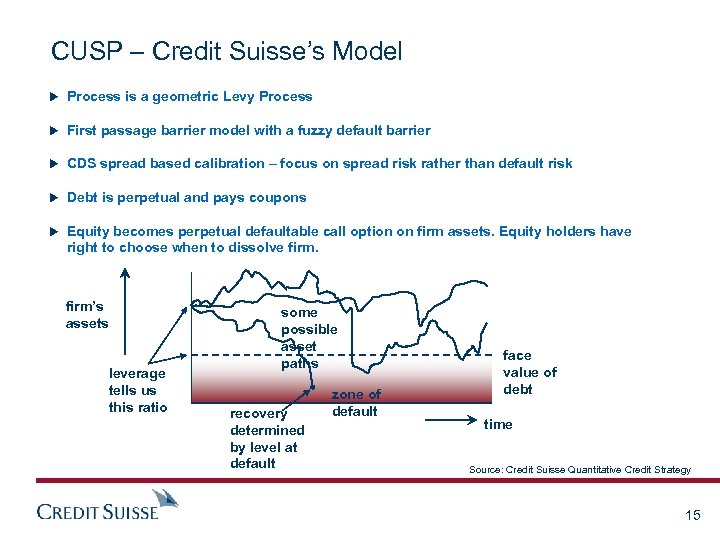 CUSP – Credit Suisse’s Model u Process is a geometric Levy Process u First passage barrier model with a fuzzy default barrier u CDS spread based calibration – focus on spread risk rather than default risk u Debt is perpetual and pays coupons u Equity becomes perpetual defaultable call option on firm assets. Equity holders have right to choose when to dissolve firm’s assets leverage tells us this ratio some possible asset paths recovery determined by level at default zone of default face value of debt time Source: Credit Suisse Quantitative Credit Strategy 15
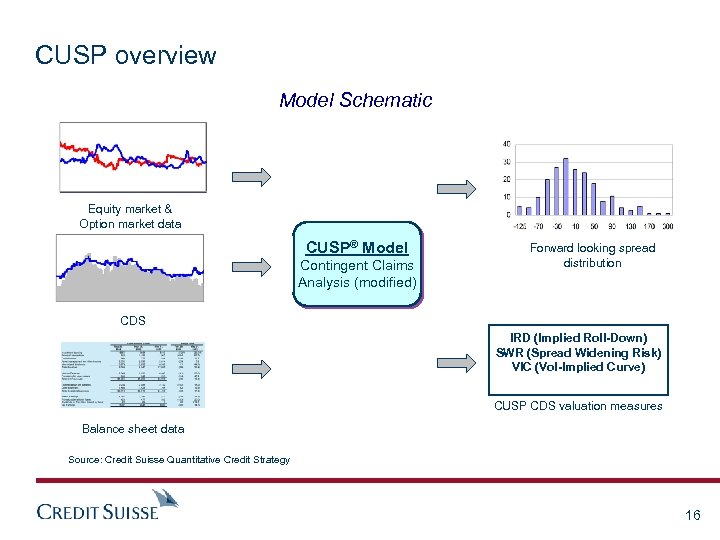 CUSP overview Model Schematic Equity market & Option market data CUSP® Model Contingent Claims Analysis (modified) Forward looking spread distribution CDS IRD (Implied Roll-Down) SWR (Spread Widening Risk) VIC (Vol-Implied Curve) CUSP CDS valuation measures Balance sheet data Source: Credit Suisse Quantitative Credit Strategy 16
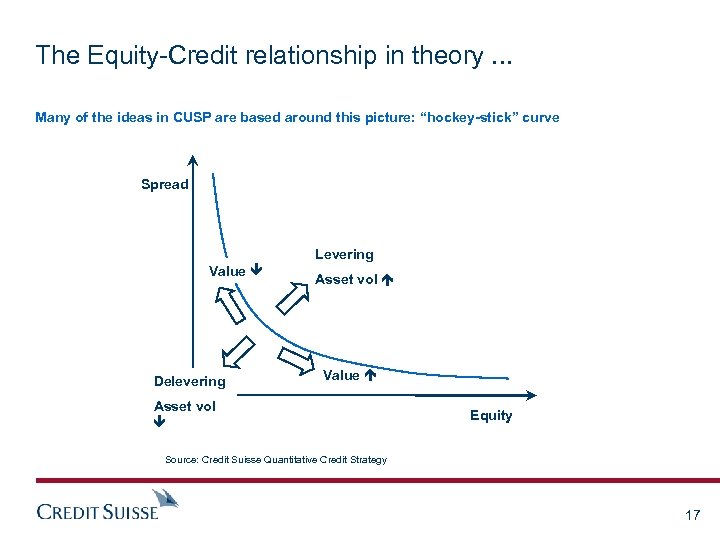 The Equity-Credit relationship in theory. . . Many of the ideas in CUSP are based around this picture: “hockey-stick” curve Spread Levering Value Delevering Asset vol Value Asset vol Equity Source: Credit Suisse Quantitative Credit Strategy 17
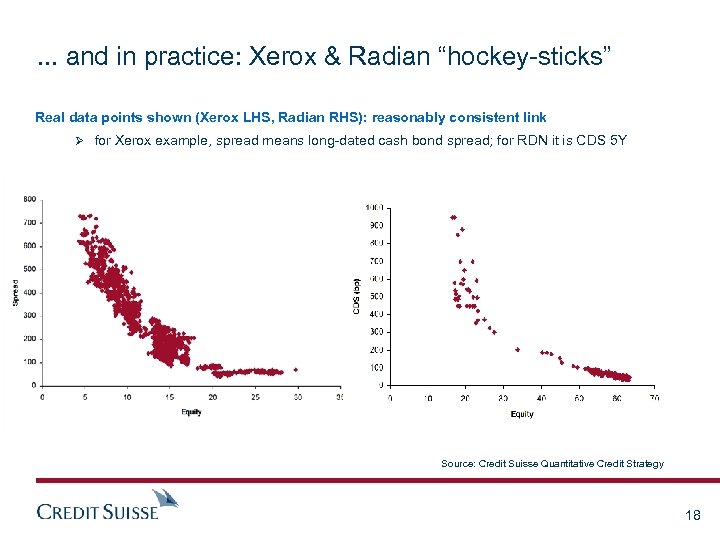 . . . and in practice: Xerox & Radian “hockey-sticks” Real data points shown (Xerox LHS, Radian RHS): reasonably consistent link Ø for Xerox example, spread means long-dated cash bond spread; for RDN it is CDS 5 Y Source: Credit Suisse Quantitative Credit Strategy 18
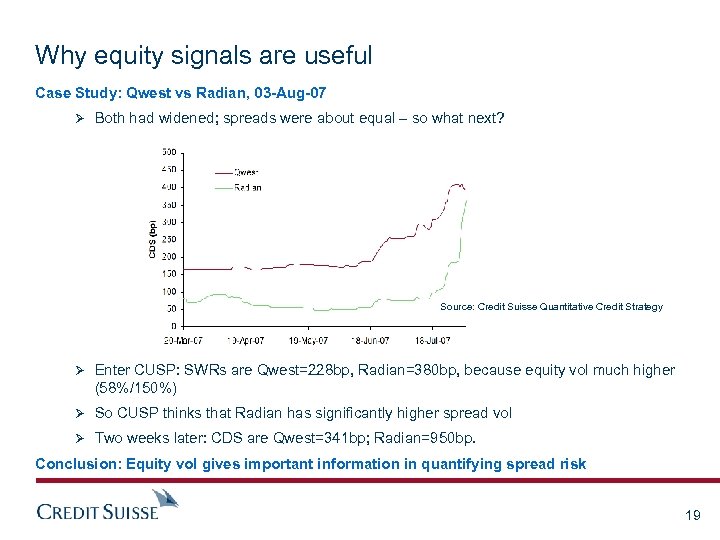 Why equity signals are useful Case Study: Qwest vs Radian, 03 -Aug-07 Ø Both had widened; spreads were about equal – so what next? Source: Credit Suisse Quantitative Credit Strategy Ø Enter CUSP: SWRs are Qwest=228 bp, Radian=380 bp, because equity vol much higher (58%/150%) Ø So CUSP thinks that Radian has significantly higher spread vol Ø Two weeks later: CDS are Qwest=341 bp; Radian=950 bp. Conclusion: Equity vol gives important information in quantifying spread risk 19
 Merging the equity vol and CDS viewpoints ATM equity vol gives information about moderate spread movements Ø however, there is little depth in out-of-the-money puts Ø hence little useful information about very large spread moves (or default) CDS gives information about very large spread movements Ø however, can’t say anything about spread vol from just looking at today’s CDS curve Therefore, need to combine the two so that both views are accommodated 20
 Applications: Portfolio Management u Almost all participants in the financial markets need to manage their credit exposures in a portfolio context, whether banks, corporations, investors, … u Need to be able to model single name exposures and their inter-relationship u Hold to maturity view Ø Number and timing of defaults u Mark-to-market (MTM) view Ø Risk due to any variation in value or spread Ø Regardless of default or rating transition 21
 MTM Risk Measures u DV 01 = Change in present value due to 1 bp parallel shift in curve Ø Does not distinguish volatile from less volatile credits Ø Does not account for curve risk u IDR = Instantaneous Default Risk Ø No differentiation between high and low quality credits u Va. R = Value at Risk Ø Commonly calculated using historical volatilites 22
 What MTM is really about Need some way of capturing: Ø spread volatility, including big moves (default is special case) Ø duration, i. e. , different maturities handled correctly Ø curve risk Ø spread risk should be inferred from market instruments rather than historical data Ø correlation between spreads Ø ability to use index instruments such as CDS indices for hedging 23
 Which is where the structural approach comes in The structural model allows many of these effects to be captured u Spread risk Ø volatility of the firm value causes spreads to be volatile u Jump/Default risk Ø to fit the CDS curve the model needs jumps, so these are implicitly captured u Use of market instruments Ø spread vol is inferred from equity volatility; jump risk from current CDS curve u Curve risk Ø the structural model does not predict that curves should move parallel Ø + convexity of the instruments is captured, so DV 01 neutrality doesn’t imply no risk 24
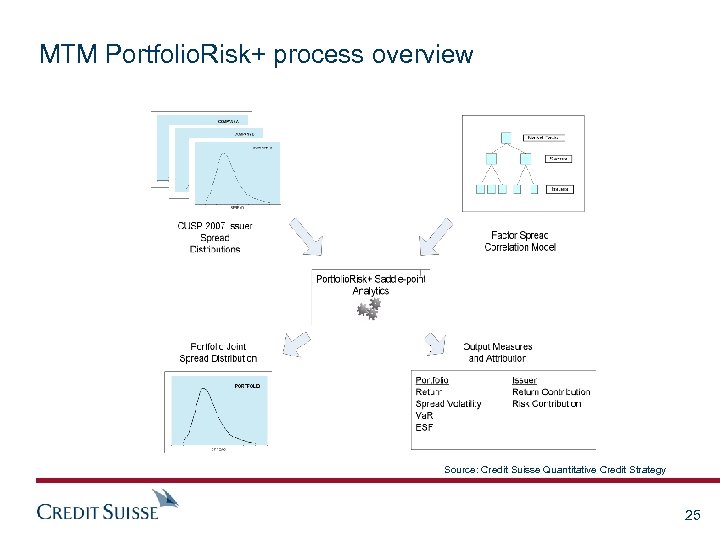 MTM Portfolio. Risk+ process overview Source: Credit Suisse Quantitative Credit Strategy 25
 Tranche Trading
 Ways of looking at trades Hold to maturity Ø Impact of numbers of defaults and their timing Mark to market Ø Deltas with respect to underlying index Ø Convexities, including index-gamma Ø Dispersion risk, i. e. effect of some credits blowing out and others tightening Ø Rolldown, i. e. what the P&L is assuming all constituent CDS curves remain fixed Ø Sensitivity to “implied correlation” i. e. which tranches may move more than their delta would suggest Ø Suppy-and-demand &/or technical effects, usually from the structured credit primary side Protection that will get bought even though it seems overpriced § Protection that will get sold even though it is already too tight § 27
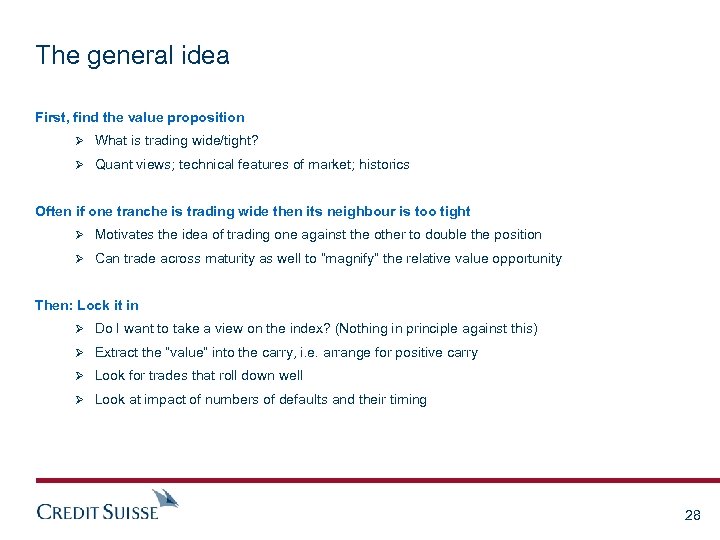 The general idea First, find the value proposition Ø What is trading wide/tight? Ø Quant views; technical features of market; historics Often if one tranche is trading wide then its neighbour is too tight Ø Motivates the idea of trading one against the other to double the position Ø Can trade across maturity as well to “magnify” the relative value opportunity Then: Lock it in Ø Do I want to take a view on the index? (Nothing in principle against this) Ø Extract the “value” into the carry, i. e. arrange for positive carry Ø Look for trades that roll down well Ø Look at impact of numbers of defaults and their timing 28
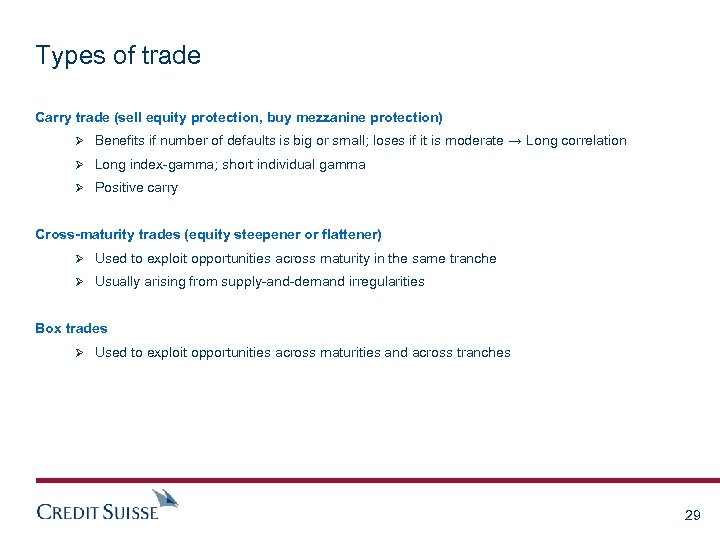 Types of trade Carry trade (sell equity protection, buy mezzanine protection) Ø Benefits if number of defaults is big or small; loses if it is moderate → Long correlation Ø Long index-gamma; short individual gamma Ø Positive carry Cross-maturity trades (equity steepener or flattener) Ø Used to exploit opportunities across maturity in the same tranche Ø Usually arising from supply-and-demand irregularities Box trades Ø Used to exploit opportunities across maturities and across tranches 29
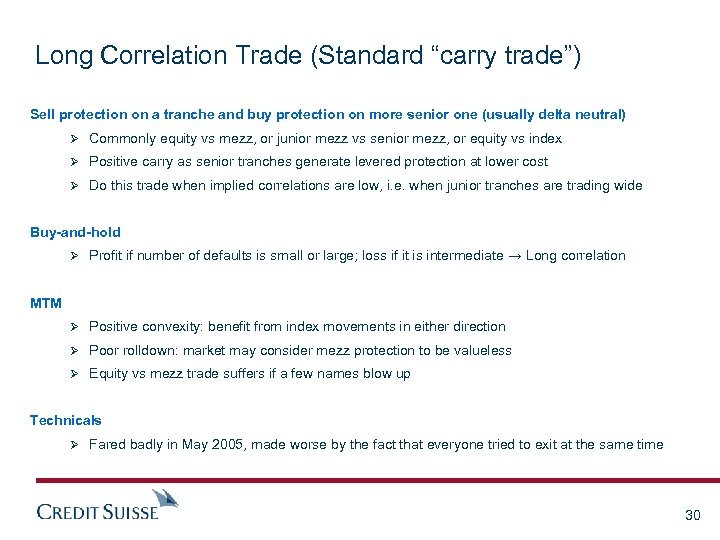 Long Correlation Trade (Standard “carry trade”) Sell protection on a tranche and buy protection on more senior one (usually delta neutral) Ø Commonly equity vs mezz, or junior mezz vs senior mezz, or equity vs index Ø Positive carry as senior tranches generate levered protection at lower cost Ø Do this trade when implied correlations are low, i. e. when junior tranches are trading wide Buy-and-hold Ø Profit if number of defaults is small or large; loss if it is intermediate → Long correlation MTM Ø Positive convexity: benefit from index movements in either direction Ø Poor rolldown: market may consider mezz protection to be valueless Ø Equity vs mezz trade suffers if a few names blow up Technicals Ø Fared badly in May 2005, made worse by the fact that everyone tried to exit at the same time 30
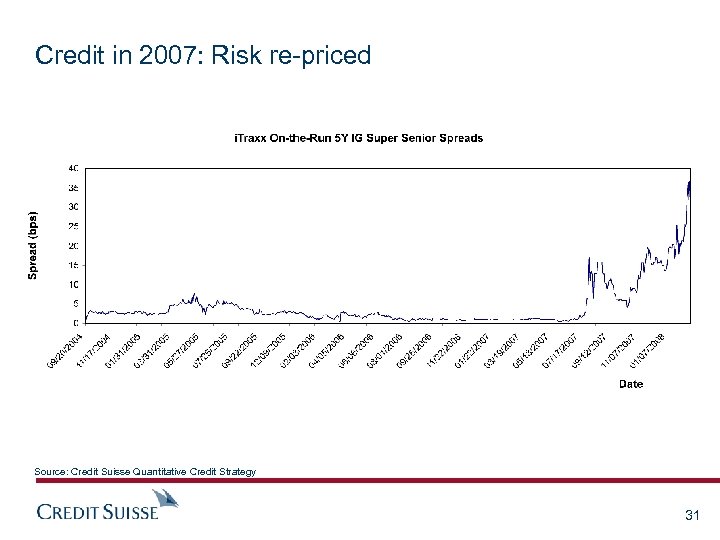 Credit in 2007: Risk re-priced Source: Credit Suisse Quantitative Credit Strategy 31
 Disclosure Appendix Analyst Certification I, Helen Haworth, certify that (1) the views expressed in this report accurately reflect my personal views about all of the subject companies and securities and (2) no part of my compensation was, is or will be directly or indirectly related to the specific recommendations or views expressed in this report. Important Disclosures Credit Suisse's policy is only to publish investment research that is impartial, independent, clear, fair and not misleading. For more detail, please refer to Credit Suisse's Policies for Managing Conflicts of Interest in connection with Investment Research: http: //www. csfb. com/research-and- analytics/disclaimer/managing_conflicts_disclaimer. html Credit Suisse’s policy is to publish research reports as it deems appropriate, based on developments with the subject issuer, the sector or the market that may have a material impact on the research views or opinions stated herein. The analyst(s) involved in the preparation of this research report received compensation that is based upon various factors, including Credit Suisse's total revenues, a portion of which are generated by Credit Suisse's Investment Banking and Fixed Income Divisions. Credit Suisse may trade as principal in the securities or derivatives of the issuers that are the subject of this report. At any point in time, Credit Suisse is likely to have significant holdings in the securities mentioned in this report. As at the date of this report, Credit Suisse acts as a market maker or liquidity provider in the debt securities of the subject issuer(s) mentioned in this report. For important disclosure information on securities recommended in this report, please visit the website at https: //firesearchdisclosure. credit-suisse. com or call +1 -212 -538 -7625. For the history of any relative value trade ideas suggested by the Fixed Income research department as well as fundamental recommendations provided by the Emerging Markets Sovereign Strategy Group over the previous 12 months, please view the document at http: //research-and- analytics. csfb. com /docpopup. asp? docid =35321113&type=pdf. Credit Suisse clients with access to the Locus website may refer to http: //www. credit-suisse. com/locus. For the history of recommendations provided by Technical Analysis, please visit the website at http: //www. credit-suisse. com/techanalysis. Credit Suisse does not provide any tax advice. Any statement herein regarding any US federal tax is not intended or written to be used, and cannot be used, by any taxpayer for the purposes of avoiding any penalties. Emerging Markets Bond Recommendation Definitions Buy: Indicates a recommended buy on our expectation that the issue will deliver a return higher than the risk-free rate. Sell: Indicates a recommended sell on our expectation that the issue will deliver a return lower than the risk-free rate. Corporate Bond Fundamental Recommendation Definitions Buy: Indicates a recommended buy on our expectation that the issue will be a top performer in its sector. Outperform: Indicates an above-average total return performer within its sector. Bonds in this category have stable or improving credit profiles and are undervalued, or they may be weaker credits that, we believe, are cheap relative to the sector and are expected to outperform on a total-return basis. These bonds may possess price risk in a volatile environment. Market Perform: Indicates a bond that is expected to return average performance in its sector. Underperform: Indicates a below-average total-return performer within its sector. Bonds in this category have weak or worsening credit trends, or they may be stable credits that, we believe, are overvalued or rich relative to the sector. Sell: Indicates a recommended sell on the expectation that the issue will be among the poor performers in its sector. Restricted: In certain circumstances, Credit Suisse policy and/or applicable law and regulations preclude certain types of communications, including an investment recommendation, during the course of Credit Suisse's engagement in an investment banking transaction and in certain other circumstances. Not Rated: Credit Suisse Global Credit Research or Global Leveraged Finance Research covers the issuer but currently does not offer an investment view on the subject issue. Not Covered: Neither Credit Suisse Global Credit Research nor Global Leveraged Finance Research covers the issuer or offers an investment view on the issuer or any securities related to it. Any communication from Research on securities or companies that Credit Suisse does not cover is a reasonable, non-material deduction based on an analysis of publicly available information. Corporate Bond Risk Category Definitions In addition to the recommendation, each issue may have a risk category indicating that it is an appropriate holding for an "average" high yield investor, designated as Market, or that it has a higher or lower risk profile, designated as Speculative and Conservative, respectively. Credit Suisse Credit Rating Definitions Credit Suisse may assign rating opinions to investment-grade and crossover issuers. Ratings are based on our assessment of a company's creditworthiness and are not recommendations to buy or sell a security. The ratings scale (AAA, A, BBB, B) is dependent on our assessment of an issuer's ability to meet its financial commitments in a timely manner. Within each category, creditworthiness is further detailed with a scale of High, Mid, or Low – with High being the strongest sub-category rating: High AAA, Mid AAA, Low AAA – obligor's capacity to meet its financial commitments is extremely strong; High AA, Mid AA, Low AA – obligor's capacity to meet its financial commitments is very strong; High A, Mid A, Low A – obligor's capacity to meet its financial commitments is strong; High BBB, Mid BBB, Low BBB – obligor's capacity to meet its financial commitments is adequate, but adverse economic/operating/financial circumstances are more likely to lead to a weakened capacity to meet its obligations; High BB, Mid BB, Low BB – obligations have speculative characteristics and are subject to substantial credit risk; High B, Mid B, Low B – obligor's capacity to meet its financial commitments is very weak and highly vulnerable to adverse economic, operating, and financial circumstances; obligor's capacity to meet its financial commitments is extremely weak and is dependent on favorable economic, operating, and financial circumstances. Credit Suisse's rating opinions do not necessarily correlate with those of the rating agencies. High CCC, Mid CCC, Low CCC –
 Disclosure Appendix cont’d CUSP and Portfolio Risk and Analysis Terms and Conditions References in this report to Credit Suisse include all of the subsidiaries and affiliates of Credit Suisse, the Swiss bank, operating under its investment banking division. For more information on our structure, please use the following link:
 Disclosure Appendix cont’d References in this report to Credit Suisse include all of the subsidiaries and affiliates of Credit Suisse operating under its investment banking division. For more information on our structure, please use the following link: http: //www. creditsuisse. com/en/who_we_are/ourstructure. html. This report is not directed to, or intended for distribution to or use by, any person or entity who is a citizen or resident of or located in any locality, state, country or other jurisdiction where such distribution, publication, availability or use would be contrary to law or regulation or which would subject Credit Suisse or its affiliates (“CS”) to any registration or licensing requirement within such jurisdiction. All material presented in this report, unless specifically indicated otherwise, is under copyright to CS. None of the material, nor its content, nor any copy of it, may be altered in any way, transmitted to, copied or distributed to any other party, without the prior express written permission of CS. All trademarks, service marks and logos used in this report are trademarks or service marks or registered trademarks or service marks of CS or its affiliates. The information, tools and material presented in this report are provided to you for information purposes only and are not to be used or considered as an offer or the solicitation of an offer to sell or to buy or subscribe for securities or other financial instruments. CS may not have taken any steps to ensure that the securities referred to in this report are suitable for any particular investor. CS will not treat recipients of this report as its customers by virtue of their receiving this report. The investments and services contained or referred to in this report may not be suitable for you and it is recommended that you consult an independent investment advisor if you are in doubt about such investments or investment services. Nothing in this report constitutes investment, legal, accounting or tax advice, or a representation that any investment or strategy is suitable or appropriate to your individual circumstances, or otherwise constitutes a personal recommendation to you. CS does not advise on the tax consequences of investments and you are advised to contact an independent tax adviser. Please note in particular that the bases and levels of taxation may change. Information and opinions presented in this report have been obtained or derived from sources believed by CS to be reliable, but CS makes no representation as to their accuracy or completeness. CS accepts no liability for loss arising from the use of the material presented in this report, except that this exclusion of liability does not apply to the extent that such liability arises under specific statutes or regulations applicable to CS. This report is not to be relied upon in substitution for the exercise of independent judgment. CS may have issued, and may in the future issue, other reports that are inconsistent with, and reach different conclusions from, the information presented in this report. Those reports reflect the different assumptions, views and analytical methods of the analysts who prepared them and CS is under no obligation to ensure that such other reports are brought to the attention of any recipient of this report. CS may, to the extent permitted by law, participate or invest in financing transactions with the issuer(s) of the securities referred to in this report, perform services for or solicit business from such issuers, and/or have a position or holding, or other material interest, or effect transactions, in such securities or options thereon, or other investments related thereto. In addition, it may make markets in the securities mentioned in the material presented in this report. CS may have, within the last three years, served as manager or co-manager of a public offering of securities for, or currently make a primary market in issues of, any or all of the entities mentioned in this report or may be providing, or have provided within the previous 12 months, significant advice or investment services in relation to the investment concerned or a related investment. Additional information is, subject to duties of confidentiality, available on request. Some investments referred to in this report will be offered solely by a single entity and in the case of some investments solely by CS, or an associate of CS or CS may be the only market maker in such investments. Past performance should not be taken as an indication or guarantee of future performance, and no representation or warranty, express or implied, is made regarding future performance. Information, opinions and estimates contained in this report reflect a judgement at its original date of publication by CS and are subject to change without notice. The price, value of and income from any of the securities or financial instruments mentioned in this report can fall as well as rise. The value of securities and financial instruments is subject to exchange rate fluctuation that may have a positive or adverse effect on the price or income of such securities or financial instruments. Investors in securities such as ADR’s, the values of which are influenced by currency volatility, effectively assume this risk. Structured securities are complex instruments, typically involve a high degree of risk and are intended for sale only to sophisticated investors who are capable of understanding and assuming the risks involved. The market value of any structured security may be affected by changes in economic, financial and political factors (including, but not limited to, spot and forward interest and exchange rates), time to maturity, market conditions and volatility, and the credit quality of any issuer or reference issuer. Any investor interested in purchasing a structured product should conduct their own investigation and analysis of the product and consult with their own professional advisers as to the risks involved in making such a purchase. Some investments discussed in this report may have a high level of volatility. High volatility investments may experience sudden and large falls in their value causing losses when that investment is realised. Those losses may equal your original investment. Indeed, in the case of some investments the potential losses may exceed the amount of initial investment and, in such circumstances, you may be required to pay more money to support those losses. Income yields from investments may fluctuate and, in consequence, initial capital paid to make the investment may be used as part of that income yield. Some investments may not be readily realisable and it may be difficult to sell or realise those investments, similarly it may prove difficult for you to obtain reliable information about the value, or risks, to which such an investment is exposed. This report may provide the addresses of, or contain hyperlinks to, websites. Except to the extent to which the report refers to website material of CS, CS has not reviewed any such site and takes no responsibility for the content contained therein. Such address or hyperlink (including addresses or hyperlinks to CS’s own website material) is provided solely for your convenience and information and the content of any such website does not in any way form part of this document. Accessing such website or following such link through this report or CS’s website shall be at your own risk. This report is issued and distributed in Europe (except Switzerland) by Credit Suisse Securities (Europe) Limited, One Cabot Square, London E 14 4 QJ, England, which is regulated in the United Kingdom by The Financial Services Authority (“FSA”). This report is being distributed in Germany by Credit Suisse Securities (Europe) Limited Niederlassung Frankfurt am Main regulated by the Bundesanstalt fuer Finanzdienstleistungsaufsicht ("Ba. Fin"). This report is being distributed in the United States and Canada by Credit Suisse Securities (USA) LLC; in Switzerland by Credit Suisse; in Brazil by Banco de Investimentos Credit Suisse (Brasil) S. A; in Japan by Credit Suisse Securities (Japan) Limited; elsewhere in Asia/ Pacific by whichever of the following is the appropriately authorised entity in the relevant jurisdiction: Credit Suisse (Hong Kong) Limited, Credit Suisse Equities (Australia) Limited, Credit Suisse Securities (Thailand) Limited, Credit Suisse Securities (Malaysia) Sdn Bhd, Credit Suisse Singapore Branch, and elsewhere in the world by the relevant authorised affiliate of the above. Research on Taiwanese securities produced by Credit Suisse, Taipei Branch has been prepared by a registered Senior Business Person. Research provided to residents of Malaysia is authorised by the Head of Research for Credit Suisse Securities (Malaysia) Sdn Bhd, to whom they should direct any queries on +603 2723 2020. This research may not conform to Canadian disclosure requirements. In jurisdictions where CS is not already registered or licensed to trade in securities, transactions will only be effected in accordance with applicable securities legislation, which will vary from jurisdiction to jurisdiction and may require that the trade be made in accordance with applicable exemptions from registration or licensing requirements. Non-U. S. customers wishing to effect a transaction should contact a CS entity in their local jurisdiction unless governing law permits otherwise. U. S. customers wishing to effect a transaction should do so only by contacting a representative at Credit Suisse Securities (USA) LLC in the U. S. Please note that this research was originally prepared and issued by CS for distribution to their market professional and institutional investor customers. Recipients who are not market professional or institutional investor customers of CS should seek the advice of their independent financial advisor prior to taking any investment decision based on this report or for any necessary explanation of its contents. This research may relate to investments or services of a person outside of the UK or to other matters which are not regulated by the FSA or in respect of which the protections of the FSA for private customers and/or the UK compensation scheme may not be available, and further details as to where this may be the case are available upon request in respect of this report. Copyright © 2007 CREDIT SUISSE GROUP and/or its affiliates. All rights reserved. Investment principal on bonds can be eroded depending on sale price or market price. In addition, there are bonds on which investment principal can be eroded due to changes in redemption amounts. Care is required when investing in such instruments. When you purchase non-listed Japanese fixed income securities (Japanese government bonds, Japanese regional bonds, Japanese government guaranteed bonds, Japanese corporate bonds) from CS as a seller, you will be requested to pay purchase price only. CREDIT SUISSE SECURITIES (JAPAN) LIMITED A member of Japan Securities Dealers Association, The Financial Futures Association of Japan