


 Скачать презентацию The Management Infrastructure of a Network Measurement System
d58cf655ea2202d751be085cd49ea1af.ppt
- Количество слайдов: 19
 The Management Infrastructure of a Network Measurement System for Qo. S Parameters Alexandru Bikfalvi, Paul Pătraş, Mihai Cristian Vancea, Virgil Dobrotă Technical University of Cluj-Napoca Communications Department 26 -28 Baritiu Street, 400027 Cluj-Napoca, Romania, Tel/Fax: +40 -264 -597083
 Agenda • • • Scenario based on existing tools Overview of a network management system Design of the management infrastructure Experimental results Conclusions and future work
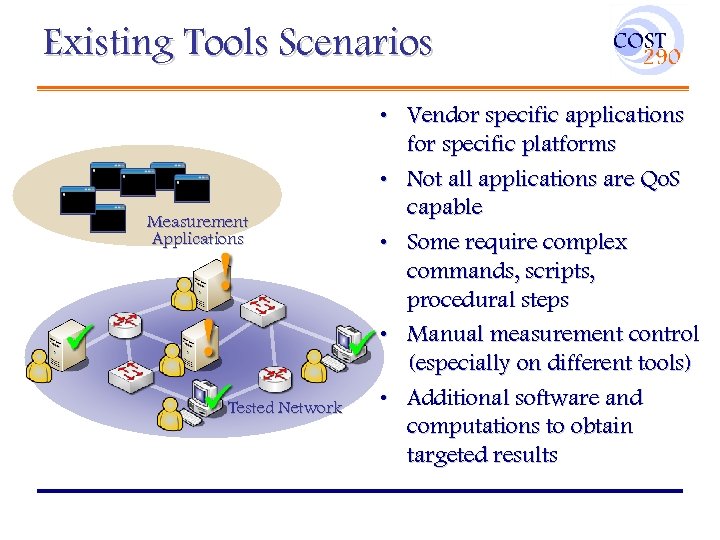 Existing Tools Scenarios Measurement Applications Tested Network • Vendor specific applications for specific platforms • Not all applications are Qo. S capable • Some require complex commands, scripts, procedural steps • Manual measurement control (especially on different tools) • Additional software and computations to obtain targeted results
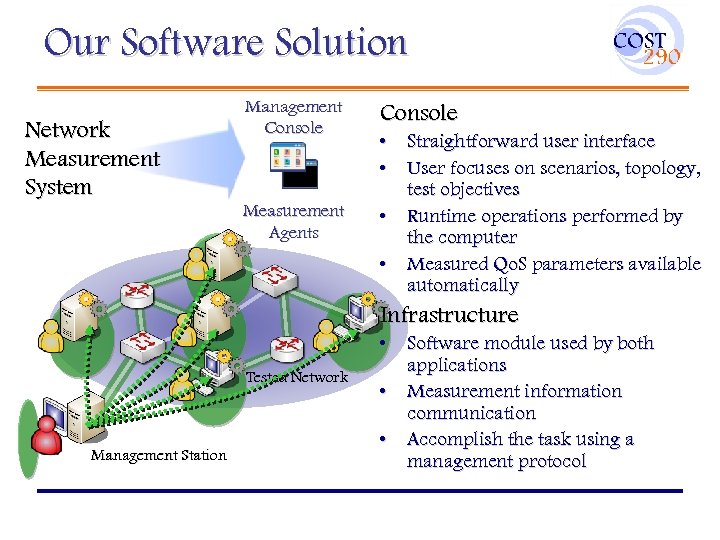 Our Software Solution Network Measurement System Management Console Measurement Agents Console • Straightforward user interface • User focuses on scenarios, topology, test objectives • Runtime operations performed by the computer • Measured Qo. S parameters available automatically Infrastructure Tested Network Management Station • Software module used by both applications • Measurement information communication • Accomplish the task using a management protocol
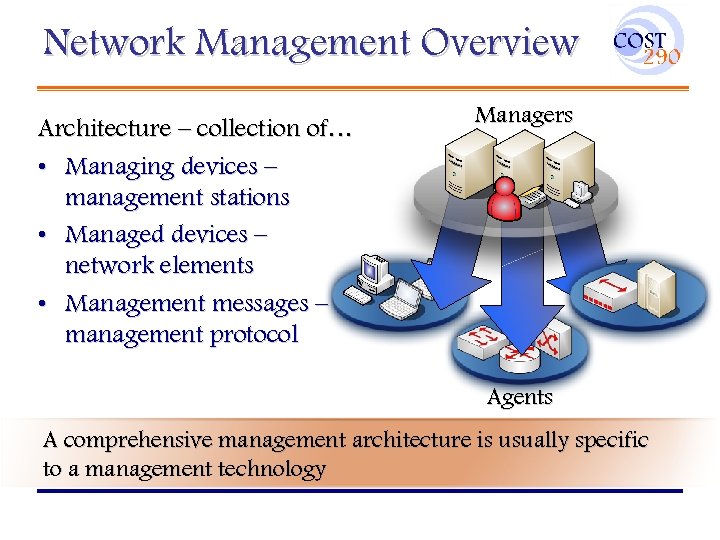 Network Management Overview Architecture – collection of… • Managing devices – management stations • Managed devices – network elements • Management messages – management protocol Managers Agents A comprehensive management architecture is usually specific to a management technology
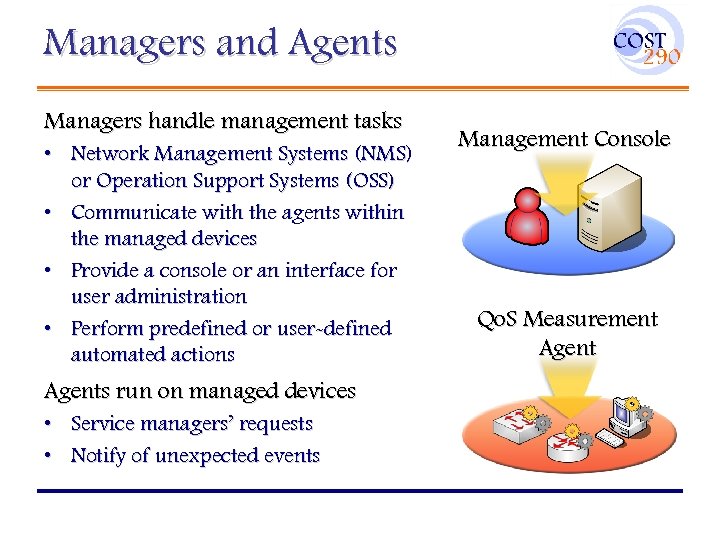 Managers and Agents Managers handle management tasks • Network Management Systems (NMS) or Operation Support Systems (OSS) • Communicate with the agents within the managed devices • Provide a console or an interface for user administration • Perform predefined or user-defined automated actions Agents run on managed devices • Service managers’ requests • Notify of unexpected events Management Console Qo. S Measurement Agent
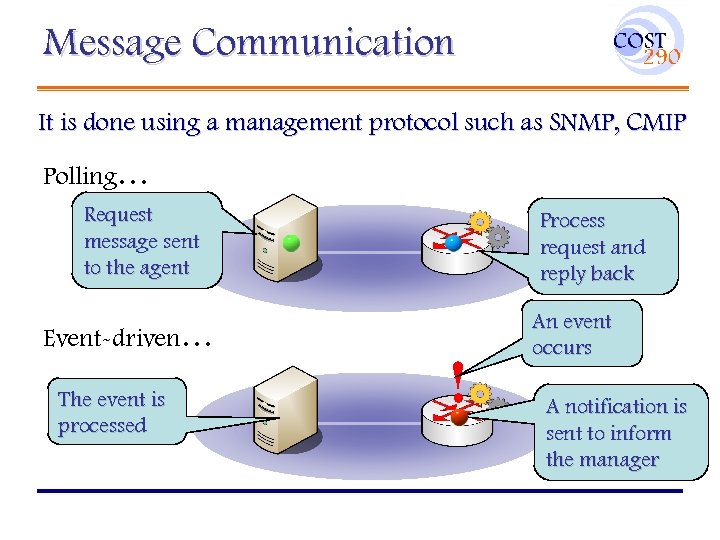 Message Communication It is done using a management protocol such as SNMP, CMIP Polling… Request message sent to the agent Event-driven… The event is processed Process request and reply back ! An event occurs A notification is sent to inform the manager
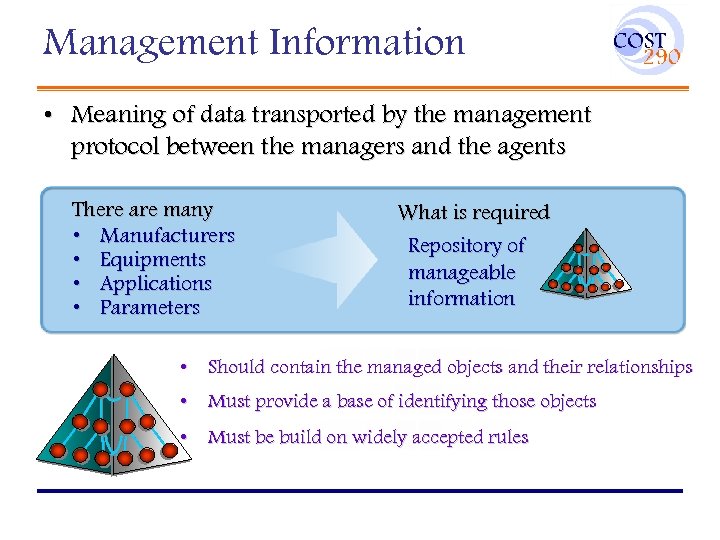 Management Information • Meaning of data transported by the management protocol between the managers and the agents There are many • Manufacturers • Equipments • Applications • Parameters What is required Repository of manageable information • Should contain the managed objects and their relationships • Must provide a base of identifying those objects • Must be build on widely accepted rules
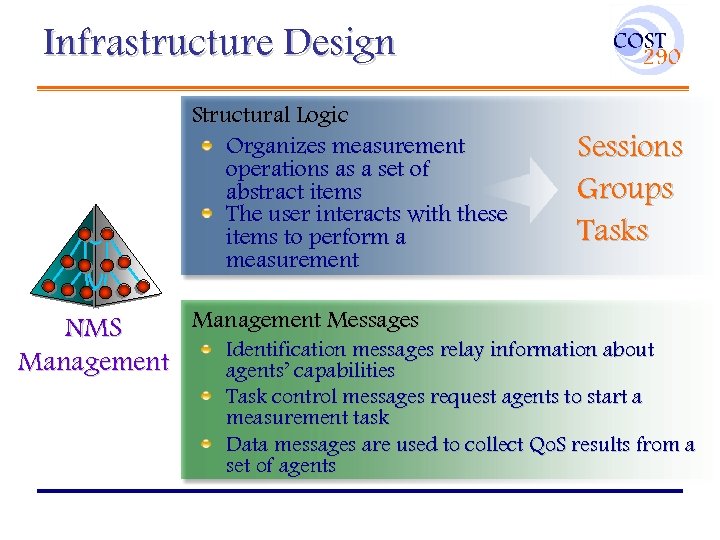 Infrastructure Design Structural Logic Organizes measurement operations as a set of abstract items The user interacts with these items to perform a measurement Sessions Groups Tasks Management Messages NMS Identification messages relay information about Management agents’ capabilities Task control messages request agents to start a measurement task Data messages are used to collect Qo. S results from a set of agents
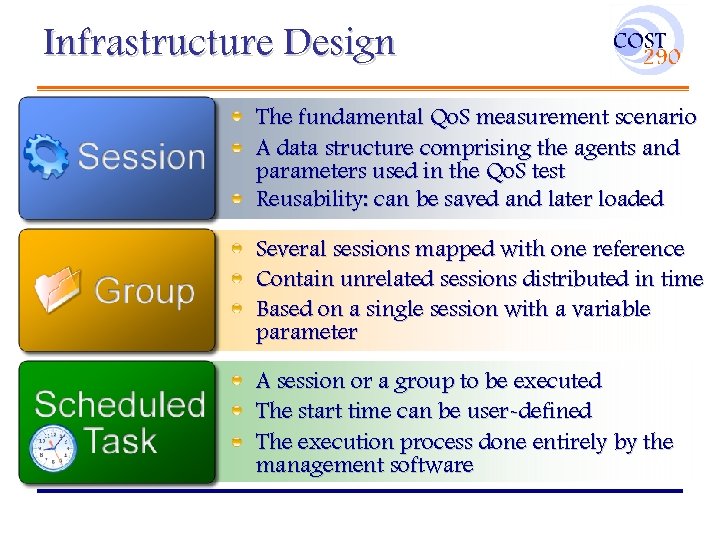 Infrastructure Design The fundamental Qo. S measurement scenario A data structure comprising the agents and parameters used in the Qo. S test Reusability: can be saved and later loaded Several sessions mapped with one reference Contain unrelated sessions distributed in time Based on a single session with a variable parameter A session or a group to be executed The start time can be user-defined The execution process done entirely by the management software
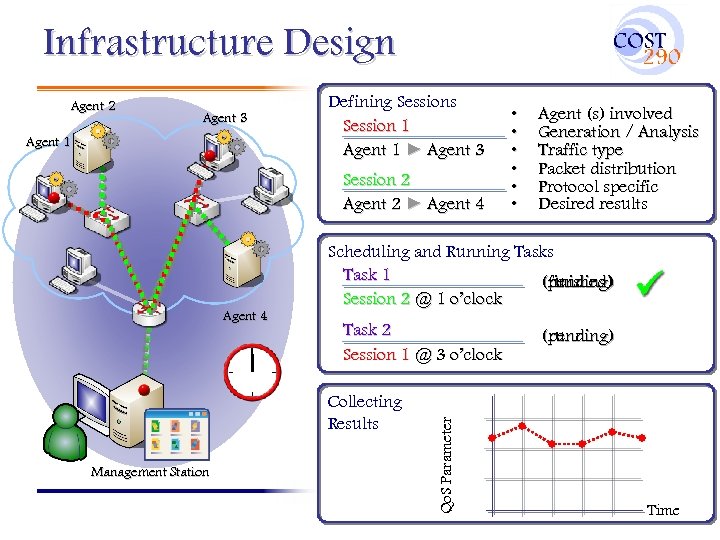 Infrastructure Design Agent 2 Agent 3 Agent 1 Defining Sessions Session 1 Agent 1 ► Agent 3 Session 2 Agent 2 ► Agent 4 Task 2 Session 1 @ 3 o’clock Collecting Results Management Station Agent (s) involved Generation / Analysis Traffic type Packet distribution Protocol specific Desired results Scheduling and Running Tasks Task 1 (finished) (running) (pending) Session 2 @ 1 o’clock Qo. S Parameter Agent 4 • • • (running) (pending) Time
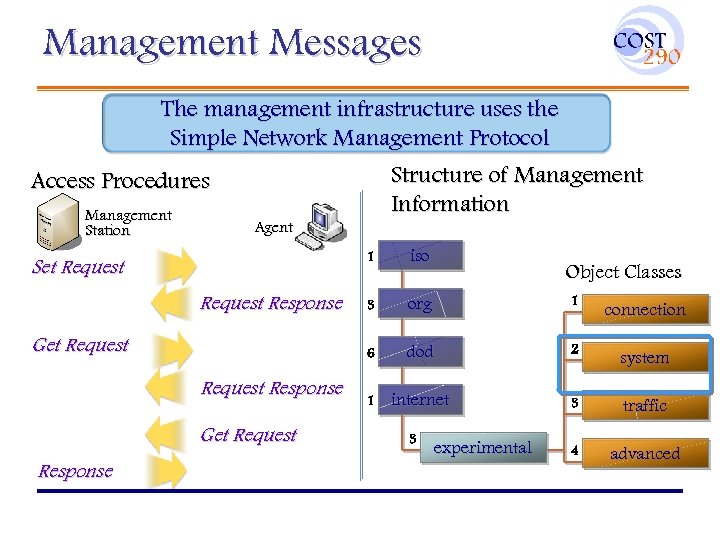 Management Messages The management infrastructure uses the Simple Network Management Protocol Structure of Management Information Access Procedures Management Station Agent 1 Request Response Get Request Response iso 3 org 1 connection 6 Set Request dod 2 system 1 internet 3 traffic 4 advanced 3 Object Classes experimental
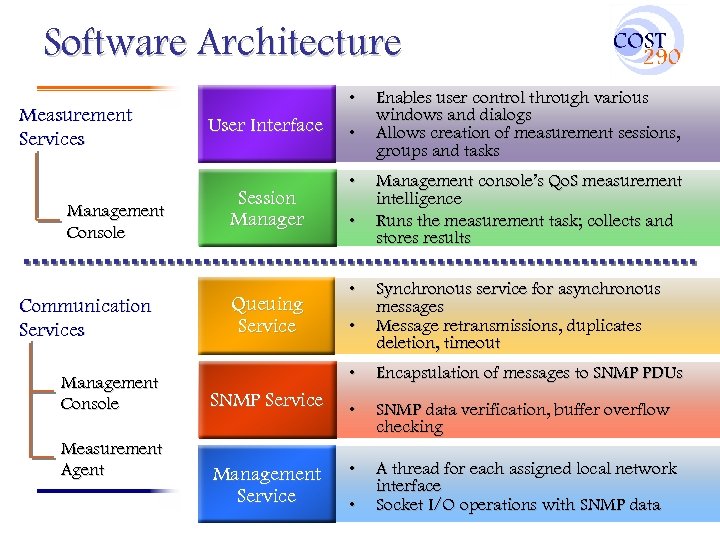 Software Architecture Measurement Services Management Console Communication Services Management Console Measurement Agent • User Interface Session Manager Queuing Service • • • Enables user control through various windows and dialogs Allows creation of measurement sessions, groups and tasks Management console’s Qo. S measurement intelligence Runs the measurement task; collects and stores results Synchronous service for asynchronous messages Message retransmissions, duplicates deletion, timeout • SNMP Service Management Service Encapsulation of messages to SNMP PDUs • SNMP data verification, buffer overflow checking • A thread for each assigned local network interface Socket I/O operations with SNMP data •
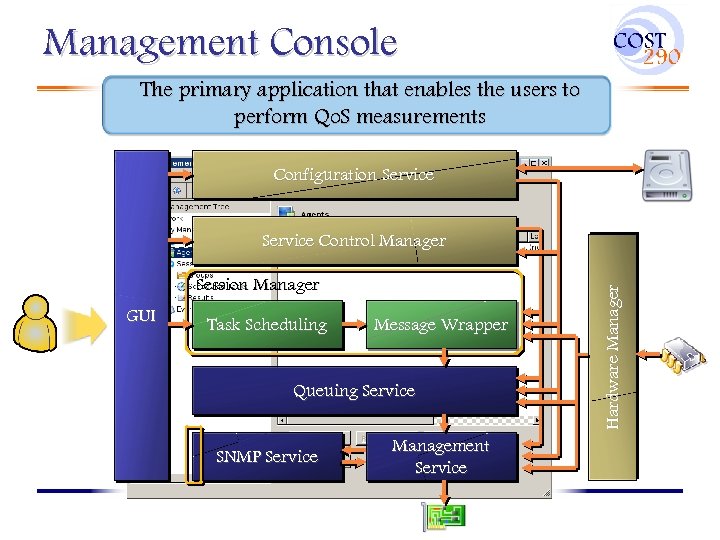 Management Console The primary application that enables the users to perform Qo. S measurements Configuration Service Session Manager GUI Task Scheduling Message Wrapper Queuing Service SNMP Service Management Service Hardware Manager Service Control Manager
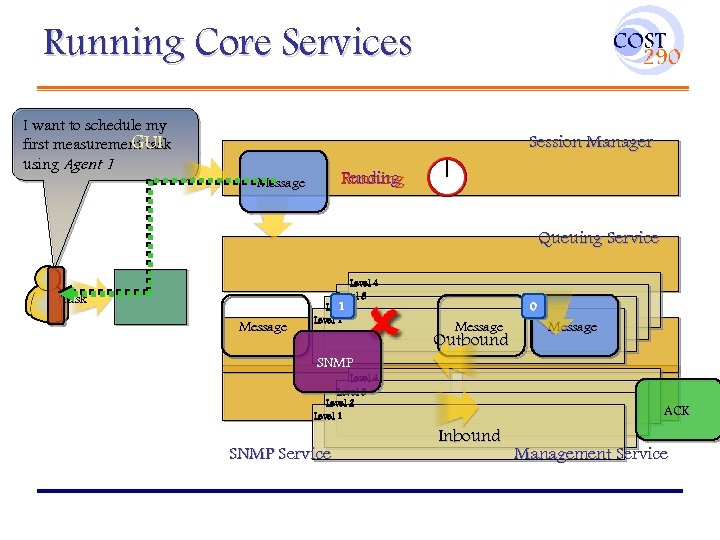 Running Core Services I want to schedule my GUI first measurement task using Agent 1 Session Manager Pending Running Message Queuing Service Task Message Level 4 Level 3 1 Level 2 Level 1 0 2 Message Outbound Message SNMP Level 4 Level 3 Level 2 Level 1 SNMP Service ACK Inbound Management Service
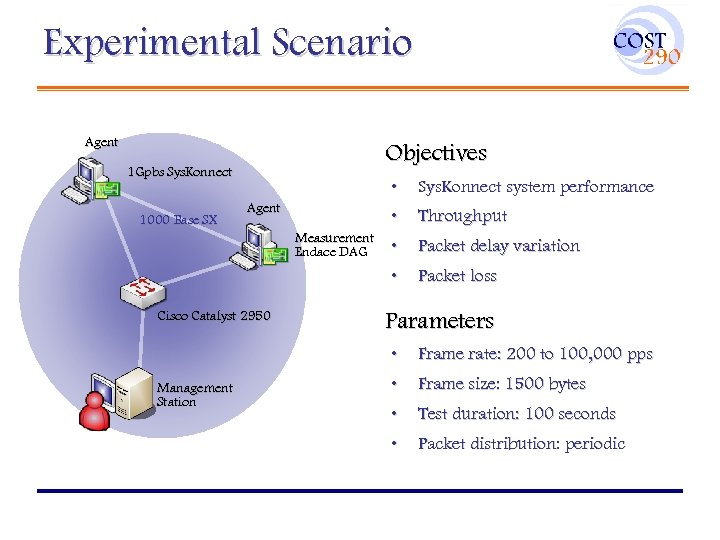 Experimental Scenario Agent Objectives 1 Gpbs Sys. Konnect • Agent Measurement Endace DAG Cisco Catalyst 2950 Sys. Konnect system performance Throughput • Packet delay variation • 1000 Base SX • Packet loss Parameters • Management Station Frame rate: 200 to 100, 000 pps • Frame size: 1500 bytes • Test duration: 100 seconds • Packet distribution: periodic
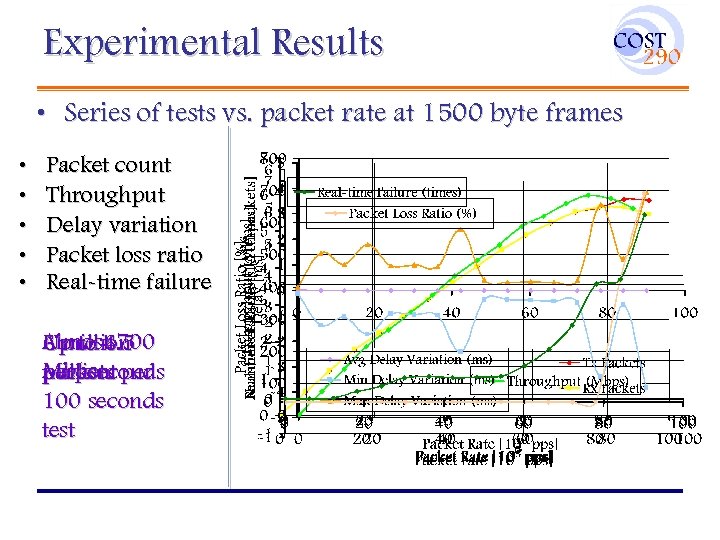 Experimental Results • Series of tests vs. packet rate at 1500 byte frames • • • Packet count Throughput Delay variation Packet loss ratio Real-time failure Almost 700 6 million Up to 4 6. 5 Mbps packets percent milliseconds 100 seconds test
 Conclusions and Future Work Advantages • • • Faster experiment setup and results processing No human attendance during testing required Extra features to make network testing easier to perform Future Work User focuses on experiment target rather on implementation • Extend support for other management protocols Greater availability of data after a test is completed • Improve communication control procedures between management console and agents • Include support for other networking technologies Drawbacks • Not portable on all existing platforms • Not optimized for local resources usage and all measurement procedures • Does not implement a fine-grained analysis to conserve management bandwidth
 Thank You