


 Скачать презентацию The Making of the Indian Market NCDEX
6758f3c69cbd01145b787ee71f9520a4.ppt
- Количество слайдов: 20
 The Making of the Indian Market : NCDEX Experience -R. Ramaseshan MD & CEO, NCDEX Ltd
 Background 2
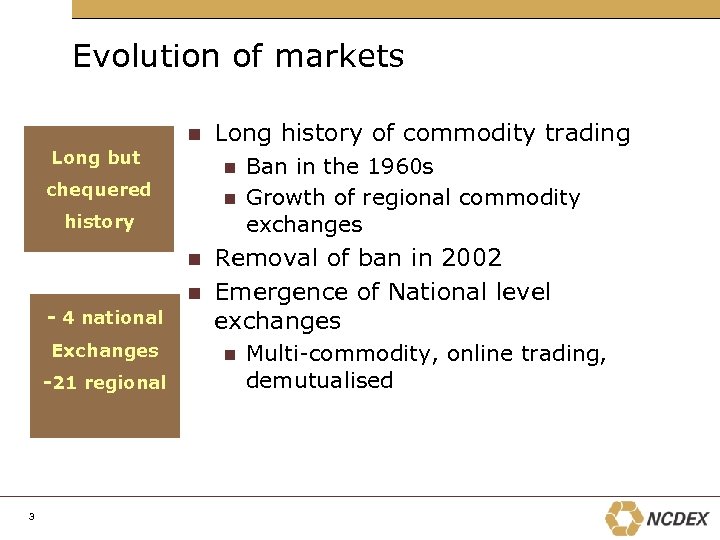 Evolution of markets n Long but Long history of commodity trading Ban in the 1960 s n Growth of regional commodity exchanges n chequered history Removal of ban in 2002 n Emergence of National level exchanges n - 4 national Exchanges -21 regional 3 n Multi-commodity, online trading, demutualised
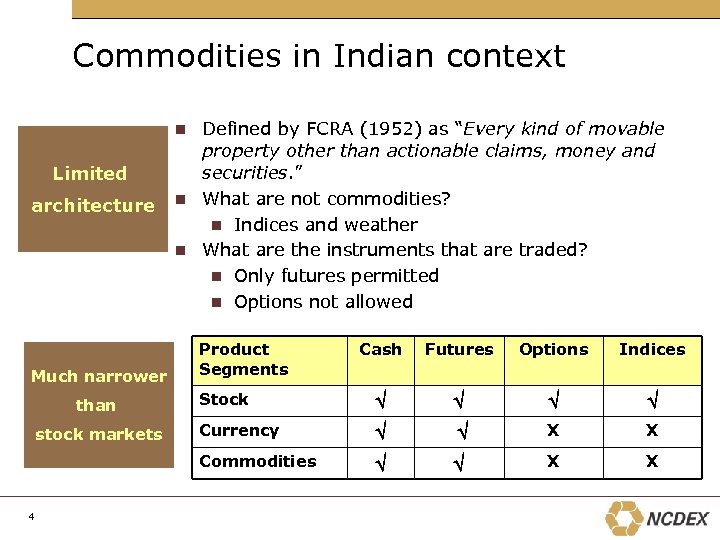 Commodities in Indian context Defined by FCRA (1952) as “Every kind of movable property other than actionable claims, money and securities. ” n What are not commodities? n Indices and weather n What are the instruments that are traded? n Only futures permitted n Options not allowed n Limited architecture than stock markets 4 Cash Futures Options Indices Stock Currency X X Commodities Much narrower Product Segments X X
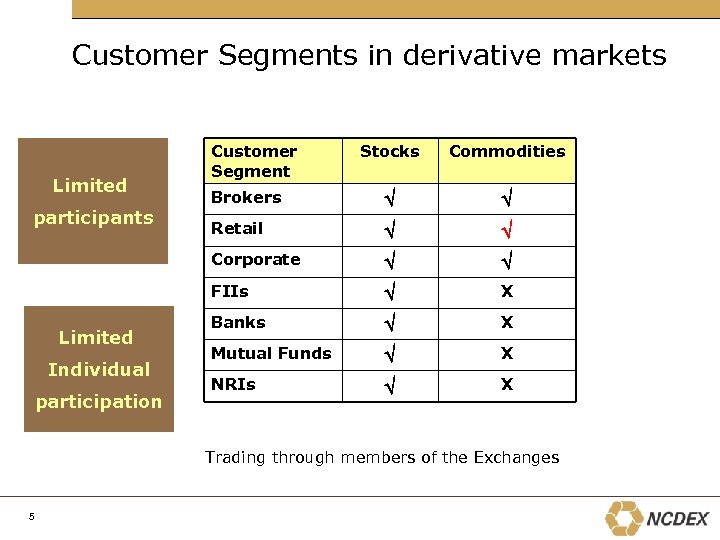 Customer Segments in derivative markets Limited Individual participation Commodities Brokers Retail FIIs participants Stocks Corporate Limited Customer Segment X Banks X Mutual Funds X NRIs X Trading through members of the Exchanges 5
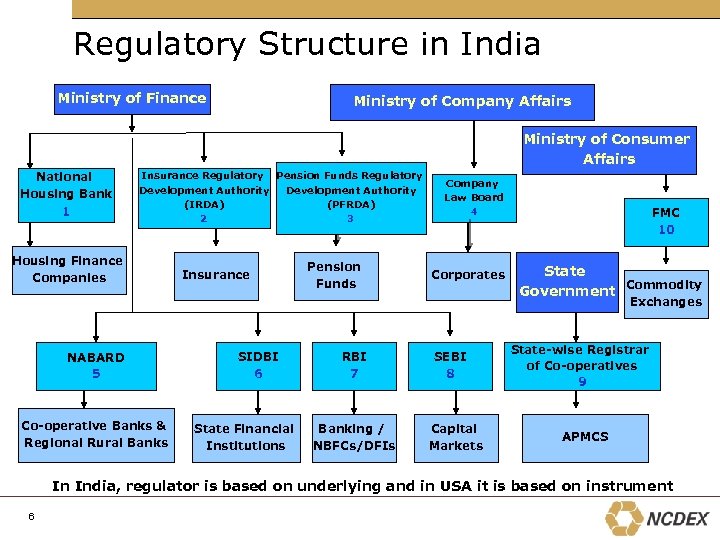 Regulatory Structure in India Ministry of Finance Ministry of Company Affairs Ministry of Consumer Affairs National Housing Bank 1 Insurance Regulatory Pension Funds Regulatory Development Authority (IRDA) (PFRDA) 2 3 Housing Finance Companies Insurance Pension Funds Company Law Board FMC 10 4 Corporates State Commodity Government Exchanges NABARD 5 Co-operative Banks & Regional Rural Banks SIDBI 6 State Financial Institutions RBI 7 Banking / NBFCs/DFIs SEBI 8 Capital Markets State-wise Registrar of Co-operatives 9 APMCS In India, regulator is based on underlying and in USA it is based on instrument 6
 Evolution in futures trading since 2003 7
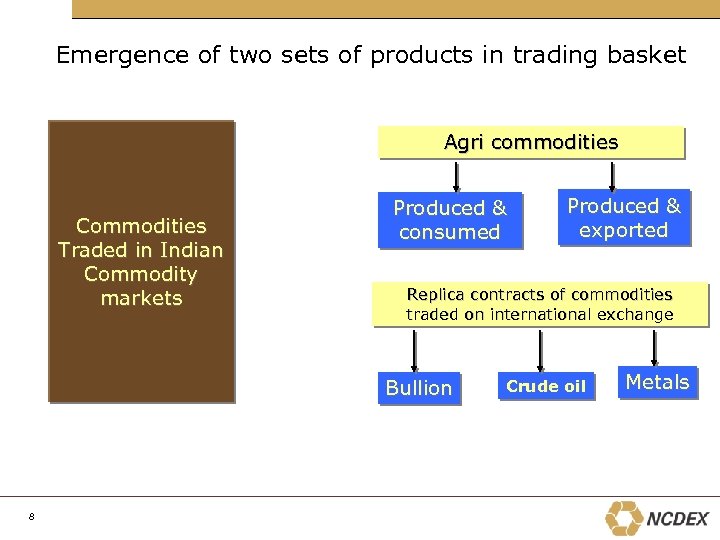 Emergence of two sets of products in trading basket Agri commodities Commodities Traded in Indian Commodity markets Produced & consumed Replica contracts of commodities traded on international exchange Bullion 8 Produced & exported Crude oil Metals
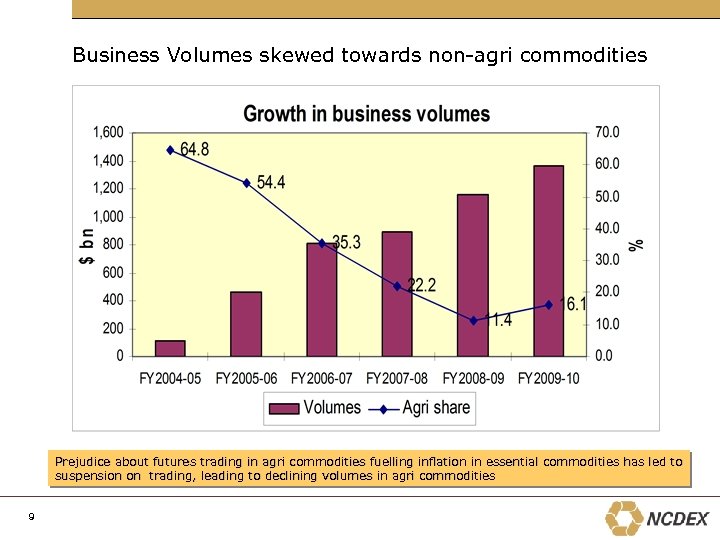 Business Volumes skewed towards non-agri commodities Prejudice about futures trading in agri commodities fuelling inflation in essential commodities has led to suspension on trading, leading to declining volumes in agri commodities 9
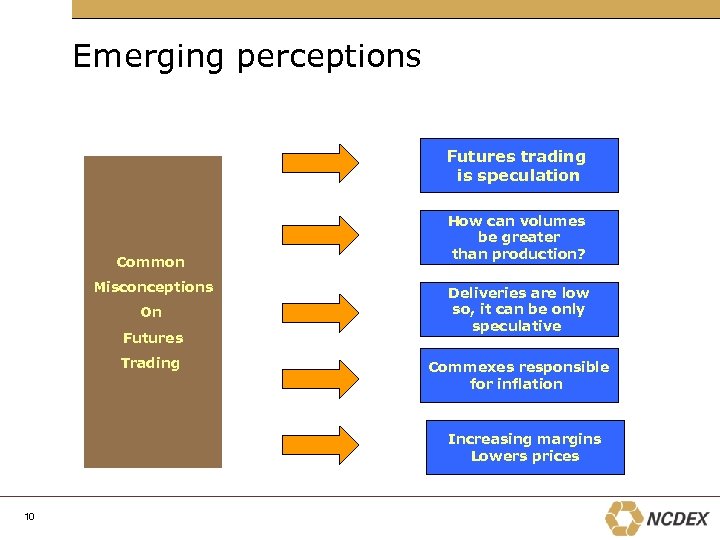 Emerging perceptions Futures trading is speculation Common Misconceptions On Futures Trading How can volumes be greater than production? Deliveries are low so, it can be only speculative Commexes responsible for inflation Increasing margins Lowers prices 10
 Building linkages in markets 11
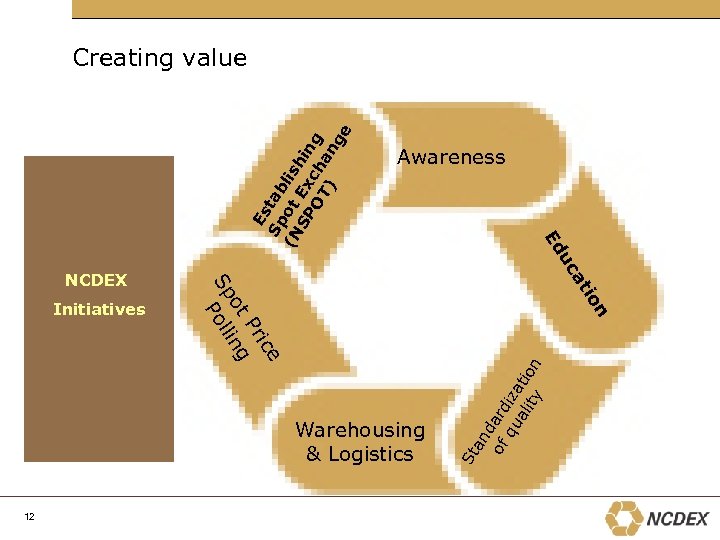 Warehousing & Logistics an d of ard qu iza al tio ity n St n io at 12 uc Initiatives ice Pr ot ing Sp Poll NCDEX Ed Es Sp tab (N ot lis SP Ex hin OT ch g ) ang e Creating value Awareness
 Efficiency in Commodity markets 13
 Futures trading – a vital messenger Futures trading gives vital signals of a possible demand-supply mismatch in a commodity n The price signals may be used to take vital decisions – fixing the minimum support price and export-import decisions n An illustration n n 14 Sugar production in the country during the year 2008 -09 was 14. 55 million tones against 26. 35 million tones in the previous year - the deficit was indicated by futures price which showed a rising trend
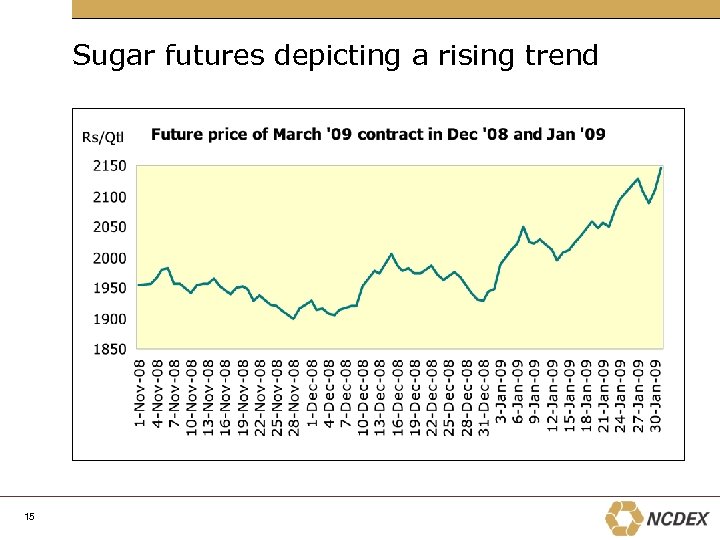 Sugar futures depicting a rising trend 15
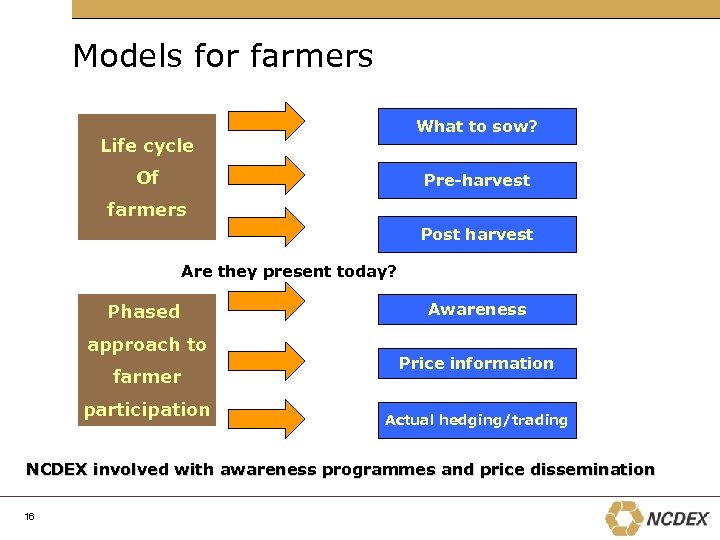 Models for farmers What to sow? Life cycle Of Pre-harvest farmers Post harvest Are they present today? Phased approach to farmer participation Awareness Price information Actual hedging/trading NCDEX involved with awareness programmes and price dissemination 16
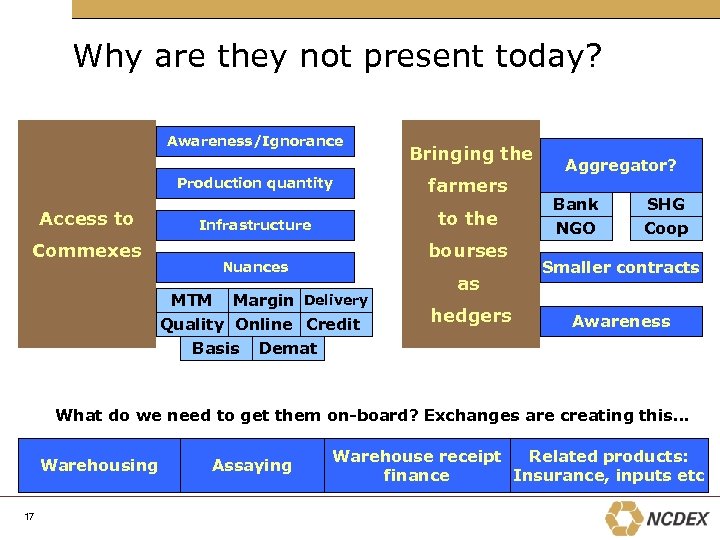 Why are they not present today? Awareness/Ignorance Production quantity Access to Commexes Bringing the farmers to the Infrastructure bourses Nuances MTM Margin Delivery Quality Online Credit Basis Demat as hedgers Aggregator? Bank NGO SHG Coop Smaller contracts Awareness What do we need to get them on-board? Exchanges are creating this… Warehousing 17 Assaying Warehouse receipt Related products: finance Insurance, inputs etc
 Issues to be resolved 18
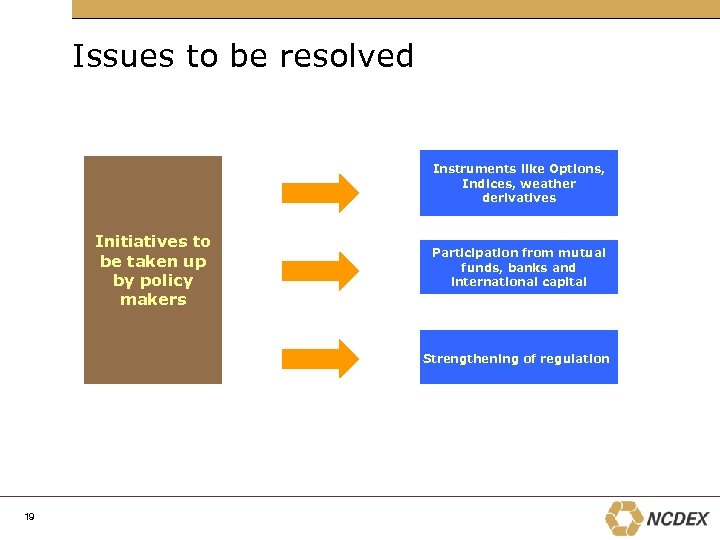 Issues to be resolved Instruments like Options, Indices, weather derivatives Initiatives to be taken up by policy makers Participation from mutual funds, banks and international capital Strengthening of regulation 19
 Thank You 20