 Скачать презентацию The librarian s view Raf Dekeyser K U Leuven
7eac23dcb189fbd730f9492c6234a1e3.ppt
- Количество слайдов: 7



The librarian’s view Raf Dekeyser K. U. Leuven 17 -9 -2002 Serenate 1
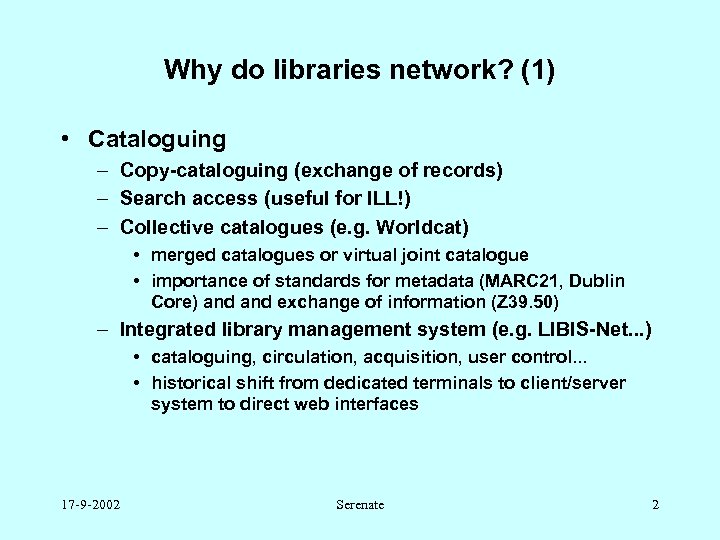
Why do libraries network? (1) • Cataloguing – Copy-cataloguing (exchange of records) – Search access (useful for ILL!) – Collective catalogues (e. g. Worldcat) • merged catalogues or virtual joint catalogue • importance of standards for metadata (MARC 21, Dublin Core) and exchange of information (Z 39. 50) – Integrated library management system (e. g. LIBIS-Net. . . ) • cataloguing, circulation, acquisition, user control. . . • historical shift from dedicated terminals to client/server system to direct web interfaces 17 -9 -2002 Serenate 2
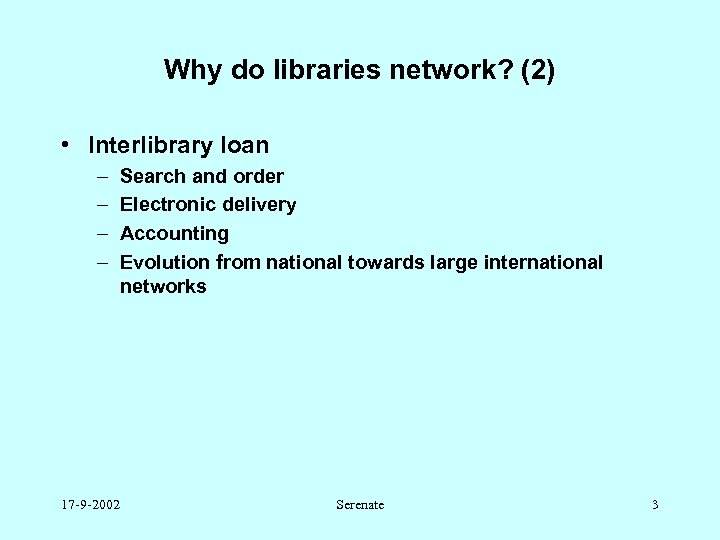
Why do libraries network? (2) • Interlibrary loan – – 17 -9 -2002 Search and order Electronic delivery Accounting Evolution from national towards large international networks Serenate 3
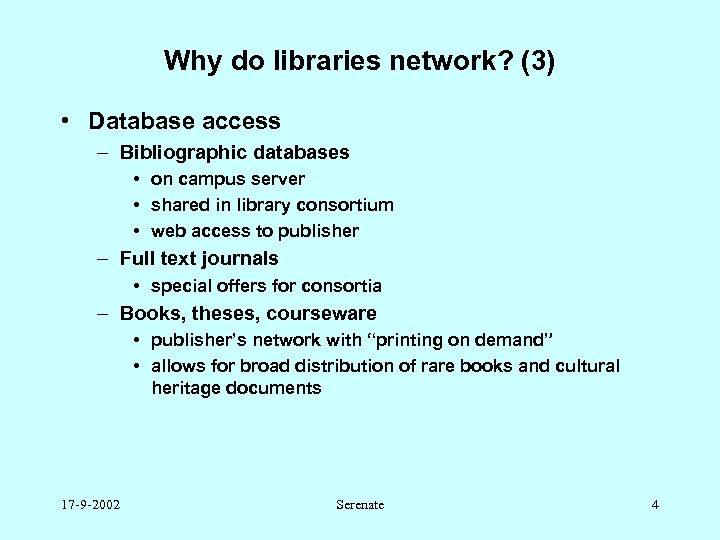
Why do libraries network? (3) • Database access – Bibliographic databases • on campus server • shared in library consortium • web access to publisher – Full text journals • special offers for consortia – Books, theses, courseware • publisher’s network with “printing on demand” • allows for broad distribution of rare books and cultural heritage documents 17 -9 -2002 Serenate 4
Why do libraries network? (4) • Electronic Reference Service: “Ask a librarian” (e. g. Question. Point from LC & OCLC) – Network for knowledge sharing – Automatic routing of questions, based on collection of strength profiles – 24/7 staffing becomes possible! – In USA already installed in large public library networks 17 -9 -2002 Serenate 5
New model for scholarly communication • Network of institutional e-print archives – inspired by Los Alamos “ar. Xiv” (Ginsparg) – metadata exchange through OAI metadata protocol – harvesters provide intelligent access to documents • Valuable alternative for commercial journals? – financially competitive – ideal for author-paid model – problems to make it acceptable to research community • Validation method (peer review) – – important success factor technical solution still lacking collaboration from learned societies requested Internet allows for new methods for evaluation and impact measurement 17 -9 -2002 Serenate 6
Requirements • Interface software for (simultaneous) search and retrieval access to diverse database systems (different standards, metadata-sets, languages, . . . ) • Intelligent full-text search engine • Foolproof quality label management system for peer review control • Fast exchange of large multimedia files • Enormous potential for wireless communication applications 17 -9 -2002 Serenate 7
Скачать презентацию The librarian s view Raf Dekeyser K U Leuven
7eac23dcb189fbd730f9492c6234a1e3.ppt