


 Скачать презентацию The Learning Online Network with CAPA — A
2a8f20b82ff1c602b9bd49643e1e67ad.ppt
- Количество слайдов: 27
 The Learning. Online Network with CAPA - A Cross-Institutional Learning Content Management System CVC Online Student Support and Instructional Services San Diego, 2003
 Some of the History
 1992 CAPA • Started by Ed Kashy et al. in Cyclotron • Individualized assessment system for science and math • Immediate feedback, multiple tries mastery based • Used paper copies of assignments and terminal input • X-Windows problem editing • Got Web student interface in 95
 1997 Lecture. Online • Started by Wolfgang Bauer, Walt Benenson, Gary Westfall, and Gerd Kortemeyer in Cyclotron • Learning content management and individualized assessment system for science and math • Sharing of content between courses • Completely web-based interface
 1999 LON-CAPA • The Learning. Online Network with CAPA • Collaboration of CAPA and Lecture. Online groups • “The best of both worlds” • Sharing of content between courses and institutions • Reusability of content on different levels of granularity • Distributed and Scalable
 LON-CAPA Today • Attracted National Science Foundation Information Technology Research grant “Investigation of a Model for Online Resource Creation and Sharing in Educational Settings” (more later) • Has over 20 partner institutions (more later) • Useful and usable for “casual” (non-”power”) faculty user outside science and math • LON-CAPA is a full-featured course management system • Software platform has GNU General Public License and is free of licensing fees • Computer. World Honors Award
 Today LON-CAPA is used … • With material written by faculty teaching course or “re-used” from other faculty • For homework in addition to “traditional” lecture and textbook • Hybrid with “traditional” lecture, homework and textbook online • Completely “virtual” courses • AP courses • Prelab quizzes • In-class exercises
 Cross-Institutional
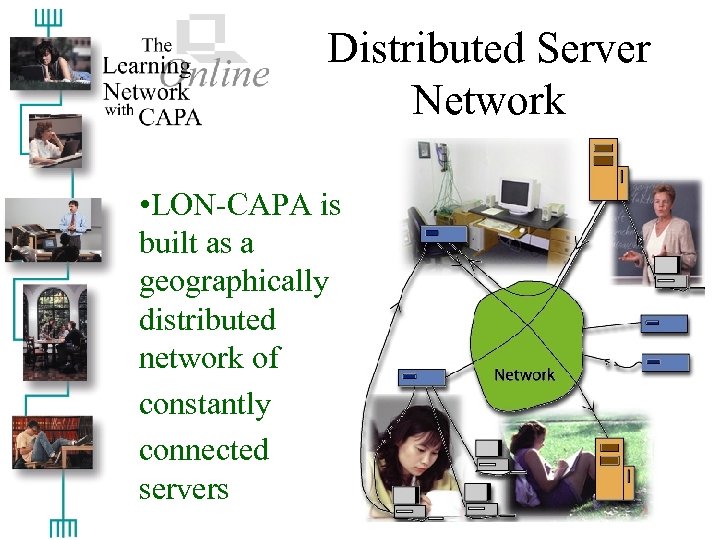 Distributed Server Network • LON-CAPA is built as a geographically distributed network of constantly connected servers
 Logical Domains • The network is logically divided into domains such as “MSU”, “FSU” or “Publisher X” • Domains limit the flow of user information • Domains can limit access to content resources • Domains limit the extent of user privileges
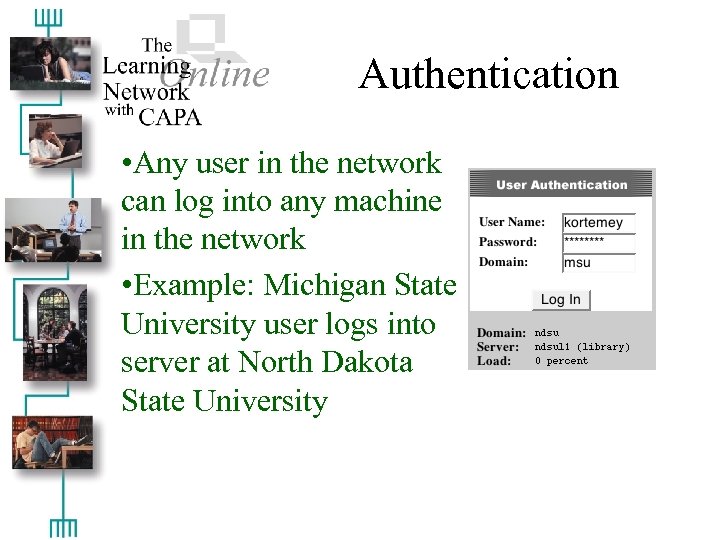 Authentication • Any user in the network can log into any machine in the network • Example: Michigan State University user logs into server at North Dakota State University
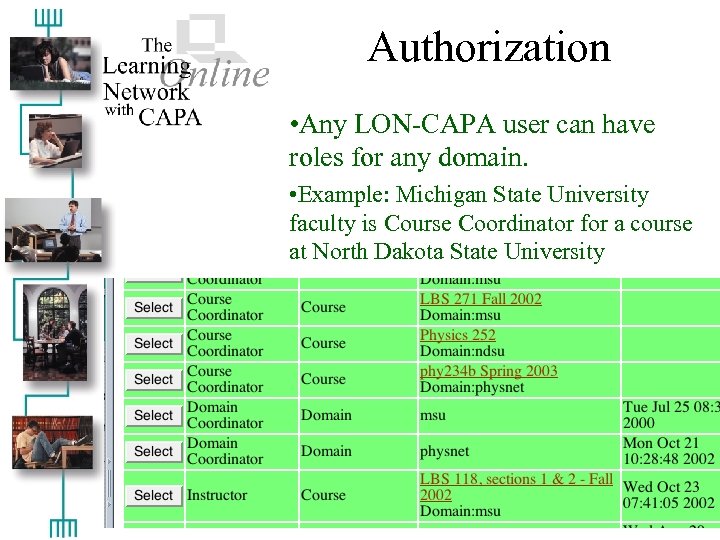 Authorization • Any LON-CAPA user can have roles for any domain. • Example: Michigan State University faculty is Course Coordinator for a course at North Dakota State University
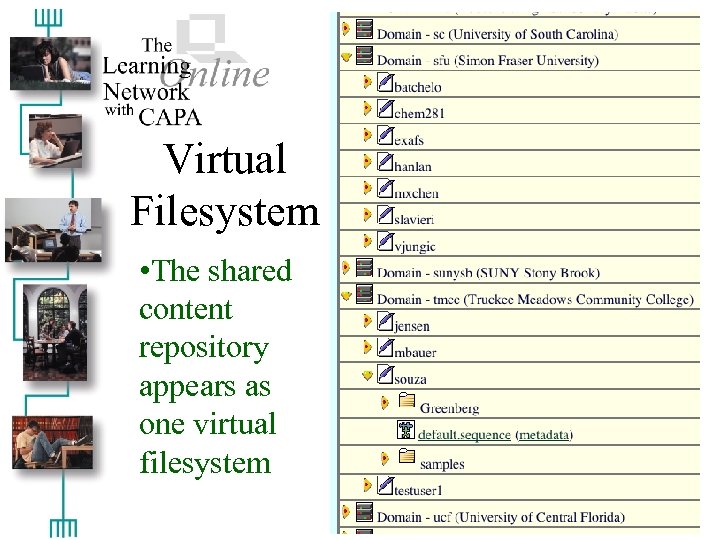 Virtual Filesystem • The shared content repository appears as one virtual filesystem
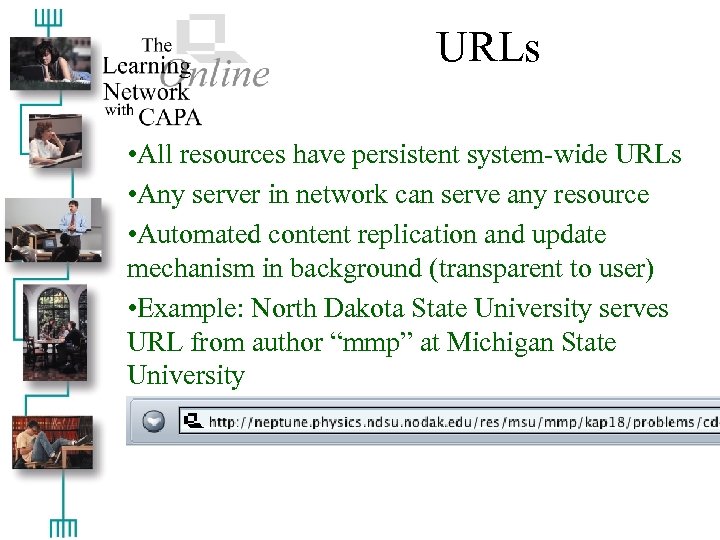 URLs • All resources have persistent system-wide URLs • Any server in network can serve any resource • Automated content replication and update mechanism in background (transparent to user) • Example: North Dakota State University serves URL from author “mmp” at Michigan State University
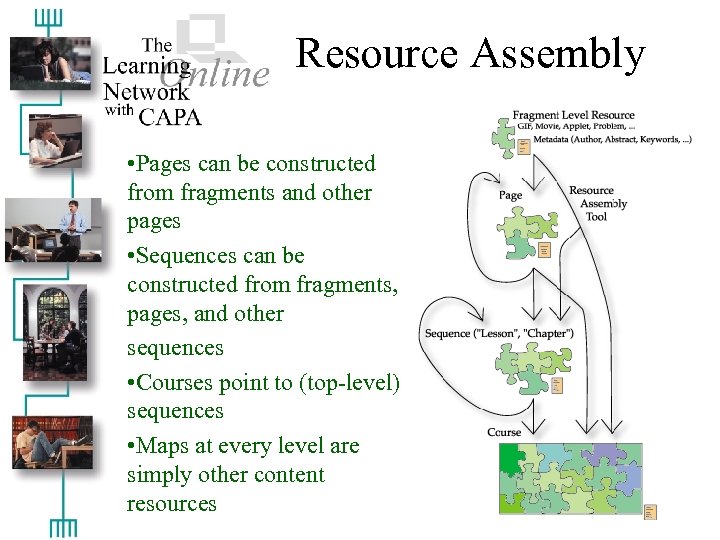 Resource Assembly • Pages can be constructed from fragments and other pages • Sequences can be constructed from fragments, pages, and other sequences • Courses point to (top-level) sequences • Maps at every level are simply other content resources
 External User Community
 Status: Installations in “Production Cluster” High Schools • Mio Au. Sable High School - Mio, Michigan • Charlotte High School - Charlotte, Michigan • Fowlerville High School - Fowlerville. Michigan • Theodore Roosevelt High School - Wyandotte, Michigan • Lansing School District • East Lansing Public Schools Community Colleges • Westshore Community College - Scottsville, Michigan • Truckee Meadows Community College - Reno, Nevada
 Status: Installations in “Production Cluster” Universities (department level) • Ohio University • SUNY Stony Brook • Florida State University • University of South Carolina • George Washington University • University of Central Florida • Michigan State University • University of Delaware • North Dakota State University • University of Wisconsin - Stevens Point
 Status: Installations in “Production Cluster” Outside United States • Simon Fraser University - Vancouver, Canada • University of Halle - Halle, Germany • University of Oldenburg - Oldenburg, Germany • Selwyn House School, Canada
 The NSF ITR Grant Project
 The Project • “Investigation of a Model for Online Resource Creation and Sharing in Education Settings” • Uses LON-CAPA as model system • Five year project, $2. 1 M, funded by the National Science Foundation Information Technology Research Program
 The Project: Research Goals • Open source code development concept for Instructional Management System • Pooling online educational resources between departments, colleges, universities and schools • Business models for “trading” such resources on small level of granularity • Business models for services and support • Metrics for resource quality and effectiveness • Curriculum adaptivity to learner types and remediation needs
 The Project: National STEM Digital Library • Supplement to cross-integrate LON-CAPA with NSF National STEM Digital Library • NSDL available to LON-CAPA as content domain • LON-CAPA resource pool available in NSDL as associated library • LON-CAPA can be used as course delivery tool for NSDL content
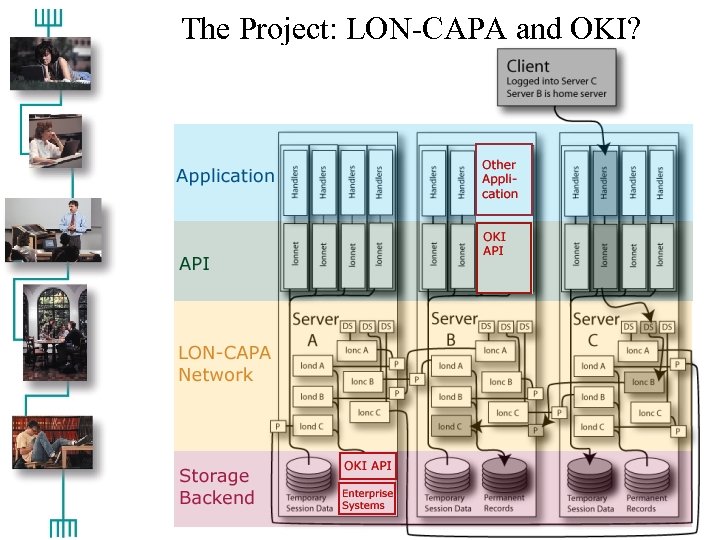 The Project: LON-CAPA and OKI?
 Conferences and Workshops • First user meetings with 50 faculty from other universities at MSU • Second user meeting at Florida State University with 56 faculty from 22 institutions • Third user meeting at Truckee Meadows Community College, Reno, with 69 faculty from 29 institutions • Two programmer Workshops (approx 20 participants) at MSU in Summer
 “Economy of Scale” • Content: System more attractive the more content is online • Code base: GNU GPL, system improvements from larger development community • Support: mechanisms for peer-to-peer support • Training: mechanisms for peer-to-peer training
 On the web. . . www. lon-capa. org help. lon-capa. org bugs. lon-capa. org mail. lon-capa. org install. lon-capa. org