


 Скачать презентацию The LCLS at SLAC Linac Coherent Light Source
7336936f0812a66acdce7785ddd3aef2.ppt
- Количество слайдов: 38
 The LCLS at SLAC Linac Coherent Light Source J. B. Hastings (for the LCLS group) January 31, 2007 LCLS LLNL ANL UCLA
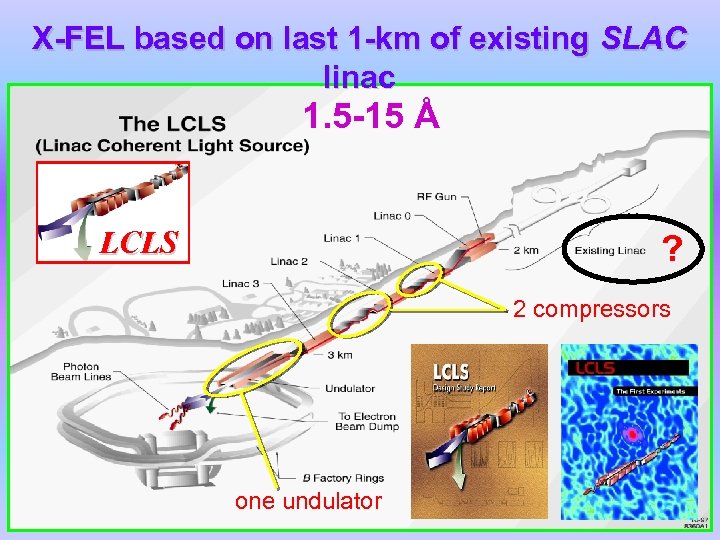
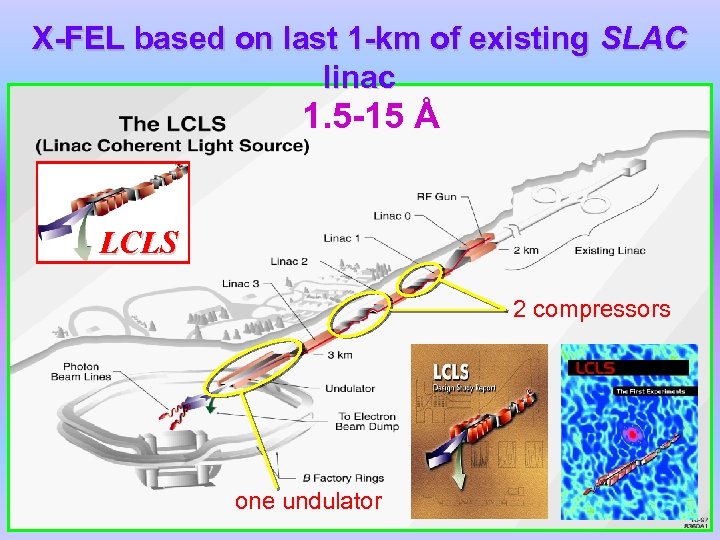 X-FEL based on last 1 -km of existing SLAC linac 1. 5 -15 Å LCLS 2 compressors one undulator
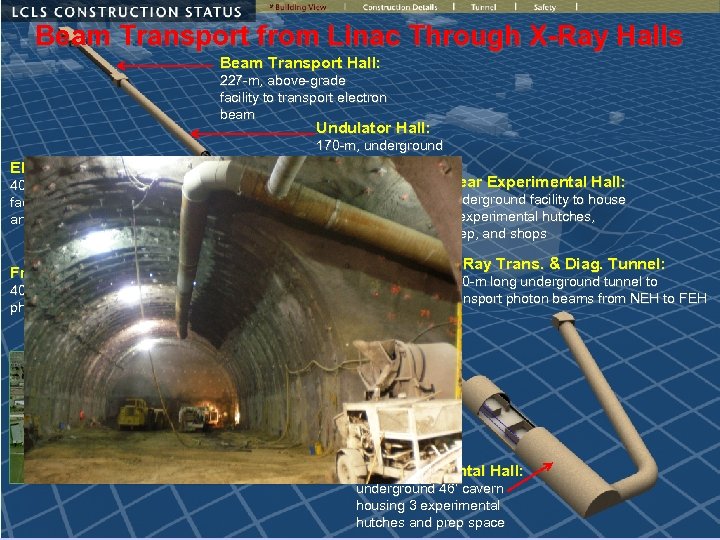 Beam Transport from Linac Through X-Ray Halls Beam Transport Hall: 227 -m, above-grade facility to transport electron beam Undulator Hall: Electron Beam Dump: 40 -m long underground facility to separate electron and x-ray beams Front End Enclosure: 40 -m long underground facility housing photon beam diagnostic equipment 170 -m, underground tunnel housing undulators Near Experimental Hall: underground facility to house 3 experimental hutches, prep, and shops X-Ray Trans. & Diag. Tunnel: 210 -m long underground tunnel to transport photon beams from NEH to FEH Far Experimental Hall: underground 46’ cavern housing 3 experimental hutches and prep space
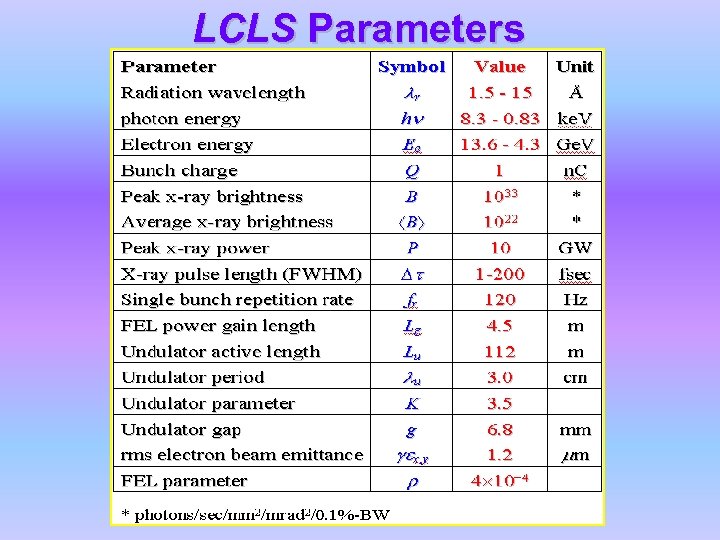 LCLS Parameters
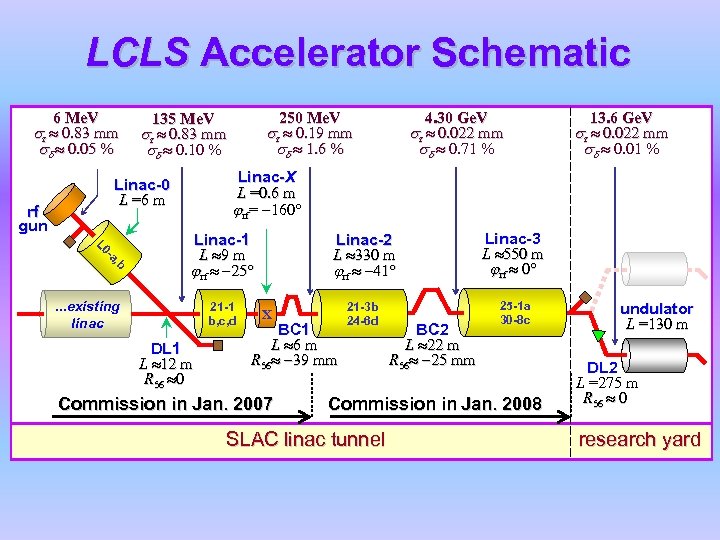 LCLS Accelerator Schematic 6 Me. V z 0. 83 mm 0. 05 % rf gun 250 Me. V z 0. 19 mm 1. 6 % 135 Me. V z 0. 83 mm 0. 10 % 4. 30 Ge. V z 0. 022 mm 0. 71 % 13. 6 Ge. V z 0. 022 mm 0. 01 % Linac-X L =0. 6 m rf= -160 Linac-0 L =6 m , b -a L 0 Linac-2 L 330 m rf -41° Linac-1 L 9 m rf -25° . . . existing linac 21 -1 b, c, d DL 1 L 12 m R 56 0 X Linac-3 L 550 m rf 0° 21 -3 b 24 -6 d 25 -1 a 30 -8 c BC 1 L 6 m R 56 -39 mm Commission in Jan. 2007 BC 2 L 22 m R 56 -25 mm Commission in Jan. 2008 SLAC linac tunnel undulator L =130 m DL 2 L =275 m R 56 0 research yard
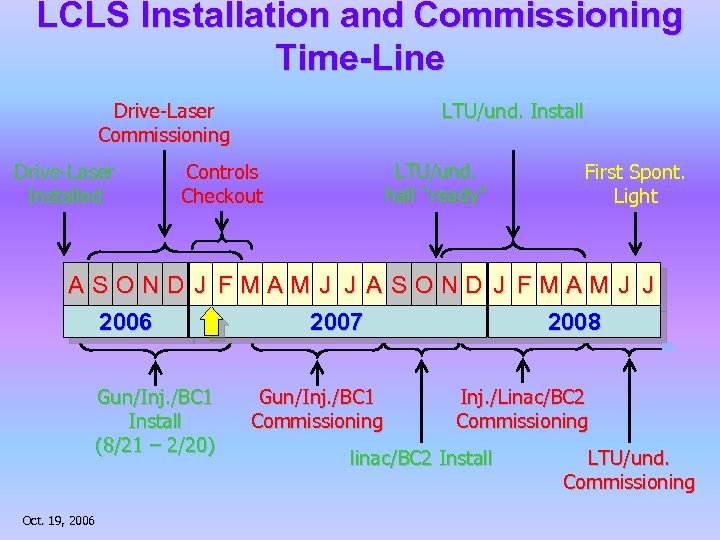 LCLS Installation and Commissioning Time-Line Drive-Laser Commissioning Drive-Laser Installed LTU/und. Install LTU/und. hall “ready” Controls Checkout First Spont. Light ASOND J FMAM J J 2006 Gun/Inj. /BC 1 Install (8/21 – 2/20) Oct. 19, 2006 2007 Gun/Inj. /BC 1 Commissioning 2008 Inj. /Linac/BC 2 Commissioning linac/BC 2 Install LTU/und. Commissioning
 LCLS Installation and Commissioning Time-Line Drive-Laser Commissioning Drive-Laser Installed LTU/und. Install LTU/und. hall “ready” Controls Checkout First Spont. Light ASOND J FMAM J J 2006 Gun/Inj. /BC 1 Install (8/21 – 2/20) Oct. 19, 2006 2007 Gun/Inj. /BC 1 Commissioning 2008 Inj. /Linac/BC 2 Commissioning linac/BC 2 Install LTU/und. Commissioning
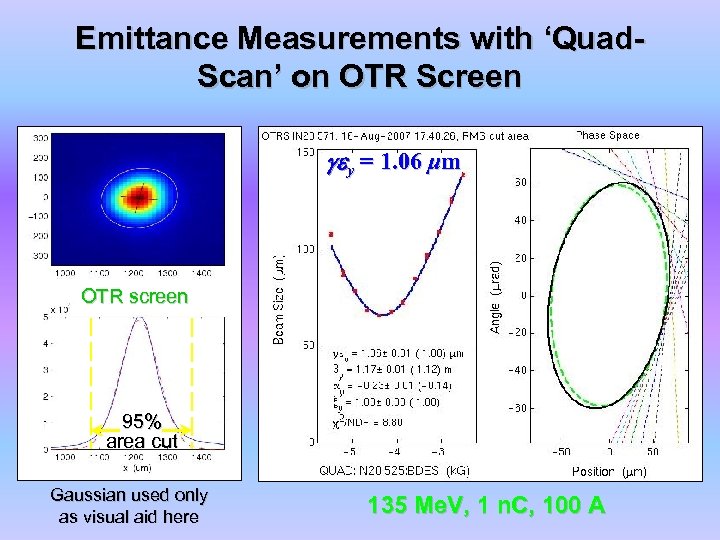 Emittance Measurements with ‘Quad. Scan’ on OTR Screen gey = 1. 06 μm OTR screen 95% area cut Gaussian used only as visual aid here 135 Me. V, 1 n. C, 100 A
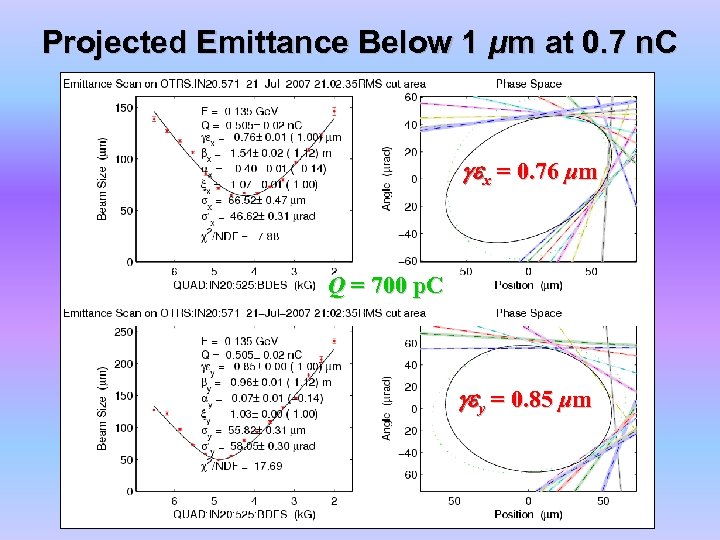 Projected Emittance Below 1 μm at 0. 7 n. C gex = 0. 76 μm Q = 700 p. C gey = 0. 85 μm
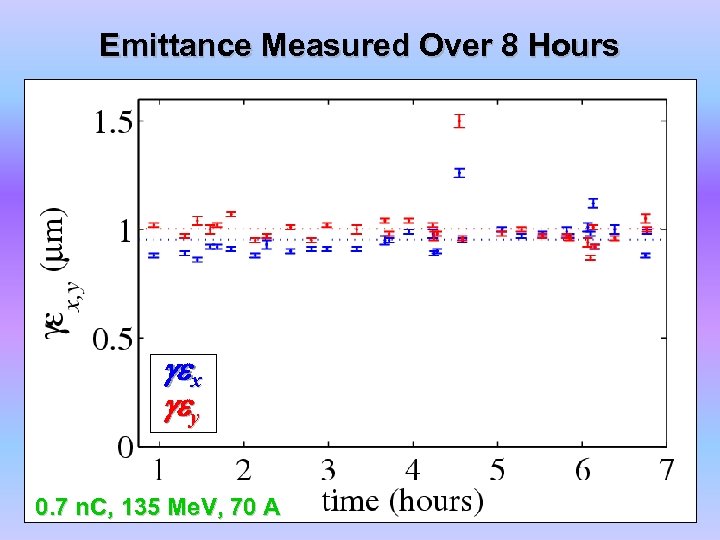 Emittance Measured Over 8 Hours gex gey 0. 7 n. C, 135 Me. V, 70 A
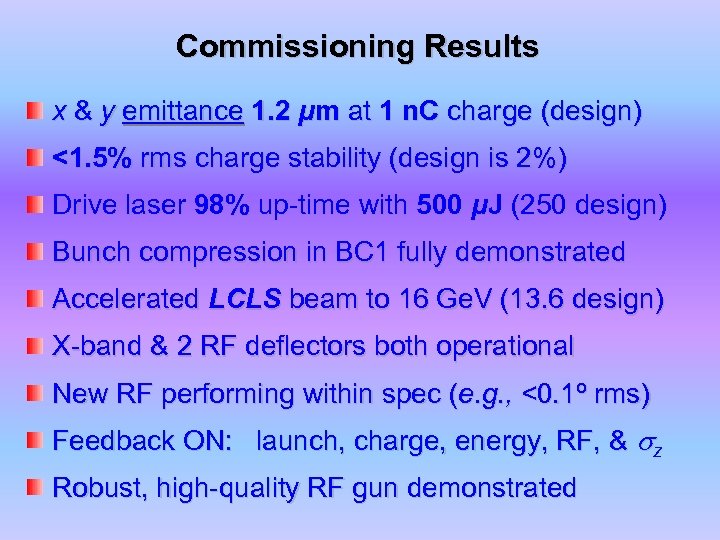 Commissioning Results x & y emittance 1. 2 μm at 1 n. C charge (design) <1. 5% rms charge stability (design is 2%) Drive laser 98% up-time with 500 μJ (250 design) Bunch compression in BC 1 fully demonstrated Accelerated LCLS beam to 16 Ge. V (13. 6 design) X-band & 2 RF deflectors both operational New RF performing within spec (e. g. , <0. 1º rms) Feedback ON: launch, charge, energy, RF, & z Robust, high-quality RF gun demonstrated
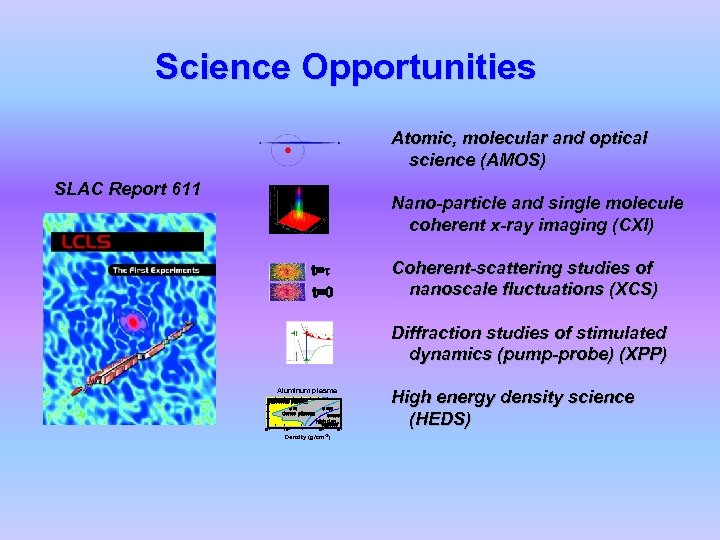 Science Opportunities Atomic, molecular and optical science (AMOS) SLAC Report 611 Nano-particle and single molecule coherent x-ray imaging (CXI) Coherent-scattering studies of nanoscale fluctuations (XCS) t= t=0 Diffraction studies of stimulated dynamics (pump-probe) (XPP) Aluminum plasma classical plasma G =1 dense plasma -4 10 -2 10 1 G =10 G=100 high den. matter 2 10 Density (g/cm-3) 4 10 High energy density science (HEDS)
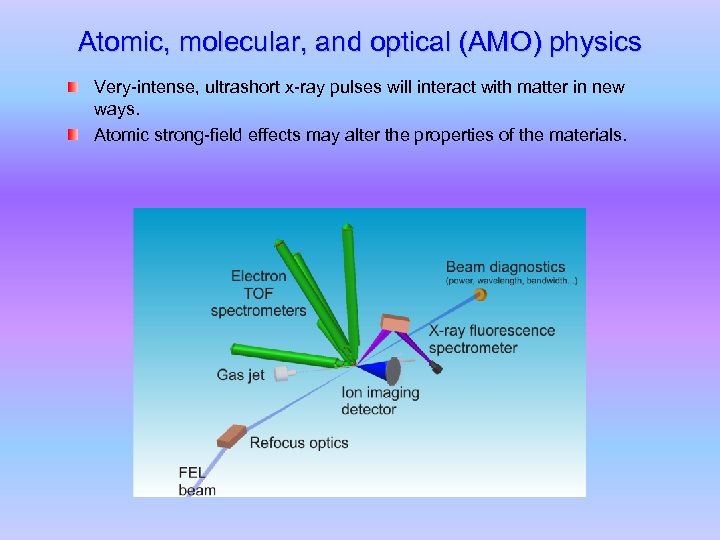 Atomic, molecular, and optical (AMO) physics Very-intense, ultrashort x-ray pulses will interact with matter in new ways. Atomic strong-field effects may alter the properties of the materials.
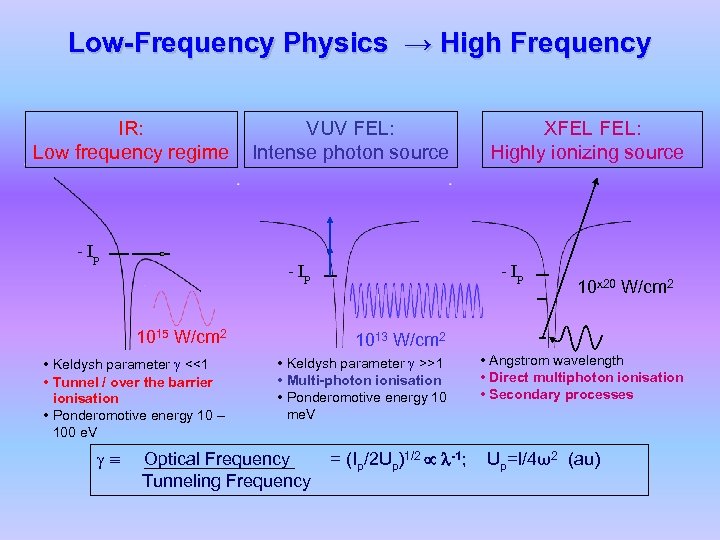 Low-Frequency Physics → High Frequency IR: Low frequency regime - Ip VUV FEL: Intense photon source - Ip XFEL FEL: Highly ionizing source - Ip 1015 W/cm 2 1013 W/cm 2 • Keldysh parameter <<1 • Tunnel / over the barrier ionisation • Ponderomotive energy 10 – 100 e. V • Keldysh parameter >>1 • Multi-photon ionisation • Ponderomotive energy 10 me. V 10 x 20 W/cm 2 Optical Frequency Tunneling Frequency = (Ip/2 Up)1/2 -1; • Angstrom wavelength • Direct multiphoton ionisation • Secondary processes Up=I/4ω2 (au)
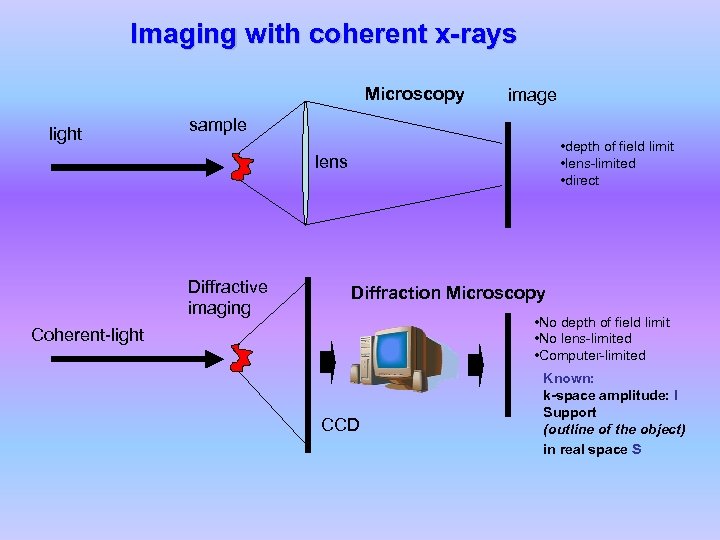 Imaging with coherent x-rays Microscopy light image sample • depth of field limit • lens-limited • direct lens Diffractive imaging Diffraction Microscopy • No depth of field limit • No lens-limited • Computer-limited Coherent-light CCD Known: k-space amplitude: I Support (outline of the object) in real space s
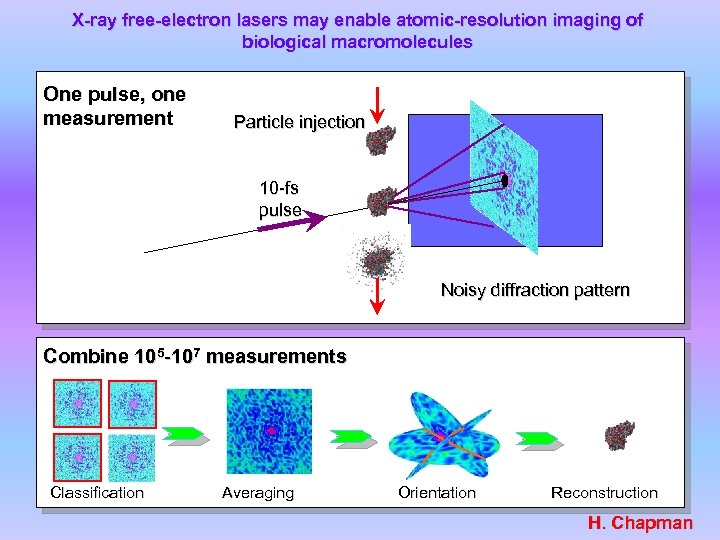 X-ray free-electron lasers may enable atomic-resolution imaging of biological macromolecules One pulse, one measurement Particle injection 10 -fs pulse Noisy diffraction pattern Combine 105 -107 measurements Classification Averaging Orientation Reconstruction H. Chapman
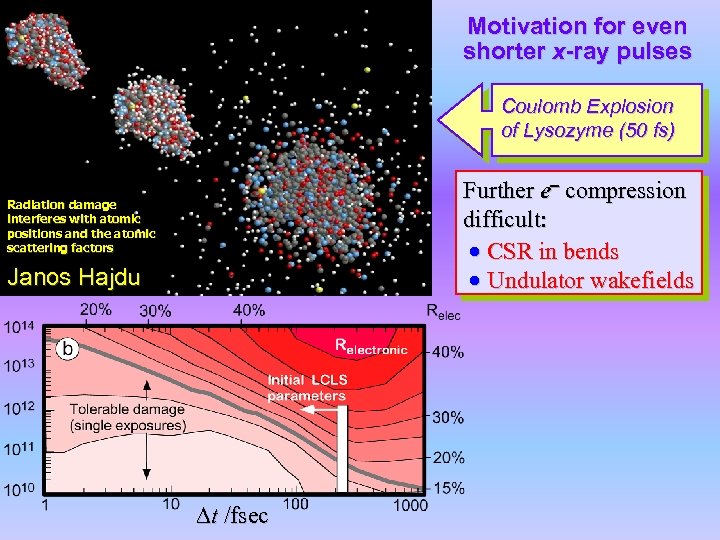 Motivation for even shorter x-ray pulses Coulomb Explosion of Lysozyme (50 fs) Further e- compression difficult: · CSR in bends · Undulator wakefields Radiation damage interferes with atomic positions and the atomic scattering factors Janos Hajdu Dt /fsec
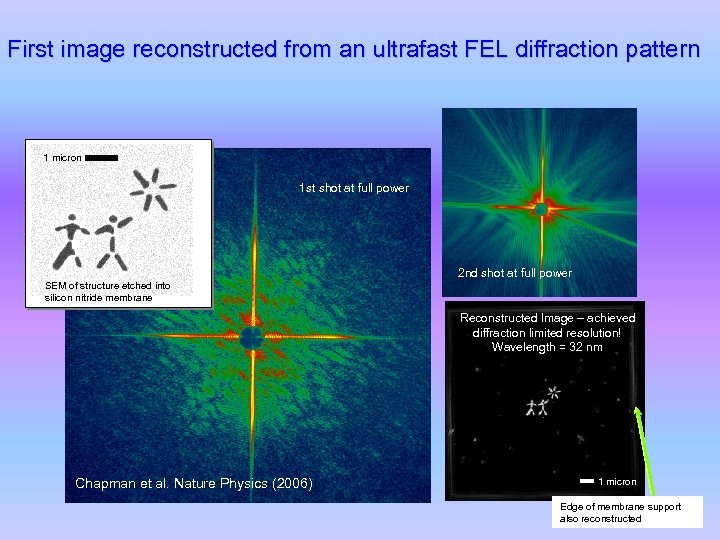 First image reconstructed from an ultrafast FEL diffraction pattern 1 micron 1 st shot at full power 2 nd shot at full power SEM of structure etched into silicon nitride membrane Reconstructed Image – achieved diffraction limited resolution! Wavelength = 32 nm Chapman et al. Nature Physics (2006) 1 micron Edge of membrane support also reconstructed
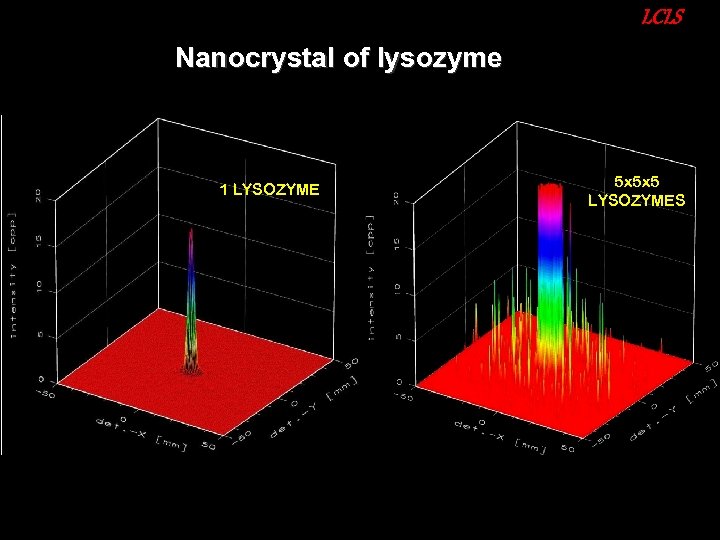 LCLS Nanocrystal of lysozyme 1 LYSOZYME 5 x 5 x 5 LYSOZYMES
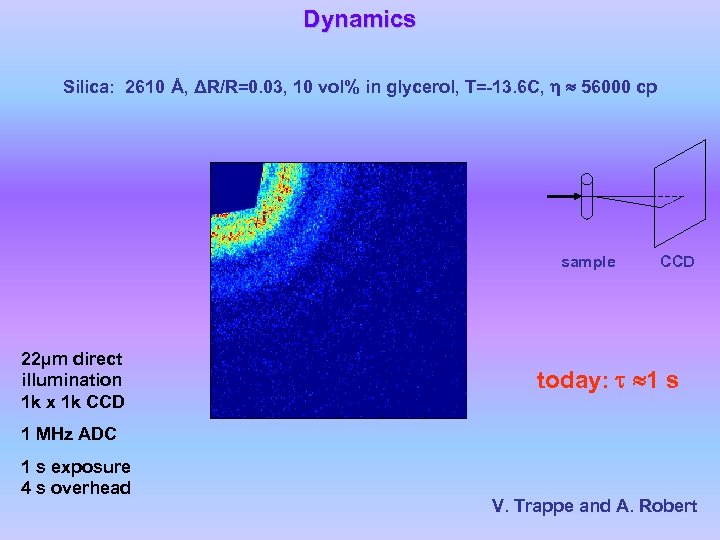 Dynamics Silica: 2610 Å, ΔR/R=0. 03, 10 vol% in glycerol, T=-13. 6 C, 56000 cp sample 22µm direct illumination 1 k x 1 k CCD today: 1 s 1 MHz ADC 1 s exposure 4 s overhead V. Trappe and A. Robert
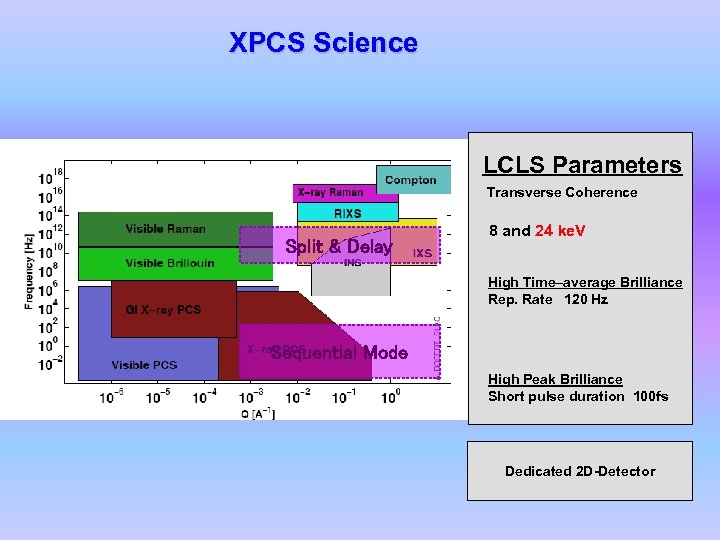 XPCS Science LCLS Parameters Transverse Coherence Split & Delay 8 and 24 ke. V High Time–average Brilliance Rep. Rate 120 Hz Sequential Mode High Peak Brilliance Short pulse duration 100 fs Dedicated 2 D-Detector
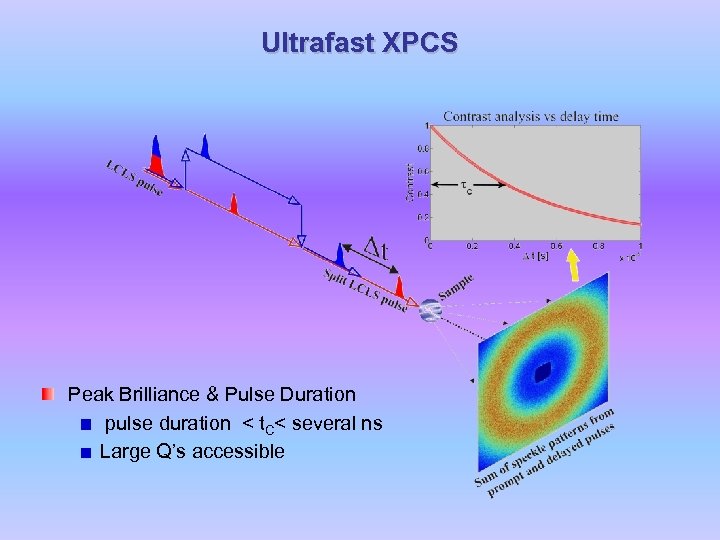 Ultrafast XPCS Peak Brilliance & Pulse Duration pulse duration < t. C< several ns Large Q’s accessible
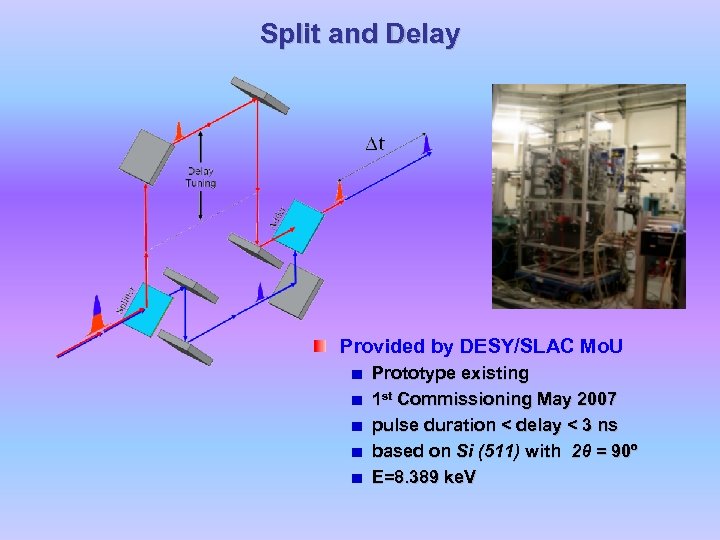 Split and Delay Provided by DESY/SLAC Mo. U Prototype existing 1 st Commissioning May 2007 pulse duration < delay < 3 ns based on Si (511) with 2θ = 90º E=8. 389 ke. V
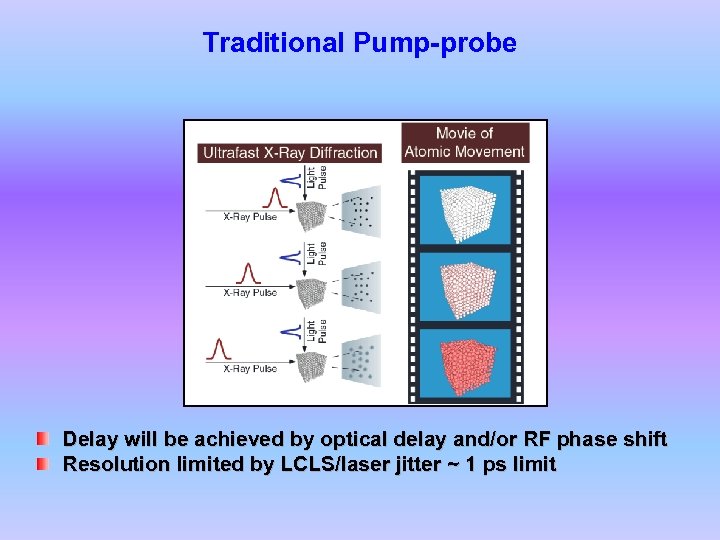 Traditional Pump-probe Delay will be achieved by optical delay and/or RF phase shift Resolution limited by LCLS/laser jitter ~ 1 ps limit
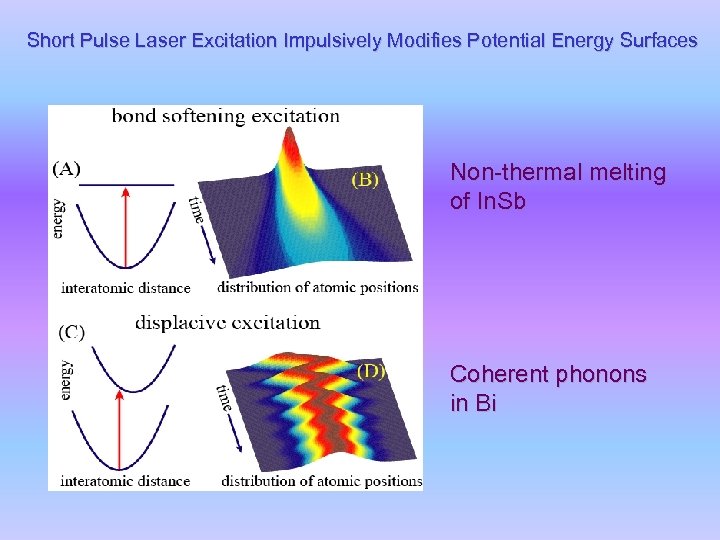 Short Pulse Laser Excitation Impulsively Modifies Potential Energy Surfaces Non-thermal melting of In. Sb Coherent phonons in Bi
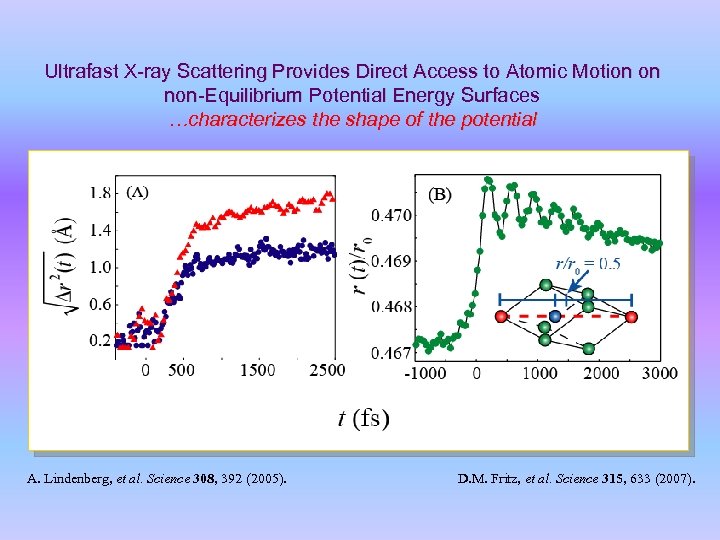 Ultrafast X-ray Scattering Provides Direct Access to Atomic Motion on non-Equilibrium Potential Energy Surfaces …characterizes the shape of the potential A. Lindenberg, et al. Science 308, 392 (2005). D. M. Fritz, et al. Science 315, 633 (2007).
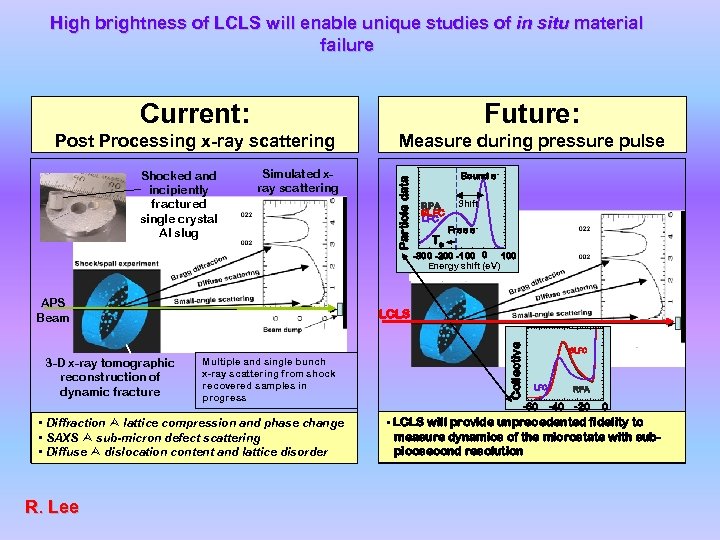 High brightness of LCLS will enable unique studies of in situ material failure Future: Post Processing x-ray scattering Measure during pressure pulse Shocked and incipiently fractured single crystal Al slug Simulated xray scattering APS Beam RPA SLFC Te Shift Free e- -300 -200 -100 0 100 Energy shift (e. V) LCLS Multiple and single bunch x-ray scattering from shock recovered samples in progress • Diffraction lattice compression and phase change • SAXS sub-micron defect scattering • Diffuse dislocation content and lattice disorder R. Lee Bound e- Collective 3 -D x-ray tomographic reconstruction of dynamic fracture Particle data Current: SLFC -60 RPA -40 -20 0 • LCLS will provide unprecedented fidelity to measure dynamics of the microstate with subpicosecond resolution
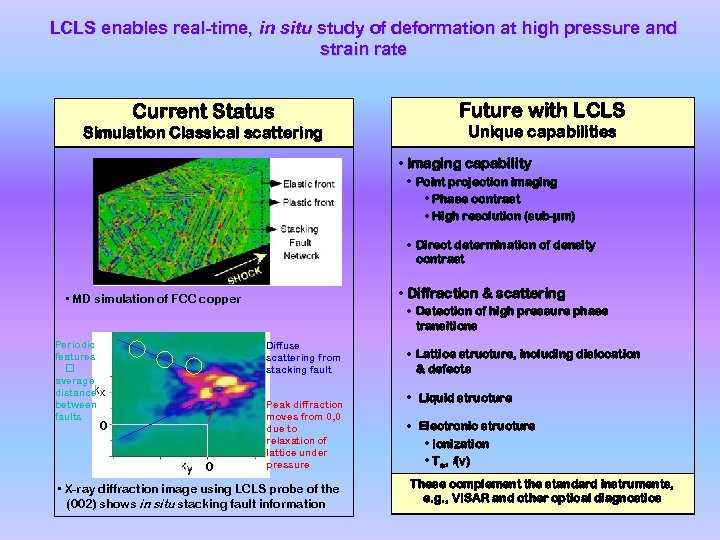 LCLS enables real-time, in situ study of deformation at high pressure and strain rate Current Status Simulation Classical scattering Future with LCLS Unique capabilities • Imaging capability • Point projection imaging • Phase contrast • High resolution (sub-µm) • Direct determination of density contrast • Diffraction & scattering • MD simulation of FCC copper Periodic features average distance between faults • Detection of high pressure phase transitions Diffuse scattering from stacking fault 0 0 Peak diffraction moves from 0, 0 due to relaxation of lattice under pressure • X-ray diffraction image using LCLS probe of the (002) shows in situ stacking fault information • Lattice structure, including dislocation & defects • Liquid structure • Electronic structure • Ionization • Te, f(v) These complement the standard instruments, e. g. , VISAR and other optical diagnostics
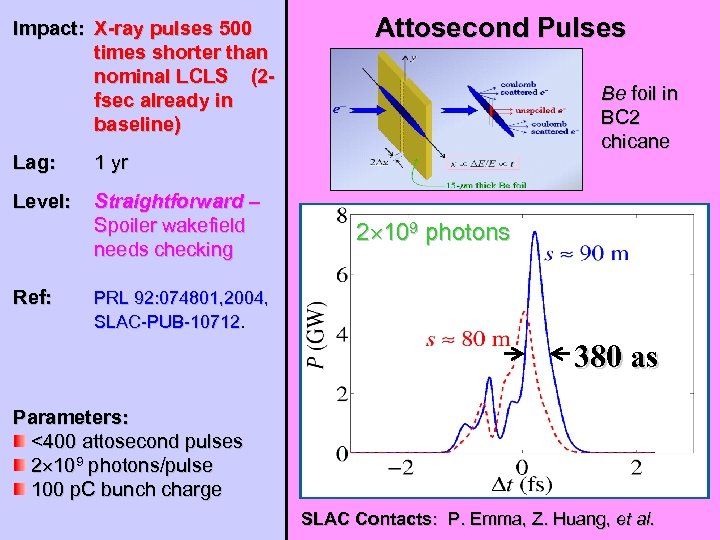 Impact: X-ray pulses 500 times shorter than nominal LCLS (2 fsec already in baseline) Lag: Straightforward – Spoiler wakefield needs checking Be foil in BC 2 chicane 1 yr Level: Attosecond Pulses Ref: 2 109 photons PRL 92: 074801, 2004, 92: 074801, 2004 SLAC-PUB-10712. 380 as Parameters: <400 attosecond pulses 2 109 photons/pulse 100 p. C bunch charge SLAC Contacts: P. Emma, Z. Huang, et al.
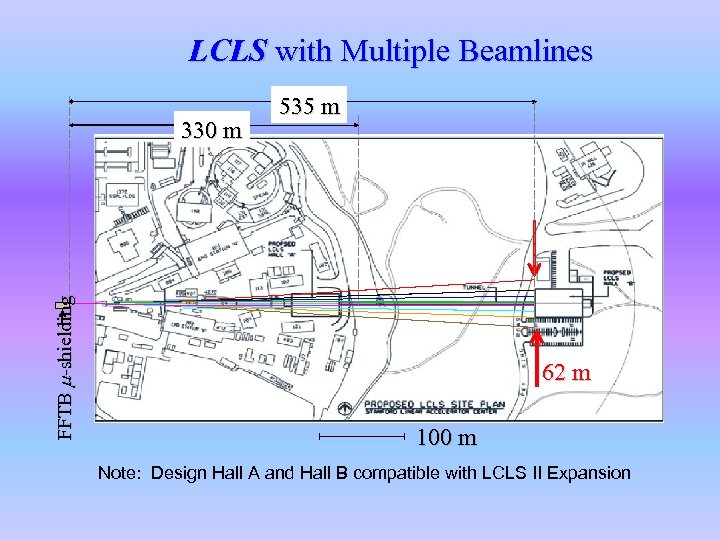 LCLS with Multiple Beamlines FFTB m-shielding 330 m 535 m 62 m 100 m Note: Design Hall A and Hall B compatible with LCLS II Expansion
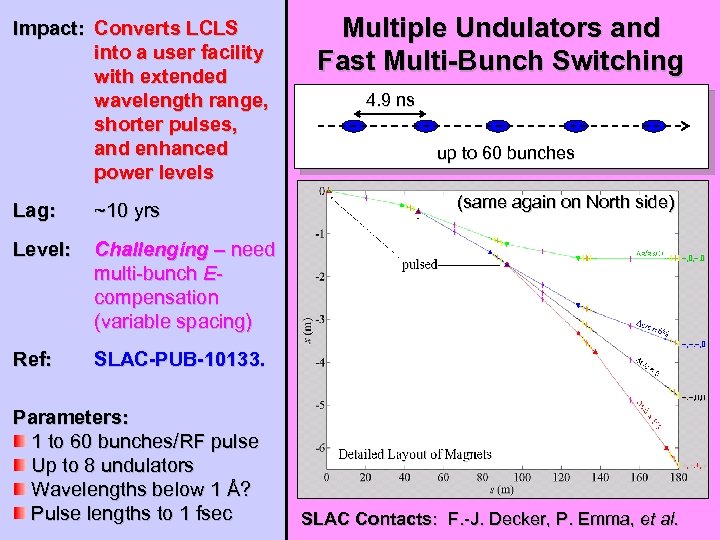 Impact: Converts LCLS into a user facility with extended wavelength range, shorter pulses, and enhanced power levels Lag: ~10 yrs Level: 4. 9 ns up to 60 bunches (same again on North side) Challenging – need multi-bunch Ecompensation (variable spacing) Ref: Multiple Undulators and Fast Multi-Bunch Switching SLAC-PUB-10133. Parameters: 1 to 60 bunches/RF pulse Up to 8 undulators Wavelengths below 1 Å? Pulse lengths to 1 fsec SLAC Contacts: F. -J. Decker, P. Emma, et al.
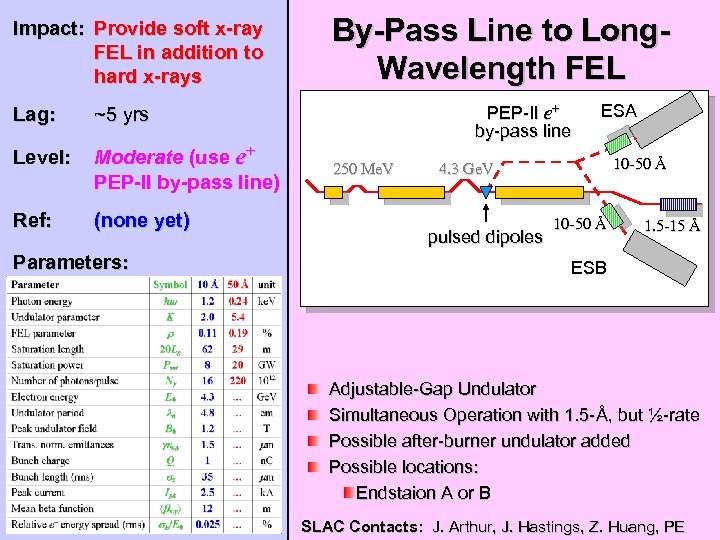
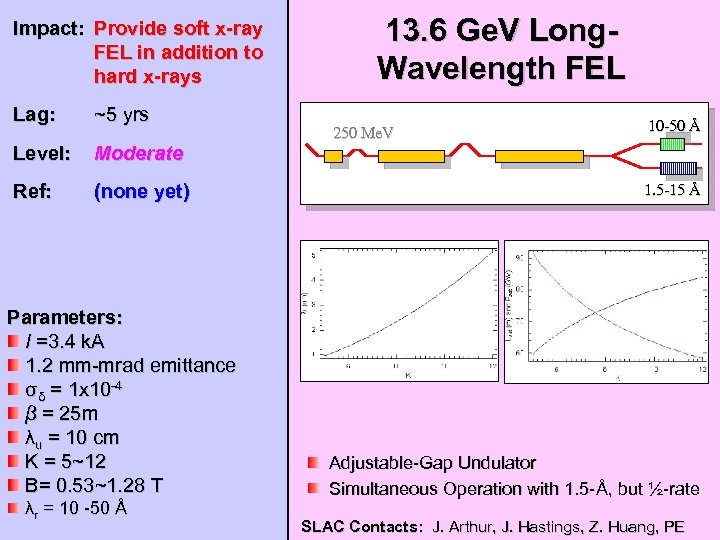 Impact: Provide soft x-ray FEL in addition to hard x-rays Lag: ~5 yrs Level: Moderate Ref: (none yet) Parameters: I =3. 4 k. A 1. 2 mm-mrad emittance σδ = 1 x 10 -4 β = 25 m λu = 10 cm K = 5~12 B= 0. 53~1. 28 T λr = 10 -50 Å 13. 6 Ge. V Long. Wavelength FEL 250 Me. V 10 -50 Å 1. 5 -15 Å Adjustable-Gap Undulator Simultaneous Operation with 1. 5 -Å, but ½-rate SLAC Contacts: J. Arthur, J. Hastings, Z. Huang, PE
 X-FEL based on last 1 -km of existing SLAC linac 1. 5 -15 Å LCLS ? 2 compressors one undulator
 27 Ge. V, ge = 0. 8 mm, 6. 0 k. A: 14 Ge. V, ge = 1. 2 mm, 3. 4 k. A: The SLAC linac can explore and reach the limits of FEL performance: Peak brightness Fluence Pulse duration These limits are primarily determined at LOW energy: Gun Bunch compression This is an extraordinary scientific opportunity Near- and long-term payoff Peak Brightness (phot. /s/mrad 2/mm 2/0. 1%-BW) LCLS Future Options: XFEL 27 Ge. V LCLS soft LCLS nom. Photon Energy (e. V)
 Impact: Provide soft x-ray FEL in addition to hard x-rays Lag: Moderate (use e+ PEP-II by-pass line) Ref: (none yet) PEP-II e+ by-pass line ~5 yrs Level: By-Pass Line to Long. Wavelength FEL Parameters: 250 Me. V ESA 10 -50 Å 4. 3 Ge. V pulsed dipoles 10 -50 Å 1. 5 -15 Å ESB Adjustable-Gap Undulator Simultaneous Operation with 1. 5 -Å, but ½-rate Possible after-burner undulator added Possible locations: Endstaion A or B SLAC Contacts: J. Arthur, J. Hastings, Z. Huang, PE
 Impact: Provide variable polarization in the 1 -5 nm wavelength range Lag: ~5 yrs Level: Moderate – new undulator Ref: none yet Circular Polarization for Soft x-rays ~ 2 GW (linear polarized) planar Six 3. 4 m sections Two sections ~ 20 GW (90% circular polarized) Parameters: Electron energy 4. 3 Ge. V 1. 2 mm-mrad emittance Energy spread 1 Me. V Standard LCLS undulator helical Contacts: Y. Ding, Z. Huang
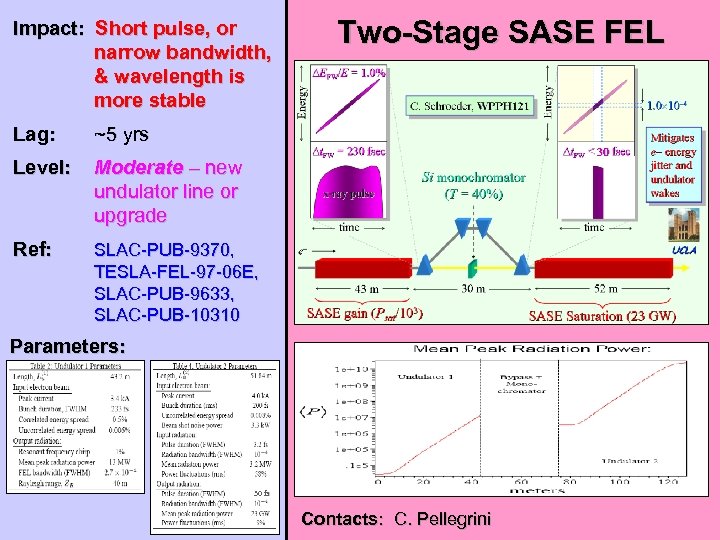 Impact: Short pulse, or narrow bandwidth, & wavelength is more stable Lag: ~5 yrs Level: Moderate – new undulator line or upgrade Ref: Two-Stage SASE FEL SLAC-PUB-9370, SLAC-PUB-9370 TESLA-FEL-97 -06 E, SLAC-PUB-9633, SLAC-PUB-10310 30 Parameters: 30 fs Contacts: C. Pellegrini
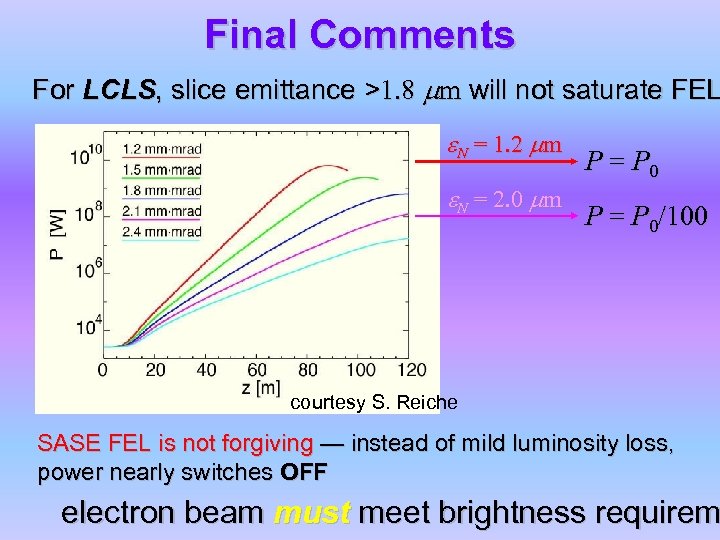 Final Comments For LCLS, slice emittance >1. 8 mm will not saturate FEL e. N = 1. 2 mm e. N = 2. 0 mm P = P 0/100 courtesy S. Reiche SASE FEL is not forgiving — instead of mild luminosity loss, power nearly switches OFF electron beam must meet brightness requirem