


 Скачать презентацию THE LAW OF COMMERCIAL CONTRACT Revision THE
6e5cf82760efb1daf5e1994795b287f5.ppt
- Количество слайдов: 47
 THE LAW OF COMMERCIAL CONTRACT Revision
 THE LAW OF COMMERCIAL CONTRACT Terms implied by Legislation § 3 Acts that imply terms in a contract § Criteria for TPA to apply § Definition on consumer contract in TPA
 THE LAW OF COMMERCIAL CONTRACT Application of Trade Practices Act § Applies only where § The vendorsupplier is subject to the Act § The purchaser is a consumer § The service is provided in the course of business
 THE LAW OF COMMERCIAL CONTRACT Application of Trade Practices Act The supplier is subject to the Act if: § A trading, financial or foreign corporation § It is operating in a territory (e. g. NT) § The contract involves interstate trade § The contract involves overseas trade § The contract involves the Commonwealth or its organisations
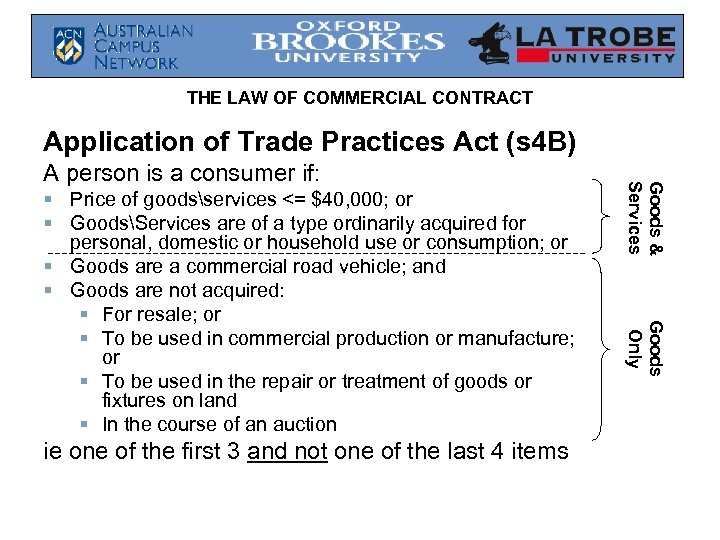 THE LAW OF COMMERCIAL CONTRACT Application of Trade Practices Act (s 4 B) ie one of the first 3 and not one of the last 4 items Goods Only § Price of goodsservices <= $40, 000; or § GoodsServices are of a type ordinarily acquired for personal, domestic or household use or consumption; or § Goods are a commercial road vehicle; and § Goods are not acquired: § For resale; or § To be used in commercial production or manufacture; or § To be used in the repair or treatment of goods or fixtures on land § In the course of an auction Goods & Services A person is a consumer if:
 THE LAW OF COMMERCIAL CONTRACT Terms of the Contract Statutory Implied Terms (Sweeney & O’Reilly Chapter 8 pp 184 – 199)
 THE LAW OF COMMERCIAL CONTRACT Goods Act (Vic) § Covers sale of goods only § Distinguishes between consumer and nonconsumer contracts § Consumer contracts Applies terms similar to those implied by Trade Practices Act § Non-consumer contracts Applies different terms that can be excluded by agreement § Applies to contracts made in Victoria § Similar legislation in other Australian States
 THE LAW OF COMMERCIAL CONTRACT Goods Act (Vic) § Defines consumer contracts as contracts for the sale of goods: § Under $20, 000; or § Ordinarily acquired for personal, domestic or household use; and are not brought for § Resale; or § Use as inputs in manufacture (Section 85 Goods Act)
 THE LAW OF COMMERCIAL CONTRACT Goods Act (Vic) § But Trade Practices Act defines a limit of $40, 000 § If a consumer contract as defined by Trade Practices Act then TPA applies § Otherwise Goods Act (Vic) applies § Consumer provisions of Goods Act apply but TPA does not apply where supplier not subject to TPA
 THE LAW OF COMMERCIAL CONTRACT Goods Act (Vic) § Non-consumer provisions of Goods Act apply to, for example: § Sale of component parts to manufacturer § Sales of raw materials to a commercial enterprise § Sales of finished goods to a reseller § Sales of industrial goods over ($40, 000) § International sales of goods
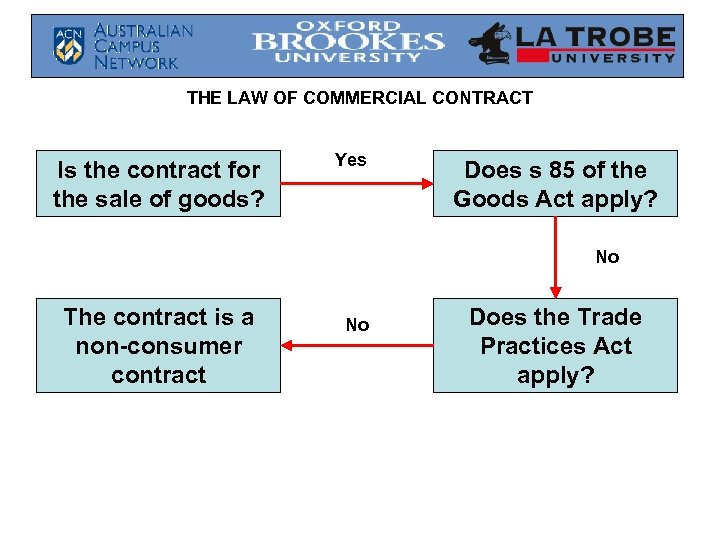 THE LAW OF COMMERCIAL CONTRACT Is the contract for the sale of goods? Yes Does s 85 of the Goods Act apply? No The contract is a non-consumer contract No Does the Trade Practices Act apply?
 THE LAW OF COMMERCIAL CONTRACT Terms Implied by Goods Act § A condition that the seller has the right to sell (s 17) § A warranty that the buyer to have quiet enjoyment (s 17) § A warranty that the goods are free from encumbrance (s 17) § Where sale by description, a condition that the goods match the description § A condition that the goods are of merchantable quality (s 19(b))
 THE LAW OF COMMERCIAL CONTRACT Terms Implied by Goods Act Where seller: § expressly or impliedly makes known to the seller the purpose for which the goods are being purchased § In such circumstances that the seller knows or ought to know that the buyer is relying on the seller’s skill or judgment There is an implied condition that the goods will be fit for the purpose (s 20)
 THE LAW OF COMMERCIAL CONTRACT Terms Implied by Goods Act § Similar to terms implied by TPA but some differences § Case law on Goods Act can be applied to interpretation of TPA
 THE LAW OF COMMERCIAL CONTRACT Fitness for Purpose § Overlaps with implied condition of merchantable quality § David Jones v Willis (S&O p 192) § Buyer must make known the particular purpose to the seller § Griffiths v Peter Conway (S&O p 193) § Purpose may be a matter of inference § Godfrey v Perry (S&O p 193)
 THE LAW OF COMMERCIAL CONTRACT Fitness for Purpose § Buyer’s reliance on seller’s skill and judgment § may be only partial but it must be a “substantial and effective inducement” to purchase § Must be reasonable § Teheran-Europe Co v S T Belton (Tractors) (S&O p 194)
 THE LAW OF COMMERCIAL CONTRACT Merchantable Quality Claim for breach of implied term exists if: § Sale by description by seller who normally deals in such goods (note: not required by TPA) § The goods are not as fit for their normal purpose or purposes as is reasonable to expect having regard to the price and other circumstances § Buyer was not aware of defect § Inspection before sale would not have revealed the defect
 THE LAW OF COMMERCIAL CONTRACT Merchantable Quality § § Sale by Description Frank v Grosvenor Motor Auctions (S&O p 187) § There has there been sale by description if the buyer primarily relies upon their classification or possession of attributes as described in the description § Having regard to Price § Brown & Son v Craiks (S&O p 190) § H Beecham v Francis Howard (*S&O p 190)
 THE LAW OF COMMERCIAL CONTRACT Merchantable Quality § Having regard to other circumstances § New v’s Used § ACCC circular (S&O p 191) § Bartlett v Sidney Marcus (S&O p 191) § Any defect, even if easily remedied § Grant v Australian Knitting Mills (S&O p 191)
 THE LAW OF COMMERCIAL CONTRACT Correspondence with Description § Those matters that identify the goods (cf merchantable quality) § Usually applies where § Goods not yet ascertained § Goods not yet in existence § Buyer has not seen goods § Varley v Whipp (S&O p 194) § Goods are part of a display § Beale v Taylor (S&O p 195)
 THE LAW OF COMMERCIAL CONTRACT Correspondence with Description § Extends to packaging § Moore v Landauer & Co (S&O p 195) § Buyer must rely on description § Harlington & Leinster Enterprise v Christopher Hull Fine Art (S&O p 196) § Ashington Piggeries v Christopher Hill (S&O p 196)
 THE LAW OF COMMERCIAL CONTRACT Correspondence with Sample § Bulk of goods must correspond with sample (s 20) Goods shall be free from any defect rendering them unmerchantable which would not be apparent from examination of the sample (s 20(2)(c)) § Buyer shall be given a reasonable opportunity of comparing the bulk with the sample (s 20(2)(b) § If sale of goods by description and sample, all goods (not just bulk) must correspond with description (s 19(a))
 THE LAW OF COMMERCIAL CONTRACT Other Implied Terms § Price § If no price, then a reasonable price is to be paid (S 13) § Delivery (s 36) § If no time is fixed, then delivery is to be within a reasonable time
 THE LAW OF COMMERCIAL CONTRACT Other Implied Terms Goods Act (VIC) implies terms relating to § Acceptance (ss 41 & 42) § Once accepted, goods cannot be returned (non-consumer contracts only) § Occurs when § Buyer says he accepts goods § Buyer does anything inconsistent with seller’s ownership § A reasonable time has elapsed
 THE LAW OF COMMERCIAL CONTRACT Other Implied Terms § Goods Act (VIC) implies terms relating to § Passing of Property (i. e. title) (ss 22 & 23) § Payment § Risk (s 25) § Goods Act (VIC) will not create a contract where none existed § ANZ Banking v Frost Holdings (S&O p 198)
 THE LAW OF COMMERCIAL CONTRACT Excluding or Limiting Implied Terms § The terms implied by the Goods Act (Vic) in nonconsumer contracts can be excluded or limited § Normal rules relating to exclusion clauses apply i. e § Is the exclusion clause a term of the contract? § Does the exclusion clause cover the breach? § Subject to equitable remedies e. g. § Unconscionable conduct § Economic duress
 THE LAW OF COMMERCIAL CONTRACT e. Commerce
 THE LAW OF COMMERCIAL CONTRACT e. Commerce Issues § § § Jurisdiction Form of contract Time and place of offer and acceptance Incorporation of terms Capacity of software agents
 THE LAW OF COMMERCIAL CONTRACT Jurisdiction § Different laws § Conflict of Laws § International conventions § Vienna Sales Convention § UNCITRAL Model Law on Electronic Commerce § International Chamber of Commerce E-Terms repository § This lecture deals only with Australian law
 THE LAW OF COMMERCIAL CONTRACT Jurisdiction § Which country’s laws are to be applied to address the respective rights and obligations of the parties? § What is the consequence of a country’s lack of jurisdiction?
 THE LAW OF COMMERCIAL CONTRACT Jurisdiction § The Internet transcends geographic borders , there are no laws or borders on the Internet. There is no ‘Lex Internet’. § Different countries have different § Legal systems § Criminal law § consumer protection legislation § etc
 THE LAW OF COMMERCIAL CONTRACT Jurisdiction § France § The Yahoo case § Germany § The Adelaide Institute § Trade mark cases § Legislation (1997) – Any web site accessible from Germany is subject to German law
 THE LAW OF COMMERCIAL CONTRACT Jurisdiction § USA approach § Systematically doing business with territory; or § Minimum contact with Territory § Targeted solicitation § Interactive response features § Provisions for taking orders and making contracts § Australia § Macquarie Bank Ltd v Berg (Unreported) Supreme Court of NSW per Simpson J, 2 June 1999 § Gutnik’s case
 THE LAW OF COMMERCIAL CONTRACT Form of Contract § Many statues require: § Writing § Signature § Sealed and delivered (Deed) § Witnesses etc § Section 8 Electronic Transactions Act § A transaction is not invalid because it took place wholly or partly by means of one or more electronic communications
 THE LAW OF COMMERCIAL CONTRACT Time & Place of Offer & Acceptance § Are electronic communications subject to the postal rule? § “instantaneous” § does not refer to speed of communication § Refers to if other party can immediately notify the other if he does not receive whole or part of message § Vienna Sales Convention § Applies to contracts involving signatory countries § Doesn’t apply to consumer goods or auctions § Contract is formed when acceptance is delivered to the offeror’s mailing address
 THE LAW OF COMMERCIAL CONTRACT Time & Place of Offer & Acceptance § Is email instantaneous? § Vienna Sales Convention § The acceptance is sent when it is put in the offeror’s mailbox § Is online shopping instantaneous? § Vienna Sales Convention § Offer is made when it is delivered to the seller’s URL
 THE LAW OF COMMERCIAL CONTRACT Time & Place of Offer & Acceptance § Section 14 Electronic Transactions Act § Dispatch occurs when it enters the first information system outside the control of the sender § Receipt occurs when it enters the information system designated by the recipient § If no information system designated then receipt occurs when it comes to the recipient’s attention
 THE LAW OF COMMERCIAL CONTRACT Time & Place of Offer & Acceptance § Section 14 Electronic Transactions Act § Dispatch occurs at the sender’s place of business § Receipt occurs at the recipient’s place of business § If more than one place of business then § Place of business most closely related to the transaction § Otherwise, principal place of business
 THE LAW OF COMMERCIAL CONTRACT Time & Place of Offer & Acceptance § Section 14 Electronic Transactions Act § If no place of business § Place of residence
 THE LAW OF COMMERCIAL CONTRACT Time & Place of Offer & Acceptance § Clicking “I accept” button § This is the offer § Seller can accept or reject § Electronic Auctions § The bid is the offer § Auctioneer can accept or reject § But, there may be a collateral contract with auctioneer that he will accept the bid
 THE LAW OF COMMERCIAL CONTRACT Shrinkwrap Agreements § Terms and conditions are not shown to purchaser until after he has bought the box and opened it § Terms cannot be imposed after contract formed § Purchaser must be given reasonable notice of terms before contract formed
 THE LAW OF COMMERCIAL CONTRACT Shrinkwrap Agreements (cont. ) § Are there 2 contracts? § One to buy the box § One to licence the software § Cases have recognised practical importance of allowing terms to be made known after sale § Mc. Robertson Miller Airlines v Commissioner for State Taxation (1975) 133 CLR 125 § Hill v Gateway 2000 Inc. § Try and return clauses
 THE LAW OF COMMERCIAL CONTRACT Electronic Agents § Can a party’s intention be expressed by a computer § Can a computer act as an electronic agent § Ostensible (apparent) authority of agents § Principal is bound where he puts agent in a position where he appears to have authority § Principal is nopt bound where agent it is clear to others that agent is acting outside ostensible authority
 THE LAW OF COMMERCIAL CONTRACT Electronic Agents (cont. ) Section 15 Electronic Transactions Act (1) For the purposes of a law of the Commonwealth, unless otherwise agreed between the purported originator and the addressee of an electronic communication, the purported originator of the electronic communication is bound by that communication only if the communication was sent by the purported originator or with the authority of the purported originator. (2) Subsection (1) is not intended to affect the operation of a law (whether written or unwritten) that makes provision for: a) conduct engaged in by a person within the scope of the person's actual or apparent authority to be attributed to another person; or b) a person to be bound by conduct engaged in by another person within the scope of the other person's actual or apparent authority.
 THE LAW OF COMMERCIAL CONTRACT Electronic Signatures § 3 possible legal scenarios § Minimalist § Only recognise that electronic signatures can be the same as written signatures § Prescriptive § Specify details of technology to be used § Set broad criteria for electronic signature to be effective
 THE LAW OF COMMERCIAL CONTRACT Electronic Signatures § Section 10 Electronic Transactions Act § adopts minimalist approach § Requires identification, attribution and assent § Does not require signature to verify message integrity § Technology used must be “as reliable as [is] appropriate”
 THE LAW OF COMMERCIAL CONTRACT Electronic Signatures § Section 10 Electronic Transactions Act § Recognises the need for different levels of authentication § Caters for technological advances § Does not favour one technology § Is consistent with international developments (e. g. UNCITRAL) § Only applies to areas covered by Commonwealth law § States are enacting parallel legislation