


 Скачать презентацию The Keys to Success Learning Experience and Proficiency
cef67b84e2d57ff789ad3e58e8406bdf.ppt
- Количество слайдов: 24
 The Keys to Success? Learning Experience and Proficiency in English. Giles Witton-Davies National Taiwan University DFLL
 Topic Age, experience and input in language learning. Differences between learners in their English learning history, and how these differences correlate with proficiency in reading, vocabulary and speaking.
 Topic (cont. ) n n Is more necessarily better? More what? Based on earlier study (2006), but more subjects and applied to speaking as well as reading and vocabulary.
 Anecdotal evidence n n n High proficiency students who have studied less. Low proficiency students who have studied more Those who have lived abroad usually have a good level, especially in oral ability.
 Factors considered in this study n Age started n Out of school study n Travel / study abroad n Communication with friends
 Factors in this study (cont. ) n n n Native speaker teachers Other second/ foreign languages spoken Opportunities to speak, read, write outside formal classes
 “English fever” Belief in the importance of …… n n n early start lots of class time native speaker teachers ……if English is to be learned successfully.
 The Age Factor n n Early start leads to higher ultimate attainment in second language contexts. Evidence very mixed on foreign language contexts. De. Keyser (2000): Critical period applies only to implicit learning, not explicit learning. Burstall (1975): Early start with French at school in the UK did not appear to lead to higher levels of proficiency later on.
 The Power of Reading n n Reading as a source of comprehensible input (Krashen 2004). Reading as an alternative to traditional classes (Lee, Mason). Reading best predictor of proficiency (Witton-Davies 2006). Availability of reading materials
 A similar study. . . Gradman H. & Hanania (1991). ESL at Indiana University, USA. Investigates 33 factors involved in language learning: formal leaning, classroom exposure, extracurricular learning, attitude & motivation. n Reading main predictor of success. n Also important: NSTs, use of English as classroom language, intensive English programs.
 This study 118 first year English Students, National Taiwan University 2004, 5, 7 Intermediate – upper int – advanced levels Data: n Questionnaire on English experience. n Reading test: Advanced level GEPT. n Nation’s vocabulary diagnostic tests. n Oral class levels.
 Questionnaire n n Age at which started learning English. Whether studied at a cram school, and for how long. Whether studied with a private tutor, and for how long. Whether had native speaker teachers. How long?
 Questionnaire (cont. ) Whether has communicated with a friend in English. How long? n Whether travelled abroad. How long? n Out of class listening/ speaking/ reading/ writing: no. of years; how often; for how long. n
 Analysis Statistical correlation: n Pearson product moment correlation between proficiency measures and each factor. n Multiple regression
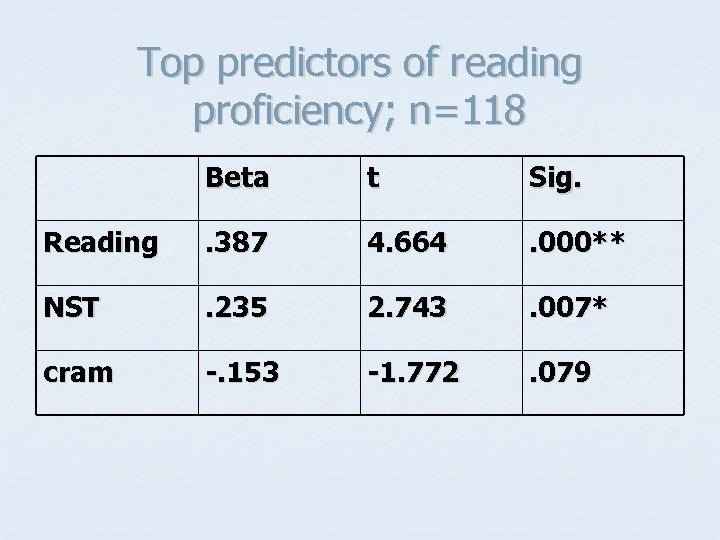 Top predictors of reading proficiency; n=118 Beta t Sig. Reading . 387 4. 664 . 000** NST . 235 2. 743 . 007* cram -. 153 -1. 772 . 079
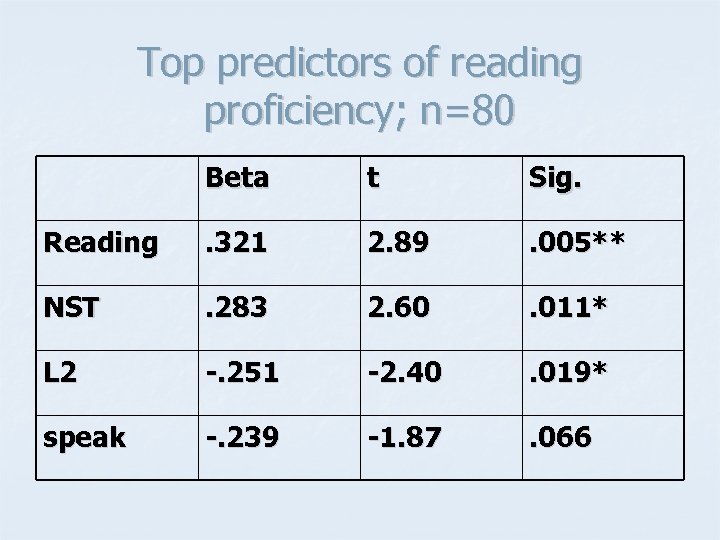 Top predictors of reading proficiency; n=80 Beta t Sig. Reading . 321 2. 89 . 005** NST . 283 2. 60 . 011* L 2 -. 251 -2. 40 . 019* speak -. 239 -1. 87 . 066
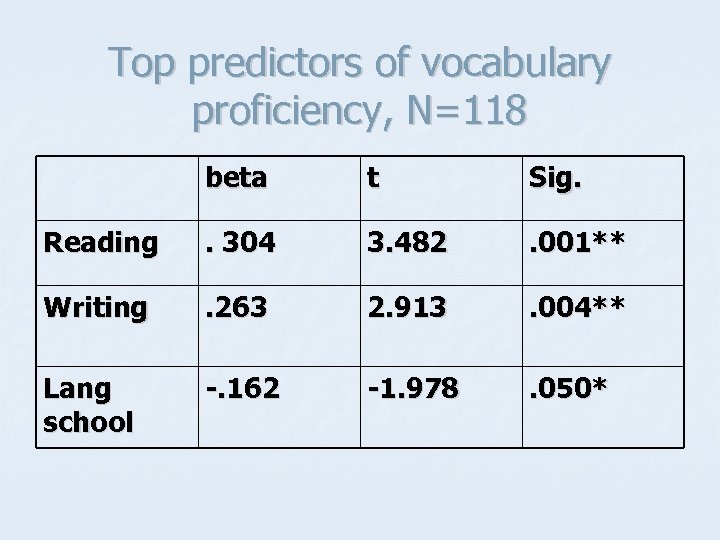 Top predictors of vocabulary proficiency, N=118 beta t Sig. Reading . 304 3. 482 . 001** Writing . 263 2. 913 . 004** Lang school -. 162 -1. 978 . 050*
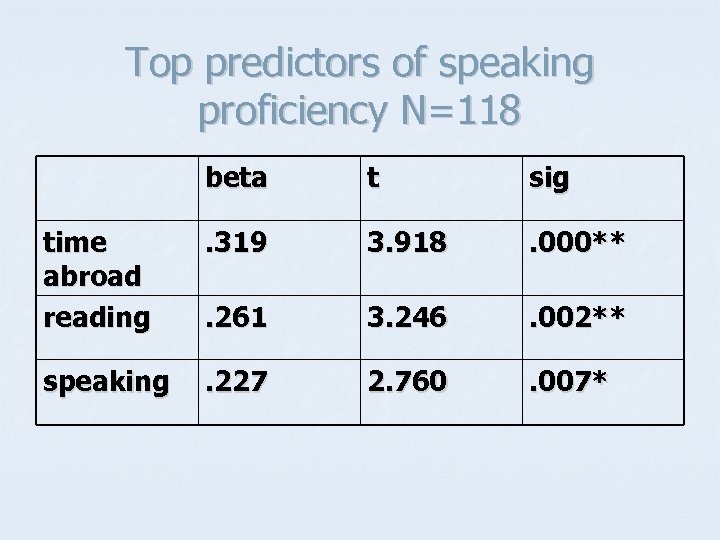 Top predictors of speaking proficiency N=118 beta t sig time abroad reading . 319 3. 918 . 000** . 261 3. 246 . 002** speaking . 227 2. 760 . 007*
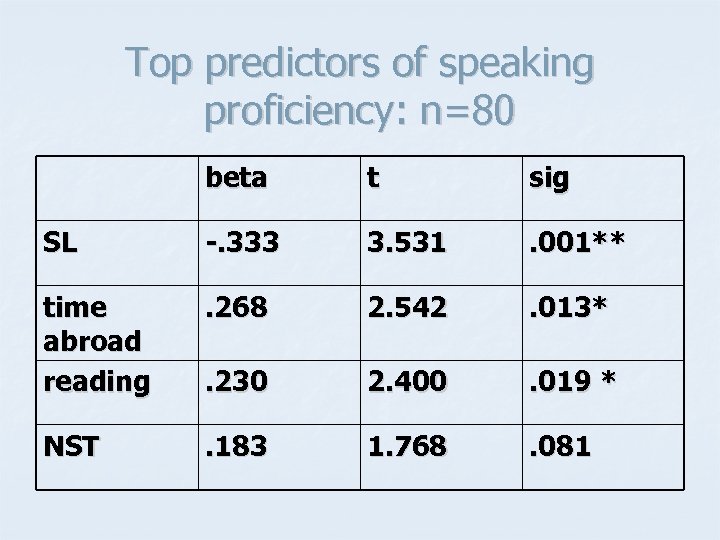 Top predictors of speaking proficiency: n=80 beta t sig SL -. 333 3. 531 . 001** time abroad reading . 268 2. 542 . 013* . 230 2. 400 . 019 * NST . 183 1. 768 . 081
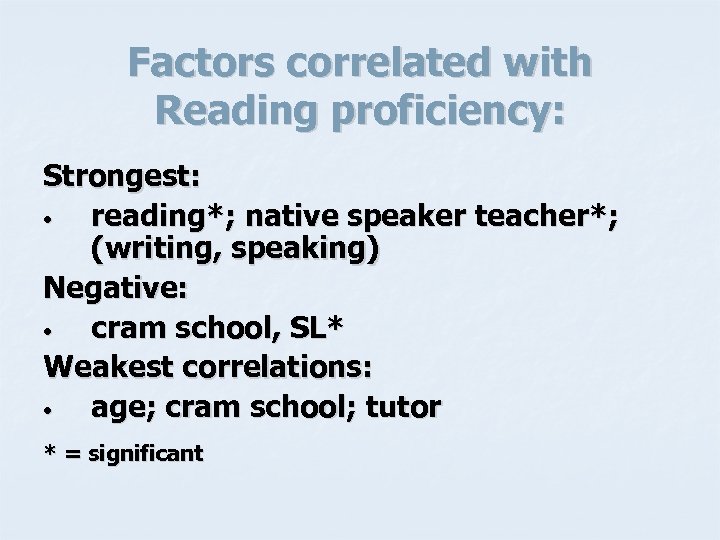 Factors correlated with Reading proficiency: Strongest: • reading*; native speaker teacher*; (writing, speaking) Negative: • cram school, SL* Weakest correlations: • age; cram school; tutor * = significant
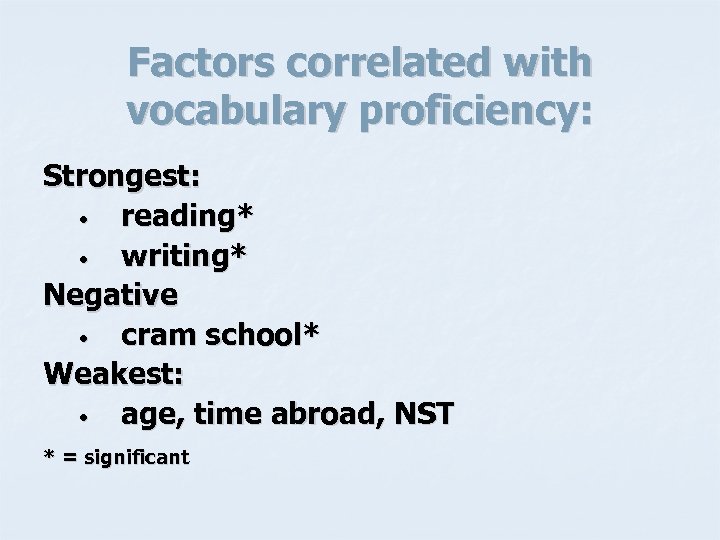 Factors correlated with vocabulary proficiency: Strongest: • reading* • writing* Negative • cram school* Weakest: • age, time abroad, NST * = significant
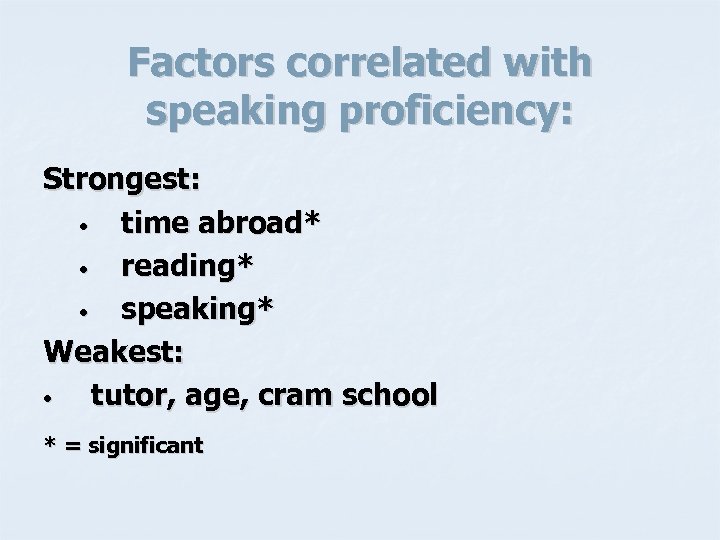 Factors correlated with speaking proficiency: Strongest: • time abroad* • reading* • speaking* Weakest: • tutor, age, cram school * = significant
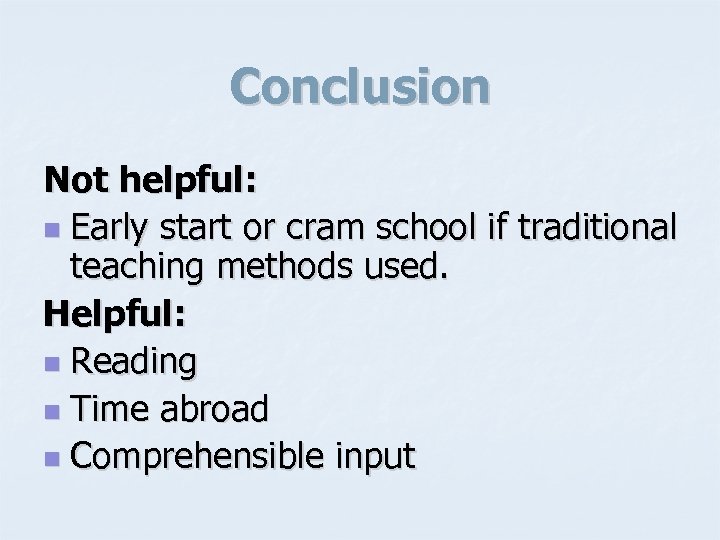 Conclusion Not helpful: n Early start or cram school if traditional teaching methods used. Helpful: n Reading n Time abroad n Comprehensible input
 References n n n n Burstall, C. (1975). Factors affecting foreign language learning: a consideration of some recent research findings. Language teaching and research abstracts 8, 5: 25. Reprinted in Kinsella (ed. ) (1978) Language teaching and Linguistics Surveys. Cambridge: CUP. Gradman, H. & Hanania, E. (1991). Language-learning background factors and ESL proficiency. Modern Language Journal 75, 1991: 39 -51. Krashen, S. (2004). The Power of Reading (2 nd edition). Portsmouth NH: Heinemann. Lee, S. Y. (2005 a). Facilitating and inhibiting factors in English as a foreign language writing performance. A model test with structural equation modeling. Language Learning 55 (2): 335 -374. Lee, S. Y. (2005 b). Sustained silent reading using assigned reading: Is comprehensible input enough? The International Journal of Foreign Language Teaching, 1(4): 10 -13. http: //www. tprstories. com/ijflt/ IJFLTFall 05. Mason, B. and Krashen, S. (1997). “Extensive reading in English as a foreign language. ” System 25: 91 -102. Witton-Davies, G. (2006). What does it take to acquire English? The International Journal of Foreign Language Teaching, 1(4): 2 -8. http: //www. tprstories. com/ijflt/ IJFLTFall 06.