


 Скачать презентацию THE KEY POINTS OF A GI APPLICATION Dr
82c77f4fadedc88f36cb9ea877bf90f8.ppt
- Количество слайдов: 33
 THE KEY POINTS OF A GI APPLICATION Dr Dominique BARJOLLE REDD Réseau Echanges Développement Durable
 Objectives of the presentation • How to identify the key points of a GI application? • How to demonstrate the link between the product and its geographical origin? • How to demonstrate the value to be recognized and protected?
 Plan 1. Main steps in getting a PDO or PGI registration 2. Factors determining the link between the product and its origin 3. How to identify the key-points from the point of view of a member of the PDO-PGI Commission? 4. How to demonstrate the link between the product and its geographical origin? 5. Value creation process
 1. MAIN STEPS IN GETTING A PDO-PGI REGISTRATION
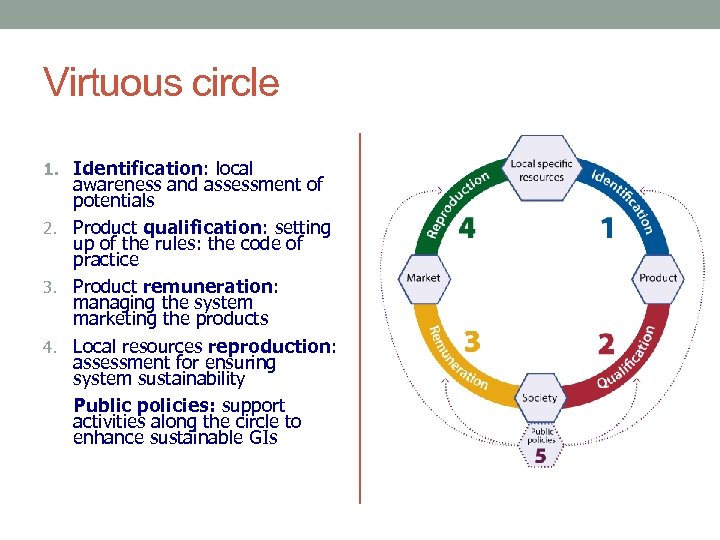 Virtuous circle 1. Identification: local awareness and assessment of potentials 2. Product qualification: setting up of the rules: the code of practice 3. Product remuneration: managing the system marketing the products 4. Local resources reproduction: assessment for ensuring system sustainability Public policies: support activities along the circle to enhance sustainable GIs
 For the producers • The first step in activating the virtuous circle of quality is the precise identification of local product and local resources needed for production. • For this, it is important that local producers realize the potential associated with specific local resources, which constitutes the basis for collective action to promote the value of the product.
 3 pre-requisites • The possibility of activating the origin-linked quality virtuous circle depends on the presence of three main prerequisites: 1. 2. 3. The product: it presents some specific characteristics linked to geographical origin that gives it a special quality and reputation in the market, resulting in specific consumer demand. The place: the special quality characteristics are the result of the natural and human resources of the local area in which it is produced. The people: the local producers, having inherited traditions and know-how, together with other local stakeholders, must be motivated to engage in a value creation and preservation process.
 Participatory approach • A participatory approach is required in order • to develop a common vision and strategy for the product, • to identify its links with the geographical origin, • to establish a collective protection system. • Moreover, local producers should be able to build and manage active and stable external relationships emanating from different perspectives: economic, political, social and scientific. • Therefore, territorial links and external networks are important to consider.
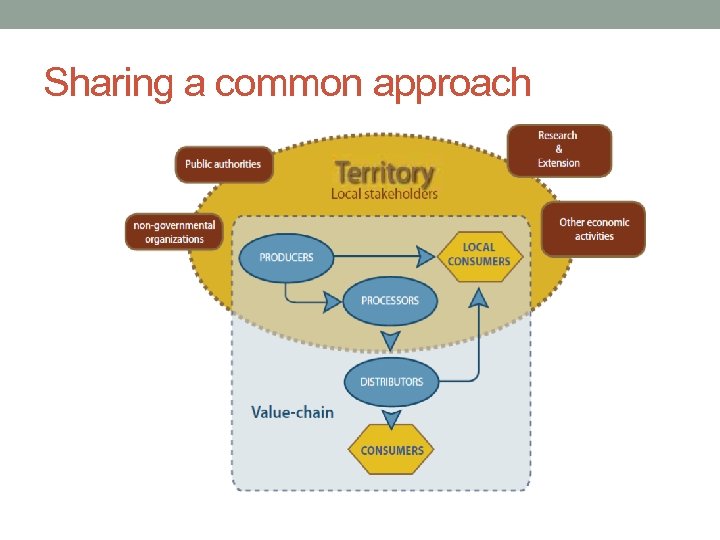 Sharing a common approach
 For the competent public authorities • Public intervention may be justified as GI products create employment and generate a positive image of the region. This can be useful for tourism and for the attractiveness of the region in general. • Public support can also come from national or international institutions, in a perspective on sustainable development and the need for balanced private-public coordination. • Scientific support may be useful during the process of rulesetting (for example by providing studies and research analysis on economic and social sustainability), to demonstrate the link between the product quality and its territorial origin and even to support the group of producers in marketing and promotion activities and collective organization management.
 Elaboration of the code of practice • The aim of the Co. P is to provide rules for applying the specific quality to the GI producers located in a delimited area. • The Co. P describes the specific characteristics of the GI product which are attributable to its geographical origin, justifying the link between the product and the territory (the same product cannot be elaborated in other territories).
 A Code of Practice. . . … must explain how • a given quality = the specific attributes that make the product different from others of the same category • a reputation = history of the product, past reputation, current reputation • or other characteristics = for instance know-how, form, etc. are linked to the origin.
 FACTORS DETERMINING THE LINK BETWEEN THE PRODUCT AND ITS ORIGIN
 2 main „types“ of factors • Natural factors • Human factors
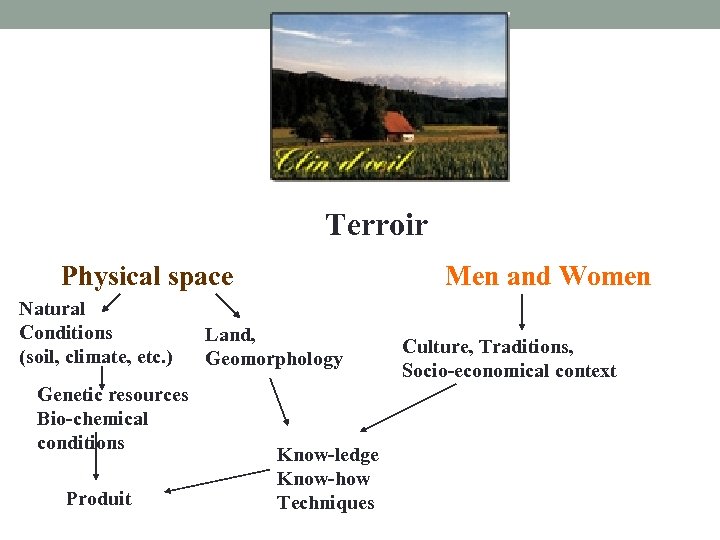 Terroir Physical space Natural Conditions (soil, climate, etc. ) Genetic resources Bio-chemical conditions Produit Men and Women Land, Geomorphology Know-ledge Know-how Techniques Culture, Traditions, Socio-economical context
 Typical from a geographic area • Typicity: What is linked to the TERROIR – Characteristics (know-ledge / know-how) which are originating from a place for a specific reason (altitude / climate / wind / …) – The characteristics are the result of localised resources, which belong to this region – Typicity is an heritage, it has a geographical and historical background
 Elements • The micro-organisms are a key-element which is link to specific natural conditions and must be preserved along the processing chain • Elements which are very important • Soil, Herb (botanic composition influence taste of the cheese) • Variety / breeds • Duration of solar period / Exposition to solar (fruit acidity) • Mediator like an animal (fat content of the milk – specific protein) or a process (wood fire) • During the maturation / storage (appearance of a specific mushroom in the blue cheese for Roquefort in France) (wood box to mature soft cheese) • After the storage, thank additional process (cutting)
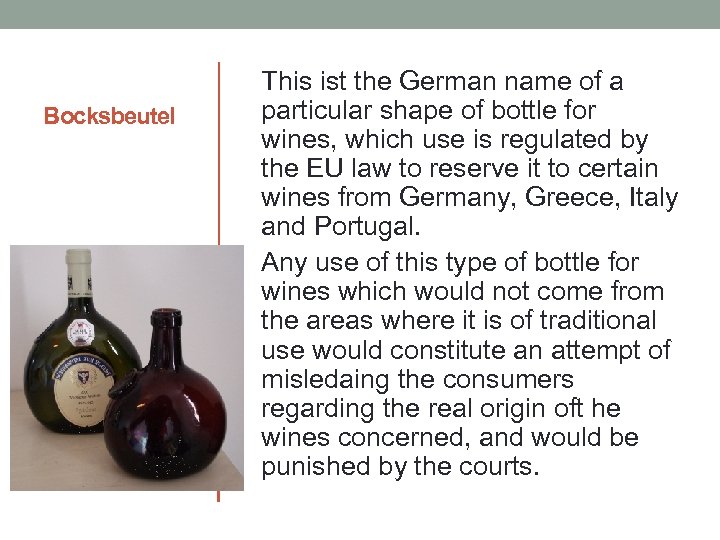 Bocksbeutel This ist the German name of a particular shape of bottle for wines, which use is regulated by the EU law to reserve it to certain wines from Germany, Greece, Italy and Portugal. Any use of this type of bottle for wines which would not come from the areas where it is of traditional use would constitute an attempt of misledaing the consumers regarding the real origin oft he wines concerned, and would be punished by the courts.
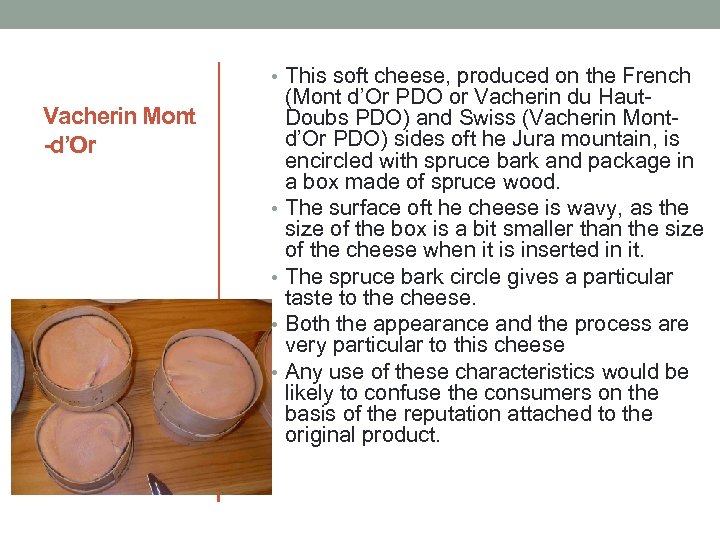 • This soft cheese, produced on the French Vacherin Mont -d’Or • • (Mont d’Or PDO or Vacherin du Haut. Doubs PDO) and Swiss (Vacherin Montd’Or PDO) sides oft he Jura mountain, is encircled with spruce bark and package in a box made of spruce wood. The surface oft he cheese is wavy, as the size of the box is a bit smaller than the size of the cheese when it is inserted in it. The spruce bark circle gives a particular taste to the cheese. Both the appearance and the process are very particular to this cheese Any use of these characteristics would be likely to confuse the consumers on the basis of the reputation attached to the original product.
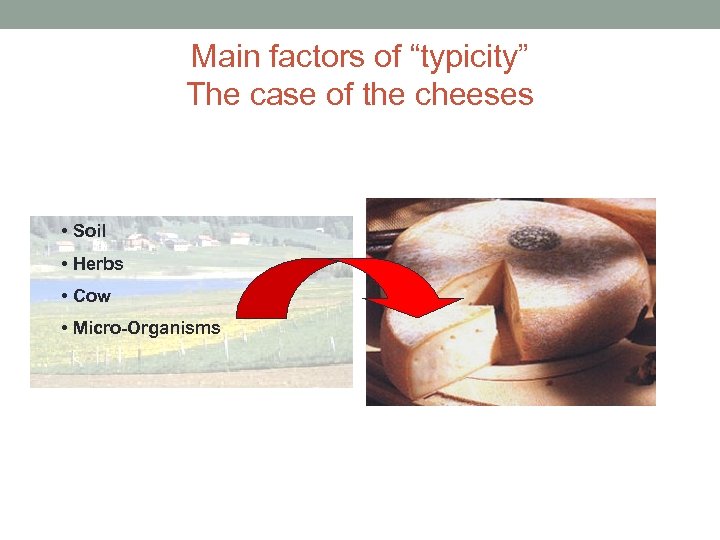 Main factors of “typicity” The case of the cheeses • Soil • Herbs • Cow • Micro-Organisms
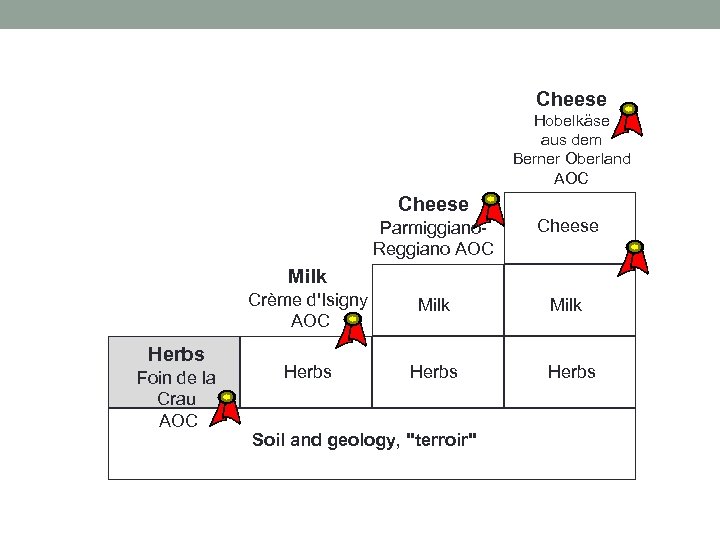 Cheese Hobelkäse aus dem Berner Oberland AOC Cheese Parmiggiano. Reggiano AOC Cheese Crème d'Isigny AOC Milk Herbs Foin de la Crau AOC Soil and geology, "terroir" Herbs
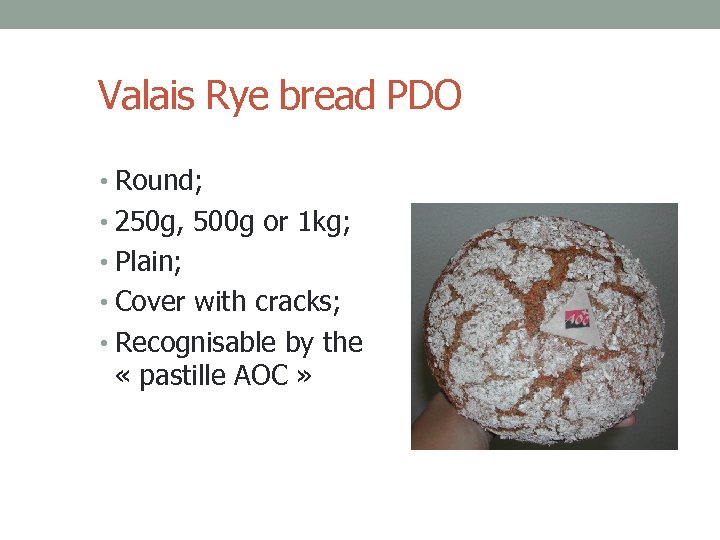 Valais Rye bread PDO • Round; • 250 g, 500 g or 1 kg; • Plain; • Cover with cracks; • Recognisable by the « pastille AOC »
 Rye bread of Valais Protected Designation of Origin The code of practice • Cereals produced in respect of the environment, exclusively in the Valais, and processed in the Valais; • A production process that is clearly defined in the code of practice; • Regular tasting by professionals; • A long fermenting leaven that gives the Rye bread its aspect (typically with cracks) and its specific taste; • A full grain bread made out of at least 90% Rye (max. 10% wheat).
 HOW TO IDENTIFY THE KEYPOINTS FROM THE POINT OF VIEW OF A MEMBER OF THE PDO-PGI COMMISSION?
 Key-points which are different and particular to the geographical origin In the application file • History of the product • Apparition of the product upon time • Cultural events linked with the product • Recipes and traditional dishes made from the product • Typicity • What makes the product specific in this region: taste / way of production (wood fire for ex. ) / texture / form / colour • Local, loyal and constant know-hows and uses Code of Practice (must reflect the application file) • Description of the product • Process of elaboration • Area delimitation
 For the Rye Bread • Origin of the rye (altitude / climate) • Origin of the rye gives a typical landscape in the region • Rye is a way to have changes in the crop rotation (maize / rye / herb x 2 or 3 years) so to preserve the quality of the soil and the yields without too much fertilizers nor pesticides • Cultivating cereals is important in the local identity and culture (mountain area) • Process (from rye to bread) • Quality of rye determines quality of the flour • Quality of the flour determines quality of the bread • Ferments – Mixing and kneading - Duration of fermenting • Way of cooking (prohibition of freezing) • Storage (vacuum-packed bread under a certain atmosphere) – duration between cooking and serving • Sensory qualities
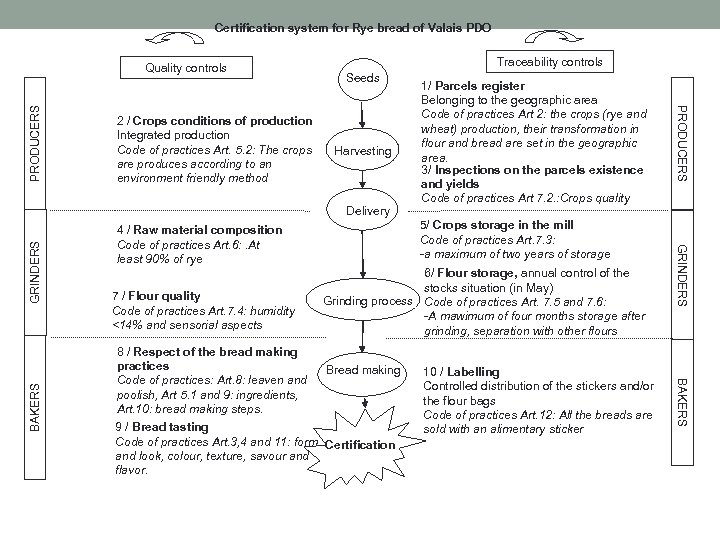 Certification system for Rye bread of Valais PDO 2 / Crops conditions of production Integrated production Code of practices Art. 5. 2: The crops are produces according to an environment friendly method Traceability controls Seeds Harvesting 7 / Flour quality Code of practices Art. 7. 4: humidity <14% and sensorial aspects 8 / Respect of the bread making practices Code of practices: Art. 8: leaven and poolish, Art 5. 1 and 9: ingredients, Art. 10: bread making steps. 6/ Flour storage, annual control of the stocks situation (in May) Grinding process Code of practices Art. 7. 5 and 7. 6: -A mawimum of four months storage after grinding, separation with other flours Bread making 9 / Bread tasting Code of practices Art. 3, 4 and 11: form Certification and look, colour, texture, savour and flavor. 10 / Labelling Controlled distribution of the stickers and/or the flour bags Code of practices Art. 12: All the breads are sold with an alimentary sticker BAKERS 5/ Crops storage in the mill Code of practices Art. 7. 3: -a maximum of two years of storage 4 / Raw material composition Code of practices Art. 6: . At least 90% of rye GRINDERS Delivery 1/ Parcels register Belonging to the geographic area Code of practices Art 2: the crops (rye and wheat) production, their transformation in flour and bread are set in the geographic area. 3/ Inspections on the parcels existence and yields Code of practices Art 7. 2. : Crops quality PRODUCERS Quality controls
 Some questions to be addressed • What is/are the designation(s) used to trade the product? • Are there specific associated signs or characteristics which may indicate the geographical origin of the product to consumers, in addition to the designation itself? • Are there problems caused by some heterogeneity of the products originating from the designated geographical area? • Are there problems of abuse or misuse of the designation?
 VALUE CREATION PROCESS
 PDO-PGI: tools for sustainable rural development Activation of the virtuous circle of quality will affect the three dimensions of sustainable development: • on the economic dimension, the consumer, paying for quality, will contribute to creating value localized in the rural territories, • environmentally, local products are often derived from extensive use of natural resources, and make use of rare and endemic breeds or varieties, • on the social dimension, origin-based products preserve traditional know-how and local cultural elements.
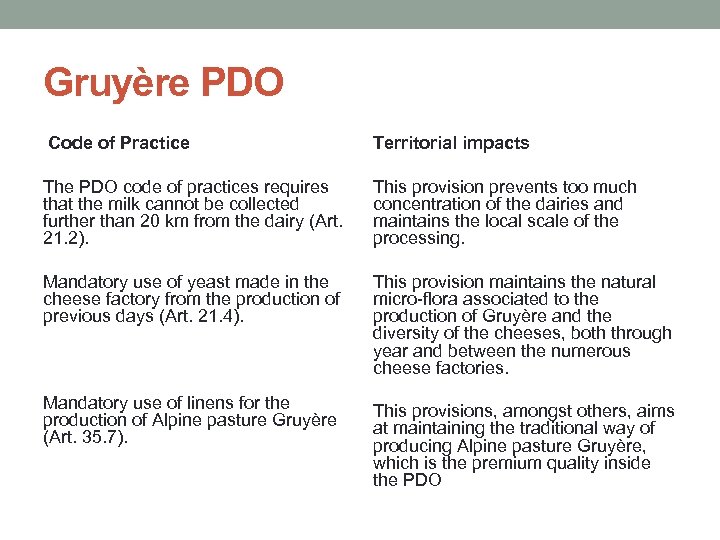 Gruyère PDO Code of Practice The PDO code of practices requires that the milk cannot be collected further than 20 km from the dairy (Art. 21. 2). Mandatory use of yeast made in the cheese factory from the production of previous days (Art. 21. 4). Mandatory use of linens for the production of Alpine pasture Gruyère (Art. 35. 7). Territorial impacts This provision prevents too much concentration of the dairies and maintains the local scale of the processing. This provision maintains the natural micro-flora associated to the production of Gruyère and the diversity of the cheeses, both through year and between the numerous cheese factories. This provisions, amongst others, aims at maintaining the traditional way of producing Alpine pasture Gruyère, which is the premium quality inside the PDO
 Monitoring • Identify during the registration process, based on the key- points of the specificity the indicators to be monitored • Can be, according to the characteristics of the products and the main challenges/expectations of the actors, various points: • Economic, like market share, volumes, turn-over, investments • Social like employment, job satisfaction, number of new entrepreneurs, cultural event, etc. • Environnemental, like biodiversity, preservation of a specific landscape, water availability, specific eco-system, forest or fisheries linked activities
 Thank you for your attention