 Скачать презентацию The K to 12 Curriculum and Capacity Building
38d9839411b4205830cfe5141780d946.ppt
- Количество слайдов: 81



The K to 12 Curriculum and Capacity Building for Teachers Brenda B. Corpuz, Ph. D
Official Launching K to 12 Launched officially in Malacanan Palace , April 26, 2012
Updates • Trainers’ Training for Grade 1 Teachers – April 23 -27 , 2012 – • Trainers’ Training for Grade 7 - April 18 May 4 , 2012 • Teachers’ Training - May, 2012 - Grade 1 - c/o Dep. Ed - Grade 7 – c/o 50% Dep. Ed and 50% TEIs
Schools Modeling Grades 11 -12 • • University of Makati Ateneo de Naga Phil. Women’s University Identified schools per region (mostly techvoc)
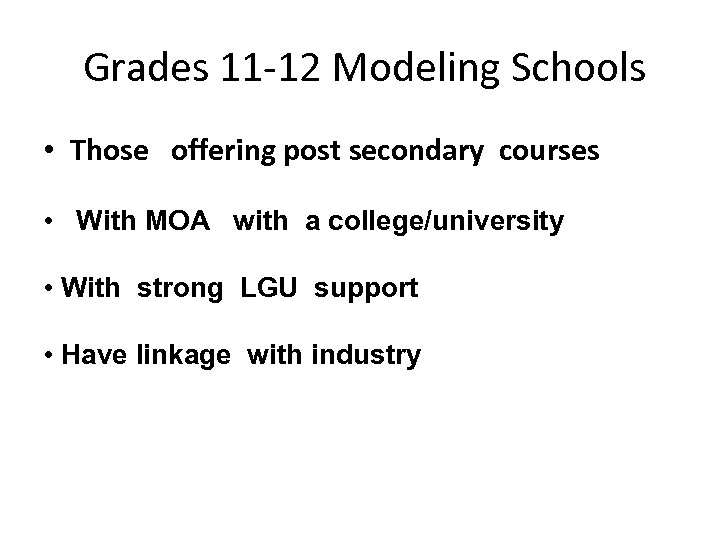
Grades 11 -12 Modeling Schools • Those offering post secondary courses • With MOA with a college/university • With strong LGU support • Have linkage with industry
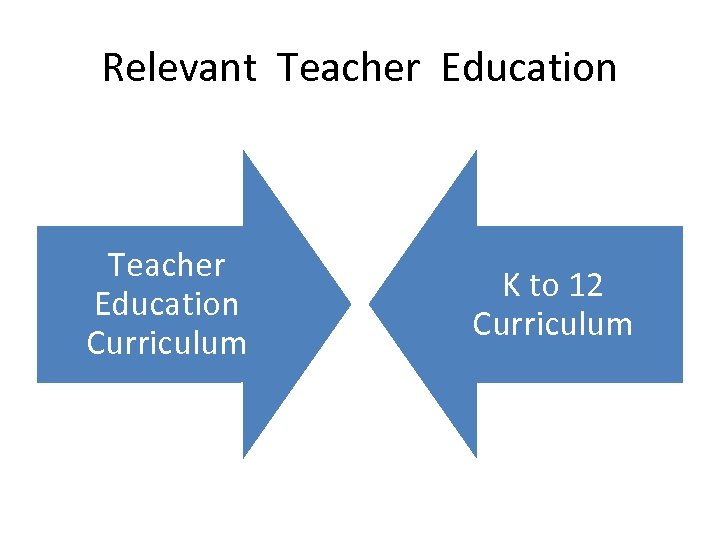
Relevant Teacher Education Curriculum K to 12 Curriculum
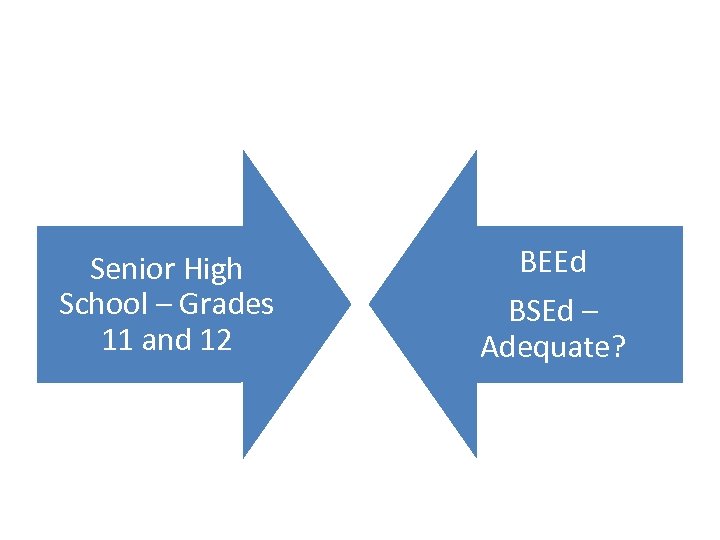
Senior High School – Grades 11 and 12 BEEd BSEd – Adequate?
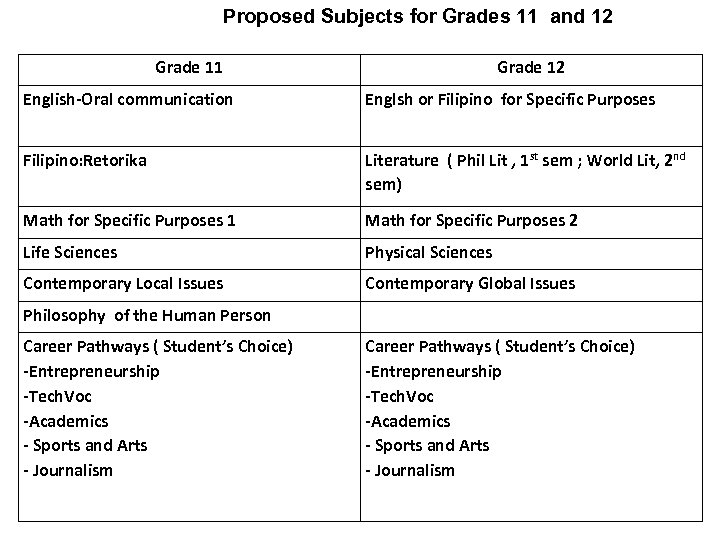
Proposed Subjects for Grades 11 and 12 Grade 11 Grade 12 English-Oral communication Englsh or Filipino for Specific Purposes Filipino: Retorika Literature ( Phil Lit , 1 st sem ; World Lit, 2 nd sem) Math for Specific Purposes 1 Math for Specific Purposes 2 Life Sciences Physical Sciences Contemporary Local Issues Contemporary Global Issues Philosophy of the Human Person Career Pathways ( Student’s Choice) -Entrepreneurship -Tech. Voc -Academics - Sports and Arts - Journalism
Transition • Grade 11 – 2016 -2017 – No First Year College • Grade 12 - 2017 -2018 – No Second Year College The instructors/professors of General Education subjects in college are expected to teach Grades 11 and 12.
Transition • Teachers teach the way they were taught. • Not all Gen Ed teachers are Education graduates – no preparation in Principles and Methods of Teaching; Assessment, etc.
Gen Ed Instructors /Professors • Need to go through capacity building /Certificate of Teaching - Philosophy of Education - Adolescent Development - Principles and Methods of Teaching - Assessment plus 6 units more • These may be offered by the College of Education
The Licensure Examination for Teachers • A license for teaching is required of basic education teachers ( R. A. 7836). • A license is an asset.
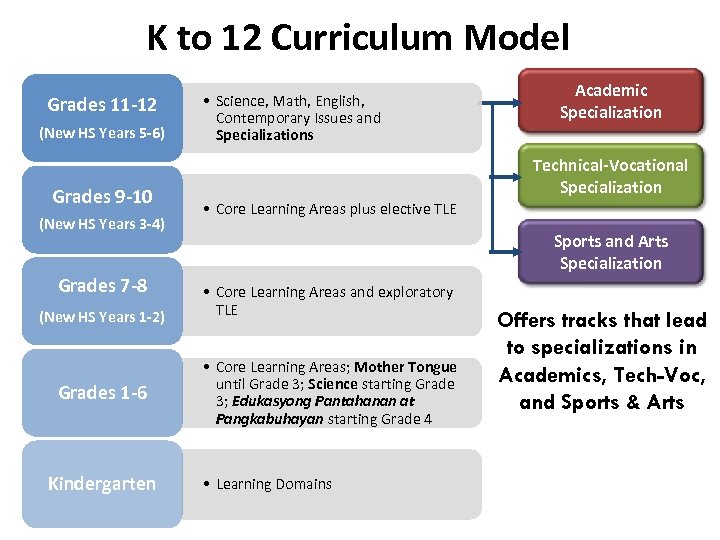
K to 12 Curriculum Model Grades 11 -12 (New HS Years 5 -6) Grades 9 -10 (New HS Years 3 -4) Grades 7 -8 (New HS Years 1 -2) Grades 1 -6 Kindergarten • Science, Math, English, Contemporary Issues and Specializations Academic Specialization Technical-Vocational Specialization • Core Learning Areas plus elective TLE Sports and Arts Specialization • Core Learning Areas and exploratory TLE • Core Learning Areas; Mother Tongue until Grade 3; Science starting Grade 3; Edukasyong Pantahanan at Pangkabuhayan starting Grade 4 • Learning Domains Offers tracks that lead to specializations in Academics, Tech-Voc, and Sports & Arts
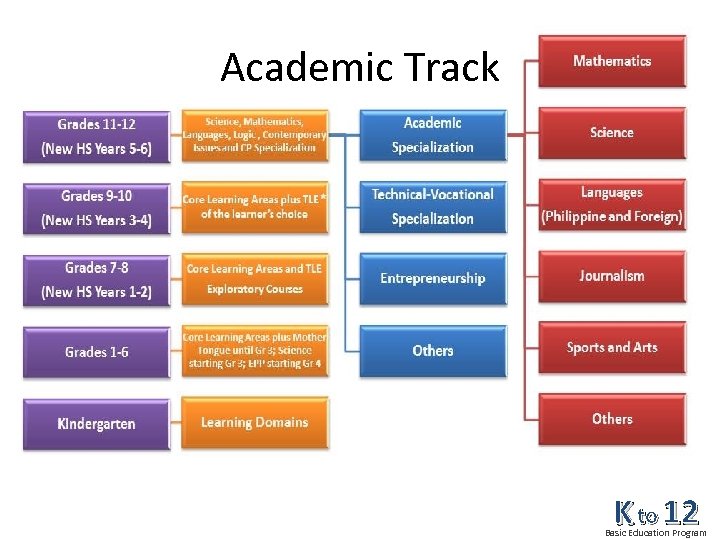
Academic Track K to 12 Basic Education Program
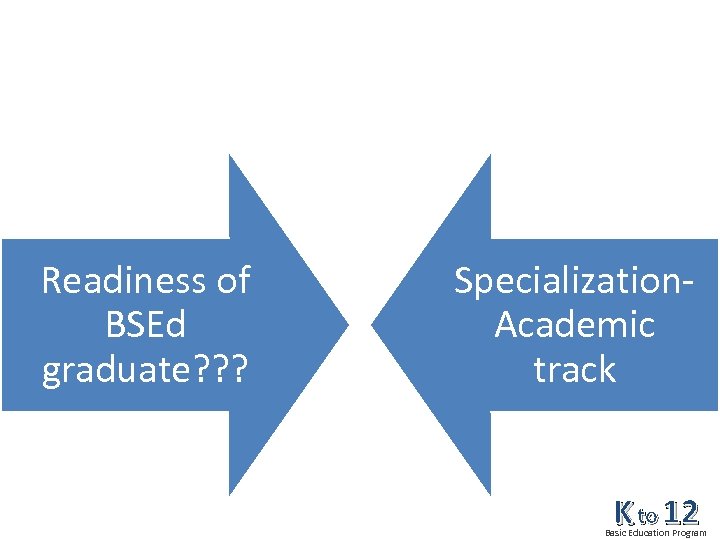
Readiness of BSEd graduate? ? ? Specialization. Academic track K to 12 Basic Education Program
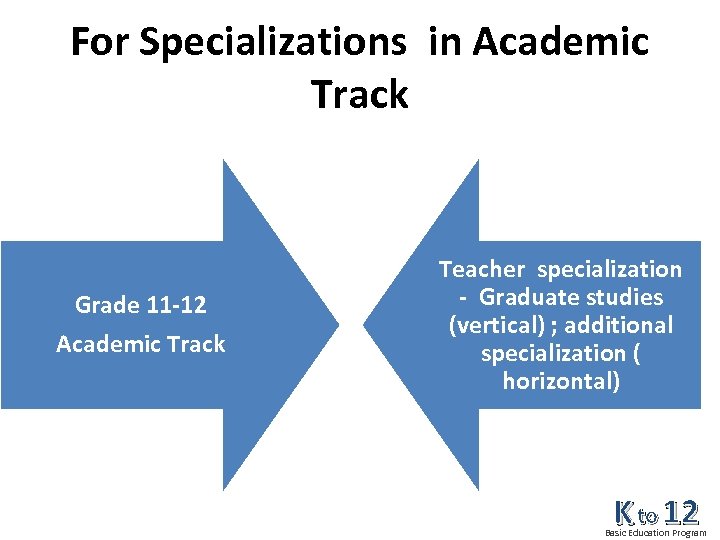
For Specializations in Academic Track Grade 11 -12 Academic Track Teacher specialization - Graduate studies (vertical) ; additional specialization ( horizontal) K to 12 Basic Education Program
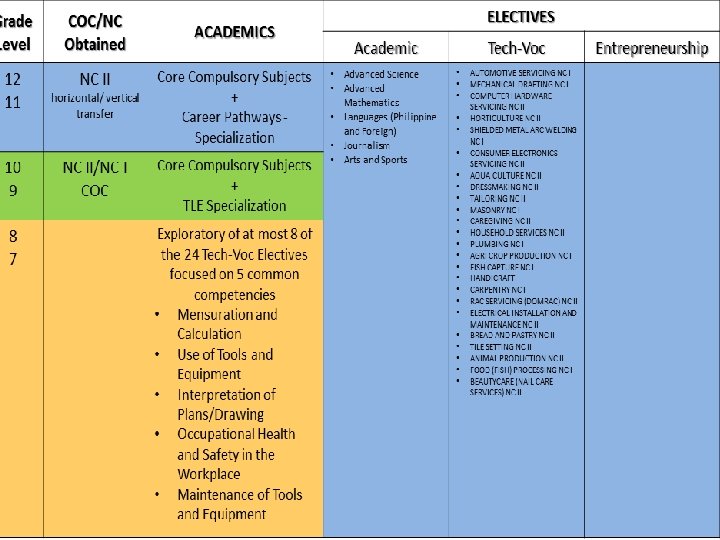
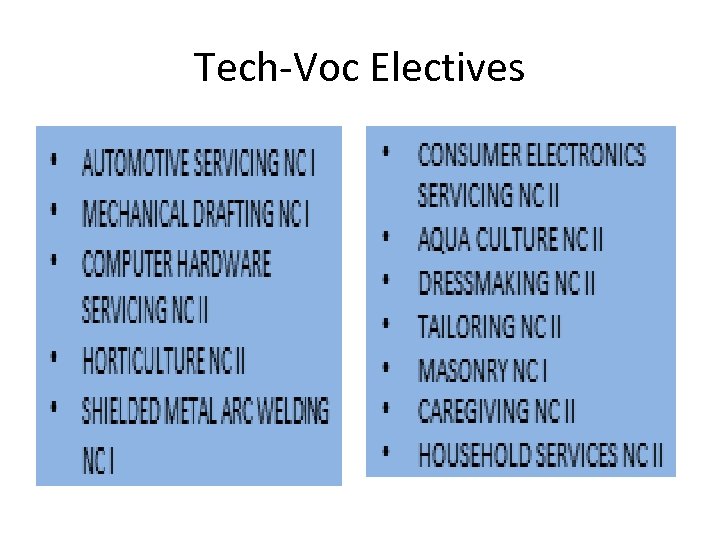
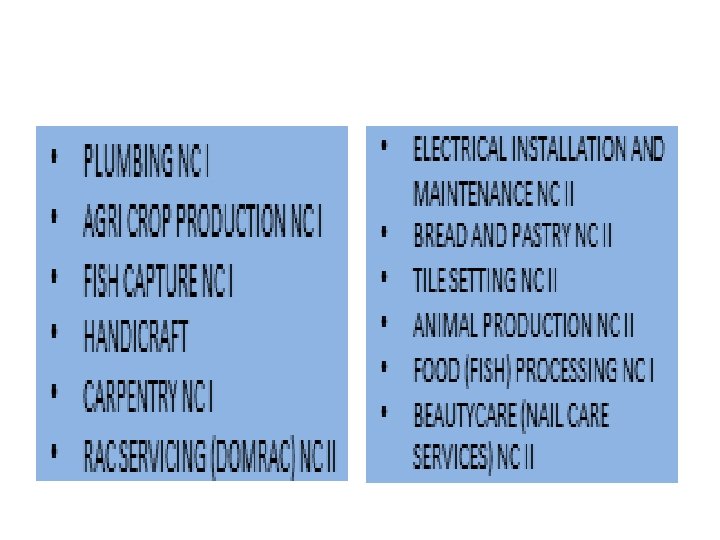
Tech-Voc Electives
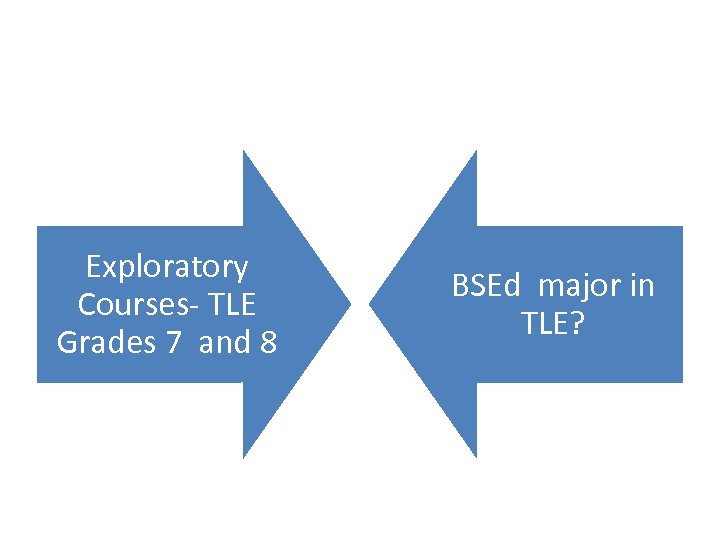
Exploratory Courses- TLE Grades 7 and 8 BSEd major in TLE?
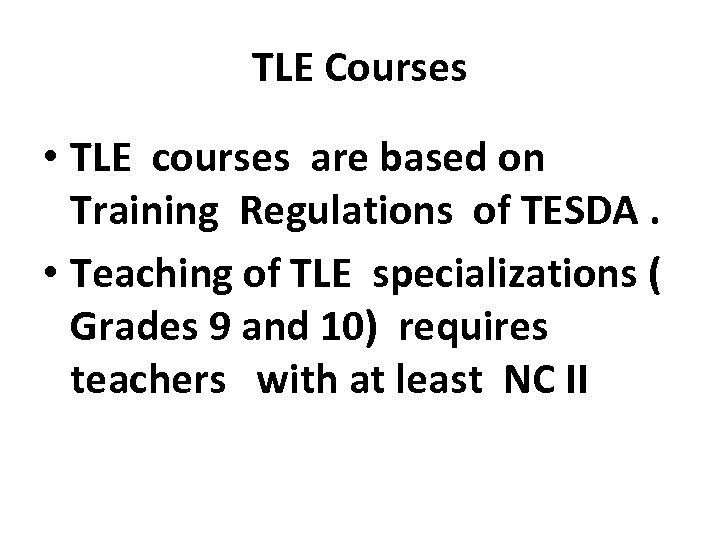
TLE Courses • TLE courses are based on Training Regulations of TESDA. • Teaching of TLE specializations ( Grades 9 and 10) requires teachers with at least NC II
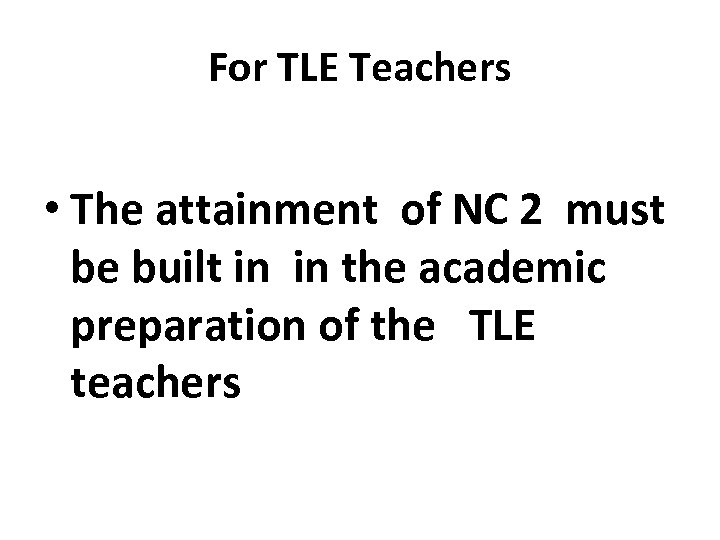
For TLE Teachers • The attainment of NC 2 must be built in in the academic preparation of the TLE teachers
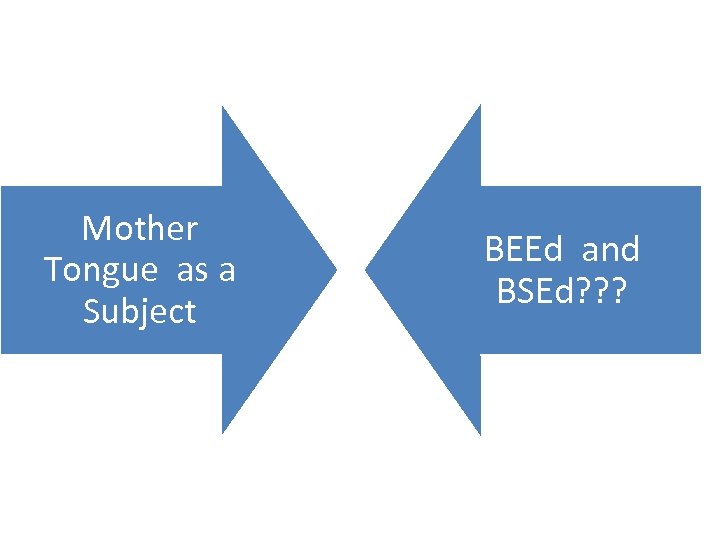
Mother Tongue as a Subject BEEd and BSEd? ? ?
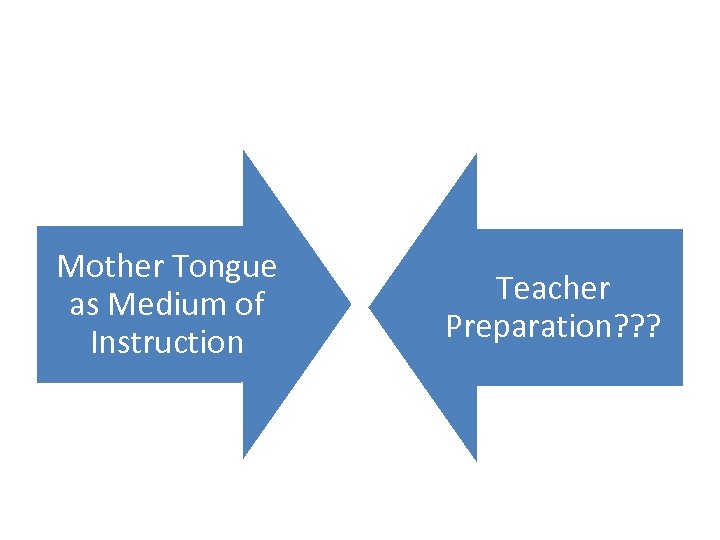
Mother Tongue as Medium of Instruction Teacher Preparation? ? ?
• Mother Tongue as a specialization for BEEd? • Or 18 units of Mother Tongue?
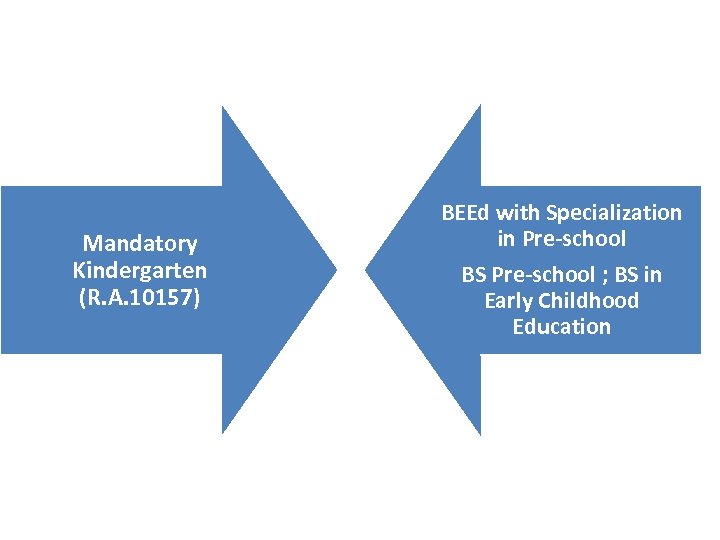
Mandatory Kindergarten (R. A. 10157) BEEd with Specialization in Pre-school BS Pre-school ; BS in Early Childhood Education
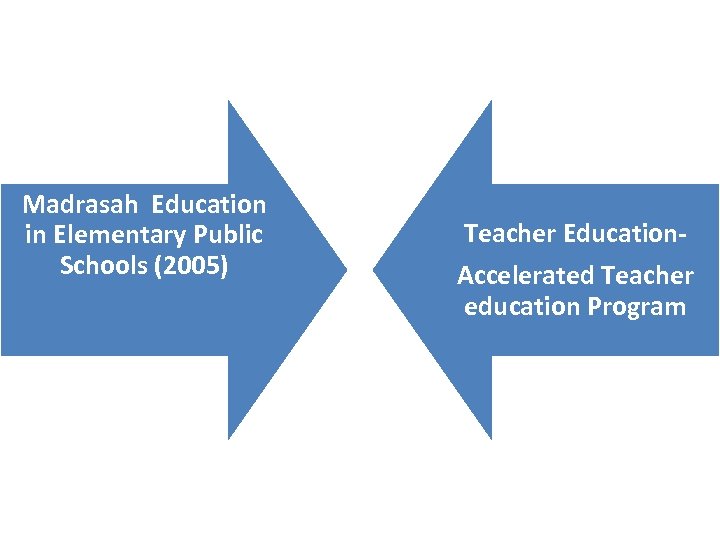
Madrasah Education in Elementary Public Schools (2005) Teacher Education. Accelerated Teacher education Program
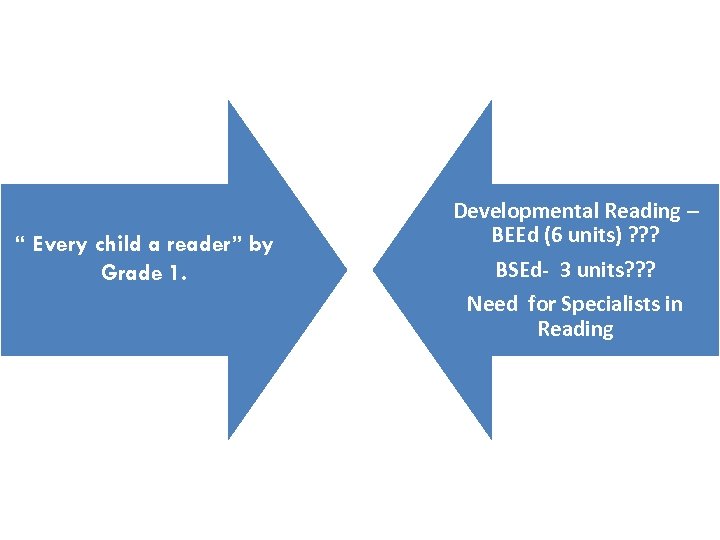
“ Every child a reader” by Grade 1. Developmental Reading – BEEd (6 units) ? ? ? BSEd- 3 units? ? ? Need for Specialists in Reading
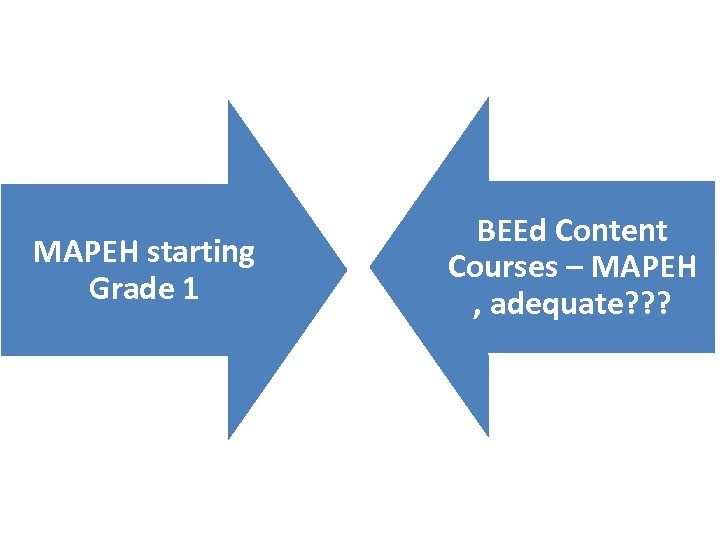
MAPEH starting Grade 1 BEEd Content Courses – MAPEH , adequate? ? ?
The Imperative for K to 12 Improve teaching through the use of enhanced pedagogies (e. g. spiral progression in Science & Math, integrative approach
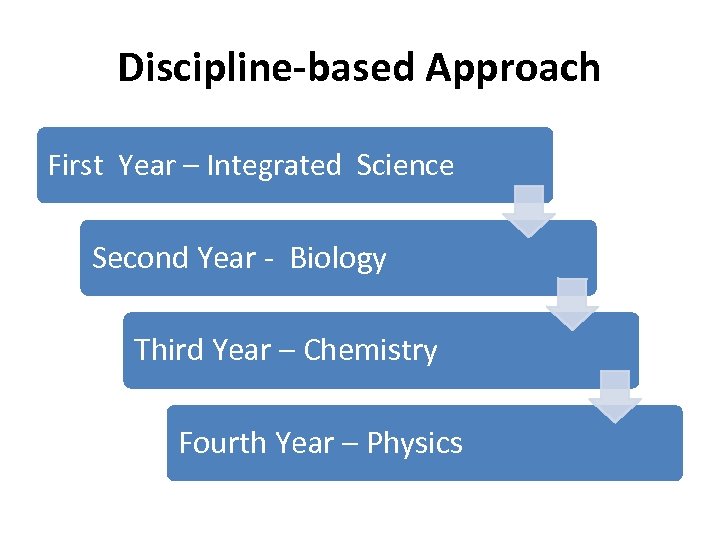
Discipline-based Approach First Year – Integrated Science Second Year - Biology Third Year – Chemistry Fourth Year – Physics
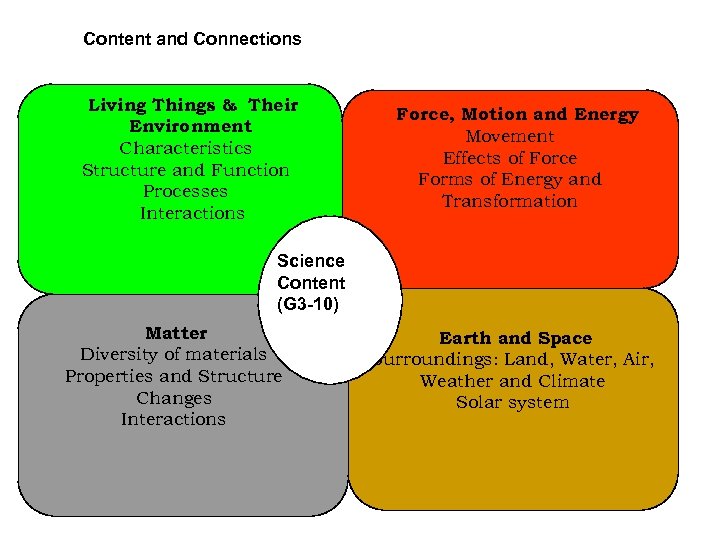
Content and Connections Living Things & Their Environment Characteristics Structure and Function Processes Interactions Force, Motion and Energy Movement Effects of Force Forms of Energy and Transformation Science Content (G 3 -10) Matter Diversity of materials Properties and Structure Changes Interactions Earth and Space Surroundings: Land, Water, Air, Weather and Climate Solar system
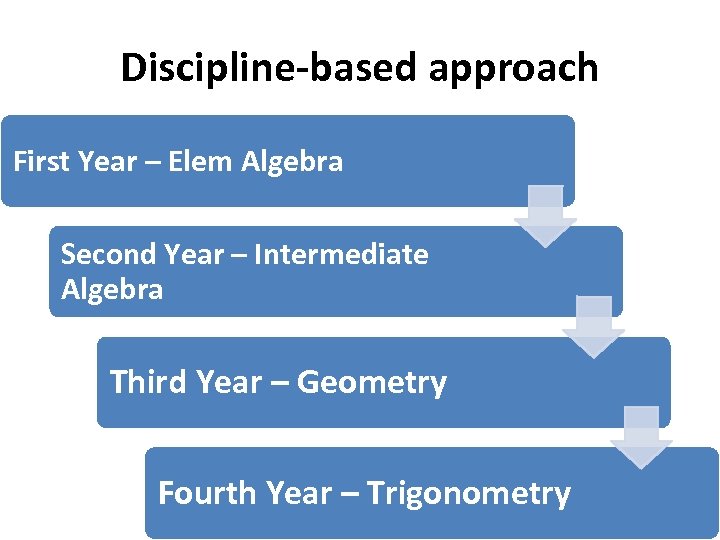
Discipline-based approach First Year – Elem Algebra Second Year – Intermediate Algebra Third Year – Geometry Fourth Year – Trigonometry
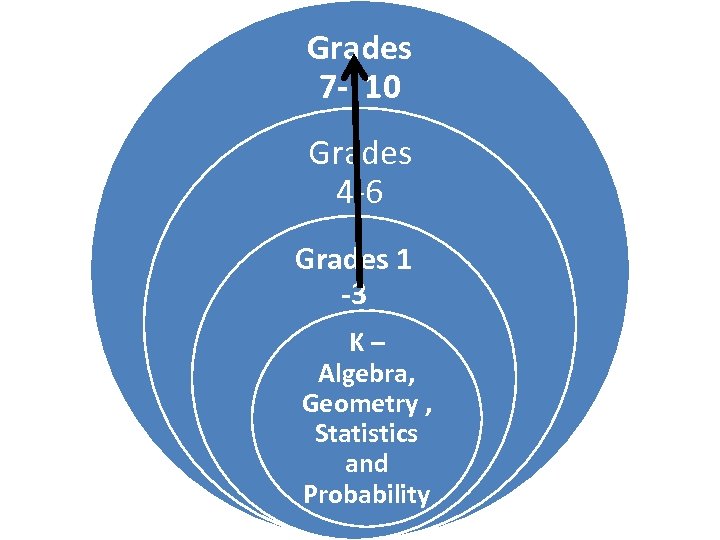
Grades 7 - 10 Grades 4 -6 Grades 1 -3 K– Algebra, Geometry , Statistics and Probability
Integrative Approach • Integration of Science content, processes and values in all subjects possible
Aus. Aid Study • Recommends articulation of subject matter within and across learning areas which is found to be wanting in the Philippine basic education curriculum
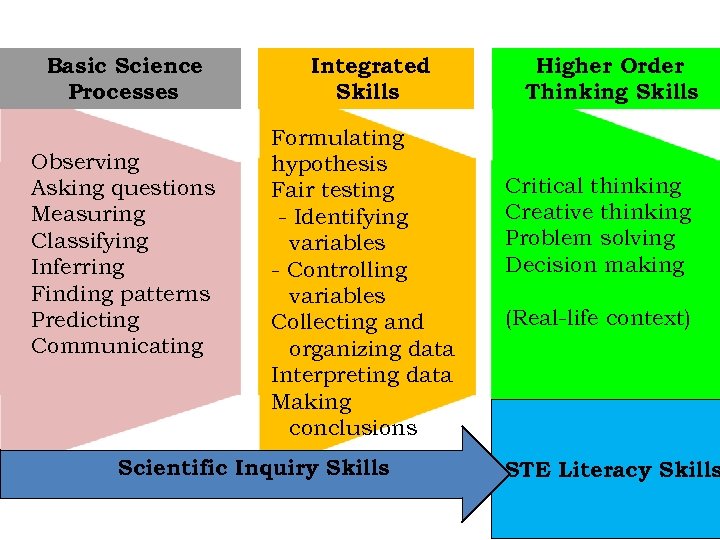
Basic Science Processes Observing Asking questions Measuring Classifying Inferring Finding patterns Predicting Communicating Integrated Skills Formulating hypothesis Fair testing - Identifying variables - Controlling variables Collecting and organizing data Interpreting data Making conclusions Scientific Inquiry Skills Higher Order Thinking Skills Critical thinking Creative thinking Problem solving Decision making (Real-life context) STE Literacy Skills
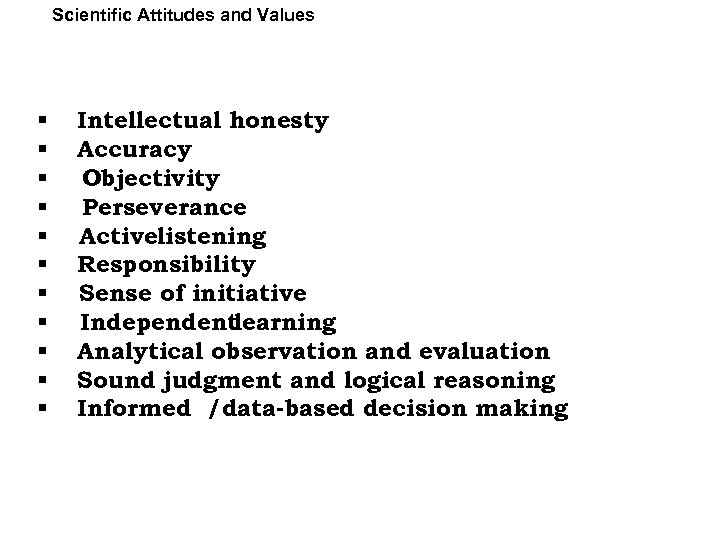
Scientific Attitudes and Values § § § Intellectual honesty Accuracy Objectivity Perseverance Activelistening Responsibility Sense of initiative Independentlearning Analytical observation and evaluation Sound judgment and logical reasoning Informed /data-based decision making
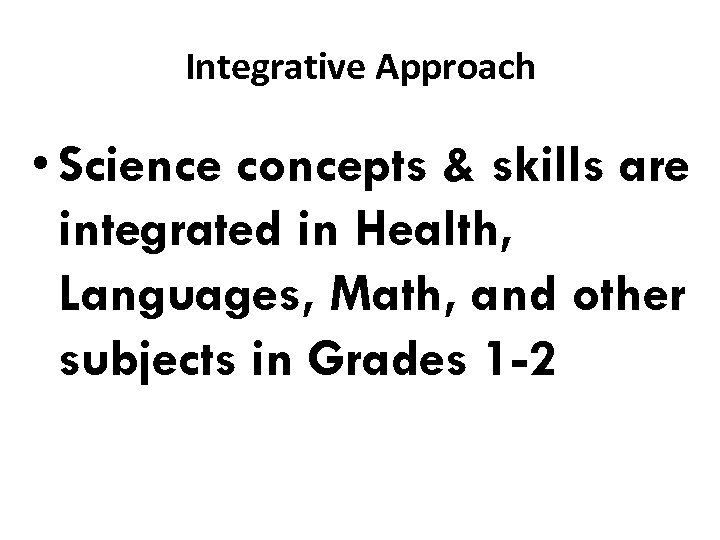
Integrative Approach • Science concepts & skills are integrated in Health, Languages, Math, and other subjects in Grades 1 -2
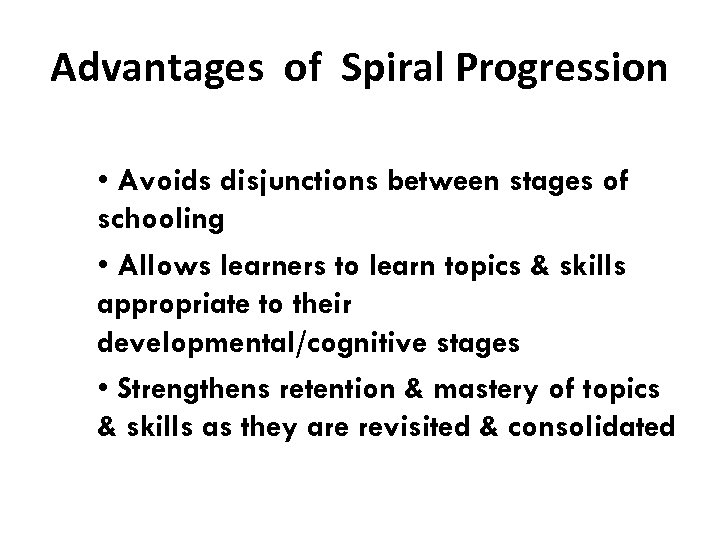
Advantages of Spiral Progression • Avoids disjunctions between stages of schooling • Allows learners to learn topics & skills appropriate to their developmental/cognitive stages • Strengthens retention & mastery of topics & skills as they are revisited & consolidated
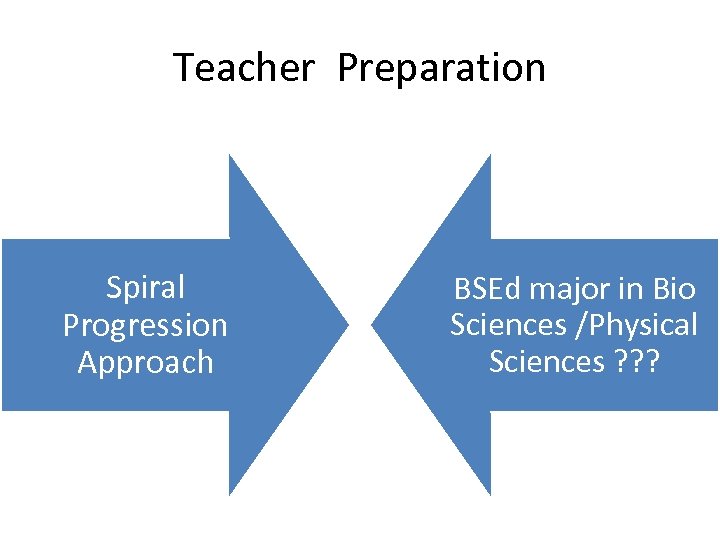
Teacher Preparation Spiral Progression Approach BSEd major in Bio Sciences /Physical Sciences ? ? ?
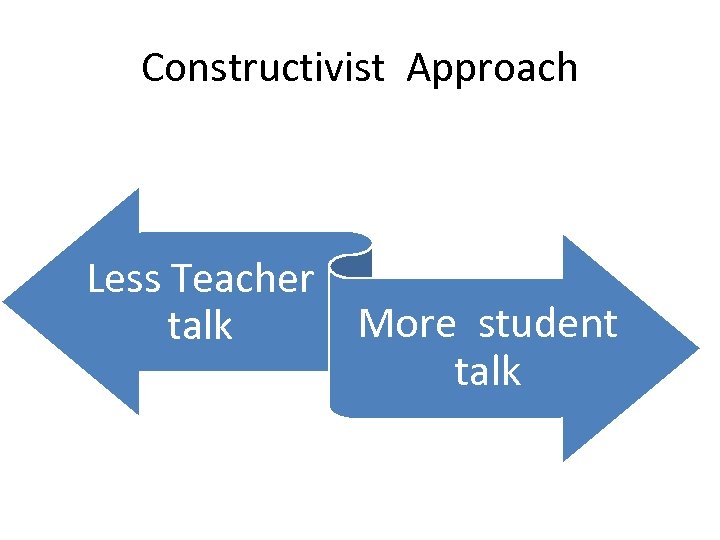
Constructivist Approach Less Teacher More student talk
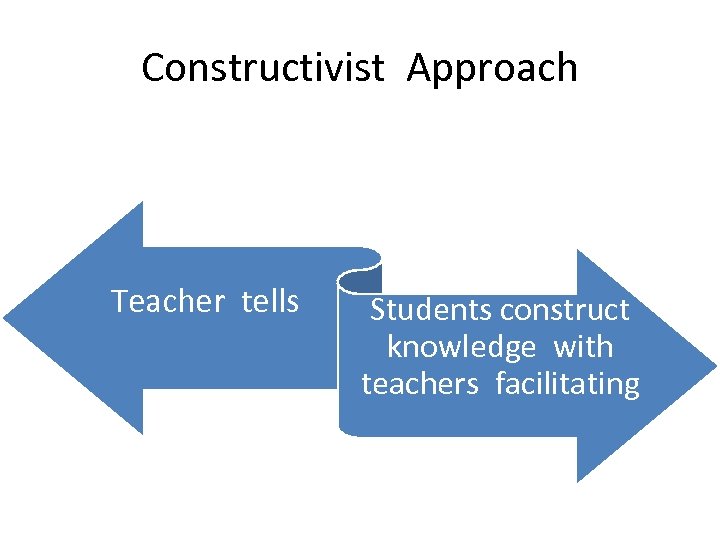
Constructivist Approach Teacher tells Students construct knowledge with teachers facilitating
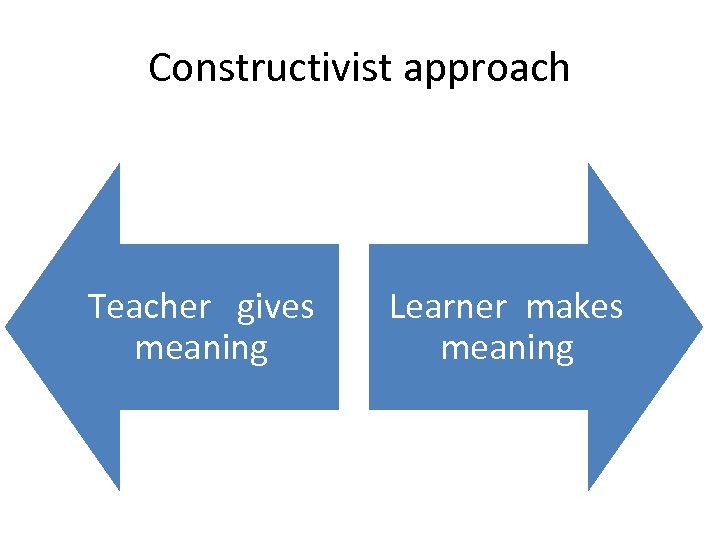
Constructivist approach Teacher gives meaning Learner makes meaning
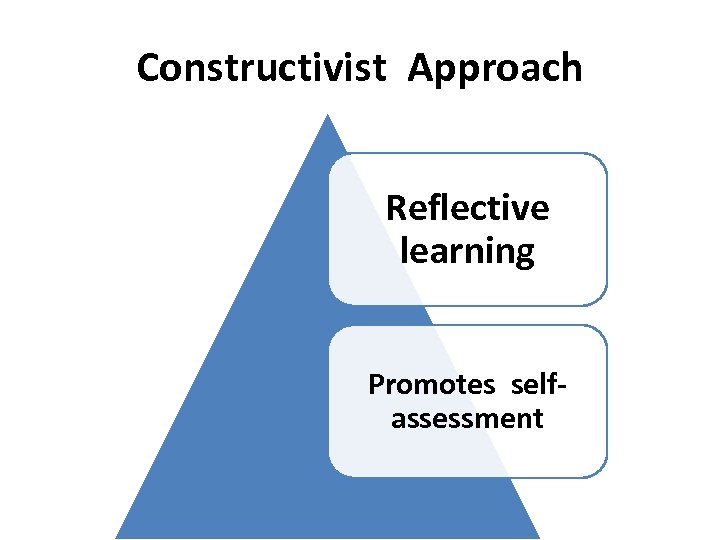
Constructivist Approach Reflective learning Promotes selfassessment
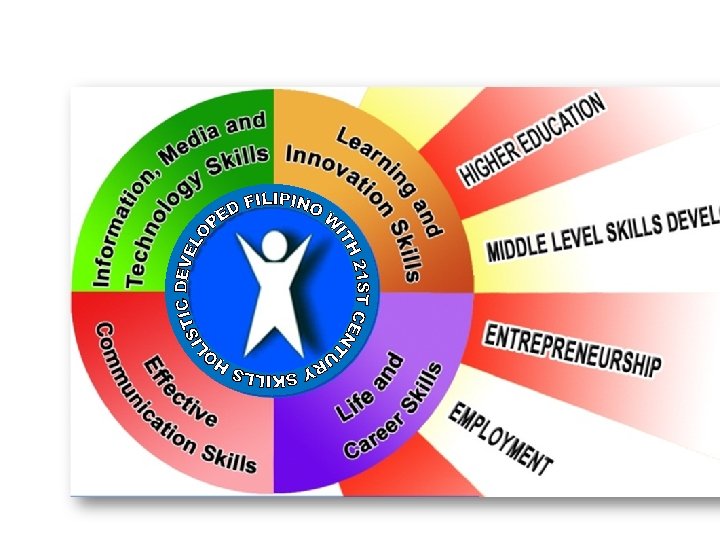
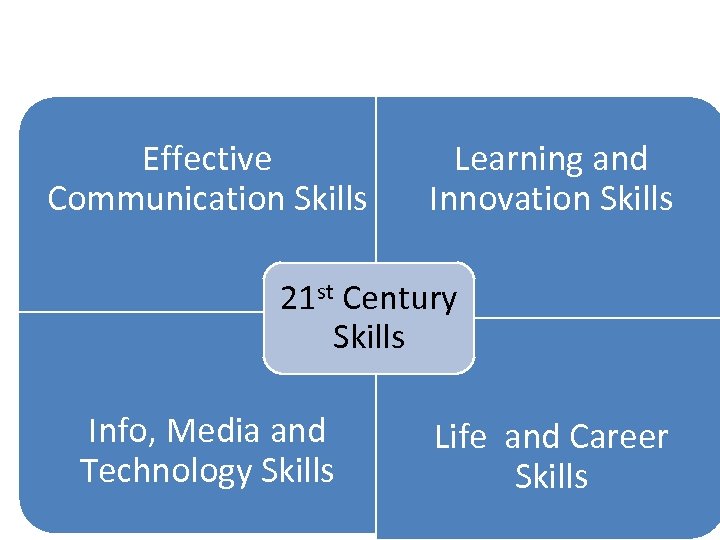
Effective Communication Skills Learning and Innovation Skills 21 st Century Skills Info, Media and Technology Skills Life and Career Skills
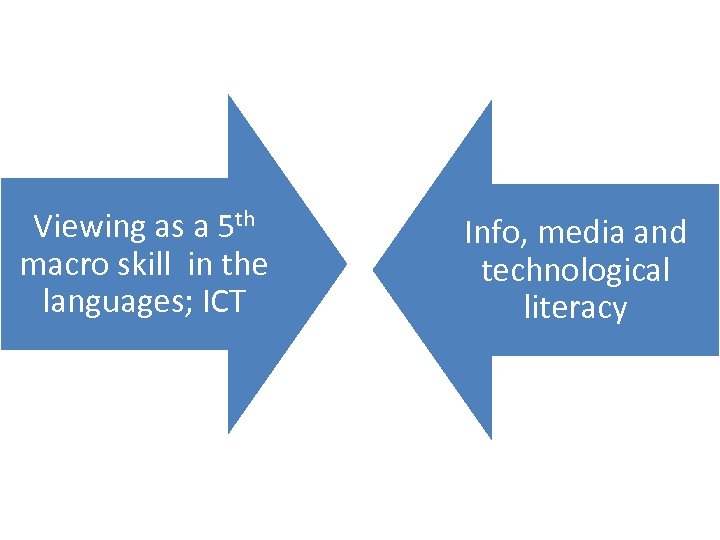
Viewing as a 5 th macro skill in the languages; ICT Info, media and technological literacy
“Netizen” “Webinar”
“Digital native” “Digital immigrant”
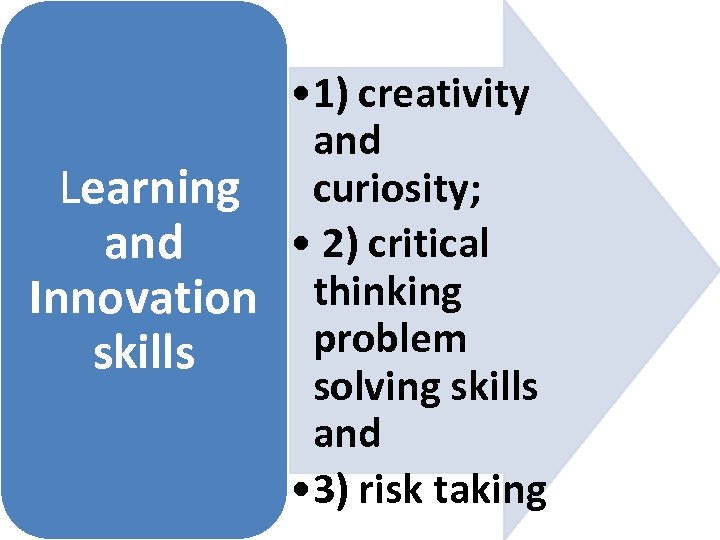
• 1) creativity and Learning curiosity; • 2) critical and Innovation thinking problem skills solving skills and • 3) risk taking
Effective communication skills • The following skills must be taught: 1) teaming, collaboration and interpersonal skills; 2) personal, social and civic responsibility 3) interactive communication, 4) local, national and global orientedness
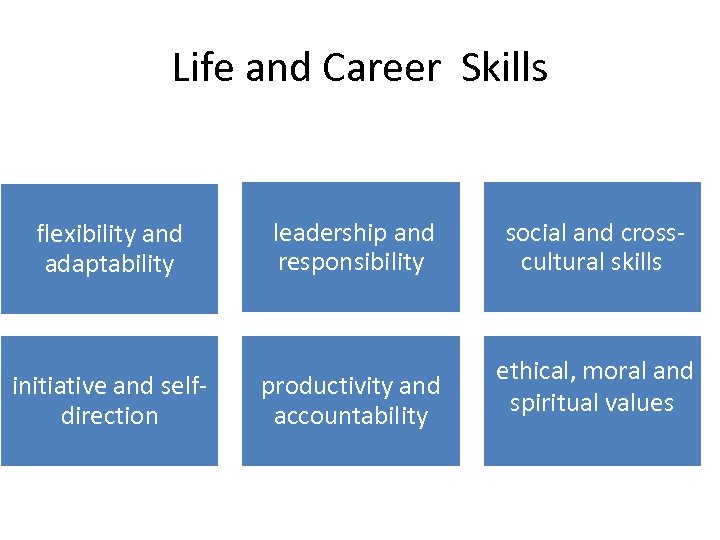
Life and Career Skills flexibility and adaptability initiative and selfdirection leadership and responsibility social and crosscultural skills productivity and accountability ethical, moral and spiritual values
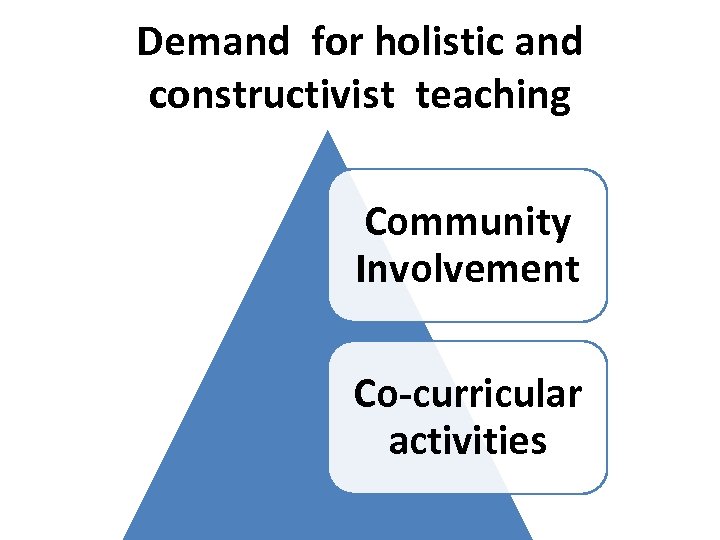
Demand for holistic and constructivist teaching Community Involvement Co-curricular activities
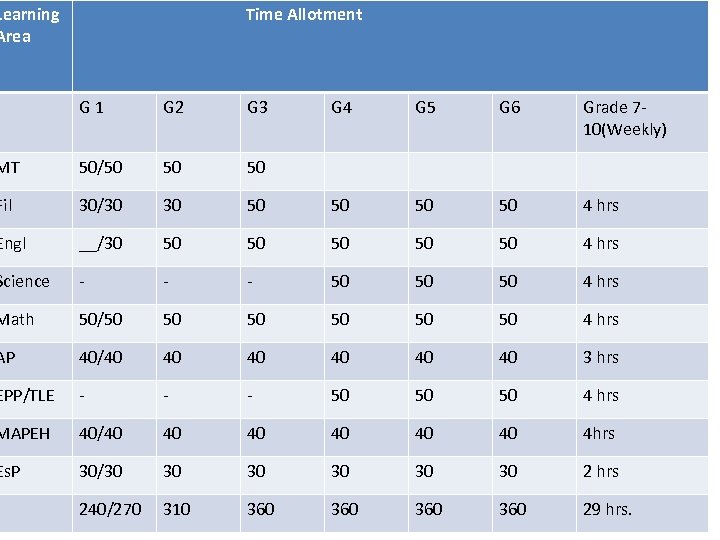
Learning Area Time Allotment G 1 G 2 G 3 G 4 G 5 G 6 Grade 710(Weekly) MT 50/50 50 50 Fil 30/30 30 50 50 4 hrs Engl __/30 50 50 50 4 hrs Science - - - 50 50 50 4 hrs Math 50/50 50 50 4 hrs AP 40/40 40 40 3 hrs EPP/TLE - - - 50 50 50 4 hrs MAPEH 40/40 40 40 4 hrs Es. P 30/30 30 30 2 hrs 240/270 310 360 360 29 hrs.
Time Allotment • The total time daily does not include off -school learning experiences that teachers may require outside of school hours • This is for the production of products and performances as evidence of transfer of learning
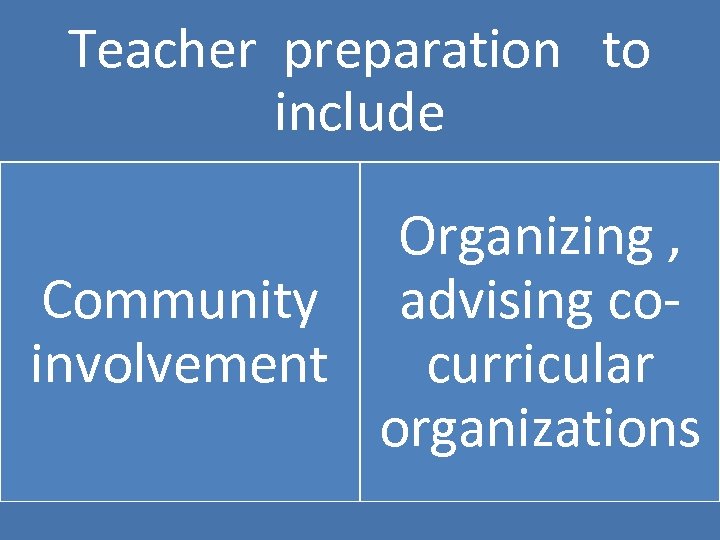
Teacher preparation to include Organizing , Community advising coinvolvement curricular organizations
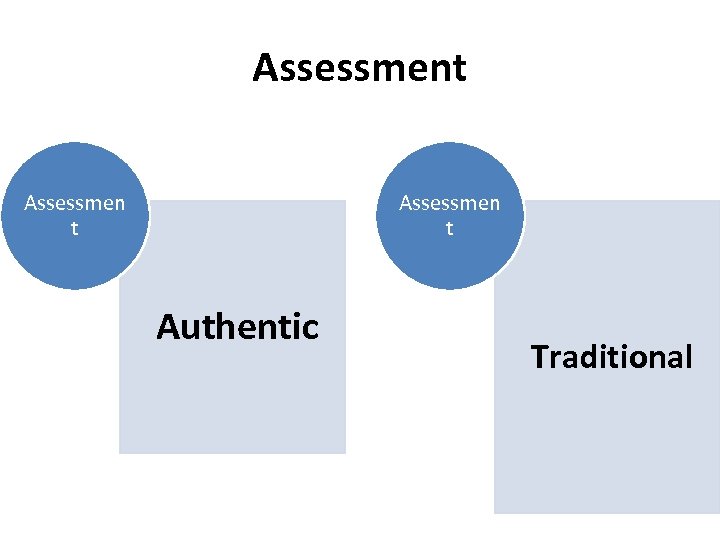
Assessment Assessmen t Authentic Traditional
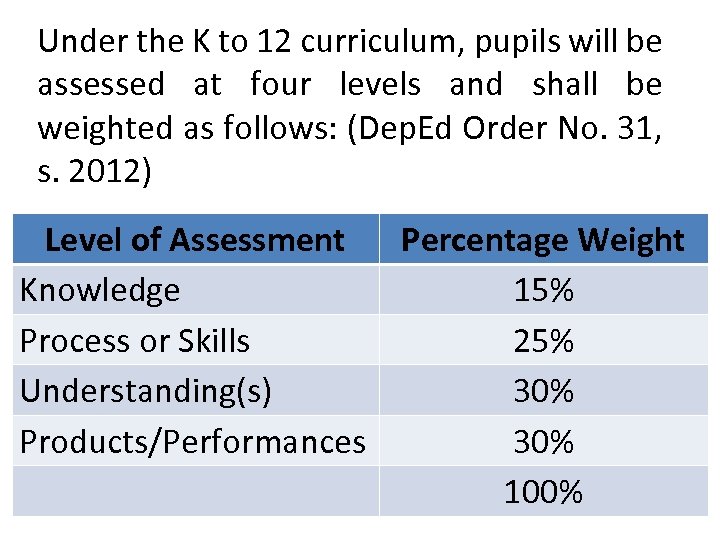
Under the K to 12 curriculum, pupils will be assessed at four levels and shall be weighted as follows: (Dep. Ed Order No. 31, s. 2012) Level of Assessment Percentage Weight Knowledge 15% Process or Skills 25% Understanding(s) 30% Products/Performances 30% 100%
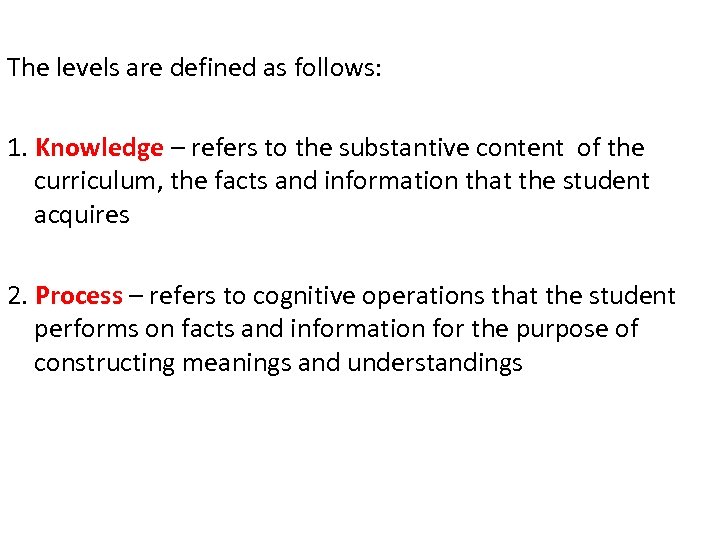
The levels are defined as follows: 1. Knowledge – refers to the substantive content of the curriculum, the facts and information that the student acquires 2. Process – refers to cognitive operations that the student performs on facts and information for the purpose of constructing meanings and understandings
The levels are defined as follows: 3. Understandings – refers to enduring big ideas, principles and generalizations inherent to the discipline, which may be assessed using the facets of understanding a. Explanation – give examples, make insightful connections b. Interpretation – make it personal through images, anecdotes, analogies c. Application – can adapt/transfer understanding into real contexts
3. Understandings d. Perspective – understand different points of view, sees the big picture e. Empathy – understand value the perspectives/point of view of others f. Self-Knowledge – show metacognitive awareness, perceive the prejudices and habits mind that shape and impede self understanding
4. Products/Performances – refers to real-life application of understandings as evidenced by the student’s performance of authentic tasks. It considers children’s MI.
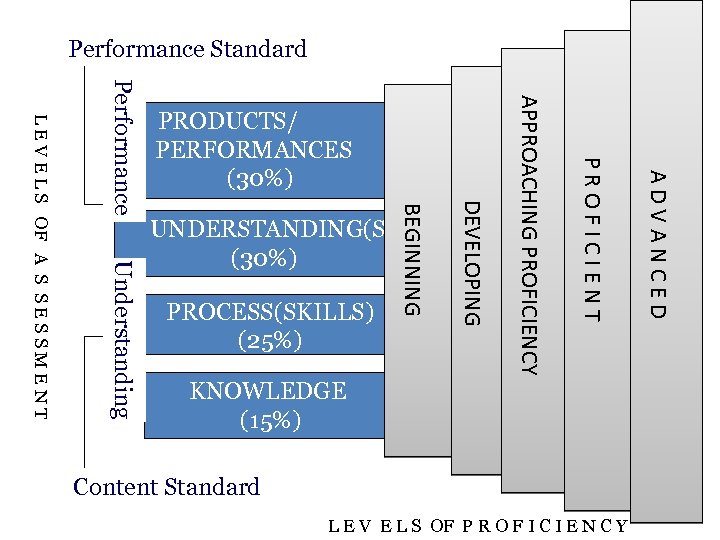
Performance Standard KNOWLEDGE (15%) Content Standard L E V E L S OF P R O F I C I E N C Y ADVANCED PROFICIENT APPROACHING PROFICIENCY PROCESS(SKILLS) (25%) DEVELOPING Understanding UNDERSTANDING(S) (30%) BEGINNING Performance L E V E L S OF A S S E S S M E N T PRODUCTS/ PERFORMANCES (30%)
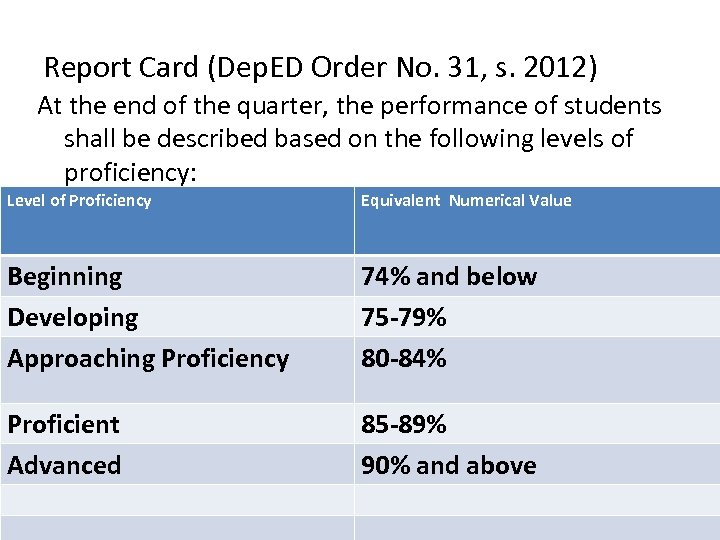
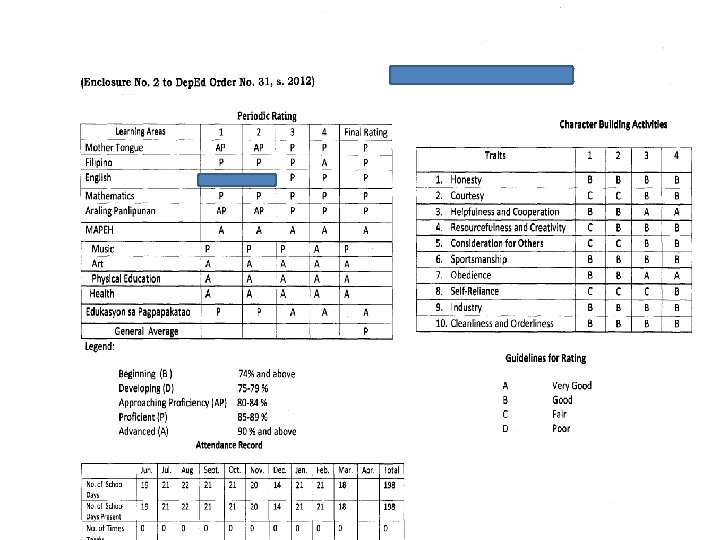
Report Card (Dep. ED Order No. 31, s. 2012) At the end of the quarter, the performance of students shall be described based on the following levels of proficiency: Level of Proficiency Equivalent Numerical Value Beginning Developing Approaching Proficiency 74% and below 75 -79% 80 -84% Proficient Advanced 85 -89% 90% and above
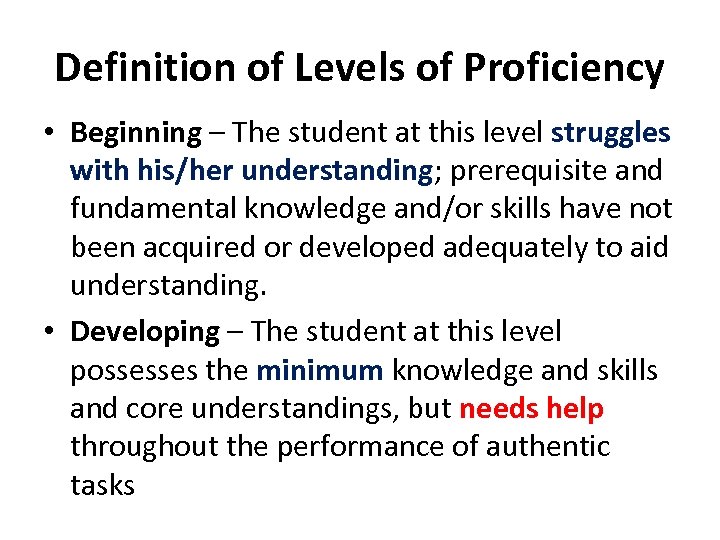
Definition of Levels of Proficiency • Beginning – The student at this level struggles with his/her understanding; prerequisite and fundamental knowledge and/or skills have not been acquired or developed adequately to aid understanding. • Developing – The student at this level possesses the minimum knowledge and skills and core understandings, but needs help throughout the performance of authentic tasks
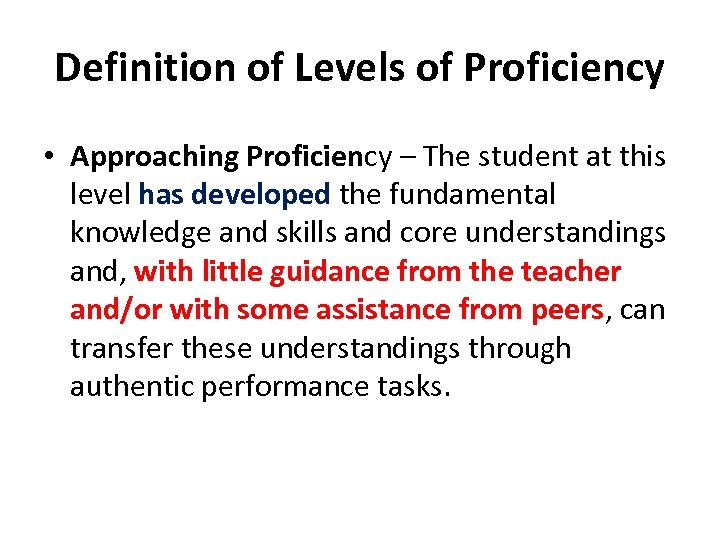
Definition of Levels of Proficiency • Approaching Proficiency – The student at this level has developed the fundamental knowledge and skills and core understandings and, with little guidance from the teacher and/or with some assistance from peers, can transfer these understandings through authentic performance tasks.
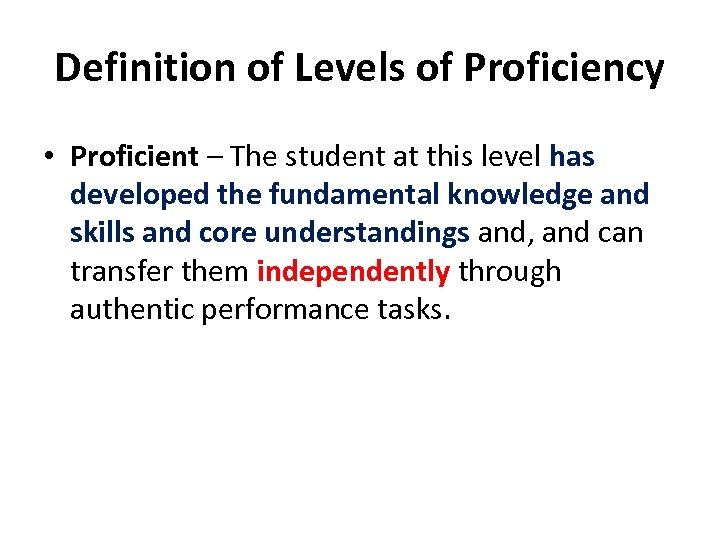
Definition of Levels of Proficiency • Proficient – The student at this level has developed the fundamental knowledge and skills and core understandings and, and can transfer them independently through authentic performance tasks.
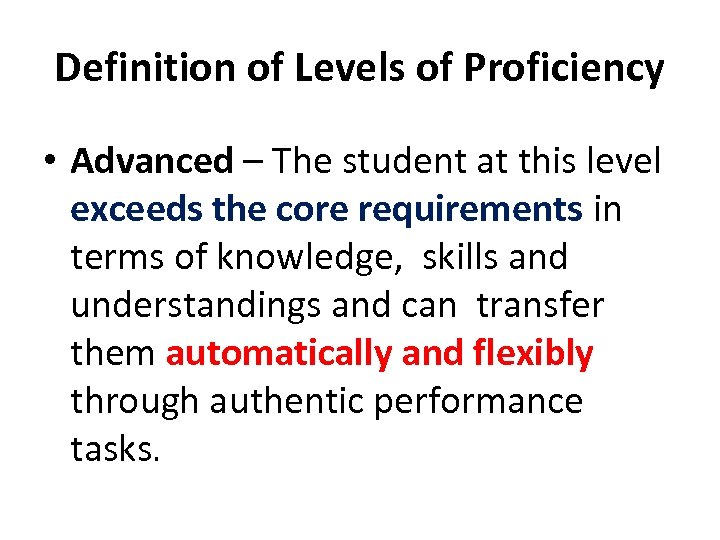
Definition of Levels of Proficiency • Advanced – The student at this level exceeds the core requirements in terms of knowledge, skills and understandings and can transfer them automatically and flexibly through authentic performance tasks.
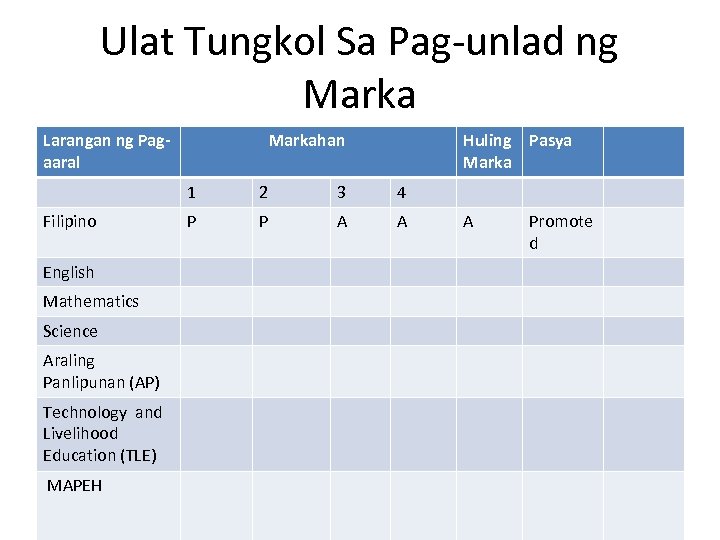
Ulat Tungkol Sa Pag-unlad ng Marka Larangan ng Pagaaral Markahan Huling Pasya Marka 1 Filipino English Mathematics Science Araling Panlipunan (AP) Technology and Livelihood Education (TLE) MAPEH 2 3 4 P P A A A Promote d
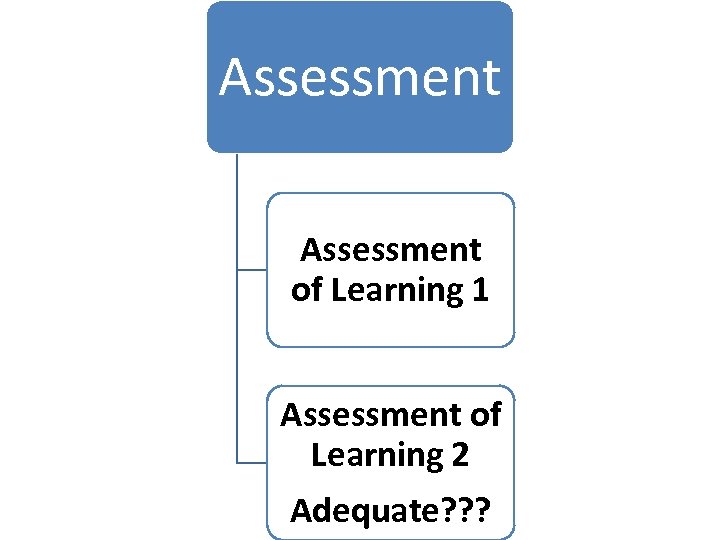
Assessment of Learning 1 Assessment of Learning 2 Adequate? ? ?
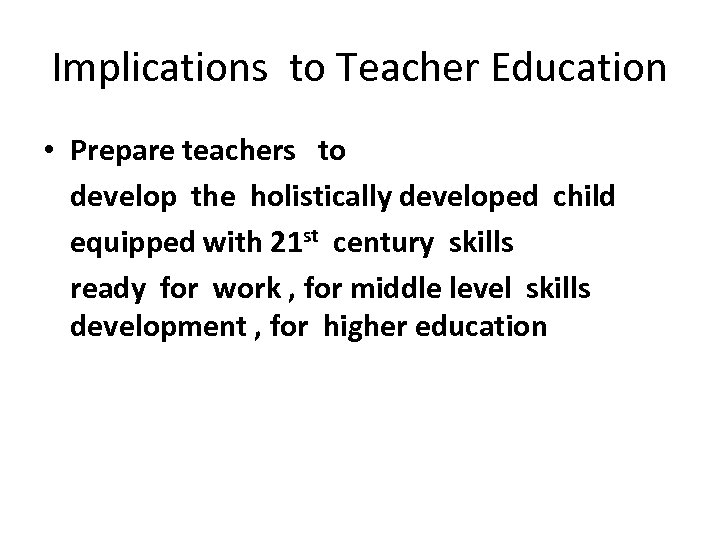
Implications to Teacher Education • Prepare teachers to develop the holistically developed child equipped with 21 st century skills ready for work , for middle level skills development , for higher education
The K to 12 teacher- Multispecialist
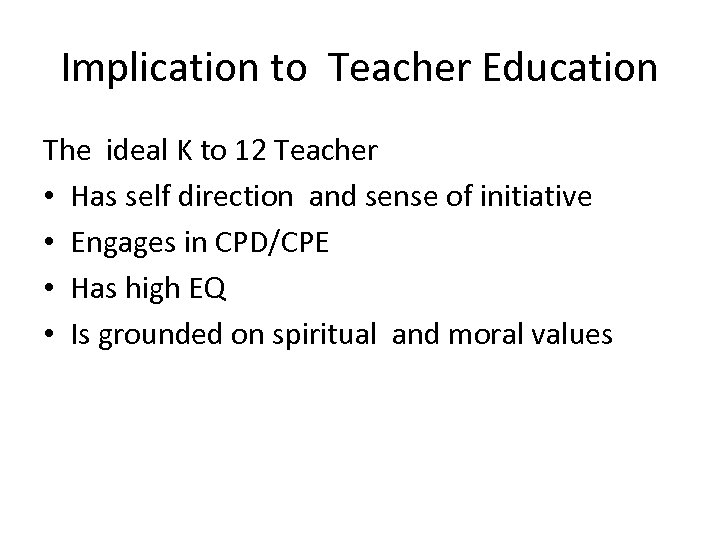
Implication to Teacher Education The ideal K to 12 Teacher • Has self direction and sense of initiative • Engages in CPD/CPE • Has high EQ • Is grounded on spiritual and moral values
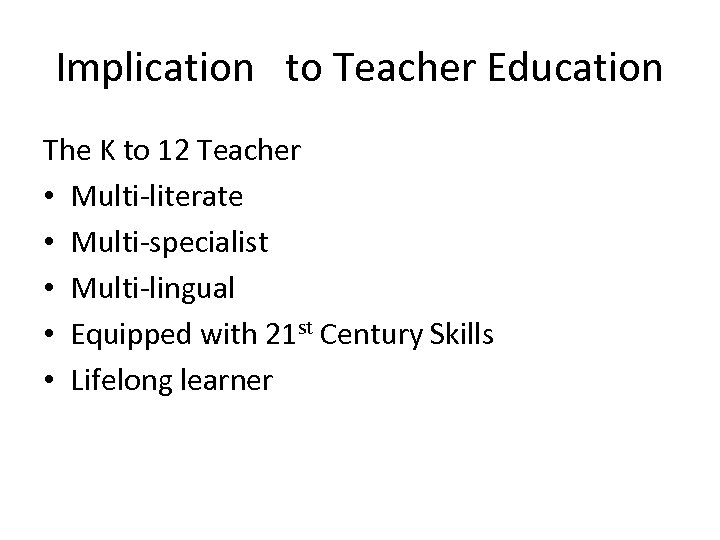
Implication to Teacher Education The K to 12 Teacher • Multi-literate • Multi-specialist • Multi-lingual • Equipped with 21 st Century Skills • Lifelong learner
The K to 12 Teacher • ICT competent – Digital native not a digital immigrant • Innovative • Flexible/adaptable • Accountable for results • Effective Communicator
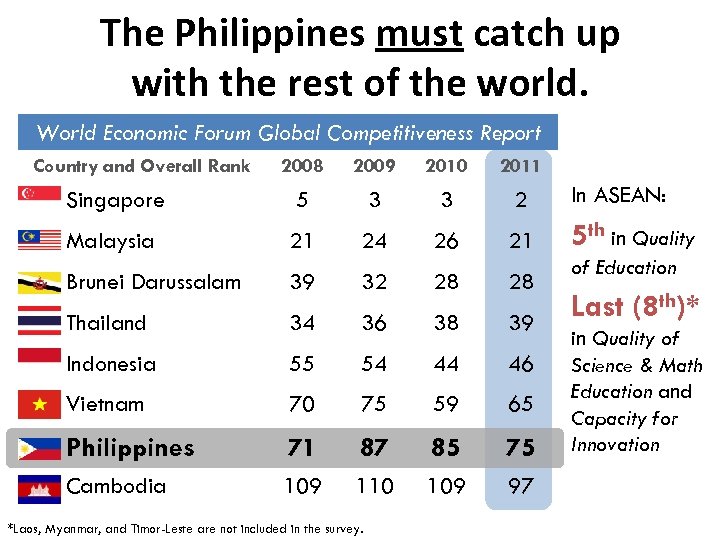
The Philippines must catch up with the rest of the world. World Economic Forum Global Competitiveness Report Country and Overall Rank Singapore Malaysia 2008 2009 2010 2011 5 3 3 2 In ASEAN: 21 5 th in Quality of Education Last (8 th)* 21 24 26 Brunei Darussalam 39 32 28 28 Thailand 34 36 38 39 Indonesia 55 54 44 46 Vietnam 70 75 59 65 Philippines 71 87 85 75 Cambodia 109 110 109 97 *Laos, Myanmar, and Timor-Leste are not included in the survey. in Quality of Science & Math Education and Capacity for Innovation

“ We look back with appreciation to our brilliant teachers but with gratitude to those who touch our hearts. ” – Carl Jung

God bless us all!
Скачать презентацию The K to 12 Curriculum and Capacity Building
38d9839411b4205830cfe5141780d946.ppt