


 Скачать презентацию The Journey of Implementing E -GOVERNMENT -GOVERNMENT A
daf24bcca93a22f603df99550c0278c9.ppt
- Количество слайдов: 36
 The Journey of Implementing E -GOVERNMENT: -GOVERNMENT A Singaporean Experience Dr Shan L PAN Coordinator Knowledge Management Laboratory Department of Information Systems School of Computing National University of Singapore pansl@comp. nus. edu. sg www. comp. nus. edu. sg/~pansl
 Agenda • Singapore’s Journey to e-Government – e-Government Action Plan I and its achievements • Conceptualizing the e-Government Action Plan II – Strategy & Process – Vision & Desired Outcomes • E-Government Research in the National University of Singapore (NUS)
 Singapore’s Journey to e-Government: e-Government Action Plan I and its achievements
 E-Government in Singapore mms: //s-one. internet. gov. sg/egov/egapii. wmv
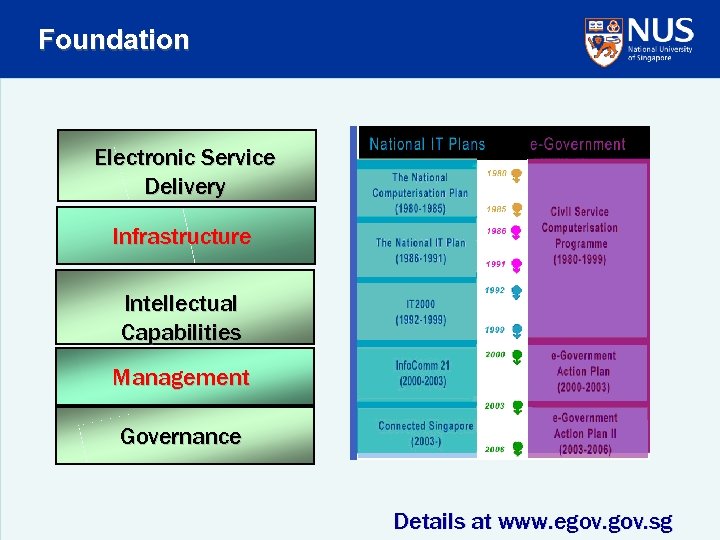 Foundation Electronic Service Delivery Infrastructure Intellectual Capabilities Management Governance Details at www. egov. sg
 About IDA • Statutory board under the Ministry of Information, Communications and The Arts (MITA) • Formed on 1 Dec 1999 – National Computer Board – Telecommunications Authority of Singapore Convergence of IT and Telecommunication
 Roles IDA Plays • Regulator – Formulate clear and transparent policies to ensure a fair and balanced competitive environment • Industry Developer – Work closely with private sector to create a vibrant environment for IT in Singapore • Promoter – Encourage foreign Info. Comm companies to locate and partner with in Singapore • Government CIO – Drive implementation of the Singapore e. Government
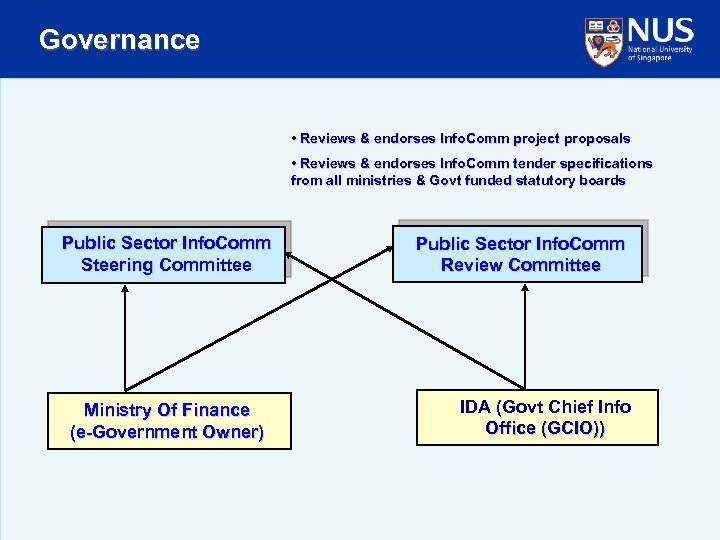 Governance • Reviews & endorses Info. Comm project proposals • Reviews & endorses Info. Comm tender specifications from all ministries & Govt funded statutory boards Public Sector Info. Comm Steering Committee Ministry Of Finance (e-Government Owner) Public Sector Info. Comm Review Committee IDA (Govt Chief Info Office (GCIO))
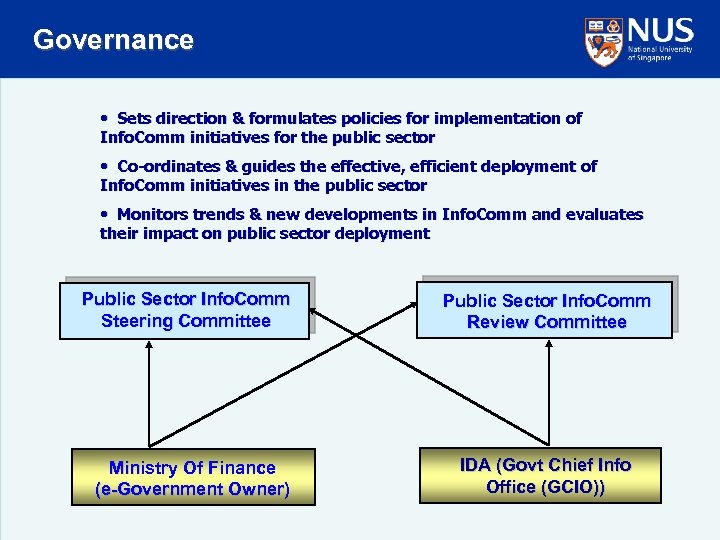 Governance • Sets direction & formulates policies for implementation of Info. Comm initiatives for the public sector • Co-ordinates & guides the effective, efficient deployment of Info. Comm initiatives in the public sector • Monitors trends & new developments in Info. Comm and evaluates their impact on public sector deployment Public Sector Info. Comm Steering Committee Ministry Of Finance (e-Government Owner) Public Sector Info. Comm Review Committee IDA (Govt Chief Info Office (GCIO))
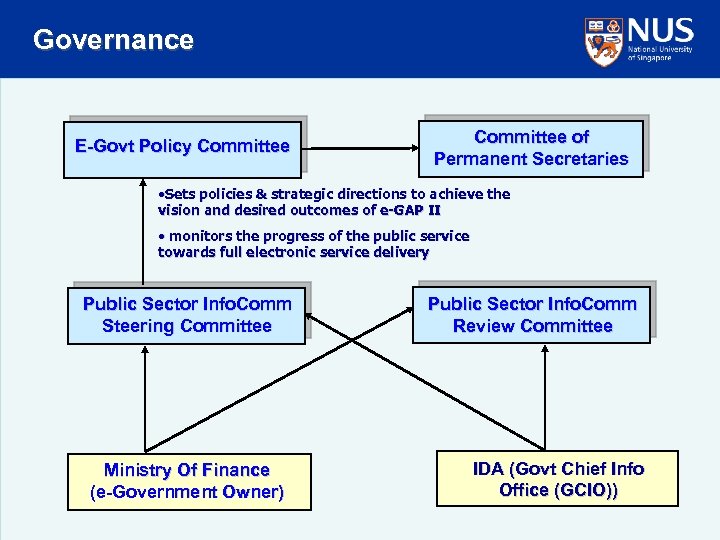 Governance E-Govt Policy Committee of Permanent Secretaries • Sets policies & strategic directions to achieve the vision and desired outcomes of e-GAP II • monitors the progress of the public service towards full electronic service delivery Public Sector Info. Comm Steering Committee Ministry Of Finance (e-Government Owner) Public Sector Info. Comm Review Committee IDA (Govt Chief Info Office (GCIO))
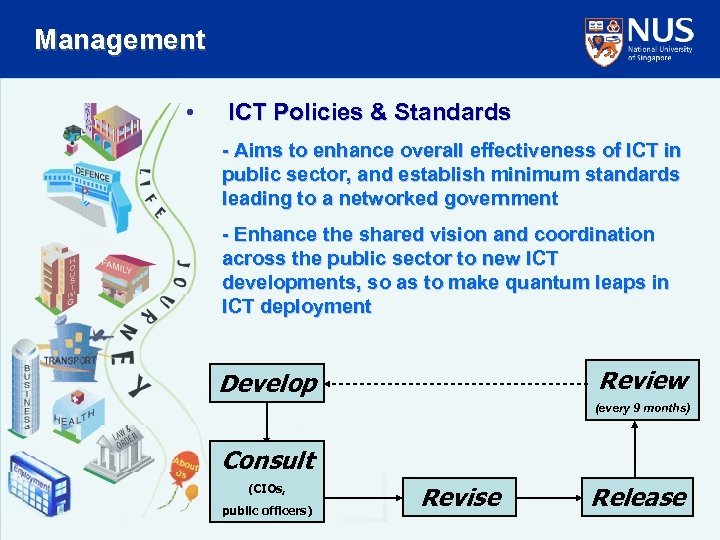 Management • ICT Policies & Standards - Aims to enhance overall effectiveness of ICT in public sector, and establish minimum standards leading to a networked government - Enhance the shared vision and coordination across the public sector to new ICT developments, so as to make quantum leaps in ICT deployment Review Develop (every 9 months) Consult (CIOs, public officers) Revise Release
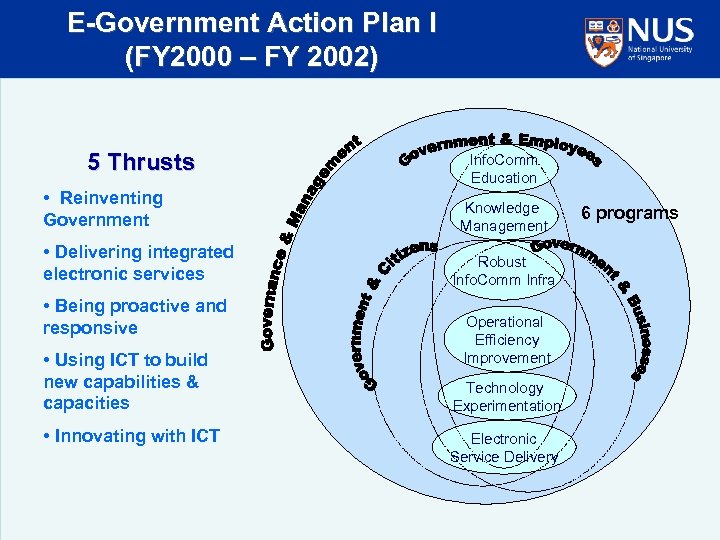 E-Government Action Plan I (FY 2000 – FY 2002) 5 Thrusts • Reinventing Government • Delivering integrated electronic services • Being proactive and responsive • Using ICT to build new capabilities & capacities • Innovating with ICT Info. Comm Education Knowledge Management Robust Info. Comm Infra Operational Efficiency Improvement Technology Experimentation Electronic Service Delivery 6 programs
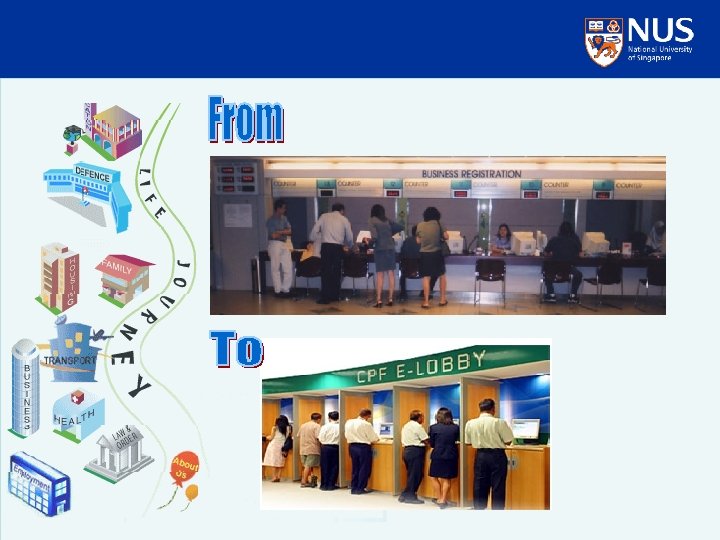
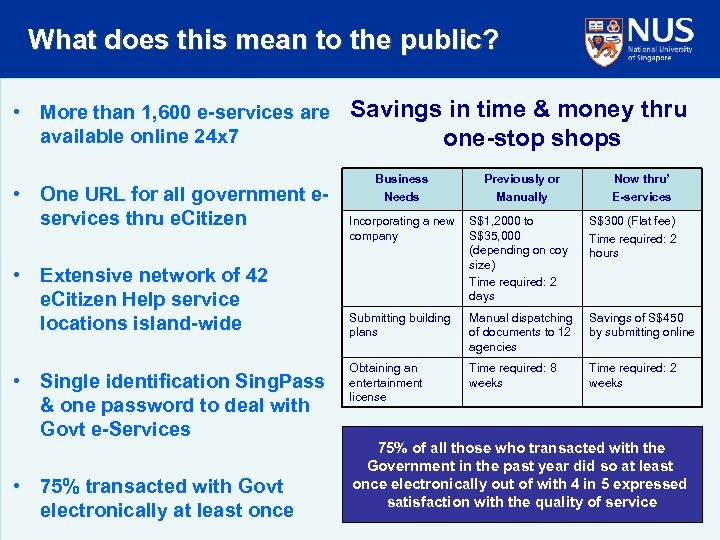 What does this mean to the public? • More than 1, 600 e-services are Savings in time & money thru available online 24 x 7 one-stop shops • One URL for all government eservices thru e. Citizen • Extensive network of 42 e. Citizen Help service locations island-wide • Single identification Sing. Pass & one password to deal with Govt e-Services • 75% transacted with Govt electronically at least once Business Needs Previously or Manually Now thru’ E-services Incorporating a new company S$1, 2000 to S$35, 000 (depending on coy size) Time required: 2 days S$300 (Flat fee) Time required: 2 hours Submitting building plans Manual dispatching of documents to 12 agencies Savings of S$450 by submitting online Obtaining an entertainment license Time required: 8 weeks Time required: 2 weeks 75% of all those who transacted with the Government in the past year did so at least once electronically out of with 4 in 5 expressed satisfaction with the quality of service
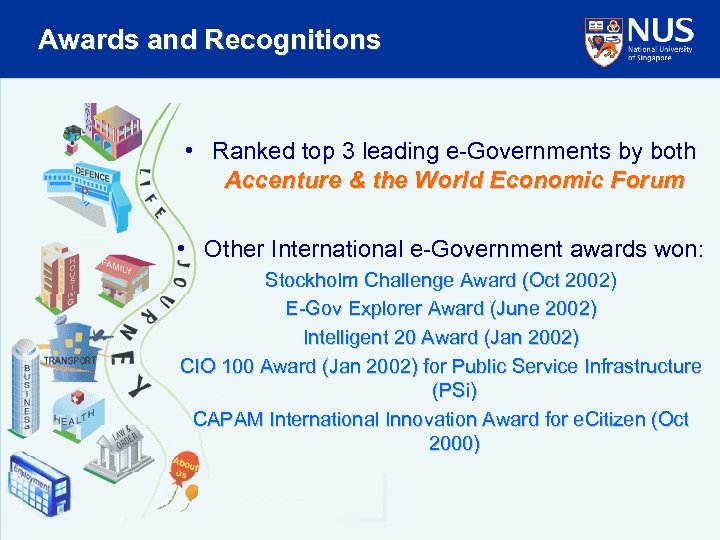 Awards and Recognitions • Ranked top 3 leading e-Governments by both Accenture & the World Economic Forum • Other International e-Government awards won: Stockholm Challenge Award (Oct 2002) E-Gov Explorer Award (June 2002) Intelligent 20 Award (Jan 2002) CIO 100 Award (Jan 2002) for Public Service Infrastructure (PSi) CAPAM International Innovation Award for e. Citizen (Oct 2000)
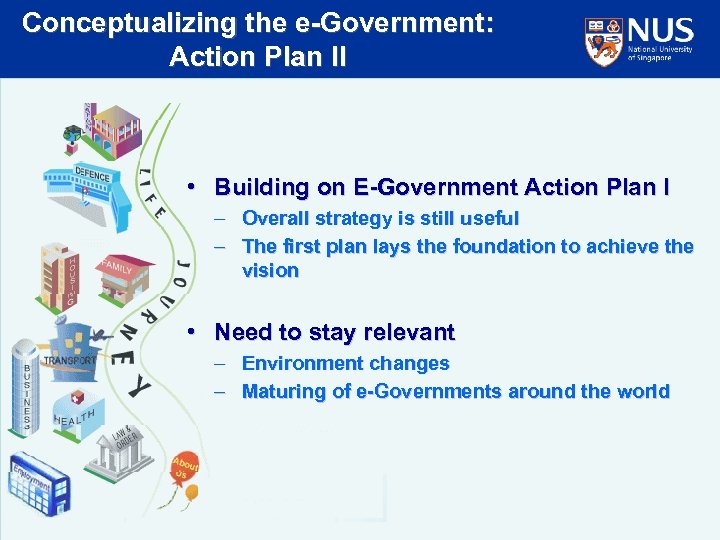 Conceptualizing the e-Government: Action Plan II • Building on E-Government Action Plan I – Overall strategy is still useful – The first plan lays the foundation to achieve the vision • Need to stay relevant – Environment changes – Maturing of e-Governments around the world
 Conceptualizing the e-Government Action Plan II: Strategy & Process and Vision & Desired Outcomes
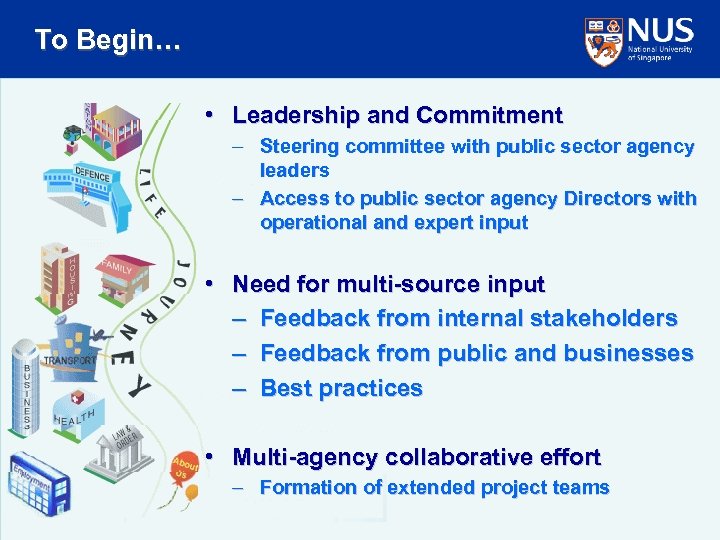 To Begin… • Leadership and Commitment – Steering committee with public sector agency leaders – Access to public sector agency Directors with operational and expert input • Need for multi-source input – Feedback from internal stakeholders – Feedback from public and businesses – Best practices • Multi-agency collaborative effort – Formation of extended project teams
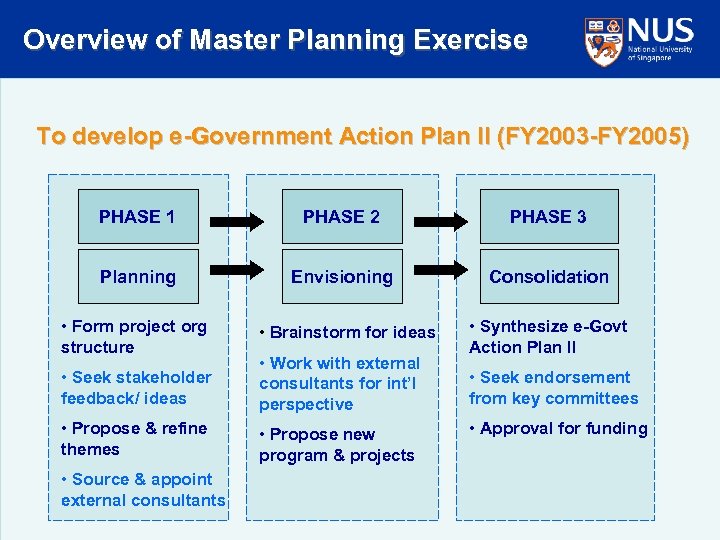 Overview of Master Planning Exercise To develop e-Government Action Plan II (FY 2003 -FY 2005) PHASE 1 PHASE 2 PHASE 3 Planning Envisioning Consolidation • Form project org structure • Brainstorm for ideas • Seek stakeholder feedback/ ideas • Work with external consultants for int’l perspective • Propose & refine themes • Propose new program & projects • Source & appoint external consultants • Synthesize e-Govt Action Plan II • Seek endorsement from key committees • Approval for funding
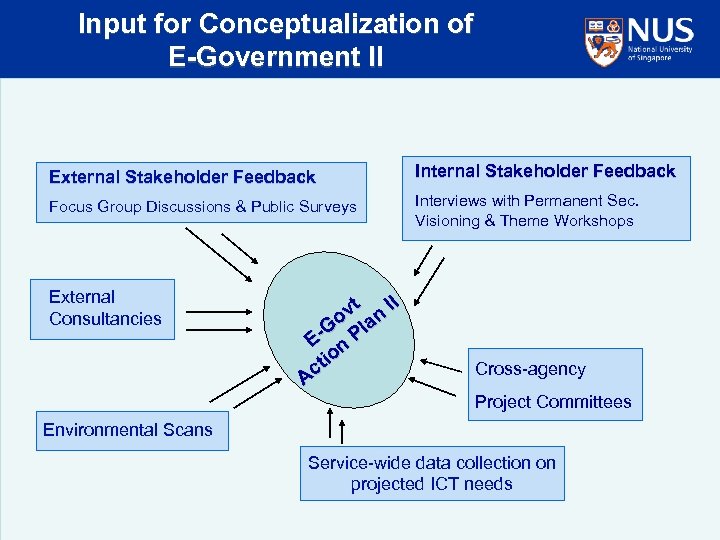 Input for Conceptualization of E-Government II External Stakeholder Feedback Internal Stakeholder Feedback Focus Group Discussions & Public Surveys Interviews with Permanent Sec. Visioning & Theme Workshops External Consultancies vt n II o -G Pla E n tio Ac Cross-agency Project Committees Environmental Scans Service-wide data collection on projected ICT needs
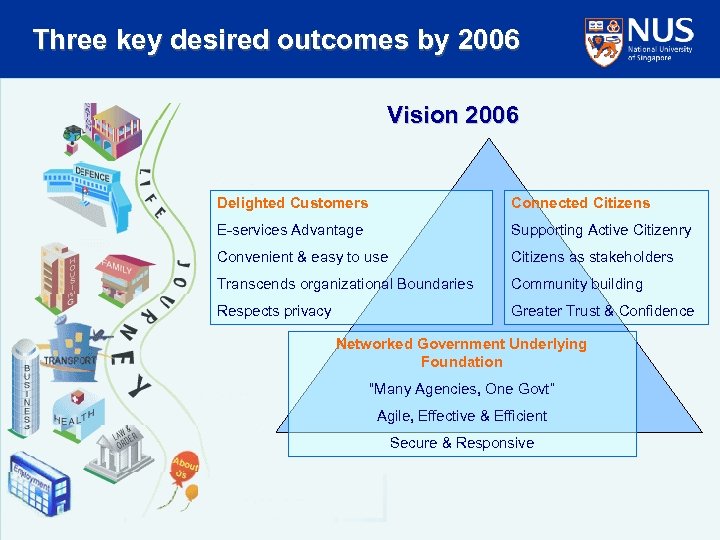 Three key desired outcomes by 2006 Vision 2006 Delighted Customers Connected Citizens E-services Advantage Supporting Active Citizenry Convenient & easy to use Citizens as stakeholders Transcends organizational Boundaries Community building Respects privacy Greater Trust & Confidence Networked Government Underlying Foundation “Many Agencies, One Govt” Agile, Effective & Efficient Secure & Responsive
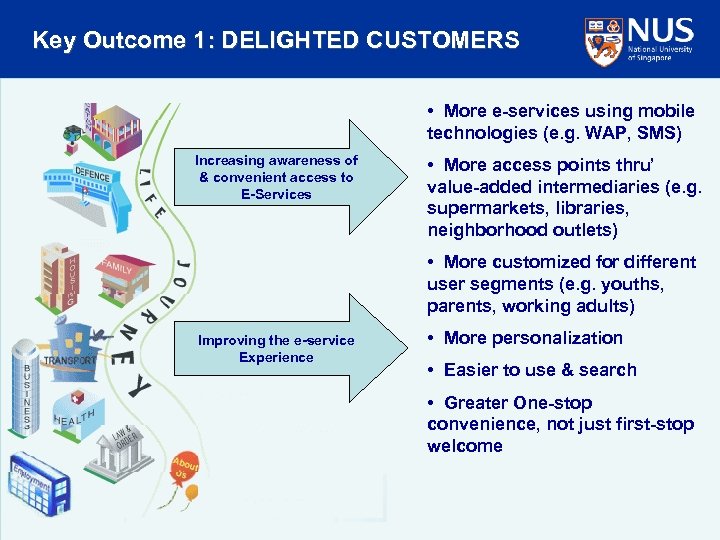 Key Outcome 1: DELIGHTED CUSTOMERS • More e-services using mobile technologies (e. g. WAP, SMS) Increasing awareness of & convenient access to E-Services • More access points thru’ value-added intermediaries (e. g. supermarkets, libraries, neighborhood outlets) • More customized for different user segments (e. g. youths, parents, working adults) Improving the e-service Experience • More personalization • Easier to use & search • Greater One-stop convenience, not just first-stop welcome
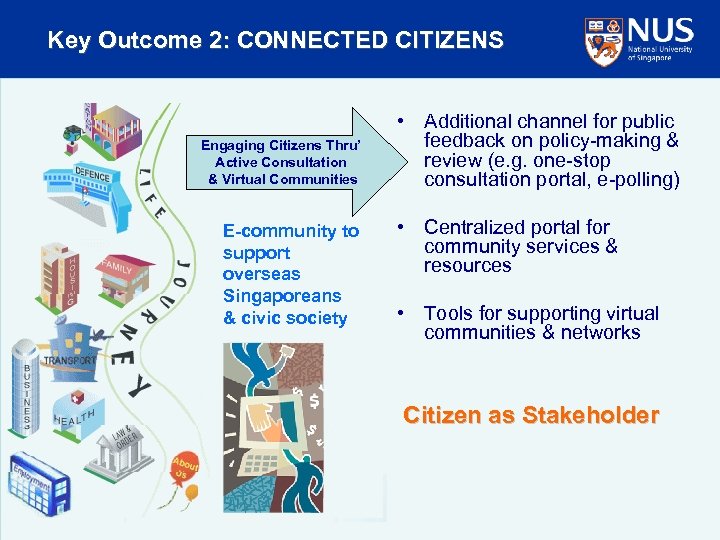 Key Outcome 2: CONNECTED CITIZENS Engaging Citizens Thru’ Active Consultation & Virtual Communities E-community to support overseas Singaporeans & civic society • Additional channel for public feedback on policy-making & review (e. g. one-stop consultation portal, e-polling) • Centralized portal for community services & resources • Tools for supporting virtual communities & networks Citizen as Stakeholder
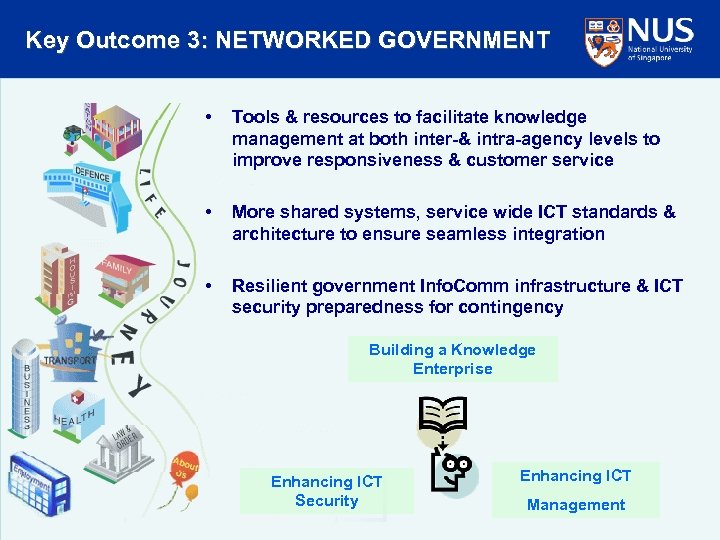 Key Outcome 3: NETWORKED GOVERNMENT • Tools & resources to facilitate knowledge management at both inter-& intra-agency levels to improve responsiveness & customer service • More shared systems, service wide ICT standards & architecture to ensure seamless integration • Resilient government Info. Comm infrastructure & ICT security preparedness for contingency Building a Knowledge Enterprise Enhancing ICT Security Enhancing ICT Management
 E-Government Targets for 2006 • Implement 12 more cross-agency integrated eservices • Have 90% of Government’s customers use eservices at least once a year • Have 90% of these users satisfied with overall quality of e-services • Explain public policies & their rationale online We will also be monitoring: • Rankings in international benchmark studies • Benefits of use by customers • Repeat usage by customers
 Implementing the E-Government Action Plan II • Ministry of Finance – Overall owner of the e-Government Action Plan II initiative & responsible for all central Info. Comm Technology (ICT) infrastructure, services and policies within the Public Service. • Strategic Priority Owners – Owners identified for each of the Strategic Priorities to drive the respective programs and work with the individual Ministries & agencies
 Overview of e-Government Research in NUS And Research Collaboration Opportunities
 Current Projects • Organization as a Convener in e. Collaboration: An Empirical Study of Dominant Modes of Convener Behavior (Feedback Unit) • IT-induced Organizational Transformation (National Library Board) • E-Services Methodology Training Workshop in IDA (an Action Research)
 Completed Projects • Ge. Biz • Agency: SCO (DSTA) – – Focus: G 2 B: Tele-Cooperation Perspective of e -Gov Key Finding: Tele-cooperation Among Public Agencies is the Fundamental Challenge of any egovernment Initiatives Devadoss, P. , Pan, S L, and Huang, J. C. M (2003). Structurational Analysis of e-Government Initiatives: A Case Study of SCO". Decision Support Systems. 34: 3 253 -269.
 E-Filling - IRAS • E-Filing – Agency: IRAS – Focus: G 2 C – Closing the Gap between Government Services and the citizens – Key Finding: Managing Citizens’ Growing Expectations of on-line Government Services is a key success factor of e-government initiatives Tan, C. W. , and Pan, S L (2003). “Managing ETransformation in the Public Sector: An Egovernment Study of Inland Revenue Authority of Singapore (IRAS)”. European Journal of Information Systems. Forthcoming in 12(4).
 Info. Comm Development Authority (IDA) – Agency: Info. Comm Development Authority – Focus: Cooperation among Multi-agencies’ Government Services On-line – Key Finding: 4 Types of Knowledge Conflicts found in the interagency collaboration Tan, C. W. , Pan, S L, Eric Lim and Chan, C. M. L (2004) “Managing Knowledge Conflicts in an Inter-organizational Project: A Case Study of IDA Singapore”. Journal of the American Society for Information Systems and Technology (JASIST) Forthcoming in 2004. Tan, C. W. , Lim, E. T. K. Pan, S. L. , and Chan, M. L. (2004) Conflicts in Knowledge Management: Visiting the Hidden Partner, ECIS 2004
 Research Collaboration with NUS • Knowledge Management Laboratory in NUS http: //kmlab. comp. nus. edu. sg • Comparison work between Singapore and European Practices • Inter-organizational Agency Collaboration from a RBV perspective • Inter-organizational Agency Collaboration and Knowledge Management Issues
 CONCLUSION: Why E-Government For Singapore? – Long Term Economic Benefits for Singapore in attracting Foreign Investors – Social Impact – The increasing technological advancement of the Internet and ICT – Efficiency in Government operations; cut bureaucracy and transparency
 Future Challenges of E-Gov in Singapore • From Intra-agency focus to Inter-agency focus • A Stakeholder Perspective of Implementing and Managing Integrated Government Services • Design, implementation and management of integrated e-government projects • OASIS and e. Citizen • One-stop e-Government Portal as the Window to a true e-Lifestyle for Singaporeans: Towards Personalization of e-Government Services • Sing. Pass and My. e. Citizen • Sharing and Exporting E-government Experiences Internationally
 Publications on E-Government • Devadoss, P. , Pan, S-L and Singh, S. (2004) “Managing Knowledge Integration in a National Healthcare Crisis: Lessons Learned from Combating SARS in Singapore”. IEEE Transactions on IT in Biomedicine (IEEE T-ITB). Forthcoming in 2004 • Tan, C. W. , Pan, S L, Eric Lim and Chan, C. M. L (2004) “Managing Knowledge Conflicts in an Inter-organizational Project: A Case Study of IDA Singapore”. Journal of the American Society for Information Science and Technology. Forthcoming in 2004. • Tan, C. W. , and Pan, S L (2003). “Managing E-Transformation in the Public Sector: An E-government Study of Inland Revenue Authority of Singapore (IRAS)”. European Journal of Information Systems. 12(4): 269281. • Devadoss, P. , Pan, S L, and Huang, J. C. M (2003). "Structurational Analysis of e-Government Initiatives: A Case Study of SCO". Decision Support Systems. 34: 3 253 -269.
 Thank You & http: //kmlab. comp. nus. edu. sg We wish to acknowledge the support from IDA of Singapore for providing some of the presentation materials